



Education Journalist | Study Abroad Lead
Iron III nitrate is a chemical compound known as ferric nitrate. Its chemical formula is Fe(NO3)3. Its molecular formula is FeN3O9. In the iron iii nitrates, the Iron ion has a positive charge (Fe3+) and the NO Nitric Oxide ion has a negative charge on it (NO)-3. Iron III Nitrate mostly exists as hydrated compound Fe(NO3)3·9H2O. The density of iron III nitrate hexahydrate is 1.68g/cm3 and nonahydrate is 1.6429g/cm3. Fe(NO3)3.9H2O has a Molar Mass: of 403.9972 grams.
| Table of Content |
Key terms: Ferric nitrate, anions, and cations, use of iron III nitrate, preparation, hybridization,
Read More: Number of Moles Formula
Iron iii nitrate
[Click Here for Sample Questions]
The term nitrate can not be observed in the periodic table but iron is found in the d-block of the periodic table. The -ate term implies that it is a polyatomic ion that contains nitrogen and oxygen. The NO3 ion will have a charge of -1. As the name depicts that the charge on the iron is 3, it generally means -3. Since the iron iii nitrates is a neutral compound, to balance the charge we use the Crisscross method as follows:
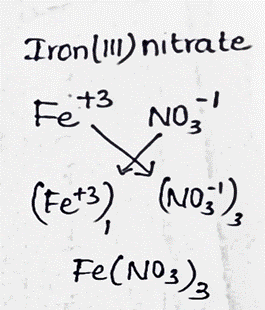
Crisscross method for formulation iron iii nitrate.
While writing the formula of a chemical compound we should not write the subscript “1”. One should make sure that after using the Crisscross method, the compound should not bear any charge and should be neutral.
The structure of the iron III nitrate has iron as the central compound, surrounded by three NO3- ions. The anions NO3- were arranged in the tetrahedral structure around the Fe atom.
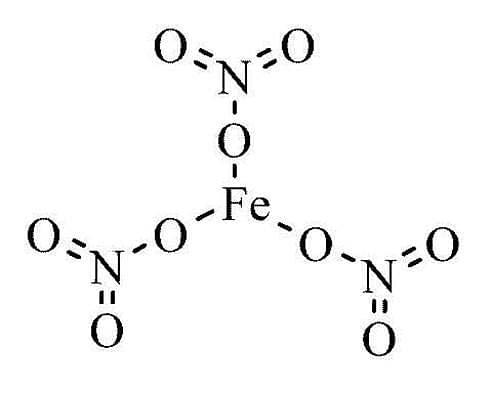
Structure of Iron III nitrate.
The structure of the molecule will appear mostly as a resonating structure by the process of resonance between the equivalent compounds. The 3 NO3- ions will resonate between their resonating structures.
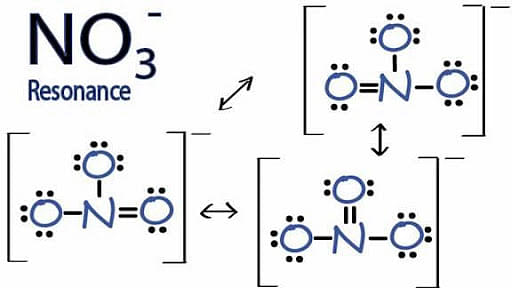
Resonance in NO3- ion.
Physical properties
[Click Here for Sample Questions]
Iron III nitrate is a deliquescent compound (a water-soluble substance that can absorb the moisture from the air and then dissolve in the absorbed moisture to change into the liquid state).
- Iron III nitrate is generally found as the non-hydrate compound which has the formula of Fe (NO 3) 3 · 9H2O.
- Without hydration, they are pale violet crystals. When hydrated by the water molecules, they turn into yellow solutions on hydrolysis.
- The crystalline iron source is compatible for use with nitrates and other lower (acidic) pH scales.
- The density of its hexahydrate is 1.68g/cm3 and its nonahydrate is 1.6429g/cm3.
- It is a monoclinic crystal that is soluble in water.
- The pH value of the Iron III nitrate moves to the acidic side. Because of the Nitrate being acidic and the metal cation of a weak base. Therefore, it is an acidic cation.
Read More: Gay-Lussac’s Law
Chemical properties
[Click Here for Sample Questions]
Iron III Nitrate compound is trinitrate salt of aqua complex [Fe ( H 2 O) 6] 3+.
- Iron III nitrate is lightly soluble in cold concentrated HNO3 (nitric acid).
- Ferric nitrate will dissolve in the molten stearic acid and it decomposes at about 120 °C to give the compound iron(III) oxide-hydroxide FeO(OH).
- When iron (III) nitrate [Fe (NO 3)3] is added t0 potassium thiocyanate [KSCN] in a solution, an equilibrium mixture of Fe+3, SCN –, and the complexion FeSCN +2 is produced. This reaction is an example of a reversible reaction where the addition of the ions involved will result in a color change in the solution.

Source of production
[Click Here for Sample Questions]
We can prepare iron iii nitrate by treating iron metal powder with nitric acid which will produce NO and H2O as the by-products.
Fe + 4 HNO3 → Fe (NO3)3 + NO + 2 H2O
This Ferric nitrate can also be produced by reacting it with the zinc nitrate along with the iron which will replace the less reactive copper from copper nitrate and form the Ferric nitrate.
3 Zn (NO3)2 + 2 Fe → 2 Fe (NO3)3 + 3 Zn
Uses and Applications of Iron III Nitrate
[Click Here for Sample Questions]
The applications of Iron III Nitrate are:
- Since ferric nitrate has no large-scale production, It is employed as the catalyst for the synthesis of the sodium amide from the solution of sodium in ammonia.
2NH3 + 2Na→2NaNH2 + H2
- In organic synthesis, it is impregnated with a certain amount of clay and used as a powerful oxidant.
- This is used by Jewellers, metalsmiths, and goldsmiths to etch silver and silver alloys.
- In industries, it is used in agriculture as non-pesticide, intermediates, panting agents, and surface treating agents.
- It can also be employed as a mordant during dying; weighting silks, tanning, corrosion inhibitor, and also as a component in analytical chemistry.
- It is used in the chemical labs for the preparation of various other compounds and also for different chemical reactions.
Read More: Electronegativity of elements
Things to remember
- This Ferric nitrate is not such a useful chemical as it is a very dangerous powder.
- Its dust causes irritation in the nose, eyes, and throat. Also, when ingested it causes irritation in the mouth and also stomach.
- It is very oxidizing in nature, and hence it can catch fire so fast and helps combustion.
- It is a corrosive material and can burn the skin when touched with a hand.
- The Ferric nitrate will be more useful when we use it for the case of laboratory reactions and in many applications of nitric acid to replace it.
- Iron III nitrate is s0luble in water like any other solutes.
- The pH value of the Iron III nitrate moves to the acidic side. Because of the Nitrate being acidic and the metal cation of a weak base. Therefore, it is an acidic cation.
Read More: Periodicity
Solved Examples
Ques. Mention a method of preparing iron iii nitrate? (4 marks)
Ans: There were a bunch of methods of preparation for the iron III nitrate.
The most accepted and used way of production is by the reaction with nitric acid with iron metal.
For a mixture of 100 ml of concentrated nitric acid, we added 30 ml of water, 50 g of iron filings or fine turnings in small portions. we can regulate the rate of the reaction by the rate of addition of iron and gently heating the mixture not crossing above 70-degree C.
4 Fe + 10 HNO3 → 4 Fe (NO3)3 + NH4NO3 + 3 H2O
If no crystal formation was observed, after standing the solution, the addition of furthermore concentrated nitric acid will make the crystals appear in the solution.
Ques. Give the details of the reaction of Iron III nitrate with water (H2O)? (4 marks)
Ans: When a metal reacts with a non-metallic compound, this gives an ionic compound as the product.
The equation for Fe (NO3)3 (Iron (III) nitrate) and H2O sometimes aren’t considered a chemical reaction since it is easy to change the Fe 3+ and NO3- back to Fe(NO3)3 (just let the H2O evaporate). At the same time, Fe (NO3)3 is a very different substance than Fe 3+ and NO3-.
The Iron III nitrate is soluble in water which can be clearly observed from the solubility table.
Fe (NO3)3 + H2O → Fe+3 (aq) + 3NO3-1 (aq)
When Fe (NO3)3 is dissolved in H2O (water) it will dissociate (dissolve) into Fe3+ and NO3- ions. To show that they are dissolved in the water we can write (aq) after each. The (aq) shows that they are aqueous – dissolved in water.
Ques. What is the chemical name of Fe (NO3) 3? (2 marks)
Ans: Iron (III) nitrate, or ferric nitrate, is the name used for some series of the inorganic compounds having the formula Fe (NO 3)3. (H 2 O) n. here n denotes the degree of hydration.
The most common form is the nonahydrate Fe (NO 3) 3. (H 2 O) 9. The hydrates are all pale-colored and water-soluble paramagnetic salts.
Ques. What is the valence state of iron in Fe(NO3)3? (4 marks)
Ans: The -ate term implies that it is a polyatomic ion that contains nitrogen and oxygen. The NO3 ion will have a charge of -1. As the name depicts that the charge on the iron is 3, it generally means -3.
the hybridization in Fe ion is given as:
Fe+3 :1s2 2s2 2p6 3s2 3p6 4s0 3d3
Firstly, give electron from outer orbit (4d) and then the 3d orbit.
hence the result is the formation of this compound.
Ques. Is iron (III) nitrate deliquescent? (2 marks)
Ans: This compound is generally found as the nonahydrate. (having 9 water molecules surrounded by the compound.

Hence, Iron III nitrate is a deliquescent compound (a water-soluble substance that can absorb the moisture from the air and then dissolve in the absorbed moisture to change into the liquid state).
Ques. When a 100ml of 0.06m Fe(NO3)3, 50ml of 0.2ml FeCl3 and 100ml of 0.26m mg (NO3)2 are mixed together, then calculate the molarity of reaction in the final solution. (4 marks)
Ans: Total volume =100+50+100=250ml
m moles of Fe3+=100×0.06+50×0.2=16
∴ [Fe3+] = 16/250=0.064M
m moles of NO3−=100 × 0.06 × 3 + 0.26 × 2 × 100 = 70
∴[NO3−] = 70/250 = 0.28M
m moles of Cl−=50×0.2×3=30
∴[Cl−]=30/250=0.12M
m moles of Mg2+=100×0.26=26
∴[Mg2+]=26/250=0.104M
Hence the molarity of the resulting solution is 0.104M.
Ques. The chemical equation, Cr + Fe(NO3)3 → Fe + Cr(NO3)3, is an example of which type of reaction? (2 marks)
a) Reversible reaction
b) Irreversible reaction
c) Displacement reaction
d) Combustion reaction
Ans: c) Displacement Reaction
Cr + Fe (NO3)3^+1 + Fe + Cr (NO3)3
It is an example of a displacement reaction. Because Cr(chromium) replaces Fe from its solution after the reaction.
Ques. 6.42% (w/w) Fe(NO3)3 (241.86 g/mol) solution has a density of 1.059 g/mL. Calculate (a) the molar analytical concentration of Fe(NO3)3 in this solution. (3 marks)
Ans: From the given values,
Molar mass of Fe (NO_{3})_{3}Fe(NO3)3 = 241.86 g/mol
Density of Fe(NO_{3})_{3}Fe(NO3)3 = 1.059 g/mol
w/w of Fe(NO3)3 = 6.42%
Let's calculate the molarity of Iron (III) nitrate.
Molarity of Fe(NO3)3:
Density = {Mass}/{Volume} = {1.059}/{10^{-3}L }
Density=Volume*Mass=10−3L
Molarity of Fe (NO3)3 = Density ×w/w × moles = 0.281M
Hence the molarity of the solution is : 0.281M
Ques. When SCN is added to an aqueous solution containing Fe(NO3)3, the complex ion produced is (3 marks)
(a) [Fe (OH2)2(SCN)]2+
(b) [Fe (OH2)5(SCN)]2+
(c) [Fe (OH2) (SCN)]2+
(d) [Fe (OH2) (SCN)]+ (MCQ type, Neet-2019)
Ans: On adding the SCN to an aqueous solution of Fe (NO3)3, a blood-red color which is due to the formation of [Fe(H2O)5(SCN)]2+ complex, is obtained.
This type of test is used for the detection of Fe³+ion.
SCN- + Fe(NO3)3 + H2O → [Fe(OH2)5(SCN)]2 (blood red colour) + NO3-
Ques. What species is reduced in the reaction Fe + AgNO3 → Fe (NO3)3 + Ag? (2 marks)
(a) Ag
(b) NO3
(c) Fe3-
(d) Fe (MCQ type, Neet-2018)
Ans: In the above reaction, we can observe the reduction of the nitrate ion.
Fe + AgNO3 → Fe (NO3)3 + Ag
Ag(silver) is being oxidized to the higher oxidation states by reducing the charge on the ion.
Ques. A 40.0 mL volume of 1.80 M Fe (NO3)3 is mixed with 21.5 mL of 0.808M Fe (NO3)3 solution. Now, Calculate the molar concentration of the final solution. (3 marks)
Ans: Let's use a slightly different way to write the subscripts:
M1V1 + M2V2 = M3V3
There is no standard way to write the subscripts in problems of this type.
Substituting:
(1.80) (40.0) + (0.808) (21.5) = (M3) (40.0 + 21.5)
M3 = 1.45 M
Hence the molarity is 1.45 moles /litre.
Related links:



Comments