



Content Curator
Class 9 Maths Chapter 6 Lines and Angles MCQs are provided below for the students as per the latest exam pattern of CBSE (2021-22) syllabus and NCERT Curriculum. Students can improve their problem-solving ability by practising the given objective-type questions. Students will also be able to score good marks by solving chapter-wise questions.
Some objective-type questions (MCQs) have been provided below from the chapter –Lines and Angles. Every question has four different answers. Students will have to find the correct answer out of the four. Students can cross-check their answer from their answer from the explanation and solved answers given below.
Also Read: NCERT Solutions for Class 7 Mathematics Chapter 5: Lines and Angles
Question:.When two lines intersect with each other, the vertically opposite angles formed are:
- Unequal
- Equal
- Cannot be determined
- None of the above
Click here for the answer
Answer: b. Equal
Explanation: While two different lines are intersecting each other, then the angles formed on the opposite sides of the point of intersection are always equal.
Question:.When two lines are parallel, they:
- Intersect at one point
- Intersect at two points
- Intersect at three points
- Does not intersect at any point
Click here for the answer
Answer: d. does not intersect at any point
Explanation: if two lines are parallel to each other, they will never intersect at any point. These lines are therefore, known as non-intersecting lines.
Question:.In the given figure, if ∠GED = 135° and AB || CD, EF ⊥ CD, ∠AGE will be:
- 120°
- 90°
- 135°
- 140°
Click here for the answer
Answer: c. 135°
Explanation: Given, GE is transversal and AB is parallel to CD
∠GED = 135°
∠GED and ∠AGE are alternate interior angles; they will have same value.
So, ∠GED = ∠AGE = 135°
Question:.In a triangle, if the measure of an exterior angle is 105° and its opposite interior angles are equal. Find the value of these equal angles
- 72 ½ °
- 52 ½ °
- 75°
- 37°
Click here for the answer
Answer: b. 52 ½
Explanation: Given, exterior angle = 105°
Let us consider the interior angles as x
Using the exterior angle theorem,
[Sum of the interior opposite angles = exterior angle]
2x = 105°
x = 52 ½ °. Hence, each of the interior opposite angles measure 52 ½ °.
Question:.Find the value of x, if AB is parallel to DE in the given figure:
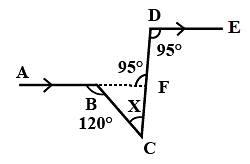
- 45°
- 25°
- 55°
- 35°
Click here for the answer
Answer: d. 35°
Explanation: If BCF is considered a triangle and ∠B = 180°- 120° = 60°
∠F = 180°- 95° = 85°
∠C = x
Since sum of the three angles of a triangle is 180°,
Therefore, 60° + x + 85° = 180°
x = 180° - 60°
x = 35°
So, the value of x is 35°
Question:.If, ∠ MXQ = 135 ° and ∠ MYR = 40 °. PQ is parallel to RS. Find ∠ XMY
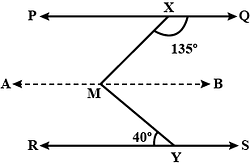
- 90°
- 60°
- 85°
- 55°
Click here for the answer
Answer: c. 85°
Explanation: Sum of interior angles on same side is 180°.
Hence, ∠MXQ + ∠ XMB = 180 °
∠ XMB = 180 ° - 135°
∠ XMB = 45°
∠BMY = ∠ MYR = 40° [alternate interior angles are equal]
So, ∠ XMB + ∠BMY = ∠XMY
= 45° + 40°
= 85°
Hence, the value of ∠ XMY = 85°
Question: If the ratio of the angles 5:3:7. The triangle will be:
- An isosceles triangle
- A right triangle
- An obtuse-angled triangle
- An acute- angled triangle
Click here for the answer
Answer: c. an acute-angled triangle.
Explanation: It is known that, the sum of the interior angles of a triangle is 180°
Let is consider the angles as 5x, 3x and 7x
Hence, 5x + 3x +7x = 180°
15x = 180°
x = 180°/5 = 12°
So, 5x = 5 x 12° = 60°
3x = 3 x 12° =36°
7x = 7 x 12° = 84 °
Here, all angles are less than 90°. Hence, it is clear that the triangle is an acute angled triangle.
Question: If the ratio of the angles 2:4:3. The value of the smallest angle will be:
- 40°
- 80°
- 60°
- 20 °
Click here for the answer
Answer: a. 40°
Explanation: let us consider 2:4:3 as 2x, 4x and 3x
So, 2x + 4x +3x = 180° [the sum of the interior angles of a triangle is 180°]
9x = 180°
x = 20°
Hence, the value of:
2x = 2(20°) = 40°
4x = 4(20°) = 80°
3x = 3 (20°) = 60°
So, the smallest angle is 40°.
Question: Find the value of x from the given figure, where POQ is a line.

- 20°
- 30°
- 25°
- 35°
Click here for the answer
Answer: a. 20°
Explanation: Given POQ is a line, which means POQ = 180°.
40° + 4x + 3x = 180°
40° + 7x = 180°
7x = 180° - 40°
7x = 140°
x = 140°/7
x = 20°
So, x = 20°
Question: If AOB is a line then the measure of ∠BOC, ∠COD and ∠DOA respectively in the given figure, are:
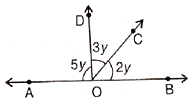
- 36°, 54°, 90°
- 90°, 54°, 36°
- 90°, 36°, 54°
- 36°, 90°, 54°
Click here for the answer
Answer: a. 36°, 54°, 90°
Explanation: ∠AOD + ∠ DOC + ∠ COR = 180° [sum of the interior angles of a triangle is 180°]
5y + 3y + 2y = 180°
10y =180°
y = 180° / 10
y = 18°
So, the values of 5y, 3yand 2y are:
5y = 5 (18°) = 90°
3y = 3 (18°) = 54°
2y = 2 (18°) = 36°
Question: Find the value of x, if B lies on AC. Given AB = x + 3, AC = 4x – 5 and BC = 2x.
- 5
- 8
- 3
- 2
Click here for the answer
Answer: b. 8
Explanation: Given that B lies on AC
Hence, AB + BC = AC
(x + 3) + (2x) = 4x – 5
3x + 3 = 4x – 5
3x – 4x = -5 +3
-x = - 8
x = 8
Hence, the value of x is 8.
Question: The interior opposite angles of a triangle are in the ratio 1: 3. Given that, an exterior angle of the triangle is 80°. Find the value of interior opposite angles.
- 40°, 120°
- 30°, 60°
- 20°, 60°
- 90°, 60°
Click here for the answer
Answer: c. 20°, 60°
Explanation: Let the third angle of the triangle be y
Hence, y + 80° = 180°
y = 100°
Let the other two angles (1:3) be 1x and 3x
1x + 3x + 100° =180° …..[sum of all interior angles is 180°]
4 x = 180° - 100°
4 x = 80°
x = 80°/4
x = 20°
Hence, the value of 3x = 3(20°) = 60°
So, the angles are 20° and 60°
Also Check:



Comments