NCERT Solutions for Class 9 Maths Chapter 6 Exercise 6.2 Solutions

Collegedunia Team logo

Collegedunia Team

Content Curator

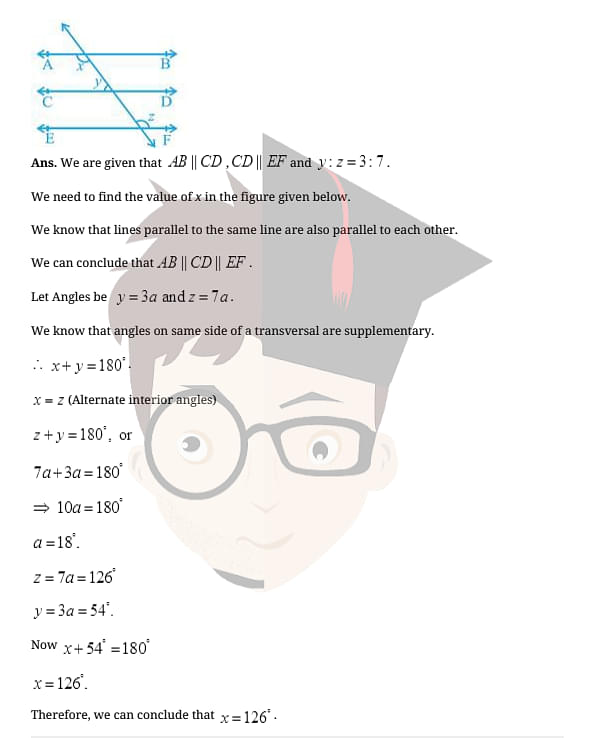
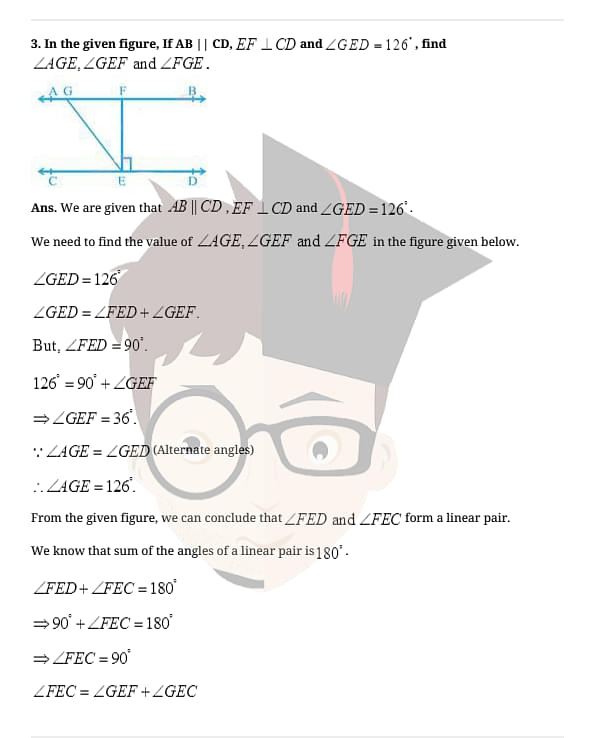
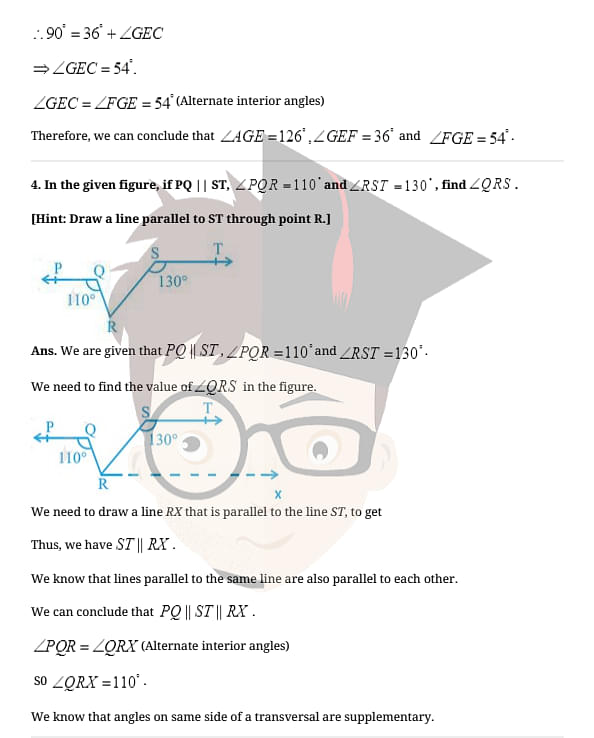
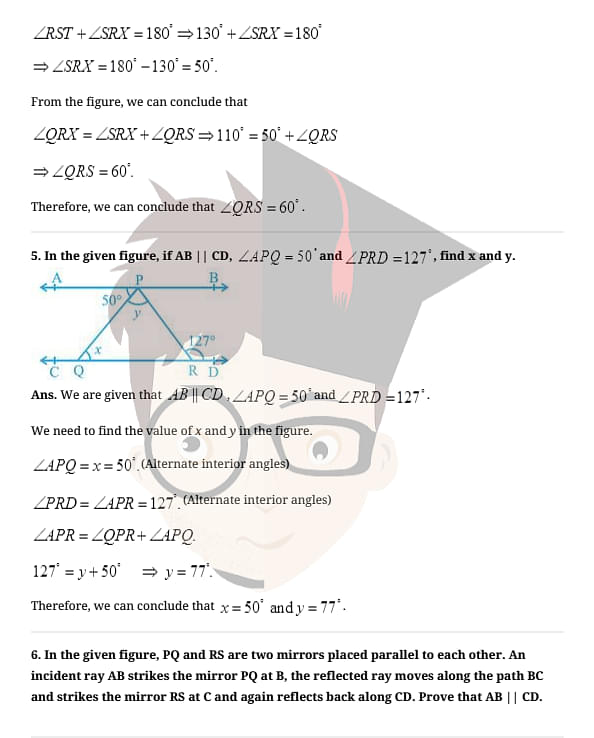
NCERT Solutions for Class 9 Maths Chapter 6 Lines and Angles Exercise 6.2 Solutions are based on alternate interior angles, alternate exterior angles, corresponding angles, Interior angles on the same side of the transversal and more.

Download PDF: NCERT Solutions for Class 9 Maths Chapter 6 Exercise 6.2 Solutions

Check out NCERT Solutions for Class 9 Maths Chapter 6 Exercise 6.2 Solutions
Read More: NCERT Solutions For Class 9 Maths Chapter 6 Lines and Angles

Exercise Solutions of Class 9 Maths Chapter 6 Lines and Angles 

Also check other Exercise Solutions of Class 9 Maths Chapter 6 Lines and Angles

Also Check:

Also check:

CBSE X Related Questions

  • 1.
    In the given figure, \(AB \parallel DE\) and \(AC \parallel DF\). Show that \(\triangle ABC \sim \triangle DEF\). If \(BC = 10\) cm, \(EB = CF = 5\) cm and \(AB = 7\) cm, then find the length DE.


      • 2.
        The natural number 1 is :

          • a prime number.
          • a composite number.
          • prime as well as composite.
          • neither prime nor composite.

        • 3.
          Prove that : \( \frac{\sec^3 \theta}{\sec^2 \theta - 1} + \frac{\text{cosec}^3 \theta}{\text{cosec}^2 \theta - 1} = \sec \theta \cdot \text{cosec} \theta (\sec \theta + \text{cosec} \theta) \)


            • 4.
              In the given figure, PA and PB are tangents to a circle centred at O. If \( \angle AOB = 130^\circ \), then \( \angle APB \) is equal to :

                • \( 130^\circ \)
                • \( 50^\circ \)
                • \( 120^\circ \)
                • \( 90^\circ \)

              • 5.
                PQ and PR are two tangents to a circle with centre O and radius 5 cm. AB is another tangent to the circle at C which lies on OP. If \(OP = 13\) cm, then find the length AB and PA.


                  • 6.
                    If \( \alpha, \beta \) are the zeroes of the quadratic polynomial \( px^2 + qx + r \), then find the value of \( \alpha^3\beta + \beta^3\alpha \).

                      Comments


                      No Comments To Show