



Content Curator
Lithium Hydroxide is an inorganic compound with the chemical formula LiOH. It is a white hygroscopic crystalline material that is soluble in water and slightly soluble in ethanol. In chemical laboratories, lithium Hydroxide is made by the action of water on lithium or lithium oxide. Lithium Hydroxide is the weakest base among the alkali metal hydroxides. It has a pH level of approximately 10. It is the first of the alkalis in the periodic table.
What is Lithium Hydroxide?
The alkali hydroxides are a class of chemical compounds that are composed of an alkali metal cation and the hydroxide anion (OH-). Lithium Hydroxide is one such alkali hydroxide. It is used most popularly in lubricants such as lithium stearate, used for its high resistance to the water and its versatility in low and high temperatures.

Lithium Hydroxide
It is also widely used in breathing gas purification systems for spacecraft, submarines, and rebreathers to remove carbon dioxide from inhaling gas by producing lithium carbonate and water. Contact with Lithium Hydroxide may cause severe irritation to the skin, eyes, and mucous membranes.
Also Read:
Lithium Hydroxide Compound Highlights
The important properties of Lithium Hydroxide are tabulated below.
| Compound | Values |
|---|---|
| IUPAC Name | Lithium Hydroxide |
| Molecular Weight | 24 |
| Vapour Pressure | Negligible at 20°C |
| Decomposition Temperature | 924°C |
| Solubility | 12.8g/100ml in water at 20°C |
| Density | 2.54 g/cm3 |
| Composition | Dry powder, Liquid |
| Odour | Pungent odour |
| Colour | Colourless to white |
| Flame susceptibility | Non-Flammable |
Lithium hydroxide Formula and Structure
Lithium peroxide molecule is formed by the lithium cation Li+ and the hydroxyl group OH-. Its molecular mass is approximately 23.91 g/mol and is found in two states: anhydrate and monohydrate. The metastable monomeric molecule is linear and quite non-rigid. Hydrated LiOH exists as a monohydrate and in the solid-state as anhydrous.
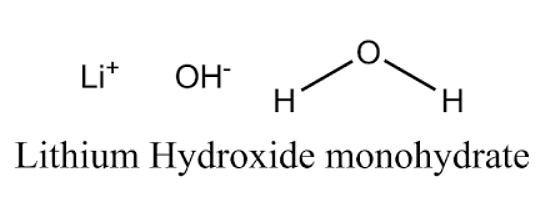
Lithium Hydroxide structure
At atmospheric pressure and room temperature, it crystallizes in a tetragonal structure with a P4/mm symmetry with two formulas per unit cell. The structure comprises layers of square lattices of lithium atoms, with each square capped by a hydroxide ion, alternating above and below the lithium layer. Thus, each oxygen ion is fourfold coordinated with lithium atoms, and each lithium atom is in a distorted tetrahedral environment of oxygen atoms.
Read More: Chemical Compound
Lithium Hydroxide Preparation
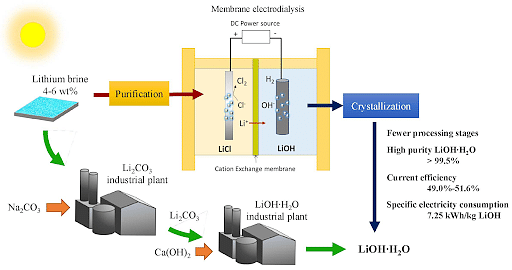
It is prepared when Lithium Carbonate reacts with Calcium Hydroxide.
Li2CO3 + Ca(OH)2→ 2LiOH + CaCO3
In this reaction, Calcium Carbonate is filtered out and the solution is then evaporated and crystallized. Thus, the product obtained is the monohydrate, LiOH•H2O.
Furthermore, the anhydrous compound is obtained by heating the hydrate above 100°C in either a vacuum or air free from carbon dioxide. Apart from that, the hydroxide also may be prepared by treating Lithium Oxide along with water.
Physical Properties of Lithium Hydroxide
- It is one of the lightest elements on earth.
- It has a melting point of 450 - 471°C.
- It has a boiling point of 925°C.
- It has a refractive index of 1.464.
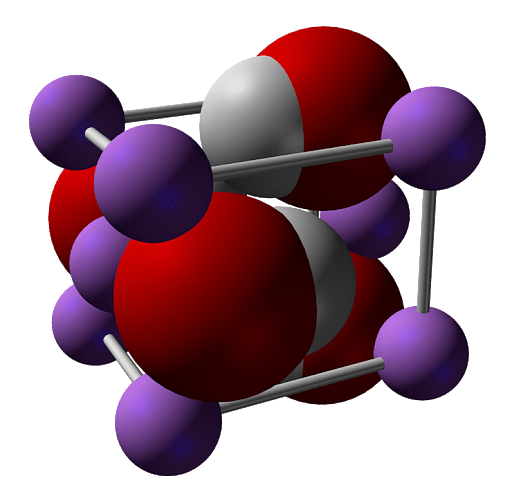
Lithium Hydroxide Unit cell
- The monohydrate form is white monoclinic crystalline solid and is more soluble than the anhydrous salt.
Read More:
Chemical Properties of Lithium Hydroxide
- Lithium Hydroxide is made industrially by reacting lime with lithium ore or with a salt made from the ore.
- It has a closer resemblance to the group 2 hydroxides than to the group 1 hydroxide.
- It is a base. However, it is less basic than sodium or potassium hydroxide.
- It undergoes neutralization reactions with acids such as Hydrochloric acid:
LiOH + HCl → LiCl + H2O
- When Lithium Hydroxide is heated over 800°C in a vacuum, it gives Lithium Oxide as the end product.
2LiOH → Li2O + H2O
- It absorbs carbon dioxide easily and gives out lithium carbonate.
2LiOH + CO2→ Li2CO3 + H2O
- When chlorine is passed through Lithium Hydroxide, it yields Lithium Hypochlorite.
LiOH + Cl2→ LiOCl + HCl
- Lithium hydroxide is used in the saponification process.
LiOH + CH3(CH2)16COOH→ CH3(CH2)16COOLi + H2O
Read More: Atomic Mass of Elements
Uses of Lithium Hydroxide
- Since Lithium Hydroxide is soluble in water, it is used widely in the making of lithium soaps which are further used in multipurpose greases.
- It is also used in the manufacturing of various lithium salts.
- It is used as an additive to the electrolyte of alkaline storage batteries.
Lithium Hydroxide Batteries
- For environmental purposes, it is used as an efficient and lightweight absorbent for carbon dioxide.
- In households, it is used in the making of cleaning products, laundry, and fabric treatment.

Lithium Hydroxide Cleaners
- It has been used nowadays by major battery producers, as its cathodes about other chemical compounds include better power density, more power capacity, longer life cycles, and enhanced safety features.
- The production cost of Lithium Hydroxide is cheaper than Brine and has been a popular feature in the manufacturing of rechargeable batteries, ceramics, polymers, and metallurgical powders.
Things to Remember
- Lithium Hydroxide is an inorganic compound with the chemical formula LiOH. It is a white hygroscopic crystalline material that is soluble in water and slightly soluble in ethanol.
- In chemical laboratories, lithium Hydroxide is made by the action of water on lithium or lithium oxide.
- Lithium Hydroxide is the weakest base among the alkali metal hydroxides. It has a pH level of approximately 10. It is the first of the alkalis in the periodic table.
- It is used most popularly in lubricants such as lithium stearate, used for its high resistance to the water and its versatility in low and high temperatures.
- It has been used nowadays by major battery producers, as its cathodes about other chemical compounds include better power density, more power capacity, longer life cycles, and enhanced safety features.
- Lithium Hydroxide is made industrially by reacting lime with lithium ore or with a salt made from the ore.
Read More:
Sample Questions
Ques. Is Lithium Hydroxide, an acid or base? (2 marks)
Ans. It is a base as when it is dissolved in a solution, it gives out two positive Li-ions and a negative OH ion. It is not a weak base, thus it will dissolve completely in water.
LiOH + (aq) → Li+(aq) + OH-(aq)
Ques. What are the pH value and basicity of Lithium Hydroxide? (2 marks)
Ans. The pH value is >7. The reason is that any molecule that gives OH- after dissolving in water is defined as a base in nature and possesses a pH value greater than 7.
However, its basicity is -0.04.
Ques. What type of reaction do Lithium and water have? (2 marks)
Ans. When Lithium reacts with water, it is an Exothermic reaction that produces Lithium Hydroxide and hydrogen gas as end products.
2Li (solid) + 2H2O (liquid) → 2LiOH (aq) + H2 (gas)
Lithium hydroxide is a soluble salt, which means that it dissociates in an aqueous solution to give lithium cations and hydroxide anions.
Ques. What happens when Lithium Hydroxide reacts with Ethanoic acid? (2 marks)
Ans. When Lithium hydroxide reacts with ethanoic acid, the following reaction would take place. The balanced chemical equation is as follows:
LiOH (aq) + CH3COOH(aq) → LiCH3COO(aq) + H2O (l)
Read More:
Ques. How will you convert a sample of solid Lithium Fluoride into Lithium Hydroxide? (2 marks)
Ans. Lithium Fluoride can be formed by adding water to Lithium Hydroxide.
LiF + H2O→ LiOH + HF
Ques. How will you calculate the molarity of a solution prepared by dissolving 1.495 moles of LiOH in enough water to give a final volume of 750ml? (2 marks)
Ans. To begin with, you will have to convert the volume to litres, 750÷1000 = 0.750L
Divide the number of moles by the number of litres and you will get the molarity,
1.495 moles of LiOH ÷ 0.75L = 1.993 M
Ques. How can Lithium hydroxide be produced from Lithium Nitride? (2 marks)
Ans. The reaction of Lithium Nitride and water gives Lithium Hydroxide and Ammonia as result.
Li3N (solid) + H2O → LiOH (aq) + NH3 (gas)
Ques. Why do transition elements show variable oxidation states? (CBSE 2014) (2 marks)
Ans. The variability of the oxidation state of transition elements is due to incompletely filled d-orbitals and the presence of unpaired electrons, i.e. (ns) and (n -1) d electrons have approximately equal energies.
Read More: Difference between baking soda and baking powder
Ques. What are some of the uses of Lithium Hydroxide? (5 marks)
Ans.
- Since Lithium Hydroxide is soluble in water, it is used widely in the making of lithium soaps which are further used in multipurpose greases.
- It is also used in the manufacturing of various lithium salts.
- It is used as an additive to the electrolyte of alkaline storage batteries.
- For environmental purposes, it is used as an efficient and lightweight absorbent for carbon dioxide.
- In households, it is used in the making of cleaning products, laundry, and fabric treatment.
- It has been used nowadays by major battery producers, as its cathodes about other chemical compounds include better power density, more power capacity, longer life cycles, and enhanced safety features.
- The production cost of Lithium Hydroxide is cheaper than Brine and has been a popular feature in the manufacturing of rechargeable batteries, ceramics, polymers, and metallurgical powders.
Ques. What are some of the physical properties of LiOH? (3 marks)
Ans.
- It is one of the lightest elements on earth.
- It has a melting point of 450 - 471°C.
- It has a boiling point of 925°C.
- It has a refractive index of 1.464.
- The monohydrate form is white monoclinic crystalline solid and is more soluble than the anhydrous salt.
Also Read:
Ques. How is Lithium Hydroxide prepared? (3 marks)
Ans. It is prepared when Lithium Carbonate reacts with Calcium Hydroxide.
Li2CO3 + Ca(OH)2→ 2LiOH + CaCO3
In this reaction, Calcium Carbonate is filtered out and the solution is then evaporated and crystallized. Thus, the product obtained is the monohydrate, LiOH•H2O.
Furthermore, the anhydrous compound is obtained by heating the hydrate above 100°C in either a vacuum or air free from carbon dioxide. Apart from that, the hydroxide also may be prepared by treating Lithium Oxide along with water.
Ques. Describe the structure of Lithium Hydroxide. (5 marks)
Ans. Lithium peroxide molecule is formed by the lithium cation Li+ and the hydroxyl group OH-. Its molecular mass is approximately 23.91 g/mol and is found in two states: anhydrate and monohydrate. The metastable monomeric molecule is linear and quite non-rigid. Hydrated LiOH exists as a monohydrate and in the solid-state as anhydrous.

At atmospheric pressure and room temperature, it crystallizes in a tetragonal structure with a P4/mm symmetry with two formulas per unit cell. The structure comprises layers of square lattices of lithium atoms, with each square capped by a hydroxide ion, alternating above and below the lithium layer. Thus, each oxygen ion is fourfold coordinated with lithium atoms, and each lithium atom is in a distorted tetrahedral environment of oxygen atoms.
Also Read:



Comments