



Content Curator
MgSO4 (Magnesium sulphate) is a sulfuric acid-magnesium salt. It is an inorganic salt that's anhydrous. However, because of its anhydrous form, it is unstable. This salt also exists as a hydrated salt with the formula MgSO4.nH2O, where the nH2O can have various values such as 1,2, 3...7, etc. Magnesium sulphate heptahydrate is the most common hydrate salt of magnesium sulphate, with the formula MgSO4.7H2O and 7 molecules of water. Epsom salt is another name for this salt.
| Table of Content |
Read More: Activation Energy Formula
Structure of Magnesium Sulphate
One Mg2+ cation (magnesium ion) and one SO42- anion are found in MgSO4 molecules (the sulphate anion).
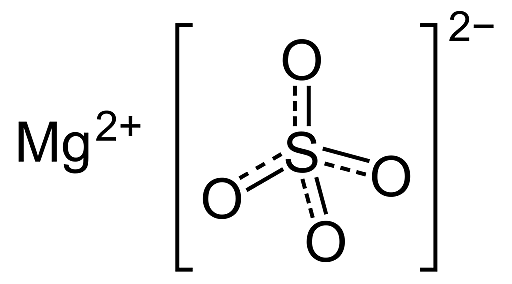
Structure of MgSO4
In magnesium sulphate, an ionic bond is formed between the magnesium cation and the sulphate anion. There are two sulphur-oxygen double bonds and two sulphur-oxygen single bonds in the sulphate anion. Each of the singly-linked oxygen atoms to the sulphur atom has a negative charge of magnitude -1. As a result, the sulphate anion's total charge is -2.

Epsom Salt
The magnitude of the charge on the magnesium cation is +2. As a result, the ionic compound's positive and negative charges cancel each other out, yielding a neutrally charged magnesium sulphate molecule. The magnesium and sulphate ions dissociate when this chemical is dissolved in water or other polar solvents.
Read More:
Properties of Magnesium Sulphate
Magnesium sulphate has the following physical properties:
- Magnesium sulphate is a white-coloured anhydrous solid salt.
- It is a salt with no odour.
- Magnesium sulphate salt is water-soluble. It is worth noting that the solubility of magnesium sulphate increases as the temperature rises.
- Organic solvents, such as alcohol, do not dissolve magnesium sulphate.

Anhydrous Magnesium sulphate
- Anhydrous magnesium sulphate has a density of 2.66g/cm3.
- Magnesium sulphate has a molecular weight of 120.366 g/mol.
- Magnesium sulphate has a bitter and saline flavour.
- This salt has an extremely high melting point of roughly 1120° Celsius.
Read More: Difference between baking soda and baking powder
Uses of Magnesium Sulphate
- Epsom salt is another name for magnesium sulphate heptahydrate.
- Magnesium sulphate dosages can be given orally or intravenously in medicine.
- As a desiccant, anhydrous magnesium sulphate is used.
- Sulphuric acid magnesium salt is another name for magnesium sulphate.
- Magnesium sulphate is thought to help pregnant women avoid labour pains.

Magnesium is used in medicines for pregnant women
- Eclampsia is a condition in which seizures occur during or after childbirth in pregnant women. Magnesium sulphate is thought to help pregnant women avoid eclampsia. However, this illness is uncommon, with fewer than 1 million instances each year in India.
- It is used to manage seizures in pregnant women. Magnesium sulphate doses, on the other hand, are not recommended during pregnancy.
- Coagulants are essential in the production of tofu. Tofu is made with magnesium sulphate as a coagulant.
- Various double salts are made from magnesium sulphate hydrated salts. Some of the double salts that contain magnesium sulphate are potassium magnesium sulphate and sodium magnesium sulphate.

Potassium Magnesium Sulphate used in fertilizers
- Magnesium sulphate salt is used as a brewing salt in the production of beer.
- The manufacture of intravenous magnesium, a critical drug for the treatment of eclampsia, is one of the most important uses of magnesium sulphate.
- It is also utilised to treat magnesium insufficiency through replacement therapy.
- It is also worth noting that magnesium sulphate can be used as a coagulant in the preparation of some foods, such as tofu.

Tofu
Read More:
Adverse effects on Humans
When taken in higher doses than those recommended by your doctor or specified on the label, this substance can be harmful. A high intake of this substance might have major negative effects and even be fatal. Hypermagnesemia is a medical disorder characterised by abnormally high magnesium content in plasma.

Hypermagnesemia Symptoms
Hypermagnesemia is an electrolyte disease in which the blood magnesium content is abnormally high. Weakness, disorientation, slowed breathing and slowed reflexes are some of the symptoms. Low blood pressure and cardiac arrest are two possible complications.

High magnesium in the blood
It is usually caused by kidney failure or is caused by treatment, such as magnesium-containing antacids. Tumour lysis syndrome, convulsions, and chronic ischemia are some of the less prevalent reasons. Magnesium levels in the blood must be greater than 1.1 mmol/L (2.6 mg/dL) to be diagnosed. If the amount is greater than 2.9 mmol/L (7 mg/dL), it is considered serious. There could be specific electrocardiogram (ECG) changes.
Read More: Ideal Gas Law Formula
Things to Remember
- MgSO4 (Magnesium sulphate) is a sulfuric acid-magnesium salt. It's an inorganic salt that's anhydrous. However, because its anhydrous form is unstable, this salt also exists as a hydrated salt with the formula MgSO4.nH2O, where the nH2O can have various values such as 1,2, 3...7, etc.
- In magnesium sulphate, an ionic bond is formed between the magnesium cation and the sulphate anion. There are two sulphur-oxygen double bonds and two sulphur-oxygen single bonds in the sulphate anion. Each of the singly-linked oxygen atoms to the sulphur atom has a negative charge of magnitude -1. As a result, the sulphate anion's total charge is -2.
- The magnitude of the charge on the magnesium cation is +2. As a result, the ionic compound's positive and negative charges cancel each other out, yielding a neutrally charged magnesium sulphate molecule. The magnesium and sulphate ions dissociate when this chemical is dissolved in water or other polar solvents.
- Hypermagnesemia is an electrolyte disease in which the blood magnesium content is abnormally high. Weakness, disorientation, slowed breathing and slowed reflexes are some of the symptoms. Low blood pressure and cardiac arrest are two possible complications.
Read More:
Sample Questions
Ques. What is the best way to make magnesium sulphate? (3 marks)
Ans: Magnesium sulphate is commonly sourced from dry lake bottoms and other natural sources. It can also be made by mixing sulfuric acid with magnesite (magnesium carbonate, MgCO3) or magnesia (oxide, MgO).
Another option is to treat seawater or industrial wastes containing magnesium to precipitate magnesium hydroxide and then react the precipitate with sulfuric acid.
Ques. What effect does magnesium sulphate have on marine aquariums? (3 marks)
Ans: Magnesium sulphate heptahydrate is also used to keep magnesium levels stable in marine aquariums with a lot of stony corals, as it is steadily depleted during the calcification process. Calcium and alkalinity concentrations are difficult to control in a magnesium-deficient marine aquarium because there isn't enough magnesium to stabilise these ions in the saltwater and prevent their spontaneous precipitation into calcium carbonate.
Ques. What role does magnesium sulphate play in the construction sector? (3 marks)
Ans: Magnesium sulphate is used to make certain cement by reacting magnesium oxide with magnesium sulphate solution. These cement have a better binding ability and are more resistant than Portland cement. This cement is primarily used to make lightweight insulating panels. Its use is limited due to its water resistance. When there are no service records of the material exposed to actual weathering circumstances, magnesium (or sodium) sulphate is used for testing aggregates for soundness in line with the ASTM C88 standard.
Ques. How does magnesium sulphate form in nature? (2 marks)
Ans: Magnesium sulphates are frequent minerals in geological contexts because Mg2+ and SO42- ions are the second cations and second anion found in saltwater, respectively, after Na+ and Cl. The majority of their occurrence is related to supergene processes. Some of them are also important ingredients of deposits of evaporitic potassium-magnesium (K-Mg) salts.
Read More:
Ques. What is Epsom Salt, and how does it help your body? (3 marks)
Ans: Epsom salt gets its name from a bitter saline spring in Epsom, Surrey, England, where the salt is made from springs that form where the porous chalk of the North Downs meets the impervious London clay. In order to generate the hexahydrate, the heptahydrate loses one equivalent of water. It's a good supplier of magnesium and sulphur. Bath salts, exfoliants, muscle relaxants, and pain medications are all popular uses for Epsom salts. These, on the other hand, are not the same as Epsom salts for gardening because they contain smells and perfumes that are harmful to plants.
Ques. Why is MgSO4 water-soluble yet BaSO4 isn't? (3 marks)
Ans: The lattice energy of sulphates remains constant in alkaline earth metals, while the hydration energy reduces noticeably from Be2+ to Ba2+ as the cation size lowers down the group.
As a result of the decreasing hydration energy, the solubility of sulphates falls down the group, and because Mg is much smaller than Ba in size, MgSO4 is formed, but at the bottom of the group, BaSO4 has the lowest solubility and is insoluble in water.
Ques. Is it possible to use magnesium sulphate to treat boils? (3 marks)
Ans: A boil is a common skin condition that is caused by bacteria entering an oil gland or hair follicle. Your skin goes red at first, and a painful lump form. The lump gets yellowish after a few days when pus accumulates beneath your skin. The neck, cheeks, shoulders, armpits, and buttocks are the most common sites for boils. A carbuncle is a collection of boils that form a single area of significant infection.
Boils normally go away on their own after a few days, although they can be excruciatingly painful. Apply magnesium sulphate paste, a natural antibacterial or antimicrobial agent, can speed up the healing of boils. It works by eliminating germs and absorbing moisture around the lesion, causing the boil to dry out and cure.
Read More: Atomic Mass of Elements
Ques. In agriculture, how is magnesium sulphate used? (3 marks)
Ans: Magnesium sulphate is used in agriculture to boost soil magnesium and sulphur levels. Potted plants or magnesium-hungry crops including potatoes, tomatoes, carrots, peppers, lemons, and roses are the most popular recipients. Magnesium sulphate has a higher solubility than other magnesium soil additions (such as dolomitic lime), allowing for foliar application. Magnesium sulphate solutions are also essentially pH neutral, as opposed to the somewhat alkaline magnesium salts found in limestone; thus, using magnesium sulphate as a magnesium source for soil does not affect soil pH.
Ques. What is the definition of an anticonvulsant? (3 marks)
Ans: Anticonvulsants (also known as antiepileptic medications or, more recently, antiseizure pharmaceuticals) are a class of pharmacological compounds that are used to treat epileptic seizures. Anticonvulsants are also being used more frequently to treat bipolar illness and borderline personality disorder, as many of them appear to operate as mood stabilisers, as well as neuropathic pain. Anticonvulsants stop neurons from firing too quickly during seizures. Anticonvulsants also prevent the seizure from spreading across the brain.
Ques. What is Eclampsia? (3 marks)
Ans: Eclampsia is a term used to describe a condition in which a person experiences an in a woman with pre-eclampsia, eclampsia is defined as the start of seizures (convulsions). Pre-eclampsia is a pregnancy disease characterised by elevated blood pressure, protein in the urine, and organ dysfunction. Before, during, or after delivery, the symptoms may appear.
The second half of pregnancy is the most common time for it. The convulsions are tonic-clonic and last around a minute on average. A period of bewilderment or coma usually follows the seizure. Aspiration pneumonia, cerebral haemorrhage, renal failure, pulmonary oedema, HELLP syndrome, coagulopathy, abruptio placentae, and cardiac arrest are some of the complications that can occur.
Read More:
Ques. What are the medicinal implications of Magnesium Sulphate? (5 marks)
Ans: Magnesium sulphate is used both physically and internally.
The formulation as bath salts is common for using externally, notably for soothing painful feet in foot baths. Such baths have also been claimed to help with muscle discomfort, soreness, and injury healing. Medical studies on the impact of magnesium on resistant depression and as an analgesic for migraine and chronic pain show that it has potential health benefits. Asthma, preeclampsia, and eclampsia have all been examined with magnesium sulphate.
Magnesium sulphate is a common ingredient in the concentrated salt solution used in isolation tanks to raise the specific gravity to 1.25–1.26. This high density allows a person to float smoothly on the water's surface in a closed tank, obliterating as many external perceptions as possible.
Magnesium sulphate can be taken by mouth, inhaled through the lungs, or injected intravenously. Replacement therapy for magnesium shortage, treatment of acute and severe arrhythmias, as a bronchodilator in the treatment of asthma, prevention of eclampsia, as a tocolytic agent, and as an anticonvulsant are all examples of internal usage.
Read More:



Comments