



Content Curator
Mendelevium is a synthetic highly radioactive element. It is named after Dimtri Mendeleyev, the father of the periodic table of chemical elements. Mendelevium isotopes have unique chemical properties for late actinides, having a predominant +3 oxidation state and a neighbouring +2 oxidation state. It is used in the synthesis of heavy atomic nuclei. It decays through the process of spontaneous fission and hence the traces are not found in the atmosphere. Humans are adversely affected due to the active radiation emitted by the element.
Read more: Inner Transition Elements
| Table of Content |
Key terms: Mendelevium, f-block elements, Transuranium, Actinides, Transition elements, Oxidation Reaction
What is Mendelevium?
[Click Here for Sample Questions]
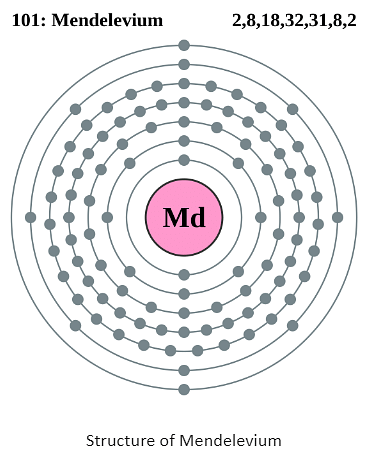
Structure of Mendelevium
The most stable isotope of mendelevium, 258Md, has a half-life of 52 days and is the first transferium element. Chemical information about it is limited to its atomic number, half-life, and isotopes. Isotopes with known atomic weights range from 245 to 261. It was named after Dimitri Mendeleyev, a Russian physicist who created one of the earliest periodic tables.
Mendelevium is a synthetic highly radioactive actinide element. It has the symbol Md and the atomic number 101. The only way to make it is to blast lighter elements with charged molecules. Bernard G Harvey, Stanley G Thompson, Albert Ghiorso, Glenn T. Seaborg, and Gregory R Choppin, all of the University of California, Berkeley, discovered the element in 1955. They found it by blasting alpha particles (helium ions) with a trace of einsteinium-253.
Read more:
Properties of Mendelevium
[Click Here for Sample Questions]
The Physical and Chemical properties of the element are mentioned below.
Physical Properties
Physical Properties of the Mendelevium are as follows:
| Physical Properties | |
|---|---|
| Atomic number | 101 |
| Atomic mass number | 258 |
| Position in periodic table | Period 7 |
| Block | f |
| Group | Actinides |
| State at 200 C | Solid |
| Electron Configuration of gaseous state | [Rn] 5f13 7s2 |
| Stablest isotope | Mendelevium-258 |
| Oxidation states | +2, +3 |
| Melting Point | 11000 K or 15210 F or 8270 C |
| Chemical Abstract Service registry number (CAS) | 7440-11-1 |
| Key isotopes | 258Md, 260Md |
| color | Its exact color is unknown, however, it's thought to be metallic, silvery-white, or grey. |
Chemical Properties
- Chemical reactions have only been carried out in solutions having oxidation states of +2 or +3 until now. Though the +1 condition has been discovered, it has yet to be proven.
- In an aqueous solution, it is trivalent.
- It condenses trivalent lanthanide salts to create insoluble fluorides and hydroxides.
- During carbon-exchange bonding, the mendelevium elutes.
- Its ionic radius is lower than that of the previous actinide in the periodic table (Fermium).
- Mendelevium(III) is easily converted to Mendelevium(II). In an aqueous solution, it has a steady behavior.
- In a water-ethanol solution, it is neutral and similar or homologous to cesium.
- When reduced, it behaves like divalent elements.
- Mendelevium crystallizes in mixed crystals with divalent elements when co-crystallized with chlorides.
- It has a proclivity for deterioration.
- It contains 16 synthetic isotopes with mass numbers ranging from 245-260.

Mendelevium Structure
Isotopes
[Click Here for Sample Questions]
Isotopes are members of the same element's family but have variable numbers of neutrons despite having the same number of protons.
- Mendelevium is divided into 16 isotopes with mass numbers ranging from 245Md to 260Md.
- 258Md, 260Md, and 259Md are the longest-lived isotopes of mendelevium, with half-lives of 51.5 days, 31.8 days, and 96 minutes, respectively.
- After Md-245, the longevity of Md isotopes increases, but then declines after Md-256.
Read more:
| Relevant Concepts | ||
|---|---|---|
| Ozone | Magnesium Phosphate | Catalase Enzyme |
| Nuclear fusion | Air pollution | Aluminum |
Production in Laboratories
[Click Here for Sample Questions]
Mendelevium production in laboratories are done in following steps
- The distinct elution characteristics of Md from those of einsteinium and fermium are used in an alternate approach to isolate Mendelevium.
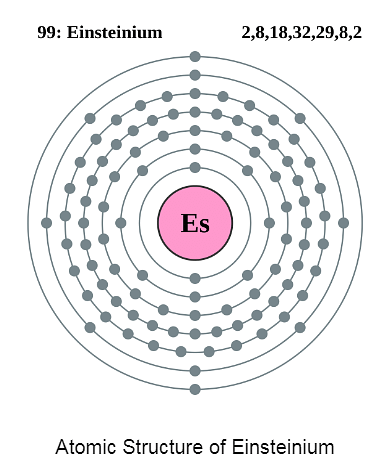
Atomic Structure of Einsteinium
- The preliminary stages are the same as before, except that instead of lanthanum fluoride, HDEHP is used for abstraction chromatography, and the mendelevium is coprecipitated with terbium fluoride.
- The Mendelevium is then given Chromium to condense it in hydrochloric acid with Zinc or Mercury.
- Even though the tetravalent lanthanides, trivalent lanthanides, and actinides remain on the column after solvent extraction, it is oxidized to the +3-state using hydrogen peroxide
- It is then isolated by elution with hydrogen peroxide (to remove contaminants and chromium) and lastly hydrochloric acid (to extract the mendelevium).
- Use zinc and cationic amalgam column with 1 M hydrochloric acid as an eluent to reduce Mendelevium(III) to Md(II), where it behaves like alkaline metals.
- Mendelevium is synthesized in the same way since it was eluted the first time. Bismuth is bombarded with strong Argon ions in a 60-inch cyclotron to create the lightest isotopes 245Md through 247Md.
- The cyclotron produces slightly heavier isotopes by bombarding Plutonium with Carbon ions and Americium with Nitrogen ions. Einsteinium is bombarded with alpha particles to yield the most stable 258Md isotope.
- Produced Md's recoil momentum separates it from the einsteinium target. Then it's vacuum-sealed onto a thin metal foil. This method eliminates the requirement for chemical separation right away.
- Fission products are used to extract Md atoms from metal foil. The Md atoms are then trapped in a gaseous environment, which is carried along by a jet of gas. Md atoms are transferred over a short distance using capillary tubes containing potassium chloride aerosols in helium gas.
Uses of Mendelevium
[Click Here for Sample Questions]
Applications of Mendelevium are as follows
- The metal has no practical or economic applications because it is not manufactured in large quantities.
- The isotope 256Md is used for scientific research and to analyze the chemical characteristics of various elements and aqueous solutions.
- It is used in the synthesis of heavy atomic nuclei.
Points To Remember
- In addition to a trivalent state, it has a reasonably stable divalent state.
- In water-ethanol solutions, it can be reduced to a monovalent state.
- Mendelevium is a highly radioactive metal that is dangerous when ingested.
- It is not known to have any environmental impact because it is not formed on the earth's crust.
Sample Questions
Ques. What is mendelevium used for? (1 mark)
Ans.Only a few atoms of this radioactive metal have ever been synthesized. Mendelevium is solely used for scientific purposes. There is no known biological function for Mendelevium.
Ques. Why was the mendelevium named after Dmitri Mendeleev? (1 mark)
Ans. The new element was named after Dmitri Mendeleev, who anticipated the chemical properties of yet-unknown elements based on their classification system positions.
Ques. Is mendelevium an element? (1 mark)
Ans. Mendelevium (Md) is a synthetic chemical element with the atomic number 101 in the actinide series of the periodic table. It was the first element to be synthesized, with only a few atoms being discovered at a time.
Ques. What Are the Sources of Mendelevium? (3 marks)
Ans. Mendelevium is a man-made substance. It does not occur naturally in the environment.
- Einsteinium-253 is created by colliding with helium ions (alpha particles), Bismuth with Argon ions, Plutonium with carbon ions, or Americium with nitrogen ions in 60-inch particle accelerators called Cyclotrons.
- It also goes through an abrasion procedure before being stored for a shorter period.
- It decays through the process of spontaneous fission, in which its nucleus becomes unstable and divides into two equal parts, resulting in lighter nuclei.
- It is not found in the atmosphere due to its quick disintegration or short life.
Ques. Is Mendelevium Toxic in Nature? (3 marks)
Ans. Although little is known about Mendelevium's biological origin, it is thought to be harmful because it is a highly radioactive metal. It should be handled with caution. The nucleus of Md splits into two parts when it decays. This process generates a significant amount of energy as well as active radiation. Humans are adversely affected by these radiations. Vomiting, haemorrhage, diarrhoea, nausea, hair loss, and other symptoms may occur after being exposed to radiation.
Ques. Is mendelevium man-made or natural? (1 mark)
Ans. Mendelevium (Md) is a synthetic chemical element with the atomic number 101 in the actinide series of the periodic table. It was the first element to be synthesized, with only a few atoms being discovered at a time.
Ques. What is the reactivity of Mendelevium with bases? (1 mark)
Ans. As only a little mendelevium has ever been made, its reactivity with bases is unknown. It is predicted to have similar behavior like thulium, the immediate element above Mendelevium in the periodic table.
Ques. Why is Mendelevium unique? (1 mark)
Ans. Mendelevium is a metallic radioactive transuranium element in the actinide series with atomic number 101. It is the first element by an atomic number that cannot yet be generated in macroscopic amounts by neutron bombardment of lighter elements
Ques. Which are transuranium elements? Give 2 examples (2 marks)
Ans. Any of the chemical elements that lie beyond uranium in the periodic table i.e : any element with atomic number greater than 92.
Example: Mendelevium, Plutonium.
Ques. What is Mendelevium made of? (1 mark)
Ans. Mendelevium does not occur naturally. It is made by bombarding einsteinium with alpha particles (helium ions).
Check out:



Comments