



Content Curator
NCERT Solutions for Class 7 Maths Chapter 6 The Triangle and its Properties Exercise 6.5 is given in the pdf format below. Exercise 6.5 discusses two very important properties of triangles:
In a right-angled triangle, the side opposite to the right angle is termed the hypotenuse and the other two sides are called its legs. The Pythagoras property is a property applied to right-angled triangles. It states that in a right-angled triangle,
The square on the hypotenuse = the sum of the squares on its legs
Download PDF: NCERT Solutions for Class 7 Maths Chapter 6 Exercise 6.5
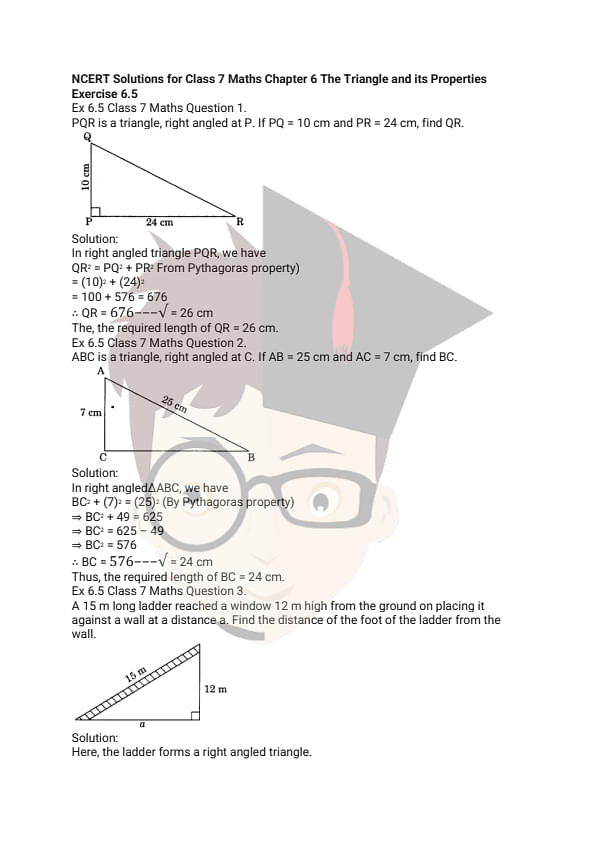


Check other NCERT Solutions for Class 7 Maths Chapter 6:
- NCERT Solutions Class 7 Maths Chapter 6 Exercise 6.1
- NCERT Solutions Class 7 Maths Chapter 6 Exercise 6.2
- NCERT Solutions Class 7 Maths Chapter 6 Exercise 6.3
- NCERT Solutions Class 7 Maths Chapter 6 Exercise 6.4
Read More: NCERT Solutions for Class 7 Maths Chapter 6
Example From Class 7 Chapter 6 The Triangle and its Properties
| Ques. Verify Pythagoras theorem for the following triangle ABC.
Ans. The Pythagoras theorem states that in a right-angled triangle, the square on the hypotenuse is equal to the sum of the squares on its legs. Therefore, in ∏ ABC, AC is the hypotenuse = 13 cm, BC is the base = 5 cm and AB is the perpendicular = 12 cm Applying Pythagoras theorem we get, (AC)2 = (AB)2 + (BC)2 On LHS we get, 132 = 169 On RHS we get, 52+ 122 = 25+ 144 =169 Therefore, LHS=RHS The Pythagoras theorem is hence proved. |

Read More:
| Triangles | Equilateral Triangle | Area of Isosceles Triangle |
| Properties of a Triangle | Isosceles Triangle Theorems | Isosceles Right Triangle |
| Isosceles Triangle | Sides of a Triangle | Similarity of Triangles |
Class 7 Maths Important Links:



Comments