



Content Writer
Obtuse Angle is an angle whose value lies between a right angle and a straight line. It is one of the types of angles formed in a plane. In the field of geometry, an angle is a figure made up of two rays that meet at a location called the vertex.
- Obtuse Angle are measured with the help of a protractor.
- It can also be constructed with the help of a compass.
- They are basically represented by a hexagon, pentagons and other type of figure.
- The angles are formed by the intersection of two curves in this plane.
- A clock is the most common example of an obtuse angle.
- Usually, for 24 hours a day, we can see a watch framed by many degrees of obtuse angle between the minute hand and the hour hand.
Read More: Circumference of Circle
Key Terms: Obtuse Angle, Rhombus, Angles, Vertex, Geometry, Triangle, Parallelogram, Acute Angle, Right Angle, Straight Angle, Circle, Isosceles Triangle
What is an Obtuse Angle?
[Click Here for Sample Questions]
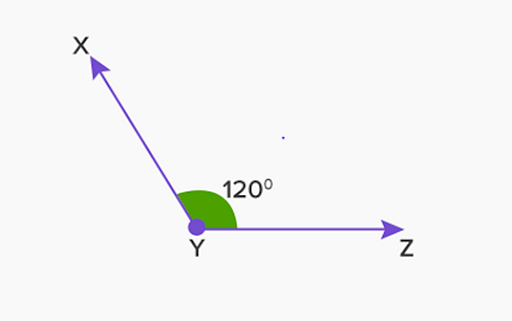
Obtuse angle is defined as an angle with a measure of larger than 90° but less than 180°. In other terms, an obtuse angle is an angle formed by the intersection of a right angle with a straight angle.
- Triangle, Rhombus and Parallelogram are some of the types of an obtuse angle.
- In case of obtuse angle triangle, the sum of square of two sides is less than value of the longest side.
- Obtuse Angle can be used to create variety of shapes.
- In case of rhombus not more than two obtuse angles can be formed.
- Angles formed between the blades of a ceiling fan is a common example.
- The angle which is formed between laptop and its screen is another example of obtuse angle.
Solved Examples of Obtuse AngleExample 1: Is it possible for an obtuse angle triangle to have sides that measure 5 units, 6 units, and 8 units? Solution: The total of the squares of the two sides of an obtuse triangle should be less than the square of the greatest side, i.e. a2 + b2 c2, where c is the largest side. Let a = 5, b = 6, c = 8 Then, a2 = 25, b2 = 36, c2 = 64, a2 + b2 = 25 + 36 = 61. Since 61<64. This means that a2 + b2 is smaller than c2. As a result, the specified measurements form an obtuse angle triangle. As a result, the sides of 5 units, 6 units, and 8 units form an obtuse triangle. Example 2: If the angle of reflection of a given ray is 264 °, what is the measure of the internal angle? Solution: Let the measure of reflex angle = 264 ° To find the unknown internal angle, use the following relationship. Reflection angle + unknown angle = 360 °…. (1) The unknown angle is "x". Next, insert the reflection angle value in (2). 264 ° + x = 360 ° x = 360 ° -264 ° x = 96 ° Therefore, the unknown angle obtained is an obtuse angle measuring 96 °. |
Read More:
Obtuse Angle Degree
[Click Here for Sample Questions]
An angle that is less than 180 degrees but greater than 90 degrees is known as a right angle. 105°, 1315°, 139°, 145°, and 151° are instances of obtuse angle degrees. As a result, the obtuse angle degree falls between 90° and less than 180°.
Read More: Area of Hollow Cylinder
Properties of an Obtuse Angle
[Click Here for Sample Questions]
Various properties of an obtuse angle are as follows:
- These types of angles range from 90º and 180º.
- An obtuse angle is larger than a right angle (90 degrees) and smaller than an acute angle (less than 90 degrees).
- It is smaller than a straight angle (180 degrees).
- In other words, the angles would be acute right obtuse straight if we ordered them from the smallest to the largest measurement.
- This angle resembles a quarter of a circle but is not quite half of a circle.
- If we divide it into four pieces, it will always occupy between 1/4 and 1/2 of a circle.
- Within an obtuse triangle, there is always an obtuse angle.
Read More: Quadrilateral formulas
Types of Obtuse Angle
[Click Here for Sample Questions]
Obtuse Angle can be represented in different shapes and sizes, which are discussed in detail in the below section.
Obtuse Angle of a Triangle
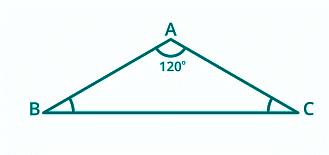
A triangle with an obtuse angle is one in which one of the triangle's angles is bigger than 90 degrees. Isosceles or scalene triangles are examples of obtuse triangles. An equilateral triangle can't be obtuse.
- The longest side of the triangle is the angle opposite the obtuse angle.
- In the same way, a triangle cannot have both a right and an obtuse angle.
- If one of a triangle's angles is obtuse, the triangle's other two angles must be acute.
Read More: Square Formula
Solved Example of Obtuse Angle of a TriangleExample: Calculate the height of the obtuse-angled triangle whose area is equivalent to 60 in2 and base is equal to 8 in.
Solution: Area of an obtuse-angled triangle is written as 1/2 × base × height. Height can be calculated with the help of this formula. Height = (2 × Area)/base Substituting the values in the given equation Height = (2 × 60)/8 = 15 inches Therefore, the height is given as 15 inches. |

Read More: Construction of Square
Obtuse Angle of a Rhombus
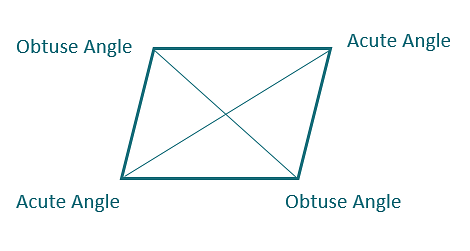
A quadrilateral with four sides is known as a rhombus. A rhombus's opposite angles are congruent with each other. Two opposed acute angles and two opposite obtuse angles make up a rhombus.
- It is supplementary to add the sum of two consecutive internal angles.
- When an acute and obtuse angle is combined together, the result is 180 degrees.
Read More: Difference Between Area and Perimeter
Solved Example of Obtuse Angle of a RhombusExample: An obtuse angle of a rhombus is greater than twice the acute angle by 60o . Find the measure of each angle. Solution: Let the acute angles of the rhombus be x and obtuse angles of the rhombus be y Given that y=2x+60o We know, the sum of two adjacent angles of a rhumbus is 180o x+y=180o ⇒x+2x+60o=180o ⇒3x=120o ⇒x=40o So, y=2×40o+60o=140o Hence.the measure of acute angle is 40o and the measure of obtuse angle is 140o. |
Read More: Area of Square Using Diagonal
Obtuse Angle of a Parallelogram
A parallelogram's opposite angles are parallel to one other. The sides of a parallelogram are parallel. It signifies that there will be two sharp angles and two obtuse angles. Because the parallelogram is leaning over, the obtuse angle measure will be bigger, while the acute angle measure will be smaller. The acute angles are A and C, whereas the obtuse angles are B and D.

Solved Example of Obtuse Angle of a ParallelogramExample: The angle between two altitudes of a parallelogram through the vertex of an obtuse angle of the parallelogram is 80o. Find the angles of the parallelogram. Solution: Given- □ABCD is a parallelogram. ∠B & ∠D are obtuse. BM & DN are altitudes from B & D on AD & AB, respectively, intersecting at O. ∠DOM=BON ...(vertically opposite angles=80o) To find out- The angles of the parallelogram ABCD. Solution- ∠DOM+∠NOM=180o ...(linear pair) ⟹80o+∠NOM=180o ⟹∠NOM=100o .........(i) Now, ∠AMO=∠DNO=90O ...(both are perpendiculares on AD & AB, respectively.)$ ∴ In the quadrilateral AMON, ∠AMO+∠DNO=180O ∴∠NOM+∠MAN=360o−180O=180o (sum of the angles of a quadrilateral =360o) ⟹∠MAN=180O−120o ...(from i ) i.e ∠A=60o ∴∠A=∠C=60o ....(opposite angles of a paralleogram) ∴∠D+∠B=360o−120o=240o ∴∠D=∠B=240o/2=120o ...(opposite angles of a paralleogram) Ans- ∠A=∠C=80o,∠D=∠B=100o |
Read More:
Things to Remember
- Obtuse angle is an angle which is measuring more than 90° and less than 180°.
- 105°, 1315°, 139°, 145°, and 151° are some degree of the angle.
- There is always an obtuse angle within an obtuse triangle.
- An angle greater than 180 degrees but less than 360 degrees is called reflex angle.
- A triangle, polygon or hexagon can represent an Obtuse Angle.
Read More:Tangential Quadrilateral Formula
Sample Questions
Ques. What is an Obtuse Angle in Geometry? (3 marks)
Ans. An obtuse angle is described as an angle formed when a ray rotates between 90 degrees and 180 degrees around a point, or we can say that if the amplitude is greater than 90 degrees but less than 180 degrees, it is an obtuse angle.
- Obtuse Angle can be used to create variety of shapes.
- In case of rhombus not more than two obtuse angles can be formed.
- Angles formed between the blades of a ceiling fan is a common example.
Ques. What is a Straight Angle? (3 marks)
Ans. A straight angle is formed when one arm is moved from the vertex so that both arms are opposite each other and create a straight line. The degree is equal to 180 degrees.
- It does not have any type of curve.
- Straight angle lie opposite to the vertex of the figure.
- It is formed by rotating a ray by 180 degree with respect to another type of ray.
- It is constructed by joining vertex of two right angles.
Ques. What Are the Characteristics of an Obtuse-Angled Triangle? (3 marks)
Ans. The attributes of an Obtuse Angled Triangle are listed below.
- The sum of the two angles in a triangle, excluding the obtuse angle, is less than 90 degrees.
- The longest side of a triangle is the side opposite the obtuse angle.
- An obtuse angle occupies ¼ and ½ of a circle if divided into four parts.
- To meet the angle sum property of the triangle, an obtuse triangle can have just one obtuse angle.
Ques. Can 2 Obtuse Angles be Supplementary and what are the zero angles? (2 marks)
Ans. Two obtuse angles, each bigger than 90°, cannot constitute a supplementary pair of angles since the aggregate is greater than 180°, which violates the definition of supplementary angles.
- If the angle measurement is 0 degrees, it is called a zero angle. That is, if two rays match, the angle between these two rays is zero.
Ques. Draw a ΔPQR, where QR = 3.5 cm, m∠Q = 40°, m∠R = 60°.  (3 marks)
Ans. Steps of construction:
(A) Draw QR = 3.5 cm.
(B) Draw ∠Q = 40°, ∠R = 60° which meet each other at P.
(C) ΔPQR is the required triangle.
Ques. What is the definition of 210 degrees and give an example of an obtuse angle? (2 marks)
Ans. 210 degrees is a type of angle in which angle is more than 180 degrees. It is a type of reflex angle. Since reflex angles have a dimension that is greater than 180 degrees but less than 360 degrees.
The obtuse angle can vary between any angle from 90 degrees to 180 degrees, for example, 145 °, 150 °, 178 °, 149 °, and 91 ° are all examples of obtuse angles because they are greater than 90 ° and less than 180 °.
Ques. Draw an equilateral triangle whose each side is 4.5 cm.  (3 marks)
Ans: Steps of construction are:
(A) Draw AB = 4.5 cm.
(B) Draw two arcs with the centres A and B and the same radius of 4.5 cm to meet each other at C.
(C) Join CA and CB.
(D) ΔCAB is the required triangle.
Ques. If the angle of reflection of a given ray is 260 °, what is the measure of the internal angle? (3 marks)
Ans: Let the measure of reflex angle = 260 °
To find the unknown internal angle, use the following relationship.
Reflection angle + unknown angle = 360 °…. (1)
The unknown angle is "x".
Next, insert the reflection angle value in (2).
260 ° + x = 360 ° x = 360 ° -260 ° x = 100 °
Therefore, the unknown angle obtained is an obtuse angle measuring 100 °.
Ques. An obtuse angle of a rhombus is greater than twice the acute angle by 120o . Find the measure of each angle? (3 marks)
Ans: Let the acute angles of the rhombus be x and obtuse angles of the rhombus be y
Given that y=2x+110o
We know, the sum of two adjacent angles of a rhumbus is 180o
x+y=180o
⇒x+2x+120o=180o
⇒3x=60o
⇒x=20o
So, y=2×20o+120o=160o
Hence the measure of acute angle is 20o and the measure of obtuse angle is 160o.
Ques. What is the difference between acute angle and obtuse angle? (3 marks)
Ans. The difference between acute angle and obtuse angle are as follows:
| Acute Angle | Obtuse Angle |
|---|---|
| Acute angle is an angle which is less than 90 degree. | Obtuse angle is an angle which is greater than 90 degree but less than 180 degree. |
| Triangle having three acute angle are known as acute angle triangle. | Triangle having two acute angle and one obtuse angle are known as obtuse angle triangle. |
| Examples of acute angles include 66°, 22° | Examples of obtuse angles include 166°, 122° |
Ques. Is it possible for an obtuse angle triangle to have sides that measure 5 units, 6 units, and 9 units? (3 marks)
Ans: The total of the squares of the two sides of an obtuse triangle should be less than the square of the greatest side, i.e. a2 + b2 c2, where c is the largest side.
Let a = 5, b = 6, c = 9
Then, a2 = 25, b2 = 36, c2 = 81, a2 + b2 = 25 + 36 = 61.
Since 61<81. This means that a2 + b2 is smaller than c2.
As a result, the specified measurements form an obtuse angle triangle. As a result, the sides of 5 units, 6 units, and 9 units form an obtuse triangle.
Ques. The measure of two adjacent angles of a quadrilateral are 10o and 70o and the other two angles are equal. Find the measure of each angle? (3 marks)
Ans: Let x be the other angle
Given: measure of two adjacent angles of a quadrilateral are 10o and 70o
We know that, Sum of angles of quadrilateral = 360∘
∴x+x+10+70=280
⇒x=280 degree
Ques. If the angle of reflection of a given ray is 160 °, what is the measure of the internal angle? (3 marks)
Ans: Let the measure of reflex angle = 160°
To find the unknown internal angle, use the following relationship.
Reflection angle + unknown angle = 360 °…. (1)
The unknown angle is "x".
Next, insert the reflection angle value in (2).
160 ° + x = 360 ° x = 360 ° – 160 ° x = 200 °
Therefore, the unknown angle obtained is an obtuse angle measuring 200 °.
Read more:



Comments