



Education Journalist | Study Abroad Lead
Square is a quadrilateral that has all four sides equal along with equal angles according to Euclidean Geometry. A square is derived from a rectangle and hence can also be defined as a rectangle having two equal adjacent sides. Square is one of the basic quadrilaterals having a definite structure and hence a quadrilateral can be considered to be a square if it poses the properties of a square such as all sides being equal and all angles being equal. A square can be defined as a quadrilateral with all four angles being right angles, i.e, 90 degrees. Given below is the detailed information on the square formulas such as area, perimeter, length of the diagonals along with solved examples.
| Table of Contents |
Key Terms: Square Formula, Area of Square, Diagonal of Square, Properties of Square, Characteristics of Square
Square Formula
[Click Here for Sample Questions]
Square is indeed one of the most recurring and basic geometrical shapes. Given below is a list of various formulae of a square that can be used in day-to-day calculations, asked in question papers, and hence are the building blocks of Geometry.
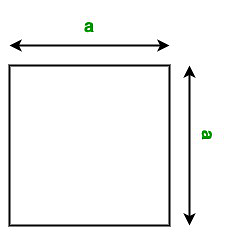
Square
For better understanding, we will take the side of a square as ‘a’ unit.
Area of a Square
[Click Here for Sample Questions]
The area of a square is the product of the length of two sides of a square and hence can be mathematically represented as
- Area of a Square = side x side = (a2)
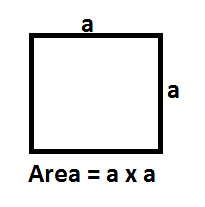
Area of a Square
For example, Calculate the area of a square with a side of 20cm.
As we know the area of the square is the square of the side of a square hence,
Area = 202
Area = 400 cm2
Perimeter of a Square
[Click Here for Sample Questions]
The perimeter of a polygon can be defined as the sum of all sides of a polygon. Hence, the perimeter of a square is calculated as
- Perimeter of a square = a+a+a+a or P= 4a
For example, A square has a side of 10 cm. What will be its perimeter?
Here, a = 10 cm
Perimeter (P) = a+a+a+a = 4a
Therefore, P = 4*10
Perimeter (P) =40 units
Also Read: Difference Between Area and Perimeter
Diagonals of a Square
[Click Here for Sample Questions]
A diagonal is a straight line joining two opposite corners of a straight-sided shape polygon.
Diagonal is calculated by using the formula:
- Diagonal (D) = a√2 units
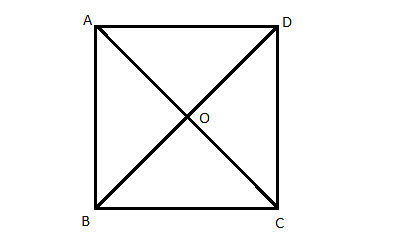
Diagonals of a Square
For example, A square has a side of 50 cm, find its diagonal.
Here, a = 50cm
As we know Diagonal (D) = a√2 units,
Therefore, D = 50√2 cm
-
Derivation of Square Diagonal Formula
Here is the derivation for the diagonal formula of the square,
From the above diagram, we can see that a square is divided into two equal right-angled triangles. Right angle triangle because every side makes an angle of 900 with the other side giving the formation of a right-angle triangle. And because it is a square, all four sides of the rectangle will be equal i.e., AB=BC=CD=AD=a.
Applying Pythagoras theorem in Triangle ABC,
AC2 = AB2 + BC2
As AB=BC=CD=AD=a.
Therefore, AC2 = AB2 + AB2 -------------- (AB=BC)
AC2 = a2 + a2 -------------- (AB=a)
AC2 = 2a2
Taking square root on both sides
AC = a√2
Also Read: Area of Square Using Diagonal
Properties of a Square
[Click Here for Sample Questions]
Square is a unique case of a rhombus, a kite, a trapezoid, a parallelogram, a quadrilateral, and a rectangle, and thus has the following of properties:
- Diagonal of a square cut each other in half and meet at a 90° angle.
- A square's diagonals cut over its angles.
- The opposite sides of a square are parallel as well as equal in length.
- All four angles of a square are equal (i.e., 900)
- Sides of a square are equal in terms of length.
- Diagonals of squares are equal.
Characteristics of a Square
[Click Here for Sample Questions]
If and only if a convex quadrilateral is one of the following, it is a square:
- Two adjacent equal sides form a rectangle.
- A rhombus with a right-angled vertex
- A rhombus having identical angles on all sides
- A parallelogram with two adjacent equal sides and one right angle.
- Four equal sides and four right angles make up a quadrilateral.
- Diagonals are equal and perpendicular bisectors of each other.
Things to Remember
- Area of a square (A) = (a2)
- Perimeter (P) = 4a
- Diagonal (D) = a√2 units.
- A square's diagonals are √2 (approximately 1.414) times the length of one of the square's sides. The square root of 2 (also known as Pythagoras' constant) was the first number to be demonstrated to be irrational.
- A parallelogram with equal diagonals that bisect the angles is also known as a square.
- A square is a figure that is both a rectangle (right angles) and a rhombus (equal edge lengths).
Sample Questions
Ques. Find the area of the square if its perimeter is given as 216 cm. (3 Marks)
Ans. Perimeter= 216 cm
Perimeter = 4a
a= Perimeter/4
a= 216/4
a= 54 cm
Area of square= side*side
Area= 54*54= 2916 cm2
Ques. If the perimeter of a square is 32 cm, find the area of the square. (3 Marks)
Ans. Perimeter = 4 * a
32 = 4 * a
a= 8
Area (A) = a2
= 8*8
=64 sq. cm
Ques. If the side of a square is 8 cm and it is doubled. Find the increase in the percentage of the area of the square. (4 Marks)
Ans. Area of square = 8*8
= 64 sq. cm
New side = 8*2
= 16
New area of square = 16*16
= 256 sq. cm
Ques. A rectangular floor is 80 m long and 30 m wide. Square tiles, each of 10 m side length, are to be used to cover the floor. Find the number of tiles which will be required to cover the floor. (4 Marks)
Ans. Given,
Length of the floor = 80 m
Breadth = 30 m
Area of the rectangular floor = length x breadth = 80 m x 30 m = 2400 sq. m
Side of one tile = 10 m
Area of one such tile = side x side = 10 m x 10 m = 100 sq. m
No. of tiles needed = Area of floor / Area of one tile = 2400 / 100 = 24 tiles.
Ques. Find the area of a square of side 45 cm. (2 Marks)
Ans. Area of a square = length × length
= 45 × 45 sq. cm.
= 2025 sq. cm.
Ques. The length of a square's side is 25 cm. find the perimeter of the square. (2 Marks)
Ans. 25 cm is the length of a square's side.
Are square = 4 * side
= 4x 25 cm
= 100 cm
Ques. A square field's side length is 275 meters. At a rate of ten rupees per square meter, how much will it cost to level the field? (3 Marks)
Ans. The square field's length is 275 meters.
Area = side* side
= 275 m × 275 m
= 75625 m2
The cost of leveling the field is 75625 * 10 rupee
= 756250 rupees
Ques. You have to build a fence around your ground. You want the ground to be square. What are the dimensions of this fence given that the perimeter is 32 meters? (2 Marks)
Ans. P = 4*side
32 = 4 * side
Thus, the side will be 8 meters
Ques. You want to build a square pool in one of the corners of your house. the house is square in dimension with one of the sides as 15 meters. The pool has to be of the dimension of 6 meters. Find how much space is left for the garden. (4 Marks)
Ans. Area of house = 15*15 = 225
Area of pool = 6*6 = 36
Area of Garden = Area of the house – area of the pool
= 225- 36
= 189 sq. meter
Ques. You and your friend have a bet. Your friend states that the length of the square is the same as the diagonal of the square. Find if your friend is right if the side of the square is 9cm. (4 Marks)
Ans. As we know, Diagonal (D) = a√2 units.
Diagonal (D) = 9√2 cm
= 9*1.41
= 12.69 cm
Check-Out:



Comments