



Content Curator
The pelvic girdle consists of the two hip bones. Other names include coxal bones, the innominate bones and the pelvic bone. The pelvic girdle is part of the appendicular skeleton and it serves to protect the organs in your pelvic region. It provides an attachment point for ligaments and muscles. Further, it also attaches to the lower limbs of the appendicular skeleton to the sacrum of the axial skeleton.
| Table of Content |
Key Takeaways- Pelvic girdle, coxal bones, appendicular skeleton, organs, axial skeleton.
Pelvic Gridle Bones
[Click Here for Sample Questions]
Pelvic bones are made up of two single coxal bones. Each hip bone is divided into three main regions: ilium , which is a brownish color, the Ischium is bluish color and the pubis is represented by pinkish color. These three regions are separate bones in youth, later fuse together to form one solid hip bone. These three hip regions meet in and around the acetabulum, which is the deep socket of the hip bone. The acetabulum is easily recognized in a lab exercise and it receives the head of the femur to form the acetabular femoral joint.
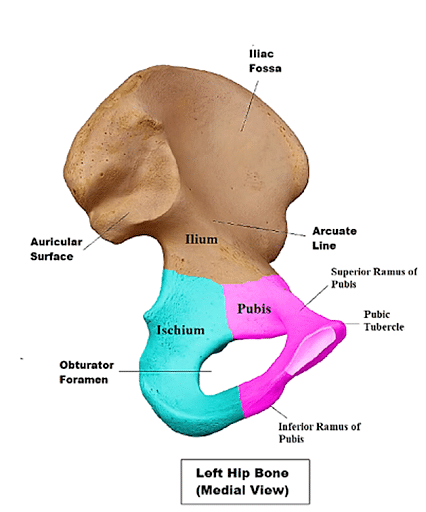
Coxal Bone
Ilium
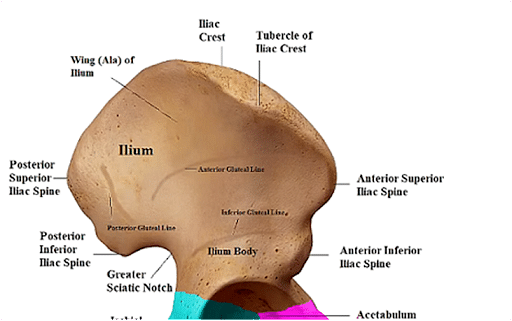
The ilium makes up the superior or top region of the hip bone. The ilium can be subdivided into two main portions of the lower region near the acetabulum called the body and the wing or tail of the ilium. If you feel the sides of your abdomen with your hand, the top of that wing lock portion of the ilium is called the iliac crest. This allows the attachment of various muscles. The superior or top spine is called the anterior superior iliac spine. It allows for the attachment of the inguinal ligament.
Ilium
Inferior iliac spine allows for the attachment of the rectus femoris muscle as well as iliofemoral ligament of the hip joint. Two iliac spines i.e. posterior superior iliac spine which allows for the attachment a part of the posterior sacroiliac ligaments. Below is the posterior inferior iliac spine. Posterior means towards the back, and inferior means away from the head or towards the feet.
Greater sciatic notch allows for the passage for the sciatic nerve. It will help to identify the posterior region of the hip bone now.
Ischium
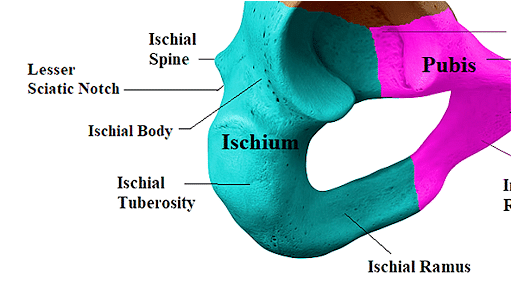
It is divided into two main regions. A projection called the Ischial spine. This allows for the various muscles and the ligaments below the ischial spine is another notch called the lesser sciatic notch. Ischial tuberosity on the lateral side of the Ischium is rough and bumpy. It allows for the attachment of the sacrotuberous ligament as well as several muscles.
Ischium
Pubis
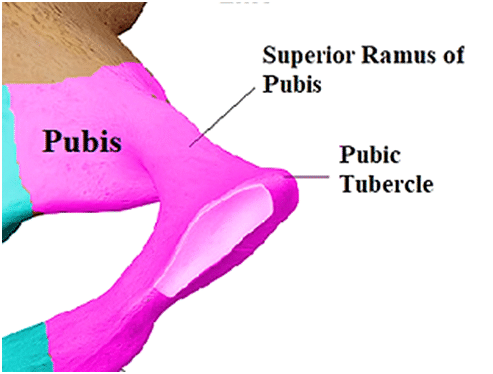
The word pubis is the area of the hip bone that is going to be on the anterior or the front side. The superior ramus is the upper portion of the pubis that branches out. There is a ridge on the superior border of this ramus called the pectineal line. It allows the attachment of various muscles and ligaments.
Pubis
Pubic Symphysis
It is a joint in the midway between the two hip bones that attaches the pubis to the femur. It's thought up of fibrous cartilage.
Acetabulum
It is a canal formed by the blending of the ilium, ischium, and pubis bones. The acetabulum is outlined by the femur or thigh bone.
Obturator Foramen
The large unveiling between the ischium and the pubic bone is known as the obturator foramen. It has a round or oval shape. It is surrounded with connective tissue and continues to serve as a site for muscle attachment.
Pectoral Gridle and Pelvic Gridle
[Click Here for Sample Questions]
Pectoral girdle is called the shoulder girdle as it is present in the shoulder region. Two main bones are in the pectoral girdle are clavicle and scapula. Glenoid cavity is present in which the humerus is articulated.
Pelvic girdle is also called the hip girdle as it is present in the hip region. Three main bones are present in the pelvic girdle that is ileum, Ischium and pubis. Pelvic girdle contains a deep depression called the acetabulum to which the head of the femur is articulated.
ALSO READ: pelvic bones
Types of Pelvis
[Click Here for Sample Questions]
Females have a wide range of pelvic shape. The shape of the pelvis helps determine whether or not a female can give birth vaginally. The four main types of pelvis are as follows:
Gynecoid: This is the most common pelvic shape in females, and it favours vaginal birth. Other shapes, such as android and platypelloid, have a more difficult time giving birth vaginal delivery. It is also referred to as the genuine pelvic floor.
Android pelvis: It has a heart-shaped brim and a narrow shape in the front. Tall women with narrow hips, and also African women, have this type of pelvis.
Anthropoid: The brim of an anthropoid pelvis is oval, with a slightly narrow pelvic cavity. The outlet is large in this case, but some of the diameters are narrower.
Functions of Pelvic Gridle
[Click Here for Sample Questions]
Pelvic girdle supports the posterior part of the trunk. It supports soft organs of the pelvic cavity such as the uterus, urinary bladder. It provides the surface for the attachment of the muscles of the leg.
Points to Remember
- Ilium is the utmost longest bone, it is fused with Ischium and pubic bones.
- Ilium is attached to the sacrum
- Ischium is the lower and back part of the pelvic girdle. It is situated behind the pubic bones.
- Pubis is located in the pelvic girdle.
- The two halves of pubic bone are joined in the middle by an area of cartilage called the pubic symphysis.
Sample Questions:
Ques - What is pelvic girdle? Explain in detail. (4 Marks)
Ans: Pelvic girdle is called the hip girdle and is present in the hip region. Pelvic girdle consists of the two hip bones. These hip bones are referred to as different names including coxal bones, the innominate bones and the pelvic bone. The pelvic girdle is part of the appendicular skeleton and it serves to protect the organs in the pelvic region and it provides attachment points for ligaments and muscles. It also attaches to the lower limbs of the appendicular skeleton to the sacrum of the axial skeleton.
Ques - What are the three main bones of the pelvic girdle? With diagram (5 Marks)
Ans-
Three main bones are present in the pelvic girdle that is ileum, Ischium and pubis.
Each hip bone is divided into three main regions ilium which is brownish color in this picture, the Ischium which is bluish color and the pubis which is represented by pinkish color.
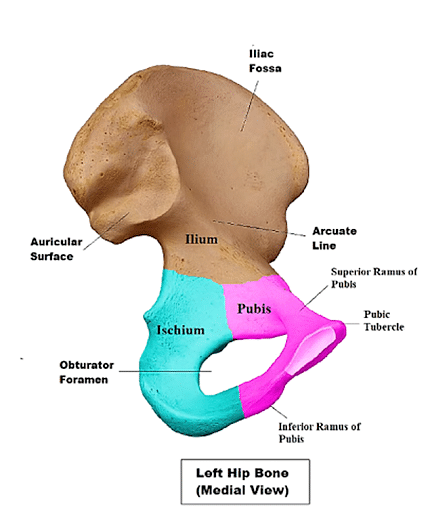
These three regions begin as separate bones in youth but they later fuse together to form one solid hip bone. And these three hip regions meet in and around the acetabulum which is a deep socket of the hip bone. Acetabulum is easily recognized in a lab exercise and it receives the head of the femur to form the acetabular femoral joint.
Ques – What are the functions of the pelvic girdle? ( 3 Marks )
Ans: Pelvic Girdle supports the posterior part of the trunk. It supports soft organs of the pelvic cavity such as uterus, urinary bladder. It provides the surface for the attachment of the muscles of the leg. In its acetabulum the femur bone of the leg articulates.
Ques – Explain about ilium in brief ( 5 Marks )
Ans: The ilium makes up the superior or top region of the hip bone. The ilium can be subdivided into two main portions of the lower region near the acetabulum called the body and then the wing or tail of the ilium. Wing lock portion of the ilium is called the iliac crest. This allows the attachment of various muscles. The superior or top spine is called anterior superior iliac spine. It allows for the attachment of the inguinal ligament. Inferior iliac spine allows for the attachment of the rectus femoris muscle as well as iliofemoral ligament of the hip joint.Two iliac spines i.e. Posterior superior iliac spine which allows for the attachment of a part of the posterior sacroiliac ligaments. Then below that posterior inferior iliac spine. Posterior means towards the back, and inferior means away from the head or towards the feet.
Ques - What is Ischium? Explain in detail ( 3 marks )
Ans: Ischium is divided into two main regions. A projection called Ischial spine. This allows for the various muscles and the ligaments below the ischial spine is another notch called lesser sciatic notch. It allows for the passage of nerves and vessels. Ischial tuberosity on the lateral side of the Ischium and this is rough and bumpy. It allows for the attachment of the sacrotuberous ligament as well as several muscles.
Ques - Explain about pubis in brief ( 3 Marks )
Ans: The word pubis means sexually mature and by thinking of your pubic region and private parts that this is the area of the hip bone that is going to be on the anterior or the front side. Like ilium and Ischium the pubis also has a body. The superior ramus is the upper portion of the pubis that branches out. There is a ridge on the superior border of this ramus called pectineal line. It allows the attachment of various muscles and ligaments.
Ques - What is the difference between Pectoral girdle and Pelvic girdle (3 Marks)
Ans:
| Pectoral girdle | Pelvic girdle |
|---|---|
|
|
Ques – what is meant by pectoral girdle? (2 marks)
Ans:
Pectoral girdle called shoulder girdle is present in the shoulder region. Two main bones are in the pectoral girdle are clavicle and one scapula. The glenoid cavity is present in which the humerus is articulated.
ALSO READ:



Comments