



Education Journalist | Study Abroad Lead
Humerus is a long upper arm bone. As it is one of the longest bones in the body, it is more prone to fractures when struck. The word "humerus" comes from the Latin word "humerus," which means "the upper arm." It is made up of three parts: a proximal end, a shaft, and a distal end, all of which have crucial anatomical markers. The humerus articulates proximally with the scapula at the glenohumeral joint, allowing it to participate in shoulder movements. At the elbow joint, the humerus has distal articulations with the radius and ulna.
Key Terms: Upper arm, glenohumeral joint, elbow joint, Shoulder joint, Humerus Bone
Read More: Difference between Bone and Cartilage
Humerus
[Click Here for Sample Questions]
Humerus bone is found between the shoulder and the elbow joint in the upper arm. The glenohumeral (shoulder) joint is a ball and socket joint. The glenoid fossa of the scapula is the ball, and the ball is the humeral head. The supraspinatus, infraspinatus, teres minor, and subscapularis muscles and tendons surround the joint, which is supported by ligaments. The scapula muscles are inserted on the humeral head.

Humerus Bone
The most fracture-prone portion of the humerus is the proximal humerus. The larger and lesser tubercles, which are projections in the bone, are located below the head of the humerus. The distal humerus is linked to the proximal humerus by the bone shaft. The radius and ulna, two arm bones that make up the forearm, articulate with the distal humerus at the elbow joint.
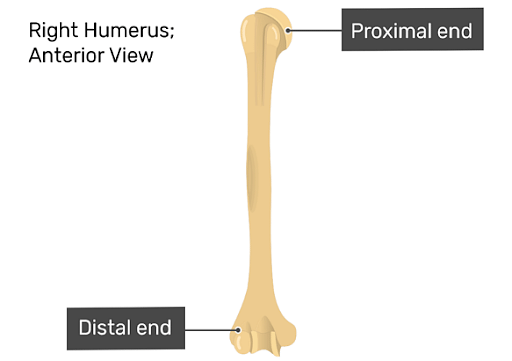
Right Humerus
Read More:
Anatomy of Humerus Bone
[Click Here for Sample Questions]
- The shoulder girdle, or pectoral girdle, which consists of the scapula and clavicle bones, connects the humerus to the axial skeleton at its proximal end.
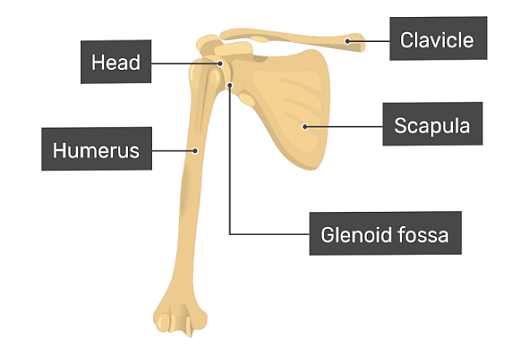
Anatomy of Humerus Bone
- The glenoid fossa (cavity) of the scapula is where the rounded humeral head fits. The small depression on the lateral side of the scapula allows the shoulder joint to move freely, but it also decreases its stability. The shoulder girdle muscles aid to support the joint and control the humerus's front-to-back, side-to-side, and rotational movements.

Shoulder Girdle
- The humerus' central section consists of a long, cylindrical shaft (body). The deltoid tuberosity, which lies towards the middle of the lateral border, is the only bump on the shaft's surface. Several muscles that move the upper and lower arms are attached to the shaft.
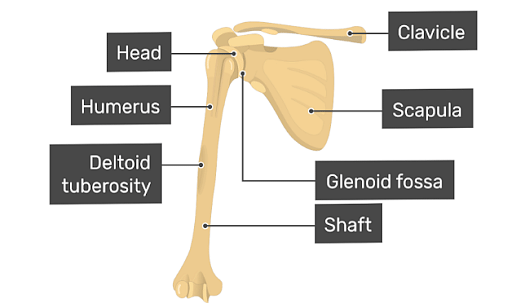
- At the elbow joint, the humerus meets the ulna and the radius medially and laterally.
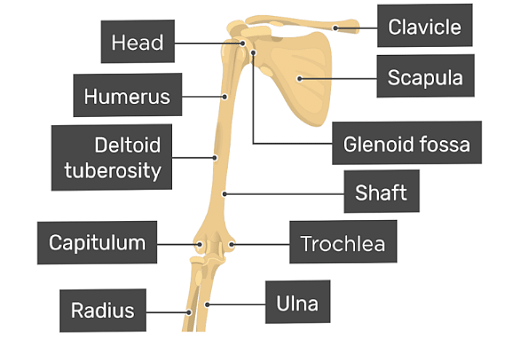
- The trochlea of the humerus and the trochlear notch of the ulna from the humeroulnar joint, which are pulley-shaped. The humeral capitulum and the concave superior surface of the radial head form the humeroradial joint.
Read More:
Function of Humerus
[Click Here for Sample Questions]
Humerus is a structurally essential bone that also functions as an insertion point for numerous muscles. The pectoralis major ("pecs") and latissimus dorsi ("lats") muscles attach to the intertubular sulcus, or groove, in the head of the humerus and assist rotate it.

Shoulder Joint
The deltoids, brachioradialis, coracobrachialis, pronator teres, teres major, brachialis, and common flexor and extensor tendons are only a few of the muscles that attach to the humerus and provide motion for the arm and upper body. Finally, the rotator cuff muscles link to the humerus to anchor the glenohumeral joint, which is highly unstable and prone to dislocation, as well as rotator cuff injury. Rotator cuff injuries are very common among adults over the age of 60.
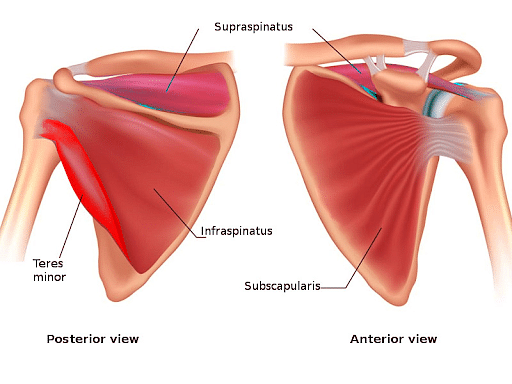
Rotator Cuff Muscles
The humerus bone has several arteries and veins. The brachial artery, the upper arm's main blood vessel, passes through the humerus bone for the most part. The radial and ulnar arteries that provide blood to the forearm split at the elbow joint. The basilic vein also runs near the humerus and aids in the drainage of the hand and forearm.

Brachial Plexus
The brachial plexus nerves also run down the humerus. The radial nerve travels down the humeral shaft in a similar manner, turning along the bone halfway down. The radial nerve may be injured by fractures in this area.
Read More:
Fractures of Humerus
[Click Here for Sample Questions]
The humerus is prone to fractures, which are one of the most common injuries. The following is a list of the different types of humerus fractures and how they are classified:
- A break in your humerus that occurs closest to your shoulder is called proximal.
- A break in the shaft or body of your humerus is known as mid-shaft or middle.
- A break at the end of your humerus closest to your elbow is called a distal break.

Types of Fractures in Humerus
Causes
A direct hit to the humerus usually results in a fracture. Contact sports and car accidents are common causes of this sort of injury. If you fall with your arm outstretched, your humerus may also be broken. An underlying medical problem can sometimes cause a humerus fracture. This type of fracture is known as a pathologic fracture, and it can be caused by osteoporosis or malignancy.
Read More:
Things to Remember
The humerus is a long bone that connects the shoulder and elbow joints in the upper arm.
The glenohumeral joint is formed when the proximal humerus meets the shoulder via the glenoid fossa of the scapula.
At the elbow, the radius and ulna in the forearm articulate with the distal humerus.
The humerus is an insertion point for numerous essential upper-body muscles, including the pectoralis major, latissimus dorsi, rotator cuff muscles, and others.
The brachial artery runs alongside the humerus, giving oxygen and other nutrients to the arm, while the basilic vein runs close by, draining the hand and forearm.
Read More:
Sample Questions
Ques. Is there a link between the Humerus and Ulna? (2 marks)
Ans. The humeroulnar joint, which is a component of the elbow joint, connects the humerus and ulna. It is the junction between the trochlea of the humerus and the trochlea of the ulna, and it consists mostly of two bones: the humerus and the ulna. It's a straightforward hinge joint that allows for extension, flexion, and circumduction movement.
Ques. What exactly is the purpose of the humerus bone? (2 marks)
Ans. The humerus connects 13 muscles that help in hand and elbow movements, as well as upper-limb function.
Ques. Which muscles connect the humerus to the rest of the body? (2 marks)
Ans. The humerus is moved by the pectoralis major, latissimus dorsi, deltoid, and rotator cuff muscles. The triceps brachii, biceps brachii, brachialis, and brachioradialis are the muscles that move the forearm and are positioned along the humerus.
Ques. What's an interesting humerus bone fact? (2 marks)
Ans. The humerus bone, which spans the shoulder and elbow joints, is located in the upper arm. This is the same bone called the "funny bone." Because the ulna nerve bends around the elbow end of the humerus, it's prone to be knocked, resulting in a strange, tingling feeling down the forearm.
Ques. When you have a broken humerus, how long does it take to heal? (2 marks)
Ans. Without surgery, the majority of proximal humerus fractures can be treated. It will take 3 to 4 months for the shattered bone to heal completely. You'll need to do exercises to regain range of motion and strength, as well as return to daily activities, during this period.
Ques. What are the symptoms of a humerus fracture? (2 marks)
Ans. Pain, swelling, and bruising are some of the symptoms. When a bone breaks through the skin, it may bleed. It may be difficult to move your shoulder, arm, or elbow as you typically would.
Ques. Is a broken humerus a significant injury? (2 marks)
Ans. A broken humerus or upper arm can be excruciatingly painful, and the patient may be unable to move their arm. The radial nerve (one of the arm's primary nerves) might be injured at any time. Around 15% of the time, this happens. Fractures that occur near to the bone's base are more likely to cause this.
Ques. What are the common causes of Humerus fracture? (2 marks)
Ans. A direct hit to the humerus usually results in a fracture. Contact sports and car accidents are common causes of this sort of injury. If you fall with your arm outstretched, your humerus may also be broken. An underlying medical problem can sometimes cause a humerus fracture. This type of fracture is known as a pathologic fracture, and it can be caused by osteoporosis or malignancy.
Related Links :



Comments