



Content Curator
Locomotion and movement are terms that define the ability of things to change position over time.
- Locomotion is the voluntary movement of an organism from one place to another.
- Walking, running, and swimming are examples of locomotion.
- The method of locomotion varies depending on the location and the need for a specific situation.
- Usually, locomotion is performed when animals look for a place to stay, food, mating, appropriate weather conditions, and to escape predators.
- Movement is a characteristic of all living organisms.
- Movement accounts for the different essential functions in living beings, ranging from protoplasmic movement in a cell and unicellular organisms to organ movement in multicellular organisms.
- Locomotion refers to a movement that results in a change in place.
| Table of Content |
Key Terms: Locomotion, Movement, Muscular system, Types of muscles, Unicellular organism, Skeletal system, Joints, Bones, Examples of locomotion, Examples of Movement
Types of Movement
[Click Here for Sample Questions]
The different types of movement are
- Amoeboid Movement
- Ciliary Movement
- Muscular Movement
Amoeboid Movement
Some specialized cells in our body, such as macrophages and leukocytes in our blood, show amoeboid movement.
- It is affected by the pseudopodia formed by the protoplasm, as in Amoeba.
- The amoeboid movement also involves Cytoskeletal elements such as microfilaments.
Ciliary Movement
Ciliary movement occurs in many of our tubular internal organs bound by the ciliated epithelium.
- The integrated movement of the cilia in the trachea helps to disperse the dust particles and other foreign substances inhaled with air.
- Transmission of ova through the female reproductive tract is also driven by the ciliary movement.
Muscular Movement
Movement of our eyelids, jaws, hands, legs, etc requires muscular movement.
- The contractile property of muscles is effectively used for locomotion and other movements by human beings and almost all other multicellular organisms.
- A perfectly coordinated activity of muscular, skeletal, and neural systems is essential for muscular movement.
The video below explains this:
Locomotion and Movement Detailed Video Explanation:
Read More:
Muscular System
[Click Here for Sample Questions]
Muscles are specialized tissues of mesodermal origin.
- They have special properties like elasticity, extensibility, excitability, and contractility.
- Muscles help in body movements and the movement of internal organs as well.
- It helps with stretching, bending, walking, and other physical activities.
- About 40-50 percent of our body weight is contributed by muscles.
Classification of Muscles
There are three types of muscles
- Skeletal Muscles
- Visceral Muscles
- Cardiac Muscles
Skeletal Muscles
Skeletal muscles are made up of muscle bundles (fascicles), which are joined together by collagenous connective tissue called the fascia.
- These are closely related to the skeletal parts of the body that have a striped appearance when viewed under a microscope.
- That is why they are known as striated muscles.
- Locomotory actions and changes in posture involve the use of these muscles.
Visceral Muscles
Visceral muscles are found on the inner walls of hollow visceral structures of the body such as the birth canal, alimentary canal, etc, and do not show striations.
- Because they appear to be smooth, they are called smooth muscles.
- These involuntary muscles facilitate the movement of food through the digestive tract and the movement of gametes through the genital tract.
Cardiac Muscles
Cardiac muscles are the muscles of the heart.
- Many cardiac muscle cells come together in a fusion pattern to form a cardiac muscle.
- Based on the structure of the muscles, cardiac muscles are striated.
- They are involuntary by nature as the nervous system does not control their operations directly.
Skeletal System
[Click Here for Sample Questions]
The skeletal system comprises bones that give shape to the body.
- An adult skeleton consists of 306 bones and a few cartilages.
- Bones and cartilage are specialized connective tissues.
- Cartilages are softer than bones.
- The human skeleton can be divided into the axial skeleton of 80 bones and the appendicular skeleton of 126 bones.
Axial Skeleton
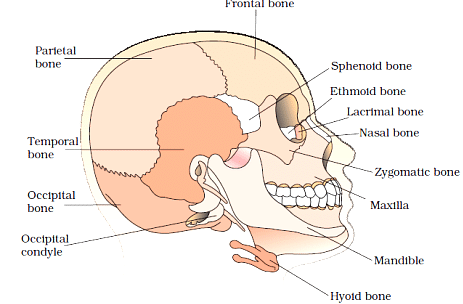
The skull, vertebral column, sternum, and ribs together form the axial system.
- The skull (22 bones) is made up of cranial and facial bones.
- The cranial (8 bones) forms a protection for the brain (cranium).
-
The facial area contains 14 bones that form the front part of the skull.
-
Hyoid bone (U-shaped) forms the lower part of the buccal cavity.
-
The middle ear bones (Malleus, Incus, and Stapes) collectively are called Ear Ossicles.
-
The skull connects to the spinal column with two occipital condyles.
-
The vertebral column consists of 26 vertebrae.
-
The first vertebra is Atlas which connects to the occipital condyle.
-
Others include Cervical-7, thoracic -12, lumbar -5, sacral – 1, and coccygeal -1.
-
The 12 pairs of ribs are connected back to the spinal column and ventrally to the sternum.
-
The 11th and 12th ribs are not connected to the sternum and are called floating ribs.
Appendicular Skeleton
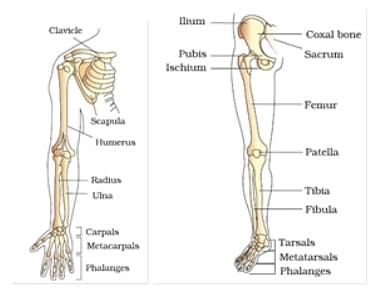
The Appendicular Skeleton includes limb bones and girdles.
- Upper Limb - Humerus, Radius and Ulna, 8-Carpals, 5-Metacarpals, 14-Phalanges.
- Lower Limb - Femur, Tibia, and Fibula, 7-Tarsals, 5-Metatarsals, 14-Phalanges, cup-shaped Patella covering the knee.
Joints
[Click Here for Sample Questions]
Joints are points of junction between bones, or between bones and cartilage.
- Joints are essential for all types of movements.
- They act as fulcums when the force generated by the muscles is used to carry out the movement.
They can be categorized as follows:
- Fibrous joints - do not allow movement. For example - the bones of a flat skull, eventually merge with the help of compacted tissues that form sutures and eventually form cranium.
- Cartilaginous joints - the bones here are joined by cartilages. The junction between the vertebrae near the spinal column is a pattern that allows for limited movement.
- Synovial joints - synovial cavities filled with fluid between articulating surfaces of two bones, allowing for certain movements. Examples include hinge joint, ball and socket joint, etc.
Disorders of Muscular and Skeletal Systems
[Click Here for Sample Questions]
The following are the disorders of muscular and skeletal systems
- Myasthenia gravis- An autoimmune disorder that affects the neuromuscular joints and leads to fatigue, weakness, and skeletal muscle paralysis.
- Muscular dystrophy- A progressive degeneration of skeletal muscle mainly due to genetic disorders.
- Tetany- Rapid spasms in muscles due to low levels of Ca++ in body fluids.
- Arthritis- Inflammation of the joints.
- Osteoporosis- An age-related issue characterized by decreased bone density and increased risk of fracture.
- Gout- Inflammation of the joints as a result of accumulation of uric acid crystals.
Read More:
Difference Between Locomotion and Movement
[Click Here for Sample Questions]
The following are the differences between locomotion and movement
| Parameters | Locomotion | Movement |
|---|---|---|
| Definition | The movement of the organism from one place to another is known as Locomotion. | Movement is defined as motion that happens with or without an organism moving away from its original place. |
| Original position | It can occur when the organism moves away from its original position. | It can happen with or without the organism moving away from its original position. |
| Voluntary or Involuntary | Locomotion is almost always voluntary. | Movement is either voluntary or involuntary. |
| Occur | It occurs at the organism level. | It occurs at the biological level. |
| Types | Aerial, Arboreal ,Aquatic, Cursorial, Fossorial, and Saltatorial. | Amoeboid, Ciliary, and Muscular. |
| Example | Running, Walking, and Swimming. | Walking and Breathing. |
Read More:
Things to Remember
- Locomotion is the voluntary movement of an organism from one place to another.
- All living organisms show movement which can range from protoplasmic movement in cells or the movement of organs in multicellular organisms.
- Movement can be divided into three types i.e. Amoeboid Movement, Ciliary Movement, and Muscular Movement.
- Muscles can also be divided into three types: Skeletal Muscles, Visceral Muscles, and Cardiac Muscles.
- The skeletal system consists of the following parts namely axis skeleton, appendicular skeleton, upper limbs, and lower limbs.
- There are mainly three kinds of joints: Fibrous joints, cartilaginous joints, and synovial joints.
- Some examples of joint and muscle disorders are Arthritis, Osteoporosis, Gout, Tetany, Muscular Dystrophy, and Myasthenia Gravis.
Read More:
Sample Questions
Ques. Name the cell/tissues that display ameboid movement. (1 mark)
Ans. Macrophages and leukocytes.
Ques. Name the cell/tissues that displays ciliary movement. (1 mark)
Ans. Cilia in the trachea, Ciliated epithelium in the fallopian tube.
Ques. A complete coordinated activity of muscular _______, _________ systems lead to locomotion. (1 mark)
Ans. Skeletal system and neural systems.
Ques. List the correct order of the ear ossicles starting from the eardrum. (1 mark)
Ans. Malleus, incus, and stapes.
Ques. What is locomotion? (1 mark)
Ans. Organisms move from one place to another place by locomotion.
Ques. Where in the body is the ball and socket joint present? (1 mark)
Ans. The ball and socket joint is present between the humerus and pectoral girdle – the shoulder joints, hip joints, femur bone in the socket pelvic girdle.
Ques. How is locomotion different from movement? (1 mark)
Ans. Locomotion is the displacement of an animal from one place to another. On the contrary, movement refers to the displacement from the original position.
Ques. What Are Cartilaginous Members? (1 mark)
Ans. The area where bones meet with the help of cartilages is called cartilaginous joints. The other two types of joints are fibrous joints and synovial joints. Fibrous joints do not facilitate movement while synovial joints assist in movement. Examples of the synovial joint are ball and socket joint, pivot joint and saddle joint.



Comments