



Content Curator
Phototropism is a response to external stimuli. It is the movement of plants in response to sunlight. Phototropism in plants is very common. In fact, it is essential for the growth of plants. There are various other movements of plants in response to factors such as touch, water, gravity, etc. Famous experiments like Charles Darwin and Boysen Jensen’s experiments led to the discovery of phototropism.
| Table of Content |
Keyterms: Phototropism, Stimuli, Plant, Sunlight, Water, Gravity, Sunlight, Root, Stem, Leaf
Phototropism
[Click Here for Sample Questions]
The term phototropism is a mixture of two words: photo and tropism. Here, photo means 'light', and tropism means 'turning'. Phototropism is defined as the ability of plants to grow and move in the direction of sunlight. All plants show phototropism.

Phototropic stimulus in a potted plant
Phototropism can be of two types:
- Positive phototropism
- Negative phototropism.
In positive phototropism, parts of plants move in the direction of the sunlight. Stems and leaves show positive phototropism. In negative phototropism, parts of plants move away from the direction of the sunlight. Roots show negative phototropism. That is because of gravitropism.

Gravitropism
Phototropism is essential in plants. Biochemical processes such as photosynthesis depend on phototropism. Light is important in photosynthesis. Energy for plants is created through this process. This helps plants to grow.
Read More:
Early Experiments Leading To Discovery Of Phototropism
[Click Here for Sample Questions]
Phototropism has been taking place in plants ever since the birth of the earth. Several studies led to the coining of this term. This article includes two of the most famous experiments that led to the discovery of phototropism in plants. These experiments are Charles Darwin's and Boysen Jensen's.

Phototropism
Read More:
Charles Darwin's Experiment
[Click Here for Sample Questions]
Charles Darwin studied phototropism with the aid of his son. They conducted experimental research around 1880. The subject of their research were oat coleoptiles and canary grass. The observations and conclusions of their experiments were published through a book titled 'The Power Of Movement In Plants'.
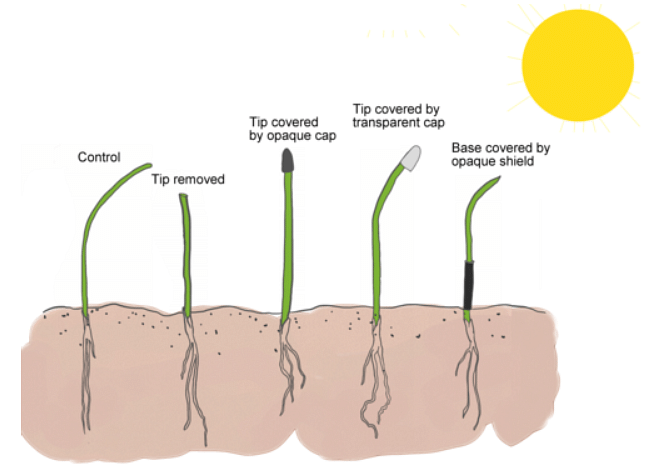
Charles Darwin Experiment
Charles covered the tip section of coleoptiles. This prevented them from getting sunlight. Thus no movement was observed in the plant. But when he covered the middle section of the same plants, the tips started responding to sunlight. The tip of these plants bent towards the light. The middle sections covered activated the protons. This led to a decrease in the pH. All of this led to acidification of the plant cell walls. Thus, an enzyme called expansin gets activated. This enzyme makes the cell wall less rigid so that plants can be flexible and respond to sunlight.
Read Also:
Boysen Jensen's Experiment
[Click Here for Sample Questions]
Boysen Jensen thought of taking Darwin's experiment a step further. He wanted to find out why these plants bend towards the light. He started his research in 1913 on the same coleoptiles as Darwin. This research followed the trial and error method to reach the conclusion.

Schematic of Jensen’s Experiment
Jensen cut up a part out of the tip of the coleoptiles. He filled this part with gelatin. He assumed that this will prevent the plants from bending. But he was wrong. He replaced gelatin with mica sheets. That led to the same results. Then he placed the mica sheet into an illuminated part of the plant. This gave opposite results. The plants did not bend. He concluded that a substance called Auxins is responsible for the curvature.
Read More: Receptors
Mechanism Of Phototropism
[Click Here for Sample Questions]
Phototropism follows a defined mechanism. It is as follows:
- A blue or violet light of wavelength 450 nm is shone on the plant.
- There are photoreceptors in the tips of plants that respond to this light. They change their shape in order to create a signaling pathway.
- The photoreceptors in plants that absorb blue light are known as phototropin.
- Auxins in the plant travel to darker regions where the light doesn't reach.
- There they release Hydrogen ions which decrease the pH of the neighbouring region.
- On a decrease in pH, enzyme expansin is activated which breaks down the cell wall.
- The cells then become more flexible and easily bend towards the source of light.
Read More: Respiration and Combustion
Examples Of Phototropism
[Click Here for Sample Questions]
All green plants taking part in photosynthesis show phototropism. The best example of phototropism is Helianthus annuus, commonly known as Sunflower. A Sunflower responds to the light. It moves its direction throughout the day to always face the sun. They direct themselves from east to west from sunrise to sunset. During the night time, they move from west to east to readily face the sun when it rises in the east in the morning.
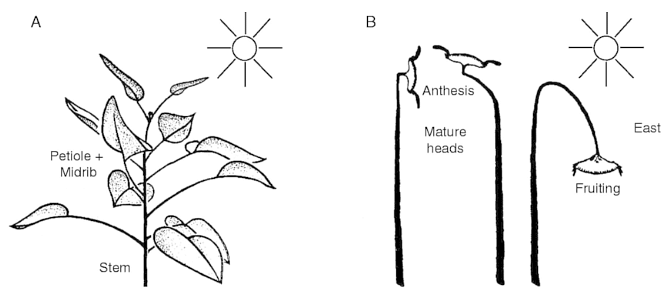
Sunflower Phototropism
Read More:
Things to Remember
[Click Here for Sample Questions]
- Phototropism is defined as the ability of plants to grow and move in the direction of sunlight.
- Charles Darwin discovered that plants move in the direction of light.
- Boysen Jensen found out that Auxins are responsible for phototropism.
- All plants showing phototropism follow the same mechanism.
- Sunflowers are the best example of plants showing phototropism.
Read More:
Sample Questions
Ques. Explain Charles Darwin's experiment for phototropism. [4 Marks]
Ans. Charles covered the tip section of coleoptiles. This prevented them from getting sunlight. Thus no movement was observed in the plant. But when he covered the middle section of the same plants, the tips started responding to sunlight. The tip of these plants bent towards the light. The middle sections covered activated the protons. This led to a decrease in the pH. All of this led to acidification of the plant cell walls. Thus, an enzyme called expansin gets activated. This enzyme makes the cell wall less rigid so that plants can be flexible and respond to sunlight.
Ques. Explain Boysen Jensen's experiment for phototropism. [4 Marks]
Ans. Jensen cut up a part out of the tip of the coleoptiles. He filled this part with gelatin. He assumed that this will prevent the plants from bending. But he was wrong. He replaced gelatin with mica sheets. That led to the same results. Then he placed the mica sheet into an illuminated part of the plant. This gave opposite results. The plants did not bend. He concluded that a substance called Auxins is responsible for the curvature.
Ques. What is phototropism? Explain in brief. [3 Marks]
Ans. Phototropism is defined as the ability of plants to grow and move in the direction of sunlight. Plants have an automatic response to light. The bend in the direction of the source of light. This phenomenon of bending to move towards the source of light is known as phototropism in plants.
Ques. Give the mechanism of phototropism. [5 Marks]
Ans. The mechanism of phototropism is quite simple. A blue or violet light of wavelength 450 nm is shone on the plants. There are photoreceptors in the tips of plants that respond to this light. The receptors change their shape on receiving the light in order to create a signaling pathway. The photoreceptors in plants that absorb blue light are known as phototropin. Auxins also play a role in phototropism. They travel to darker regions where the light doesn't reach. There they release Hydrogen ions which decrease the pH of the neighbouring regions. On the decrease in pH, enzyme expansin is activated which breaks down the cell wall. The cells then become more flexible and swollen. They now easily bend towards the source of light.
Ques. Give and explain an example of phototropism. [3 Marks]
Ans. An example of phototropism is Sunflower. Sunflowers follow the light of the sun. It changes its direction from east to west as the sun advances throughout the day. At night, it moves from west to east to face the early morning sun.
Ques. What is the role of Auxins? [3 Marks]
Ans. Auxins are plant hormones. They are present in the roots and stems of plants. They are responsible for phototropism in plants. They also participate in cell division. They promote the growth of roots and stems in plants.
Ques. Why does the Pilobolus Fungi use phototropism? [3 Marks]
Ans. Pilobolus Fungi is a fungus that shows phototropism. It grows in decaying matter and feeds on them. The spores of Pilobolus Fungi are directed towards the sunlight. Sunlight usually comes from open spots in the grass. That is generally away from the dung. This helps in the growth and the spores easily disperse.
Ques. Explain geotropism with examples. [3 Marks]
Ans. Geotropism is the phenomenon in which the growth of plants is influenced by the action of gravity. The gravitational force of the earth attracts the plants towards the center of the earth. The stem and tips of plants show negative geotropism. The roots of plants show positive geotropism. Geotropism is also known as gravitropism.
Read Also:



Comments