



Exams Prep Master
What is the fundamental building block of a wall? Just a brick. Our body, like a brick wall, is made up of basic building blocks, and the building blocks of our body are cells. As shown in the above image bricks in cooperation form a wall, in a multicellular organism, cooperative assemblies of similar cells form tissues, and collaboration between tissues forms organs, which perform the functions required to sustain an organism's life. Tissues are formed by the grouping of cells in animals and plants. The structure, function, and origin of these tissues vary. This topic will provide a basic review of tissue, as well as the differences and similarities between plant and animal tissue. We will also learn about their types.
| Table of Content |
Key Takeaways: Cell, Tissue, Plant Tissue, Animal Tissue, Meristematic Tissue, Permanent Tissue, Parenchyma.
Also Read: Reproductive Health
Definition of Tissue
[Click Here for Sample Questions]
A tissue is described as a group of cells that have a similar structure and work together to accomplish a certain purpose. They form a cellular organizational level in the cell and organ system hierarchy. Tissues are made up of specialized cells that carry out certain tasks. The functional groups of tissues are then combined in order to produce organs. Tissues in multicellular organisms offer structural and mechanical strength as well as allow labour division.
Also read: Anatomy of Flowering Plants
Plant Tissues
[Click Here for Sample Questions]
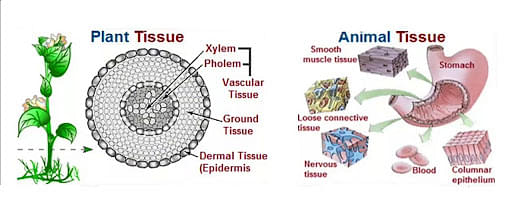
Plant tissue is a group of similar cells that work together to accomplish an organized function for the plant. These tissues give rise to organs including stems, roots, flowers, and leaves. Plant tissue systems are classified into two categories: meristematic tissue and permanent (or non-meristematic) tissue.

Meristematic Tissues
Plant growth happens exclusively in a few locations. This is due to the fact that dividing tissue, also known as meristematic tissue, is only found at these sites. Meristematic tissues are classified as apical, lateral, or intercalary depending on where they are found. These meristems expand the cell and lengthen and widen the stem, roots, and leaves.

Meristematic Tissue
- Apical meristems are found at the growth tips of stems and roots and help to lengthen the stem and root. When cell division begins, this meristem aids in cell expansion and has a significant impact on the structure of mature plants. They make the plant grow longer.
- The girth of the stem or root grows as a result of the lateral meristem. They are crucial in growing the diameter and width of the stems and roots. They boost the plant's thickness.
- The intercalary meristem in plants is found at the base of leaves or near the node. They primarily aid in the growth of leaves and stems. The cells in this tissue are very active. They have thick cytoplasm, a distinct nucleus, and thin cellulose walls.
Also read: Plant Tissues
Permanent Tissues
Meristematic tissue cells take on a specific role and lose their ability to divide. As a result, they form a permanent tissue. This is referred to as differentiation. Differentiation results in the formation of simple and complex permanent tissues.
Permanent Simple Plant Tissues
These tissues are simple. They are only made up of one sort of cell. In this case, all of the cells that comprise the tissue are comparable and have the same structure, as well as the same type of parts. Simple plant tissue is further classified into the parenchyma, collenchyma, and sclerenchyma.

Type of Permanent Simple Plant Tissues
Permanent Complex Plant Tissues
The complex permanent tissues are made up of multiple cell types. They collaborate to carry out the same specialized functions in the plant body. They are divided into two kinds: xylem and phloem.

Xylem Phloem
Also read: Plant Growth
Animal Tissues
[Click Here for Sample Questions]
Various animal tissues are responsible for carrying out specific functions for the organism. One of the causes for the enormous diversity of animals is tissue differentiation and specialization. Animals, for example, have a unique ability to sense and respond to changes in their environment as a result of nerve and muscle tissue evolution. This allows animals to thrive in environments where they must compete for food resources with other species. The body of an animal is made up of four different types of tissues, Epithelial Tissue, Muscle Tissue, Connective Tissue and Nervous Tissue.
Also read: Animal Tissues
Epithelial Tissues
Epithelial tissues are a single layer or multiple layers of cells that line the lumens of organs and cover the exteriors of organs and structures in the body. The number of cell layers and cell morphologies observed in epithelia are used to classify the various types of epithelia. Simple epithelia is epithelial tissue composed of a single layer of cells, whereas stratified epithelia is epithelial tissue composed of many layers. Epithelial tissues line all internal and external organs in the animal body.
Muscle Tissue
Muscle tissue type gives rise to three types of muscles: skeletal i.e. striated or voluntary muscle, smooth i.e. non-striated or involuntary muscle, and cardiac or heart muscle. They aid movement by contracting and relaxing muscles.
Connective Tissue
Connective tissue connects the body's many tissues, organs, and parts. Areolar tissue, adipose tissue (fat), blood, lymph, bone, and cartilage are all examples of connective tissues. They link and support organs, as well as transmit substances from one organ to another.
Nervous Tissue
Nervous tissues are made up of nerve cells, which are specialized cells (neurons). Electrochemical impulses are conducted and sent between neurons by them.
Also read: Squamous and Glandular Epithelium
Plant Tissue Vs Animal Tissue
[Click Here for Sample Questions]
The distinctions between plant and animal tissues are discussed further below.
| Plant Tissue | Animal Tissue |
|---|---|
| Plant tissues are composed of eukaryotic cells with a nucleus and specialised structures called organelles that perform specific functions. | Animal Tissues are composed of eukaryotic cells that do not have a cell wall and have a true membrane-bound nucleus as well as other cellular organelles. |
| Tissue arrangement is simple and designed for plants' fixed habits. | Tissue organisation is complicated and geared toward animal mobility. |
| There is a lot of dead and supporting tissue in plants. | In animals, living tissues outnumber dead tissues. |
| Plant tissues require extremely little energy to maintain themselves. | Animal tissues demand more energy than plant tissue. |
| Plants have two types of tissues, permanent tissues and meristematic tissues. | Animal tissues, on the other hand, are classified into four types, epithelial tissue, muscular tissue, connective tissue, and nerve tissue. |
| Meristematic tissues are necessary for plant growth. This tissue aids in the growth of a plant. | Animals lack such growth tissues but do have reparative growth. |
| In plants, permanent tissues and meristematic tissue are observed in distinct ways. | However, there is no difference between the tissues. |
Facts about Cell and Tissue
[Click Here for Sample Questions]
- The Kingdom Animalia accounts for three-quarters of all species on the planet.
- The human body is made up of 1014 cells that range in size from 10 to 30 µm in diameter.
- Plant cells are the only cells known to be capable of producing their own food.
- The cell was first discovered by English Scientist Robert Hooke in 1665.
- Every day, millions of cells are produced in the body of an animal, while more than 100 to 150 million cells die in the human body every second to a minute.
- There are over 600 muscles in our body, with the gluteus maximus being the largest.
Also read:
Things to Remember
- A tissue is described as a group of cells that have a similar structure and work together to accomplish a certain purpose.
- Plant Tissues are classified into meristematic tissue and permanent tissue.
- Meristematic tissues are classified as apical, lateral, or intercalary.
- The xylem transports water and dissolved minerals from the roots to the leaves of the plant.
- The phloem transports nutrients from the leaves to the roots.
- The body of an animal is made up of four different types of tissues, Epithelial Tissue, Muscle Tissue, Connective Tissue and Nerve Tissue.
- Plant tissues require extremely little energy to maintain themselves.
- Animal tissues demand more energy than plant tissue.
Also read: Difference Between Mitochondria and Plastids
Sample Questions
Ques: Define the term ‘Tissue’? (2 marks)
Ans: A tissue is described as a group of cells that have a similar structure and work together to accomplish a certain purpose. They form a cellular organizational level in the cell and organ system hierarchy. Tissues are made up of specialized cells that carry out certain tasks. The functional groups of tissues are then combined in order to produce organs.
Ques: What is a Plant Tissue? (2 marks)
Ans: A plant tissue is a group of cells within the plant body that is specialized to perform a specific function. A cellulose cell wall, as well as several vacuoles, are found in plant cells. They also have photosynthetic pigments that look like chlorophyll and produce simple sugars inside the cells. Because a plant is an immobile organism, the majority of its cells are involved in providing structural support. The organization of the cells in plant tissues can be divided into two types: meristematic tissue and permanent tissue.
Ques: What is an Animal Tissue? (2 marks)
Ans: A group of similar cells specialized to perform a specific function in the animal body is referred to as animal tissue. Cell walls and vacuoles are absent in animal cells. They lack photosynthetic pigments as well. As a result, animal tissues are unable to produce food within their cells. For animal cells to perform their functions, nutrients must be transported to them. Epithelial tissue, muscle tissue, nerve tissue, and connective tissue are the four types of animal tissues.
Ques: What are the similarities and differences between plant and animal tissues? (3 marks)
Ans: There are several parallels between plant and animal tissues. They may appear distinct physiologically, but they provide comparable roles. Some of the commonalities between plant and animal tissues are mentioned below.
Many animals rely on bone tissue for support. Some specialized stem tissues in plants serve the same purpose.
Arteries and veins made of connective tissues convey nutrition, gases, and waste throughout the animal body. Xylem and phloem do the same thing in vascular plants.
Animal respiratory tissue exchanges gases and leaf tissues do the same. They are responsible for the exchange of carbon dioxide and oxygen.
Plants do not require movement, so these tissues require less energy and maintenance. While animal tissues require more energy and maintenance due to their extensive body mobility.
Ques: What are Meristematic Tissues and how are they classified? (2 marks)
Ans: Plant growth happens exclusively in a few locations. This is due to the fact that dividing tissue, also known as meristematic tissue, is only found at these sites. Meristematic tissues are classified as apical, lateral, or intercalary depending on where they are found. These meristems expand the cell and lengthen and widen the stem, roots, and leaves.
Ques: What are the functions of the xylem? (2 marks)
Ans: Xylem is a type of vascular tissue found in plants that transport water and dissolved minerals from the roots to the rest of the plant while also providing physical support.
Ques: Why is the xylem called "dead tissue"? (2 marks)
Ans: Other than xylem parenchyma, xylem is characterized as dead tissue or non-living tissue since all of its components are dead. The xylem tissues lack cell organelles, which are involved in storing and moving more water with the plant cells.
Ques: What are the functions of phloem? (2 marks)
Ans: The main function of phloem tissue is to transport carbohydrates from sources to sinks via sieve elements. Phloem also contains parenchyma cells, which are important for water storage.
Ques: What are the different types of Animal tissues? (2 marks)
Ans: The body of an animal is made up of four different types of tissues, Epithelial Tissue, Muscle Tissue, Connective Tissue and Nervous Tissue.
Ques: Define Epithelial tissues and describe their types? (2 marks)
Ans: Epithelial tissues are a single layer or multiple layers of cells that line the lumens of organs and cover the exteriors of organs and structures in the body. The number of cell layers and cell morphologies observed in epithelia are used to classify the various types of epithelia. Different types of Epithelial tissues are Squamous, Cuboidal, Columnar, Ciliated and Glandular.
Ques: Name the tissue responsible for movement in our body? (2 marks)
Ans: Elongated cells, also known as muscle fibers, make up muscular tissue. Our body's movement is controlled by Muscular Tissue.
Science Related Links:



Comments