



Education Journalist | Study Abroad Lead
Probability is a mathematical concept of expressing the possibility of certain events. Generally, probability is a term that is also related to our daily lives, there are multiple events of which we are not so sure. Making a guess based on acknowledgeable conditions is what is known as probability. Mathematically, we make such guesses using certain formulas and principles which ultimately results in more ‘accurate probability’. Mathematically, probability shall be expressed between 0 to 1, where 0 means almost no probability and 1 indicates some extent of the possibility of an event. Here we will discuss the types, formulas and other important details of probability.
Key Terms: Probability, Trials, Space, Occurrence, Possible Outcomes, Probability Formula, Heads, Tails, Dice, Possibility, Event, Impossible Events, Prediction, Weather Forecasting, Insurance
What is Probability?
[Click Here for Sample Questions]
The term probability defines the chance/s or the possibility of the occurrence of any particular event. In general, probability can be used interchangeably with predictions, for instance, there is less probability of rain tonight due to the clear sky. This sentence represents the quantified chances of rain which if expressed mathematically shall contain some digits based on approximate data. Therefore, probability is meant to measure the likelihood of the occurrence of certain events, although, not strikingly absolute, but always in adequate estimates. Mathematically, probability shall be expressed between 0 to 1, where 0 means almost no probability and 1 indicates some extent of the possibility of an event.

Probability
Also Read: Types of Events in Probability
Discovery of Probability
The thought process over some concepts like probability began with the curiosity of a gambler named Chevalier de Mere who wanted to know about the chances of a number appearing on a roll of a dice. This curiosity made him share the thought with the mathematician Blaise Pascal, who then began working on the understanding of the same. Following all this, a book named, ‘A Book on the Game of Chance’ written by J. Cardan, gained a lot of attention from mathematicians worldwide. The book dealt with some of the basic conceptions and principles of probability. Later, mathematicians like A.N. Kolmogorov and A.A Markov came up with further rudimentary theories which led to the development of probability as a wholesome domain within mathematics.
Formula of Probability
[Click Here for Sample Questions]
The probability of occurrence or non – occurrence of certain events can be determined by applying the below–mentioned formula.
As per the basis of the experimental formula, the probability is:
P (E) = Number of trials in which the event has happened/ Total number of trials
On the basis of the theoretical formula, the probability is:
P(E) = Number of outcomes that are favourable to E / Total Number of all possible outcomes of the experiment
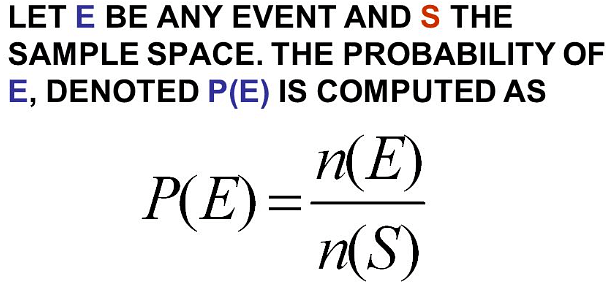
Formula for Probability
Types of Probability
[Click Here for Sample Questions]
Probability could be understood into three types.
- Theoretical Probability: In this, the possibility of an event can be determined by analysing the statistical data of the given event and understanding the possibility of occurrence of the event. For instance, in order to calculate the theoretical probability of number 4 on rolling a die, firstly determine the total number of possible outcomes, that is in this case of the die is six. Therefore, the total possibility of getting 4 is one out of six.
- Experimental Probability: In this case, the calculation is based on the number of trials. When the number of all possible outcomes of an event is divided by the total number of trials it gives experimental probability. For instance, a coin is tossed almost 20 times, out of which, we got 12 tails, then according to this experimental probability, the possibility of getting heads shall be 12 out of 20.
- Axiomatic Probability: It works on the basis of a certain set of rules as defined by mathematician Kolmogorov. It is also known as a theory of unifying probability.
The three axioms are as follows,
- The probability of any event A always tends to be greater than or equal to zero, however, it can never be less than zero.
- If S is considered as a sample space, then the probability of occurrence of sample space is always 1. Hence, it is stated that the occurrence of one of the sample spaces is inevitable if an experiment is performed.
- For the case of the mutually exclusive events, the probability of either of the events happening is the sum of the probability of both the events happening.
Also Read: Geometric Probability
Properties of Probability
[Click Here for Sample Questions]
Some of the important properties related to the concept of Probability are as follows:
- Mathematically, the probability of an event E is defined as P(E) = [Number of favourable outcomes of E] / [ total number of possible outcomes of E].
- The probability of a sure event or certain event is considered to be 1.
- The probability of an impossible event is considered to be 0.
- The probability of an event E can be defined as a number P(E) such that 0 ≤ P (E) ≤ 1. Probability is always considered a positive number.
- Suppose A and B are 2 events and both are mutually exclusive, then P(AUB) = P(A) + P(B).
- Any event that has only one outcome is known as an elementary event. The sum of the probabilities of such events of an experiment is said to be 1.
- The sum of probabilities of an event with its complimentary event is 1. P(A) + P(A’) = 1.
- P(AUB) = P(A) + P(B) – P(AUB)
- P(AUB) = P(A) + P(B) – P(AUB)
- If A1, A2, A3,………, An are mutually exclusive events, then P(A1 U A2 U A3… UAn) = P(A1) + P(A2) + ………. + P(An)

Mutually Exclusive Event VS Independent Event
Also Read: Difference Between Mutually Exclusive and Independent Events
Terms Related to Probability
[Click Here for Sample Questions]
- Randomness: When the outcome of an experiment is unknown, it is known as a random experiment.
- Event: While calculating the probability, we consider the events that are taken into account. For instance, the number of times 4 has occurred if a die is rolled twice, here the rolling of die is an event followed by the occurrence of 4.
- Trial: It is an action that has more than one result. For instance, more than one outcome occurs when we throw a dice.
- Impossible Event: When the probability of occurrence of an event is zero, that event is termed as an impossible event. For instance, getting 8 on a die is an impossible event.
- Elementary Event: When the possibility of occurrence of an event is only one, it is called an elementary event.
- Sample Space: It is defined as the set consisting of all possible outcomes of a random experiment.
Favourable and Unfavourable Events
- When a trial is done for an expected outcome, that is, when the outcome of an experiment is known and there are chances when the expected outcome is achieved, it is termed as a favourable event.
- When a trial is done for an expected outcome, that is, when the outcome of an experiment is known but there are chances when the expected outcome is not achieved, it is termed as an unfavourable event.
- These favourable and unfavourable event outcomes are directly or indirectly related to the well-defined set of outcomes.
- For instance, consider that an event of sample space S has n favourable outcomes. Then, in this case, there are S - n, unfavourable outcomes.
- The number of trials performed also deeply influence the probability of favourable and unfavourable events. Although, it is found that the sum of both these probabilities is always equal to one.
Check More:
Solved Examples
[Click Here for Sample Questions]
| Example 1: Suppose a bag contains three sets of balls, that is, a blue ball and a red ball and a yellow ball of the same size and weight. If Mahi picks out a ball from the bag randomly, then what shall be the probability of getting an (i) blue ball (ii) yellow ball and (iii) red ball. Solution: Since the total number of balls inside the bag is 3 out of which one ball is red, one ball is blue and yellow. If Mahi takes out a ball from the bag randomly then
Example 2: Calculate the probability of getting a tail if a person tosses a coin once? Solution: As the coin is tossed once, the total number of possible outcomes is 2 that is Head and Tail. The event of getting a tail is taken as E. Probability of getting a tail on tossing a coin will be: P(E) = Number of favourable outcomes to E /Number of all possible outcomes of the experiment = 1/2 Example 3: Calculate the probability of getting a 2 if a die is thrown once? Solution: As the die is thrown once, the total number of possible outcomes is 6 that is 1, 2, 3, 4, 5 and 6. Let the event of getting a 2 be E. The probability of getting a 2 on throwing a die will be P(E) = Number of favourable outcomes to E /Number of all possible outcomes of the experiment = 1 / 6 |
Uses of Probability
[Click Here for Sample Questions]
- Weather Forecasting: The meteorological departments worldwide somewhat rely on this concept of probability. The prediction of weather, such as 60% of rainfall is predicted or 30% chances of lightning and thunder are seen, all work on the phenomenon of probability.
- Agriculture: The sowing of seeds, tilling of soil and other associated agricultural works are done keeping the weather in view. The variations in temperature and the erratic weather phenomenon adversely impact agriculture, therefore, the probability of accepted weather phenomenon is something on which the farmers rely upon for cultivation and harvesting.
- Exit Polls: Every time before the actual elections, several news channels and intellectuals engage in this task of predicting the results, their foresightedness based on multiple conditions tries to determine the names of the parties winning the election, this is also a very good example of how probability is applicable in real life.
- Insurance: The probability of future changes in a person’s life is determined by the insurance companies for selling their product. At the same time, it helps the customers in selecting the best products for themselves.
Read more:
| Conditional Probability | Empirical Probability |
| Independent Events in Probability | Probability Distribution |
Things to Remember
- Probability is something that is meant to deal with the random chances of events.
- In general, probability aims at measuring how likely something is to happen.
- It can be defined as the ratio of the number of favourable outcomes and the total number of outcomes.
- Probability is always taken as a number between 0 and 1. Here, 0 denotes the least likelihood of occurrence of an event whereas, 1 denotes the maximum possibility of occurrence of an event.
- The number of odds in an event is probably a way of determining any set of probabilities as relatively useful.
- The concept of Probability is useful in various daily life masters, for instance, it is used in weather forecasting, agriculture, exit polls, insurance, etc.
Sample Questions
Ques. What will be the probability of getting an even number when a die is tossed? (3 Marks)
Ans. S will be 1, 2, 3, 4, 5, 6
Favourable events = {2, 4, 6}
Number of favourable events = 3
Total number of outcomes = 6
Hence probability, P = 3/6 = ½
Ques. Calculate the following, if a coin is tossed 210 times out of which 70 times, we get heads and 130 times we get tails. (5 Marks)
a) Calculate the probability of getting heads.
b) Calculate the probability of getting a tail.
c) Calculate if the sum of the two probabilities is equivalent to 1 or not.
Ans. Let the probability of getting heads on the coin be P (H)
Therefore,
P (H) = number of trials in which the head comes / total number of trials
= 70 / 210 = 0. 33
Let the probability of getting heads on the coin be P (T)
Therefore,
P (T) = number of trials in with tails / total number of trials
= 130 / 210 = 0. 61
Total sum of the two probabilities will be = P(H) + P(T)
= 70 / 210 + 130 / 210 = 210 / 210 = 1
Ques. Find the probability of getting a 6 if a die is thrown once? (3 Marks)
Ans. As the die is thrown once, the total number of possible outcomes is 6 that is 1, 2, 3, 4, 5 and 6.
Let the event of getting a 6 be E.
The probability of getting a 6 on throwing a die will be:
P(E) = Number of favourable outcomes to E /Number of all possible outcomes of the experiment = 6 / 6 = 1
Ques. What will be the probability of getting the odd number when a die is tossed? (3 Marks)
Ans. S will be 1, 2, 3, 4, 5, 6
Favourable events = {1, 3, 5}
Number of favourable events = 3
Total number of outcomes = 6
Hence probability, P = 3/6 = ½
Ques. Suppose a seller has three sets of rings, that is, a gold ring and a silver ring and a platinum ring of the same size and weight. If he sells out a ring randomly, then what shall be the probability of selling an (a) gold ring (b) silver ring (c) platinum ring (3 Marks)
Ans. Since the total number of rings with the seller is 3 out of which one ring is of gold, one ring is of silver and platinum. If the seller sold out a ring randomly then
(i) The probability of getting a gold ring = 1 / 3
(ii) The probability of getting a silver ring = 1 / 3
(iii) The probability of getting a platinum ring = 1 / 3
Ques. A box contains a total of 200 watches out of which 190 are good ones, 7 have minor defects and 3 watches have major defects. There is a merchant Priya, she shall accept only the good watches, but another merchant Seema shall only reject the watches with the major defects. One watch has been drawn at random from the given carton. Find the probability that the watch is acceptable to Priya? Calculate the probability that it is acceptable to Seema? (3 Marks)
Ans. A watch is drawn at random from 200 watches.
So, the total outcomes shall be 200
No. of outcomes acceptable to Priya = 190 / 200 = 0. 95
No. of outcomes acceptable to Seema = (190 +7) / 200 = 197 / 200 = 0. 985
Ques. Find the probability of getting a 6 if a die is thrown twice? (3 Marks)
Ans. As the die is thrown once, the total number of possible outcomes is 6 X 2 = 12, i.e, 2 (1, 2, 3, 4, 5 and 6)
Let the event of getting a 6 be E.
The probability of getting a 6 on throwing a dice twice is:
P(E) = Number of favourable outcomes to E /Number of all possible outcomes of the experiment = 6 / 12 = 1 / 6
Ques. Calculate the following, if a coin is tossed 100 times out of which 30 times, we get heads and 60 times we get tails. (3 Marks)
a) Calculate the probability of getting heads.
b) Calculate the probability of getting a tail.
Ans. Let the probability of getting heads on the coin be P (H)
Therefore,
P (H) = number of trials with heads / total number of trials
= 30 / 100 = 0. 3
Let the probability of getting tails on the coin be P (T)
Therefore,
P (T) = number of trials when with tails / total number of trials
= 60 / 100 = 0. 6
For Latest Updates on Upcoming Board Exams, Click Here: https://t.me/class_10_12_board_updates
Check More:



Comments