



Content Curator
Integers have a few characteristics that affect how they are applied and equations can be solved using these principles and properties. Any positive or negative number, including 0, is an integer. The properties of these integers will assist in efficiently simplifying and answering a series of integer operations. All of the integers share the same properties and identities as the addition, subtraction, multiplication, and division of numbers. Positive numbers, zero, and negative numbers are all referred to as integers, and they are represented by the symbol Z.
Read Also: Math Formulas
| Table of Content |
Key takeaways: Properties of Integers, Addition, integers, subtraction, multiplication
What are Integers?
[Click Here for Sample Questions]
Any number that comes in the set or category of whole numbers, natural numbers, or negative numbers, are known as integers. We can also say that whole numbers, natural numbers, and negative numbers are all integers.
Integers can be represented as:
(…………..-5,-4,-3,-2,-1,0,1,2,3,4,5,……………….)
Properties of Integers
[Click Here for Sample Questions]
Five properties are possessed by the integers. They include:
- Closure Property
- Associative Property
- Commutative Property
- Distributive Property
- Identity Property
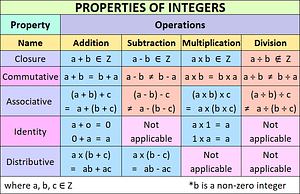
Closure Property
The closure property in the integers defines that in performing any operation be it addition, subtraction or multiplication if m and n are two integers then the result that is generated will also be an integer. That is, m+n, m-n, and mn all three would be an integer.
Example of closure property in addition:
(-3)+5=2
Example of closure property in subtraction:
1-2=1+(-2)=-1
Example of closure property in multiplication:
3×4=12
-3×4=-12
However, in the division, the closure property is not applicable as the result generated is not an integer.
Example to show that closure property does not work in case of division:
(-2)÷(-4)=12 which is not an integer.
Associative Property
Associative property of integers in case of addition and multiplication states that if there are any three integers and we form the group of any two integers, the result will be the same, irrespective of the selection of integers that is made for the grouping. For an instance, if p,q, and r are two integers,
- p+(q+r)=(p+q)+r
- p× (q×r)=(p×q) ×r
Example of associative property in addition:
2+(5+8)=(2+5)+8
2+(13)=(7)+8
15=15
Example of associative property in multiplication:
9×(2×4)=(9×2) ×4
9×(8)=(18) ×4
72=72
However, it is not true for the two operations that are division and subtraction as
- p-(q-r) ≠ (p-q)-r
- p÷ (q÷r) ≠ (p÷q) ÷r
To demonstrate why the associative property does not work in the case of subtraction, consider the following example:
2-(4-8) and (2-4)-8
2-(-4) and (-2)-8
6 and -10 which is not the same
Example to show that associative property does not work in case of division:
2÷(4÷8) and (2÷4) ÷8
2÷(1/2) and (1/2) ÷8
4 and 1/16 which is not the same
Commutative Property
The commutative property of the integers in case of addition and multiplication defines that whatever be the order of integers in the operation, the result obtained will be the same, that is it will remain unchanged. Swapping of any integer in the operation will not impact the result. For example, m and n are the two integers, then:
- m+n = n+m
- m×n = n×m
Example of commutative property in addition:
3+(-6)=(-6)+3=-3
Example of commutative property in multiplication:
8×3=3×8=24
However, it is not applicable in the case of division and subtraction as
- m-n ≠ n-m
- m/n ≠ n/m
Example to show that commutative property does not work in case of subtraction:
7-4 and 4-7
3 ≠ -3
Example to show that commutative property does not work in case of division:
10÷2 and 2÷10
5≠1/5
Check Important Differences Between in Maths
Distributive Property
According to the distributive property of integers, the operation can be performed over other operations within a bracket. It can be applied in both the distributive property of multiplication over addition and the distributive property of multiplication over subtraction. The operations can be first multiplied followed by the addition or subtraction or can be first added or subtracted followed by the multiplication. If p,q,r can be represented as integers:
- p×(q+r)=p×q+q+r
- p×(q-r)=p×q-p×r
Example to depict distributive property:
6×(1+9)= 6×1+6×9=6+54=60
7×(3-2)=7×3-7×2=21-14=7
Identity Property
According to the identity property, the additive identity property is when in addition zero is added to an integer, it yields the same integer. Therefore, additive identity also refers to zero. If m is an integer:
- m+0=0+m
Ex: 3+0=3+0=3
In the case of multiplication, if any integer is multiplied by 1, it yields the same integer. It is termed multiplicative identity. Therefore, multiplicative identity also refers to one. If m is an integer:
- m×1=1×m
Ex: 5×1=1×5=5
When zero is multiplied with any integer, it gives the product of 0.
- m×0=0×m
Ex: 8×0=0×8=0
When -1 is multiplied with any integer, it gives the result as an opposite integer.
- m×(-1)=-m=(-1) ×m
Ex: 9×(-1)=-9=(-1) ×9
Things to Remember
[Click Here for Sample Questions]
- Integers are the numbers that come in the set of whole numbers, integers, or natural numbers.
- For closure property, the addition or subtraction of any two integers is always an integer.
- In commutative property, the order of the terms in an operation does not change the result.
- An associative property, the grouping of numbers does not yield a different result irrespective of the choices of the numbers.
- In distributive property, the operations can be performed over the other operations in a particular bracket.
Sample Questions
Ques. State the properties of integers. [3 marks]
Ans. There are in total five properties that are followed by the integers. These include:
- Closure Property- It is of the form x + y = y + x.
- Associative Property- It is of the form x+ ( y + z ) = ( x + y ) + z.
- Commutative Property- It is of the form x+0=x=0+x.
- Distributive Property- It is of the form x + y ∈ Z.
- Identity Property- It is of the form x × ( y+ z )=x y + x × z.
Ques. Prove that the integers -23 + -17 follow the commutative property of integers. [3 marks]
Ans. The commutative property states that the result remains the same irrespective of the order in which the terms of the numbers or integers are arranged during an operation. If p and q are two integers then p+q=q+p.
For the integers -23 and -17:
In case of addition
Order1= -3-7=(-3)+(-7)=-10
Order2=-7-3=(-7)+(-3)=-10
The result for both the orders are the same. Thus, the integers follow the commutative property.
Ques. Solve the equation 5+8+4 using the associative property? [3 marks]
Ans. The associative property, the grouping of the integers does not affect the result.
If p,q, and r are the integers then (p+q)+r=p+(q+r).
5+(8+4)=(5+8)+4
5+(12)=(13)+4
17=17
As a result, both the LHS and RHS are the same, therefore the equation satisfies the associative property.
Ques. What would be the equation for the operation 5×7=? [3 marks]
Ans. According to the commutative property in the case of multiplication, the order of the numbers is changed but the order does not have any effect on the result obtained. Concerning this, we can say that for the given equation:
5×7= 7×5
The result of both 5×7 and 7×5 is 35. This depicts the commutative property of multiplication
Ques. Show that (-8), (2), and (-4) are associative under addition. [3 marks]
Ans. Let a = - 8; b = 2, and c = -4
According to the associative property for addition:
a + ( b + c) = ( a+ b ) + c
L.H.S. = -8 + ( 2 + -4)
= – 8 + (-2)
= -10
R.H.S. = (- 8 + 2) + (-4)
= (- 6) + (-4)
= - 10
Therefore, LHS=RHS.
Hence,(-8), (2), and (-4) are associative under addition.
Ques. What would be the equation for the operation 5×7=? [3 marks]
Ans. According to the commutative property in the case of multiplication, the order of the numbers is changed but the order does not have any effect on the result obtained. Concerning this, we can say that for the given equation:
5×7= 7×5
The result of both 5×7 and 7×5 is 35. This depicts the commutative property of multiplication.
Ques. Show the distributive property for the following equations. [3 marks]
a) 5× (4+3)=?
b)4×(6-3)=?
Ans. The distributive property is only applicable in the cases of addition and subtraction. In the distributive property, the operations are performed on the different operations that are given in the particular bracket.
For the given equations
- 5× (4+3)=5×4+5×3=20+15=35 [a×(b+c)=a×b+a+c]
- 4×(6-3)=4×6-4×3=24-12=12 [a×(b-c)=a×b-a×c]
Ques. Explain the distributive property with an example. [3 marks]
Ans. The distributive property is only applicable in the cases of addition and subtraction. In the distributive property, the operations are performed on the different operations that are given in the particular bracket. For an instance, if a, b, c are three integers, then:
- a×(b+c)=a×b+a+c
- a×(b-c)=a×b-a×c
In the integer form, the example to show distributive property can be:
- 5× (4+3)=5×4+5×3=20+15=35
- 4×(6-3)=4×6-4×3=24-12=12



Comments