



Education Journalist | Study Abroad Lead
A pyramid is a three-dimensional structure with a polygonal basis. You've certainly heard of The Great Pyramid of Giza, constructed along similar lines. Every corner of this structure is connected to a single apex, giving it the illusion of a one-of-a-kind shape. In geometry, a pyramid is known as a polyhedron. It comprises a base and three or more triangular faces that meet above the base (the apex). A pyramid's base, edge, and peak create a triangle known as a lateral face. A pyramid is defined as a self-dual conic solid with a polygonal base. A pyramid has n + 1 vertices, n + 1 faces, and 2n edges, as well as an n-sided base. The apex of a right pyramid is immediately above the centroid of its base. Oblique pyramids are not on the right side of the pyramid.
Key Terms: Pyramid, triangular pyramid, Pythagoras theorem, edges, surface area of a pyramid, volume of a pyramid
Pyramid
[Click Here for Sample Questions]
A pyramid is a three-dimensional polyhedron with a polygonal base and three or more triangle-shaped faces that intersect at the top. The triangle sides are referred to as faces, while the point above the base is the apex. A pyramid is built by linking the base and peak. To distinguish them from the base, the triangular sides are typically referred to as lateral faces. The triangular face is formed by connecting each edge of the pyramid's base to the summit.
Properties of a Pyramid
[Click Here for Sample Questions]
Some of the qualities of a pyramid that may assist you in identifying it are as follows:
- The opposite vertex from the base that gives the pyramid its form is the apex.
- A pyramid comprises three major components: the apex, the face, and the base.
- The triangles are congruent and isosceles if the base is a regular polygon.
- The most common polygon foundation form is square.
- The vertex is the point or corner at which three or more edges meet, whereas edges are the line segments formed by two intersecting faces.
- Except for the base, the faces of the pyramid are referred to as lateral faces.
Types of Pyramids
[Click Here for Sample Questions]
The shape of the base of a pyramid determines its classification. Let's have a look at the many forms of pyramids:
Square Pyramid
When the pyramid's base is square, a square pyramid is formed. A square pyramid has one square foundation and three triangle faces. In other words, it contains eight edges, five vertices, and four faces. Take a look at the square pyramid displayed below to understand its shape.
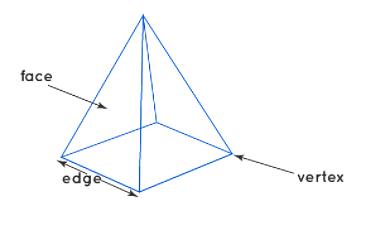
Square pyramid
Triangular Pyramid
If the base of a pyramid is formed like a triangle, it is triangular. A triangular pyramid has four faces, six edges, and four vertices. A tetrahedron is another name for this sort of pyramid.
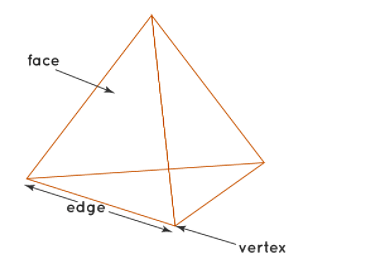
Triangular pyramid
Pentagonal Pyramid
A pentagonal pyramid has a base fashioned like a pentagon, while the other faces are triangles. This pyramid comprises six faces, six vertices, and ten edges.
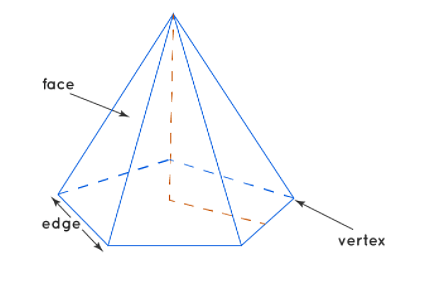
Pentagonal Pyramid
Right Pyramid vs Oblique Pyramid
The position of the apex or top of a pyramid defines whether it is a right pyramid or an oblique pyramid. A right pyramid is one in which the pyramid's pinnacle is directly above the centre of the pyramid's base. The summit of a pyramid is an oblique pyramid when it is not squarely above the centre but is somewhat away. In other words, a right pyramid is produced when a perpendicular line from the top intersects the base's centre. An oblique pyramid does not intersect the base's centre.

Right Pyramid vs Oblique Pyramid
Regular vs Irregular Pyramid
A regular pyramid has a regular polygon as its foundation. If the base is an irregular polygon with sides that are not equal, the pyramid is irregular.

Regular vs Irregular Pyramid
Surface Area of a Pyramid
[Click Here for Sample Questions]
The surface area of a pyramid is defined as the number of square units required to cover the whole surface of the pyramid. The total surface area may also be defined as the sum of the areas occupied by each of its surfaces.
Because all of the surfaces are identical, calculating the surface area of the proper pyramid is straightforward. Consequently, we only need to compute the area of one of the surfaces. By adding the base area, we can determine the total surface area.
Total Surface Area
Pyramid math may be used to compute the total surface area of a Pyramid as follows:
4bh2 + b2 = area
In this situation, b is the length of the base's side, and h is the height of the slant.
The following equation can be simplified as well:
area = b2 + 2bh
- The surface area of a regular polygon is simple to calculate. Still, the area of an irregular pyramid is more complex to compute because the triangular faces of an irregular pyramid vary in form and size. The following are several ways of determining the area of an irregular pyramid.
- Triangles may be formed from pyramids. The surface areas of these triangles may be calculated individually and added.
- A pyramid can also be represented as a regular hexagon with one triangular component removed. If we know how to calculate the surface area of the missing triangle, we can find the area of a regular hexagon and subtract the area of the missing triangle from it.
- A pyramid may be broken down into two parallelograms. Thus, the total surface area may be calculated by adding the areas of two parallelograms.
- If the coordinates and vertices of the pyramid are known, we may calculate the area manually or with a computer programme.
Volume of a Pyramid
[Click Here for Sample Questions]
The volume of a pyramid may be defined as the number of cubic units that can fill a pyramid.
A pyramid's volume may be computed as one-third of its base area multiplied by its perpendicular height. The formula for calculating the volume of the pyramid is as follows:
volume = (1/3) x b x h
Here,
b = area of the base of the pyramid
h = height (the vertical distance between apex and base of a pyramid).
Net of a Pyramid
[Click Here for Sample Questions]
When different pyramids are flattened and opened up, the net of a pyramid is seen. The net of a square pyramid, for example, is made up of a square base and four triangular sides or faces. A triangular pyramid's net has five faces: one square base and four triangular lateral faces.
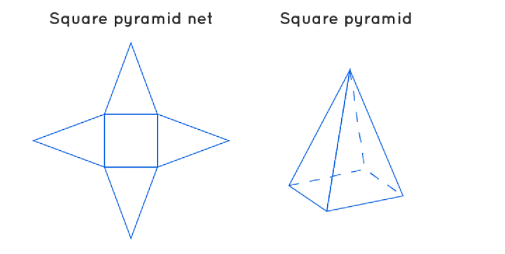
Net of a Pyramid
Applications of pyramids
[Click Here for Sample Questions]
The applications of pyramids are:
- The Great Giza Pyramid in Egypt was built. The burial chamber of Pharaoh is located deep beneath the Pyramids.
- Traffic officers are increasingly using Pyramid construction cones to reduce the number of accidents on the road.
- Pyramids are used to accelerate the healing process.
- Egypt's largest pyramid can store electric and magnetic energy within its chambers, allowing it to generate higher quantities of energy.
- Pyramids help to reduce stress and tension in the physical body.
- A pyramid can help to restore energy flow in the human body.
- Pyramids offer high-energy spaces that are suitable for meditation.
- A Pyramid strengthens the power of purpose while also harmonising the environment.
Things to remember
- A pyramid is a three-dimensional geometric shape with a polygonal base and triangular lateral surfaces that meet at a common vertex.
- Although the four-sided pyramid with base is the most common variant, a pyramid must have at least three outside triangular surfaces plus the base.
- The Surface Area is split into two parts: the base area (the Base Area) and the area of the side faces (the Area of the Side Faces) (the Lateral Area).
- When the side faces of a pyramid differ (as in an "irregular" pyramid), we must sum the area of each triangle to calculate the overall lateral area.
- The Triangular Pyramid is a Tetrahedron with four faces, three of which are triangles. The base of a triangular pyramid is also a triangle, having four vertices (corner points) and six edges.
- The Square Pyramid has five triangle-shaped faces and a square base. It consists of five vertices (corner points). It has eight corners.
Sample Questions
Ques. What exactly is an Oblique Pyramid? What is the formula for calculating the volume of an oblique pyramid? (3 marks)
Ans. Oblique implies 'to lean over.' An oblique pyramid has an apex that is not directly above the centre of the base. An oblique pyramid has four triangular faces, a square base, five vertices, and eight edges. The volume of an oblique pyramid may be calculated using the same formula as the volume of other pyramids. Volume = 1/3 x b x h is the formula for calculating the volume of a pyramid with height (h) and base (b).
Ques. How do you calculate the unknown height of a pyramid? (3 marks)
Ans - Assume you have a pyramid with a base and a diagonal. If the height of the pyramid is unknown, we may apply Pythagoras' theorem to determine the unknown height of the pyramid such that the base is half of 'a.'
As a result of Pythagoras' formula,
(Base)2 + (Height)2 = (Hypotenuse)2.
(D)2 = (a/2)2 + (h)2.
Ques. Find the volume of a pyramid with a base area of 60 unit2 and a height of 12 units. (3 marks)
Ans. 60 for the base area and 12 for the height.
Let us compute the volume by substituting the numbers from the formula.
A pyramid's volume equals one-third of its base area and height.
Volume = 1/3 × 60 × 12
Volume = 240 units3
As a result, the pyramid's volume is 240 units3.
Ques. Calculate the surface area of a square pyramid with the following dimensions: The length of the base is 16 inches, and the height of the slant is 15 inches. (5 marks)
Ans. The base perimeter is 4 x 16 = 64 inches; the base area is a2 = 162 = 256 square inches; and the slant height is 15 inches.
Fill in all of the dimensions in the formula:
Surface Area = Base Area + (1/2 Base x Perimeter Slant Height)
Surface area = 256 + (1/2 x 64 x 15)
736 inch2 = surface area
As a result, the square pyramid's surface area is 736 inch2.
Ques. What is the formula for calculating the surface area of a regular prism? (3 marks)
Ans. Each pyramid type, like volume, has a unique formula. A normal pyramid has the following formula:
When all of the side faces are the same, the formula is as follows: Surface Area = Base Area + (1/2 Base Perimeter x Slant Height)
When the side faces differ, the calculation is as follows: Surface Area = Base Area + Lateral Area
Ques. Determine the volume of a square pyramid with a base area of 56 cm2 and a height of 9 cm. (5 marks)
Ans. The square pyramid's base area is 56 cm2 and is 9 cm in height
As a result, the volume of the square pyramid equals (1/3) x (Base area) x (Height) cubic units.
When we replace the values in the formula, we obtain
A square pyramid's volume = (1/3) x (56) x (9)
(56) x (3) = V
168 cm3 = V
As a result, the square pyramid has a volume of 168 cm3.
Ques. Calculate the total surface area of a square pyramid if each side of the base is 16 cm long, the slant height is 17 cm, and the altitude is 15 cm. (5 marks)
Ans. As the base is square, the circumference is four times 16 cm.
16 x 4 =P
64 cm = P
The base area is equal to a2.
B = 162 = 256 cm2
The square pyramid has a total surface area of (1/2)Pl +B square units.
We obtain by substituting the numbers in the provided formula
The square pyramid's entire surface area Equals [(1/2)(64)(17)] + (256)
TSA is equal to 544 + 256.
800 cm2 = TSA
As a result, the square pyramid's total surface area is 800 cm2.
Ques. Find the volume of the following pyramid. Round off the result to the least big integer. (5 marks)

Ans. The volume of a pyramid is:
V=w x l x h3
where w is the width of the base, l is the length of the base, and h is the height of the pyramid.
To determine the height of the pyramid, you will need to use the Pythagorean Theorem to find the slant height:
A2 + B2 = C2
A2 + (5m)2 = (13m)2
A2=144m2
A=12m
Now we can use the slant height to find the pyramid height, once again using the Pythagorean Theorem:
A2 + B2 = C2
A2 + (5m)2 = (12m)2
A2 = 119m2
A = √119m
Plugging in our values, we get:
V=w x l x h3
V=(10m) x (10m) x (√119)3
V=100 x √119
V ≈364m3
Ques. Find the volume of the following pyramid. (5 marks)

Ans. The volume of a pyramid is:
V=1/3 x (base) x (height)
V=1/3 x (l) x (w) x (h)
Where l denotes length of the base, w denotes the width of the base, and h denotes the height of the pyramid
Use the Pythagorean Theorem to find the length of the slant height:
A2 + B2 = C2
A2 + (6m)2 = (10m)2
A2=64m2
A=8m
Now we can use the slant height to find the pyramid height, once again using the Pythagorean Theorem:
A2 + B2 = C2
A2 + (6m)2 = (8m)2
A2 = 27m2
A = √27m
Plugging in our values, we get:
V=w x l x h3
V=1/3 x (12m) x (12m) x (√27)3
V= √967m3
Ques. What is the sum of a square pyramid's vertices, edges, and faces? (5 marks)
Ans. The base of a square pyramid is square, and the sides are triangular.
- Vertices (where two or more edges meet): The base of the pyramid has four vertices (one at each corner of the square) and a fifth at the summit.
- Edges (the points where two faces meet): There are four edges on the base (one on each side) and four more along the sides of the triangle faces that stretch from the base's corners to the top vertex.
- Faces (planar surfaces) The pyramid has one face at the base and four triangular faces at the summit.
Total =5+8+5=18
Ques. What is the surface area with a 15m square base length and a 12m slant height (the height from the midway of one of the side lengths to the top of the pyramid)? (5 marks)
Ans. To calculate the surface area, sum the areas of all five forms that make up the pyramid. We have four triangles with the same area and a square that supports the pyramid. To get the square area, multiply the side length by 15 and square it: 152 =225. The square has a total area of 225.
To calculate the area of a triangle, we must utilise the area of a triangle equation, which is base x height2. In our equation, we substitute the slant height 12 as the triangle's height and the side length of the square 15 as the base to get 1/2 x 15 x 12=90.
Each triangle has a surface area of 90 square metres. The area of each triangle is then multiplied by four to get the total area of all four triangles (4 x 90=360). The surface area of the four triangles is 360. We sum the surface areas of the four triangles and the square to get the surface area of the pyramid, which is 360 + 225 = 585.
The correct answer is 585.
Ques. Determine the surface area of the following pyramid. (5 marks)

Ans. The surface area of a pyramid is:
SA = (base) + ½ x (perimeter) x (slant height)
SA=((l) x (w)) + ½ (l+l+w+w) x (hs)
Where l is the length of the base, w is the width of the base, and hs is the slant height
Use the Pythagorean Theorem to find the length of the slant height:
A2+B2=C2
A2+(6m)2=(10m)2
A=8m
Plugging in our values, we get:
SA=((12m) x (12m)) + 1/2(12m+12m+12m+12m)(8m)
SA=336m2
Read More:



Comments