



Education Journalist | Study Abroad Lead
Rate of reaction plays a significant role in the chemical reaction because it tells us the speed of the reaction. Rate of reaction is referred to as the speed with which reactants are converted into products at a given time. In other words, rate of reaction is defined as the change in concentration of reactants or products per unit time.
There are many factors which affect the rate of reaction such as the nature of the reactant, presence of catalyst, presence of radiation, surface area of the reactants, temperature etc. One such factor is the concentration which is directly proportional to the rate of reaction.
Read More: Concepts in Chemistry
Key Terms: Rate of Reaction, Reactants, Products, Catalyst, Concentration, Sodium Thiosulphate, Hydrochloric Acid
Aim
[Click Here for Sample Questions]
To study the effect of concentration on the rate of reaction between sodium thiosulphate and hydrochloric acid.
Apparatus Required
[Click Here for Sample Questions]
The materials/ apparatus used in the given experiment are as follows:
- Five conical flasks - 100 ml
- One measuring cylinder - 50 ml
- One pipette - 10 ml
- One burette
- One plain paper
- One white tile
- One stopwatch
- Chemicals: Sodium thiosulphate (0.2M), Hydrochloric acid (1M)
Read More:
Theory
[Click Here for Sample Questions]
The effect of concentration on the reaction rate is governed by the law of mass action. As per this law, the rate of reaction is directly proportional to the product of molar concentration of the reactants. Moreover, with the increase or decrease in the concentration of the reactants the rate of reaction increases or decreases.
When sodium thiosulphate reacts with hydrochloric acid then it forms the elemental sulphur accompanied by the evolution of sulphur dioxide gas. The reaction that takes place is written as follows:
Na2S2O3 (aq) + 2HCL (aq) \(\rightarrow\) 2NaCl (aq) + SO2 (g) + H2O (l) + S (s)
Furthermore, the rate of disappearance or consumption of sodium thiosulphate (Na2S2O3) or the rate of precipitation of elemental sulphur tells us the rate of reaction. It is more convenient to determine the reaction by the rate of precipitation of sulphur which imparts the turbidity to the reaction mixture. Also, the rate of reaction can be studied by measuring the time taken to form enough sulphur to make some mark invisible on the paper, kept under the conical flask in which the reaction is carried out.
Therefore, with the increase in the concentration of the reacting species, the rate of precipitation of sulphur also rises. As a result, the molecular collisions per unit time of reactants increase which increases the chances of product formation. If the product formation increases then the rate of reaction will also increase.
Read Also:
Procedure
[Click Here for Sample Questions]
To determine the effect of concentration on rate of reaction follow the given steps:
- Initially, take the five flasks (each 100ml). Wash them properly with water and mark them as 1,2,3,4,5.
- Now, put the 50ml, 40ml, 30ml, 20ml and 10ml of 0.2M sodium thiosulphate (hypo) solution in the flasks marked 1,2,3,4 and 5 respectively.
- Then, put 10ml, 20ml, 30ml and 40ml of distilled water in conical flasks 2,3,4 and 5.
- Now, each flask contains the 50 ml solution i.e. hypo solution + distilled water.
- Now, take a pipette out 10 ml of 1M HCl solution in the flask no.1.
- Then, place it on a white sheet of paper having a mark of ‘X’ as shown in figure below.
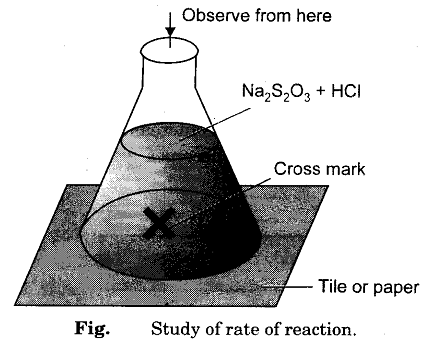
- After that, immediately start the stopwatch.
- Observe the contents of the flask from the top and note down the time taken for the disappearance of the cross marked on the paper due to formation of the elemental sulphur in the flask which makes the solution opaque.
- Repeat this experiment by taking conical flasks no.2 to no.5 in the order as well as adding 10 ml of 1M HCl solution in each flask.
Read Also:
Observation Table
[Click Here for Sample Questions]
The readings of the given experiment is recorded in the tabular form so that calculations can be done easily.
Volume of 1M HCl solution added to each conical flask = 10 ml
| Flask No. | Volume of 0.2M sodium thiosulphate( Na2S2O3) solution taken | Volume of Water added (in ml) |
|---|---|---|
| 50 ml | - | t1 |
| 40 ml | 10 ml | t2 |
| 30 ml | 20 ml | t3 |
| 20 ml | 30 ml | t4 |
| 10 ml | 40 ml | t5 |
From the observation table, it is concluded that the time taken for disappearance of the mark ‘X’ should increase with the decrease in the concentration of sodium thiosulphate solution ( from 50 ml to 10 ml in flask no.1 to no.5 in the same order). The trend is shown below:
t5 > t4 > t3 > t2 > t1
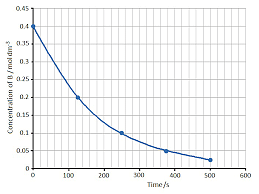
The graph between the concentration of the sodium thiosulphate and time taken for the disappearance of the mark 'X’ is plotted as:
Read More:
Result
[Click Here for Sample Questions]
From the observation table and trend observed in the time taken for the disappearance of the mark ’X’ , it is clear that the rate of reaction between sodium thiosulphate and hydrochloric acid decreases with the decrease in the concentration of the sodium thiosulphate.
Precautions
[Click Here for Sample Questions]
There are some basic precautions that should be followed while performing the experiment:
- The volume of the distilled water, sodium thiosulphate and HCl should be measured accurately.
- The cross marked on the paper should be observed from the same height.
- The time taken for the disappearance of the mark ‘X’ should be noted carefully.
- Wash the apparatus properly.
Read More:
Things to Remember
- Rate of reaction tells us the speed of the chemical reaction.
- The rate of reaction is directly proportional to the concentration of the reactants as per the definition of the law of mass action.
- With the increase in the concentration, the rate of reaction rises.
- With the decrease in the concentration, the rate of reaction also decreases.
- Rate of reaction can be determined by finding the rate of precipitation of sulphur.
Read More:
Sample Questions
Ques. What are the units of the rate of a reaction? (2 marks)
Ans. There are two main units of expressing the rate of reaction. These are:
- Moles per litre per second \(\rightarrow\) Mol L-1 s-1
- Moles per litre per minute \(\rightarrow\) Mol L-1 min-1
However, Mol L-1 s-1 is widely used in chemistry.
Ques. Is it possible to determine the rate of reaction for all the reactions? (1 mark)
Ans. No, it is not possible for all the reactions. The rate of reaction for very slow and fast reactions cannot be determined.
Ques. What do you mean by hypo solution? (1 mark)
Ans. An aqueous solution of sodium thiosulphate (Na2S2O3.5H2O) is known as hypo solution.
Ques. What is the order of reaction involving reaction between sodium thiosulphate and hydrochloric acid? (3 marks)
Ans. The first order reaction is involved between the sodium thiosulphate and hydrochloric acid. It is because of the lower concentrations of the chemicals.
Na2S2O3 (aq) + 2HCl (aq) \(\rightarrow\) 2NaCl (aq) + SO2 (g) + H2O (l) + S (s)
Here, the rate of a reaction is first order with respect to sodium thiosulphate (Na2S2O3(aq)) as well as hydrochloric acid(HCl).
Ques. What is the nature of the rate of a reaction with time? (2 marks)
Ans. The rate of a reaction decreases with the passage of time because concentrations of the reactants are high in the beginning. As the time increases, the concentration of the reactants becomes low which slows down the reaction. As a result, the rate of a reaction goes down with time.
Ques. Why should air-free water be used for preparation of sodium sulphite solution? (2 marks)
Ans. Air free water should be used for preparation of sodium sulphite solution because sodium sulphite is easily oxidised to sulphate by dissolving air in the water. Therefore, air free water should be used to prepare aqueous solution of sodium sulphite.
Ques. Write down the principle involved in the study of the rate of a reaction between sodium thiosulphate and hydrochloric acid? (2 marks)
Ans. In the reaction between sodium thiosulphate and hydrochloric acid, the elemental sulphur i.e. colloidal sulphur is produced which results in the appearance of the turbidity in the solution. Also, it appears as when the cross marked on the paper disappears.
Ques. What do you understand from the rate of a reaction? (3 marks)
Ans. The rate of speed at which the reactants convert into products at a given time is known as the rate of a reaction. It can be represented as;
A \(\rightarrow\)B
where, A refers to the reactant and B refers to the product
Rate of a reaction = Decrease in concentration of A / Time taken
Rate of a reaction = -\(\Delta \)[A] /\(\Delta\)t
or,
Rate of a reaction = Increase in concentration of B / Time taken
Rate of a reaction = +\(\Delta \)B /\(\Delta\)t
Read Also:



Comments