



Education Journalist | Study Abroad Lead
Oxoacids of halogen are compounds that contain at least one oxygen, hydrogen and no less than one other halogen (Group 17 elements include fluorine, chlorine, bromine, iodine, and astatine which are known as halogens). They form oxoacids in four different types with general formula (HOX) known as Hypohalous, (HOXO) called halous acid, halic acid (HOXO2) and perhalic acid with formula (HOXO3) where X is any halogen excluding fluorine as it only forms one oxoacid i.e., HOF. They are considered to be stable only in aqueous solutions or in their salt form.
| Table of Content |
Key Terms: Oxoacids, Halogens, Electronegativity, Thermal Strength, Acidic Character, Oxidation state, Double bond, Periodic, Hypohalous
Also Read: Group 17 elements
Properties of Oxoacids of Halogens
[Click Here for Sample Questions]
Oxoacids of halogens are found in four different oxidation stages:
- Hypohalous (HOX) with +1 oxidation stage
- Halous acid (HOXO) with +3 oxidation stage
- Halic acid (HOXO2) with +5 oxidation stage
- Perhalic acid (HOXO3) with +7 oxidation stage
Also Read: P- block elements
Oxidation Power
Oxidation power of the oxoacids of halogens is inversely proportional to the oxidation number. This means that, with the increase in the oxidation number of the oxoacids, the oxidation power of the compound decreases. For example,
HClO > HClO2 > HClO3 > HClO4
Acidic strength
- The acidic character of the oxoacids of halogen with the same oxidation number decreases as we move down the group 17 elements in the periodic table. For example,
HOClO3 > HOBrO3 > HOIO3
- Acidic strength increases with an increase in the oxidation number of the oxoacid of halogen. For example, among the four oxoacids of chlorine, the acidic strength increases markedly from hypochlorous acid to perchloric acid.
HClO < HClO2 < HClO3 < HClO4
Thermal strength
Thermal strength of the compound is the ability to resist the breakdown under thermal stress. The thermal stability of both acids and salts increases with an increase in the oxidation number of the halogens. For example,
HClO < HClO2 < HClO3 < HClO4
Also Read: Oxides of Nitrogen
Oxoacid of fluorine
[Click Here for Sample Questions]
Fluorine is the first element of Group 17. It is very small in size and high electronegative which results in the formation of the single oxoacid i.e., hypofluorous acid (HOF). It is only oxoacid with the negative oxidation state because the main atom in HOF gains electrons from oxygen. The bond lengths of the O–F and O–H bond are 144.2 and 96.4 pm respectively. The bond angle between H–O–F is 97.2° which is slightly narrower as it is examined in the gas phase.
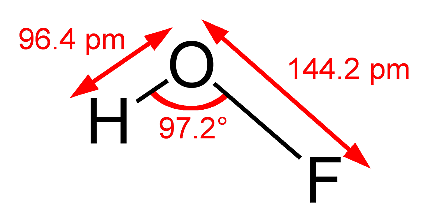
Structure: hypofluorous acid
Also, it is considered as dangerous to keep it in room temperature because of the formation of HF and O2
2 HOF → 2 HF + O2
Also Read: Oxoacids of Sulphur
Oxoacids of Chlorine
[Click Here for Sample Questions]
Chlorine forms four oxoacids at each oxidation state. Hence, the four oxoacids of chlorine are
- Hypochlorous acid (HClO)
- Chlorous acid (HOClO or HCIO2)
- Chloric acid (HOClO2 or HClO3)
- Perchloric acid (HOClO3 or HClO4)
All these oxoacids differ in their structure, acidic strength, thermal strength, oxidation number and other properties. The bond between Cl and OH (i.e., Cl–OH bond) is present in every oxoacid of chlorine whereas a double bond of Cl and O (i.e., Cl=O bond) is found in most of them. Moreover, the central atom is sp3 hybridised in the chlorine oxoacids.
Oxoacids of chlorine are considered very useful in chemistry labs as they are ingredients in the preparation of chlorine, ammonium chloride and glucose. Apart from this, they are used to extract glue from bones and purify boneblack. They have a number of applications in medicine and laboratory.

Also Read:
Things to Remember
- Acidic strength increases with an increase in oxidation number.
- Oxoacids with the same oxidation state decrease for element in order:
HCl > HBr > HI
- Fluorine is the only halogen that forms a single oxoacid i.e., HOF.
- HBrO2 does not exist in nature.
- Oxoacids of halogens are stable in aqueous solution and in their salt form.
- Oxoacids of chlorine are water-soluble.
- The central atom in the oxoacid of halogen is sp3 hybridised.
- Every oxoacid has X- OH bond where X is any element.
Also Read: Oxoacids of Phosphorus
Sample Questions
Ques: Why acidic strength increases for an increase in oxidation number? (2 Marks)
Ans: The acidic strength of the oxoacids increases as the number of oxygens increases with the increase in oxidation state. This is because of a high number of oxygen atoms attached to the central atom to pull the electron density across the OH bond. For example, the acidic character of the oxoacids of chlorine are in order:
HClO < HClO2 < HClO3 < HClO4
Ques: How is hypohalous acid prepared? (2 Marks)
Ans: Hypohalous acid with the general formula HOX where X= Cl, Br, I. It is prepared by the reaction of the dihalogen with mercury oxide.
2 X2 + 3 HgO + H2O → 2 HOX + Hg3O2X2
Where X =Cl, Br, I
The salts of hypohalous acids formed from the halogens are characterised as weaker acids.
Ques: Is hydrochloric an oxoacid? (2 Marks)
Ans: Oxoacids are the compounds that contain oxygen, hydrogen and one more different element. Hydrochloric acid with the chemical formula HCl does not have any oxygen atom. So, as per the definition of oxoacids, hydrochloric acid is not an oxoacid. In the initial years, it was considered that all acids contain oxygens but which is proven wrong. Hence, now hydrochloric acid is a type of hydroacids.
Ques: Which oxoacid of halogen is most acidic? (2 Marks)
Ans: The acidic strength decreases as we go down Group 17 so it is clear that the oxoacids of the chlorine will be more acidic than that of bromine or iodine. Moreover, the oxidation state is directly proportional to the acidic character of the oxoacids. Hence, the oxoacid of chlorine with the highest oxidation state +7 is HClO4 known as perchloric acid.
Ques: Why HClO4 is more thermal stable than HClO3? (2 Marks)
Ans: HClO4 or perchloric acid is oxoacid of chlorine with the oxidation state of +7 whereas chloric acid or HClO3 is of +5 oxidation state. As the oxidation state of the central halogen atom increases the halogen oxygen bond becomes more and more covalent. As a result, the thermal stability of the oxoacid increases. Thus, HClO4 is more thermal stable than HClO3.
Ques: What type of bonds are present in oxoacids of halogen? (2 Marks)
Ans: There are two types of bonds present in the oxoacids. One X-OH bond is basically present in each oxoacid where X is any halogen. In the majority of these oxoacids, the double bond between halogen and oxygen "X = O" bonds are available. The double bond introduced in an oxoacid between the focal halogen particle and oxygen is d pi - pi in nature.
Ques: What are the different oxoacids formed by bromine, and what is the oxidation state of bromine in each of them? (2 Marks)
Ans: There are three different types of oxoacids of bromine which are named as hypobromous acid, bromic acid and perbromic acid. The oxidation state of bromine in hypobromous acid (HOBr) is +1 whereas the oxidation state of bromine in bromic acid (HbrO3) and perbromic acid (HBrO4) is +5 and +7 respectively.
Ques: Which of the following oxoacid of halogen does not exist? (2 Marks)
(a) HBrO2
(b) HClO3
(c) HIO3
(d) HBrO
Ans: (a) HBrO2
Explanation: Among the given options, only HBrO2 does not exist because of their instability in nature as they would likely decompose into the water vapour and oxides when trying to isolate them from their respective acid solutions. Other oxoacids HClO3 (Chloric acid), HIO3 (Iodic acid) and HBrO (hypobromous acid) exists in nature.
Ques: Describe the shape of sp, sp2, sp3 hybrid orbitals? (2 Marks)
Ans: Shapes of orbitals:
sp Hybridization- When one s- and one p-orbital intermix, it is called hybridization. For instance, in BeF2, Be undergoes sp-hybridization which has a linear shape, and bond angle is 180°.
sp2 Hybridization- Here one s- and two p- orbitals get hybridized in order to form three equivalent hybrid orbitals. The three hybrid orbitals are directed towards the three corners of an equilateral triangle. Thus it is known as trigonal hybridization.
sp3 Hybridization- Here one s- and three p- orbitals get hybridized to form four equivalent hybrid orbitals. These orbitals are directed towards the four corners of a regular tetrahedron.
Ques. How is astatine different from other halogens? (2 Marks)
Ans. Astatine is the heaviest element in group 17. It is the only radioactive element among the halogens. It is not naturally found in nature and is created by bombarding Bismuth-209 with alpha particles. It has a half-life of 8.3 hours. Unlike other halogens, astatine is not diatomic. Astatine has no uses in industry as it is radioactive and toxic, though other halogens have a vast application in industries.
For Latest Updates on Upcoming Board Exams, Click Here: https://t.me/class_10_12_board_updates
Check-Out:



Comments