



Education Journalist | Study Abroad Lead
A solution that has more solute dissolved in it as compared to a saturated solution is known as a supersaturated solution. It can be prepared by adding more solute to a solution that is already saturated with the process of heating so that the solute can be easily dissolved. These solutions are in a non-equilibrium state. In this article, we will have a look at the supersaturated solutions, their phase change process, and various applications of the same.
| Table of Content |
Keyterms: Solute, solvent, mixture, Solution, homogenous mixture, components, combination, concentration
What is a Solution?
[Click Here for Sample Questions]
A solution is a molecularly homogenous mixture of two or more pure substances, the composition of which can vary within specific limitations. The solute and the solvent are two components of a solution.
Also Read:
| Related Articles | ||
|---|---|---|
| Aldehyde | Tetravalency | Thermochemistry |
| Coupling Reaction | Sandmeyer Reaction | Thermal Conductivity of Copper |
| Green Chemistry | Metal Excess Defect | Hoffmann Bromamide Degradation Reaction |
What is a Supersaturated Solution?
[Click Here for Sample Questions]
A supersaturated solution is a kind of solution that has more amount of dissolved solute than a regular saturated solution.
This supersaturated solution can be obtained by boiling a saturated solution, then adding extra solute in it, and then slowly leaving it to cool off. The excess of the dissolved solute crystallizes when a few of the crystals of the solute are seeded into a supersaturated solution.
The goal of pan boiling, for example, is to produce a fine, even crop of sugar crystals. Maintaining control over the rate of crystallization during the growing process is a prerequisite for achieving this goal. In general, a crystal surface maintained in a solution will only grow if the solution's concentration is kept higher than the concentration of the saturation. A solution like this is referred to as supersaturated.
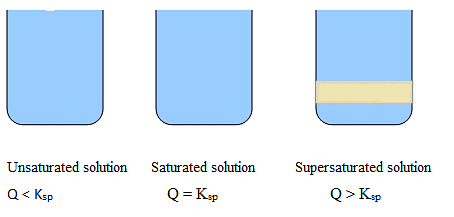
Unsaturated, Saturated, and Supersaturated Solution
Phase Change Process of Supersaturation (Crystallization and Condensation)
[Click Here for Sample Questions]
- Every system's physical and chemical processes take place in the phases of melting of vapor or solution phase through the synthesis of three-dimensional 3D nuclei of a new phase, which can only happen when the medium is supersaturated.
- The nuclei formation is linked to an observed shift in the system's free energy. The nuclei of the new phase in a homogeneous system are not created the moment the system becomes saturated even though it is possible for this formation to occur thermodynamically.
- The system is considered to be in a state of meta-stable equilibrium if it can persist in that state without achieving the equilibrium state's minimal free energy.
- In other words, in such cases, after a period of time, the nucleation of the new phase occurs. Various factors such as the pressure and temperature of the system, the increased levels of supersaturation that aids in the nucleation of the new phase, and the presence of other chemical phases determine the length.
- When the new phase nucleates instantly, there is always a supersaturation level. This is when the new phase emerges.
- This supersaturation level establishes the metastable width and corresponds to the upper limit of the metastable equilibrium condition.

Schematic Illustration of the metastable zone of crystallization
Applications of Supersaturated Solution
[Click Here for Sample Questions]
- A solution of a solid solute dissolved in a liquid solvent is saturated and in thermal equilibrium. In order for crystallization to occur, the state of a system must be changed to a non-equilibrium state. In this state, the concentration of the solute in the given solution exceeds the concentration at its equilibrium under a given set of circumstances. Supersaturated solutions are in an out-of-equilibrium state. Cooling is the simplest way to make a supersaturated solution.
- Cooling is the easiest and most usual way to make a supersaturated solution, but it isn't the only one. Other techniques include solvent evaporation, temperature changes, pH changes, chemical reactions, and changes in solvent composition.
- At point A, a solution is first prepared. When this solution is cooled, it intersects the saturation line and becomes saturated. It will be supersaturated if it is cooled past the saturation line to point B. However, just because a solution is supersaturated does not indicate it will crystallize right away. Metastability is a property of supersaturated solutions. This signifies that there is a free energy barrier that must be overcome in order to complete the phase transition.
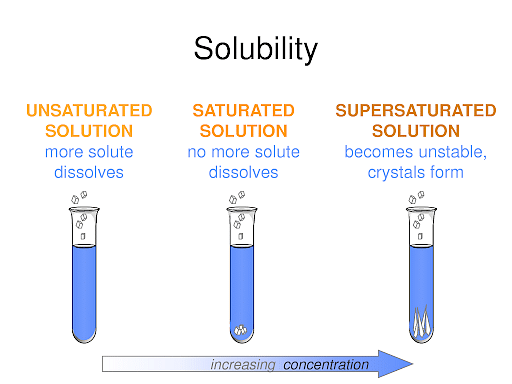
Solubility and Supersaturated Solution
Uses of Supersaturated Solution
[Click Here for Sample Questions]
- In terms of pharmaceuticals, the features of supersaturation have practical implications. A medicine can be consumed in liquid form by making a supersaturated solution of it. Any conventional mechanism can be used to bring the medication into a supersaturated state, which can then be prevented from precipitating out by adding precipitation inhibitors. The oral administration of medicine in this form is straightforward and allows for the precise measuring of dosages. Its primary purpose is to allow medications with extremely low solubility to be turned into aqueous solutions.
- The presence of supersaturation in the atmosphere is a common phenomenon. The production of ice lattices in the troposphere is common when water is supersaturated. Under tropospheric circumstances, water particles in a saturated state will not produce ice.
At saturation pressures, water molecules do not form an ice lattice on their own; they need a surface to condense on or conglomerations of liquid water molecules to freeze. Because of these factors, relative humidities above the ice in the atmosphere might exceed 100%, indicating that supersaturation has occurred.
Process of making a Supersaturated Solution
[Click Here for Sample Questions]
- To begin with, the solution must be warmed. This permits the molecules in the solution to move quicker and wider apart, allowing for the addition of additional solute.
- The solution is left for cooling down.
- The solute remains dissolved in solution despite the molecules slowing down and moving closer together, resulting in a supersaturated solution.
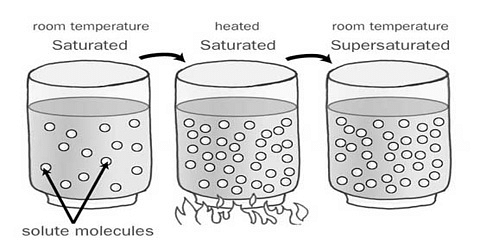
Forming a supersaturated solution
For example, Hand Warmer
If you've ever visited a chilly region, you're probably familiar with the small, liquid-filled hand warmers that you can buy for your gloves or stocks at the store. The supersaturated solution of a chemical called sodium acetate is disturbed when you bend the metal. The sodium acetate in the hand warmer crystallizes as a result of the disruption.
Things to Remember
- A solution is a molecularly homogenous mixture of two or more pure substances, the composition of which can vary within specific limitations.
- A supersaturated solution has more dissolved solute than a saturated solution.
- Cooling is the simplest way to make a supersaturated solution.
- Every system's physical and chemical processes take place in the phases of melting of vapor or solution phase through the synthesis of three-dimensional 3D nuclei of a new phase.
- Metastability is a property of supersaturated solutions. This signifies that there is a free energy barrier that must be overcome in order to complete the phase transition.
- A medicine can be consumed in liquid form by making a supersaturated solution of it.
Also Read:
Sample Questions
Ques. What is the appearance of a supersaturated solution? (1 mark)
Ans. A supersaturated solution contains more solute than the solvent can dissolve. A solute is a substance that dissolves in a solution, such as salts but not limited to salts. The most well-known example is supersaturated sodium acetate.
Ques. What causes a solution to become supersaturated? (2 marks)
Ans. A supersaturated solution contains more solvent than the usual that can be dissolved at a specific temperature. Inserting a tiny solute crystal, known as a seed crystal, into a super-saturated solution can trigger the recrystallization of the excess dissolved solvent.
Ques. What is a supersaturated sugar solution? (2 marks)
Ans. A "supersaturated" solution yields more dissolved content than it should, based on the solubility of the chemical. In the instance of sugar, which has the chemical name "sucrose," 100 milliliters of water may dissolve approximately 211 grams of sugar. Temperature affects solubility; hot water dissolves more sugar than cold water.
Ques. When a supersaturated solution is cooled, what happens? (2 marks)
Ans. The hydrated crystals' solid crystals disintegrate in the bath, resulting in a supersaturated solution. The super-saturated solution for sodium thiosulfate should remain liquid when the solution is gradually cooled. Placing a tiny crystal in an oversaturated solution will solidify the liquid.
Ques. What is the mass percent of sodium hydroxide in a solution generated by dissolving 8.00 grams of sodium hydroxide in 50.0 grams of water? (3 marks)
Ans. NaOH = 8.00g
H2O = 50.0 g
Calculating the mass %
= 8.00g NaOH + 50.0g H2O /8.00g NaOH
= 13.8 percent sodium hydroxide solution
Ques. At 20oC, will a solution prepared by mixing 2.5g CuSO4 with 10g H2O be saturated or unsaturated? (3 marks)
Ans. We must first determine the CuSO4 solution at 20°C. CuSO4 has a solubility of roughly 21g per 100g of H2O at 20oC. This equates to 2.1 grams of CuSO4 per ten grams of water.
The solution will be saturated and 0.4g of CuSO4 will be preserved since 2.5g per 10g of H2O is more than 2.1g per 10g of H2O.
For Latest Updates on Upcoming Board Exams, Click Here: https://t.me/class_10_12_board_updates
Also Read:



Comments