



Education Journalist | Study Abroad Lead
Silver Phosphate formula is an inorganic salt created by one phosphate anion and three silver cations. It is generally available in most volumes. The chemical or molecular formula of silver phosphate is Ag3PO4. It has many synonyms such as trisilver phosphate, silver salt, phosphoric acid, silver orthophosphate, and trisilver (1+) phosphate. The compound is formed as a yellow precipitate due to the reaction between a soluble silver compound with a soluble orthophosphate. In its pure form, silver phosphate is a yellow solid and it turns darker as it becomes impure.
Key Terms: Silver phosphate, light sensitive chemical compound, tri silver phosphate formula, silver orthophosphate formula
Read More: Concepts in Chemistry
Silver Phosphate
[Click Here for Sample Questions]
Silver phosphate is a yellow, water-insoluble compound. It is also a light sensitive chemical compound composed of silver and phosphate ions. The compound is formed as a yellow precipitate due to the reaction between a soluble silver compound with a soluble orthophosphate. In its pure form, silver phosphate is a yellow solid and it turns darker as it becomes impure. This chemical compound is insoluble in water and soluble in acids and other solutions. Silver phosphate is synthesized by reacting the salt orthophosphate and silver nitrate.

Silver Phosphate
Read More:
Formula & Structure of Silver Phosphate
[Click Here for Sample Questions]
The chemical formula of silver phosphate is Ag3PO4. It is a yellow solid in its pure form and becomes darker in its impure form. The formula structure of silver phosphate is given below.
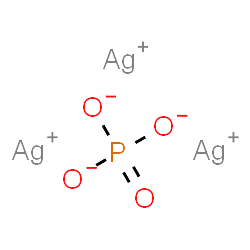
Silver phosphate Structure
It is formed by 3 silver cations (Ag+) and 1 phosphate anion (PO43-) which again gives a cubic crystal structure to the compound. This compound cannot be traced in nature. It is a chemical substance which is formed as a yellow precipitate when reacted with silver nitrate and salt orthophosphate. The obtained product is not soluble in water, so it can be filtered and recovered as a pure solid:
AgNO3 + (PO4)³- → Ag3PO4 (S)
Read More:
Properties of Silver Phosphate
[Click Here for Sample Questions]
- The molar mass of silver phosphate is 418.574 g mol-¹ and the density is 6.37 g mL-¹.
- Silver phosphate is light sensitive and its melting point is 849 °C.

Molecular structure of Silver Phosphate
- At high temperature, the ion phosphate goes through a reaction of condensation to form pyrophosphate. In this condition, silver pyrophosphate can also be formed when silver nitrate is combined.
- This second phosphate is also light sensitive and it's possible to get new material from it through photocatalytic activity.
Read More:
Uses of Silver Phosphate
[Click Here for Sample Questions]
- Silver phosphate is used as catalysts such as bactericide, astringent, etc in some medical purposes and used in the staining of biological materials.
- It is also used as a standard for tracing the concentration of phosphates in solution.
- It acts as a potential material in order to incorporate silver ion antibacterial properties into materials.
- In early photography, silver phosphate was used as a light sensitive agent.
Read More:
Things to Remember
- Silver phosphate is a light sensitive chemical compound made of silver and phosphate ions. The chemical formula of silver phosphate is Ag3PO4.
- Silver phosphate is also known as trisilver phosphate formula or silver orthophosphate formula.
- Silver phosphate is formed as a yellow precipitate as a result of the reaction between a soluble silver compound with a soluble orthophosphate.
- Silver phosphate has a molar mass of 418.574 g mol-¹. Its density is 6.37 g mL-¹ and the melting point is 849 °C.
Read More:
Sample Questions
Ques: What is the chemical formula of silver phosphate? (2 marks)
Ans: The chemical formula of silver phosphate is
Ag3PO4. Silver phosphate or silver orthophosphate is a yellow compound composed of silver and phosphate ions.Ques: XCI2 is the chloride of metal X. What is the formula of sulphate and hydroxide of the metal X? (2 marks)
Ans:
XCI2 = X+2 (-1) = X= +2The oxidation state of metal is +2. Metal ion X+²
The metal sulphate formula is XSO4 and the metal hydroxide formula is X(OH)2
Ques: Silver phosphate, Ag3PO4 (S) has Ksp = 8. 89 x 10-17. Find the equilibrium concentration of silver ions in the saturated solution of a silver phosphate? (2 marks)
Ans: Ksp = [Ag+]³[PO4]³-
In every 1 mole silver phosphate dissolved, 3 moles Ag+ is ionized so plug in 3x for [Ag+]. For [PO4]³- only 1 mole is ionized, so just 1x.
Ksp = [3x]³[x]
Ksp = 27x4, and x=
1.82x10⁻⁹Question: Calculate the molality of 60.5% mass of nitric acid (HNO3) solution? Also, calculate the mole fraction of HCL and H2O in a 20% (w/ w) aqueous of HCL solution (4 marks)
Ans: M
(HNO3) = 63.01 g/ mol100g sIn is given, so m (
HNO3) = 60.5 gM (H2O) = 100-60.5 = 39.5 g (0.0395 kg). Moles HNO = 60.5/ 63.01 = 0.9602 mol
Hence, the molality is 0.9602 mol/ 0.0395 kg = 24.3 m
HNO3.20% (w/ w) aqueous HCI solution is equal to 20g HCI+80 g of water = 100 g of solution
M (HCI) = 36.46 g/ mol and M (H2O) = 18.02 g/ mol
20/ 36.46 = 0.5485 mol HCI and 80/ 18.02 = 4.4395 mol H2O
The mole fraction = 0.5485/ (0.5485+4.4395) = 0.11 or x 100% = 11%
Ques: Calculate how much moles of NaOH are present in 26.5 ml of 0.290 M NaOH (2 marks)
Ans: The volume of NaOH solution is given, VNaOH= 26.5 ml
The concentration of NaOH solution, SNaOH= 0.290 M
Which means, in a 1 liter, 1000 ml of solution 0.290 mole of NaOH are present
So in 1 ml of solution, 0.290 mole of NaOH are present
In a 26.5 ml solution, (0.290/ 1000)x 26.5 mole of NaOH are present
=
7.685 x 10-³ mole NaOHHence,
7.685 x 10-³ moles of NaOH are present in 26.5 ml of 0.290 M NaOHQues: Is silver phosphate acidic or basic? (1 marks)
Ans: The compound is a moderately water and acid soluble silver source for uses compatible with phosphates.
Ques: What are the uses of silver phosphate? (2 marks)
Ans: It is used in photography as emulsions. This is because the silver phosphate is light sensitive. The compound has also been used as catalysts in some reactions such as bactericide, astringent, etc.
Ques: State the formula for silver one phosphate? (2 marks)
Ans: The chemical formula of silver phosphate is
Ag3PO4. The molar mass of the compound is 418.574 g mol-¹. The salt is made by three silver cations (Ag+) and one phosphate anion (PO4³-) that takes a cubic crystal structure.Question: How to prepare silver phosphate? (2 marks)
Ans: The chemical compound is formed as a yellow precipitate due to the reaction between a soluble silver such as silver nitrate and soluble orthophosphate. The solubility product is
8.89x10⁻¹⁷ mole dm-¹².Ques: Can magnesium be considered as a phosphate? (2 marks)
Ans: Magnesium phosphate is an essential mineral which could be traced in bones, seeds, and other minerals. The chemical formula of the compound is
Mg3(PO4)2. Magnesium phosphate is considered as the source of supplemental dietary magnesium.Read More:



Comments