



Content Curator
Sodium Nitrate is the alternative name of the cubic or nitrate of the formula of sodium oxide. It has cation as the sodium that is Na+ and anion as nitrate that is NO3-. It comes under the category of the inorganic salt of sodium. It appears as an alkali metal of white color and has no odor. It is used as a food additive in many applications. It is highly soluble in water, ammonia, hydrazine, and is non-combustible.
| Table of Content |
Key Takeaways: Sodium Nitrate formula, sodium nitrate, Alkali Metal, NaNO3, Chile Saltpeter
Sodium Nitrate Formula
[Click Here for Sample Questions]
The molecular formula of sodium nitrate is NaNO3 with the chemical formula is NaNO3 and the molar mass is 84.9947 g/mol. It is formed as the nitric acid’s sodium salt that is HNO3 and has anion as nitrate NO3- and cation as sodium Na+. The central atom is a nitrogen atom in which the nitrate ion is bonded to the three atoms of the oxygen with the help of two single bonds and one double bond that are in resonance with the other.
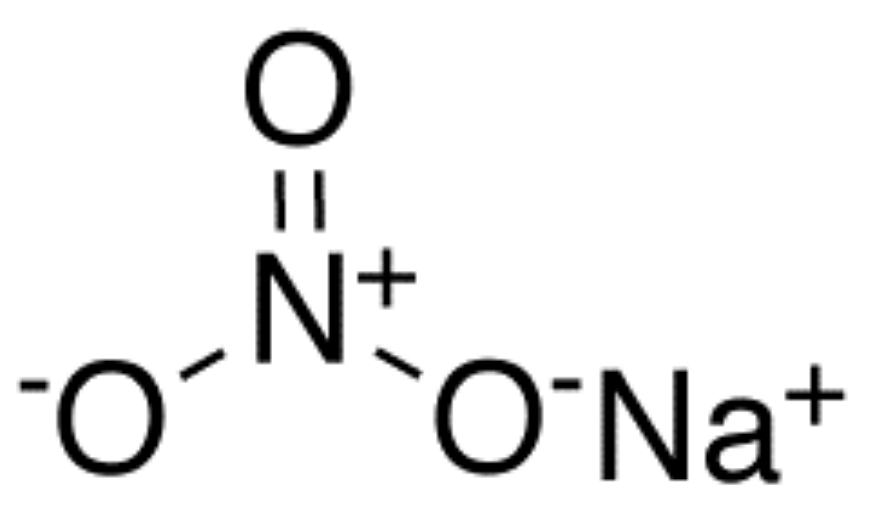
Sodium nitrate structure
Occurrence of Sodium Nitrate
[Click Here for Sample Questions]
The sodium nitrate is mainly and naturally found in the dry regions particularly in the South American deserts as the large mineral deposits and hence is also known as Chile/Peru saltpeter. These deposits of sodium nitrate occur as impure gravel or rock of nitrate. After the process of mining and purification, the main source of sodium nitrate is through the deposit of sodium nitrate salt.
Preparation of Sodium Nitrate
[Click Here for Sample Questions]
The sodium nitrate is formed with the reaction of a base like sodium carbonate with nitric acid or HNO3. These bases can also include sodium hydroxide or sodium bicarbonate.
HNO3 + NaOH → NaNO3 + H2O
NaHCO3 + HNO3 → NaNO3 + H2O + CO2
Na2CO3 + 2HNO3 → 2NaNO3 + CO2 + H2O
This chemical of sodium nitrate is also formed by the reaction of the bases with ammonium nitrate. However, this is a less exothermic reaction(the reaction that emits heat) than that of the one which is mentioned above.
NH4NO3 + NaOH → NaNO3 + NH4OH
Na2CO3 + 2NH4NO3 → (NH4)2CO3 + 2NaNO3
NaHCO3 + NH4NO3 → NH4HCO3 + NaNO3
Physical Properties of Sodium Nitrate
[Click Here for Sample Questions]
Any chemical substance exhibits two kinds of properties, physical and chemical. The physical properties that the Sodium Nitrate possesses are as follows:
- It can hold and retain water.
- It appears in white color and is a crystalline solid with a sweet or no smell.
- It is a bit soluble in pyridine and is not soluble in acetone as an ionic compound.
- The sodium nitrate's crystal structure is either trigonal or rhombohedral.
- It is more soluble in ammonia.
- The solubility is approximately 91.2 g/100 ml in the temperature of around 25 degrees in the water.
- The boiling point of sodium nitrate is approximately 380 degrees celsius while the melting point is around 308 degrees celsius.
- The density possessed by the sodium nitrate compound is 2.257 g/cm3 with a molecular weight of 84.997 g/mol.
The summary of the physical properties are shown in the table below:
| Molecular Weight | 84.997 g/mol |
| Density | 2.257 g/cm3 |
| Melting Point | 308º C |
| Boiling Point | 380º C |
| Crystal Structure | Trigonal and Rhombohedral |
Chemical Properties of Sodium Nitrate
[Click Here for Sample Questions]
The chemical properties of the sodium nitrate include:
- It dissociates in water completely to form the nitrate(NO3-) and sodium ions(Na+).
- It can release toxic fumes when heated otherwise it remains stable.
- When reacted with the flammable materials or the strong reducing agents, it reacts violently as sodium nitrate is a highly oxidizing agent.
- When the temperature is high, the compound of sodium nitrate is called to explosively decompose.
Things to Remember
- The sodium nitrate is the nitrate of the sodium salt.
- Its chemical formula is NaNO3 and has a molar mass of 84.9947 g/mol.
- It is white and has no or a little sweet kind of smell.
- It can be found on large mineral deposits.
- It can be prepared using the reaction of a base with nitric acid or ammonium nitrate.
- It is prominently used as smoke bombs, explosives, or dental products.
- It can be a reason for skin or eye irritation as it is a strong oxidizer.
Sample Questions
Ques. Mention the uses of sodium nitrate. (2 marks)
Ans. Being nitrate anion as the main constituent, the sodium nitrate is used in the smoke bombs, fertilizers, food preservatives, pyrotechnics, solid rocket propellant, and glass and pottery enamels. It is also used to produce hybrid aqua regia used in the refiners to dissolve metals like gold. It is also used for the respiration of microorganisms that are facultative in wastewater treatment.
Ques. Can sodium nitrate be dangerous? (2 marks)
Ans. Sodium Nitrate has had some health effects that make it dangerous to work with. It is a compound that works as an oxygen replacement. It can be mainly responsible for the health hazards like skin or eye irritation, nausea, diarrhea, and abdominal pain. It can kill a large number of humans or can even be a reason for sub-lethal effects in humans. The organs which require oxygen in higher demands like the heart and the brain are at more risk.
Ques. Can we term sodium nitrate as highly explosive? (2 marks)
Ans. Sodium Nitrate has the structure and appearance of a white crystalline solid that is in general a non-combustible substance. However, it is known to enhance the burning of any material that tends to be in the category of combustible materials. Moreover, if the sodium nitrate is divided into larger divisions and is mixed finely with the combustible materials, then it could lead to an explosion.
Ques. How is Sodium Nitrate prepared? Give the reaction. (3 marks)
Ans. Sodium Nitrate can be prepared using two methods. Either it can be prepared by the reaction of sodium carbonate/sodium hydroxide/ sodium bicarbonate along with the nitric acid is a highly exothermic reaction.
HNO3 + NaOH → NaNO3 + H2O
The other reaction is when the base is reacted with that of ammonium nitrate which is likely to be a less exothermic reaction.
NH4NO3 + NaOH → NaNO3 + NH4OH
Ques. State some physical properties of Sodium Nitrate. (3 marks)
Ans. Some of the physical properties of Sodium Nitrate are as follows:
- It has a trigonal or rhombohedral crystalline structure that is white with no odor.
- The molecular weight of the compound is 84.997 g/mol with a density of 2.257 g/cm3.
- It is insoluble as it is an ionic compound in acetone and is a little soluble in pyridine.
Ques. State some chemical properties of Sodium Nitrate. (3 marks)
Ans. Some of the chemical properties of Sodium Nitrate are as follows:
- When dissolved in water, it dissociates to form the sodium and nitrate ions.
- In general, it is a stable compound but generates toxic fumes on heating.
- When the sodium nitrate is made to react with the strong reducing agents or the flammable substance, it reacts violently.
Ques. Mention the melting and the boiling points of the Sodium Nitrate. (2 marks)
Ans. Sodium Nitrate is a compound that has a high melting and boiling point. The melting point of the sodium nitrate compound is 308º C. The boiling point of the sodium nitrate, in general, is 380º C.
Read More:



Comments