



Content Writer
Sonic boom is a tremendous amount of shock waves produced when the speed of an object crosses the speed of sound. Sonic booms produced immense sound energy, identical to an explosion or a thunderclap. Although it is powerful, it cannot be heard or detected in all directions. Sonic booms cause serious effects on human behavior and living experience. It can disrupt sleep and relaxation. Extreme conditions cause insomnia.
Read more: Wave speed
KeyTerms: Sonic Boom, Wave speed, Sound, Shock waves, High altitudes, Wake, Pounds per square
What is Sonic Boom?
[Click Here for Sample Questions]
A sonic boom is a loud, booming sound created when traveling sound waves are compressed. It is produced by a substance moving more quickly than sound (about 335 m/s at sea level).
- Pressure waves combine and create shock waves, which propagate forward from the generation or "release" point when an aeroplane flies faster than sound.
- Although a sonic boom is extraordinarily loud, it cannot be heard or felt everywhere.
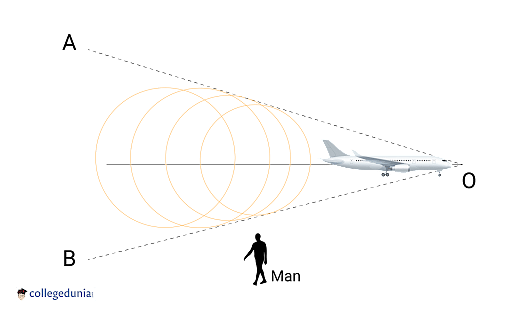
- An imaginary three-dimensional cone at the back of the traveling item is where one hears a sonic boom.
- As the object passes you, you can hear the sonic boom inside that geometrical zone. The sonic boom, however, won't be audible outside of the imaginary zone.

Observer experiences sonic boom
The imaginary conical zone actually moves beside the car. The observer feels the boom for a very brief moment as the object passes close by.
The video below explains this:
Sonic Boom Detailed Video Explanation:
Sonic Boom Principle
[Click Here for Sample Questions]
The basic principle of sonic boom is caused by pressure waves that are superimposed as a result of extremely high speed.
For instances,
- A pebble thrown in a pond, small waves are created in concentric circles, and move away from the point of contact.
- A boat moving faster than the speed of the waves, does not move out of trajectory and forms a wake (i.e., single big wave).
To supersonic objects, air behaves like a fluid. Sound waves are created whenever an object moves through the atmosphere. Fast-moving aircraft will cause a significant and potent air disturbance.
- The characteristics of the sound waves produced alter as speed rises.
- Sound waves can pass in front of an aeroplane if it is traveling slower than the speed of sound.
- A sonic boom is produced when an aircraft exceeds the speed of sound and crosses the sound threshold.
- The sonic boom is the sound wave's "wake." Within a split second, one will hear the tremendous boom when all sound waves that would typically flow in front of the aeroplane are combined.

Pressure wave at different frequencies
Factors Affecting Sonic Boom
[Click Here for Sample Questions]
Sonic booms can be influenced by a variety of factors, including aircraft or object weight, size, and shape. In addition to physical characteristics, the movement's direction and style are also quite important. A sonic boom is produced by a combination of weather, altitude, flight path, and attitude factors.
Weather affects Sonic Boom
Sonic Boom Measurement
[Click Here for Sample Questions]
Pounds per square foot is the unit of measurement for sonic booms (overpressure). It is the amount over the typical atmospheric pressure (14.7 psi/2,116 psf).
A sonic boom typically exerts pressure of a few pounds per square foot or less.
There will be less pressure on the ground at greater altitudes. The power of the shock wave decreases as it moves farther from the aeroplane.
Effects of Sonic Booms
[Click Here for Sample Questions]
Some of the effects of sonic booms are as follows
- A sonic boom generates an enormous amount of noise and pressure changes.
- Anything in its path will certainly hear the sonic boom. The height of the source (from the receiver) and other factors affecting the atmosphere are strictly correlated with the after-effects.
Read more:
- Delicate construction components with broad surfaces and poor tensile strength may be harmed by a powerful sonic boom.
- One pound of excess pressure has no negative effects on the structure.
- With 2 to 5 pounds of overpressure, minor damage could be produced.
- Structures in good condition are easily able to tolerate overpressures of up to 11 pounds.
- Overpressures of 20 to 144 pounds that are produced by sonic booms have not resulted in any fatalities.
- Eardrum injury occurs at 720 pounds of overpressure.
- In excess of 2160 pounds of overpressure, lung injury is anticipated.
- As evidenced by unusual reactions and feelings of terror, sonic booms have had a profound impact on human behavior and daily life. It may interfere with relaxation and sleep.
- It is important to take special account of individual situations like insomniacs and noise-sensitive people.
- In some instances, concerns about sonic booms are brought about by the perception that such disturbances have the potential to harm property.
Things to remember
- Sonic booms are produced when objects travel beyond the speed of sound.
- The sonic boom from aeroplanes can cause ground-level damage.
- A sonic boom exerts pressure of a few pounds per square foot or less.
- Sonic booms influence human behavior, also disrupt relaxation.
- A sonic boom creates significant amounts of noise and pressure changes.
- At increased pressure of sonic boom ear drums and lungs can be damaged.
Sample Questions
Ques. What is a sonic boom? (2 marks)
Ans. A sonic boom is a loud, booming sound created when traveling sound waves are compressed. It is produced by a substance traveling more quickly than the speed of sound, which is 335 m/s at sea level.
Pressure waves combine and create shock waves, which travel forward from the generating or "release" point when an aircraft exceeds the speed of sound.
Ques. Are there sonic booms in space? Explain. (1 mark)
Ans. In an absolute vacuum, sound cannot exist (space). Sound must travel through a medium. Therefore, practically speaking, sonic booms can not be heard or detected in space.
Ques. Who was the first human to create a sonic boom? (1 mark)
Ans. On October 14, 1947, Chuck Yeager became the first person to break the sound barrier while flying at a height of 45,000 feet.
Ques. What are the factors that control the sonic boom? (1 mark)
Ans. The vehicle's size, weight, and shape all have a significant impact. Along with physical characteristics, the movement's trajectory plays a significant role.
Ques. What is supersonic speed? (1 mark)
Ans. A vehicle traveling at a speed faster than sound is said to be supersonic. This speed is roughly 343.2 m/s for moving objects in dry air (20 °C) at sea level.
Ques. What causes the sound of a sonic boom? (3 marks)
Ans. Sonic booms are powerful noises that resemble explosions.
- Any object that moves through the air faster than the speed of sound will produce shock waves that cause it.
- Large volumes of sound energy are produced by sonic booms.
- A moving object creates pressure waves in front of and behind it as it travels through the air.
Ques. What does the sonic boom depend on? (2 marks)
Ans. The physical parameters of the aircraft and its operation affect the size and severity of the sonic boom path. In general, the overpressure on the ground decreases with increasing aircraft height. A greater region is exposed to the boom as its lateral spread expands with height.
Ques. What are the effects of the sonic boom? (2 marks)
Ans. As demonstrated by fright reactions and associated sensations of dread, sonic booms have a noticeable impact on behavior and subjective experience. Such disruptions obstruct communication and interfere with calm, relaxation, and sleep.
Ques. Can you hear sonic booms? (2 marks)
Ans. When an object moves through the air more quickly than sound can travel, shock waves are produced that produce the sound known as a sonic boom. Sonic booms produce a tremendous quantity of sound energy and, to the human ear, sound like an explosion or a thunderclap. The most common unit used to measure sound is the decibel.
Check out:



Comments