



Exams Prep Master
Vaporization is the process through which conversion of a substance from the liquid or solid phase into the gaseous or vapour phase takes place. When conditions allow the formation of vapour bubbles within a liquid, then the vaporization process is called boiling. While the direct conversion from solid to vapour is called sublimation. Let’s have a closer look at the topic along with few important questions.
| Table of Content |
Keyterms: Sublimation, liquid, solid, gaseous, Evaporation, Boiling, Vapor lock, Saturated vapor
Read Also: States of Matter
What is Vaporization?
[Click Here for Sample Questions]
As mentioned earlier, vaporization is a transformation of a substance from the liquid or solid stage into the gaseous stage. If circumstances allow the formation of vapor bubbles into a liquid, the vaporization procedure is known as boiling. Direct conversion from solid to vapor is termed sublimation.
Vaporization
Heat should be supplied to a solid or liquid to result in vaporization. If the surroundings do not supply adequate heat, it shall come from the system itself as a reduction in temperature. The atoms or molecules of a liquid or solid are detained together by cohesive forces and these forces must be overcome in splitting the atoms or molecules to form the vapor; the heat of vaporization is an uninterrupted portion of these cohesive forces.
The concentration of vapor to arrange a liquid or a solid is the opposite of vaporization, and in the procedure, heat should be transmitted from the condensing vapor to the surroundings. The quantity of this heat is distinctive of the substance, and it is numerically similar to the heat of vaporization.
Types of Vaporization
[Click Here for Sample Questions]
The Vaporization can be distributed into three types which are as follows:
Evaporation
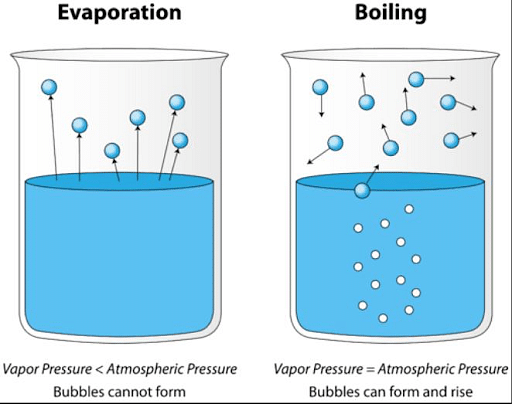
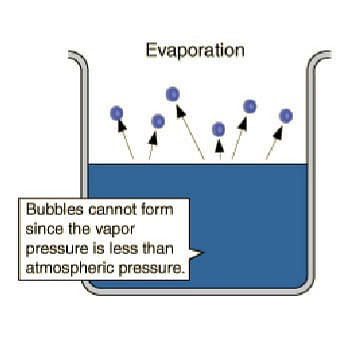
It is a stage of transitioning from the liquid to the vapor phase which is a state of substance or material below the critical temperature that arises. Evaporation happens at temperatures lower than the boiling temperature at a specified pressure, it constantly arises on the surface. That means the water rapidly escapes into the atmosphere that means no formation of bubbles. Drying clothes on the roof is a daily example of evaporation. Evaporation happens only when the limited or incomplete pressure of vapor of a substance or material is lower than the equilibrium vapor pressure.
Evaporation
Boiling
Boiling is comparable to evaporation. It is also termed as the stage transition from the liquid to the gas phase but boiling is the development of vapor as bubbles of high-temperature water underneath the surface of the liquid just like we retain the water jar on a high flame, it fits bubbles and then the steam outflows into the atmosphere. Boiling arises only when the equilibrium vapor pressure of the substance is better than or equal to the environmental or atmospheric pressure. Henceforth, the temperature at which boiling arises is the boiling temperature or boiling point. The boiling point differs with the pressure of the environment or the atmospheric pressure.

Boiling
Sublimation
We all know that initially, ice transforms into liquid and then this liquid goes into steam; though, there is a procedure that directly adapts solidly into gaseous form without turning to the liquid stage. The direct change of solid into the gaseous state is sublimation.

Sublimation
Also Read:
| Related Articles | ||
|---|---|---|
| Ideal Gas Equation | Charles Law Formula | |
| Electron Spin | Aufbau Principle | |
| Phase changes | Critical Pressure | |
Applications of Vaporization
[Click Here for Sample Questions]
The word vaporization was being used in colloquia or hyperbolic manner to allude to the physical damage of an object or element that is visible to intense heat or explosive force, where the object of large mass is divided into minor quantities somewhat then transforming into gaseous form.
Vaporization or Ablation
Vaporization arises when a laser heats the material beyond or corresponding to its boiling point. The high-power densities created by short-pulsed lasers let the vaporization happens with the least thermal destruction to the surrounding material. This, in turn, permits fine features to be formed without the production of any notable heat-affected zone or recast level.

Vaporization or Ablation
Saturated Vapour
When evaporation arises in a closed container, it continues until all the molecules inside the liquid escape. At this juncture, a vapor is supposed to be saturated. The pressure of the saturated vapor is stated in mmHg; this pressure is also termed the saturated vapor pressure. Meanwhile, the molecular pressure and the kinetic energy of every molecule inside the container are high because of the high temperature; thus, added molecules escape the surface, and the saturated vapor pressure also rises.

Saturated Vapour
Vapor Lock
A Vapor lock is a partial or complete intermission or disruption of the fuel flow in an internal combustion engine that is initiated by the formation of vapor or bubbles of gas in the fuel-feeding method. Vapor lock interrupts the operation of the fuel pump, leading to the loss of feed pressure to the fuel injection structure, resulting in transient loss of power or broad stalling and stoppage.

Vapor Lock
Factors Affecting the Rate of Vaporization
[Click Here for Sample Questions]
- Temperature: Vaporization is straight proportional to temperature. As the temperature increases the kinetic energy of the molecules also rises. As an outcome, the force of attraction decreases. Henceforth, with temperature growth, the rate of evaporation raises.
- Surface area: With the growth in surface area, the rate of vaporization also rises as an additional number of particles is exposed to the modification in temperature.
- Pressure: Pressure is in reverse propositional to evaporation. As pressure upsurges, it gets challenging for the particles to gain the essential kinetic energy and escape.
- Wind speed: With an increase in wind speed, the rate also upturns as particles are driven gone by the wind.
Read More About Daltons law of Partial Pressure
Things to Remember
- To effect vaporization, heat must be supplied to a solid or liquid.
- If the surroundings do not supply heat enough, it may come from the system itself in the form of a reduction in temperature.
- The atoms or molecules of a solid or liquid are held together by cohesive forces which must be overcome to separate the atoms and molecules to form the vapour.
- Condensation of vapour to form a liquid or a solid is the reverse of vaporization wherein heat must be transferred from condensing vapour to the surroundings.
Sample Questions
Ques: Explain the process of vaporization. (2 marks)
Ans: Vaporization is a transformation of a substance from the liquid or solid stage into the gaseous stage. If circumstances allow the formation of vapor bubbles into a liquid, the vaporization procedure is known as boiling. Direct conversion from solid to vapor is termed sublimation.
Ques: What are the uses/ applications of vaporization? (3 marks)
Ans: The uses of vaporization are as follows:
- Vaporization or ablation
Vaporization arises when a laser heats the material beyond or corresponding to its boiling point. The high-power densities created by short-pulsed lasers let the vaporization happens with the least thermal destruction to the surrounding material.
- Saturated vapour
When evaporation arises in a closed container, it continues until all the molecules inside the liquid escape. At this juncture, a vapor is supposed to be saturated.
- Vapour lock
A Vapor lock is a partial or complete intermission or disruption of the fuel flow in an internal combustion engine that is initiated by the formation of vapor or bubbles of gas in the fuel-feeding method.
Ques: Describe Electrochemical Vaporization in detail? (3 marks)
Ans: It is a kind of vaporization in which a minor amount of material like 5-100 L of substance is deposited in the electrically conductive vaporization cell. A slight magnitude of electric current is provided to the cell. This originates resistive heating to happen and drying of the sample. After this, a high current is passed for a small time which is about 5 seconds to entirely vaporize the sample.
Ques: How does the Vapor lock arise? (2 marks)
Ans: Vapour procedures due to the boiling of fuel in the fuel frameworks, as the outcome of extreme heating of the engine in warm water or operation of the vehicle in high altitude sections that lowers the boiling point of the fuel because of which the vapor lock arises.
Ques: Mention a few examples of Vaporization from our daily life. (3 marks)
Ans: Few examples of vaporization from daily life is as follows:
- Industrially, salt is improved from seawater by the procedure of vaporization.
- Wet clothes are dried up owing to the procedure of vaporization.
- The procedure is used in several industrial procedures for splitting the components of a combination.
Ques: Why is the water stored in the earthen pots as the term of vaporization? (3 marks)
Ans: The science intricate in this medieval preparation is evaporation. Water is stored in earthen pots particularly in summers to have the water cool. Earthen pots are through up of clay particles and have pores in them. When water is transferred into the pot, it gets evaporated from the pores by captivating heat from the remaining water in the pot. This reasons the cooling of the remaining water in the pot owing to heat loss. Henceforth, water is reserved cool which makes it appropriate for drinking during summers.
Ques: What are the types of vaporization? (3 marks)
Ans: There are three types of vaporization those are:
- Evaporation: It is a stage of transitioning from the liquid to the vapor phase which is a state of substance or material below the critical temperature that arises.
- Boiling: Boiling is comparable to evaporation. It is also termed as the stage transition from the liquid to the gas phase but boiling is the development of vapor as bubbles of high-temperature water underneath the surface of the liquid just like we retain the water jar on a high flame, it fits bubbles and then the steam outflows into the atmosphere.
- Sublimation: We all know that initially, ice transforms into liquid and then this liquid goes into steam; though, there is a procedure that directly adapts solidly into gaseous form without turning to the liquid stage. The direct change of solid into the gaseous state is sublimation.
Ques: What is the entropy of vaporization? (2 marks)
Ans: When one mole of liquid is boiled at its boiling point reversibly, the heat that is absorbed in this process is called the molar heat of vaporization. The entropy change is given by:
ΔSV = ΔHV/ Tb
Where ΔHV is the molar heat of vaporization and Tb is the boiling point.
Ques: What is meant by molar heat of vaporization. (2 marks)
Ans: The molar heat of vaporization can be defined as the change in enthalpy when one mole of liquid is converted into vapour or gaseous state at its boiling point.
Ques: Calculate the entropy change when 1 mole of ethanol is evaporated at 351 K. the molar heat of vaporization of ethanol is 39.84 kJ/mol-1. (2 marks)
Ans: ΔHVap = 39840 J/mol
ΔHV = ΔHVap/ Tb
Tb = 351 K
ΔHV = 39840/ 351
ΔHV = 113.5 Jk-1 mol-1
Ques: What are the factors that influence vaporization? (3 marks)
Ans: The factors that affect vaporization are as follows:
- Temperature: Vaporization is straight proportional to temperature. As the temperature increases the kinetic energy of the molecules also rises. As an outcome, the force of attraction decreases. Henceforth, with temperature growth, the rate of evaporation raises.
- Surface area: With the growth in surface area, the rate of vaporization also rises as an additional number of particles is exposed to the modification in temperature.
- Pressure: Pressure is in reverse propositional to evaporation. As pressure upsurges, it gets challenging for the particles to gain the essential kinetic energy and escape.
- Wind speed: With an increase in wind speed, the rate also upturns as particles are driven gone by the wind.
Also Read:



Comments