



Education Journalist | Study Abroad Lead
Matter and energy together make up our universe. Humans are continuously attempting to understand the relationship between energy and matter, as well as how they interact in everyday life. We need to learn more about this relationship to comprehend it. Even before the first man appeared on the planet, matter existed. Do you realize that all substances found in our environment can be categorized as matter? What exactly is the phenomenon? In this article, we will discuss the definition, characteristics, and sample questions of the topic physical nature of matter.
Read Also:- States of Matter
| Table of Contents |
Keyterms: Matter, Energy, phenomena, photons, waves, atoms, particles
What is matter?
[Click Here for Sample Questions]
Matter exists all around us. From the things we eat and drink to even our own selves, comprises the matter in our universe.
- Matter is defined as any substance that has mass and that takes up space by having a volume in classical physics and general chemistry.
- All touching objects are ultimately made up of atoms, which are made up of interacting subatomic particles, and "matter" refers to atoms and anything made up of them, as well as any particles (or a combination of particles) that act as though they possess both volume and rest mass.
- Matter does not, however, include massless particles like photons, as well as other energy phenomena or waves like light.
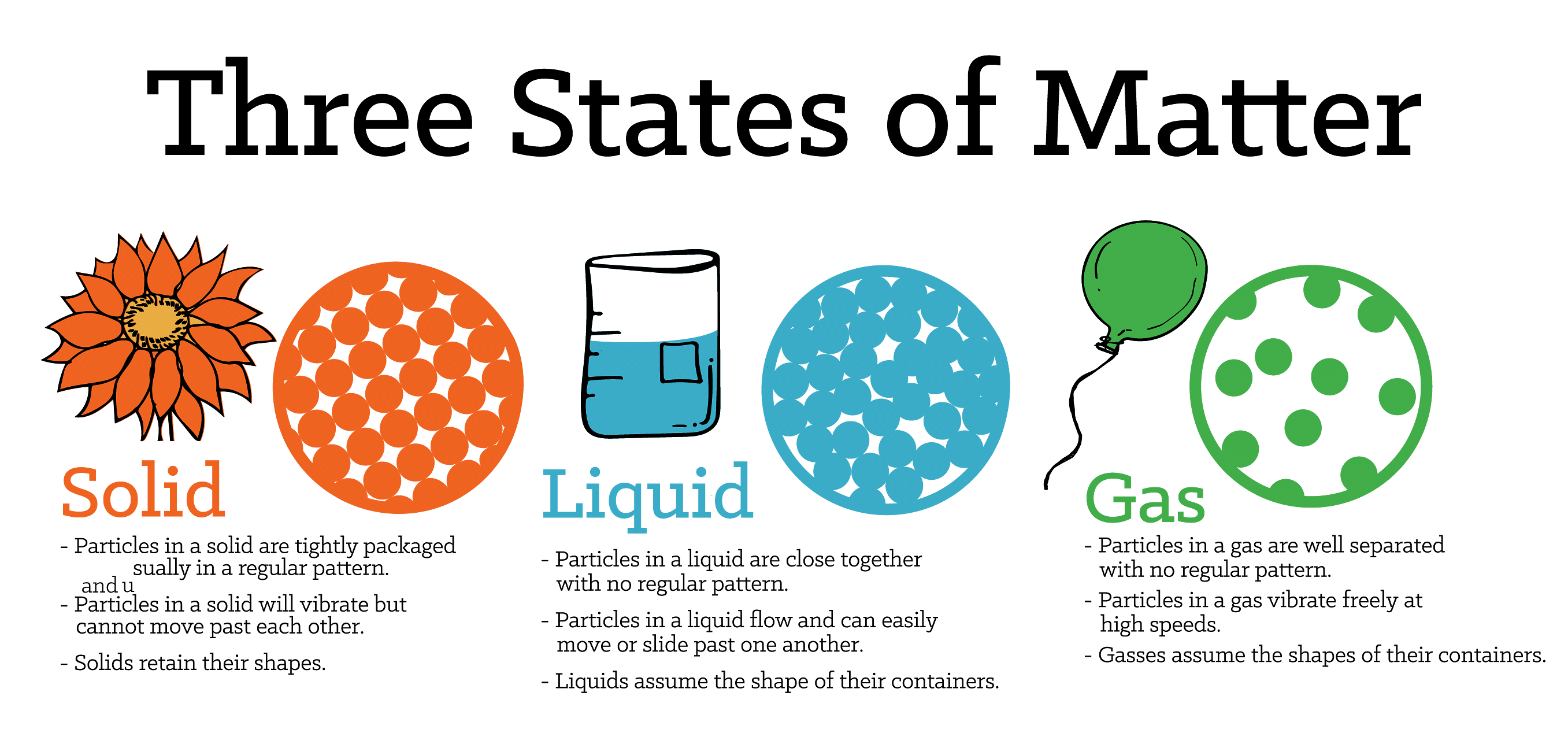
Three states of matter
Classification of Matter
[Click Here for Sample Questions]
Matter can be classified into two categories:
Physical state
Based on the physical state of matter under normal temperature and pressure circumstances, the matter is divided into three types:
- Solid-state
- Liquid state
- Gaseous state
Chemical state
Chemically, matter can also be classified. For example, matter can be divided into pure substances (single element or compound) and impure substances (a mixture of different substances).
- Pure substance- A pure substance is a material that is homogeneous (of the same sort) and has a definite, invariable chemical composition as well as definite, invariable physical and chemical properties.
- Impure substance- Impure substances are made up of various components mixed in any proportion, or more pure substances put together in any proportion. Mixtures are another term for impure things.

Properties of matter
Read More:- Dual Nature of Radiation and Matter
Solid-state of matter
[Click Here for Sample Questions]
Solids are defined by their hardness and rigidity, as well as the fact that they have a defined shape and volume. The following are the essential features of the solid-state:
- Due to the high intermolecular forces of attraction, they have a distinct form.
- Solids are separated by clear lines.
- They have a predetermined volume.
- Solid matter substances are unable to flow.
- As the distance between neighboring molecules is so small, they exhibit little compressibility.
- When exposed to external stress, they tend to maintain their shape.
- They break when pressed, but changing their shape is difficult, thus they remain hard.
- They are dense and do not diffuse in any way.

(Solid (Wooden plank) particles are compacted and have less space between them)
Also Read:
| Related Articles | ||
|---|---|---|
| Thermal Properties of Matter | Three States of Matter | |
| Magnetism and Matter | Properties of Matter | |
| What are Noble Gases? | Atoms and Molecules | |
| Ionic Radius | Electron Gain Enthalpy | |
Liquid state of matter
[Click Here for Sample Questions]
The liquid state of matter is a kind of transition phase that exists between solid and gaseous states. Intermolecular attraction affects liquid particles in the same way that it affects solid particles; however, because liquid particles have more space between them, they are not held in place. The attraction between the particles of a liquid matter maintains the volume of the liquid.
- Liquid has a defined volume and mass.
- Liquids do not have a distinct shape and instead take on the form of the container vessel.
- The attraction between liquid molecules is weaker than that between solid molecules. Liquids can therefore flow.
- In liquids, intermolecular gaps are larger than in solids. Liquids, on the other hand, are slightly more compressible than solids.
- Liquids only have one unoccupied surface.
- The density of liquid matter is lower than that of the solids.
- When heated, liquids expand significantly more than solids, and when cooled, they contract more.
- Depending on the nature of liquid molecules, particles from two different liquids can diffuse into one another.
- Milk and water particles, for example, diffuse in each other, whereas oil and water particles do not.
- Fluidity, not stiffness, characterizes liquids.
- Water, milk, kerosene, gasoline, and alcohol are examples of substances that exist in a liquid state.

Liquid state
Gaseous State of matter
[Click Here for Sample Questions]
The interparticle gaps in the gaseous state are the largest of the three states of matter. The interparticle interactions in the gaseous state keep the various particles together as much as possible. As a result, stiffness is at its lowest, while fluidity is at its highest.
- Gases don't have a predetermined shape.
- Gases have the highest fluidity and the lowest rigidity.
- Gases have no set volume and are extremely compressible.
- The majority of gases are very light.
- Particles in the gaseous state have a very high kinetic energy.
- Exert Pressure Gases Diffuse Quite Quickly
- When gas is kept in a container, it completely fills it.

Particles of gaseous matter
Things to remember
- Everything in our environment is formed of matter. A substance that occupies space and has mass is referred to as matter.
- The mass occupied by a solid per unit volume is the density of a solid.
- Liquids are less stiff than solids, and their molecular mobility is significantly greater in comparison. Both of these properties are due to the presence of reduced interparticle interactions in the liquid state.
- The interparticle gaps in the gaseous state are the largest of the three states of matter.
- The interparticle interactions in the gaseous state keep the various particles together as much as possible.
- The interparticle gaps inherent in various types of matter give rise to the three states of matter.
Read More:- Matter In Our Surroundings
Sample Questions
Ques. What is the difference between Matter's physical and chemical natures? (3 marks)
Ans. Physical attributes are used to classify matter based on its appearance. Every sort of Matter is made up of particles that vary in shape, size, and nature from one another.
Chemical characteristics refer to the classification of matter based on its chemical makeup. A chemical change is required for the measurement or observation of chemical properties.
Chemical attributes include acidity or basicity, combustibility, and other characteristics of various compounds' reactions.
Ques. What is the nature of Matter? (2 marks)
Ans. The matter is made up of minuscule particles. The matter is categorized into three categories based on how these particles are arranged.
Solids, liquids, and gases are the three types. These are also known as Matter's physical states.
Ques. What is the difference between the different nature of matter? (2 marks)
Ans. There are two classifications for the matter. They are:
- Mixtures and
- Pure substances.
Ques. What are the characteristics of matter? (3 marks)
Ans. The four characteristics of matter are as follows:
- Matter has physical qualities such as shape, color, size, and temperature.
- The physical property of Matter's phase (or state) is crucial
- Solid, liquid, and gas are the three primary states of matter.
Ques. What are Matter's physical properties? (5 marks)
Ans. The physical properties of matter are as follows:
- Mass
- Length
- Volume
- Shape
- Melting point
- Boiling temperature
- Color
- Density
Ques. Is it a chemical or physical change that makes anything flammable? (2 marks)
Ans. A chemical attribute is an ability (or inability) to transform one type of matter into another.
Toxicity, Flammability, reactivity, acidity, and heat of combustion are some examples of chemical qualities.
Ques. Is density a physical property or chemical property? (3 marks)
Ans. Physical attributes are general characteristics of matter such as color, density, and hardness.
- Chemical characteristics are properties that define how a substance transforms into an entirely other substance.
- Chemical features include flammability and corrosion/oxidation resistance.
- Hence, density is a physical property.
For Latest Updates on Upcoming Board Exams, Click Here: https://t.me/class_10_12_board_updates
Also Check:



Comments