



Exams Prep Master
Imbibition in seeds is a common phenomenon occurring throughout Biology. The process serves up to be the first and foremost step when it comes to germination of seed. It can be described as the absorption of water by a certain substance that does not lead to the formation of any solution. Wooden doors during rain and swelling of seeds are a common example of imbibition. Let's take a closer look at the determinants affecting imbibition, its importance, and an experiment to get more in-depth knowledge regarding the topic.
| Table of Content |
What is Imbibition?
[Click Here for Sample Questions]
The term imbibition can be defined as a process of diffusion which occurs when absorption of water takes place by solids and colloid substances. This in turn leads to an increase in the volume of water. It plays a crucial role in the germination of a seed by setting a base for the process. Diffusion can be defined as the movement of molecules from a place of a higher concentration, to a place of lower concentration.
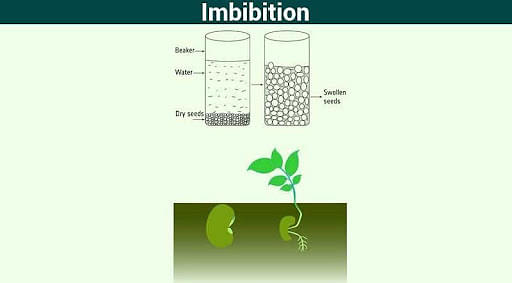
Being a passive transporter of materials, the process does not require any energy. A good example of this is raisins. When dry raisins are kept fully immersed in a beaker or container for some time, after they are removed, an increase is observed in their mass. This happens because they have absorbed water. During this process, water molecules are overloaded and become capable of moving around freely. The kinetic energy of these molecules transforms into heat energy and is released into the atmosphere. This is popularly called humidity.
Factors affecting rate of Imbibition
[Click Here for Sample Questions]
There are certain factors that disrupt the normal flow of imbibition. These are described as follows:
- Nature of imbibant - The nature of the imbibant plays a major role in influencing the rate of imbibition. Nature changes in different organic substances. Starch is known to have a much lesser capacity as compared to proteins which are known for their greater capacity in imbibing. Cellulose is an organic substance with the least capacity to imbibe. It is because of this reason when imbibition takes place, pea seeds swell more than wheat seeds, as the former contains proteins and the latter contains starch.
- Temperature - Temperature is directly proportional to the rate of imbibition. As the temperature increases, the rate of imbibition also increases.
- Concentration of solute - Solute’s concentration is indirectly proportional to the rate of imbibition. When one increases, the other one falls down. For example, if the concentration of the solute is increased, a decrease is witnessed in imbibition. This happens primarily because of a decrease in the diffusion pressure gradient between the imbibant and the liquid being imbibed.
- Surface area - The rate of imbibition is again directly proportional to the surface area of the imbibant. When the surface area shows a rise, the imbibition will also increase.
Signifcance of Imbibition
[Click Here for Sample Questions]
The significance of imbibition is as follows:
- The process of germination of a seed is initiated by imbibition
- When the roots absorb water in the initial stage, imbibition plays a dominant role
- Water retention due to the active presence of fruits also happens because of imbibition
- The transformation of ovules as they ripen into seeds also takes place because of imbibition. It acts as a driving force that pushes water into the ovules
- As imbibition takes place, it releases a force that helps in the cohesion of water to the walls present outside the elements of the xylem.

Experiment
[Click Here for Sample Questions]
Aim of the experiment: To study and analyze the imbibition of water with seeds.
Theory: We can perform this experiment with seeds belonging to three different species. We can take peas for proteins, rice for starch, and groundnut for fats. Remember to peel off the coating of the seed. 4 ml of each kind of seed is taken and is kept in airtight bottles. After these bottles are weighed.
Every kind of seed is to be taken and placed inside a beaker after which an equal quantity of water must be poured keeping in mind that seeds are properly immersed. At an interval of 15 minutes, the seeds are taken out and blotted. By observation, you can see that there is a considerable increase in the weight of seeds.
Result: The percentage increase in weight by each type of seed is determined and plotted graphically.
Explanation: After the dry seeds are peeled off their coats, and put into the water, it causes a physical barrier to absorption. We all know that seeds are responsible for absorbing all the water with the process of imbibition due to the colloidal nature associated with the protoplasm of seeds.
As a result, the seeds become swollen because of the water and now absorption of water is done by osmotic process. The rate of absorption varies in each seed because of its individual and unique nature. They have different protoplasmic elements which monitor and regulate their capacity to imbibe.
We can infer from the outcome that, absorption of water is maximum in the case of seeds with protein and minimum in the case of seeds with fat. This is because proteins have a high affinity towards water, unlike fats which are the least. Starch also absorbs water along the surfaces of hydrophilic colloids apart from cellulose.
You can also take dry raisins and conduct a separate experiment. Swollen raisins definitely show a rise in their mass and it is possible due to imbibition.
Things to Remember
- Imbibition is a process where substances like colloids upon being exposed to water, absorb it, leading to an increase in the volume, without forming a solution. Good imbibing is really necessary to be present in the process like seeds, dry wood, etc. these are generally solid substances that take part in binding.
- There are many factors that may affect the normal flow of this process. These are temperature, nature of the imbibant, solute concentration, and surface area. Temperature and the surface area involved, are directly proportional to the rate of imbibition. One automatically increases when the other shows a rise.
- The process of imbibition is crucial when it comes to absorption of water by the roots, the initial stage of germination, and so on. It is also responsible for the retention of water in fruits. Imbibition only takes place in the presence of adsorbents where the temperature is high.
- Diffusion is a contrast in nature when it comes to imbibition. It can be seen only in liquids, and not in solids. Imbibition, on the other hand, is an irreversible process and doesn't need any semipermeable membrane. It just requires colloidal and hydrophilic substances.
Sample Questions
Ques. What is imbibition? (2 marks)
Ans. When substances absorb all water without forming a solution, the process is called imbibition. For example, swelling of seeds is a common example as it leads to a temporary increase in the volume. This process does not require any energy to take place. When you put dry raisins in water, and bring them out after some time, you can notice a rise in their weight.
Ques. Define germination of seeds. (2 marks)
Ans. Germination is defined as the process by which an organism grows into a seed under healthy conditions. Apart from adequate amounts of temperature, oxygen supply and water, a seed also requires the support of ample light conditions to be able to grow. For instance, most plants are not affected by light, but a seedling cannot grow until there is sufficient exposure to light.
Ques. How is osmosis different from imbibition? (2 marks)
Ans. Imbibition refers to the absorption of water by a solid substance whereas osmosis is the movement of water from a higher point to the lower point. Osmosis takes place with the help of a semipermeable membrane whereas in imbibition semipermeable membrane has no role to play. There is no generation of heat energy in osmosis whereas heat is produced to some extent in imbibition.
Ques. What are the external factors affecting seed germination? (3 marks)
Ans. There are many external factors that cause disturbances in the smooth flow of germination of a seed. These are,
- Water - Insufficient supply of water harms the process as essential nutrients are not supplied to the seed which it requires in order to grow.
- Oxygen - Oxygen plays a crucial role in seed germination as seeds breathe vigorously in the process which gives out energy. This energy is essential for their growth. Lack of oxygen affects the seed badly.
- Temperature - The health of the seed, as well as the growth, is affected if an adequate amount of temperature is not received.
Ques. What are the steps in germination? (2 marks)
Ans. The steps in germination are,
- Imbibition
- Respiration
- Impact of light
- Mobilising reserves
- Growth regulators
Ques. How is temperature important in germination? (2 marks)
Ans. It is evident that temperature plays a great role in influencing the nature of the soil, with relation to water, oxygen, and other components. For an effective process of germination to take place, the temperature must be favorable and fall within an optimal range. The optimal temperature for wheat and corn is 15-30, and 26-32 respectively.
Ques. What is the difference between imbibition and diffusion? (2 marks)
Ans. The process of imbibition is a special type of diffusion process where water is greatly absorbed by colloids and thus leads to an increase in the overall volume. On the other hand, diffusion is the process of movement of particles like ions and molecules along the concentration gradient.
Ques. Give some examples of imbibition in everyday life. (2 marks)
Ans. Some common examples of imbibition are,
- Collapsing of seed coat during germination
- Roots absorbing water
- Wooden doors during rainy season
- Water absorption by hydrophilic colloids
Biology Related Links:



Comments