



Exams Prep Master
Summation is required when a large number of data are concerned. In other words, in order to write a very large number, summation notation is useful. We frequently need to calculate a large number of terms in a sequence. As a result, methods for summarizing a series are crucial in mathematics. Summation notation is highly beneficial for writing a really large number. In simple words, summation notation helps write a short form for the addition of a very large number of data. We use this symbol –, which is called sigma in order to denote summation. Here, we will be discussing the summation formula along with some solved examples and important questions.
| Table of Content |
Read More: Trigonometry Table
What is Summation?
A summation, or sum, is the result of adding all the numbers or quantities supplied in the form of a series arithmetically. An integral number of terms is always present in a summation. It is possible to have as few as two terms or as many as a thousand or even more. Some summations have an unlimited number of terms.
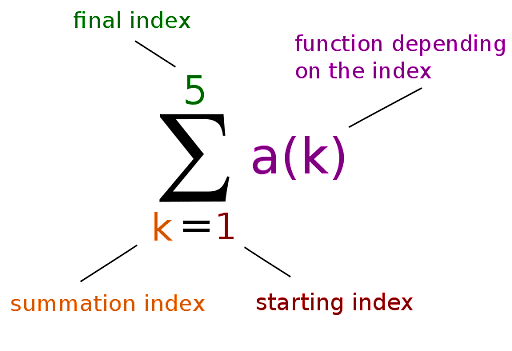
As a result, the summation symbol was created, i.e.
x1+x2+x3+x4+x5+……... xn = ∑ni-n xi
In this section, we'll go over summation notation, often known as sigma notation. We'll start with two integers, n, and m, along with n < m and a list of numbers denoted as follows:
an, an+1, an+2, …, am-2, am-1, am
an+an+1+an+2+…+am-2+am-1+am
This is a complicated notation for huge lists. The aforesaid scenario is depicted as follows.
∑mi=n ai =an+ an+1, an+2 +…+ am-2, am-1, am
i is known as the summation index. This syntax instructs us to add all of the a_i's values.
Also read:
Some Formulas Related to summation
The total of the series is calculated using summation formulas. There are many distinct sorts of sequences, such as arithmetic, geometric, and so on, and thus many different types of summing formulas for diverse sequences. There are also summation formulas for finding the sum of natural numbers, the sum of natural numbers squared, the sum of natural numbers cubes, the sum of even numbers, the sum of odd numbers, and so on.
Read More:
Summarization is frequently required when dealing with vast amounts of data. Summation notation is useful for writing a huge number. Summation is the sequence [1,2,4, 2...] whose value is the sum of each integer in the sequence. To put it another way, summation notation aids in the creation of a short form for the addition of a big quantity of data.
To express summation, we use the sign –, often known as sigma. When a sequence is needed to add from left to right, it could provide a partial sum, running total, or prefix sum as an intermediate result.
For the series of first n natural numbers, i.e., 1,2,3,4,5, ……. the standard word for an arithmetic progression is:
A.P. general word = a, a+ d, a + 2d, a + 3d.....
Also read:
Sum Formula for Arithmetic Progression
For the first n terms, the arithmetic progression sum formula is as follows:
S = n/2 2a+(n - 1) d
Progression sum formula in the above arithmetic:
The total number of terms is n, the common difference is d, and the first term in the series is a.
In the arithmetic Progression sum formula, the formula for calculating common difference 'd' is as follows:
Common Difference (d) = a2 – a1 = a3 –a2 an –an-1
Also Read:
Sum of Geometric Progression Formula
For the above sequence, the sum formula for geometric progression is:
a1, a1 r, a1 r2, ........a1 rn-1, a1 rn is written as:
Sum formula for geometric progression (Sn) = a1 (rn-1)/ r-1 for r≠1
Read More:
Sum of Infinite Series Formula
For the geometric formula with the common ratio r satisfying |r| < 1, the sum of an infinite series formula is:
S∞ = a/1 – r
The sum of the geometric progression formula and the sum of an infinite series formula is written as follows:
Sn is the sum of the G.P terms with n terms.
S∞= Sum of g.p with infinite terms
The common ratio is denoted by the letter r.
n denotes the total number of terms.
a1 = The G.P sequence's terms
r is the common ratio, which is determined as follows:
Common ratio (r) = a2 /a1 = a3 /a2 = an / an-1
Also read:
Summation of Cubes Formula
For the first n natural numbers, 13 + 23 + 33 + 43+ 53........... + n3, the summing of cubes formulas are as follows:
{n(n+1)/2}2
Summation of n Numbers Formula
For natural numbers, the sum of "n" numbers formulas are as follows:
n (n + 1)/2
Read More:
Sum of Even Numbers Formula
The formulas for the sum of even numbers for the first n natural numbers are presented.
S = n (n + 1)
For the first n consecutive natural numbers, the sum of even numbers formula is as follows:
Se = n (n + 1)
Read More:
Sum of Odd Numbers Formula
For the first n natural numbers, the sum of odd numbers formulas are as follows:
n2
Read More:
Things to Remember
- Summation or sigma notation is considered to be the easiest and simplest form of an abbreviation that is used to give precise representation for a sum of the values of a variable.
- The summation sign, which is the Greek uppercase letter S, is denoted by a symbol ∑. The summation symbol (∑) suggests totaling up all the terms of a given sequence.
- General term of an A.P. = a, a+ d, a + 2d, a + 3d…..
- Sum formula for geometric progression (Sn) = a1 (rn-1)/ r-1 for r≠1
- For the first n natural numbers, 13 + 23 + 33 + 43+ 53........... + n3, the summing of cubes formulas are as follows: {n(n+1)/2}2?
Read More:
Sample Questions
Ques: Find the sum of all even numbers from 1 to 100. (2 marks)
Ans: We know that the number of even numbers from 1 to 100 is n = 50.
Using the summation formulas, the sum of the first n even numbers is
n (n + 1) = 50 (50 + 1) = 50 (51) = 2550
The required sum = 2,550.
Read More:
Ques: Find the Sum of the First 10 Odd Natural Numbers. (3 marks)
Ans: Sequence - 1, 3, 5, 7, 9,11, ......
The above given series is A.P., where
a= 1, d= 2, and n = 10
Sum of 10th term will be = n/2 2a+(n−1)d 2a+(n−1)d
S = 10/22×1+(10−1)×22×1+(10−1)×2
= 100
Hence, the sum of the first 10 odd natural numbers will be 100.
Read More:
Ques: An Arithmetic Progression has 23 terms, with the total of the middle three terms being 720 and the sum of the last three terms being 1320. What is the Arithmetic Progression's 18th term? (3 marks)
Ans: The twelfth term will be represented by the average of these three terms, i.e., 720/3 = 240. The twenty-second term will equal the average of the previous three terms, i.e., 1320/3 = 440.
The difference between the twenty-second and the twentieth terms will be ten times the difference, i.e., 440 – 240 = 200/10 = 20. If the twelfth term is 240, the 18th term will be 240 + 6d, which is 240 + 6 * 20 = 360.
Read More:
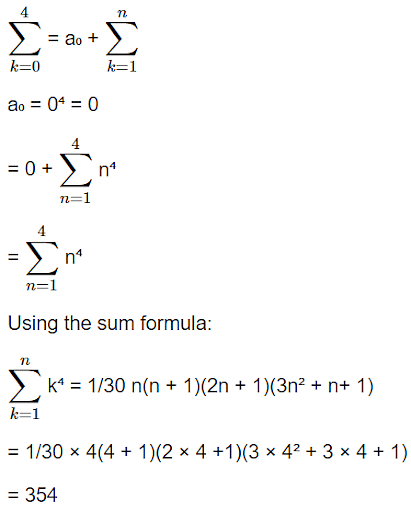
Ques:

(3 marks)
Ans:
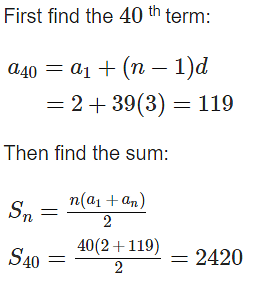
Ques: Find the sum of the first 40 terms of the arithmetic sequence
2,5,8,11,14, ? (3 marks)
Ans:
Read More:
Ques:

(3 marks)
Ans:

Also Read:



Comments