



Education Journalist | Study Abroad Lead
Sympathetic Nervous System refers to a division of the Autonomic Nervous System. The other division is known as the parasympathetic nervous system. They both comprise an extensive neuron network that helps in the regulation of the involuntary processes of the body. Sympathetic nervous system forms adjustments, for instance in response to a rise in temperature, it leads to sweating. The entire system gets activated under certain stressful circumstances. The 'fight or flight' response is governed by the SNS. This response includes the release of epinephrine in large quantities from the adrenal gland. This leads to an increase in the heart rate and causes piloerection or goosebumps. In this article, we will learn more about the sympathetic nervous system, the responses, information transmission through the SNS and its functions.
| Table of Content |
Key Takeaways: Autonomic Nervous System, Sympathetic Nervous System, Blood Pressure, Nerves, Neurons, Spinal Cord, Fight or Flight Response, Epinephrine, Norepinephrine
Autonomic Nervous System
[Click Here for Sample Questions]
The autonomic nervous system controls involuntary actions such as blood pressure or heart rate. The specific processes of the body such as urination, breathing, digestion, blood circulation, etc which are further controlled by the autonomic nervous system. The system is named ‘autonomous’ as it works without any of the conscious effort of a person. It also helps in maintaining the internal environment of the body and is responsible for regulation of various functions and homeostasis. It consists of two systems that act together in a complementary manner:
- Sympathetic Nervous System (SNS)
- Parasympathetic Nervous System (PNS)

Sympathetic Nervous System
[Click Here for Sample Questions]
Sympathetic Nervous System includes many pathways that are adopted by an organism while responding to danger. This includes various actions such as hiding, running, and fighting. These are the actions that are generally used in order to escape the predators. The parasympathetic system on the other hand controls actions related to breeding and feeding.
Sympathetic nervous system structurally consists of multiple nerve cells that are found in the central nervous system and peripheral nervous system. This helps an organism to activate multiple responses all at once that leads to a coordinated fight or flight response. This is helpful for living beings as an ineffective or slow response can lead to an organism's death.
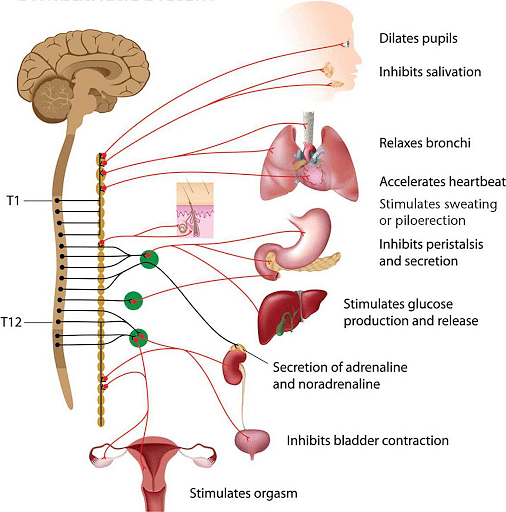
Sympathetic nervous system actions take place according to the other neural or hormonal responses. With respect to human beings, chronic stress can result in a long term stimulation of the fight or flight response. This constantly leads to the production and secretion of catecholamines such as epinephrine along with hormones like cortisol.
A long term secretion of these substances induced by stress can lead to various psychological consequences such as hyperglycemia, or high levels of blood glucose. This can cause type 2 diabetes mellitus, as well as high blood pressure, also known as hypertension that can cause multiple cardiovascular diseases.
Read Also: Difference Between Cerebellum and Cerebrum
Structure
[Click Here for Sample Questions]
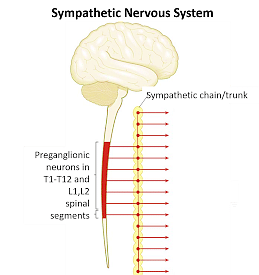
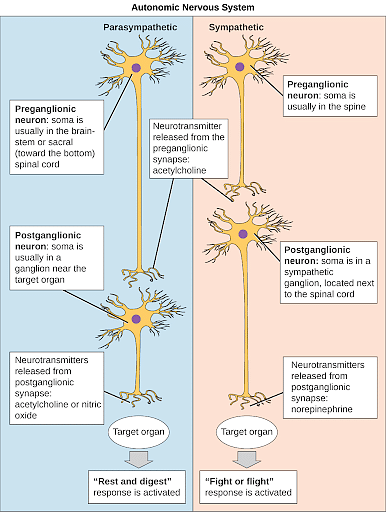
In the sympathetic system, there are two kinds of neurons that transmit any signal. These are preganglionic and postganglionic neurons. Preganglionic neurons are shorter and they originate in the thoracolumbar region of the spinal cord, specifically at T1 to L2-L3. Then they travel towards the ganglion where they synapse with another neuron known as the postganglionic neuron. These neurons then extend to most of the human body.
At these synapses in ganglia, in response to this stimulation, postganglionic neurons in turn release acetylcholine. Acetylcholine is a neurotransmitter that is responsible for activating the nicotinic acetylcholine receptors present on the postganglionic neurons.
The neurons then release norepinephrine and activate the adrenergic receptors present on the peripheral target tissues. The receptors of this target tissue lead to certain effects that are associated closely with the sympathetic system. Therefore, the longer the sympathetic Nervous System stays active, the more noradrenaline and adrenaline is released from the adrenal medulla.
Read More:
Organization of Sympathetic Nervous System
The emergence of the sympathetic nerves takes place from the intermediolateral nucleus of the lateral gray column that is present in the mid of the spinal cord. They extend at the first thoracic vertebra and then extend to the second and third lumbar vertebra.
Read More: Thyroid Gland
Information Transformation in Sympathetic Nervous System
[Click Here for Sample Questions]
Sympathetic nervous system helps in the travelling of messages through a bi-directional flow. Various changes in different body parts can be simultaneously triggered due to different messages. For instance, SNS can accelerate the heart rate, widen the bronchial passages, decrease movement of the large intestine, constrict the blood vessels and increase peristalsis in the oesophagus. This can cause sweating, lead to goosebumps, and raise the blood pressure significantly high.
Certain blood vessels however such as the ones present in the cerebral and coronary arteries dilate rather than being constricted.
Read More: Diagram of Human Brain: Location and Parts of Brain
Functions of the sympathetic nervous system
[Click Here for Sample Questions]
The sympathetic neurons in living organisms are responsible for the up and down regulation of homeostatic mechanisms. SNS fibers innervate tissues at almost every system of organs providing a few regulations of functions that include urinary system functions, pupil diameters, and gut motility. The functions of the sympathetic nervous system depend on whether the system is activated across the body or in a localized manner. SNS helps in maintaining homeostasis through various actions such as altering the cardiac output or sweating to dissipate heat. The functions of SNS are as follows:
- Fight or Flight Response
When the SNS is activated, it prepares an individual for emergency situations. This results in bronchial dilation, an increase in heart rate, dilation of pupils, and an increase in cardiac output. These reactions prepare one to combat danger by increasing one's awareness. It decreases the blood flow in non-essential organs and specifically targets the skeletal muscles. SNS could be activated in response to emotional stress or long-term psychological stress.

- Regulating Body Temperature
SNS also regulates body temperature by changing the flow of blood of skin and by mobilizing the fat reserves in order to enhance the production of heat. It also stimulates the sweat glands to cool down the body.
- Cardiovascular Effects
The cardiac output changes with a change in posture to accommodate the change. In the same way, during intense exercise, our body needs to focus on delivering oxygen and nutrients to skeletal muscle while removing the generated metabolic waste quickly in the tissue. There is a surge of activity of the sympathetic nervous system when a person transitions from sleep to being awake.
Read More:
Response of Sympathetic Nervous System
[Click Here for Sample Questions]
The overall SNS is designed so that the voluntary muscle activity can be enhanced while all the non-essential functions are shut down. Veins and arteries in most of the vascular beds constrict, thereby reducing the flow of blood to the digestive organs and the skin. Sphincters present in the digestive organs also constrict so that the flow of food from one organ to another can be controlled. The cardiac output is enhanced due to the dilation of the coronary blood vessels, parts of the respiratory tree, and pulmonary circulation. The heart, therefore, beats with a great force at a high frequency. Blood pressure is also increased by vasoconstriction in multiple body parts.
Autonomic Nervous System - Sympathetic Nervous System and Parasympathetic Nervous System
For instance, when a person is faced with a charging elephant, the body adapts itself to run rapidly for a longer time period. All these changes to the cardiovascular system are designed as such so that our survival can be ensured. The body responds as such even when the threat is just being observed rather than being experienced like it is experienced also while watching a scary movie.
Hormones and Receptors
[Click Here for Sample Questions]
The three major molecules that are secreted in the sympathetic nervous system such as acetylcholine, epinephrine, and norepinephrine.
- Acetylcholine plays an important role in the synaptic transmission of the electrochemical signals from the presynaptic neurons.
- Epinephrine or adrenaline is a hormone that regulates the visceral functions of the body. It is produced by adrenal glands.
- Norepinephrine is an abundant neurotransmitter that is released by the postsynaptic neurons. It binds to certain receptors in the effector cells.
Also check:
Things to Remember
- Sympathetic nervous system consists of multiple nerve cells found in the CNS and PNS.
- Preganglionic and Postganglionic neurons in the sympathetic system transmit signals in the SNS.
- Sympathetic nervous system actions take place according to the other neural or hormonal responses.
- SNS is mainly responsible for alerting us by activating the fight or flight response.
- The three major molecules secreted in the sympathetic nervous system are acetylcholine, epinephrine, and norepinephrine.
- The functions of the sympathetic nervous system depend on whether the system is activated across the body or in a localised manner.
- SNS fibres innervate tissues at almost every system of organs.
- Its functions include urinary system functions, pupil diameters and gut motility.
Sample Questions
Ques. What is the autonomic nervous system? (3 marks)
Ans. The specific processes of the body such as breathing, urination, digestion, blood circulation, etc are controlled by the autonomic nervous system.
- The system is named so as it works without the conscious effort of a person.
- It maintains the internal environment of the body and is responsible for homeostasis.
- Autonomic Nervous System is also involved in digestion, metabolism, balance of fluids, maintaining breathing rate, urination, etc.
- The autonomic nervous system controls involuntary actions such as blood pressure or heart rate. It consists of two systems, Sympathetic Nervous System (SNS) and Parasympathetic Nervous System (PNS) that act together in a complementary manner
Ques. Explain the components of the general sympathetic pathway. (3 marks)
Ans. The various components of the general sympathetic pathways can be simplified as:
- Preganglionic
The preganglionic components of the sympathetic nervous system have preganglionic neurons that are present inside the spinal cord and axons.
- Ganglionic
The ganglionic component is made up of cell bodies of postganglionic neurons. It has paravertebral and prevertebral ganglia. Paravertebral ganglia are on all the sides of the vertebral column. The prevertebral ganglia are present in the abdominal cavity.
- Postganglionic
The postganglionic fibres make up the postganglionic component. These fibres are greater than the preganglionic ones.
Ques. Describe the effect of the sympathetic nervous system on various parts of the body. (5 marks)
Ans. The sympathetic nervous system has the following effects on the parts of the body:
- Eyes: It causes the dilation of the pupil.
- Skin: SNS causes sweating, goosebumps, and vasoconstriction.
- Heart: It leads to an increase in the heart rate and strengthens the contraction.
- Lacrimal and salivary glands: Sympathetic Nervous System decreases the secretion by these glands.
- Lungs: SNS decreases the secretion of bronchial glands.
- Blood Vessels: It causes vasoconstriction which means it contracts the smooth muscle.
- Genital System: It leads to ejaculation.
- Digestive System: It constricts the blood vessels, contracts the anal sphincters, and redirects the blood to skeletal muscles.
- Gallbladder and Liver: It stimulates the release of energy by breaking down glycogen into glucose.
- Suprarenal Gland: SNS stimulates the release of adrenaline or epinephrine into the blood.
- Urinary System: Sympathetic Nervous System causes a decrease in the production of urine and contracts the internal bladder sphincter.
Ques. Write a short note on the nerves of the sympathetic nervous system. (5 marks)
Ans. The sympathetic Nervous System comprises neurons that are found within the PNS or the peripheral nervous system and the central nervous system. These neurons work to stimulate the organs of the body in response to stress or fear. The two types of neurons are the preganglionic neurons and the postganglionic neurons, also known as ganglion cells.
The term 'ganglia' is used to refer to clusters of neurons that are outside the spinal cord and the brain. These neurons are a part of the autonomic nervous system and they run along the spinal cord.
The preganglionic neurons are located in the spinal cord or the brain stem. They leave the spinal cord through the lumbar and thoracic regions. These neurons then synapse with the postganglionic neurons that are located outside the spinal cord.
The postganglionic neurons then extend out to the targeted organs of the sympathetic nervous system such as sweat glands, stomach, and heart. It triggers certain effects when it is activated.
Ques. State the neurotransmitters within the sympathetic nervous system. (5 marks)
Ans. Neurotransmitters can be understood as the chemical messengers that are transferred through the neurons in the body. The primary neurotransmitter of the preganglionic neuron is acetylcholine.
Acetylcholine is a neurotransmitter that is found in both the peripheral nervous system and the central nervous system. It plays an important role in muscle and brain function.
The preganglionic neurons within the lumbar and thoracic regions present in the spinal cord carry acetylcholine and release the same at the synapses within the ganglia. The neurotransmitter is then taken by the receptors present on the postganglionic neurons located outside of the spinal cord. When this process is activated, the signals extend to the target areas of the SNS and release another neurotransmitter that is known as norepinephrine.
Norepinephrine or noradrenaline is a kind of excitatory neurotransmitter. It stimulates our body by activating the body along with the brain to act during tough times in the fight or flight response that leads to alertness. This chemical is released by the adrenal medulla after it is activated prolongedly from the postganglionic neurons.
Adrenaline or epinephrine is also released by the adrenal medulla after it has been activated for long. It is also an excitatory neurotransmitter like norepinephrine. It enhances the neuronal effects of the sympathetic nervous system when it is released into the bloodstream.
These neurotransmitters encourage the body organs that are involved in the sympathetic nervous system to respond to threats or stressful situations. It causes the blood vessels to open up more allowing more blood to flow in the muscles for the fight or flight response. Therefore when a threat is perceived, it leads to the secretion of epinephrine and norepinephrine from the adrenal medulla thereby mediating the fight or flight response of the body.
Ques. What are some issues or problems with the sympathetic nervous system? (5 marks)
Ans. Though most of the modern-day stress that can trigger the sympathetic nervous system might appear small, it can be interpreted as a potential life threat by our nervous system. If SNS gets activated too frequently, it can have certain long-lasting effects on the human body that results in chronic stress. In a similar way, constant epinephrine surges damage the arteries and blood vessels. This can, in turn, increase the risk of heart attacks and strokes and increase blood pressure.
On the other hand, if the sympathetic nervous system is under-functioning, it can also cause many issues. This might result in under-functioning of the response of a person he times of danger. The person might be unable to recognise danger and therefore are at more risk as they are not alerted by the SNS in various life-threatening situations. This may render them unprepared as there is a lack of blood that is being pumped into the body and the pupils do not dilate. One such disorder is autonomic dysfunction wherein the autonomic nervous system and many of its divisions do not work in a proper manner. This condition can develop when the nerves present in the autonomic nervous system are damaged. The condition can range from being mild to life-threatening.
Ques. What are the differences between sympathetic and parasympathetic nervous systems? (5 marks)
Ans. The main differences between the sympathetic nervous system and parasympathetic nervous system are as follows:
| Sympathetic Nervous System (SNS) | Parasympathetic Nervous System (PNS) |
|---|---|
| SNS is mainly involved in the flight or fight response of the body. | The Parasympathetic Nervous System is involved in permitting rest, maintaining homeostasis, and digestion response. |
| It prepares the body for any kind of potentially dangerous situation. | It works to maintain a sense of calmness in the body. |
| Sympathetic Nervous Systems have a faster response time due to shorter neuron pathways. | PNS has a comparatively slower response time as it has longer neuron pathways. |
| When the system activates the muscles tense up and the heartbeat increases. | The system relaxes the muscles and reduces the heartbeat. |
| During situations when the fight or flight response is activated, adrenaline or epinephrine is released by the adrenal glands. Therefore glycogen is broken down into glucose. | PNS does not have any function in fight or flight situations. |
Ques. What are the functions of the Sympathetic Nervous System or SNS? (5 marks)
Ans. The sympathetic neurons in living organisms are responsible for the up and down regulation of homeostatic mechanisms. SNS fibres regulate the functioning of urinary system functions, pupil diameters and gut motility. SNS helps in maintaining homeostasis through various actions such as altering the cardiac output or sweating to dissipate heat. The functions of SNS are as follows:
- Fight or Flight Response
When the SNS is activated, it prepares an individual for emergency situations. The reactions prepare one to combat danger by increasing one's awareness. It decreases the blood flow in non-essential organs and specifically targets the skeletal muscles.
- Regulating Body Temperature
SNS also regulates body temperature by changing the flow of blood of skin and by mobilizing the fat reserves in order to enhance the production of heat.
- Cardiovascular Effects
The cardiac output changes with a change in posture to accommodate the change. In the same way, during intense exercise, our body needs to focus on delivering oxygen and nutrients to skeletal muscle while removing the generated metabolic waste quickly in the tissue.
Read More:



Comments