



Content Curator
Tendril is a plant organ whose main function is to anchor and support the vine system of the plant. It is a system of rearrangement of different parts of the plant system such as leaves, leaflets, leaf tips, or leaf stipules. It is made of the stem tissue or of leafstock tissue. Tendrils grow from the node of the stem and help the plant to grow with the support of the other plant on which it relies.
| Table of Content |
Key Takeaways: Tendrils, Thigmotropism, Auxin, Effects, Features, Support-structure
Tendril Definition
[Click Here for Sample Questions]
These are spirally coiled structures that develop from either an axillary or a terminal bud. The most assuring example is grapes. They are the thin, connecting thread-like structure supporting itself on the climbing plant systems. They are of two categories, stem tendrils or leaf tendrils based on their growth and support. A tendril doesn't grow in a straight manner however it grows as it comes in contact with a vertical substrate, which then wraps itself around it, grows in height, and also gets better access to light. Their root function is to provide support, an occurrence called thigmotropism.
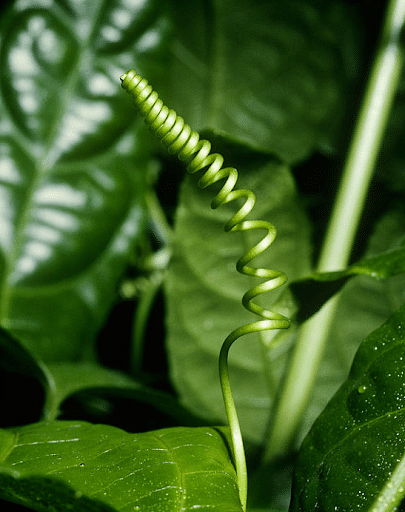
Tendril
Tendrils are defined in botany as a plant organ that is specialized for anchorage and supporting vining stems. They can be modified leaves, leaf tips, leaflets, or stipules. They can also be derived from modified stem branches, such as those found in grapes. Tendrils have a strong attachment to leaves. They circle plant systems in contact. It is thus a slender and whip-like strand that grows from the node of the stem of a vine or plants that climb on objects or other plants. Tendrils' anatomy may resemble that of a leafstalk or a stem tissue.
Characteristics of Tendrils
- Tendrils are touch-sensitive, and they actually bend towards the ground.
- Tendrils encircles itself and clings to it for the effect of stimuli when it comes into contact with an object.
- Sclerenchyma, a strong mechanical tissue, eventually develops in tendrils and supports the vining system, making them strong enough to support the plant's weight.
- Some tendrils develop terminal enlargements when they come into contact with firm surfaces, flattening and secreting an adhesive that actually glues the tendril to the substrate.
Types of Tendril
There are two types of tendrils based on their growth: stem tendrils and leaf tendrils. The stem tendril differs from the modified tendril in that the stem tendril is a modified stem, whereas the leaf tendril is a modified leaflet, leaf, or its part.
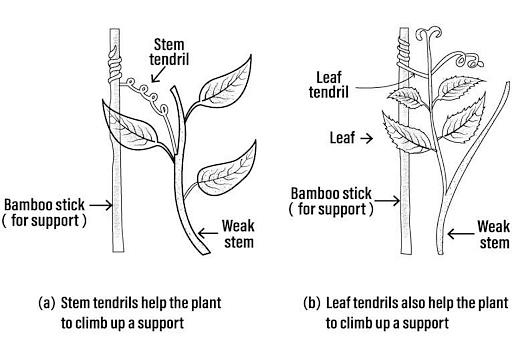
Stem Tendrils and Leaf Tendrils
Functions of Tendrils
The functions of tendrils include:
- They are the modified structure of leaf, stem, or petiole.
- They are the torch-bearers of support. Due to their supportive nature, the plant explores a suitable environment to grow.
- Tendrils are present in plants, including leaves, stems, and branches.
Also Read:
Thighmotropism
[Click Here for Sample Questions]
Thigmotropism is a phenomenon in which plants retaliate to the touch stimulus that can be seen in many climbers. The mutation is its first indication consecutively is its touch support.
Grapes, which are members of the squash or melon family (Cucurbitaceae), Lathyrus odoratus, commonly known as the sweet pea, and passion flowers are all examples of tendril-producing plants also called the Passiflora species.
Role of Auxin in Tendril Growth
[Click Here for Sample Questions]
A growth hormone is produced at the shoot tip. The main function is to promote cell growth by division, allowing the plant to grow its height. Auxin stimulates the cell to grow faster when it comes in contact with the support system. This results in the tendril forming a coil-like structure in its support.
Things to Remember
- A tendril is a slender whiplike or threadlike strand that grows from the node of a stem and allows a vine or other plant to climb. Tendrils are made up of stem tissue or leafstalk tissue.
- The grape, which is a member of the Cucurbitaceae family, the sweet pea also known as Lathyrus odoratus, and passion flowers are all examples of tendril-producing plants of the Passiflora species.
- Their primary function is to support the plant as it climbs a structure. As a result of the increased light, the plant is able to find a more suitable location to grow.
- They are sensitive structures and cling to the plant surface as long as the stimulation lasts. The sclerenchyma in the tissue fosters the weight of the plant.
Also Read:
Sample Questions
Ques: Explain the alteration of plants that forms tendril. (3 Marks)
Ans: Plants that undergo modification for tendril formation are:
- The terminal leaflets of pea plants are modified to form a tendril.
- In yellow vetch, the entire leaf is modified to form a tendril, and the stipules enlarge to facilitate photosynthesis.
- A specialized pitcher trap forms tendril from one end of the Pitcher plant.
Ques: What is the function of tendrils? ?(2 Marks)
Ans: The main function of the tendrils is to provide support to the plant when it is climbing on an object. This enables the plant to grow in a suitable location while receiving the necessary amount of sunlight. When the stems are transformed into tendrils, the stem tendrils assist the plants in climbing. Tendril positions vary between plants, just as leaf, stem, and even branch positions do.
Ques: What is thigmotropism? (2 Marks)
Ans: Thigmotropism, which is observed in many climber plants, is defined as the plant's curve movement in response to a touch stimulus. When tendrils come into contact with an object, they respond to the stimulus and begin circling it. It has a whip-like or thread-like structure as a result of this. The growth of stem and leaf tendrils primarily supports the part to which they are attached and provides support to them.
Ques: What is the effect of Auxin in plants? (2 Marks)
Ans: Auxin is determined by Gibberellins, a growth hormone that enables the length of the plant. Auxin highly influences the orientation of seeds towards the sun. it also controls other actions of the plant cell. Gravity affects the auxin hormone, causing it to accumulate at the bottom. As a result, where there is a high concentration of this hormone, the cells grow. Applying auxin to the cuts, roots can be obtained.
Ques: What is the function of Auxin in plants? (2 Marks)
Ans: Auxin is a plant hormone that is synthesized at the shoot tip and aids in cell growth, thereby promoting plant growth. When a tendril comes into contact with a substance or support, the auxin stimulates rapid cell growth in the opposite direction. This is why the tendril has a coil shape. Auxin promotes cell growth, which allows the plant to grow longer. As a result, auxins play an important role in the growth of tendrils as well as the growth of plants.
Ques: Define Tendril. (2 Marks)
Ans: In botany, tendril is referred to as an organ of a plant which focuses on anchoring and supporting vining stems. Tendrils can be modified leaves, leaflets, leaf tips, or leaf stipules; however, they can also be modified stem branches (e.g., grapes). Other special plant structures serve a similar function, but the tendril is distinct in that it is a specialized lateral organ with a strong twining tendency that causes it to encircle any object encountered.
Ques: Elucidate the biology of tendrils (2 Marks)
Ans: A tendril when is in contact with an object for a long period of time, it tends to wrap itself around it, forming a strong anchor point for the pitcher. In this way, the tendrils aid in the support of the plant's growing stem. Cuscuta, a parasitic plant, uses airborne chemicals to guide its tendrils and only twines around suitable hosts.
Ques: Explain the feature of tendril (2 Marks)
Ans: Tendrils are prehensile and highly sensitive to touch. When lightly stroked on its lower side, the tendril will curve toward that side in a minute or two. When it comes into contact with an object, it turns toward it and wraps itself around it, clinging to it for as long as the stimulation lasts. Tendrils also possess terminal enlargements which in contact with a jelly substance cling to it.
Ques:Name the plant which is modified into a tendril. Who was the first to study Tendril? (2 Marks)
Ans: Pea is a plant that is modified into a tendril. Charles Darwin was the first to study Tendril.



Comments