



Content Curator
A trapezium is a quadrilateral that has one set of parallel opposite sides. The word trapezium is derived from the Greek word "trapeze" which means a table.
- A trapezium is a quadrilateral having two parallel sides of inconsistent length.
- The other two sides are non-parallel in a trapezium.
- The parallel sides are called bases and the non-parallel sides are called legs. It is thus called a trapezoid.
- It is a 2D plane shape and has four sides and four corners.
Key Terms: Trapezium, Trapezoid, Vertices, Angles, Isosceles Trapezium, Scalene Trapezium, Right Trapezium, Irregular Trapezium
What is Trapezium?
[Click Here for Sample Questions]
A trapezium is a 2 dimensional-shaped structure, that has four sides, four corners/vertices, and four angles. Any one set of opposite sides of a trapezium is parallel to one another.
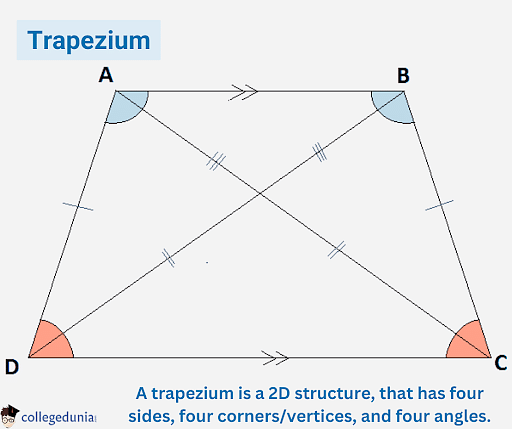
Trapezium
- There are some real-life examples of trapezium shapes that we can see around us. For example, a lamp, pop-corn holder, or ring shaped like a trapezium.
- The parallel sides of a trapezium are known as bases, while the non-parallel sides of a trapezium are known as legs.
- A trapezium is also referred to as a trapezoid.
- Occasionally, the parallelogram is also named as a trapezoid that has two parallel sides.
Read Also:
Types of Trapezium
[Click Here for Sample Questions]
The trapezium is partitioned into three distinct classifications as underneath:
- Isosceles trapezium
- Right trapezium
- Scalene trapezium
![Types of Trapezium]()
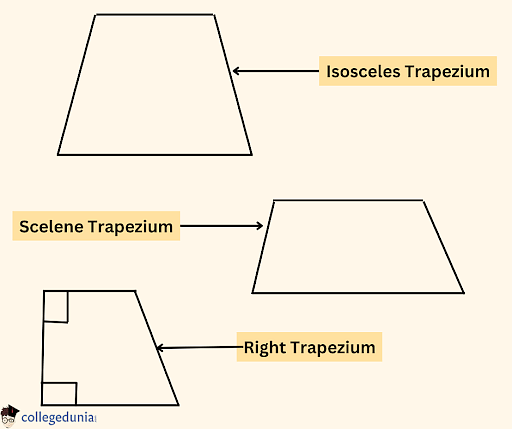
Types of Trapezium
Trapeziums are described based on the length of the legs or the measurement of its angles. The description of each kind of trapezium alongside its shape is given beneath.
Isosceles trapezium
If the legs or the non-parallel sides of the trapezium are of the same length, then, that trapezium is called an isosceles trapezium. It tends to be characterized as a trapezium in which the two legs and base angles are of equal measure. In the diagram below, AD=BC.
Scalene Trapezium
A trapezium with every one of the sides and angles of different measures is called a scalene trapezium. It is a trapezium in which every side is of a different length.
Right Trapezium
A right trapezium is a trapezium that has at least two right angles, adjacent to one another.
Irregular Trapezium
We know, a trapezium has primarily a pair of parallel sides and the other two sides are non-parallel. A regular trapezium will have the other two non-parallel sides equal or similar, whereas an irregular trapezium will have the other two non-parallel opposite sides, unequal.
Also check: Transversal and Angles
Properties of Trapezium
[Click Here for Sample Questions]
Each quadrilateral has its own properties which make it recognizable and different from the rest. The properties of a trapezium are recorded underneath:
- In a trapezium, one set of opposite sides are parallel.
- The diagonals intersect one another.
- The non-parallel sides in the trapezium are inconsistent besides in isosceles trapezium.
- The line that joins the mid-points of the non-parallel sides is parallel with the bases or parallel sides which is equal to half of the sum of parallel sides.
- In an isosceles trapezium, the legs or non-parallel sides are congruent.
- The sum of the interior angles of the trapezium is equivalent to 360 degrees. i.e., ∠A + ∠B + ∠C + ∠D = 360°.
- The sum of the two adjacent angles is equivalent to 180°. This implies that the two adjacent angles are supplementary.
Trapezium Formula
[Click Here for Sample Questions]
The two important formulas of the trapezium are given below:
Area of Trapezium
Let us take a trapezium having the lengths of parallel sides a, and b units respectively, and the elevation "h".
The trapezium area is given by ascertaining the average of bases and multiplying its outcome by the height or altitude.
Area of trapezium = ((AB + DC)/2) × AM =((a+b)/2) × h
where AB and CD show the bases and AM is the height.
Area of Trapezium = ½ x (Sum of Parallel Sides) x (Distance Between Them).
Area of Isosceles Trapezium
In the trapezium ABCD, assuming that a and b are the length of parallel sides, then
a>b
And, c is the length of the two non-parallel sides, while h is the height of an isosceles trapezium.
Thus,
AB = a,
CD = b,
BC = AD = c
Thus,
| Area of isosceles trapezium = 1/2 [√(c2 – (a-b)2) (a+b)] |
Perimeter of Trapezium
The perimeter of a trapezium is the sum of all four sides.
Mathematically, Perimeter of Trapezium = (AB + BC + CD + AD)
Where, “AB”, “BC”, “CD” and “AD” are respective sides of trapezium ABCD.
Perimeter of Isosceles Trapezium
In an Isosceles trapezium, assuming that a and b are the length of the parallel sides, while c is the length of two non-parallel sides, then the perimeter will be:
Perimeter = a + b + 2c
Read More: Straight Lines
Trapezium and Trapezoid
[Click Here for Sample Questions]
The trapezium is a four-sided polygon that has exactly one pair of parallel sides opposite to one another.
A trapezoid, like a trapezium, is a four-sided polygon as well but with one pair of parallel sides opposite to one another. The parallel sides are the bases, along with the other two sides the legs of the trapezoid.
Trapezium and Trapezoid are the same and are often used interchangeably.
How to Determine the Angles of Trapezium?
In case of a regular or isosceles trapezium, the sets of angles which are adjoined by parallel lines are equivalent.
- For any quadrilateral, the sum of all interior angles is equal to 360 degrees.
- Hence, if an angle x is given between one parallel side, along with one non-parallel side, then subtracting twice the angle from 360 can give the sum of two angles on the formed opposite side of x.
- Once found, dividing the sum by 2 will yield the measure of the fourth angle.
Things to Remember
- A trapezium can be described as a four-sided closed figure with one set of parallel sides opposite to one another and the other set of sides are non-parallel.
- It is a quadrilateral, which is curved in shape and has 4 sides, 4 angles, and 4 vertices.
- The sum of the angles present interiorly is 360 degrees.
- The adjacent sides' angle is 180 degrees and the diagonals of this construction intersect one another.
- Area of Trapezium = ½ x (Sum of Parallel Sides) x (Distance Between Them).
- Perimeter of Trapezium = (AB + BC + CD + AD)
Read Also:
Sample Questions
Ques. Do Diagonals bisect each other in a Trapezium? (1 mark)
Ans. No, the diagonals of a trapezium probably won't bisect one another. If the diagonals are bisecting, the trapezium will be a parallelogram. Thus, every parallelogram is a trapezium but every trapezium probably won't be a parallelogram.
Ques. Are the Diagonals of a Trapezium Equivalent? (1 mark)
Ans. No, the diagonals of a trapezium may not be equal. For a trapezium, just one set of its sides is parallel. However, for any quadrilateral to have equal diagonals, two sets of sides need to be parallel like in a square, square shape, and so on.
Ques. Find the Border of Trapezium ABCD Whose Side Measures 100 cm, 120 cm, 140cm, and 160 cm separately. (2 marks)
Ans. The side of the Trapezium = Amount of everything on four sides.
= 100 cm + 120 cm +140 cm + 160 cm
= 520 cm.
Ques. Find the length of the line that joins the midpoints of non-parallel sides of a trapezium whose proportion of bases is 40 cm and 60 cm. (2 marks)
Ans. The length of the line that joins the midpoints of non-equal sides of the trapezium is given by: EF = (AB+CD)/2
Here, AB = 40 cm and CD = 60 cm
Thus, EF =(40+60)/2
=100/2
= 50 cm
Ques. Find the area of a trapezium whose parallel sides are 240 cm and 200 cm and the distance between them is 150 cm. (2 marks)
Ans. Area of a trapezium= ½ × (Sum of parallel sides) × (Distance between them)
={½ × (240+200) × 150} cm2
=(½ × 440 × 150) cm2
=(220 × 150) cm2=33000 cm2
Hence, the area of the trapezium is 33000 cm2.
Ques. The shape of the top surface of a table is a trapezium. The parallel sides are 100 cm and 140 cm and the altitude is 90 cm. Find its area. (3 marks)

Ans. Area of a trapezium=½ × (Sum of parallel sides) × (Distance between them)
={12 × (1 + 1.4) × 0.9} m2
=(12 × 2.4 × 0.9) m2
=(1.2 × 0.9) m2
=1.08 m2
Hence, the area of the top surface of the table is 1.08 m2.
Ques. The area of a trapezium is 1080 cm2. If the lengths of its parallel sides are 50 cm and 30 cm, find the distance between them. (3 marks)
Ans. Let the distance between the parallel sides be x.
Now,
The Area of trapezium = {1/2×(50+30)×x} cm2
=(½ × 80 × x)cm2 = 40x cm2
Area of the trapezium=1080 cm2
As per the given data, 40x =1080
⇒ x = 1080/40
⇒ x = 27cm
Hence, the distance between the parallel sides is 27 cm.
Ques. A field is in the shape of a trapezium. Its area is 1586 m2 and the is 26 m. If one of the parallel sides is 84 m, find the other. (3 marks)
Ans. Let the length of the required side be x cm.
Now,
Area of trapezium={12×(84+x)×26} m2
=(1092+13x) m2
Area of Trapezium = 1586 m2
As per the given data,
1092 + 13x =1586
⇒13x = (1586−1092)
⇒13x = 494
⇒x = 494/13
⇒x = 38 m
Hence, the length of the other parallel side is 38 m.
Ques. The area of a trapezium is 1800 cm2 and its height is 90 cm. If one of the parallel sides is longer than the other by 10 cm, find the two parallel sides. (3 marks)
Ans. Let the lengths of the parallel sides be x cm and (x + 10) cm.
Now, Area of trapezium={½ × (x + x + 10) × 90} cm2
=(½ × (2x + 10) × 90) cm2
=45(2x+10) cm2=(90x+450) cm2
Area of trapezium = 1800 cm2
Thus, as given,
90x+450 = 1800
⇒90x = (1800−450)
⇒90x=1350
⇒x=1530/90
⇒x=15
Hence, the lengths of the parallel sides are 15 cm and 25 cm, that is, (15+10) cm.
Ques. In a trapezium-shaped field, one of the parallel sides is twice the other. If the area of the field is 9450 m2 and the perpendicular distance between the two parallel sides is 84 m, find the length of the longer parallel sides. (5 marks)
Ans. Let the lengths of the parallel sides be x cm and 2x cm.
Area of trapezium={12×(x+2x)×84} m2
=(12 × 3x × 84) m2
=(42 × 3x) m2
=126x m2
Area of the trapezium=9450 m2
As per the data,
126x = 9450
⇒x = 9450/126
⇒x = 75
Thus, the length of the parallel sides are 75 m and 150 m, that is, (2 × 75) m, and the
length of the longer side is 150 m.
Ques. In the given figure, ABCD is a trapezium in which AD||BC, ∠ABC = 90°, AD = 16 cm, AC = 41 cm and BC = 40 cm. Find the area of the trapezium. (5 marks)

Ans. ∠ABC=90°
From the right ΔABC, we have:
AB2 = (AC2−BC2)
⇒AB2 = {(412)−(402)}
⇒AB2 = (1681−1600)
⇒AB2 = 81
⇒AB = 9 cm
∴ Length AB = 9 cm
Now, Area of the trapezium = {12 × (AD+BC) × AB}
= (12 × (16 + 40) × 9) cm2
= (12 × 56 × 9) cm2
= (28×9) cm2
=252 cm2
Hence, the area of the trapezium is 252 cm2.
Check-Out:



Comments