



Content Curator
Two-dimensional coordinate geometry is used to mark the coordinates in two planes that are x and y-axis. This can be used to measure the distance between the two points and the segments formed by another point can also be calculated by using the sectional formula.
| Table of Content |
Key Takeaways: Coordinate Geometry, Coordinate Planes, Sectional Formula, Algebra
What is Two-Dimensional Coordinate Geometry?
[Click Here for Sample Questions]
Two-dimensional coordinate geometry comprises both the study of graphs as well as x and y coordinate planes. There are two axes in the coordinate planes, the horizontal one is the x-axis and the vertical is the y-axis. The point on the coordinate planes can be represented by p(x,y) as shown in the diagram. In this diagram, the origin is represented by O. The two-dimensional coordinate is essential as it helps locate the points and combines algebra and geometry.
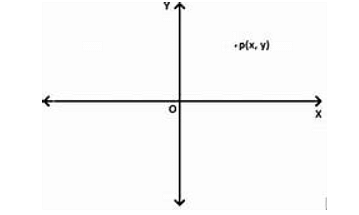
A point on a coordinate plane
The video below explains this:
Coordinate Geometry Detailed Video Explanation:
Read more:
Coordinate Geometry to Locate Points
[Click Here for Sample Questions]
With the help of a two-dimensional coordinate geometry, you can easily locate the points. For eg: if the point is marked as (3,5) then it means that the point is 3 units away from the x-axis and 5 units away from the y-axis. For a point that lies on the x-axis will be 0 for the y-axis and for a point that lies on the y-axis, it will be 0 for the x-axis. Some of the examples for this are point (0,6) will lie on the y axis and a point (7,0) will lie on the x-axis.
Read Also:
Distance Between Two Points
[Click Here for Sample Questions]
Coordinate geometry can be used to find the distance between two points in two dimensions.
Let us assume that the points given are A (x1, y1) and B (x2, y2) on the x-y plane. Then the formula to find out the distance between the two points is:
AB = \(\sqrt{(x_2 -x_1)^2 + (y_2-y_1)^2}\)
For eg: A (5,7) and B (2,5)
Then AB = \( \sqrt{(2-5)^2 + (5-7)^2}\)
\( \sqrt{(-3)^2 +(-2)^2} \)
\(\sqrt{9+4} \)
\( \sqrt13 \)units
Reflection of Points
[Click Here for Sample Questions]
To find the reflection of the points for the x and y-axis you have to change the sign of the y-coordinate and x-coordinate respectively. For eg: if the point is given as P (x,y) for the reflection on the x-axis, the coordinates will be P (x, -y) and for the reflection on the y-axis the coordinates will be P( -x, y).
Read Also: NCERT Solutions for class 10 Mathematics chapter 7: Coordinate Geometry
Sectional Formula
[Click Here for Sample Questions]
Two-dimensional coordinate geometry is also used if the ratios of a segment are given and you need to find the coordinates. This is called the sectional formula.
Let point A be (x1, y1) and B is (x2, y2) and Q (x, y) is any point on the segment which divide the segment in a ratio such that AQ:QB = m:n.
Condition 1:
If the ratio of m : n is formed internally in AB, then the coordinates (x,y) can be calculated by;
[ \(\frac{mx_2+nx_1}{m+n}\) , \(\frac{my_2+ny_1}{m+n}\)]
Condition 2:
If the coordinates P (x,y) divides the line segments AB externally, then the formula for the coordinates is;
[\(\frac{mx_2-nx_1}{m-n}\) , \(\frac{my_2-ny_1}{m-n}\)]
Condition 3:
If the coordinates P (x,y) divides the segments AB into equal ratios, that is, m = n, then the x,y coordinates can be calculated by;
(\(\frac{x_1+x_2}{2}\), \(\frac{y_1+y_2}{2}\))
Read more:
Things to Remember
[Click Here for Sample Questions]
- Two-dimensional coordinate geometry can help in locating specific points on the XY planes.
- It can be used during the formation of graphs.
- Distances between two points can be calculated by the formula;
AB = \( \sqrt{(x? -x?)² + (y?-y?)²} \)
- The sectional formula is useful to find the coordinates of a point that divides the segment into two ratios.
Read more:
Sample Questions
Ques. Calculate the distance between A (5, 6) and B (8, 1). (2 marks)
Ans. AB = \(\sqrt{(x_2 -x_1)^2 + (y_2-y_1)^2}\)
= \(\sqrt{(8-5)^2 + (1-6)^2}\)
=\( \sqrt{ 9 + 25} \)
= \(\sqrt 34 \)units
Ques. There are two points A (4,7) and B (6,1). A point P within the segments cuts it in an equal ratio. Find the point P. (3 marks)
Ans. The point P can be calculated by the formula;
(\(\frac{x_1+x_2}{2}\), \(\frac{y_1+y_2}{2}\))
x = \(4+6 \over 2\) and y = \(7+1 \over2\)
x = \(10\over2\) and y = \(8 \over 2\)
= 5 and 4
Therefore, the coordinates of point P is (5,4).
Ques. Find the ratio in which y-axis divides the line segment joining the points A (5, -6) and B (-l, -4). Also find the coordinates of the point of division. (5 marks)
Ans. let us assume that the point on the y axis is P (0,y) and AP:PB = k:1
Therefore, the coordinates of P can be given by (\(\frac{mx_2+nx_1}{m+n}\), \(\frac{my_2+ny_1}{m+n}\))
Then, taking x axis of A,B = \(51+k(-1) \over k+1\)=0
=\(51+k(-1) \over k+1\)=0, k=5
Hence, the ratio is 5:1
Now, taking the y axis, y = \((-4)(5) + (1)(-6) \over 5+1\) = -\(13 \over3\)
Hence, the point on the y axis is 0, -\(13 \over3\)
Ques. For what values of k are the points (8,1), (3, -2k) and (k, -5) collinear? (3 marks)
Ans. Points that need to be collinear should have the area of the triangle as 0.
\(1 \over 2\) [x1(y2 – y3) + x2(y3 – y1) + x3(y1 – y2)] = 0
8(- 2k + 5) + 3( – 5 – 1) + k(1 + 2k) = 0
-16k + 40 – 18 + k + 2k2 = 0
2k2 – 11k – 4k + 22 = 0
(2k – 11) (k – 2) = 0
k = 2, k = \(11\over 2\)
Ques. If the points P(-3,9), Q(a, b) and R(4, -5) are collinear and a + b = 1, find the value of a and b. (3 marks)
Ans. Since all the three points are collinear, the area of the triangle should be 0
\(1\over2\)[x1(y2 – y3) + x2(y3 – y1) + x3(y1 – y2)] = 0
\(1\over2\)[-3(b+5)+a(-5-9)+4(9-b)]
-3b-15-14a+36-4b=0
2a+b=3
And it is given that a+b=1
By solving the two equation, a = 2, b = -1
Ques. If A(5, 2), B(2, -2) and C(-2, t) are the vertices of a right angled triangle with ∠B = 90°, then find the value of t. (5 marks)

Ans. ABC is a right angled triangle,
∴ AC2 = BC2 + AB2 ……… (i)
Using distance formula,
AB2 = (5 – 2)2 + (2 + 2)2
= 25
BC2 = (2 + 2)2 + (t + 2)2
= 16 + (t + 2)2
AC2 = (5 + 2)2 + (2 – t)2
= 49 + (2 – t)2
Putting values of AB2, AC2 and BC2 in equation (i), we get
49 + (2 – t)2 = 16 + (t + 2)2 + 25
∴ 49 + (2 – t)2 = 41 + (t + 2)2
⇒ (t + 2)2 – (2 – t)2 = 8
⇒ (t2 + 4 + 4t – 4 – t2 + 4t) = 8
8t = 8 ⇒ t = 1
Ques. If the point P(x, y) is equidistant from the points A(a + b, b – a) and B(a – b, a + b), prove that bx = ay. (5 marks)
Ans. PA = PB
PA2 = PB2 … [Squaring both sides]
⇒ [(a + b) – x]2 + [(b a) – y)]2 = [(a – b) – x]2 + [(a + b) – y]2
⇒ (a + b)2 + x2 – 2(a + b)x + (b – a)2 + y2 – 2(b – a)y = (a – b)2 + x2 – 2(a – b)x + (a + b)2 + y2 – 2(a + b)y ……….. [? (a – b) 2 = (b – a)2]
⇒ -2(a + b)x + 2(a – b)x = -2(a + b)y + 2(b – a)y
⇒ 2x (-a – b + a – b) = 2y (-a – b + b – a)
⇒ -2 bx = – 2 ay
⇒ bx = ay
Ques. For what value of k will k + 9, 2k – 1 and 2k + 7 are the consecutive terms of an A.P.? (2 mark)
Ans. a2 – a1 = a3 – a2
2k – 1 – (k + 9) = 2k + 7 – (2k – 1)
2k – 1 – k – 9 = 2k + 7 – 2k + 1
k – 10 = 8
∴ k = 8 + 10 = 18
Ques. Find the relation between x and y if the points A(x, y), B(-5, 7) and C(-4, 5) are collinear. (2 marks)
Ans. when the points are collinear, the area of the triangle is 0.
= [x1 (y2 – y3) + x2 (y3 – y1) + x3 (y1 – y2)] = 0
= x (7 – 5) – 5 (5 – y) -4 (y – 7) = 0
= 2x – 25 + 5y – 4y + 28 = 0
∴ 2x + y + 3 = 0 is the required relation.
Ques. Show that the points (-2, 3), (8, 3) and (6, 7) are the vertices of a right triangle. (2 marks)
Ans. Let A (-2, 3), B(8,3), C(6, 7).
(AB)2 = (8 + 2)2 + (3 – 3)2 = 102 + 02 = 100
(BC)2 = (6 – 8)2 + (7 – 3)2 = (-2)2 + 42 = 20
(AC)2 = (6 + 2)2 + (7 – 3)2 = 82 + 42 = 80
Now, (BC)2 + (AC)2 = 20 + 80 = 100 = (AB)2
By converse of Pythagoras’ theorem
Therefore, Points A, B, C are the vertices of a right triangle.
Read Also:



Comments