



Education Journalist | Study Abroad Lead
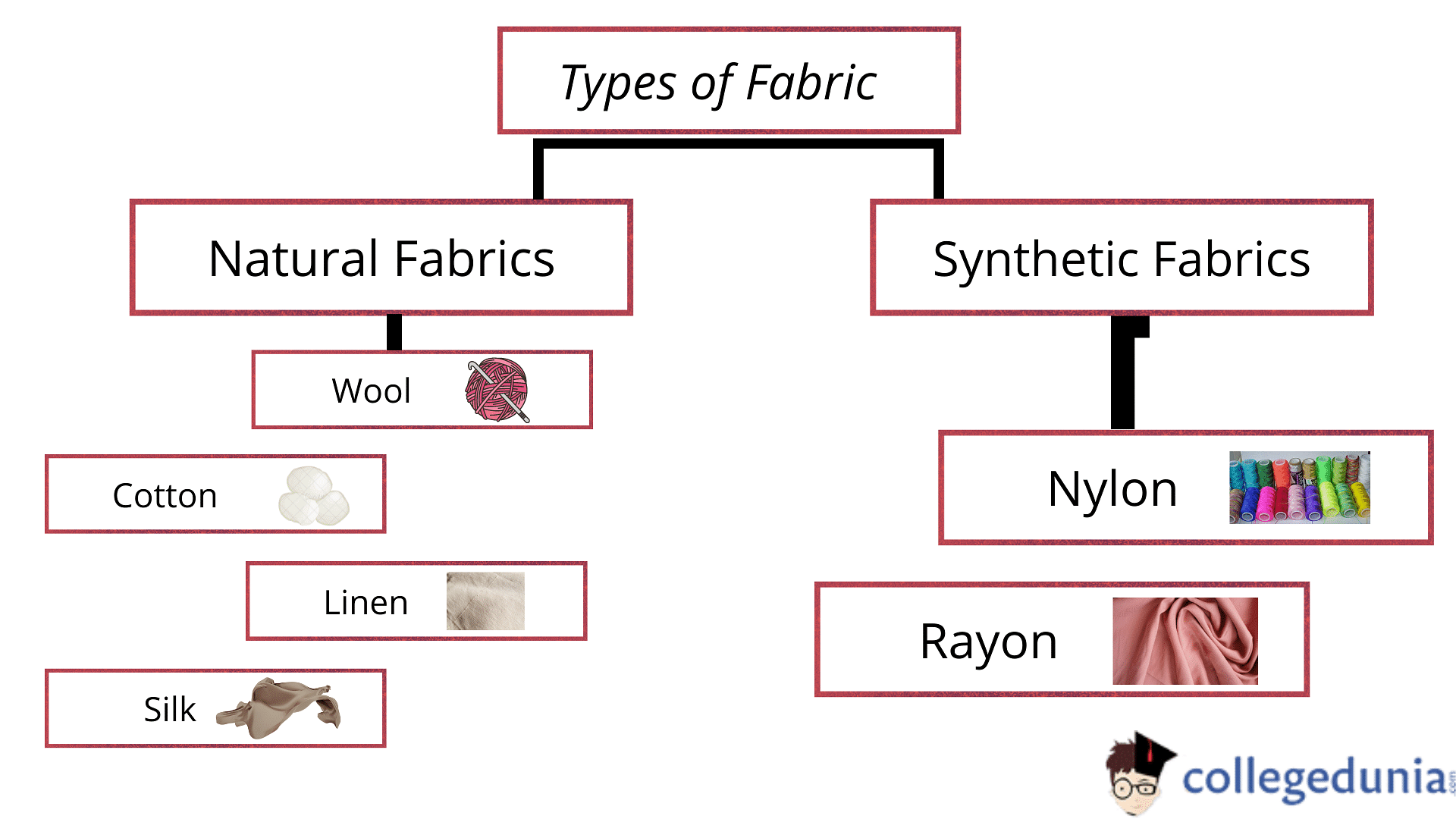
On a daily basis, we come into contact with a variety of fabrics. Based on the type of fibers from which they are derived, textiles may be divided into two categories namely, synthetic and natural textiles. The fabric obtained from natural fibers can be classified as Natural Fabric. For example, from the cotton plant, we can obtain cotton fiber, from a silkworm’s cocoon, silk fiber is obtained. The fabrics formed through the help of chemical processes are known as Synthetic fabrics and are also called Man-Made Fabrics. This includes velvet, nylon, felt, rayon, etc.
| Table of Content |
Key Terms: Natural Fabrics, Synthetic Fabrics, Nylon, Rayon, Cotton, Silkworm
What are Fabrics?
[Click Here for Sample Questions]
Fabrics are clothing materials made by weaving or knitting threads. It is obtained from the yarn.
- Fabrics are made from tiny thread-like fibers that are twisted to make a yarn.
- The characteristics of fabrics vary with the type of fiber used and its treatment.
- Examples of Fabrics – Cotton, rayon, satin, and denim.
- Fabrics are mainly classified as natural and synthetic fabrics
Read More:
Types of Natural Fabrics
[Click Here for Sample Questions]
The fabrics that are naturally produced using raw materials are known as Natural Fabrics. The different kinds of Natural Fabrics are as follows:
Silk
Silk is a fiber that is derived from natural resources. It is obtained from the cocoons of the silkworm. Although there are many insects that can produce silk, but for the manufacturing of textiles, silk is derived only from the moth caterpillar. Silk is used for making silk sarees, wall hangings, Surgical sutures, etc.
Linen
From the fibers of the flax plant, linen is made. It is a natural fiber but takes more time to harvest. The weaving of the flax fibers is very difficult hence it takes a longer time to make it into a fabric. This fabric is commonly used in the making of tablecloths, towels, bedsheets, napkins, etc.
Cotton
From the natural fibers of cotton plants, cotton fabric is made. The fiber of the cotton grows with the seed of the plant. When these fibers are ready, they are plucked from the plant and then spun into a yarn. This yarn is further woven into the required fabric. Cotton's unique properties of strength, durability, and absorbency are due to the way its cellulose is organized.
Wool
From animals like sheep, wool fibers are obtained which are further converted to wool fabrics. This wool fabric is used in the manufacturing of items like carpets, blankets, shawls, etc. The ability to trap heat makes the wool fabric most useful in cold areas in order to keep the wearer warm.
Types of Synthetic Fabrics
[Click Here for Sample Questions]
Synthetic fabrics are produced from man-made or artificial materials or Synthetic fibres. Some important types of synthetic fabrics are as follows:
Nylon
Nylon is a fabric made from a polymer that is made of synthetic fiber. The fibers of nylon are easy to wash and have excellent toughness and high tensile strength. As nylon fabrics are stretchable hence they are used in the manufacturing of sportswear, stockings, and socks.
Rayon
Fibers from naturally derived cellulose are used to create rayon which is a synthetic fabric. Unlike Nylon, rayon is obtained from a natural resource or natural raw material and hence is not fully considered a Synthetic fiber. It shows some properties similar to cotton, wool, silk, and other fabrics and thus can be used in the manufacturing of clothes. The products thus obtained are very comfortable, soft, and quite absorbent.
Different types of fabrics have varying properties that strongly influence how one treats their clothing. For example, the fiber content in one fabric will influence how to clean the cloth which will be different from another fabric’s fiber content.
Things to Remember
- On the basis of the fabrics used, the textiles are divided into natural and synthetic fabrics.
- Silk is derived from the cocoon of the silkworm.
- Natural fibres are obtained from plants and animals.
- Natural fibers include silk, linen, cotton, and wool.
- Synthetic fabrics are clothing materials made of artificial fibres such as nylon and rayon.
Sample Questions
Ques 1: Why do we need clothes? (3 marks)
Ans: Clothes are needed as:
- They help us to maintain our body temperature.
- They also protect us from harmful bacteria and dirt.
- Our body is protected from extreme weather conditions like rain, cold, or heat with the help of clothes.
Ques 2: What are the 3 qualities of cotton fibers? (3 marks)
Ans: The 3 qualities are:
- Cotton is a smooth and soft fiber
- It can be dyed into other colors.
- It absorbs sweat and water
Ques 3: What are the qualities of Jute? (3 marks)
Ans: The qualities of Jute are:
- It is Strong
- Durable
- It can be recycled.
- It is 100% biodegradable
- Other fibers can easily be combined with Jute
Ques 4: Write the properties of synthetic and cotton clothes. (5 marks)
Ans: The properties of Synthetic clothes are:
- Not friendly to skin
- Durable
- Moth resistant
- crease- resistant
- Cheap
- Soft
- Comfortable
- Easily creasable
- Have no pronounced luster
- Good absorbent of moisture
Ques 5: Define Loom. Write the difference between the power loom and handloom. (3 marks)
Ans: A loom is a machine that weaves yarn or threads to make fabrics. The difference between a power loom and handloom is:
- Powerloom: The machine runs on the supply of power. It is used in the clothing industry for the production of clothes on a large scale.
- Handloom: The machine is operated manually.
Ques 6: Explain how cotton yarn is manufactured. (3 marks)
Ans: Cotton is manufactured using the following steps:
- The dried leaves and straws are removed from the raw cotton by loosening and cleansing it.
- The cleansed cotton is then put into the machine which transforms the fibre into a silvery rope-like structure.
- The obtained fibre of cotton is then spun into yarn with the help of equipment. The silver is turned into yarn in this final step.
Ques 7: Name different types of fabrics that are obtained from plant and animal resources. (3 marks)
Ans: The fabrics obtained from plant resources are:
- Jute
- Flax
- Wool
- Silk
Check out:



Comments