



Content Curator
Silkworms are referred to as the larva of a moth, i.e., Bombyx mori, native to Asia. It spins a cocoon of fine, strong, lustrous fiber from where commercial silk is produced. The culture of silkworms is known as sericulture. Silkworms generally feed on the leaves of the mulberries (genus Morus) and sometimes on the Osage orange (Maclura pomifera).
Also read: NCERT Solutions for Class 7 Science
What are Fibers?
[Click Here for Sample Questions]
Thin and long thread-like materials are called fibres. Fibres can be divided into two - natural and artificial fibres. The fibres which are obtained from nature or living beings are called natural fibres. Artificial fibres are made in factories or laboratories. Both plants and animals produce fibres. Cotton and jute are two plant-made fibres and silk and wool are animal-made ones. The fleece of sheep gives wool and the cocoon of the silkworm gives silk.

Read more:
History of Silk
[Click Here for Sample Questions]
The history of silk-making could be traced back to China. People in China knew this art since 2500 BC which they kept a secret to maintain a monopoly in silk trading. However, the opening up of the Silk Road changed the picture. The secret of silk-making soon spread to India and Korea and later to Europe. Still, China is the market leader in silk production in the world. The developments in science and technology and later the industrial revolution made it possible to develop multiple varieties of silks. Varieties in lustre and texture boosted the sales of silk worldwide.
Features of Silk
[Click Here for Sample Questions]
Some of the characteristic features of silk are as follows:
- Silk is known for its strength, lustre, and texture
- Silk is light-weighted, smooth, flexible, and elastic
- Water weakens fibre and is hence harmful to silk
- Silk is a good thermoregulator
- The most common silk moth used for silk production is Mulberry Silkmoth
- The rearing of silkworms to produce silk is called Sericulture
- China is the largest producer of Silk in the world and India is the second

The Life Cycle of Silkworm
[Click Here for Sample Questions]
The process starts with the female silk moth laying eggs. Soon the eggs hatch and the larvae or caterpillars come out. Caterpillars feed on mulberry leaves and grow fast. Soon, they undergo the process of hibernation, transforming into a pupa. During this process, they weave a protective net around them to cling to. Sooner, it starts to swing its head from side to side, secreting a fibre. This fibre is made up of protein which hardens on exposure to air. In this process, the silk thread is created. Soon, it is covered by these silk fibres and transforms into a pupa. The pupa is enveloped in this covering called cocoon until it transforms into a moth. Cocoons are used for silk manufacturing which in turn is used in making silk clothes.
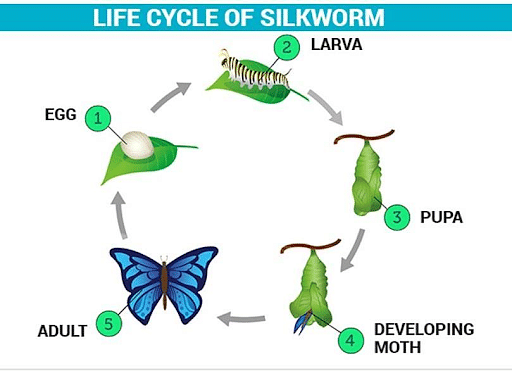
Stage 1: Laying eggs
The first stage starts when a female silk moth lays eggs on mulberry leaves. These tiny dot-like eggs are usually laid in multiples of a hundred and they hatch in 10 days.
These eggs are collected, preserved under hygienic conditions and sold to farmers. Farmers store these eggs at optimal temperature and humidity, maintaining the hygiene factor.
Stage 2: Silkworm
The eggs hatch giving birth to hairy silkworms (caterpillars or larvae). The caterpillars consume large quantities of food(mulberry leaves) to grow up faster. Within 25 to 35 days, they moult four times with significant changes in the body after each moult. These changes show its progress to the next stage.
In the case of silkworm rearing, the eggs are incubated to an optimal temperature for egg-hatching. This is usually done during the harvest of mulberry trees so that the caterpillars can feed a lot to grow up faster.
Once larvae are born, they are kept in clean bamboo trays. Food is placed in that tray. When the 4 moulting are over, the caterpillar move to a tiny chamber of bamboo in the tray to spin cocoons
Stage 3: Cocoon
At this stage, silkworms start netting a thread around them which soon becomes ball-sized. This ball is called a cocoon and is made up of a layer of silk. The change in coloration of the silkworm indicates whether it is ready for the pupa stage.
The twigs or racks kept in the tray serve as an anchor for the silkworm to get attached for spinning cocoons.
Stage 4: Pupa
The caterpillar soon moves to its hibernation which is called the pupa stage. Inside the cocoon, the silkworm transforms into a moth after the last mounting.
During commercial silk production, the pupa is killed and the cocoon is taken as silk is manufactured from the cocoon.
Stage 5: Moth
This is the final stage in the life cycle of a silkworm. Moths come out from the cocoon after 14 days. Soon, they release pheromones to attract the female and mate. This restarts stage 1, thus making the lifecycle of the silkworm complete.
Sericulture
[Click Here for Sample Questions]
[Click Here for Sample Questions]
- The entire process of producing silk raising the silkworms is referred to as sericulture.
- The cocoons obtained after killing pupa are heated.
- This is done to kill the germs by exposing the cocoons to the sun or steaming or simply boiling.
- Reeling is the process used to extract silk threads from the cocoon in specialized machines.
- After bleaching, the extracted threads are then woven into a fine silk cloth.
Read more:
Things To Remember
- Silk is a protein and it comes from the cocoons of mulberry silk moths.
- China produces the largest silk in the world and India is second. Most of India’s silk comes from Bangalore
- Mulberry silk moth is commonly used for silk production
- The Value of silk depends upon its lustre and texture.
- The 5 stages in the life cycle of a silkworm are laying eggs, silkworm, cocoon formation, pupa, and Moth.
- To extract silk, pupa are killed mostly in hot water.
- Cultivating mulberry leaves and raising silkworms for the production of silk is called Sericulture
- Reeling is the process used to extract raw silk.
Sample Questions Based on Silkworms
Ques: What is Reeling? (1 Mark)
Ans: Reeling is the process of extracting raw silk from the cocoon. It is part of silk processing.
Ques: Name some natural fibres and artificial fibres. (2 Marks)
Ans: Natural Fibres- Wool, silk and jute.
Artificial Fibres- Rayon, nylon and polyester.
Ques: Name some plant-made fibres and some animal-made fibres. (2 Marks)
Ans: Plant-made fibres- Jute, cotton and coconut husk.
Animal- made fibres- Wool and silk.
Ques: (i) How do you get silk? (ii) Which country is the largest producer of silk and which country is the largest importer? (2 Marks)
Ans: (i) We get silk from the cocoon of the silkworm after the pupa are subjected to heat.
(ii) China produces the largest amount of silk in the world and the USA is the largest importer of silk.
Ques: (i) Is water bad for silk? Explain why? (ii) Why is silk a thermoregulator? (2 Marks)
Ans: (i) Yes, water is bad for silk. Silk is made up of thread-like elongated structures called fibre. Water weakens it, thereby destroying the silk.
(ii) Silk can adapt to any temperature- be it summer or winter. So, it is a good thermoregulator.
Ques: (i) Why is it necessary to cultivate mulberry leaves for silk production? (ii) Why is hygiene necessary in the rearing of silkworms? (iii) In silk production where are the caterpillars kept? (3 Marks)
Ans:(i) Caterpillars or silkworms need to feed on enormous quantities of mulberry leaves to grow fast and move to the cocoon stage for silk production
(ii) Enormous quantities of the cocoon are necessary for the manufacture of silk. So, hygiene should be maintained.
(iii) Caterpillars are kept in bamboo trays and mulberry leaves are kept in it for feeding.
Ques: How long is it possible for the silkworms to live without food? (3 marks)
Ans: The silkworms can be stopped feeding every day once they’ve moulted a couple of times. Depending on temperature and size, it is possible for them to go a week or longer without eating. However, feeding them every couple of days will keep them hydrated and healthy, extending the “hold” period.
Ques: After the silk is extracted what happens to silkworms? (2 marks)
Ans: Peace silk is referred to as the silk that is farmed ethically. Meaning, the silkworms will be permitted to mature into full-fledged Bombyx mori moths, which naturally emerge from their cocoons and die a natural death.
Ques: Does a silkworm turn into a butterfly? (3 marks)
Ans: It is not possible for us to observe what happens within the cocoon, but the larva’s body undergoes changes for two or three weeks. During this time, it transforms into a pupa, and then into a white butterfly. The butterfly secretes a yellowish liquid in spite of the cocoon being constructed of a strong silk thread.
Ques: The process of rearing a silkworm for silk is referred to as: (a) Pisciculture (b) Agriculture (c ) Sericulture (d) None of the above. (1 mark)
Ans: The correct answer is (c )
The process of rearing a silkworm for silk is referred to as sericulture.
Ques: A lot of feeding is required at the: (a) Silkworm stage (b) Cocoon stage (c ) Egg stage (d) Both (b) and (c ) (1 mark)
Ans: The correct answer is (a)
A lot of feeding is required at the silkworm stage.
Ques: What is meant by sericulture? (3 marks)
Ans: Sericulture is defined as the rearing of silkworms on a commercial scale to produce silk. China is the leading producer of silk, followed by India. In India, silk farming is most popular in Assam, Bihar, Madhya Pradesh, Odisha, Karnataka and Tamil Nadu.
Read More:



Comments