



Content Curator
Weeds are considered to be one of the greatest enemies of crops just like insects, mites and rodents. Likewise, these are treated as one of the most dangerous matters of concern for farmers since they affect the growth of plants and at times prove to be poisonous for both animals and human beings. Weed management has thus started gaining popularity among farmers for the past couple of years to improve and protect crop cultivation. Several combinations of physical, chemical, biological, and organic methods are used to eliminate or limit the growth of weeds. High-density plantings, tilling, application of weedicides, etc are some of the common techniques deployed to implement weed management.
| Table of Content |
Key Takeaways: Weeding, Weed Killers, Weed Management, Crop Protection, Herbicides, Weedicides.
Weeding & Weed Management
[Click Here for Sample Questions]
Weeds are unwanted grass and plants growing alongside regular crops in a cultivation area and hindering the growth of plants.
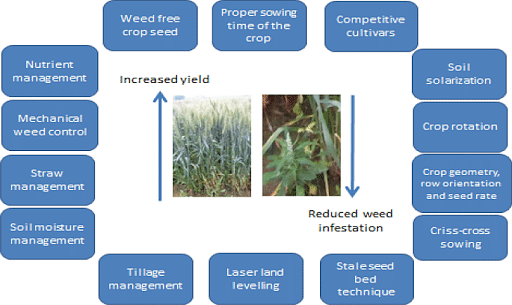
Common examples of weed are algae, grass, chenopodium, and amaranthus. Thus Weed Management commonly called weeding is defined as the process of applying biological, chemical, and organic methods to either eliminate or remove weeds from the cultivation area in order to improve the production of crops.
Read More:
Types of Weeding
[Click Here for Sample Questions]
Different physical, chemical, biological methods or a combination of these are employed for weed management. Some of the most popular ones are listed below:
Hand Pulling and Cultivation: This is a manual process of removing weeds with both hands. Shovels are used in such cases to remove individual weeds while hand cultivators which are a kind of rake are used at times to remove weeds around plants.
Pre-Emergent Herbicides: These are chemicals applied before these unwanted plants start growing above the soil surface. These are applied to the soil surface, preferably after planting annual or perennial plants. To apply these chemicals mulching the soil is necessary, followed by sprinkling these granular herbicides and finally applying water on the surface for the herbicide to go deep inside the soil.

Post-Emergent Herbicides: These chemicals are applied once they start appearing above the soil surface and are in an active growth state. When applied, these herbicides soak into plant leaves and then reach the plants’ roots for complete weed removal.
Mulches: This is an organic method whereby a thick 3-4 inch layer of mulch smoothers weed before they reach maturity and develop seeds.
This is an effective method of weed removal and must be applied at regular intervals for effective results.
Read More:
Types of Weed Killer
[Click Here for Sample Questions]
Weed killers can be categorized into systemic, contact, residual, selective, and non-selective.

Contact: These weed killers kill weeds the moment they come in contact with a herbicide.
Systemic: These weed killers start working through the transport system of unwanted plants.
Residual: These weed killers poisons the surrounding soil thereby making the weed inactive and useless for further growth.
Selective: These weed killers kill a particular variant of weed leaving the main plant unharmed.
Non-selective: These weed killers come into action when the main plant is severely damaged and kill everything that comes in contact with them.
Read More:
Crop Protection through Weed Management
[Click Here for Sample Questions]
Integrated weed management is a combination of mechanical, cultural, and biological practices that can be put to use for the removal of those unwanted plants otherwise known as weeds.
Following methods are employed for integrated weed management:
- Crop rotation for ensuring soil fertility and economic diversity.
- Cover crops namely cereal rye, sorghum Sudan grass, and oats to plant inhibiting weed growth.
- Timing and spacing for suppressing late germinating weeds.
- Mulching especially leaf mulch or plastic mulch or weed-free straw provides a thick layer to prevent weed growth.
- Use of flaming, a pre-emergent tactic can help protect crops and plants.
- Organic herbicides viz vinegar also work as an effective solution.
Things to Remember
[Click Here for Sample Questions]
- Weeds are undesirable plants growing alongside cultivated crops.
- Weeds hinder the normal growth of crops and at times can prove to be poisonous for both plants and animals.
- Weeding is the process of removal of these unwanted plants and grass from a cultivating field.
- Various mechanical, physical, chemical, and cultural practices are deployed during weed management.
- Hand pulling and cultivation, pre-emergent herbicides, post-emergent herbicides, and mulching are a few of the commonly used weeding practices.
- Khurpi, seed drill, etc are a few of the common tools used for manual removal of weed
- Weedicides are chemicals used for weed control.
Read More:
Sample Questions
Ques. Can weeds be put to medicinal use? (2 marks)
Ans: Medical marijuana, a derivative of the Cannabis Sativa plant can be used to treat many diseases namely Alzheimer's disease, epilepsy and seizures, glaucoma, etc. Dandelion on the other hand can be used to decrease blood pressure levels.
Ques. Cite some common examples of weedicides? (2 marks)
Ans: Weedicides are chemicals used to kill or stunt the growth of weeds. Some popularly used weedicides are MCPA, 2,4-D, Atrazine, Metribuzin WP, etc. But these weedicides can cause health hazards and environmental issues.
Ques. What is the procedure for physically removing weeds from the cultivating field? (2 marks)
Ans: Khurpi, seed drills, and other similar tools are used for manually removing weeds whereby these weeds are either uprooted or cut close to the ground from time to time to completely remove or shunt the growth of weeds.
Ques. What are the poisonous effects of weeds? (2 marks)
Ans: Weeds can be poisonous not only for plants but also for human beings. For instance, Toxicodendron Vernix, a small shrub or tree, can trigger rashes and allergic reactions to humans when touched. Similarly, pokeweed, a kind of weed, can be very harmful to humans by causing anything from vomiting to internal bleeding due to contamination.
Ques. What is mulching in weed management? (2 marks)
Ans: Mulching is an effective method of weed management whereby a thick layer of some external layer may be plastic or mineral mulch is applied over the soil surface and thus helps in blocking weed growth, reducing weed seed germination, and favoring crop growth by conserving soil moisture and temperature.
Ques. What are the common methods of weed control? (2 marks)
Ans: Below is listed the popular methods practiced for weed control:
- Hand Pulling and Cultivation
- Pre-emergent herbicides
- Post-emergent herbicides
- Mulches
Ques. What are dandelions? (2 marks)
Ans: Dandelions are a type of weed having bright yellow flowers and grow throughout the year. They signal the arrival of spring and are seen between cracks in sidewalks, driveways and footpaths and lead to cracks. They can be put to medicinal use and are consumed as salad occasionally.
Ques. How are weedicides used? (2 marks)
Ans: Weedicides are chemicals namely MCPA, 2,4-D, Atrazine, Metribuzin WP etc and used for weed control. These are diluted with water to reduce concentration and sprayed in the cultivation area using a sprayer.
Ques. How do weeds affect growth in crops? (2 marks)
Ans: Weeds compete with crops for essential nutrients and components leading to scarcity of these components for the growth of crops. In addition, they also compete for water, sunlight and space required for the normal growth of crops. Lastly, they can also be the main source of diseases for crops which may lead to shunting of growth in crops.
Ques. How weeds are removed using the flame weeding method? (2 marks)
Ans: Flame weeding, also called slow kill is a method employed for killing weeds with intense heat produced by propane gas burners whereby carefully controlled and a directed flame is passed over weeds leading to the destruction of their seeds. Thus leading to shunting of growth of weeds.
Read More:



Comments