




Four of the eleven questions in the Class 10 History Chapter 5 Print Culture and the Modern World previous year questions set are 3-mark short answers, and every one of them is printed with an OR alternative, which means the band is really eight prompts wide. The whole compilation runs to 11 real CBSE board questions worth 22 marks and is free to download as a 15-page PDF, with the year and set code sitting under each question and a full worked solution for every one of them in the second half of the file.



- 11 board questions, 22 marks, from five CBSE set codes of the 2026 cycle, reproduced exactly as the board printed them.
- All 11 questions solved step by step, in a Detailed Solutions section that restates each question above its answer and links back to it.
- Free 15-page PDF, no sign-up, aligned to the 2026-27 CBSE Class 10 Social Science syllabus.
|
Table of Contents |
The Marks Bands in This PYQ PDF
The value is in having every Chapter 5 question the 2026 papers carried sitting in one file, in paper order, with a worked answer for each. Use it as a practice set by attempting the questions cold and then marking yourself against the Detailed Solutions half, or as a revision resource by reading each question with its solution. Every solution card repeats the question above the working and links back to it, and the objective questions also appear in a short answer key.
| Marks | Questions | Total Marks | CBSE Section | Question Type |
|---|---|---|---|---|
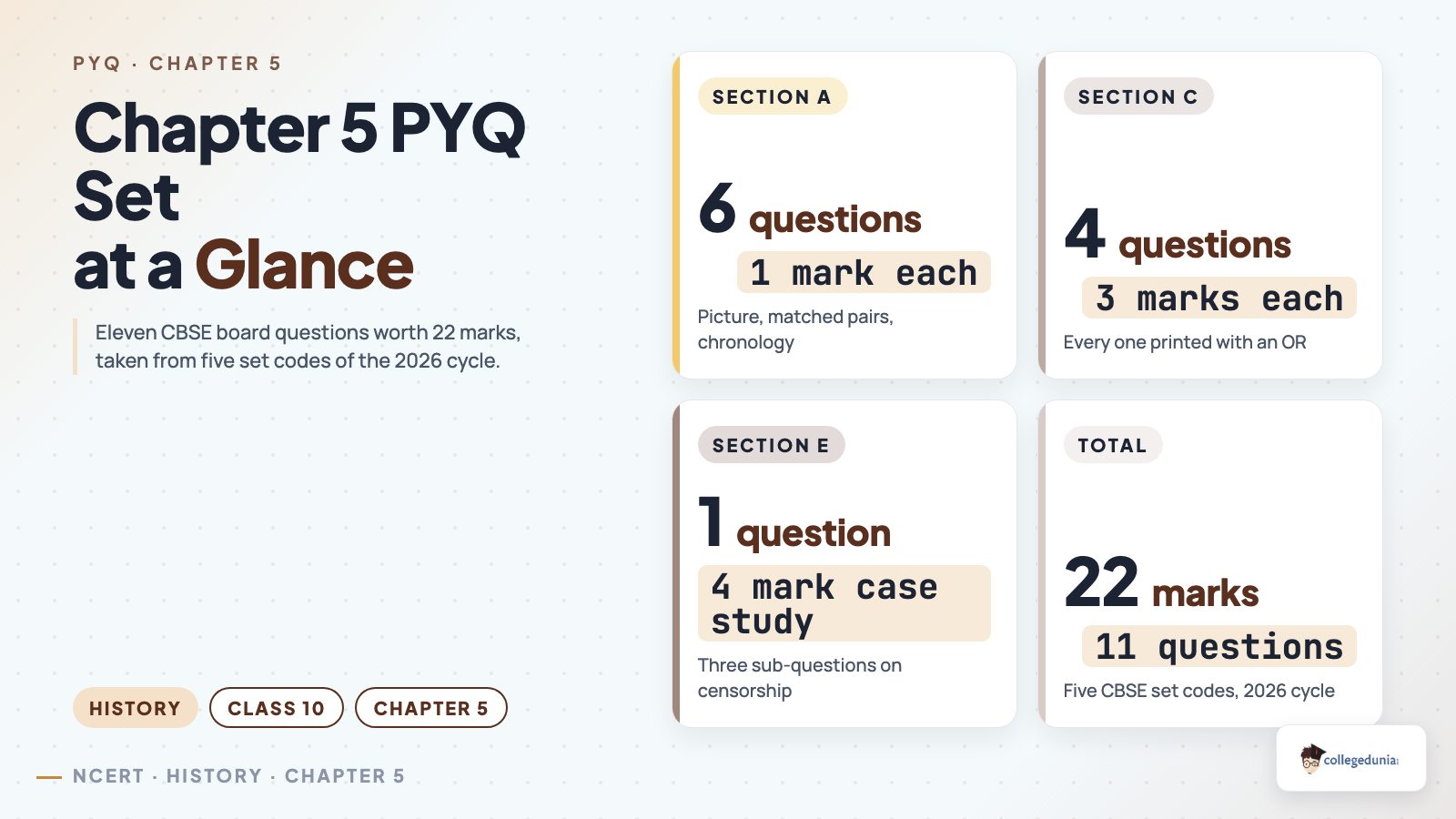
| 1 mark | 6 | 6 | Section A | Objective: picture identification, matched pairs, chronology ordering |
| 3 marks | 4 | 12 | Section C | Short answer, each one printed with an OR alternative |
| 4 marks | 1 | 4 | Section E | Source-based case study with three sub-questions |
| Total | 11 | 22 | Sections A, C and E | Objective, short answer and source based |
Roughly 55 per cent of the marks in this compilation sit in the 3-mark band. If you have a single sitting for Chapter 5, spend it writing three-point answers rather than drilling the objective questions.
Where the 11 Questions Come From
All 11 questions belong to the 2026 CBSE board cycle. This is a compact recent set, not a complete archive of every question the board has set on print culture.
- Set codes represented: 32-1-1, 32-2-1, 32-3-1, 32-4-1 and 32-5-1.
- Set 32-1-1 and set 32-3-1 each supply two objective questions, which is why those codes repeat inside the 1-mark band.
- Every question carries the year and the set code printed beneath it, so you can isolate one paper's Chapter 5 questions and attempt them as a block.
A Note on the Picture-Based Questions
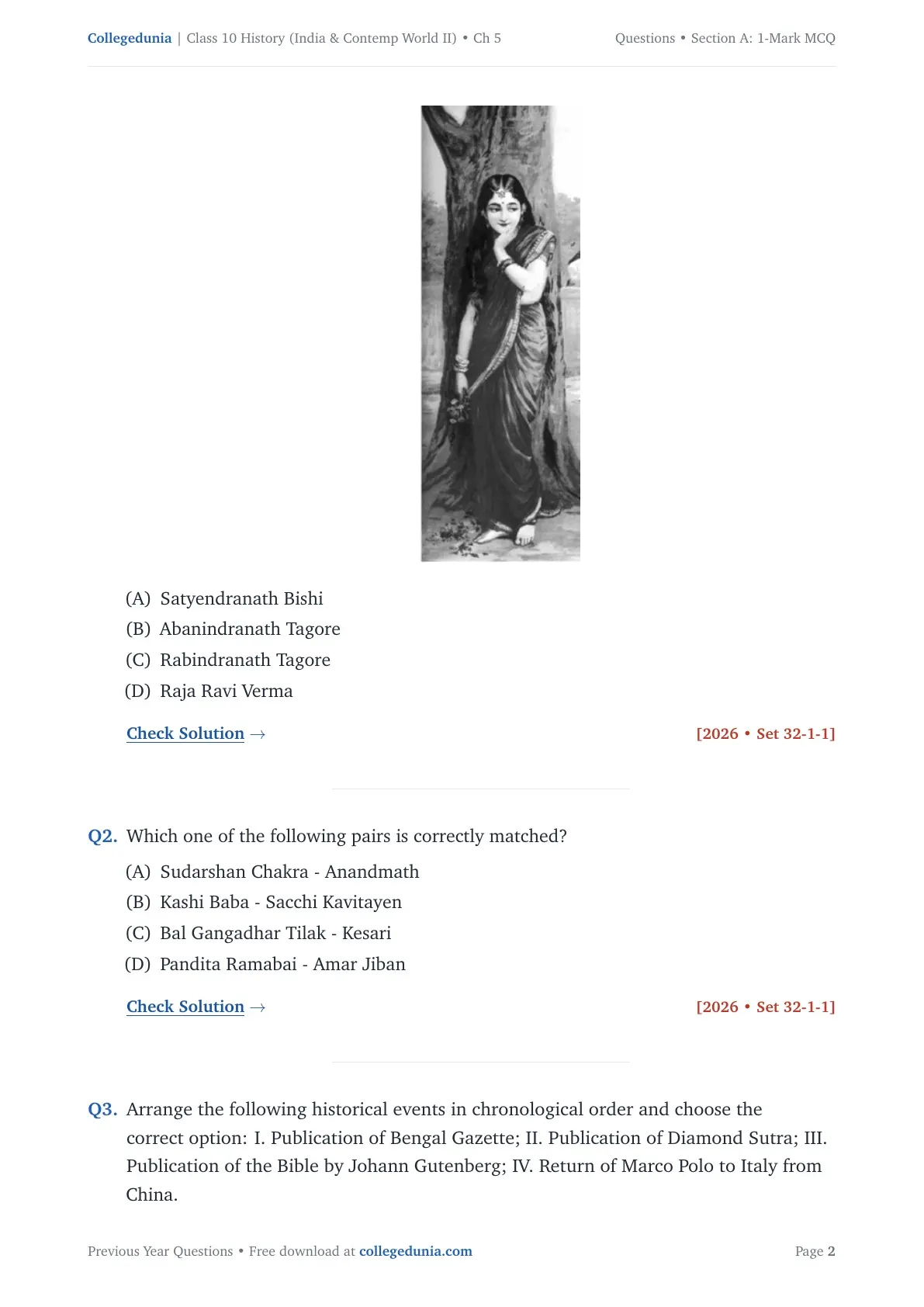
Three of the six objective questions in this set are built on an image in the original question paper. One shows a famous painting and asks who painted it. One asks you to identify a printed object from four options. One shows a sixteenth century painting from Mughal India and asks what work is being carried out in it.
Those three questions are printed here with their full option sets and with the source image from the board paper reproduced above each one, so you can attempt them exactly as they were set.
- Study what separates the four options. In each case the four options are the candidates the board considered plausible, so knowing what distinguishes them is what turns a correct guess into a certain answer, even with the picture in front of you.
- Go back to the chapter images. The NCERT chapter carries the illustrations these questions are drawn from. Working through the chapter with the pictures in front of you is what makes the identification automatic in the exam hall.
What the Board Tested in Chapter 5
Print Culture and the Modern World runs from the earliest print in East Asia, through the coming of print to Europe and Gutenberg's press, to print arriving in India, colonial censorship, and print in the service of social reform. The 11 questions here touch most of that arc, though unevenly.
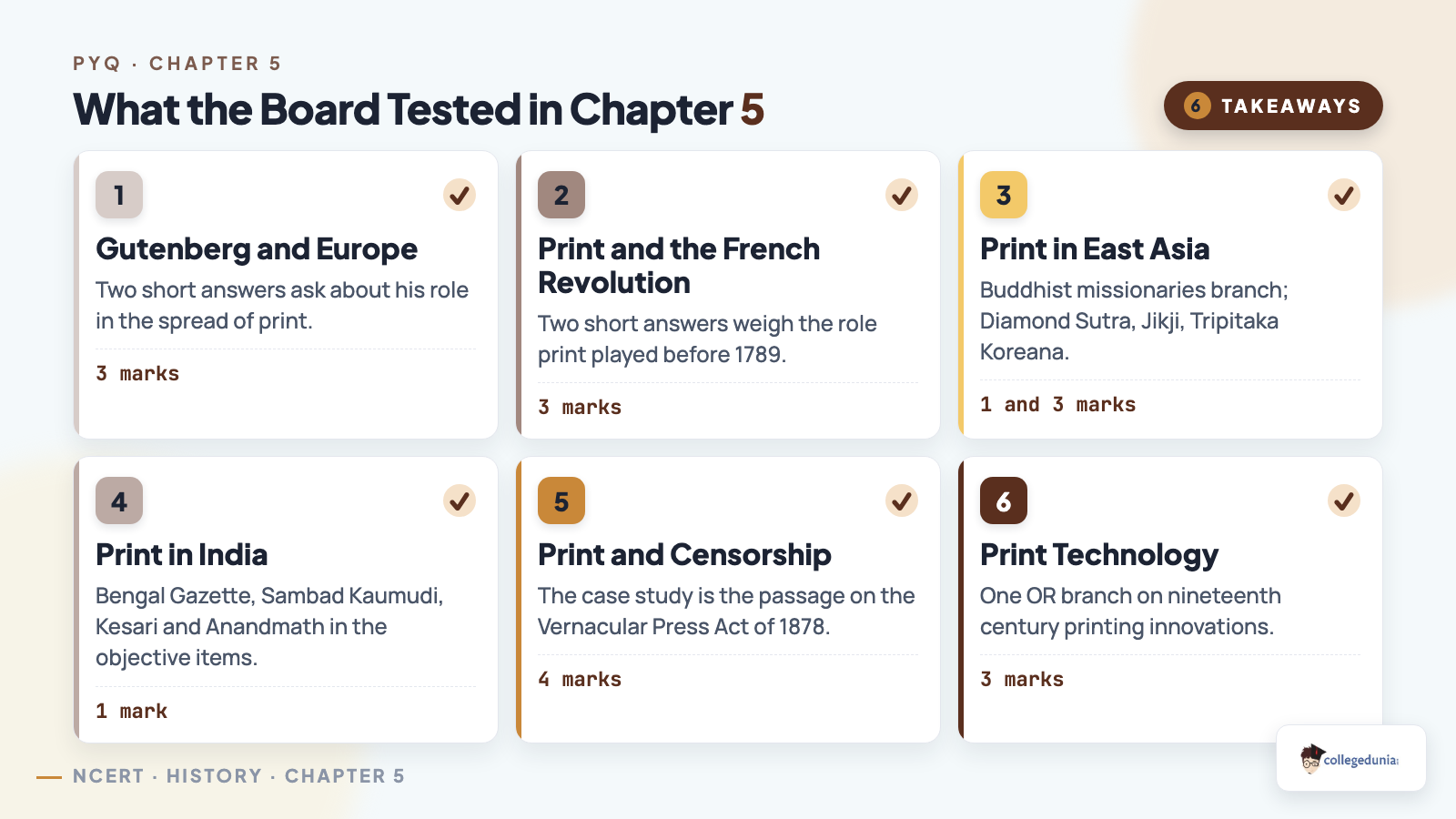
- Gutenberg and print in Europe. Two of the four short answer questions have a Gutenberg branch, one asking about his role in the spread of print culture in Europe and one asking you to analyse his contribution to printing. The OR branches attach the Protestant Reformation and the statement that printing is the ultimate gift of God and the greatest one.
- Print and the French Revolution. Two short answer questions reach for this, once as a direct evaluation of the role of print and once as the statement that print culture created the favourable conditions for the French Revolution.
- Print in East Asia. One OR branch asks about the role of Buddhist missionaries in printing culture, and one objective question asks you to identify a printed object with the Diamond Sutra, the Korean Jikji and the Tripitaka Koreana among the options.
- Print in India. The chronology questions involve the Bengal Gazette, Sambad Kaumudi, the Vernacular Press Act, the first printed edition of the Ramcharitmanas, the Diamond Sutra, Gutenberg's Bible and the return of Marco Polo to Italy. The matched-pair question puts Anandmath, Sacchi Kavitayen, Kesari and Amar Jiban against the names associated with them.
- Print and censorship. The single case study is built on the textbook passage about the Vernacular Press Act of 1878, which was modelled on the Irish Press Laws, and the powers of censorship it gave the colonial government.
- Print technology. One OR branch asks about the series of innovations in printing technology through the nineteenth century.
How to Write the 3-Mark and 4-Mark Answers
The two bands that carry the marks here reward structure more than length, and both have a repeatable shape.
- Three marks means three points. Aim for three distinct, separately stated points inside about 60 words. A single point elaborated three ways is scored as one point.
- Read both branches of the OR first. All four short answer questions carry an OR, so eight prompts are on the page and you write four answers. Spend fifteen seconds choosing, then commit and do not write the other one.
- For a statement question, take a position and support it. Two of the branches here are quoted statements rather than direct questions. The marking scheme wants the statement explained with examples, not agreed with in the abstract.
- For the case study, stay inside the passage. The three sub-questions under the censorship passage are answerable from the passage itself. One asks what the Vernacular Press Act was modelled on, one asks why the colonial government was not in favour of press freedom, and one asks which two powers the Act gave the government. Each has its answer sitting in a specific sentence.
Common Mistakes in Chapter 5 Answers
- Mixing up the East Asian print landmarks. The Diamond Sutra, the Jikji and the Tripitaka Koreana are three different objects from three different places, and the objective questions turn on exactly that difference.
- Putting the chronology questions in the order the options list them. Both ordering questions in this set span more than a thousand years, so date each item before you look at any option.
- Writing a three-mark answer as a paragraph. Three separated points inside about 60 words is the shape that scores.
- Answering the case study from memory instead of from the passage. The sub-questions are anchored to specific lines of the given source.
- Attempting both halves of an OR question. Only one is marked, and the second one costs time you need for the case study.
Student Feedback
The picture-based questions in this file are the ones we most want to hear about. If you have the original paper page for any of them, or if a set code here does not match the paper you sat, leave a comment below. Notes like that decide what gets fixed in the next refresh of this PDF and which chapter is extended first.
Other Class 10 History Chapter 5 Resources
The PYQ file answers all 11 of its own questions. These pages cover the rest of the chapter, beyond what the 2026 papers happened to ask.
| Resource | What It Gives You | Link |
|---|---|---|
| NCERT Solutions | Textbook exercise answers for the chapter | NCERT Solutions |
| Revision Notes | Concept notes to revise before attempting the questions | Revision Notes |
| NCERT Book PDF | The official chapter text the paper is set from, illustrations included | NCERT Book PDF |
| Handwritten Notes | Notebook-style summary for last-week revision | Handwritten Notes |
All Class 10 History Chapterwise PYQ PDFs
India and the Contemporary World II has five chapters, and each chapterwise PYQ file is built the same way, straight from the official CBSE papers.
| Chapter | Chapter Name | Previous Year Questions |
|---|---|---|
| Chapter 1 | The Rise of Nationalism in Europe | PYQ PDF |
| Chapter 2 | Nationalism in India | PYQ PDF (coming soon) |
| Chapter 3 | The Making of a Global World | PYQ PDF (coming soon) |
| Chapter 4 | The Age of Industrialisation | PYQ PDF (coming soon) |
| Chapter 5 | Print Culture and the Modern World | You are here |
Class 10 History Chapter 5 Print Culture and the Modern World PYQ FAQs
What Students Usually Ask About This Question Set
Ques. How many previous year questions are in the Class 10 History Chapter 5 PYQ PDF?
Ans. There are 11 questions worth 22 marks across 15 pages, questions and worked solutions together: 6 one-mark objective questions, 4 three-mark short answers and 1 four-mark source-based case study.
Ques. Does the PDF include answers or a marking scheme?
Ans. Yes. All 11 questions carry a full step-by-step solution in the Detailed Solutions section, and the objective questions are also gathered into a short answer key. Each solution restates its question above the working and links back to it, so you can write your own answer first and check after, or read question and solution together during revision.
Ques. Are the images shown with the picture-based questions?
Ans. Yes. All three picture-based questions carry their original board-paper image in the PDF, so the painting and the printed object can be identified from the page itself. The remaining objective questions are text only and need no image.
Ques. Which CBSE set codes were used to build the compilation?
Ans. Five codes from the 2026 cycle: 32-1-1, 32-2-1, 32-3-1, 32-4-1 and 32-5-1. It is a compact recent set rather than an exhaustive archive of every Chapter 5 question ever set.
Ques. Which topic comes up most often in these questions?
Ans. Gutenberg and the arrival of print in Europe, which appears in two of the four short answer questions, and print in relation to the French Revolution, which appears in two more. Between them they account for most of the 3-mark band.
Ques. What does the case study question cover?
Ans. Print and censorship. The passage describes the Vernacular Press Act of 1878, which was modelled on the Irish Press Laws, and the three sub-questions ask what it was modelled on, why the colonial government opposed press freedom, and which two powers the Act gave it.
Ques. Is this chapter part of the 2026-27 syllabus?
Ans. Yes. Print Culture and the Modern World remains the fifth chapter of the History unit in the 2026-27 CBSE Class 10 Social Science syllabus, and India and the Contemporary World II carries 20 marks of the 80-mark theory paper.



Comments