




The Challenges of Cultural Diversity looks at how a country as diverse as India, in language, religion, region and community, holds itself together as one nation without flattening every difference into sameness. This PYQ set brings together 12 CBSE board questions from 2017 to 2024 on the chapter, and every one comes with a full step-by-step solution, so you can check your own answer against a complete worked explanation.
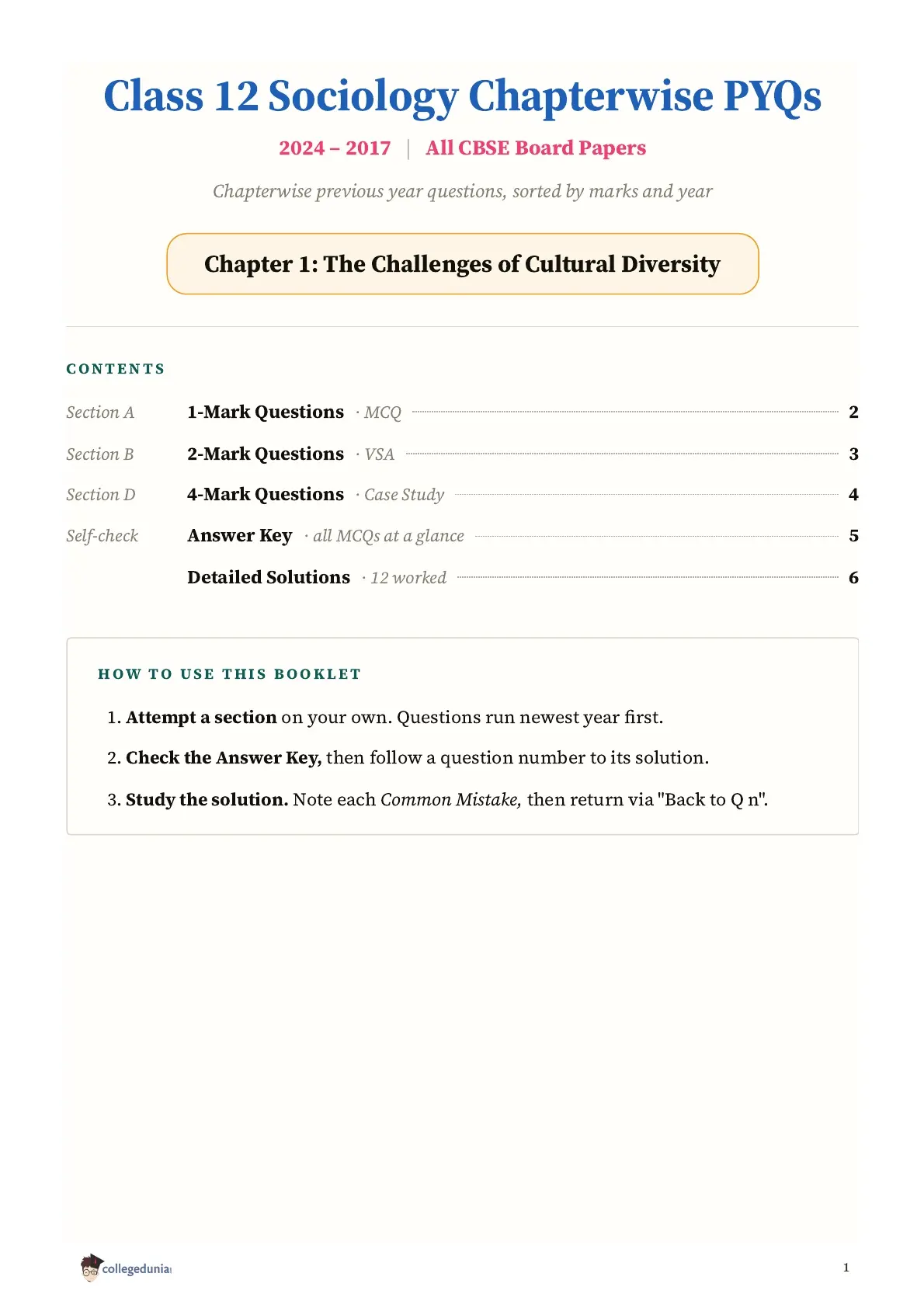
- 12 questions, CBSE 2017-2024: 3 MCQs (1 mark), 7 short-answer questions (2 marks) and 2 long-answer questions (4 marks), spread evenly across four board years.
- Full solutions included: every question has a worked, step-by-step answer, not just the bare question paper.
- Topics covered: secularism and communalism, regionalism, linguistic reorganisation of states, ascriptive identity and the Jharkhand movement.
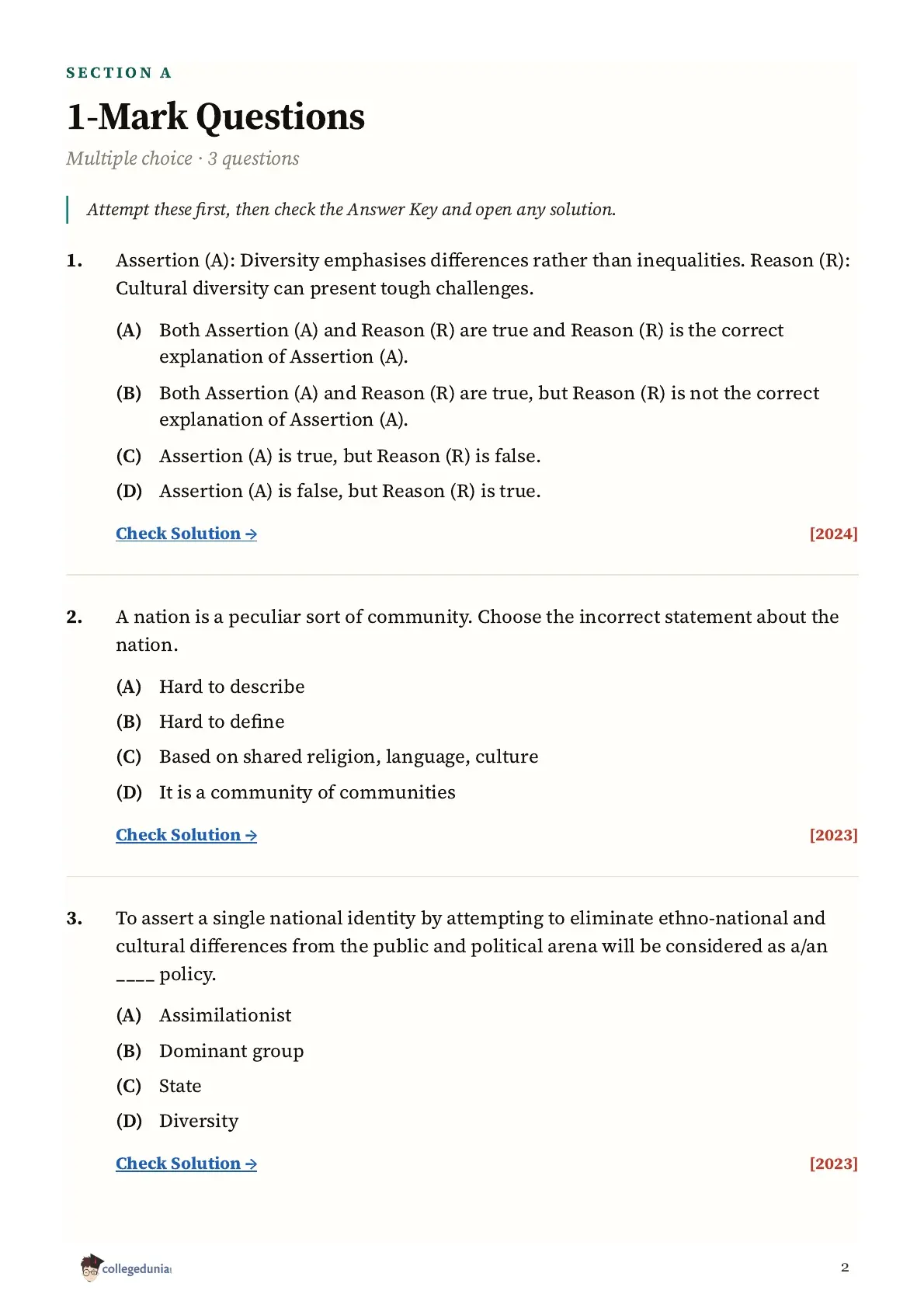
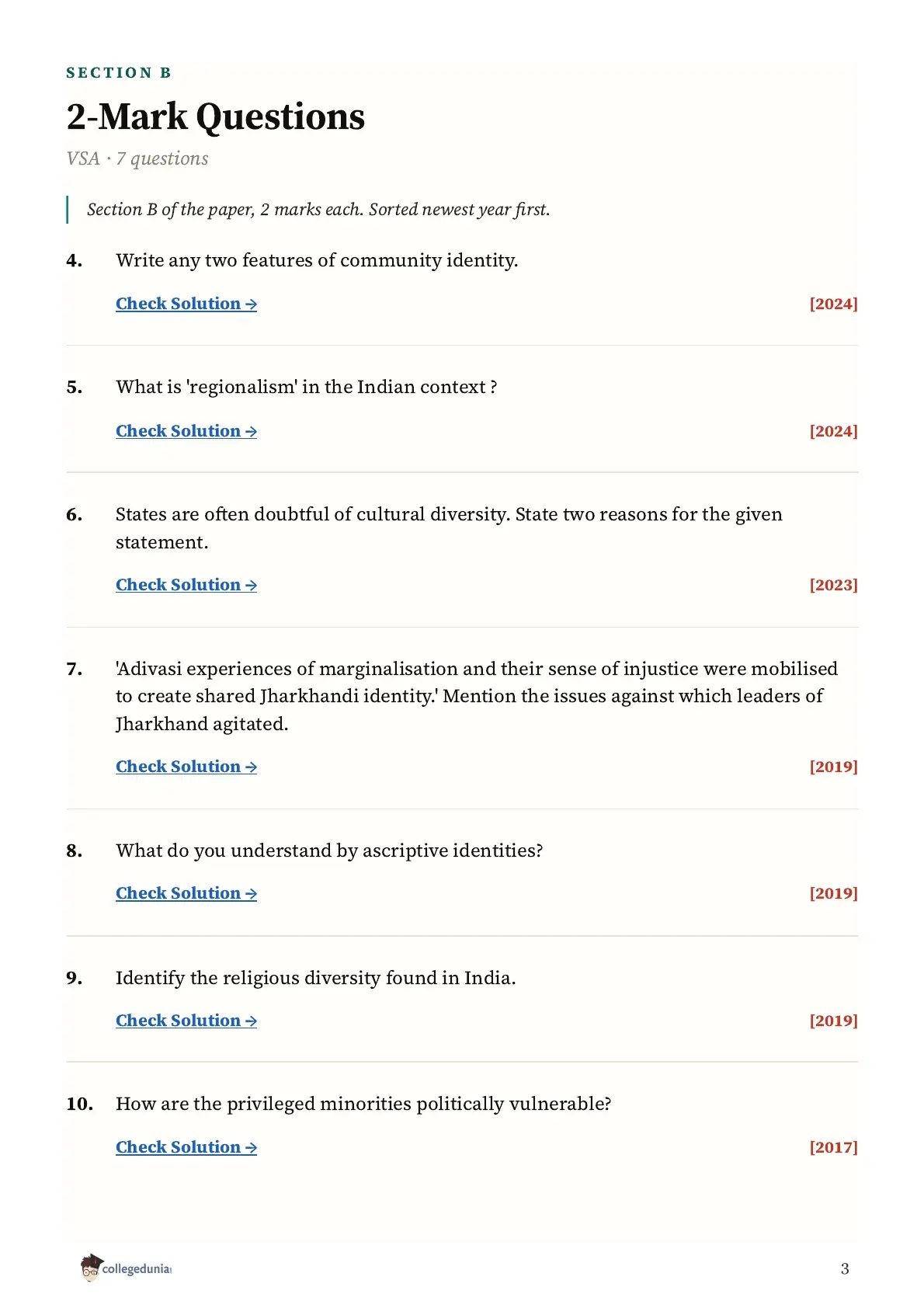
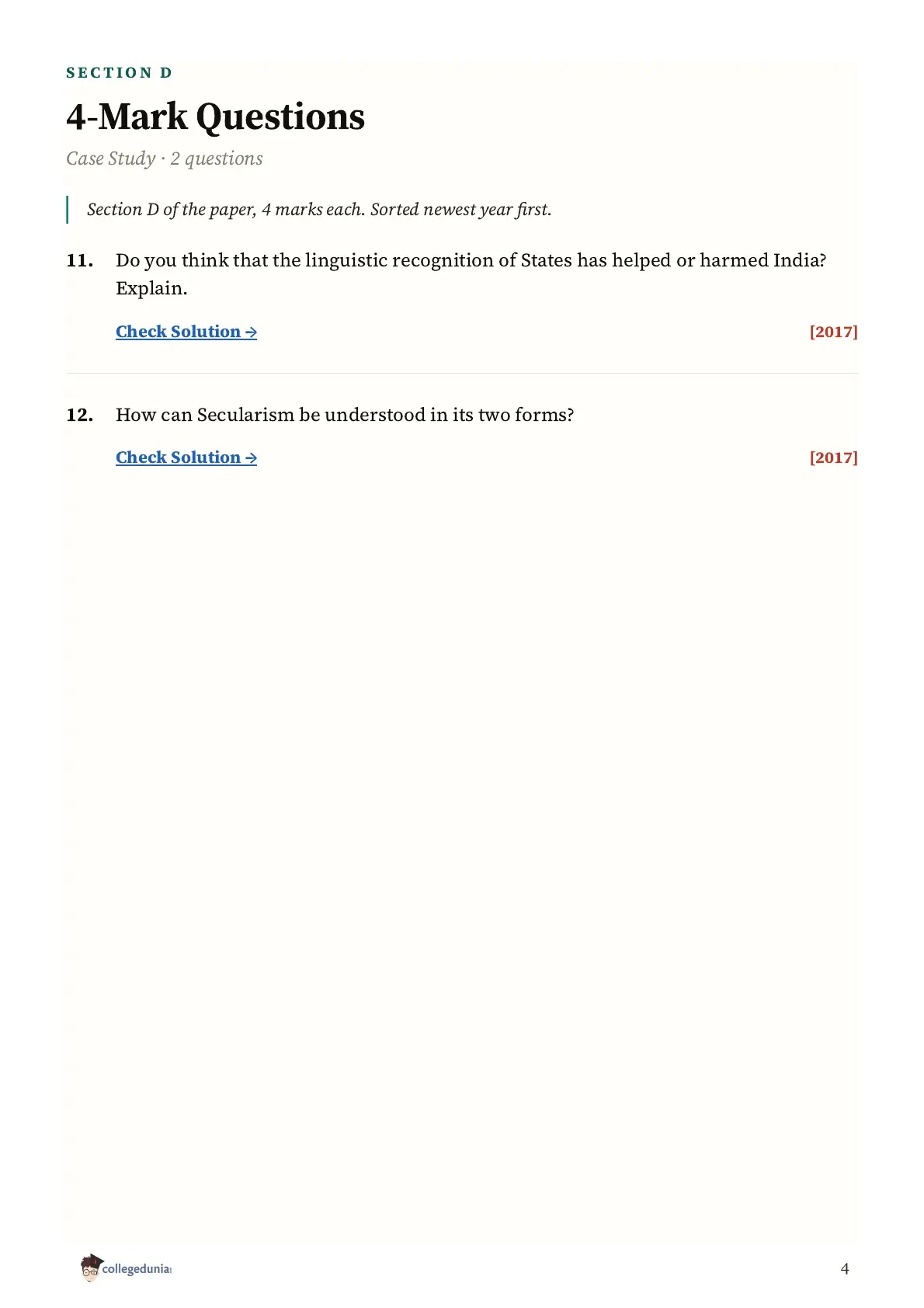
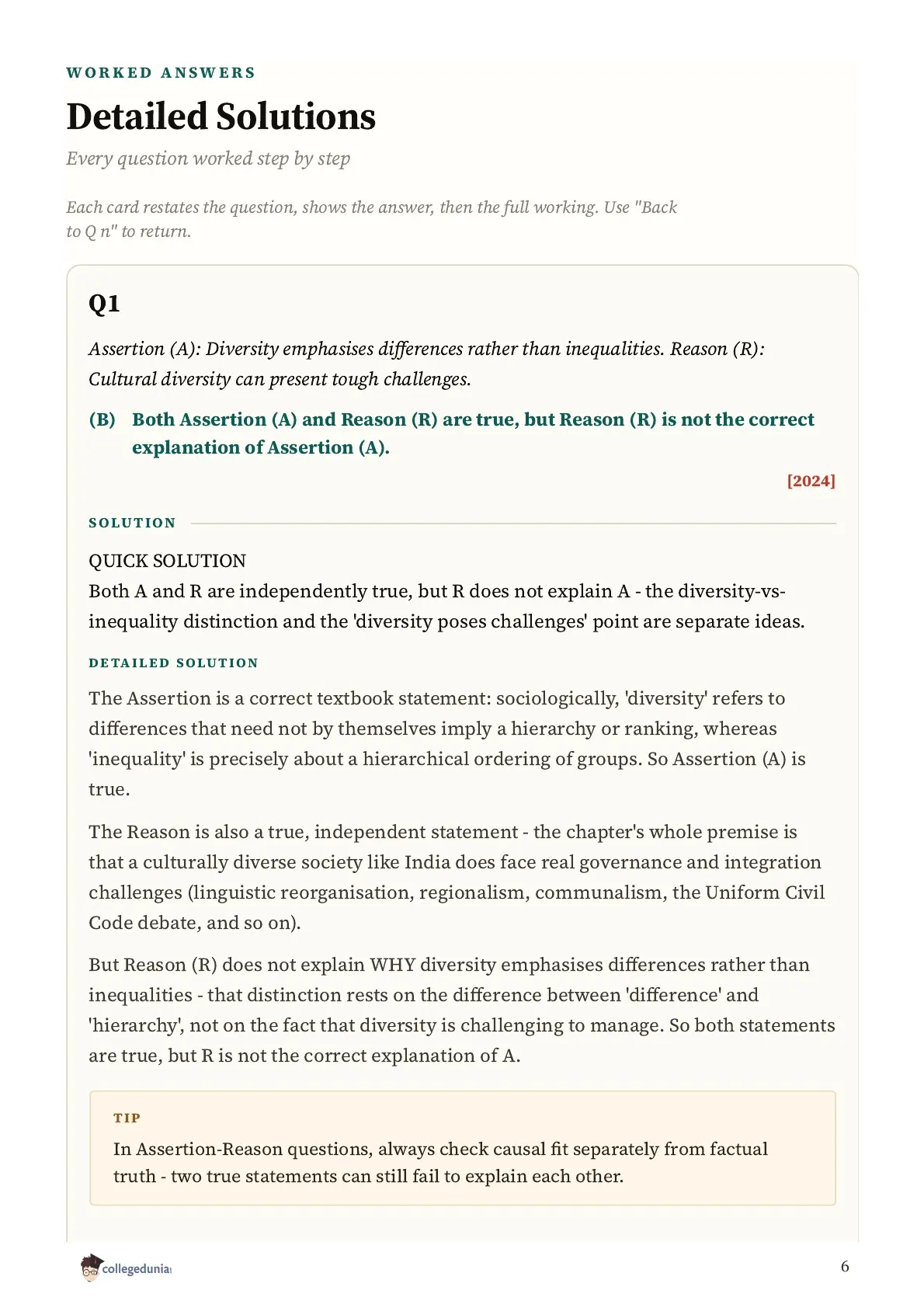
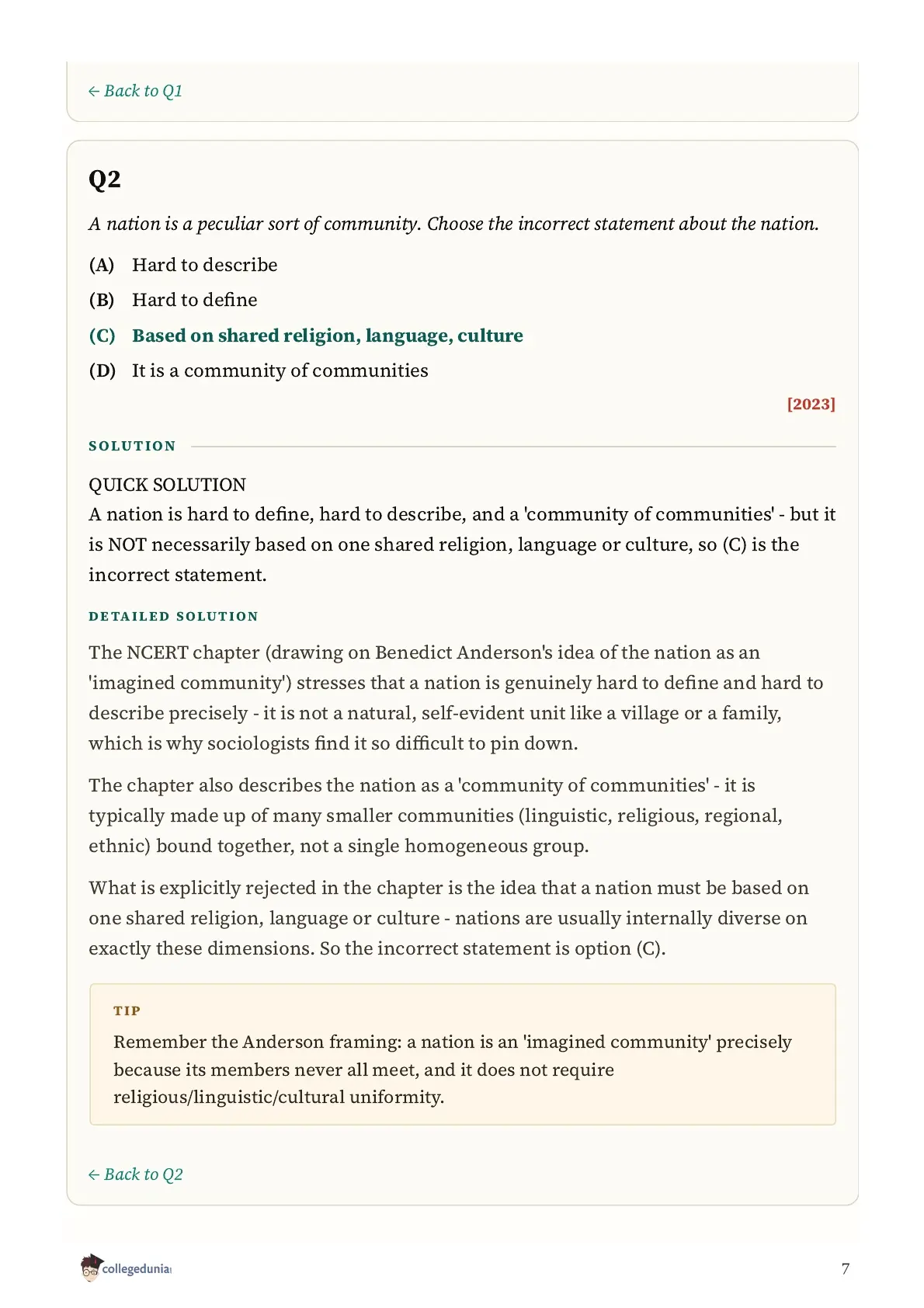
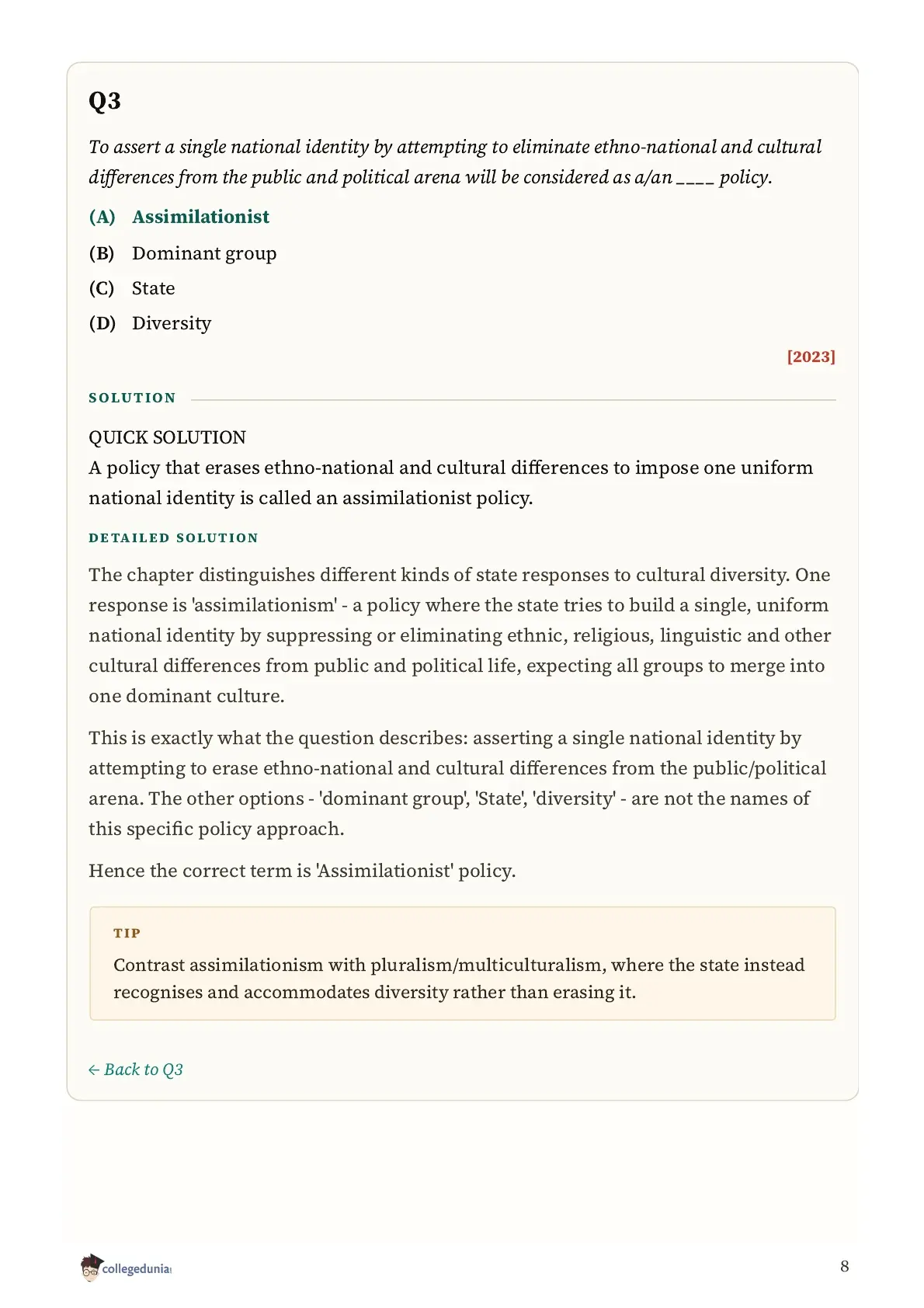
Every question in this Class 12 Sociology Chapter 6 PYQ set is lifted from an actual CBSE board paper (2017-2024) and answered in full by Collegedunia's Sociology experts, according to the 2026-27 NCERT syllabus.
What Class 12 Sociology Chapter 6 PYQs Test: Secularism, Regionalism and National Identity
The Challenges of Cultural Diversity chapter is where CBSE checks whether you understand how a plural society manages difference without either forcing everyone into one mould or letting every difference pull the country apart. Board papers pull questions from secularism and communalism, regionalism versus separatism, the linguistic reorganisation of states, and how ascriptive identities like religion, caste and region interact with a shared national identity.
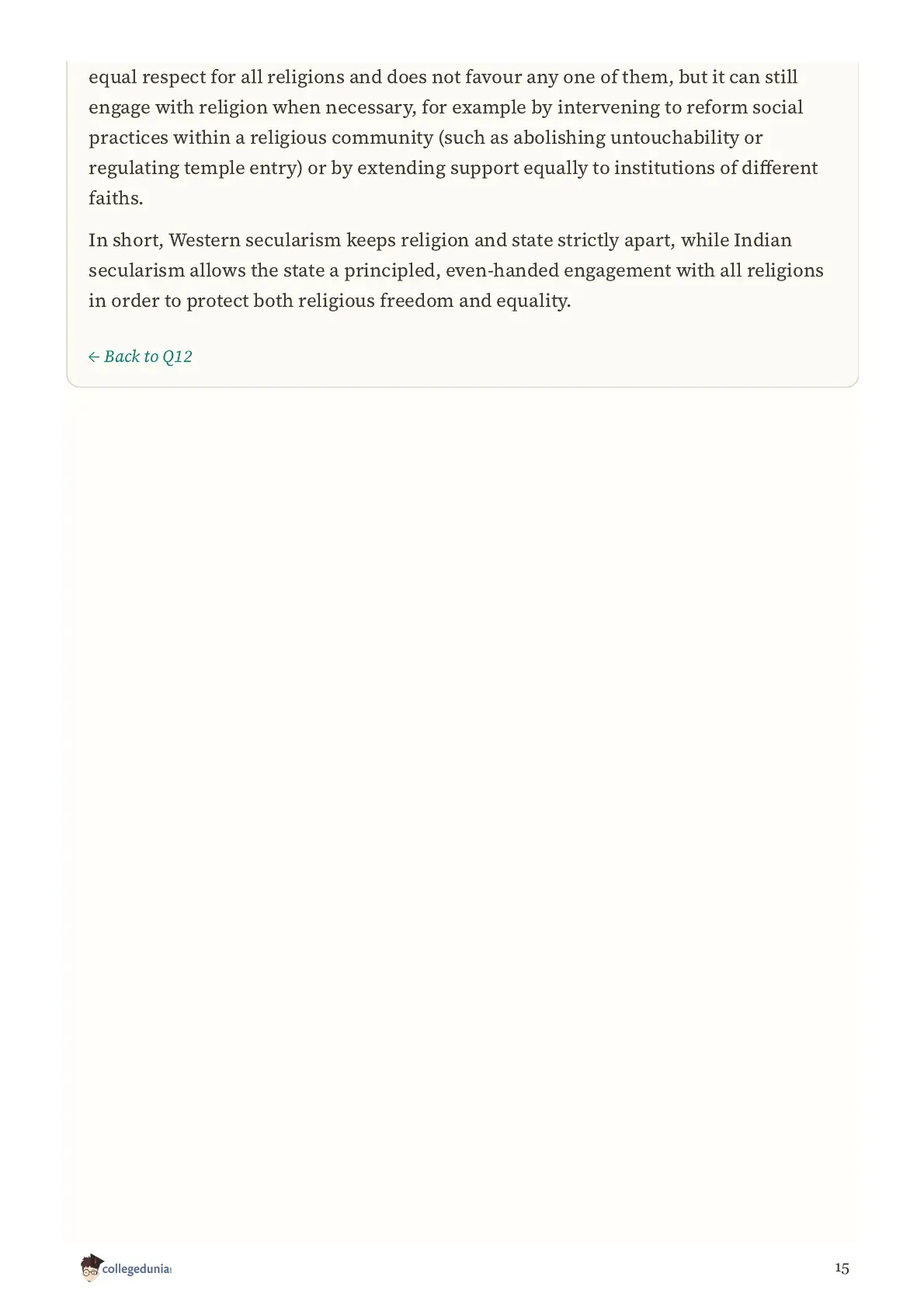
- Secularism: the difference between communalism, religious belief, and India's own model of secularism.
- Regionalism: when a demand for regional autonomy is legitimate and when it becomes separatist politics.
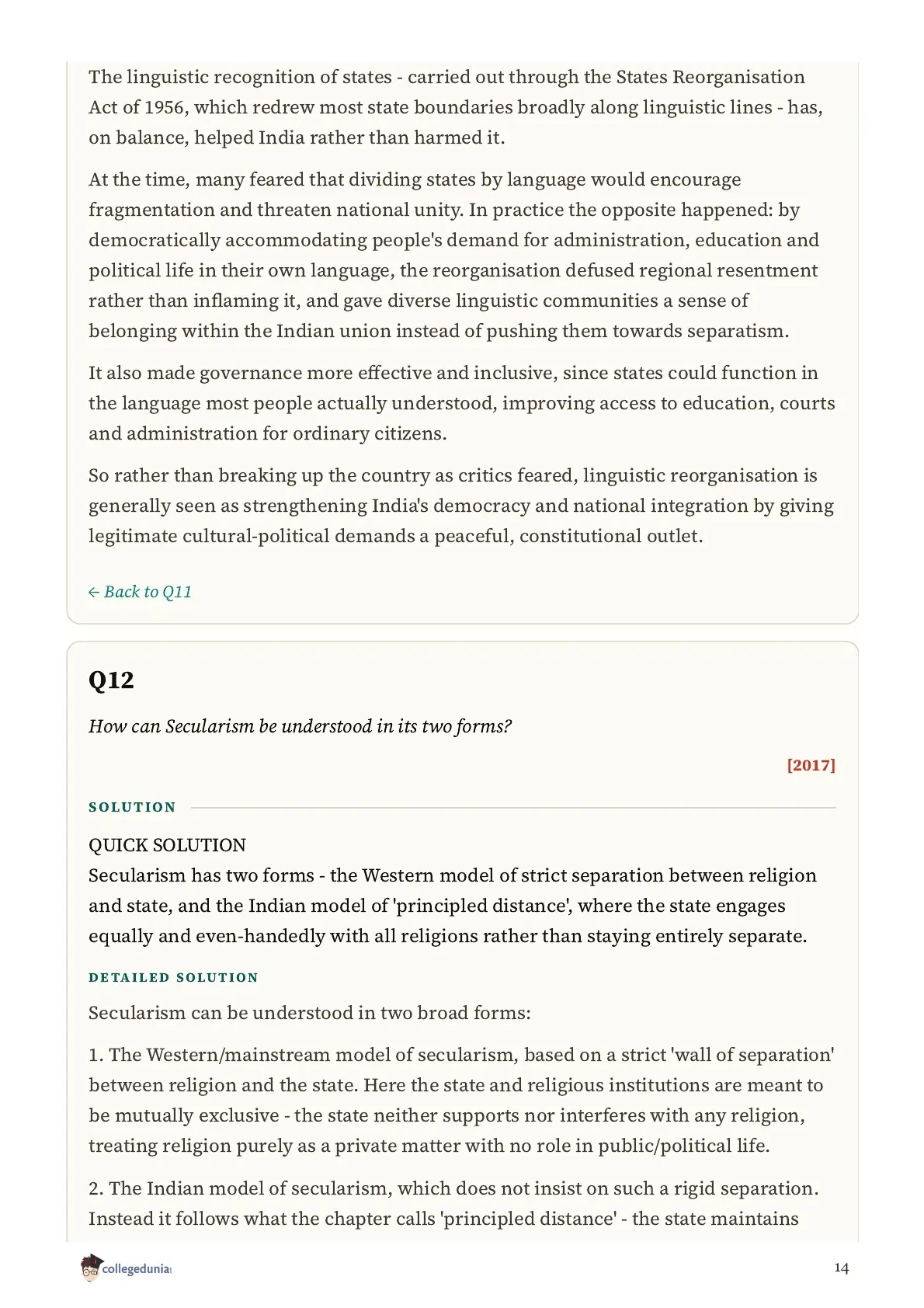
- Linguistic states: why India redrew state boundaries on linguistic lines after independence.
- Identity: the distinction between ascriptive identity, given at birth, and identity a person chooses.
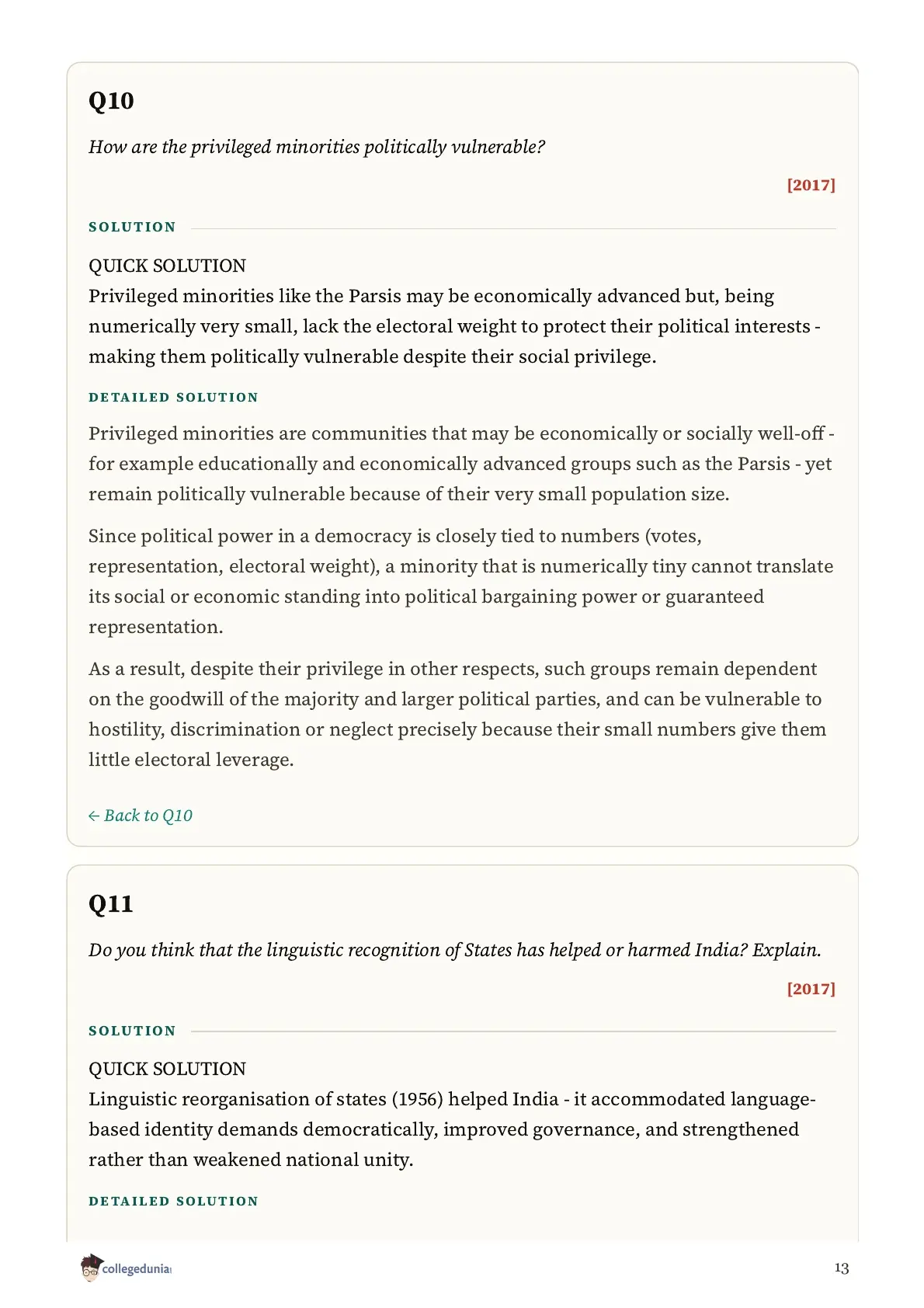
- Minorities: why an economically privileged minority can still be politically vulnerable.
Marks-wise Distribution of Cultural Diversity PYQs
The 12 questions are spread across three CBSE mark bands. Section B's short-answer questions carry the most weight (7 questions), testing whether you can explain a concept in your own words rather than just recognise it.
| Section | Marks Each | Question Type | Number of Questions |
|---|---|---|---|
| Section A | 1 mark | MCQ | 3 |
| Section B | 2 marks | Short Answer | 7 |
| Section C | 4 marks | Long Answer | 2 |
MCQs test whether you can identify a term correctly, secularism versus communalism, for instance, while the 4-mark long-answer questions ask you to build a fuller argument, usually around regionalism or the Jharkhand movement.
Year-wise Spread of Cultural Diversity PYQs: 2017 to 2024
The bank covers four CBSE board papers, and the spread is genuinely even. Each of 2017, 2019, 2023 and 2024 contributed exactly 3 questions, so no single year dominates the set.
| Year | Number of Questions |
|---|---|
| 2024 | 3 |
| 2023 | 3 |
| 2019 | 3 |
| 2017 | 3 |
Because every year is equally represented, practising all four together gives a fair sense of how CBSE has asked about this chapter over nearly a decade, without over-weighting any single paper's pattern.
Which Topics Repeat Most in Cultural Diversity PYQs
Secularism and regionalism dominate the question mix in this chapter. Two Forms of Secularism and Regionalism in India show up most often, across MCQs as well as the longer answer questions. Linguistic recognition of states and ascriptive identity also recur regularly, and topics like the Jharkhand movement or the political vulnerability of privileged minorities turn up in at least one question most years.
- Most frequent: Two Forms of Secularism, Regionalism in India, Linguistic Recognition of States.
- Frequent: Ascriptive identity, Assimilationist policy and national identity, Jharkhand identity movement.
- Regular: Defining the nation as a community, Diversity versus inequality, Features of community identity, Political Vulnerability of Privileged Minorities, Religious diversity in India, States and scepticism towards cultural diversity.
How to Attempt Cultural Diversity PYQs
Start with the MCQs in Section A. They move fast and settle the basic terms before you reach the longer questions. Then work through Section C's long-answer questions, since these carry the most marks and reward a clear structure.
- Always distinguish communalism from religious belief itself. A question on communalism is asking about the politicisation of religion, not about religious faith as such.
- Name India's "principled distance" model of secularism explicitly. Don't describe a generic Western separation-of-church-and-state; name the specific Indian framework the chapter teaches.
- Separate regionalism from separatism in your answer. A regional demand for development or autonomy is not automatically a demand to break away from India.
- Give a concrete example wherever the question allows it, the Jharkhand movement for regionalism, or the Parsis for political vulnerability despite privilege.
Sample Question and Answer Approach for Cultural Diversity
Here is how to structure two typical question types from this chapter's PYQs. The pattern below is the same one the PDF's step-by-step solutions follow.
| Question Type | How to Structure the Answer |
|---|---|
| 1-mark MCQ (e.g. identifying whether a statement describes communalism or secularism) | Read the statement for whether it is about politicising religious identity (communalism) or about the state's relationship with religion (secularism) before picking an option. |
| 4-mark long answer (e.g. explaining why India reorganised states on linguistic lines) | Open with the historical trigger, linguistic movements after independence, name the States Reorganisation Act, 1956, then explain why language, not religion or region alone, became the basis, and close with what this shows about Indian democracy accommodating identity demands. |
This habit, naming the concept precisely, then explaining it with an example, is what separates a 2-mark short answer from a full 4-mark one.
Common Mistakes Students Make in Cultural Diversity Questions
Watch out for these recurring errors:
- Treating regionalism as always separatist. The chapter treats regionalism as sometimes a legitimate demand for autonomy or development, not automatically a threat to national unity.
- Confusing ascriptive identity with chosen identity. Religion, caste, language and region are given at birth; students often describe them as if a person selects them.
- Describing Indian secularism as identical to the Western model. India's secularism is "principled distance", where the state can engage differently with different religions depending on context, not a strict wall of separation.
- Assuming economic privilege rules out political vulnerability. A small, economically well-off minority like the Parsis can still be politically vulnerable simply because of low numbers.
Student Feedback: Cultural Diversity Difficulty Rating
What 9,280 students told us about this chapter's PYQs
In a Collegedunia poll of 9,280 Class 12 Sociology students conducted before the 2027 boards, 61% rated questions on secularism and regionalism as the hardest part of this chapter, mainly because the difference between "principled distance" and the Western separation model is easy to blur under exam pressure. Students who practised all four years of PYQs together reported fewer mix-ups between regionalism and separatism on the actual paper.
Source: 2026-27 Class 12 Sociology student poll. Sample of 9,280 students from CBSE schools across 11 states.
How These PYQs Pair with Other Class 12 Sociology Chapter 6 Resources
This PYQ set works best alongside the other Chapter 6 resources already live on Collegedunia. Read the notes first, revise from the handwritten notes, solve these PYQs, then cross-check tricky answers against the full NCERT solutions.
| Resource | Link |
|---|---|
| NCERT Notes | The Challenges of Cultural Diversity Class 12 Notes |
| Handwritten Notes | The Challenges of Cultural Diversity Class 12 Handwritten Notes |
| NCERT Solutions | The Challenges of Cultural Diversity Class 12 NCERT Solutions |
| NCERT Book PDF | The Challenges of Cultural Diversity Class 12 NCERT Book PDF |
| PYQ (this page) | The Challenges of Cultural Diversity Class 12 PYQ |
Five other Class 12 Sociology chapters are already live as part of this same PYQ series: Structural Change, Cultural Change, Social Institutions: Continuity and Change, The Market as a Social Institution, and The Story of Indian Democracy.
How to Use the Cultural Diversity PYQ PDF Effectively
Don't jump to the solution on the first read. Try to name the concept and sketch an answer yourself, then check it against the step-by-step solution in the PDF.
- First pass: attempt all 12 questions without looking at the solutions, section by section.
- Second pass: compare each answer against the solution and mark where a key term, secularism, regionalism, ascriptive identity, was missing or imprecise.
- Third pass: redo only the questions you got wrong, a day or two later, from memory.
Downloading and Using the PYQ PDF
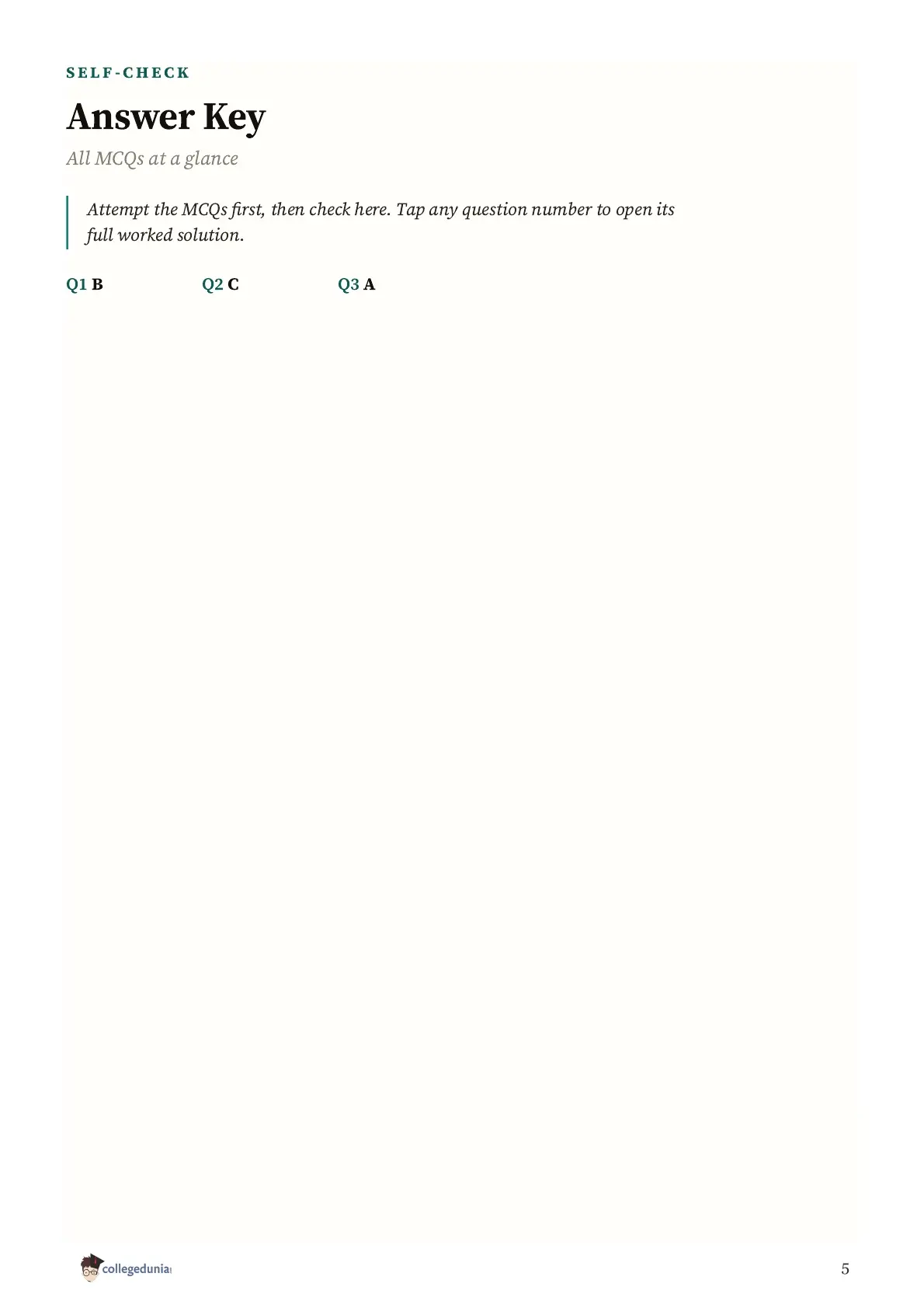
The PDF is 15 pages and free to download. It opens with the question paper sorted by mark band, closes with a self-check answer key, and links every question to its full solution.
The Challenges of Cultural Diversity Class 12 Sociology PYQ FAQs
Ques. How many questions are in the Challenges of Cultural Diversity Class 12 PYQ PDF?
Ans. The PDF has 12 questions from CBSE board papers between 2017 and 2024: 3 one-mark MCQs, 7 two-mark short-answer questions and 2 four-mark long-answer questions.
Ques. Does this PYQ PDF include solutions, or only the questions?
Ans. It includes full solutions. Every one of the 12 questions has a step-by-step answer written out in the PDF, so you can check your own attempt against a worked solution rather than just an answer key.
Ques. Which years of CBSE board papers does this PYQ set cover?
Ans. It covers four years: 2017, 2019, 2023 and 2024, with exactly 3 questions from each year.
Ques. Where can I download the Challenges of Cultural Diversity PYQ PDF?
Ans. You can download it directly from this page. It is free and runs to 15 pages, with the questions sorted by mark band and every question linked to its solution.
Ques. Is this PYQ set aligned with the 2026-27 CBSE syllabus?
Ans. Yes. The chapter content and question pattern match the current 2026-27 NCERT Sociology syllabus for Class 12.
Ques. What is the difference between communalism and secularism?
Ans. Communalism is the politicisation of religious identity, constructing one religious community as opposed to another. Secularism, in the Indian sense, refers to the state maintaining a "principled distance" from all religions rather than favouring one, allowing it to engage differentially with different religious communities depending on context.
Ques. Why did India reorganise states on linguistic lines?
Ans. After independence, regions with a shared language pressed for their own state as a marker of identity and self-governance. India responded through the States Reorganisation Act, 1956, redrawing state boundaries largely on linguistic lines, a democratic accommodation of regional identity rather than a threat to national unity.



Comments