




These Class 12 Sociology Chapter 6 The Challenges of Cultural Diversity Notes sum up the whole chapter for fast revision, set to the 2026-27 CBSE syllabus. They cover the core ideas of the chapter: cultural diversity, community identity, regionalism, minorities, communalism and secularism, with every key term in one place.
- One-page revision of diversity, regionalism, communalism and secularism, built around difference, not inequality.
- This Class 12 Sociology chapter usually carries 6 to 8 marks per board paper.
- Pairs with the NCERT Solutions, Handwritten Notes and NCERT Book PDF linked lower on this page.
These Class 12 Sociology Chapter 6 Notes are written by subject experts from the official NCERT Indian Society textbook, with every fact mapped to the latest 2026-27 syllabus.
Student Feedback: In a Collegedunia poll of 8,140 Class 12 Sociology students, 72% of students said a one-page split of communalism and secularism made this chapter far quicker to revise. Most students wanted the two senses of Indian secularism summed up in a single line.
Source: 2026-27 Class 12 Sociology student poll. Sample of 8,140 students from CBSE schools across 12 states.
The Challenges of Cultural Diversity Class 12 Notes Overview
This chapter studies how India's many communities live together and where their differences turn into challenges. The thread that ties the whole chapter is that diversity is about difference, not inequality, so keep that idea in mind for every section.
For quick revision, sort the chapter into three blocks and ask the same question of each:
- Diversity and identity: what makes India diverse, and where community identity comes from.
- The challenges: regionalism, the nation versus state, minorities and communalism.
- The responses: linguistic states, secularism and an active civil society.
A student who keeps these three blocks separate can revise the whole chapter in one sitting. The trick is to learn the definitions first, then the debates, because most board questions ask for one or the other.
Key Terms and Definitions for Quick Revision
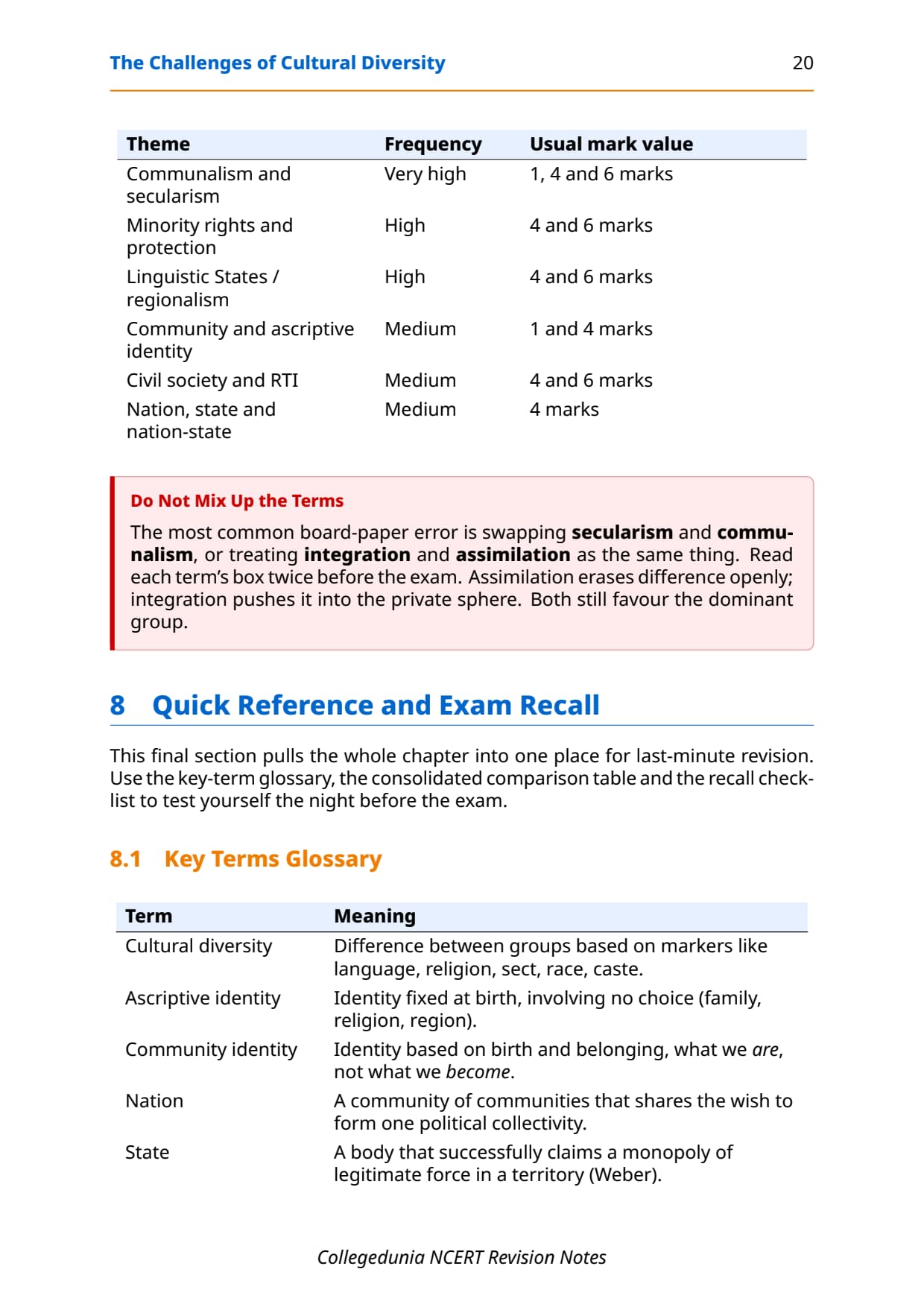
The chapter rests on a handful of terms that come up again and again in the board paper. Learn these first, because a clear definition often earns the opening mark of any answer.
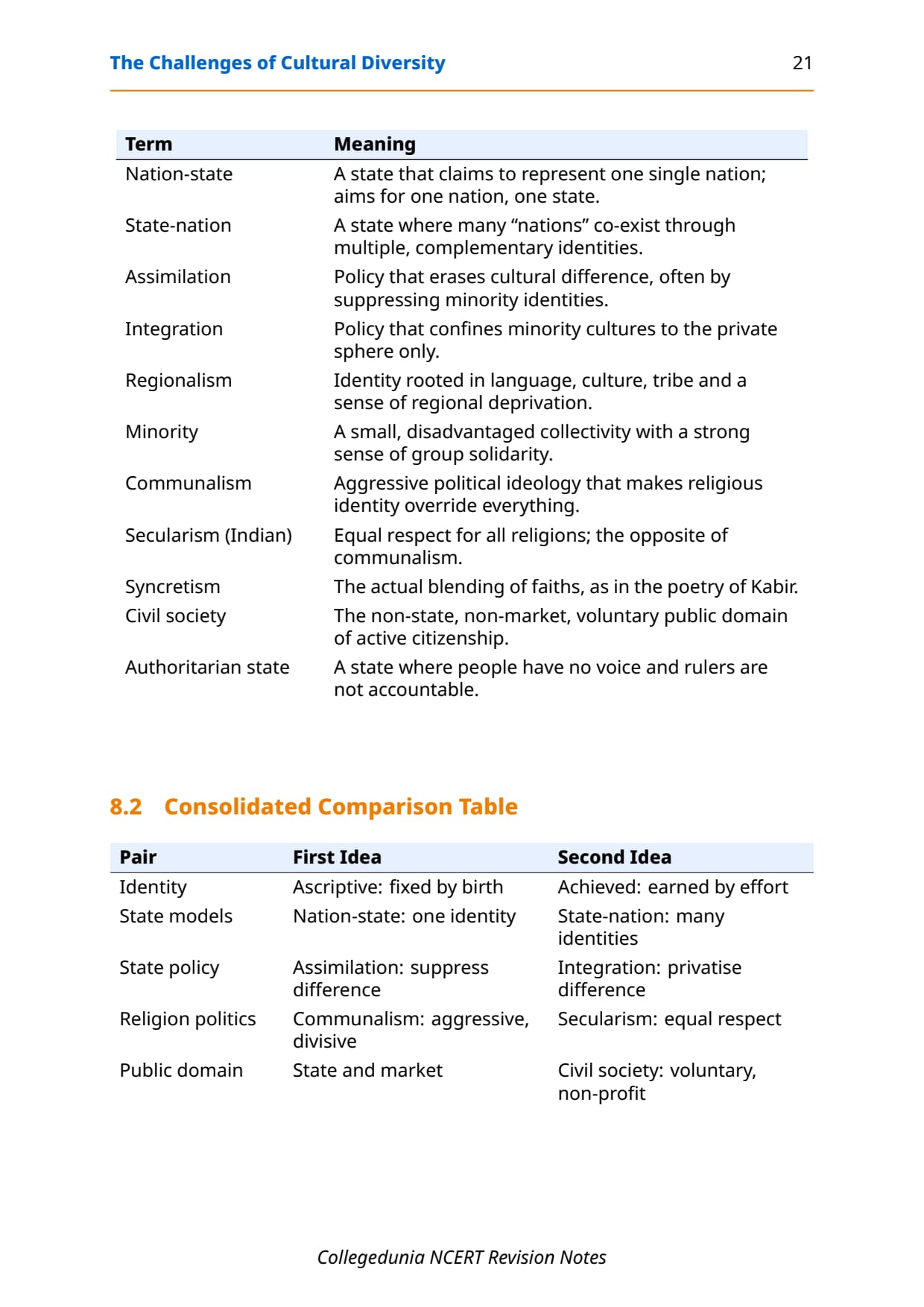
| Term | Meaning to recall |
|---|---|
| Cultural diversity | Many communities marked by language, religion, sect, race or caste in one society. |
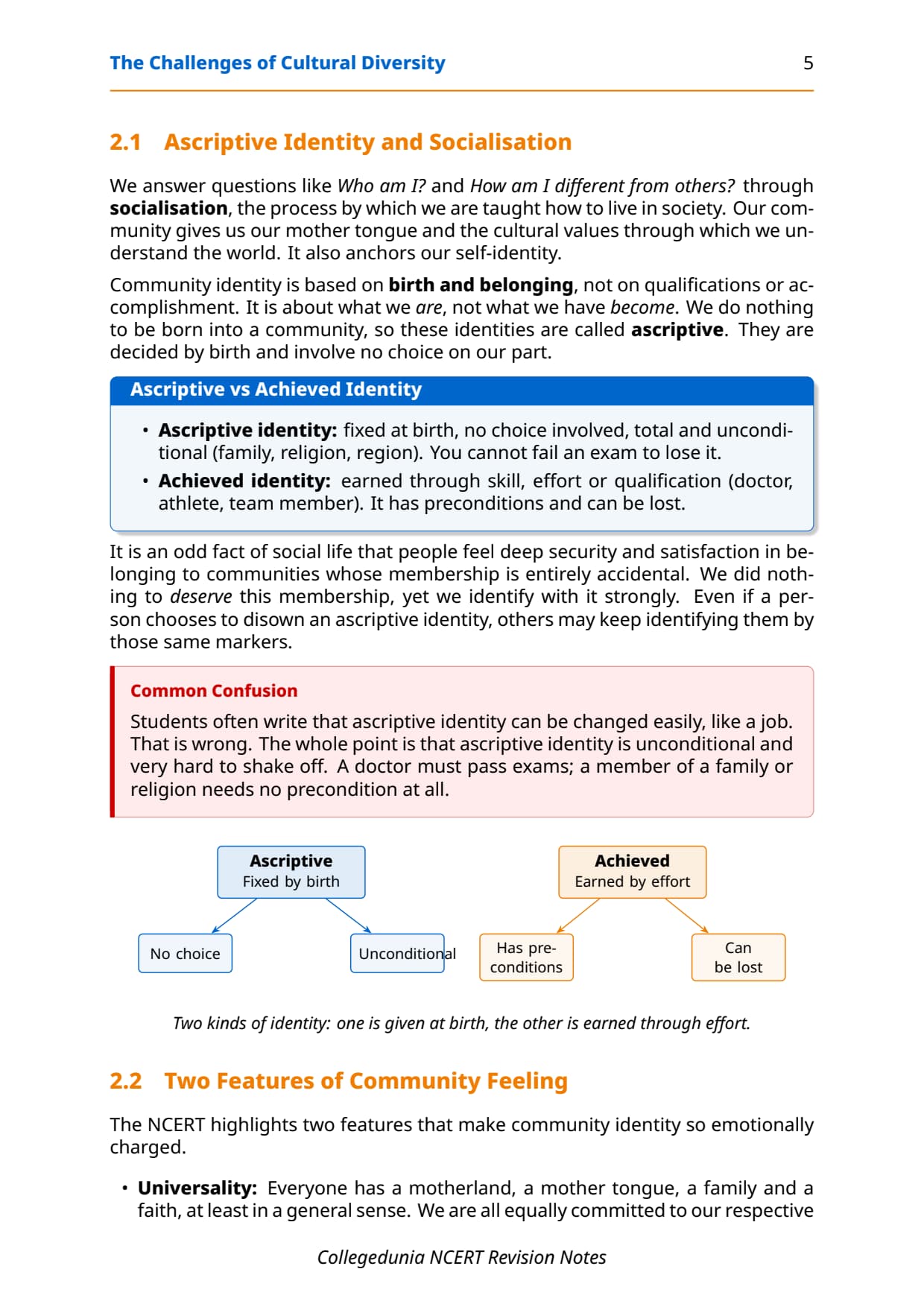
| Ascriptive identity | An identity given at birth, with no choice, like family, caste or religion. |
| Regionalism | The assertion of regional identity, mostly based on language. |
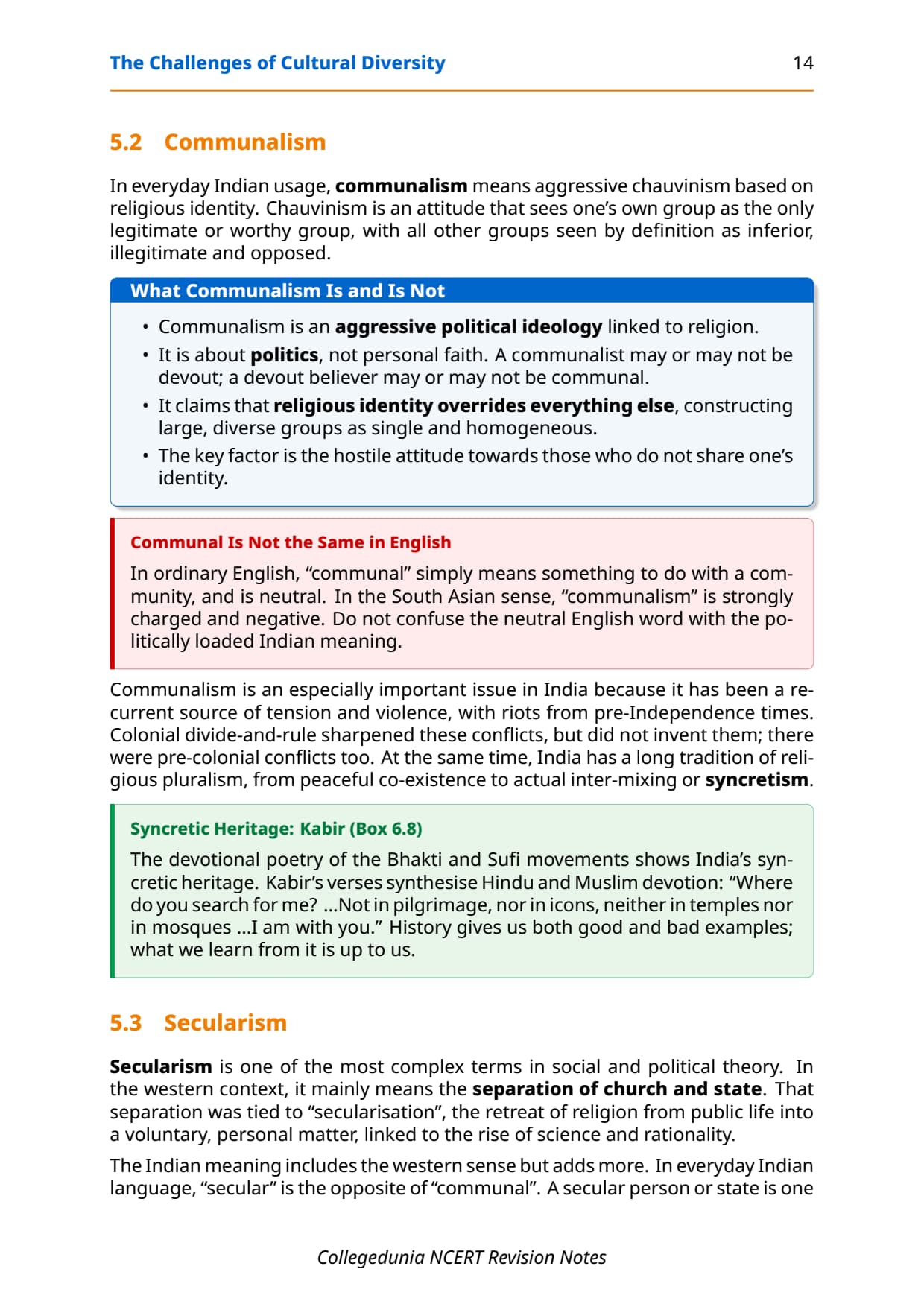
| Communalism | An aggressive political ideology of religious chauvinism, about politics not faith. |
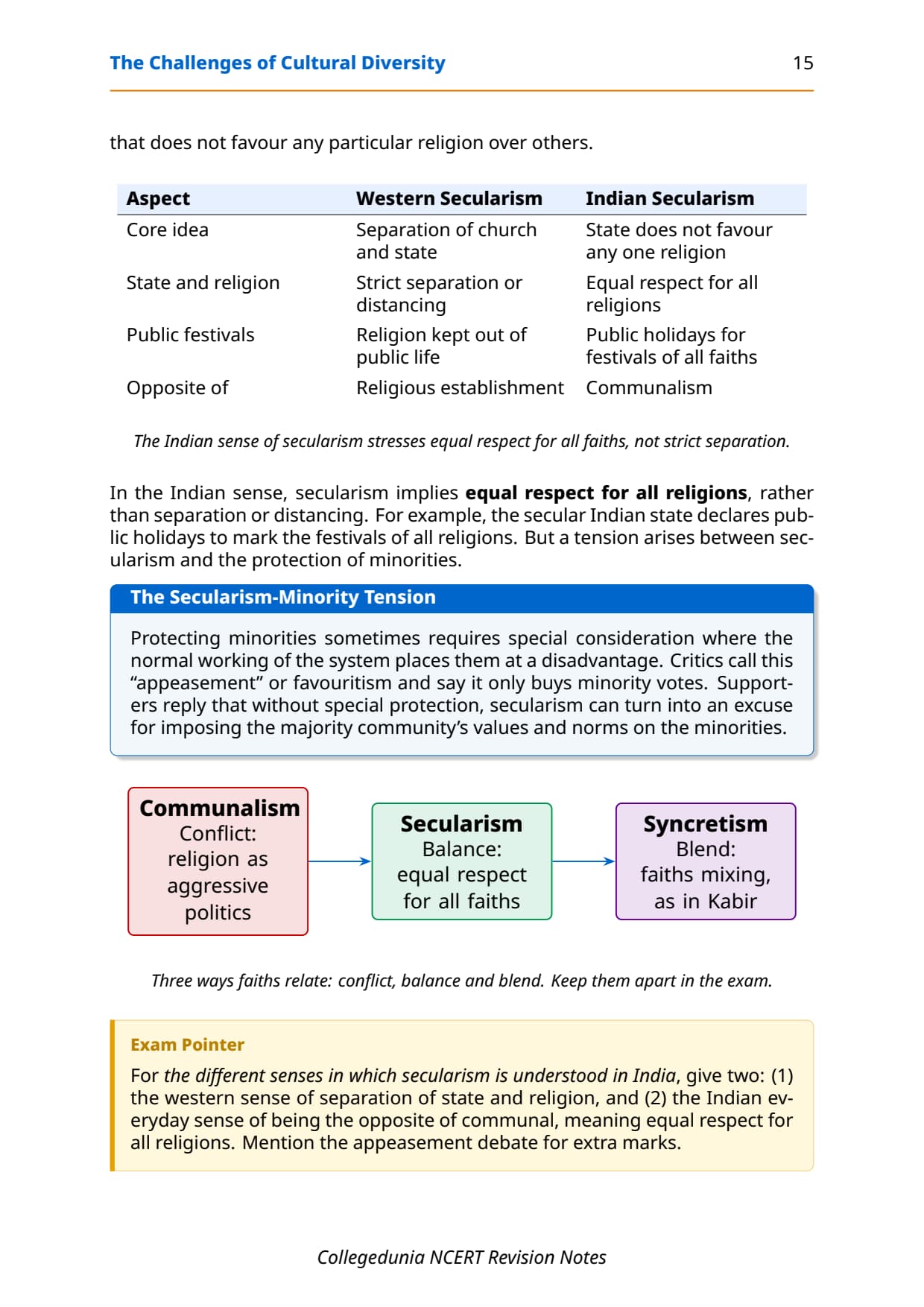
| Secularism | The Indian state keeping a principled distance from all religions. |
Keep these five terms on a single flashcard. Examiners often hide a definition inside a longer question, so a student who knows them cold can pick up easy marks before tackling the harder analysis.
Cultural Diversity and Community Identity
The opening block sets up the whole chapter, so it deserves careful revision. Hold on to two ideas: what makes India diverse, and why identity feels so powerful.
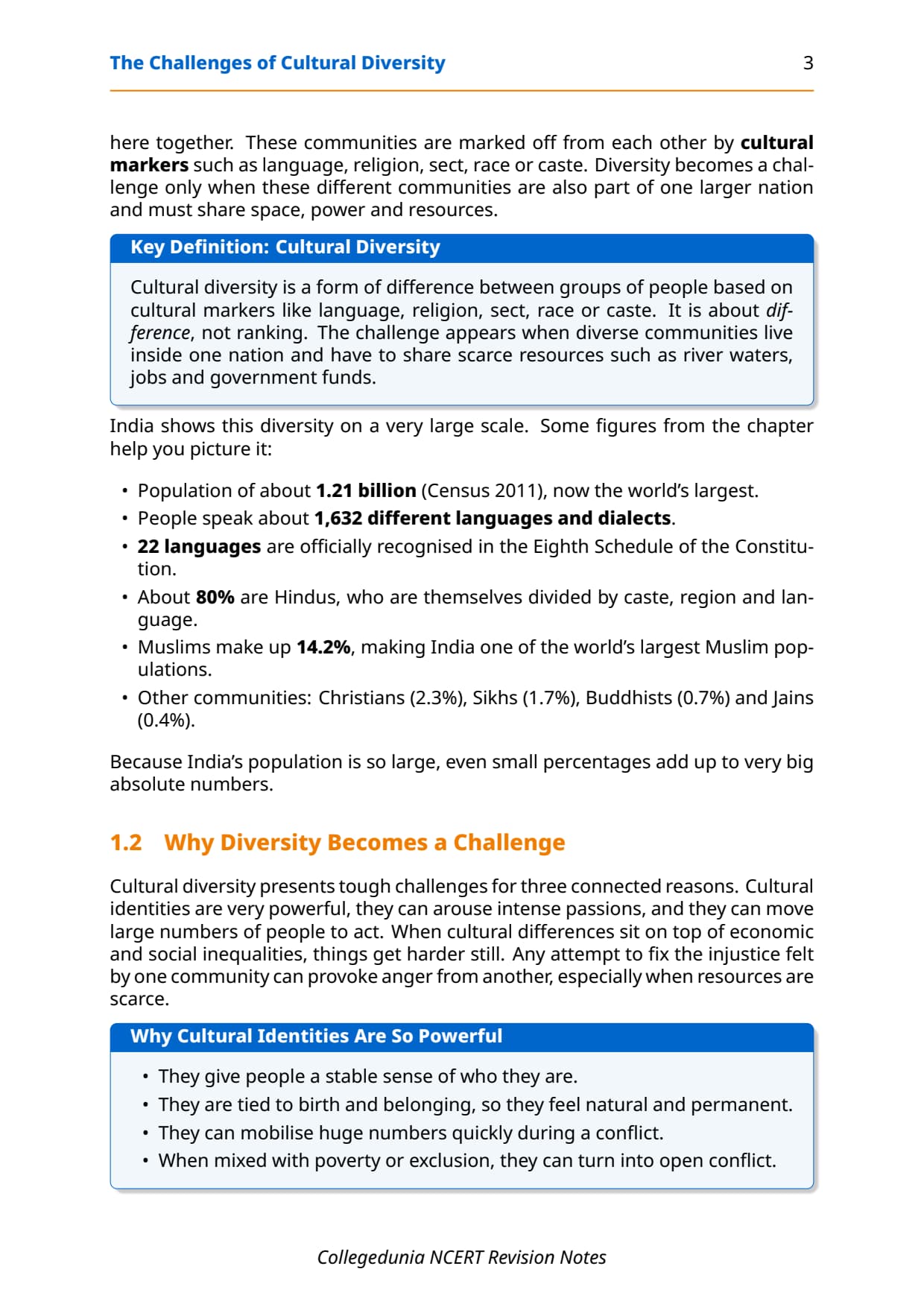
- Diversity in numbers: about 1,632 languages and dialects, 22 in the Eighth Schedule, and a plural religious mix topped by a caste-divided Hindu majority.
- Community identity is ascriptive: given at birth, learned through socialisation, based on belonging not achievement.
- It is emotionally powerful: people defend it strongly and may react when it feels threatened.
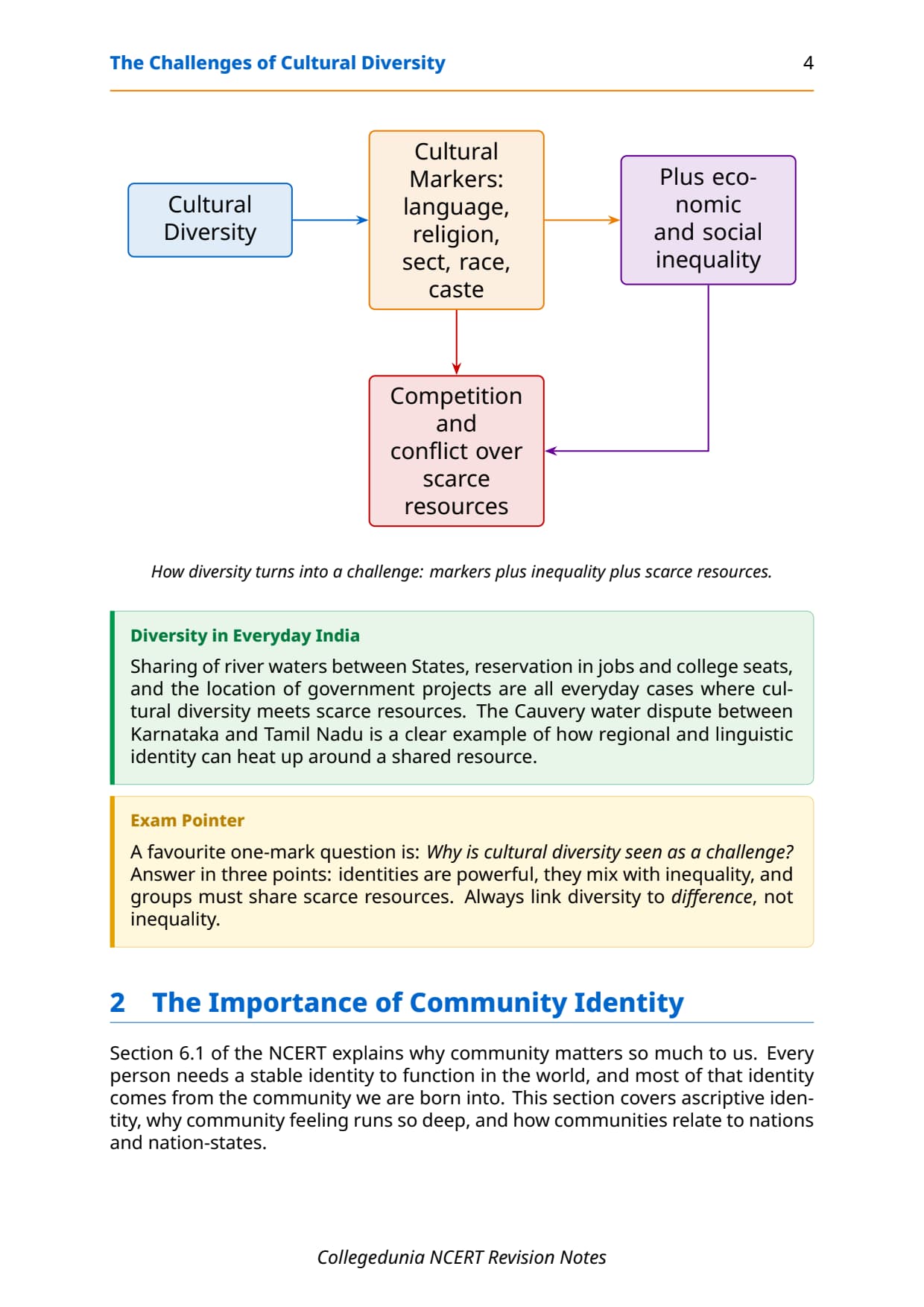
- Diversity versus inequality: diversity is difference; trouble starts when it overlaps with inequality.
The single point to remember is that every nation is diverse inside, so the real test is how it treats its communities. A balanced revision note keeps the diversity facts and the identity idea side by side.
Regionalism, Minorities and Communalism
This block holds the chapter's core challenges, and the board often asks for both a definition and a reason. Revise each in one or two lines.
| Challenge | What to recall |
|---|---|
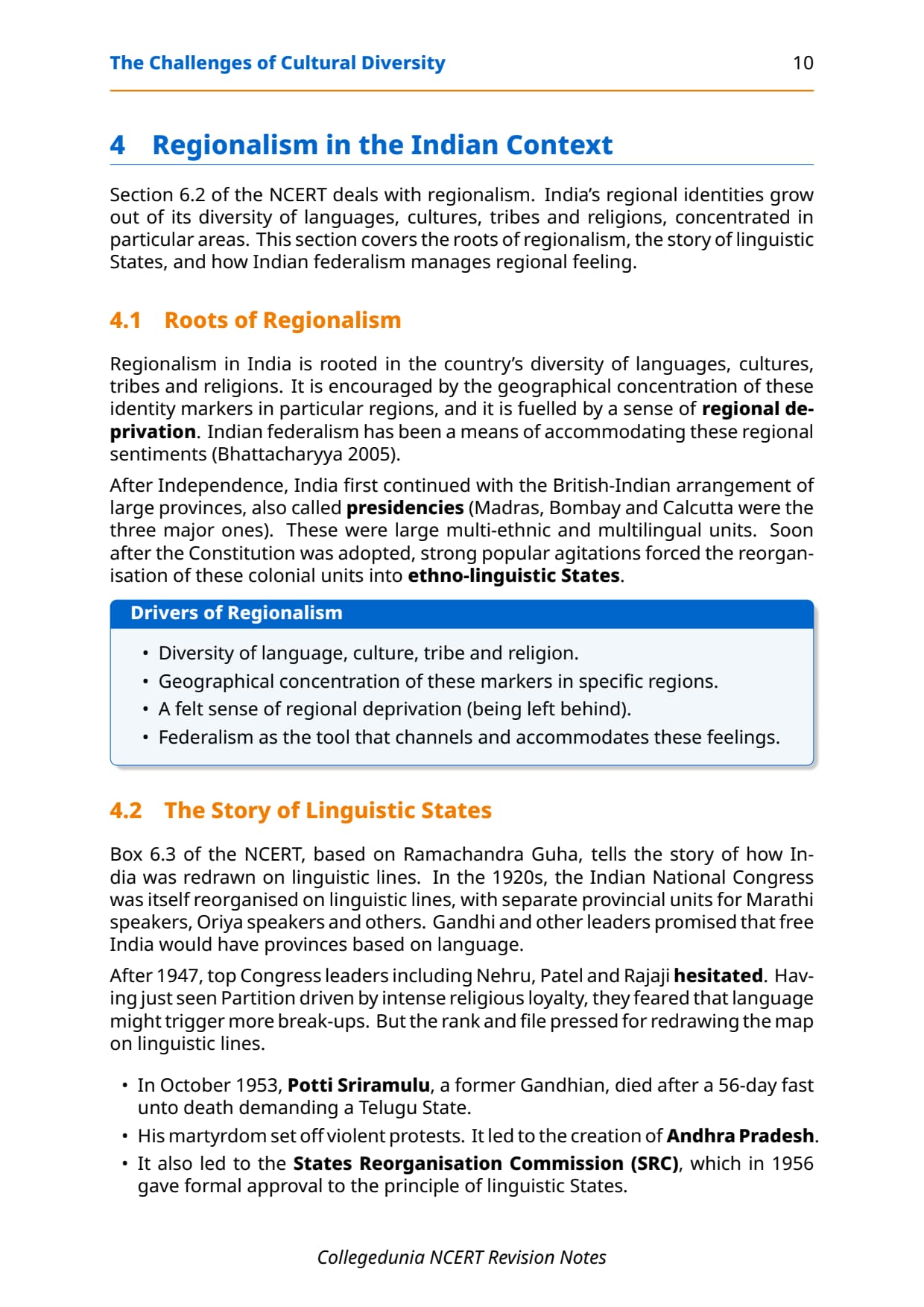
| Regionalism | Region-based identity, mostly on language, joined by tribe, ecology and a sense of deprivation. |
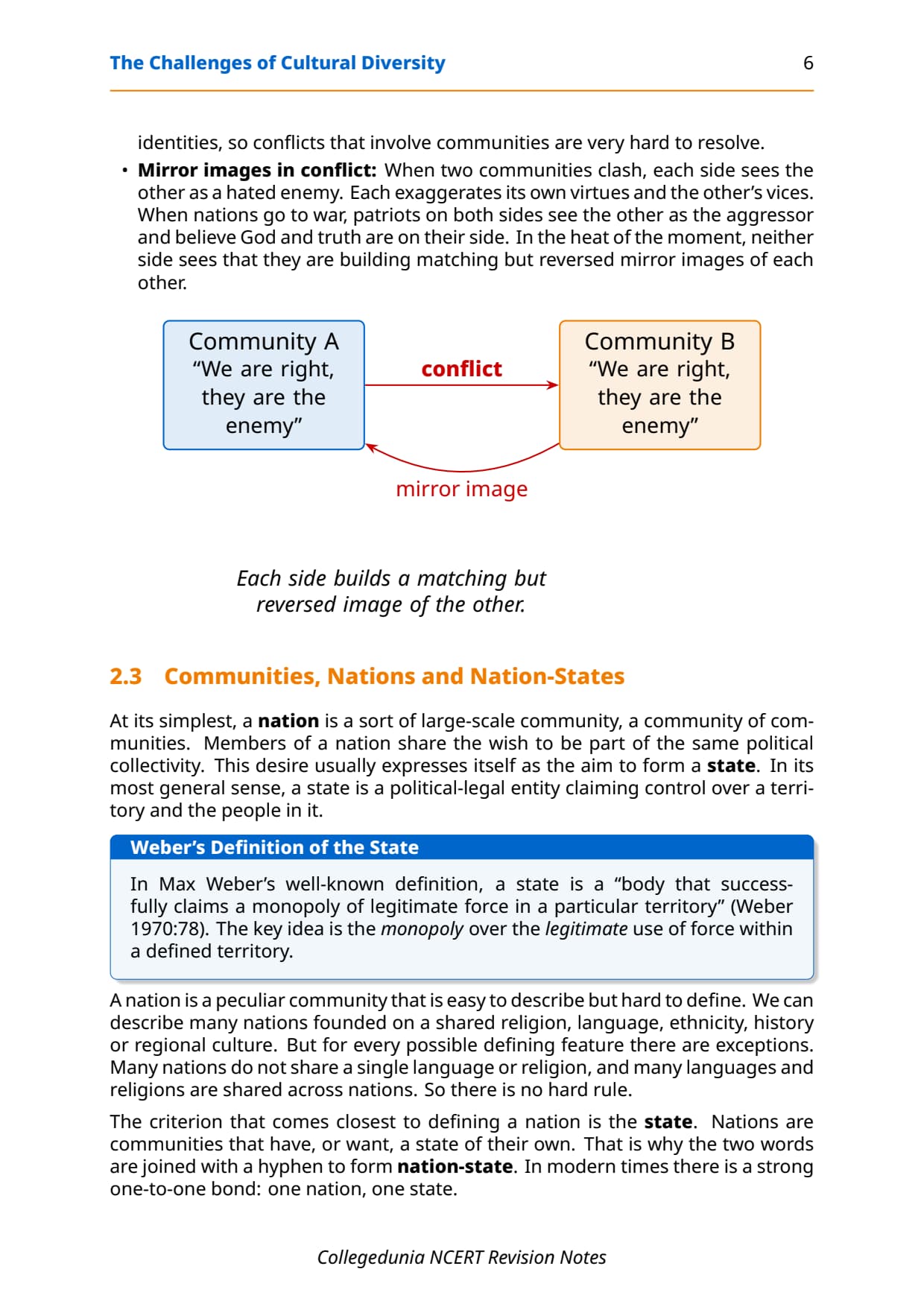
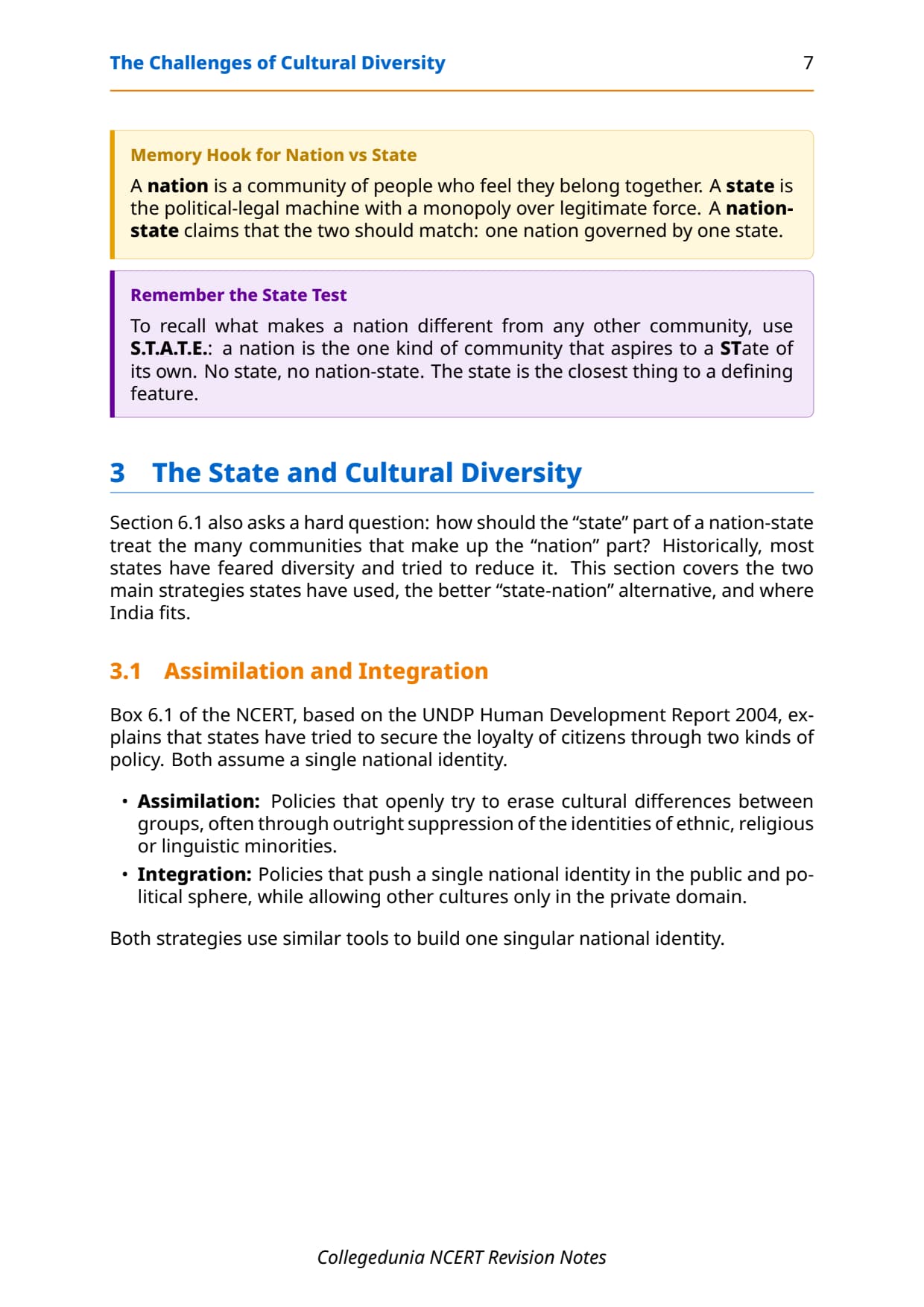
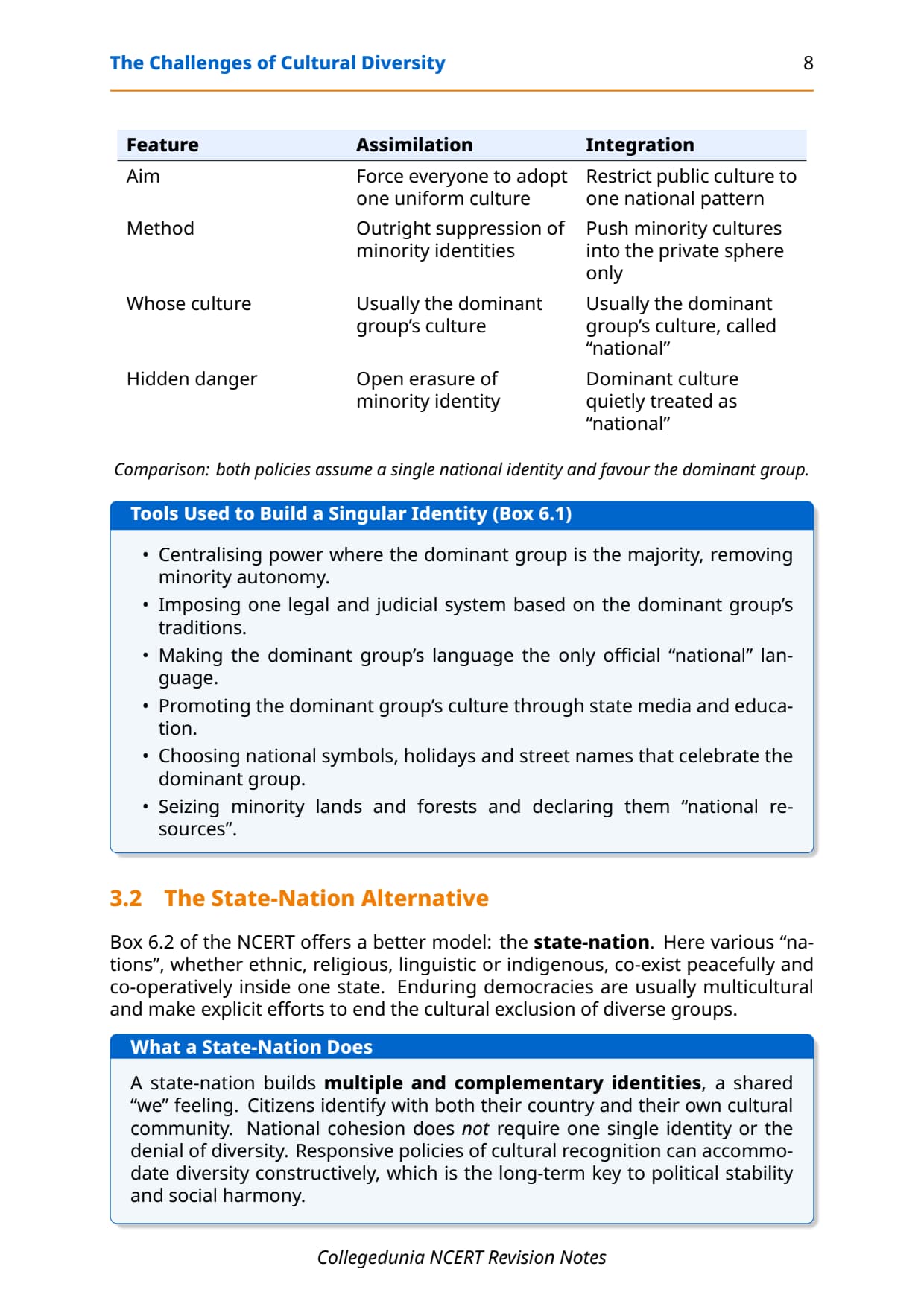
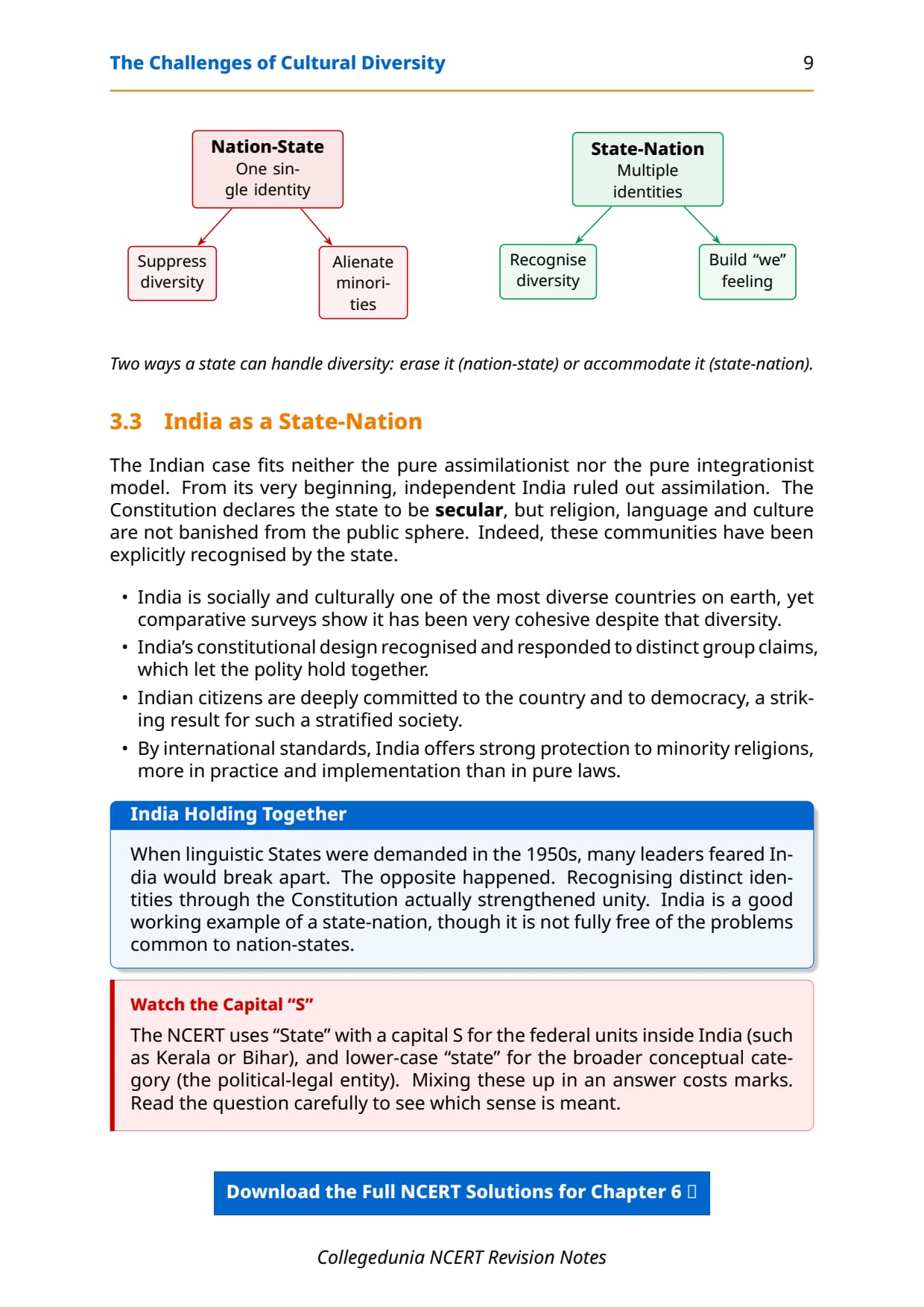
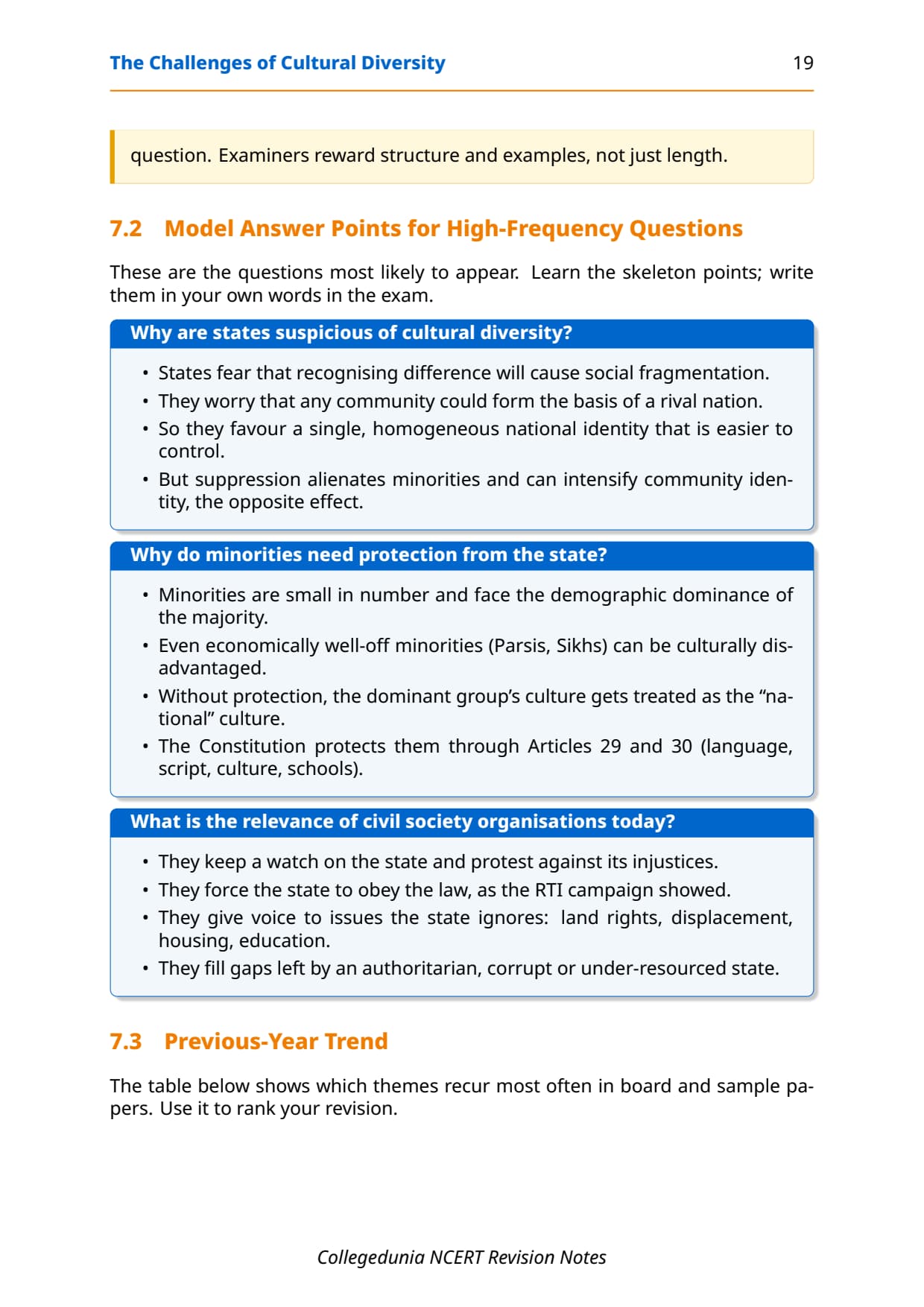
| State suspicion of diversity | States fear fragmentation and rival nations, so they push one identity; suppression backfires. |
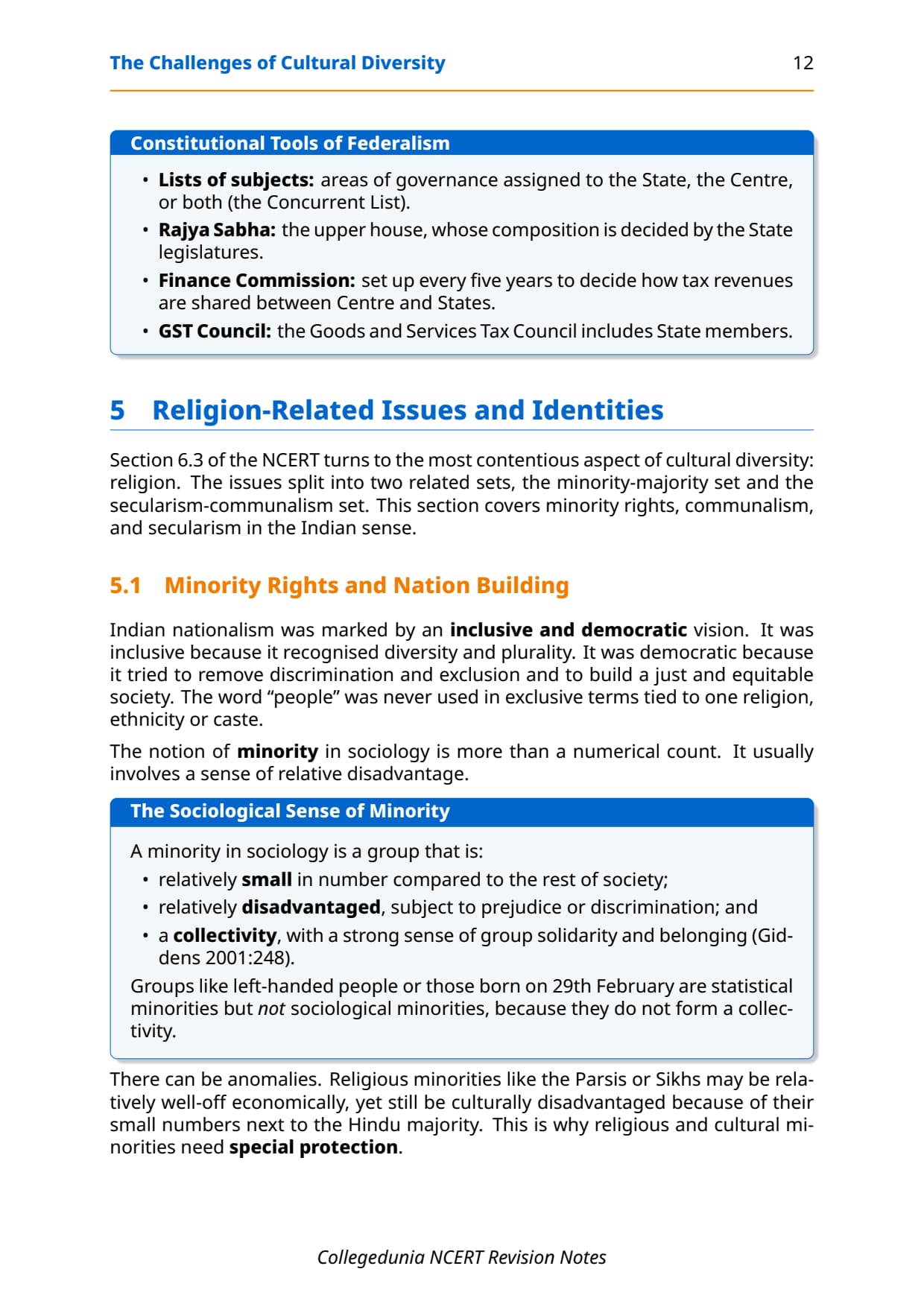
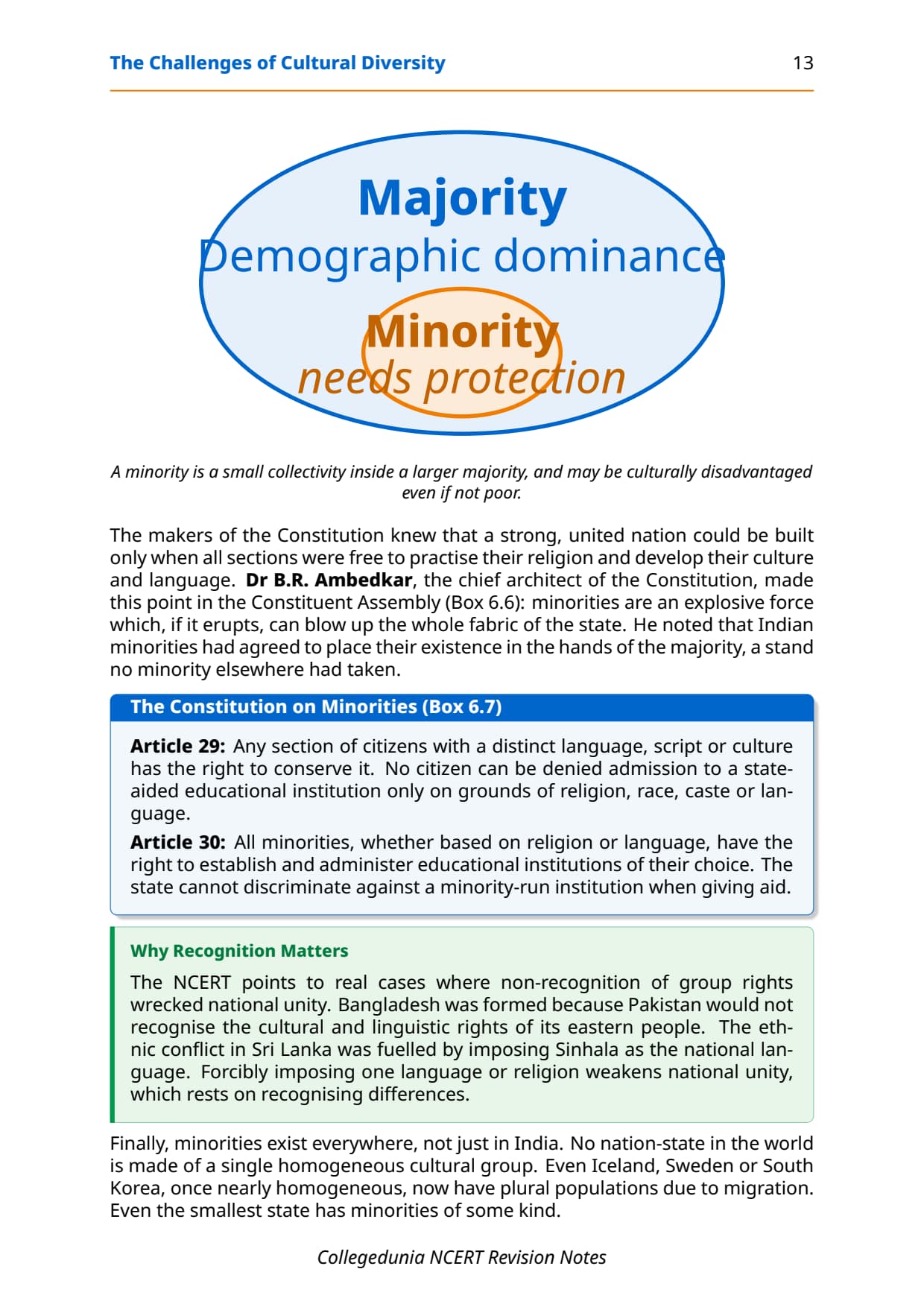
| Minority | A small, disadvantaged group bound by a sense of collectivity, not just a numerical few. |
| Communalism | An aggressive political ideology that treats one religion as the only legitimate one. |
The honest revision point is that communalism is about politics, not personal faith. A devout person is not communal; communalism begins when religion is turned into a political weapon. Pair each challenge with its one-line reason for a full answer.
Linguistic States, Secularism and Civil Society
The closing block holds India's responses to diversity and the most-confused pair of terms. Learn the facts, then the difference that trips most students.
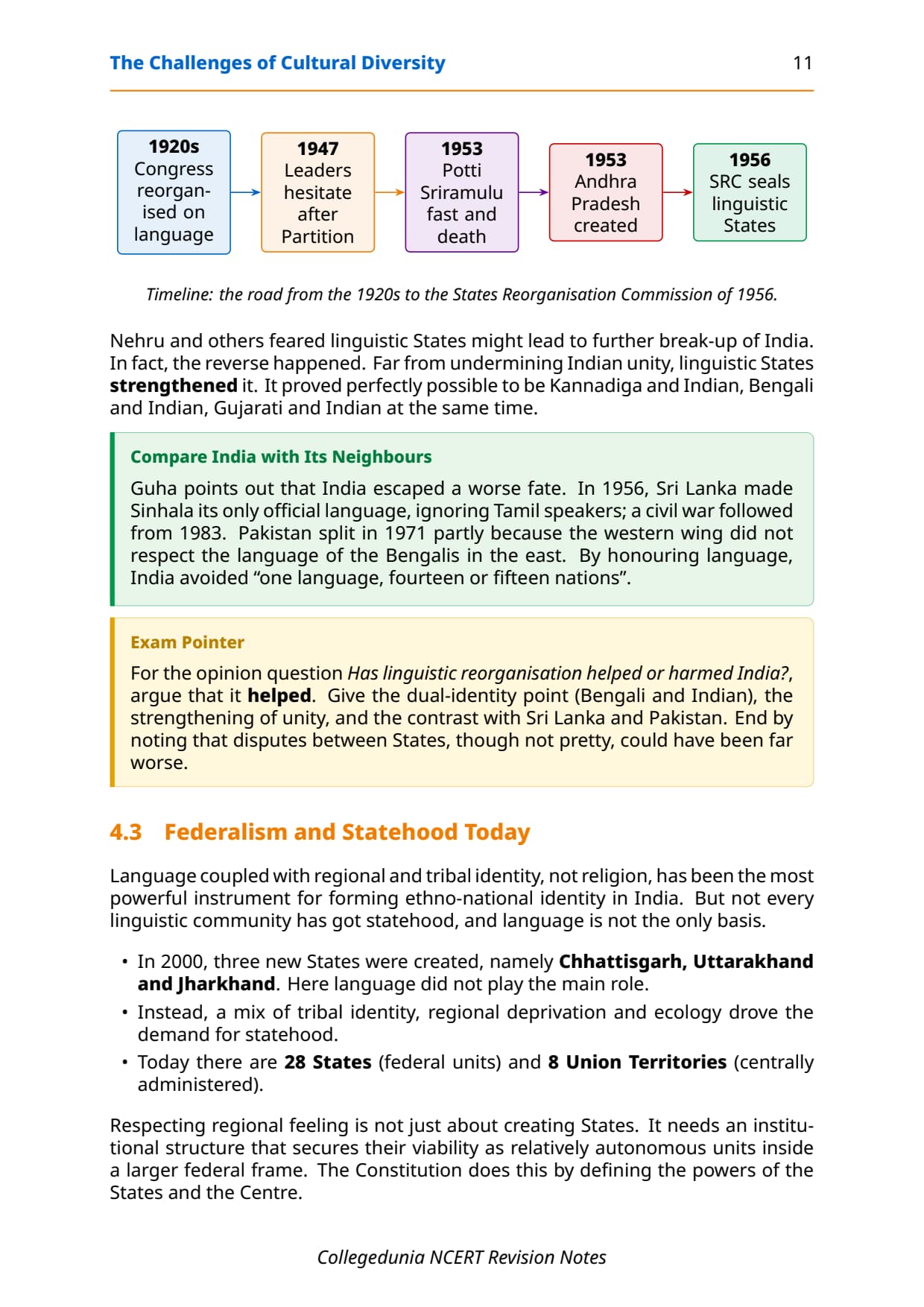
- Linguistic reorganisation: states redrawn on language from 1 November 1956; it let Indians be regional and national at once and strengthened unity.
- Western secularism: strict separation of state and religion.
- Indian secularism: a principled distance from all religions, treating each equally and even reforming injustice within them.
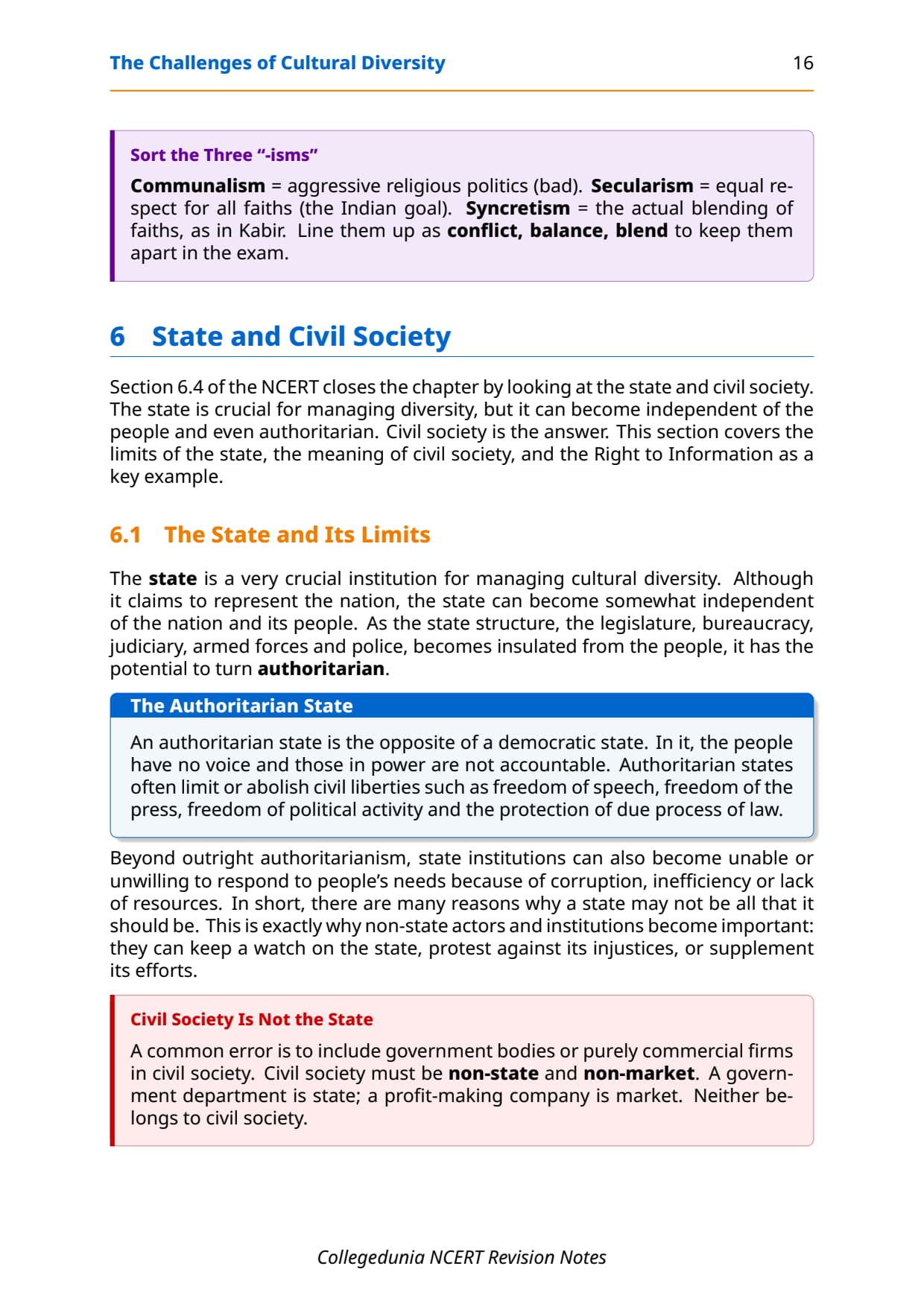
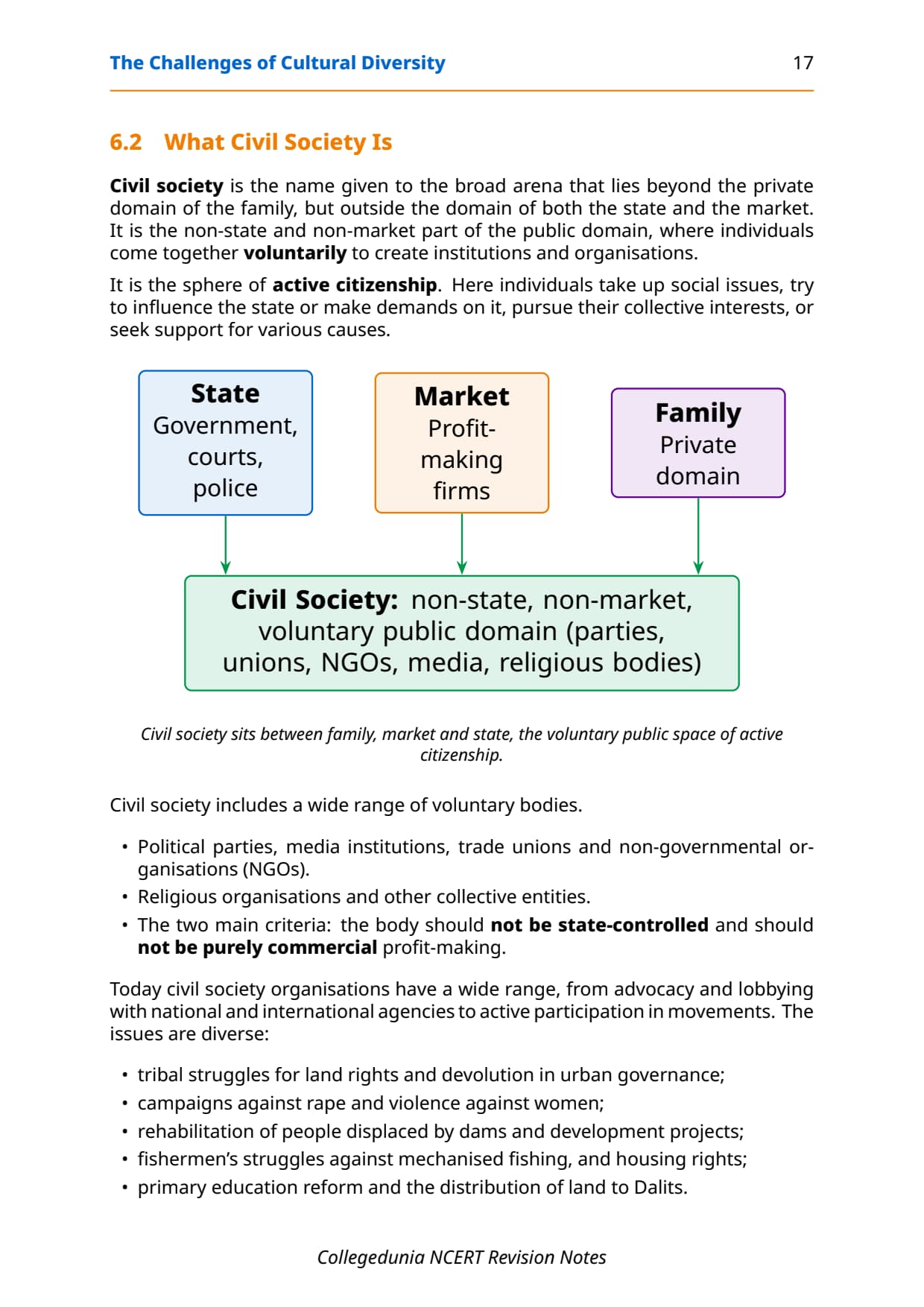
- Civil society: voluntary groups, movements and the media outside the family, market and state, which deepen democracy.
The line to memorise is that Indian secularism is active, not passive. Rather than ignoring religion, the state stays equidistant from all faiths and may step in to remove injustice. Knowing the 1956 date and both senses of secularism covers most of the marks here.
The Challenges of Cultural Diversity Revision Table
This single table puts the whole chapter in one view. Use it on the last night before the exam to check that you can recall the idea and the response for each challenge.
| Theme | The challenge | India's response |
|---|---|---|
| Language | Regionalism and demands for linguistic states | Reorganisation of states on language in 1956 |
| Religion | Communalism and majority dominance | Secularism, principled distance from all faiths |
| Community | Minorities left disadvantaged in politics | Constitutional safeguards and civil society voice |
If you can fill this table from memory, you are ready for the chapter. Most board answers are just one row of this table written out in full, with an example or two added.
How These Notes Pair with the Solutions and Book PDF
These Notes give the quick summary. To finish the chapter, students should use them with the other resources for the same chapter, all linked in the table below.
| Resource | Best used for |
|---|---|
| The Challenges of Cultural Diversity NCERT Solutions | Full point-wise answers to all 10 exercise questions |
| The Challenges of Cultural Diversity Handwritten Notes | Last-minute, one-shot revision in a scanned notebook style |
| The Challenges of Cultural Diversity NCERT Book PDF | Reading the original NCERT chapter text |
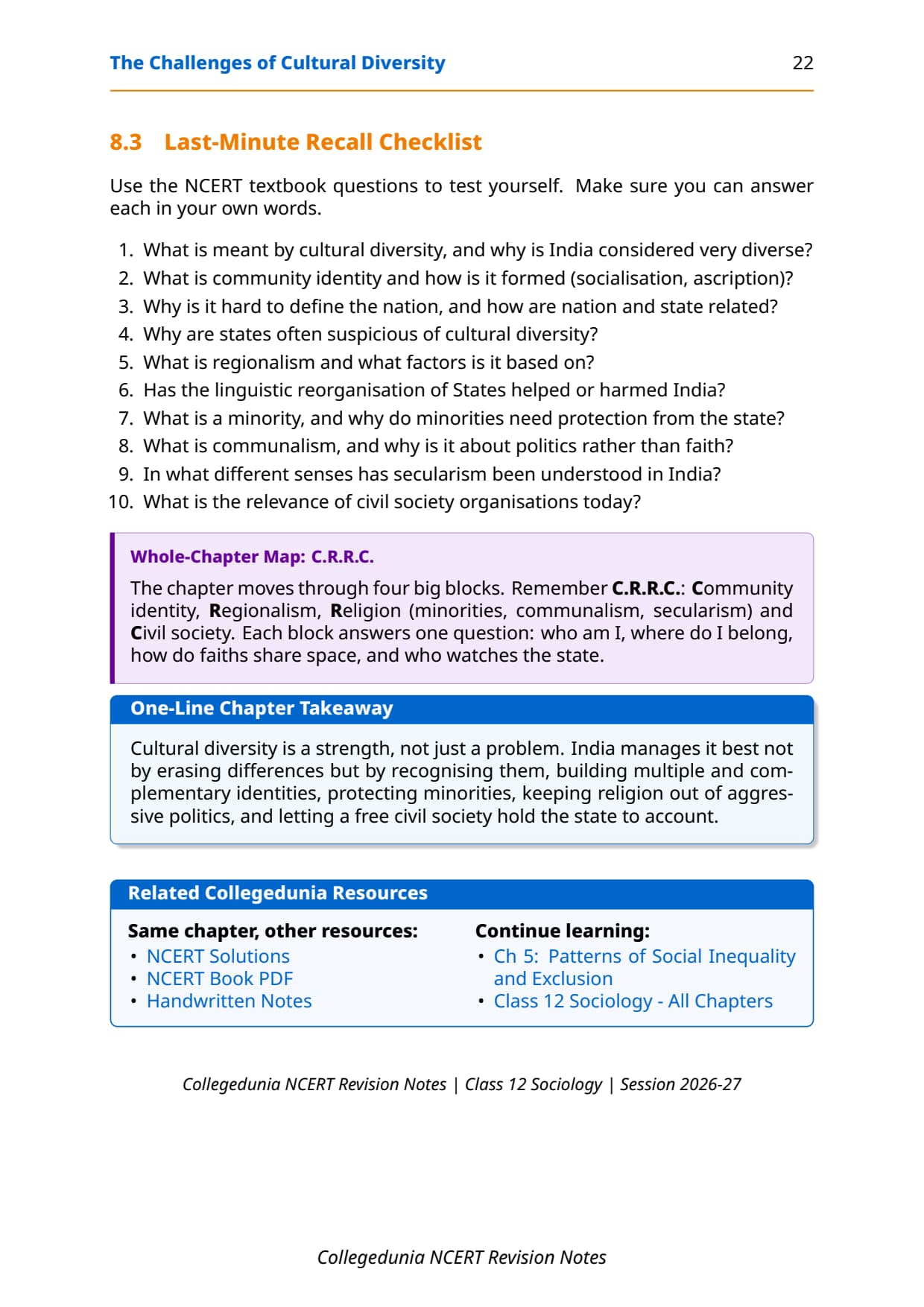
Tip: read these Notes first, then attempt the Solutions on your own, and keep the Book PDF open for any term you want to check.
All NCERT Notes for Class 12 Sociology
The table links the Notes for every chapter in both Class 12 Sociology books, so students can revise the whole course in one place. The Challenges of Cultural Diversity is highlighted.
| Chapter | Notes |
|---|---|
| Indian Society | |
| Chapter 1 | Introducing Indian Society |
| Chapter 2 | The Demographic Structure of the Indian Society |
| Chapter 3 | Social Institutions - Continuity and Change |
| Chapter 4 | The Market as a Social Institution |
| Chapter 5 | Patterns of Social Inequality and Exclusion |
| Chapter 6 | The Challenges of Cultural Diversity |
| Social Change and Development in India | |
| Chapter 1 | Structural Change |
| Chapter 2 | Cultural Change |
| Chapter 3 | The Constitution and Social Change |
| Chapter 4 | Change and Development in Rural Society |
| Chapter 5 | Change and Development in Industrial Society |
| Chapter 6 | Globalisation and Social Change |
| Chapter 7 | Mass Media and Communications |
| Chapter 8 | Social Movements |
FAQs on The Challenges of Cultural Diversity Class 12 Notes
The Challenges of Cultural Diversity Class 12 Sociology Notes Common Questions
Ques. Where can I download the class 12 sociology chapter 6 Notes PDF?
Ans. You can download the The Challenges of Cultural Diversity Class 12 Sociology Notes PDF directly from this page. It is free, follows the 2026-27 NCERT, and sums up diversity, regionalism, communalism and secularism for fast revision.
Ques. What is the main theme of The Challenges of Cultural Diversity?
Ans. The main theme is that diversity is about difference, not inequality. The chapter shows how India's many communities live together, where their differences turn into challenges like regionalism and communalism, and how India responds through linguistic states, secularism and civil society.
Ques. What is the difference between communalism and secularism?
Ans. Communalism is an aggressive political ideology that treats one religious group as the only legitimate one. Secularism, in India, is the state keeping a principled distance from all religions and treating each equally. In short, communalism weaponises religion in politics, while secularism keeps the state fair to every faith.
Ques. What does ascriptive identity mean in this chapter?
Ans. An ascriptive identity is one given at birth, with no choice on the person's part, such as family, caste, region or religion. Community identity is ascriptive: it is learned through socialisation, based on belonging rather than achievement, and is emotionally very powerful.
Ques. Are these Notes enough for the board exam?
Ans. These Notes are ideal for quick revision and recall. For full board practice, pair them with the NCERT Solutions for the same chapter, which give the complete point-wise answers to all 10 exercise questions.



Comments