The NCERT Solutions for Class 12 Sociology Chapter 6 The Challenges of Cultural Diversity answer every textbook question on cultural diversity, community identity, the nation and state, regionalism, the linguistic reorganisation of states, minorities, communalism, secularism and civil society, set to the latest 2026-27 CBSE syllabus. Each answer is written in plain points so students can revise fast and write full board answers.
Covers all 10 exercise questions from Indian Society Chapter 6, with point-wise model answers.
This Class 12 Sociology chapter usually carries 6 to 8 marks per board paper.
Pairs with the Notes, Handwritten Notes and NCERT Book PDF linked lower on this page.
Every solution for Class 12 Sociology Chapter 6 in this Collegedunia compilation is written by subject experts from the official NCERT Indian Society textbook, and checked against the last five years of CBSE board papers.
Student Feedback: In a Collegedunia poll of 8,140 Class 12 Sociology students taken before the 2026 boards, 74% of students said the difference between communalism and secularism was the part of this chapter they mixed up most. Most students said a simple "politics versus personal faith" line made the two terms click at once.
Source: 2026-27 Class 12 Sociology student poll. Sample of 8,140 students from CBSE schools across 13 states.
What The Challenges of Cultural Diversity Class 12 Chapter Is About
The Challenges of Cultural Diversity is the sixth chapter of Indian Society. It explains that diversity is about difference, not inequality, and then studies how those differences turn into challenges when communities share one nation. The chapter runs from community identity through regionalism, minorities and communalism to secularism and civil society.
The chapter answers a few big questions that students must keep in mind:
What makes India diverse? Many communities marked off by language, religion, sect, race and caste, all living in one society.
When does diversity become a challenge? When community identities are tied to a nation, and competition or inequality sharpens the differences.
How does India respond? Through linguistic states, minority protection, secularism and an active civil society.
So the chapter is really about reading diversity as something to accommodate, not suppress. A student who sorts each point under "diversity", "challenge" or "response" can connect almost any question in The Challenges of Cultural Diversity class 12 back to one of these threads. That is why revision works best when you label each point before you learn it.
Key Concepts of Cultural Diversity Every Answer Uses
Before the case studies, the chapter fixes a short list of terms. Almost every answer in the exercise leans on one of them, so students should learn these first. The table below keeps each concept next to a plain meaning for quick revision.
Concept
What it means
Cultural diversity
The presence of many different communities, set apart by cultural markers like language, religion, sect, race or caste, in one society.
Community identity
The stable sense of self a person draws from belonging to a community; an ascriptive identity, given at birth.
Nation and state
A nation is a community claiming political rights; a state is the political-legal body that governs a territory.
Regionalism
The assertion of a regional identity, usually rooted in language, tribe, ecology and a sense of being left behind.
Communalism
An aggressive political ideology that treats one's own religious group as the only legitimate one.
Secularism
In India, the state keeping a principled distance from all religions, treating each on equal terms.
A key insight for the exam is that diversity points to difference, while inequality points to rank. Trouble starts when the two overlap, so an answer that holds them apart and then shows where they meet scores higher than one that treats every difference as a conflict.
Cultural Diversity, Community Identity and the Nation
The first three exercise questions build the chapter's foundation: what diversity is, where community identity comes from, and why the nation is hard to define. Students should learn these as clear definitions with one or two facts each, not as stories.
Cultural diversity: India has about 1,632 languages and dialects, with 22 recognised in the Eighth Schedule, and a plural religious make-up topped by a caste-divided Hindu majority.
Community identity: it is ascriptive, given at birth and through socialisation, based on belonging rather than achievement, and emotionally very powerful.
Nation versus state: a nation is a special kind of community that claims political rights, while a state governs a territory; modern states try to be nation-states, matching one nation to one state.
The honest exam point is that no nation is made of just one community. Every nation is culturally diverse inside, so the real question is how it treats the many communities within it. Naming the cultural markers and the word "ascriptive" is what separates a full-mark answer from a half one.
Why States Fear Diversity, and Regionalism Explained
Questions four and five move from concept to politics. They ask why states are suspicious of diversity and what regionalism rests on. Students should give the textbook reason first and then the deeper point.
Topic
What to give the examiner
State suspicion of diversity
States fear that recognised differences will cause fragmentation and spawn rival nations, so they push one identity through assimilation or integration.
Cost of suppression
Forcing a single identity alienates minorities and can deepen the very identities it tries to erase, so accommodation is wiser.
Regionalism
The assertion of regional identity, rooted in India's diversity and a sense of regional deprivation.
Factors behind regionalism
Language is the strongest factor, joined by regional and tribal identity, ecology and a feeling of being left behind in development.
The balanced point is that suppressing diversity backfires, while accommodating it builds unity. India's choice to recognise regions and languages is why regionalism here rarely turns into separatism. Mentioning language as the leading factor behind regionalism is the detail examiners look for.
Linguistic Reorganisation, Minorities and Communalism
The next four questions are the chapter's core debates. They mix a definition with an opinion or a list, so students should state the textbook fact and then add a reasoned point. The table maps each topic to what the exam wants.
Topic
What to give the examiner
Linguistic reorganisation
States redrawn on language from 1 November 1956; it let Indians be regional and national at once and strengthened unity, unlike Sri Lanka and Pakistan.
Minority
A small, disadvantaged group bound by a sense of collectivity, not just a numerical few; needs protection because the majority can equate its culture with the nation.
Communalism
An aggressive political ideology of religious chauvinism: about politics, not personal faith.
How communalism works
It claims religious identity overrides all else, lumps diverse people into single religious blocs, and turns hostile to those outside the group.
The point examiners reward is that communalism is about politics, not piety. A devout person is not communal; communalism begins when religion is turned into an aggressive political weapon. On minorities, stress that the word means a disadvantaged collectivity, not simply a small number.
Secularism and the Role of Civil Society
The last two questions close the chapter with the state's answer to communalism and the wider role of citizens. Students should keep the two senses of secularism clear and give a current example of civil society.
Western secularism: a strict separation, where the state and religion stay out of each other's affairs entirely.
Indian secularism: the state keeps a principled distance from all religions, treating each equally and even intervening to reform, as with the abolition of untouchability.
Civil society: the space of voluntary associations, movements, the media and citizens' groups that lies outside the family, the market and the state.
Why it matters today: civil society checks state and market power, deepens democracy and gives ordinary people a voice between elections.
The honest point on secularism is that the Indian model is active, not passive. Rather than ignoring religion, the state stays equidistant from all faiths and may step in to remove injustice within them. On civil society, name a real form, a movement, an NGO or the free press, to anchor the answer.
The Challenges of Cultural Diversity Exercise-wise Coverage
The chapter exercise has 10 questions. The table maps each one to its topic so students can plan revision and find the right NCERT answer fast. The full point-wise solution for each sits in the question set lower on this page.
Question
Topic it tests
Q 1
Meaning of cultural diversity and why India is so diverse
Q 2
Community identity and how it is formed
Q 3
Why the nation is hard to define; nation and state
Q 4
Why states are often suspicious of cultural diversity
Q 5
Meaning of regionalism and the factors behind it
Q 6
Whether linguistic reorganisation helped or harmed India
Q 7
Meaning of a minority and why minorities need protection
Q 8
Meaning of communalism
Q 9
The different senses of secularism in India
Q 10
The relevance of civil society organisations today
Questions 1, 6, 8 and 9 are the most-asked long answers, so students preparing The Challenges of Cultural Diversity class 12 important questions should learn those first. The minority and regionalism items (Q5 and Q7) are quick scorers once the key terms are clear in your head.
Students who want the offline copy can save the class 12 sociology chapter 6 pdf from the download card above and tick off each question as they finish it.
The Challenges of Cultural Diversity Important Questions and Previous Year Trends
CBSE sets a steady mix of short and long answers from this chapter. Knowing the pattern helps students decide how much to write. The chapter is a regular source of one 4-mark and one 6-mark question, which is why a focused list of The Challenges of Cultural Diversity important questions saves a lot of revision time.
Long answer (6 marks): meaning of cultural diversity with proof, communalism and how it works, or the senses of secularism in India.
Short answer (4 marks): community identity, regionalism and its factors, or why minorities need protection.
Opinion-based: whether linguistic reorganisation helped or harmed India, or the relevance of civil society, with your own view.
Objective and MCQ: ascriptive identity, the Eighth Schedule, the 1956 reorganisation, and the meaning of communalism and secularism.
For quick recall before the exam, students often practise the class 12 sociology chapter 6 mcq set and a list of The Challenges of Cultural Diversity class 12 important questions. The most repeated items are cultural diversity, communalism and secularism, so keep those answer points ready in your own words.
Working through the ncert solutions class 12 sociology chapter 6 set twice, once open-book and once from memory, fixes the terms, debates and dates well before the board exam.
Common Mistakes Students Make in This Chapter
A few errors cost marks every year in this chapter. Most come from blurring the key terms or treating every difference as a conflict. Avoiding them is the fastest way to lift a score.
Confusing diversity with inequality - diversity is about difference, not rank.
Calling a devout person communal - communalism is about politics, not personal faith.
Describing Indian secularism as strict separation - it is principled distance, equal treatment of all religions.
Defining a minority as just a small number - it is a disadvantaged group bound by a sense of collectivity.
Saying linguistic states weakened India - they let people be regional and national together and strengthened unity.
Students who fix these five points usually move from average to high marks on the long answers. The exam rewards answers that hold diversity and inequality apart and then show where they meet, so always add the "why" behind the fact.
The Challenges of Cultural Diversity PDF Download Formats and Languages
The solutions are free to download in more than one format, so students can pick what suits their device and revision style. The download card at the top of the page carries each option for this chapter.
Normal and HD PDF: the class 12 sociology chapter 6 pdf comes in a normal size for quick downloads and an HD version for clear printing.
English medium: all 10 answers are written in simple English for the CBSE board paper.
Question-only set: a print-and-practise sheet of The Challenges of Cultural Diversity extra questions for self-testing.
Whole-book pack: the solutions sit in one set that runs through every Indian Society chapter, so you can revise from Chapter 1 onwards in one place.
Many students search for class 12 sociology chapter 6 answers on their phone the night before a test, so a saved PDF means you can revise even without internet. Keep both the question set and the solved version handy for a full self-check.
How These Solutions Pair with the Notes and the Book PDF
These NCERT Solutions answer the back-exercise questions. To revise the full chapter, students should use them alongside the other resources for the same chapter, all linked in the table below.
Reading the original NCERT chapter text, boxes and case studies
Tip: read the Notes first, then attempt these solutions on your own, and only then check the model answers here. That order builds memory faster than copying answers straight away.
All NCERT Solutions for Class 12 Sociology
The table links the NCERT Solutions for every chapter in both Class 12 Sociology books, so students can move across the course in one click. The Challenges of Cultural Diversity is highlighted.
All NCERT Solutions for The Challenges of Cultural Diversity with Step-by-Step Solutions
Below are all 10 NCERT exercise questions for this chapter, exactly as they appear in the textbook. Tap Check Solution for the model answer or Expert Solution for the topper-style approach.
Q 6.1
What is meant by cultural diversity? Why is India considered to be a very diverse country?
Concept used.Cultural diversity means the presence of
many different types of social groups and communities living together in a
society. The word diversity stresses differences rather
than inequalities. These communities are marked off by cultural
markers such as language, religion, sect, race or caste.
Diversity stresses differences. To call a society culturally diverse
is to say that many distinct communities, set apart by their language,
religion, sect, race or caste, share the same space. The focus is on
difference, not on who ranks above whom.
Diversity can become a challenge. When diverse communities are also
part of one larger nation, competition or conflict can break out
between them. Cultural identities are very powerful: they stir strong
passions and can mobilise large numbers of people, so differences can
turn into tension.
India is diverse in many ways at once. India has a population of about
1.21 billion (Census 2011) who speak around 1,632 different languages
and dialects. As many as twenty-two of these languages are officially
recognised in the Eighth Schedule of the Constitution.
India is religiously diverse too. About 80% of the population are
Hindus, who are themselves regionally varied and divided by caste,
sect and language. About 14.2% are Muslims, making India the second
or third largest Muslim country in the world, along with Christians
(2.3%), Sikhs (1.7%), Buddhists (0.7%) and Jains (0.4%). Because
the total population is huge, even small percentages add up to large
absolute numbers.
Cultural diversity is the presence of many different communities,
marked off by language, religion, sect, race or caste, living in one society.
India is considered very diverse because its billion-plus people speak about
1,632 languages and dialects (22 constitutionally recognised) and belong to
many religions, with Hindus a regionally and caste-divided majority and large
Muslim, Christian, Sikh, Buddhist and Jain communities.
AB
Ananya Bhattacharya
MA Sociology, Delhi School of Economics
Verified Expert
Strategic angle. Split the answer cleanly in two. First define
cultural diversity in one tight line built on the cultural markers, then
prove India's diversity with hard figures. Examiners reward the numbers, so
keep the language and religion data ready.
Definition first. Cultural diversity is many distinct communities,
marked by language, religion, sect, race or caste, sharing one
society. Stress that diversity points to difference, not rank.
Linguistic proof. About 1,632 languages and dialects, with 22
recognised in the Eighth Schedule, make India one of the most
linguistically varied countries on earth.
Religious proof. Hindus at roughly 80%, Muslims at 14.2%, then
Christians, Sikhs, Buddhists and Jains. Add the twist that the Hindu
majority is itself plural, split by caste, sect, region and language.
Close the loop. Because India's base population is so large, even a
tiny percentage is millions of people, so every community is sizeable
in absolute terms.
Why this matters. This same diversity is the raw material for every
later section, regionalism, minorities, communalism. Setting the scale here
makes the rest of the chapter fall into place.
Cultural diversity is many communities (language, religion, sect,
race, caste) in one society; India qualifies through 1,632 languages (22
scheduled) and a plural religious make-up topped by a caste-divided Hindu
majority.
Q 6.2
What is community identity and how is it formed?
Concept used.Community identity is the sense of stable
identity a person draws from belonging to a community such as a family, kin
group, caste, region, language group or religion. It is based on
birth and belonging rather than on any acquired qualification, so
it is called an ascriptive identity: it is given at birth and
involves no choice.
Identity comes through socialisation. Every person needs a stable
sense of who they are. We learn this through socialisation,
the process by which our families and community teach us how to live
in society. The community gives us our mother tongue and our cultural
values, and so anchors our self-identity.
It is based on birth and belonging, not accomplishment. Community
identity rests on what we are rather than on what we have
become. We do not have to do anything to be born into a family,
community or country, so these identities are ascriptive: fixed by
birth, with no choice on the individual's part.
It is unconditional and almost inescapable. Membership in a family or
religious or regional community has no preconditions, unlike a
profession or a sports team that demands proven skill. Even if we try
to disown such an identity, others may keep identifying us by those
markers of belonging.
It is emotionally powerful and universal. Because belonging is
accidental, unconditional and hard to shake off, people are deeply,
emotionally attached to it and may react violently when it feels
threatened. Ascriptive identities are also universal: everyone has a
motherland, a mother tongue, a family and a faith, at least in a
general sense.
Community identity is the stable, emotionally charged sense of self
we get from belonging to communities of family, kin, caste, region, language
or religion. It is an ascriptive identity, formed at birth and through
socialisation, based on belonging rather than achievement, unconditional,
hard to shake off, and shared universally.
RP
Rohan Pillai
MA Sociology, Jawaharlal Nehru University
Verified Expert
Quick reading. Hold two contrasts in your head: ascribed versus
achieved, and accidental yet inescapable. Build the whole answer on those two
hooks and nothing important slips out.
Ascribed, not achieved. Community identity is what we are, not what we
become. No exam, skill or competence is needed, unlike a doctor or an
athlete who must qualify, so membership is total and without
preconditions.
Formed by socialisation. Family and community teach us our language
and values from childhood, which is how the identity is built into us
rather than chosen by us.
Accidental yet inescapable. Our membership is entirely a matter of the
accident of birth, yet others keep identifying us by it even if we try
to disown it.
Emotional and universal. Precisely because it is unchosen and total,
people are fiercely attached to it and can react violently to a
perceived threat, and because everyone has a motherland, a mother
tongue, a family and a faith, the feeling is universal even if not
every individual feels it equally strongly.
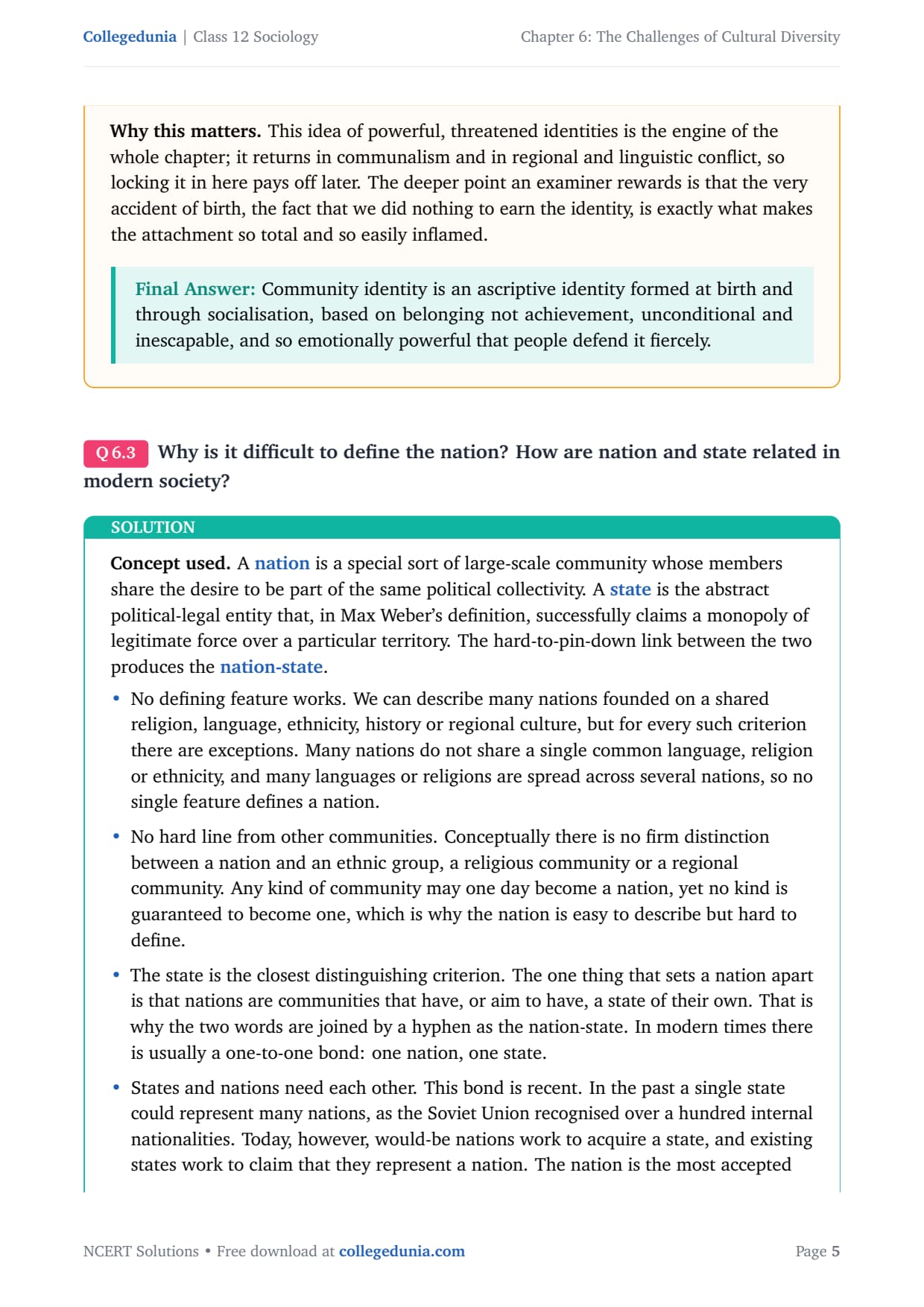
Why this matters. This idea of powerful, threatened identities is the
engine of the whole chapter; it returns in communalism and in regional and
linguistic conflict, so locking it in here pays off later. The deeper point an
examiner rewards is that the very accident of birth, the fact that we did
nothing to earn the identity, is exactly what makes the attachment so total
and so easily inflamed.
Community identity is an ascriptive identity formed at birth and
through socialisation, based on belonging not achievement, unconditional and
inescapable, and so emotionally powerful that people defend it fiercely.
Q 6.3
Why is it difficult to define the nation? How are nation and state related in modern society?
Concept used. A nation is a special sort of large-scale
community whose members share the desire to be part of the same political
collectivity. A state is the abstract political-legal entity that,
in Max Weber's definition, successfully claims a monopoly of legitimate force
over a particular territory. The hard-to-pin-down link between the two
produces the nation-state.
No defining feature works. We can describe many nations founded on a
shared religion, language, ethnicity, history or regional culture, but
for every such criterion there are exceptions. Many nations do not
share a single common language, religion or ethnicity, and many
languages or religions are spread across several nations, so no single
feature defines a nation.
No hard line from other communities. Conceptually there is no firm
distinction between a nation and an ethnic group, a religious
community or a regional community. Any kind of community may one day
become a nation, yet no kind is guaranteed to become one, which is why
the nation is easy to describe but hard to define.
The state is the closest distinguishing criterion. The one thing that
sets a nation apart is that nations are communities that have, or aim
to have, a state of their own. That is why the two words are joined by
a hyphen as the nation-state. In modern times there is usually a
one-to-one bond: one nation, one state.
States and nations need each other. This bond is recent. In the past a
single state could represent many nations, as the Soviet Union
recognised over a hundred internal nationalities. Today, however,
would-be nations work to acquire a state, and existing states work to
claim that they represent a nation. The nation is the most accepted
justification for a state, and the people are the ultimate source of a
state's legitimacy, so states need nations as much as nations need
states.
The nation is hard to define because no single feature, language,
religion, ethnicity or history, marks off every nation, and there is no firm
line dividing a nation from other communities. The one criterion that comes
closest is the state: a nation is a community that has, or wants, a state of
its own. In modern society the two are tightly linked as the nation-state,
each needing the other for legitimacy.
MK
Meher Kapadia
MPhil Sociology, University of Hyderabad
Verified Expert
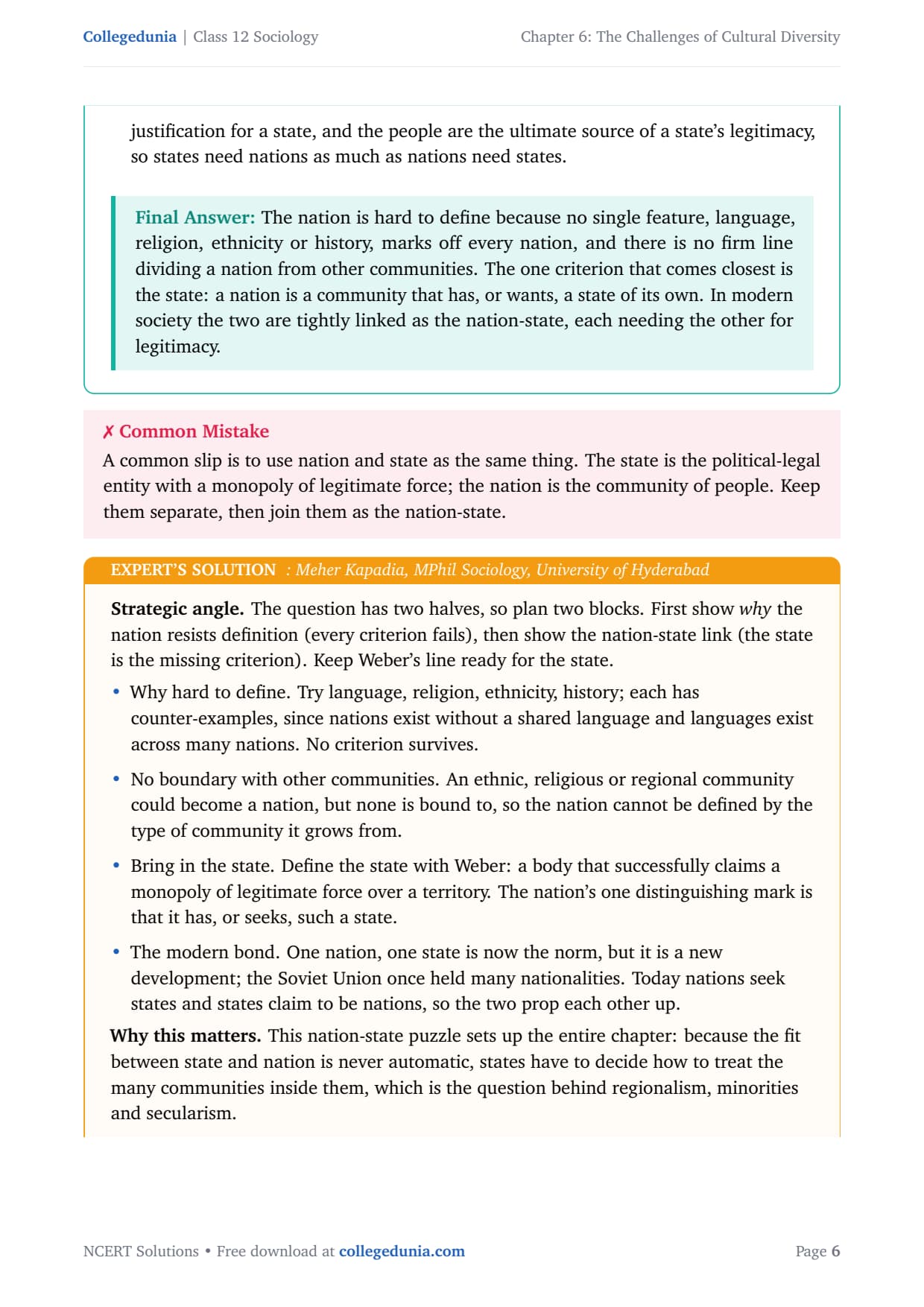
Strategic angle. The question has two halves, so plan two blocks.
First show why the nation resists definition (every criterion fails),
then show the nation-state link (the state is the missing criterion). Keep
Weber's line ready for the state.
Why hard to define. Try language, religion, ethnicity, history; each
has counter-examples, since nations exist without a shared language
and languages exist across many nations. No criterion survives.
No boundary with other communities. An ethnic, religious or regional
community could become a nation, but none is bound to, so the nation
cannot be defined by the type of community it grows from.
Bring in the state. Define the state with Weber: a body that
successfully claims a monopoly of legitimate force over a territory.
The nation's one distinguishing mark is that it has, or seeks, such a
state.
The modern bond. One nation, one state is now the norm, but it is a
new development; the Soviet Union once held many nationalities. Today
nations seek states and states claim to be nations, so the two prop
each other up.
Why this matters. This nation-state puzzle sets up the entire chapter:
because the fit between state and nation is never automatic, states have to
decide how to treat the many communities inside them, which is the question
behind regionalism, minorities and secularism.
The nation defies definition because every cultural criterion fails
and it shades into other communities; the state is the closest mark, since a
nation is a community that has or wants a state, and in modern society the two
fuse as the mutually dependent nation-state.
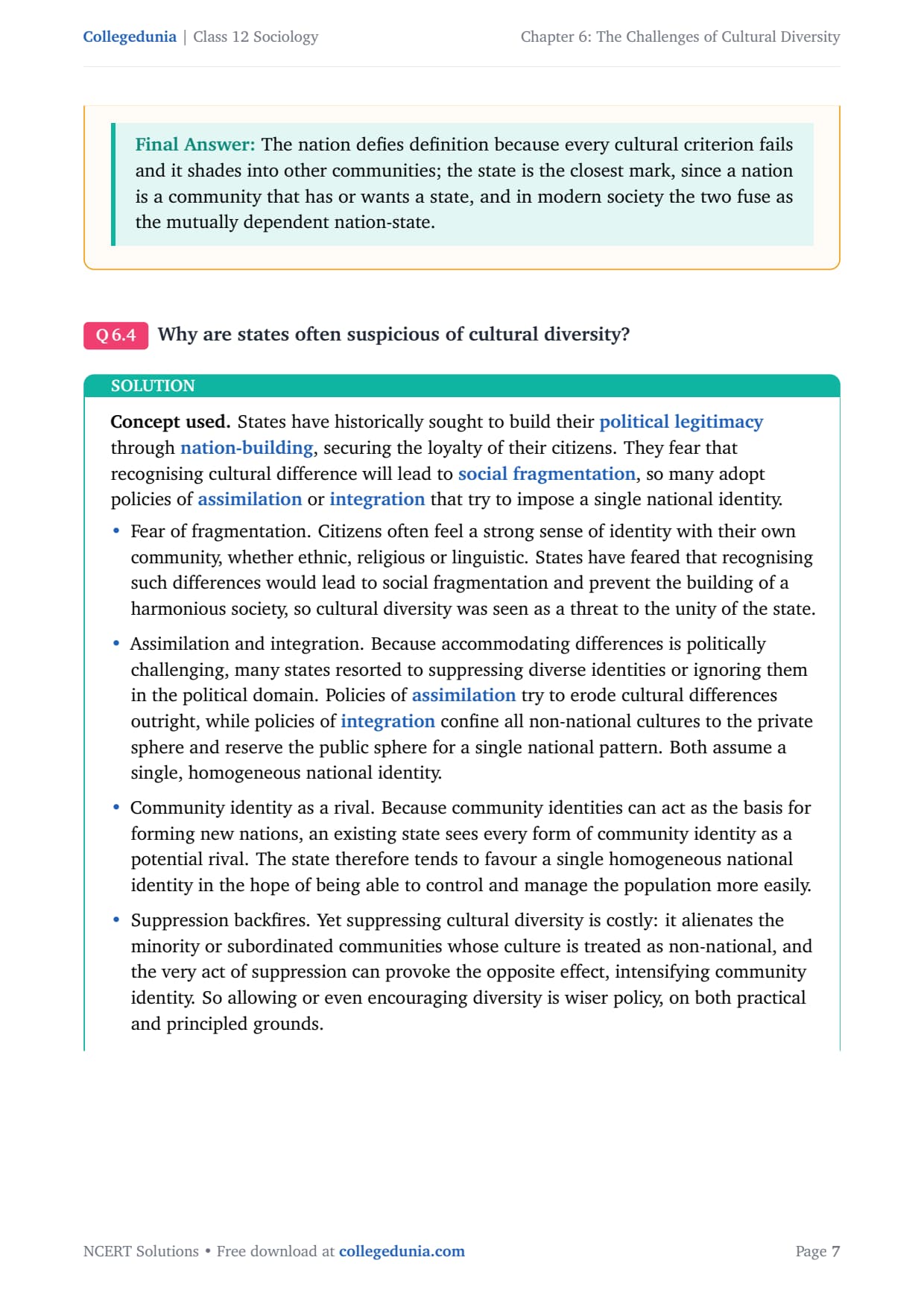
Q 6.4
Why are states often suspicious of cultural diversity?
Concept used. States have historically sought to build their
political legitimacy through nation-building, securing the
loyalty of their citizens. They fear that recognising cultural difference
will lead to social fragmentation, so many adopt policies of
assimilation or integration that try to impose a single
national identity.
Fear of fragmentation. Citizens often feel a strong sense of identity
with their own community, whether ethnic, religious or linguistic.
States have feared that recognising such differences would lead to
social fragmentation and prevent the building of a harmonious society,
so cultural diversity was seen as a threat to the unity of the state.
Assimilation and integration. Because accommodating differences is
politically challenging, many states resorted to suppressing diverse
identities or ignoring them in the political domain. Policies of
assimilation try to erode cultural differences outright,
while policies of integration confine all non-national
cultures to the private sphere and reserve the public sphere for a
single national pattern. Both assume a single, homogeneous national
identity.
Community identity as a rival. Because community identities can act as
the basis for forming new nations, an existing state sees every form
of community identity as a potential rival. The state therefore tends
to favour a single homogeneous national identity in the hope of being
able to control and manage the population more easily.
Suppression backfires. Yet suppressing cultural diversity is costly:
it alienates the minority or subordinated communities whose culture is
treated as non-national, and the very act of suppression can provoke
the opposite effect, intensifying community identity. So allowing or
even encouraging diversity is wiser policy, on both practical and
principled grounds.
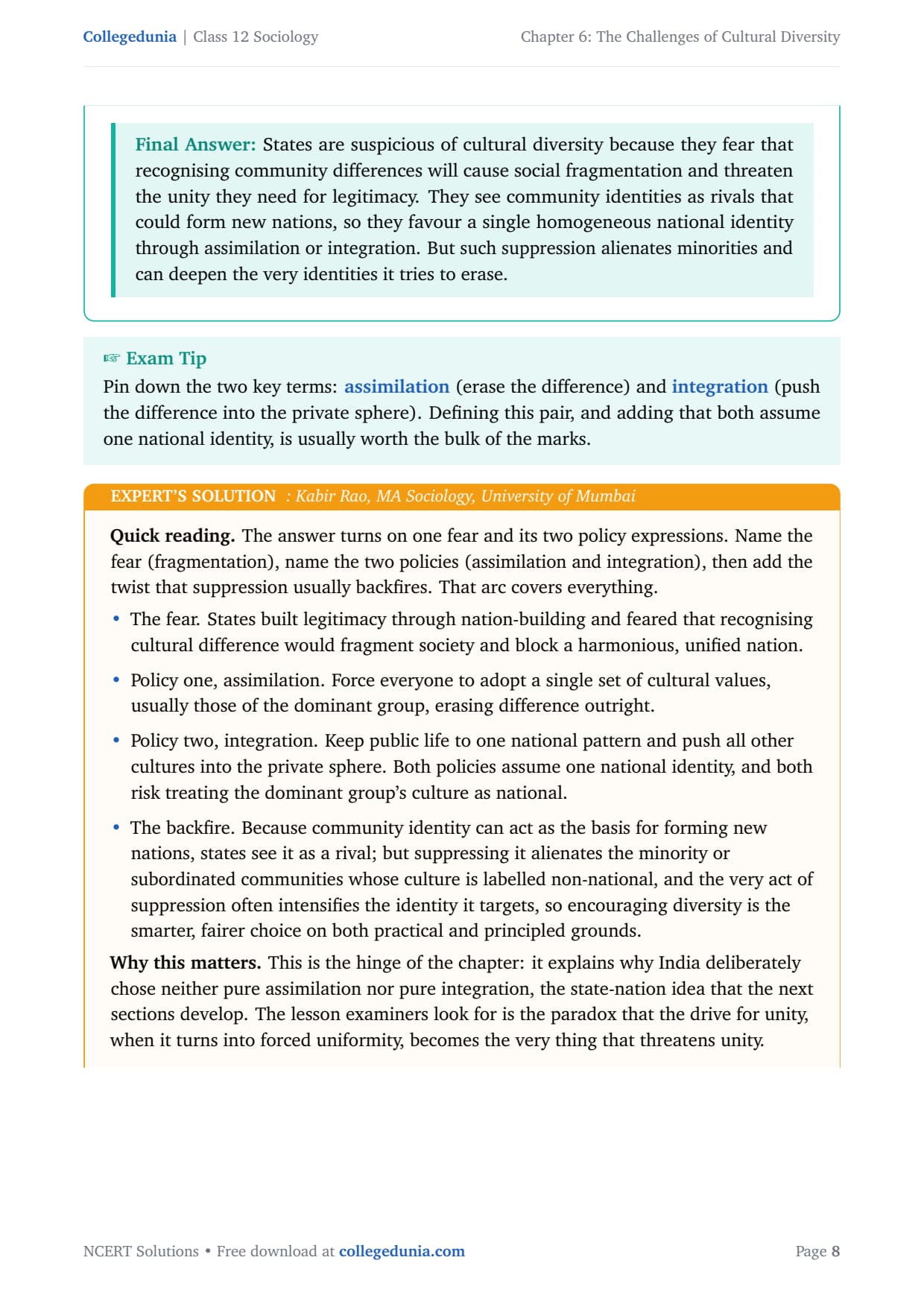
States are suspicious of cultural diversity because they fear that
recognising community differences will cause social fragmentation and threaten
the unity they need for legitimacy. They see community identities as rivals
that could form new nations, so they favour a single homogeneous national
identity through assimilation or integration. But such suppression alienates
minorities and can deepen the very identities it tries to erase.
KR
Kabir Rao
MA Sociology, University of Mumbai
Verified Expert
Quick reading. The answer turns on one fear and its two policy
expressions. Name the fear (fragmentation), name the two policies
(assimilation and integration), then add the twist that suppression usually
backfires. That arc covers everything.
The fear. States built legitimacy through nation-building and feared
that recognising cultural difference would fragment society and block
a harmonious, unified nation.
Policy one, assimilation. Force everyone to adopt a single set of
cultural values, usually those of the dominant group, erasing
difference outright.
Policy two, integration. Keep public life to one national pattern and
push all other cultures into the private sphere. Both policies assume
one national identity, and both risk treating the dominant group's
culture as national.
The backfire. Because community identity can act as the basis for
forming new nations, states see it as a rival; but suppressing it
alienates the minority or subordinated communities whose culture is
labelled non-national, and the very act of suppression often intensifies
the identity it targets, so encouraging diversity is the smarter,
fairer choice on both practical and principled grounds.
Why this matters. This is the hinge of the chapter: it explains why
India deliberately chose neither pure assimilation nor pure integration, the
state-nation idea that the next sections develop. The lesson examiners look for
is the paradox that the drive for unity, when it turns into forced uniformity,
becomes the very thing that threatens unity.
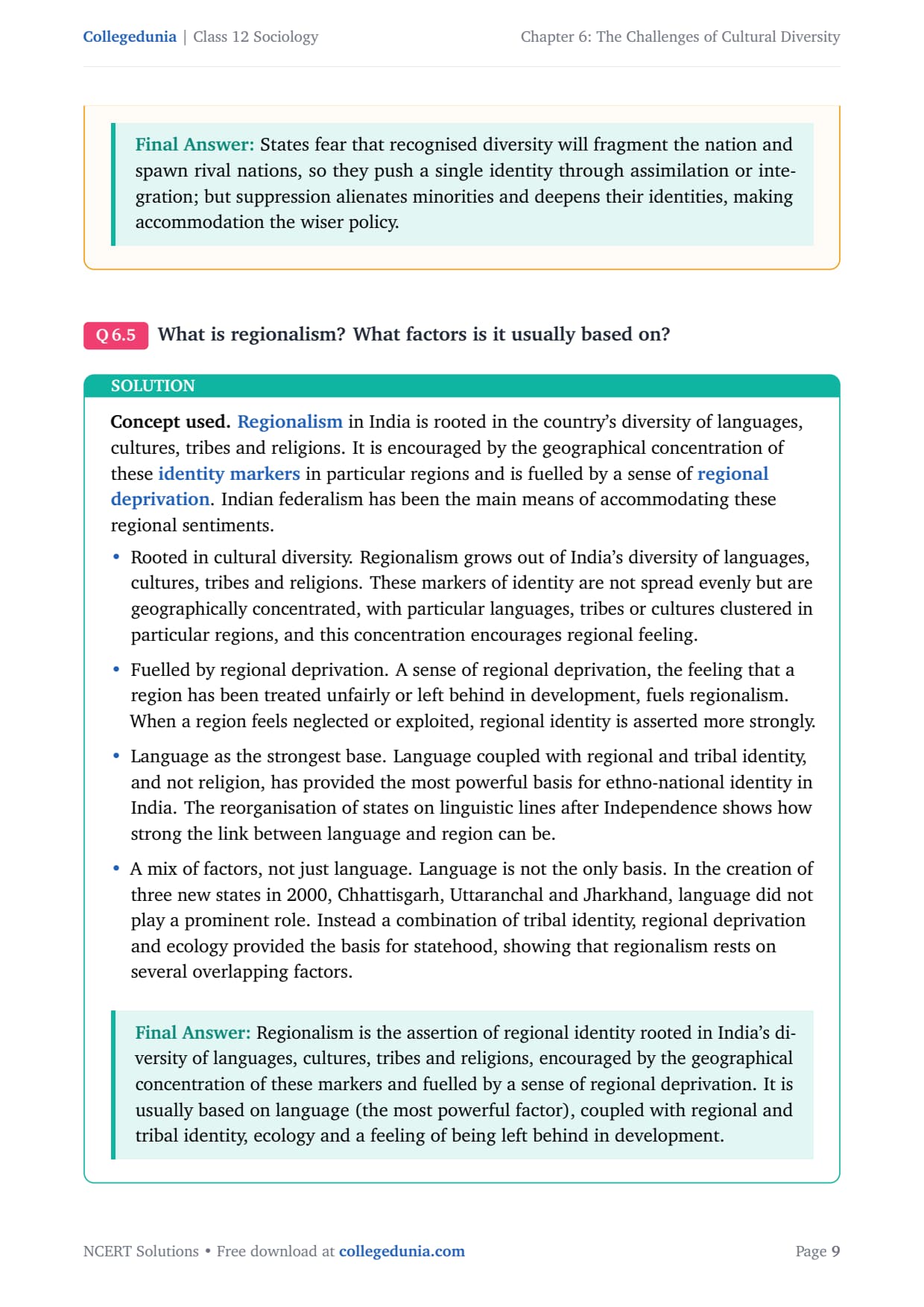
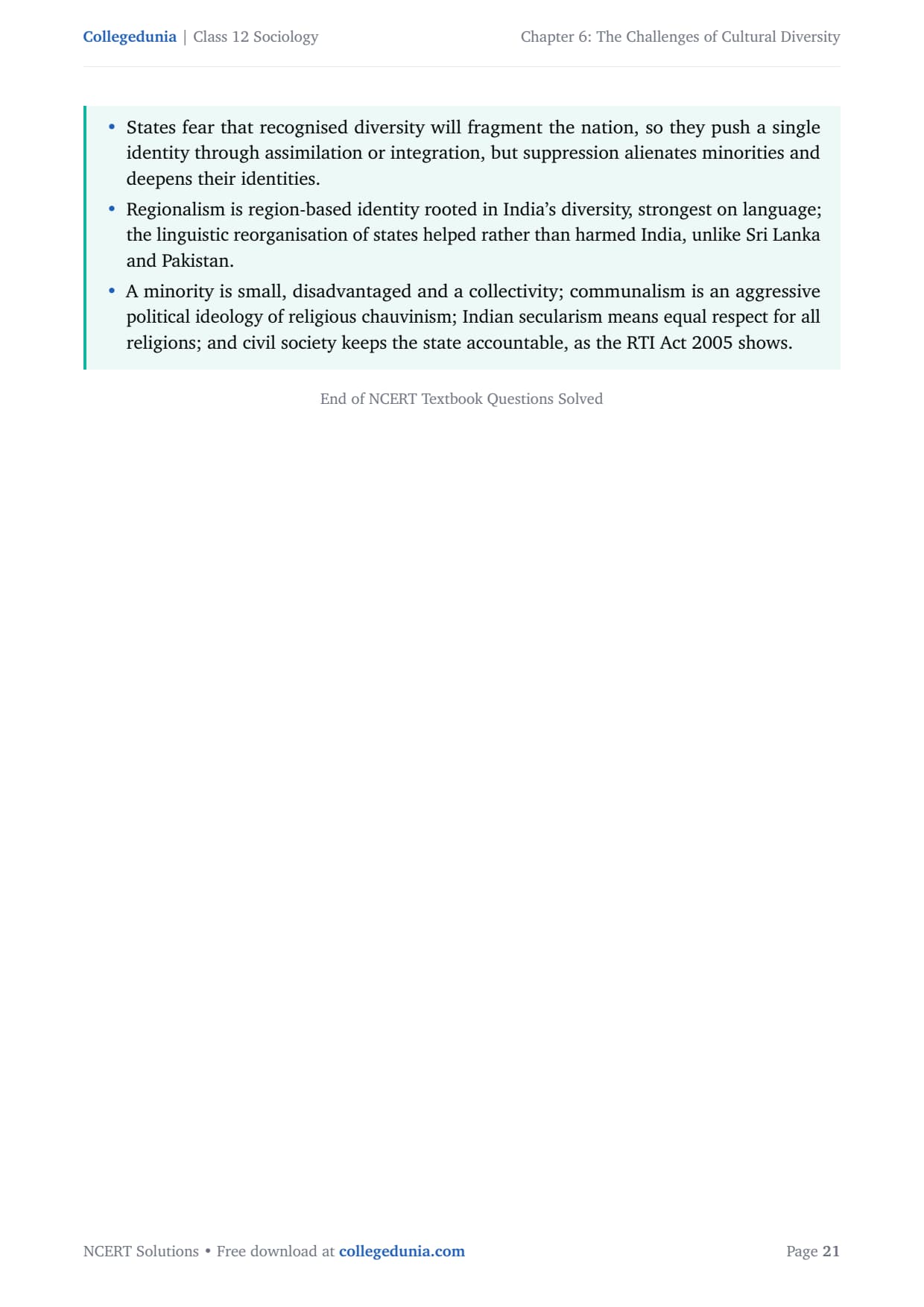
States fear that recognised diversity will fragment the nation and
spawn rival nations, so they push a single identity through assimilation or
integration; but suppression alienates minorities and deepens their
identities, making accommodation the wiser policy.
Q 6.5
What is regionalism? What factors is it usually based on?
Concept used.Regionalism in India is rooted in the
country's diversity of languages, cultures, tribes and religions. It is
encouraged by the geographical concentration of these identity
markers in particular regions and is fuelled by a sense of regional
deprivation. Indian federalism has been the main means of accommodating
these regional sentiments.
Rooted in cultural diversity. Regionalism grows out of India's
diversity of languages, cultures, tribes and religions. These markers
of identity are not spread evenly but are geographically concentrated,
with particular languages, tribes or cultures clustered in particular
regions, and this concentration encourages regional feeling.
Fuelled by regional deprivation. A sense of regional deprivation, the
feeling that a region has been treated unfairly or left behind in
development, fuels regionalism. When a region feels neglected or
exploited, regional identity is asserted more strongly.
Language as the strongest base. Language coupled with regional and
tribal identity, and not religion, has provided the most powerful
basis for ethno-national identity in India. The reorganisation of
states on linguistic lines after Independence shows how strong the
link between language and region can be.
A mix of factors, not just language. Language is not the only basis.
In the creation of three new states in 2000, Chhattisgarh, Uttaranchal
and Jharkhand, language did not play a prominent role. Instead a
combination of tribal identity, regional deprivation and ecology
provided the basis for statehood, showing that regionalism rests on
several overlapping factors.
Regionalism is the assertion of regional identity rooted in India's
diversity of languages, cultures, tribes and religions, encouraged by the
geographical concentration of these markers and fuelled by a sense of regional
deprivation. It is usually based on language (the most powerful factor),
coupled with regional and tribal identity, ecology and a feeling of being
left behind in development.
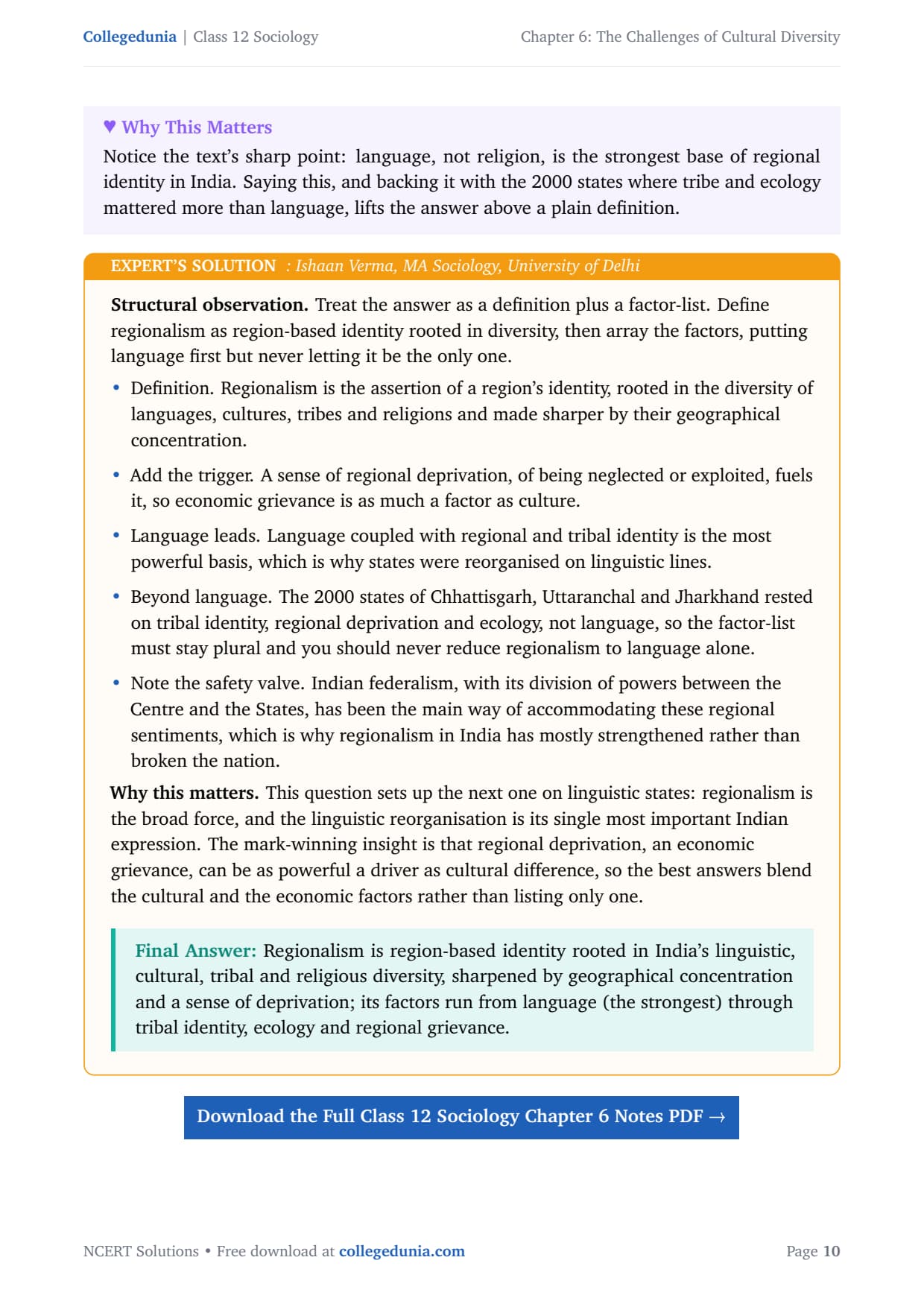
IV
Ishaan Verma
MA Sociology, University of Delhi
Verified Expert
Structural observation. Treat the answer as a definition plus a
factor-list. Define regionalism as region-based identity rooted in diversity,
then array the factors, putting language first but never letting it be the
only one.
Definition. Regionalism is the assertion of a region's identity,
rooted in the diversity of languages, cultures, tribes and religions
and made sharper by their geographical concentration.
Add the trigger. A sense of regional deprivation, of being neglected
or exploited, fuels it, so economic grievance is as much a factor as
culture.
Language leads. Language coupled with regional and tribal identity is
the most powerful basis, which is why states were reorganised on
linguistic lines.
Beyond language. The 2000 states of Chhattisgarh, Uttaranchal and
Jharkhand rested on tribal identity, regional deprivation and ecology,
not language, so the factor-list must stay plural and you should never
reduce regionalism to language alone.
Note the safety valve. Indian federalism, with its division of powers
between the Centre and the States, has been the main way of
accommodating these regional sentiments, which is why regionalism in
India has mostly strengthened rather than broken the nation.
Why this matters. This question sets up the next one on linguistic
states: regionalism is the broad force, and the linguistic reorganisation is
its single most important Indian expression. The mark-winning insight is that
regional deprivation, an economic grievance, can be as powerful a driver as
cultural difference, so the best answers blend the cultural and the economic
factors rather than listing only one.
Regionalism is region-based identity rooted in India's linguistic,
cultural, tribal and religious diversity, sharpened by geographical
concentration and a sense of deprivation; its factors run from language (the
strongest) through tribal identity, ecology and regional grievance.
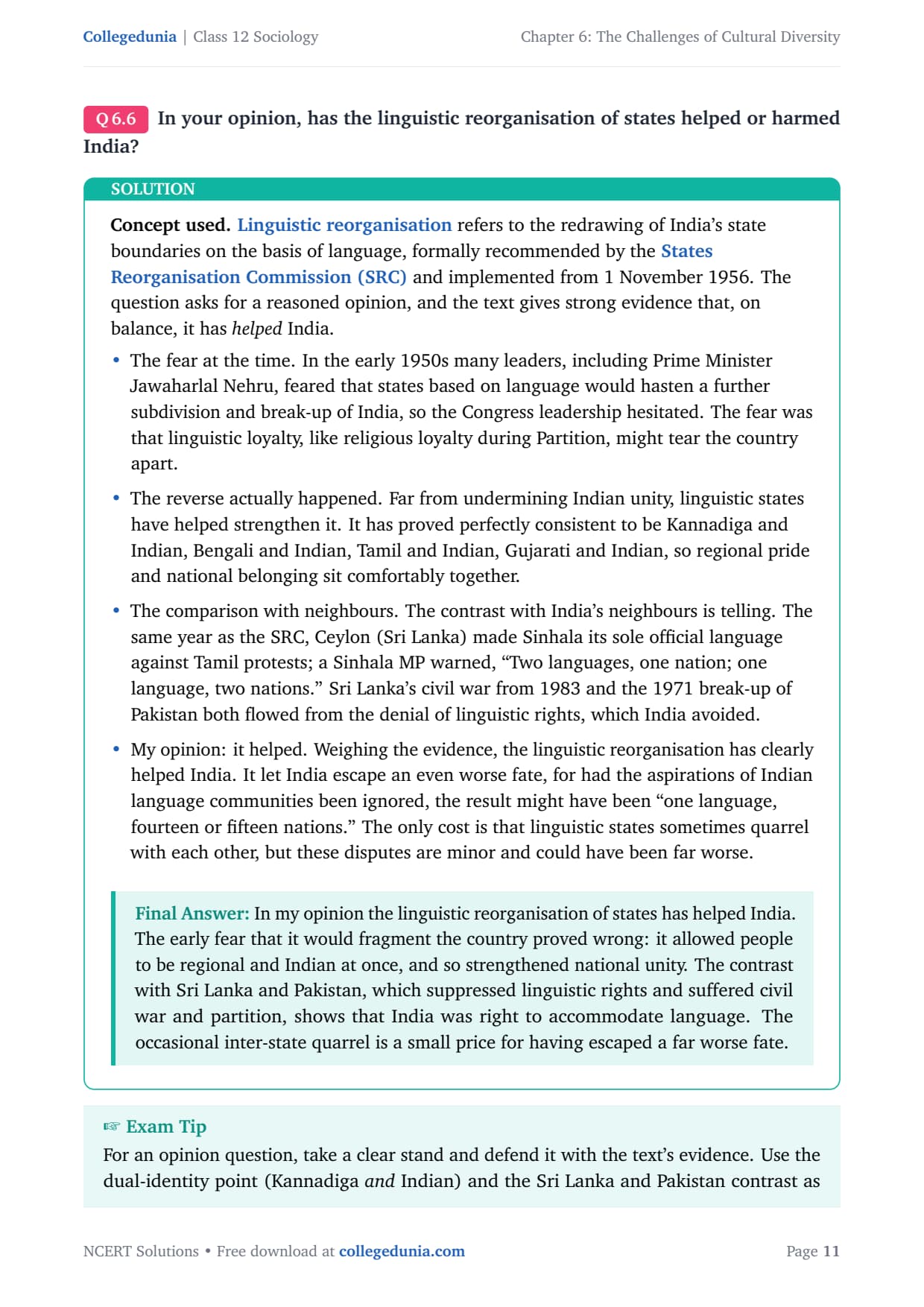
Q 6.6
In your opinion, has the linguistic reorganisation of states helped or harmed India?
Concept used.Linguistic reorganisation refers to the
redrawing of India's state boundaries on the basis of language, formally
recommended by the States Reorganisation Commission (SRC) and
implemented from 1 November 1956. The question asks for a reasoned opinion,
and the text gives strong evidence that, on balance, it has helped
India.
The fear at the time. In the early 1950s many leaders, including Prime
Minister Jawaharlal Nehru, feared that states based on language would
hasten a further subdivision and break-up of India, so the Congress
leadership hesitated. The fear was that linguistic loyalty, like
religious loyalty during Partition, might tear the country apart.
The reverse actually happened. Far from undermining Indian unity,
linguistic states have helped strengthen it. It has proved perfectly
consistent to be Kannadiga and Indian, Bengali and Indian, Tamil and
Indian, Gujarati and Indian, so regional pride and national belonging
sit comfortably together.
The comparison with neighbours. The contrast with India's neighbours
is telling. The same year as the SRC, Ceylon (Sri Lanka) made Sinhala
its sole official language against Tamil protests; a Sinhala MP warned,
``Two languages, one nation; one language, two nations.'' Sri Lanka's
civil war from 1983 and the 1971 break-up of Pakistan both flowed from
the denial of linguistic rights, which India avoided.
My opinion: it helped. Weighing the evidence, the linguistic
reorganisation has clearly helped India. It let India escape an even
worse fate, for had the aspirations of Indian language communities
been ignored, the result might have been ``one language, fourteen or
fifteen nations.'' The only cost is that linguistic states sometimes
quarrel with each other, but these disputes are minor and could have
been far worse.
In my opinion the linguistic reorganisation of states has helped
India. The early fear that it would fragment the country proved wrong: it
allowed people to be regional and Indian at once, and so strengthened national
unity. The contrast with Sri Lanka and Pakistan, which suppressed linguistic
rights and suffered civil war and partition, shows that India was right to
accommodate language. The occasional inter-state quarrel is a small price for
having escaped a far worse fate.
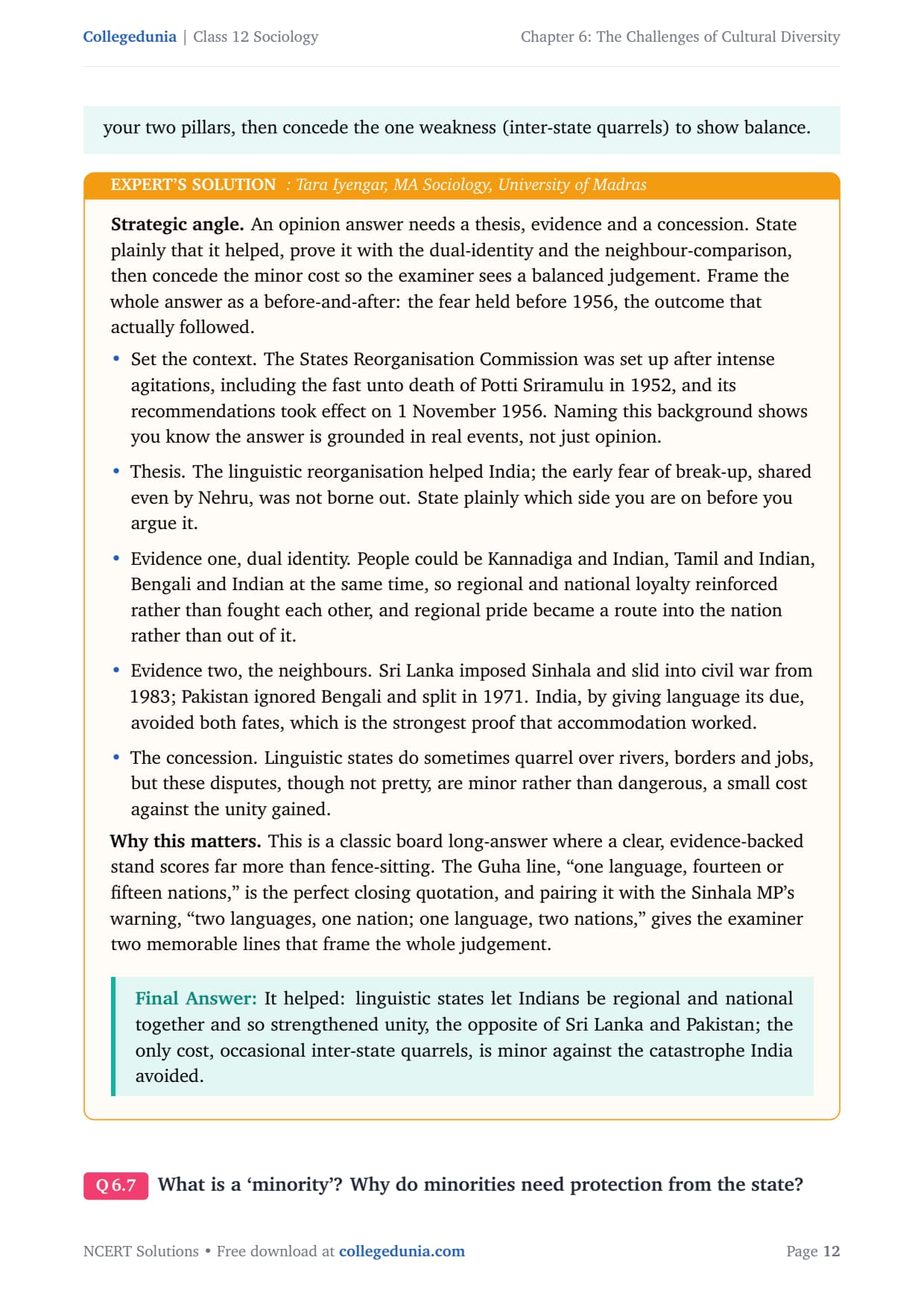
TI
Tara Iyengar
MA Sociology, University of Madras
Verified Expert
Strategic angle. An opinion answer needs a thesis, evidence and a
concession. State plainly that it helped, prove it with the dual-identity and
the neighbour-comparison, then concede the minor cost so the examiner sees a
balanced judgement. Frame the whole answer as a before-and-after: the fear
held before 1956, the outcome that actually followed.
Set the context. The States Reorganisation Commission was set up after
intense agitations, including the fast unto death of Potti Sriramulu in
1952, and its recommendations took effect on 1 November 1956. Naming
this background shows you know the answer is grounded in real events,
not just opinion.
Thesis. The linguistic reorganisation helped India; the early fear of
break-up, shared even by Nehru, was not borne out. State plainly which
side you are on before you argue it.
Evidence one, dual identity. People could be Kannadiga and Indian,
Tamil and Indian, Bengali and Indian at the same time, so regional and
national loyalty reinforced rather than fought each other, and regional
pride became a route into the nation rather than out of it.
Evidence two, the neighbours. Sri Lanka imposed Sinhala and slid into
civil war from 1983; Pakistan ignored Bengali and split in 1971. India,
by giving language its due, avoided both fates, which is the strongest
proof that accommodation worked.
The concession. Linguistic states do sometimes quarrel over rivers,
borders and jobs, but these disputes, though not pretty, are minor
rather than dangerous, a small cost against the unity gained.
Why this matters. This is a classic board long-answer where a clear,
evidence-backed stand scores far more than fence-sitting. The Guha line, ``one
language, fourteen or fifteen nations,'' is the perfect closing quotation, and
pairing it with the Sinhala MP's warning, ``two languages, one nation; one
language, two nations,'' gives the examiner two memorable lines that frame the
whole judgement.
It helped: linguistic states let Indians be regional and national
together and so strengthened unity, the opposite of Sri Lanka and Pakistan;
the only cost, occasional inter-state quarrels, is minor against the
catastrophe India avoided.
Q 6.7
What is a `minority'? Why do minorities need protection from the state?
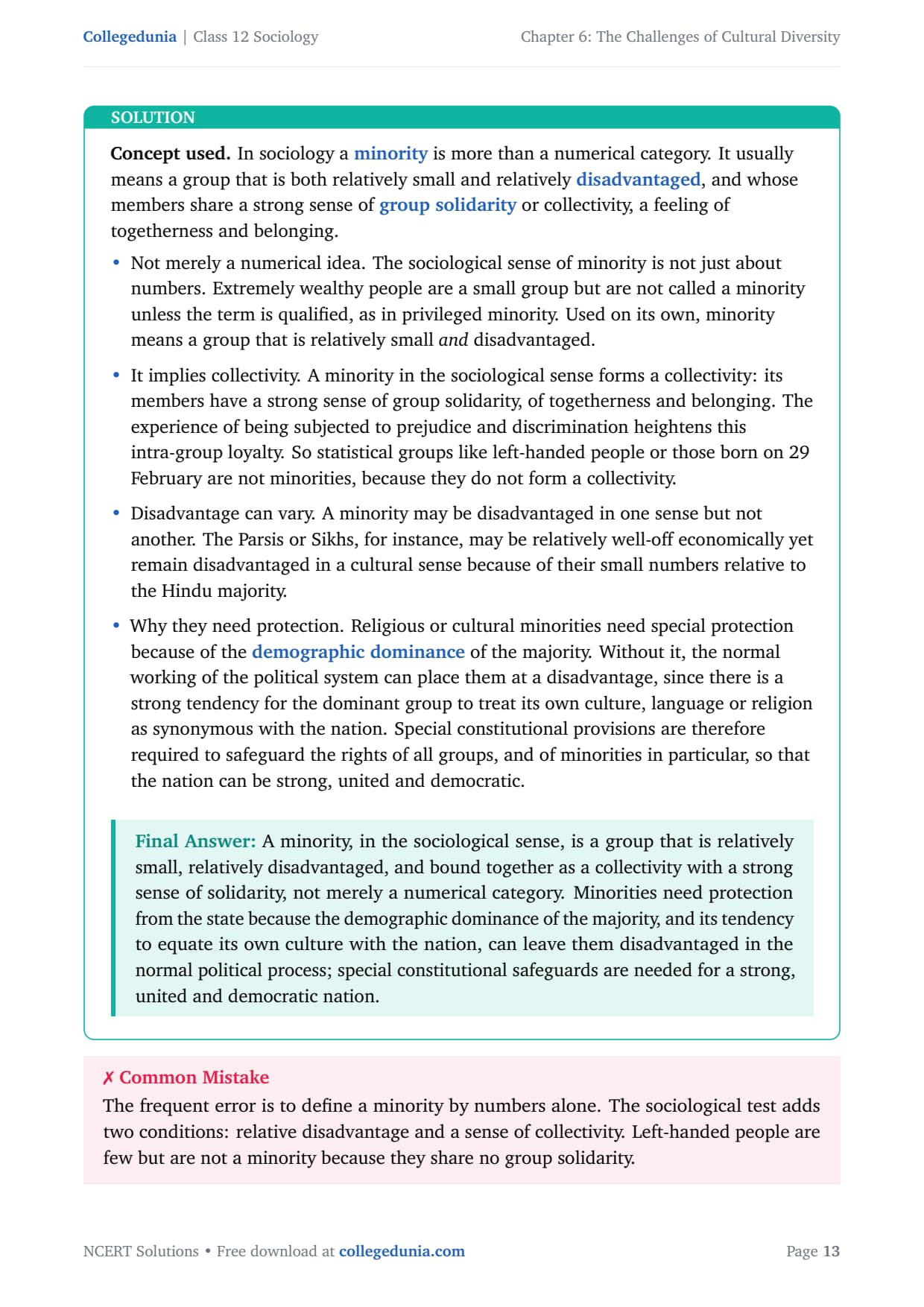
Concept used. In sociology a minority is more than a
numerical category. It usually means a group that is both relatively small and
relatively disadvantaged, and whose members share a strong sense of
group solidarity or collectivity, a feeling of togetherness and
belonging.
Not merely a numerical idea. The sociological sense of minority is not
just about numbers. Extremely wealthy people are a small group but are
not called a minority unless the term is qualified, as in privileged
minority. Used on its own, minority means a group that is relatively
small and disadvantaged.
It implies collectivity. A minority in the sociological sense forms a
collectivity: its members have a strong sense of group solidarity, of
togetherness and belonging. The experience of being subjected to
prejudice and discrimination heightens this intra-group loyalty. So
statistical groups like left-handed people or those born on 29
February are not minorities, because they do not form a collectivity.
Disadvantage can vary. A minority may be disadvantaged in one sense
but not another. The Parsis or Sikhs, for instance, may be relatively
well-off economically yet remain disadvantaged in a cultural sense
because of their small numbers relative to the Hindu majority.
Why they need protection. Religious or cultural minorities need
special protection because of the demographic dominance of
the majority. Without it, the normal working of the political system
can place them at a disadvantage, since there is a strong tendency for
the dominant group to treat its own culture, language or religion as
synonymous with the nation. Special constitutional provisions are
therefore required to safeguard the rights of all groups, and of
minorities in particular, so that the nation can be strong, united and
democratic.
A minority, in the sociological sense, is a group that is relatively
small, relatively disadvantaged, and bound together as a collectivity with a
strong sense of solidarity, not merely a numerical category. Minorities need
protection from the state because the demographic dominance of the majority,
and its tendency to equate its own culture with the nation, can leave them
disadvantaged in the normal political process; special constitutional
safeguards are needed for a strong, united and democratic nation.
ZH
Zoya Hussain
MA Sociology, Aligarh Muslim University
Verified Expert
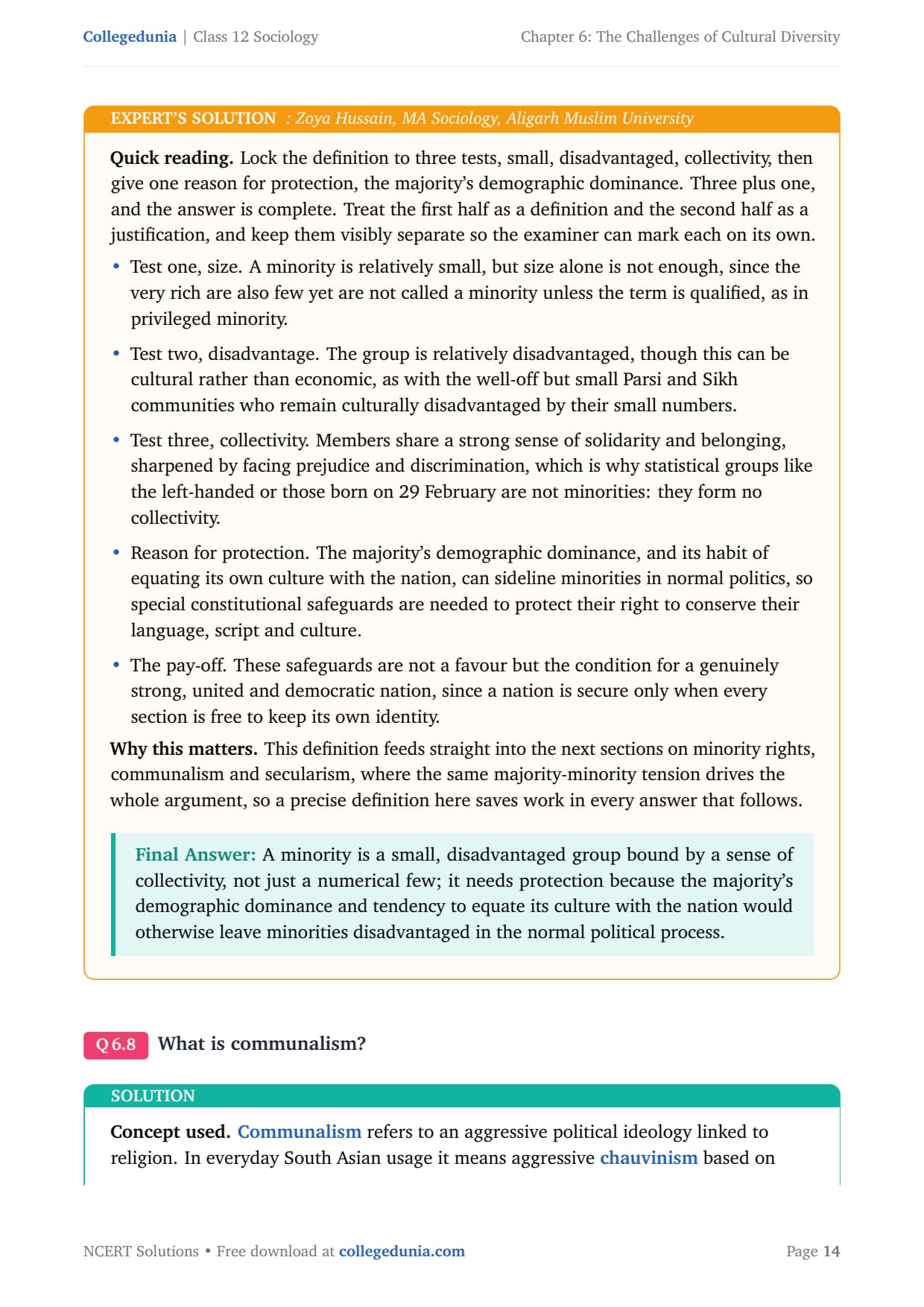
Quick reading. Lock the definition to three tests, small,
disadvantaged, collectivity, then give one reason for protection, the
majority's demographic dominance. Three plus one, and the answer is complete.
Treat the first half as a definition and the second half as a justification,
and keep them visibly separate so the examiner can mark each on its own.
Test one, size. A minority is relatively small, but size alone is not
enough, since the very rich are also few yet are not called a minority
unless the term is qualified, as in privileged minority.
Test two, disadvantage. The group is relatively disadvantaged, though
this can be cultural rather than economic, as with the well-off but
small Parsi and Sikh communities who remain culturally disadvantaged
by their small numbers.
Test three, collectivity. Members share a strong sense of solidarity
and belonging, sharpened by facing prejudice and discrimination, which
is why statistical groups like the left-handed or those born on 29
February are not minorities: they form no collectivity.
Reason for protection. The majority's demographic dominance, and its
habit of equating its own culture with the nation, can sideline
minorities in normal politics, so special constitutional safeguards are
needed to protect their right to conserve their language, script and
culture.
The pay-off. These safeguards are not a favour but the condition for a
genuinely strong, united and democratic nation, since a nation is
secure only when every section is free to keep its own identity.
Why this matters. This definition feeds straight into the next
sections on minority rights, communalism and secularism, where the same
majority-minority tension drives the whole argument, so a precise definition
here saves work in every answer that follows.
A minority is a small, disadvantaged group bound by a sense of
collectivity, not just a numerical few; it needs protection because the
majority's demographic dominance and tendency to equate its culture with the
nation would otherwise leave minorities disadvantaged in the normal political
process.
Q 6.8
What is communalism?
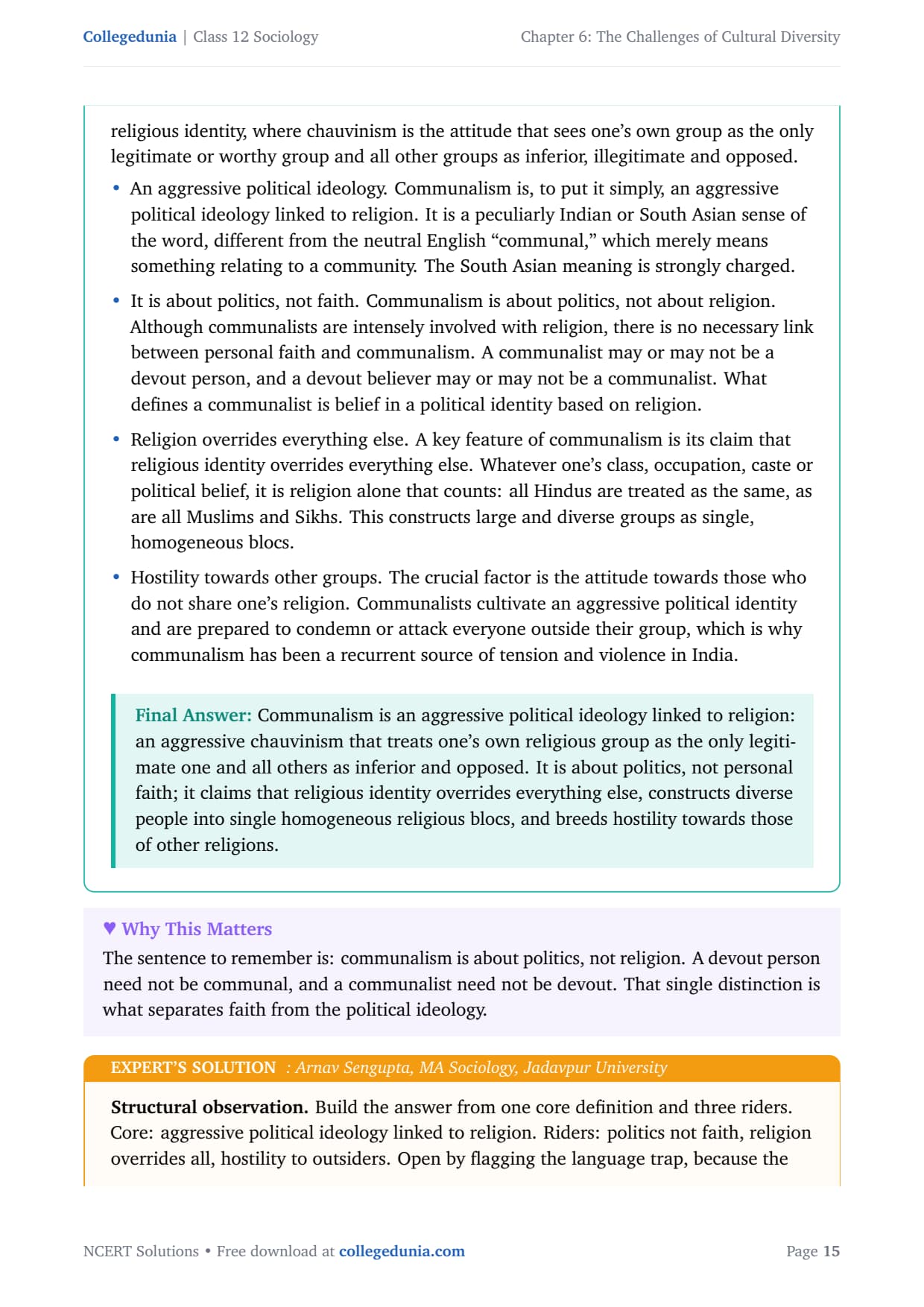
Concept used.Communalism refers to an aggressive political
ideology linked to religion. In everyday South Asian usage it means aggressive
chauvinism based on religious identity, where chauvinism is the
attitude that sees one's own group as the only legitimate or worthy group and
all other groups as inferior, illegitimate and opposed.
An aggressive political ideology. Communalism is, to put it simply, an
aggressive political ideology linked to religion. It is a peculiarly
Indian or South Asian sense of the word, different from the neutral
English ``communal,'' which merely means something relating to a
community. The South Asian meaning is strongly charged.
It is about politics, not faith. Communalism is about politics, not
about religion. Although communalists are intensely involved with
religion, there is no necessary link between personal faith and
communalism. A communalist may or may not be a devout person, and a
devout believer may or may not be a communalist. What defines a
communalist is belief in a political identity based on religion.
Religion overrides everything else. A key feature of communalism is
its claim that religious identity overrides everything else. Whatever
one's class, occupation, caste or political belief, it is religion
alone that counts: all Hindus are treated as the same, as are all
Muslims and Sikhs. This constructs large and diverse groups as single,
homogeneous blocs.
Hostility towards other groups. The crucial factor is the attitude
towards those who do not share one's religion. Communalists cultivate
an aggressive political identity and are prepared to condemn or attack
everyone outside their group, which is why communalism has been a
recurrent source of tension and violence in India.
Communalism is an aggressive political ideology linked to religion:
an aggressive chauvinism that treats one's own religious group as the only
legitimate one and all others as inferior and opposed. It is about politics,
not personal faith; it claims that religious identity overrides everything
else, constructs diverse people into single homogeneous religious blocs, and
breeds hostility towards those of other religions.
AS
Arnav Sengupta
MA Sociology, Jadavpur University
Verified Expert
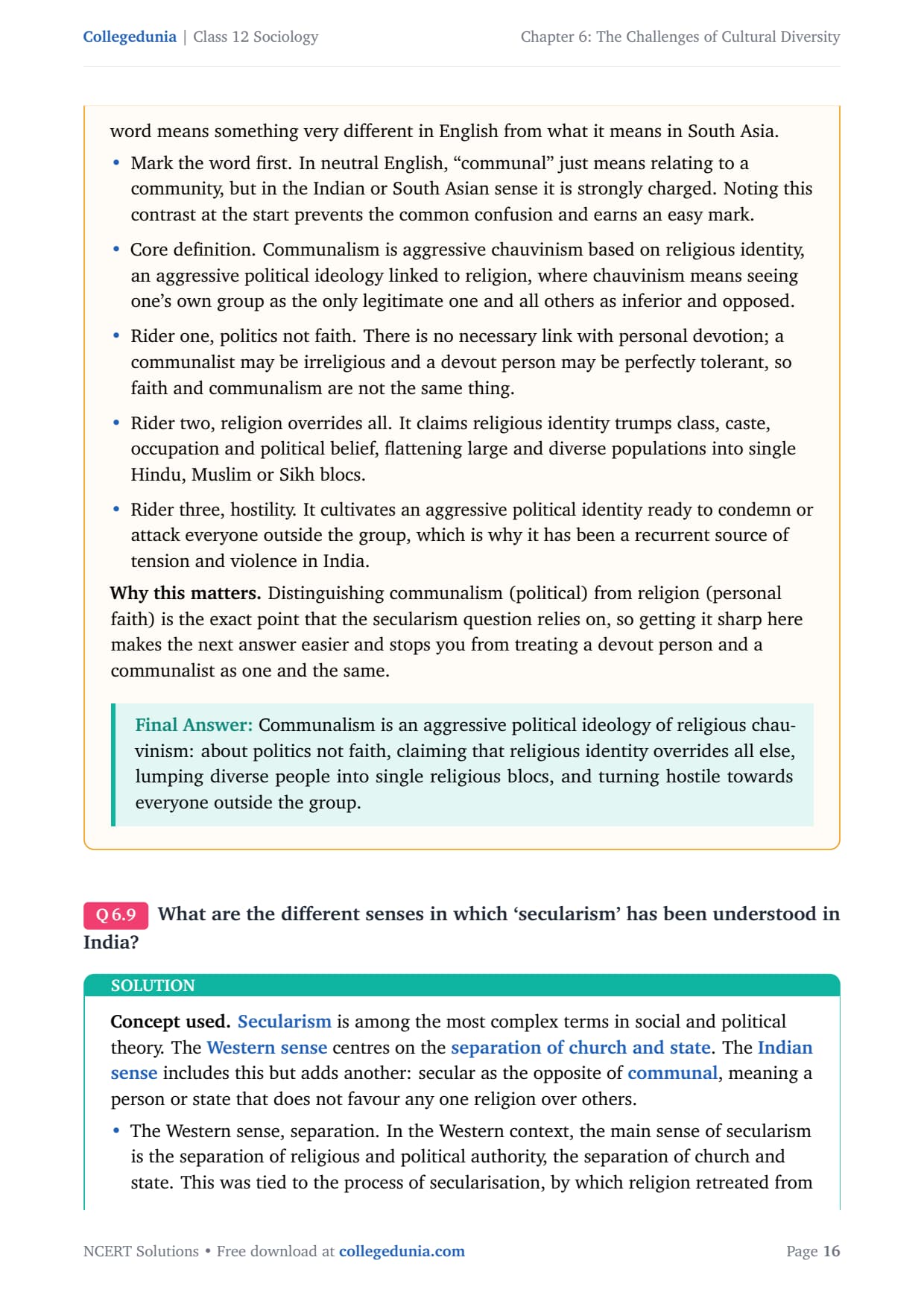
Structural observation. Build the answer from one core definition and
three riders. Core: aggressive political ideology linked to religion. Riders:
politics not faith, religion overrides all, hostility to outsiders. Open by
flagging the language trap, because the word means something very different
in English from what it means in South Asia.
Mark the word first. In neutral English, ``communal'' just means
relating to a community, but in the Indian or South Asian sense it is
strongly charged. Noting this contrast at the start prevents the common
confusion and earns an easy mark.
Core definition. Communalism is aggressive chauvinism based on
religious identity, an aggressive political ideology linked to
religion, where chauvinism means seeing one's own group as the only
legitimate one and all others as inferior and opposed.
Rider one, politics not faith. There is no necessary link with
personal devotion; a communalist may be irreligious and a devout
person may be perfectly tolerant, so faith and communalism are not the
same thing.
Rider two, religion overrides all. It claims religious identity trumps
class, caste, occupation and political belief, flattening large and
diverse populations into single Hindu, Muslim or Sikh blocs.
Rider three, hostility. It cultivates an aggressive political identity
ready to condemn or attack everyone outside the group, which is why it
has been a recurrent source of tension and violence in India.
Why this matters. Distinguishing communalism (political) from religion
(personal faith) is the exact point that the secularism question relies on, so
getting it sharp here makes the next answer easier and stops you from treating
a devout person and a communalist as one and the same.
Communalism is an aggressive political ideology of religious
chauvinism: about politics not faith, claiming that religious identity
overrides all else, lumping diverse people into single religious blocs, and
turning hostile towards everyone outside the group.
Q 6.9
What are the different senses in which `secularism' has been understood in India?
Concept used.Secularism is among the most complex terms in
social and political theory. The Western sense centres on the
separation of church and state. The Indian sense includes
this but adds another: secular as the opposite of communal, meaning
a person or state that does not favour any one religion over others.
The Western sense, separation. In the Western context, the main sense
of secularism is the separation of religious and political authority,
the separation of church and state. This was tied to the process of
secularisation, by which religion retreated from public life and
became a voluntary personal practice rather than a mandatory
obligation, alongside the rise of science and rationality.
The Indian sense includes the Western one. The Indian meanings of
secular and secularism include the Western sense but also involve
others. So the Western idea of separating religion from the state is
part of the Indian meaning, but not the whole of it.
The Indian sense, opposite of communal. The most common everyday use
of secular in India is as the opposite of communal. A secular person
or state is one that does not favour any particular religion over
others. In this sense secularism is the opposite of religious
chauvinism and need not imply hostility to religion as such.
Equal respect, not distance. In terms of the state-religion
relationship, the Indian sense implies equal respect for all
religions, rather than separation or distancing. This is why the
secular Indian state declares public holidays to mark the festivals of
all religions, instead of keeping religion entirely out of public
life.
In India secularism has been understood in two main senses. The
first is the Western sense: the separation of religious and political
authority, the separation of church and state. The second, more common in
everyday Indian use, is secular as the opposite of communal: a person or state
that favours no single religion. In the state-religion relationship the Indian
sense implies equal respect for all religions rather than separation, which is
why the Indian state honours the festivals of all faiths.
NM
Nikhil Menon
MA Sociology, University of Kerala
Verified Expert
Quick reading. Two senses, two labels. Western secularism equals
separation; Indian secularism equals equal respect (the opposite of communal).
Hang the answer on that contrast and add the holidays example.
Western sense. Secularism means the separation of church and state,
linked to secularisation, the retreat of religion from public life,
and the rise of science and rationality.
Indian sense includes it. India's meaning contains the Western idea
but does not stop there, so it is the wider of the two.
Indian sense, opposite of communal. The everyday Indian use makes
secular the opposite of communal: favouring no religion over another,
without necessarily being anti-religion.
Equal respect, not distance. The Indian state shows equal respect for
all faiths rather than keeping its distance, which is why it declares
public holidays for the festivals of every religion instead of banning
religion from public life.
Hold the two apart. The Western sense distances the state from
religion; the Indian sense brings the state close to all religions
equally. Mixing them up is the single most common error, so name which
sense you mean at every step.
Why this matters. The Indian, equal-respect sense is what creates the
tension the chapter notes: protecting minorities can be attacked as
appeasement, a debate that turns entirely on which sense of secularism you
use, so being clear about the two senses is what lets you discuss that debate
without contradicting yourself.
Two senses: the Western one of separating church and state, and the
Indian one of being the opposite of communal, favouring no religion and giving
equal respect to all, shown by the state honouring every religion's festivals.
Q 6.10
What is the relevance of civil society organisations today?
Concept used.Civil society is the broad arena that lies
beyond the private domain of the family but outside the domain of both the
state and the market. It is the non-state, non-market part of the public
domain where individuals come together voluntarily to create institutions and
organisations. It is the sphere of active citizenship.
What it is. Civil society consists of voluntary associations,
organisations and institutions formed by groups of citizens. It
includes political parties, media institutions, trade unions,
non-governmental organisations (NGOs) and religious organisations. The
main criteria are that the organisation should not be state-controlled
and should not be a purely commercial, profit-making entity.
Its wide range of activity. Today civil society organisations cover a
very wide range. They take up advocacy and lobbying with national and
international agencies and join many movements. The issues are diverse:
tribal land rights, urban governance, campaigns against violence
against women, rehabilitation of those displaced by dams, struggles
against slum demolitions, housing rights, education reform and the
rights of Dalits, among others.
Keeping a watch on the state. Civil liberties organisations have been
particularly important in keeping a watch on the state and forcing it
to obey the law. The media, especially its visual and electronic
segments, has taken an increasingly active role. Civil society can
protest against the injustices of the state or supplement its efforts,
which becomes vital when the state turns authoritarian, corrupt,
inefficient or short of resources.
A concrete example, the Right to Information. Among the most
significant recent initiatives is the campaign for the
Right to Information. It began with an agitation in rural
Rajasthan demanding the release of information on government funds
spent on village development, then grew into a nationwide campaign.
Despite the resistance of the bureaucracy, the government was forced
to respond and pass a new law (the RTI Act 2005) acknowledging
citizens' right to information. This shows the crucial importance of
civil society in ensuring that the state is accountable to the nation
and its people.
Civil society is the non-state, non-market arena of voluntary
citizen organisations, parties, unions, NGOs and the media. Its relevance
today lies in giving citizens an active voice: it takes up diverse causes from
land rights to violence against women, keeps a watch on the state and forces
it to obey the law, and holds the state accountable, as the Right to
Information campaign and the RTI Act 2005 show.
DN
Devika Nambiar
MA Sociology, Tata Institute of Social Sciences
Verified Expert
Strategic angle. Define civil society by what it is not (not
state, not market, not family), then show its relevance through range,
watchdog role and one strong example, the RTI. That structure is hard to leave
incomplete. Begin by placing civil society on the map of the four domains, so
the definition is precise before you list its work.
Define by exclusion. Civil society is the public arena that lies beyond
the private family but outside both the state and the market: voluntary
citizen bodies like political parties, trade unions, NGOs, religious
organisations and the media, neither state-controlled nor purely
profit-making.
Name it the sphere of active citizenship. This is the space where
individuals come together voluntarily to take up social issues, make
demands on the state and pursue collective interests, which is the
heart of why it matters in a democracy.
Show the range. It works on tribal land rights, devolution in urban
governance, campaigns against violence against women, rehabilitation
of those displaced by dams, struggles against slum demolitions, housing
rights, education reform and the rights of Dalits, so its reach across
public life is very broad.
The watchdog role. Civil liberties organisations and the media watch
the state, force it to obey the law, and either protest its injustices
or supplement its efforts, which becomes crucial exactly when the state
turns authoritarian, corrupt, inefficient or short of resources.
The clinching example. The Right to Information campaign, born in an
agitation in rural Rajasthan and grown into a nationwide movement,
forced a reluctant bureaucracy and government to pass the RTI Act 2005,
proving that civil society can make the state accountable to its people.
Why this matters. This is the chapter's hopeful note: after surveying
the threats that cultural diversity can pose, it shows that an active civil
society is the democratic answer that keeps the state honest, accountable and
inclusive, which is why this question so often closes the chapter in exams.
Civil society is the voluntary, non-state, non-market arena of active
citizenship; its relevance today is to champion diverse causes, watch over the
state, force it to obey the law and hold it accountable, exactly as the RTI
campaign and the RTI Act 2005 demonstrate.
FAQs on The Challenges of Cultural Diversity Class 12 NCERT Solutions
The Challenges of Cultural Diversity Class 12 Sociology Common Questions
Ques. Where can I get the class 12 sociology chapter 6 NCERT Solutions PDF?
Ans. You can download the The Challenges of Cultural Diversity Class 12 Sociology NCERT Solutions PDF directly from this page. It is free, follows the 2026-27 NCERT, and answers all 10 exercise questions point by point.
Ques. How many questions are there in The Challenges of Cultural Diversity class 12 questions and answers?
Ans. The chapter has 10 exercise questions. They cover cultural diversity, community identity, the nation and state, state suspicion of diversity, regionalism, linguistic reorganisation, minorities, communalism, secularism and civil society.
Ques. What is meant by cultural diversity in Class 12 Sociology?
Ans. Cultural diversity is the presence of many different communities, marked off by language, religion, sect, race or caste, living in one society. India is very diverse because its billion-plus people speak about 1,632 languages and dialects and belong to many religions, with a caste-divided Hindu majority.
Ques. What is the difference between communalism and secularism?
Ans. Communalism is an aggressive political ideology that treats one religious group as the only legitimate one. Secularism, in India, is the state keeping a principled distance from all religions and treating each equally. In short, communalism weaponises religion in politics, while secularism keeps the state fair to every faith.
Ques. Why do minorities need protection from the state?
Ans. A minority is a small, disadvantaged group bound by a sense of collectivity, not just a numerical few. Minorities need protection because the majority's demographic dominance, and its tendency to equate its own culture with the nation, can leave them disadvantaged in the normal political process, so special constitutional safeguards are needed.
Ques. Is class 12 sociology chapter 6 easy to score in the board exam?
Ans. Yes. It is a high-scoring chapter if you keep the key terms separate and tie diversity to accommodation rather than conflict. Learn the meaning of cultural diversity, communalism and the two senses of secularism, and keep your own view ready for the opinion parts on linguistic states and civil society.








Comments