




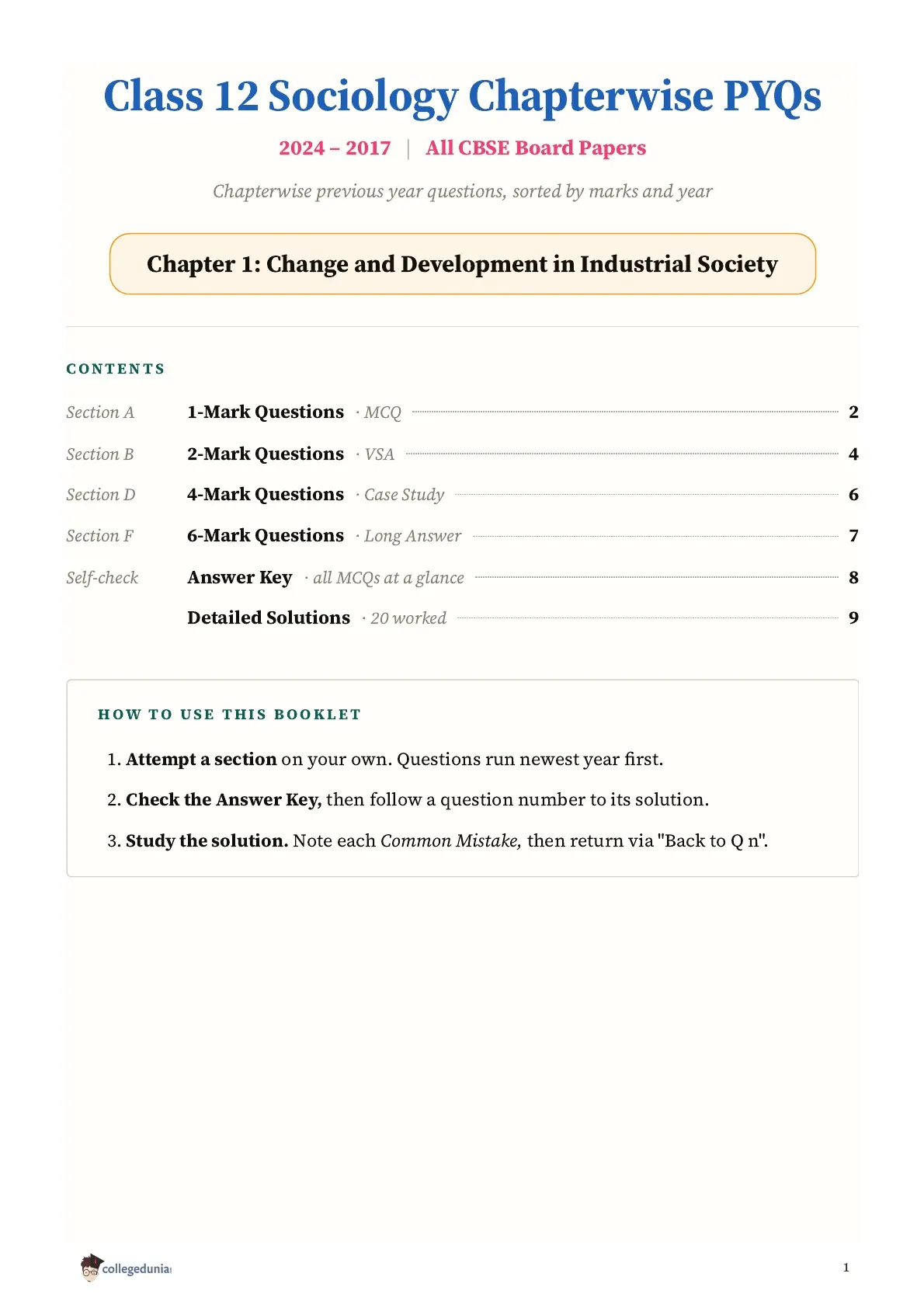
Change and Development in Industrial Society traces how India moved from a colonial economy built around traditional crafts and plantations to a planned, state-led industrial economy after independence, and then into liberalisation, privatisation and globalisation from 1991 onward. This PYQ set brings together 20 CBSE board questions from 2017 to 2024 on the chapter, and every one comes with a full step-by-step solution, so you can check your own answer against a complete worked explanation.
- 20 questions, CBSE 2017-2024: 4 MCQs (1 mark), 10 Very Short Answer questions (2 marks), 3 Short Answer questions (4 marks) and 3 Long Answer questions (6 marks).
- Full solutions included: every question has a worked, step-by-step answer, not just the bare question paper.
- Topics covered: organised and unorganised sector work, strikes and lockouts, alienation, Scientific Management, industrial policy after independence, and employment and self-employment schemes.
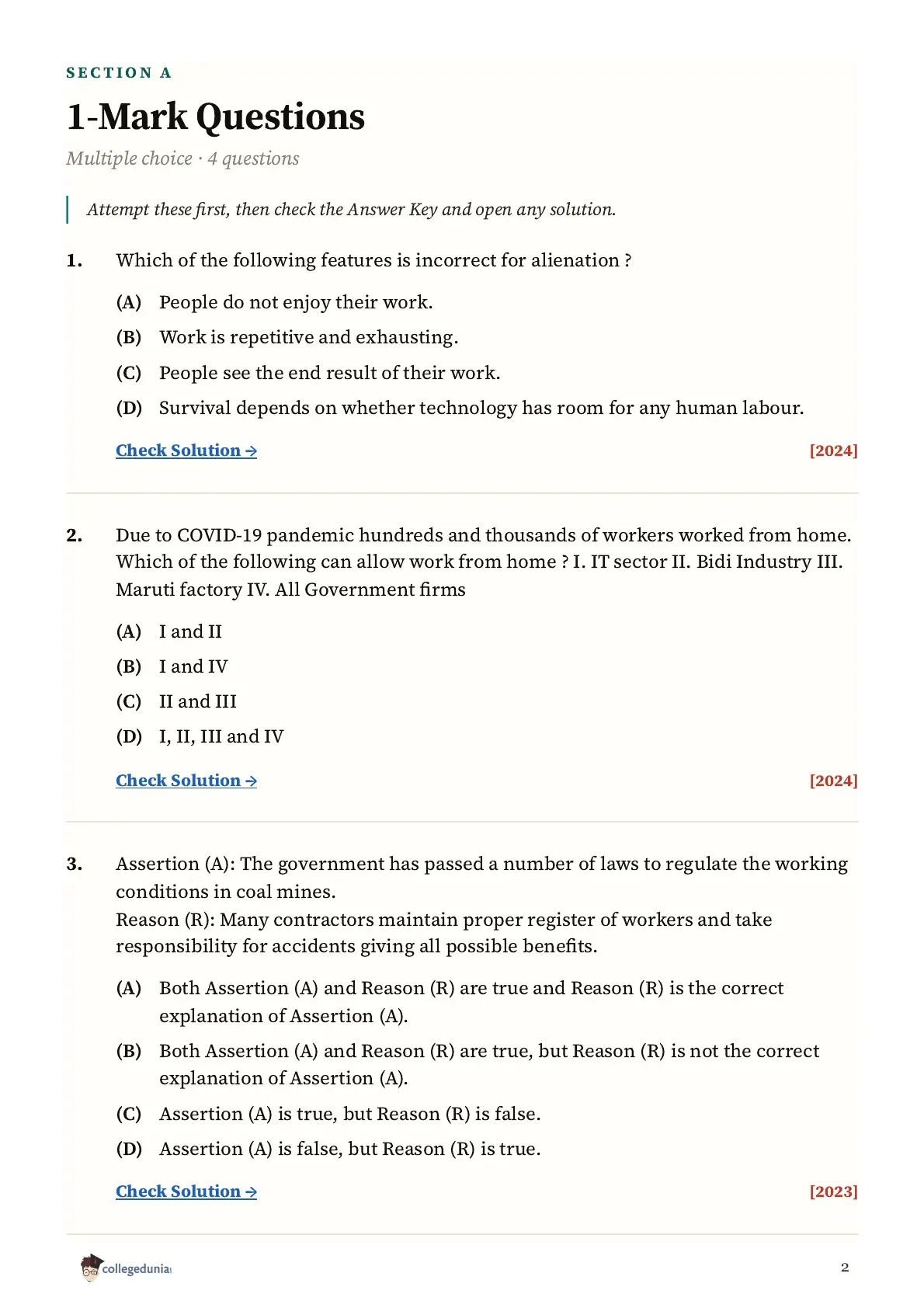
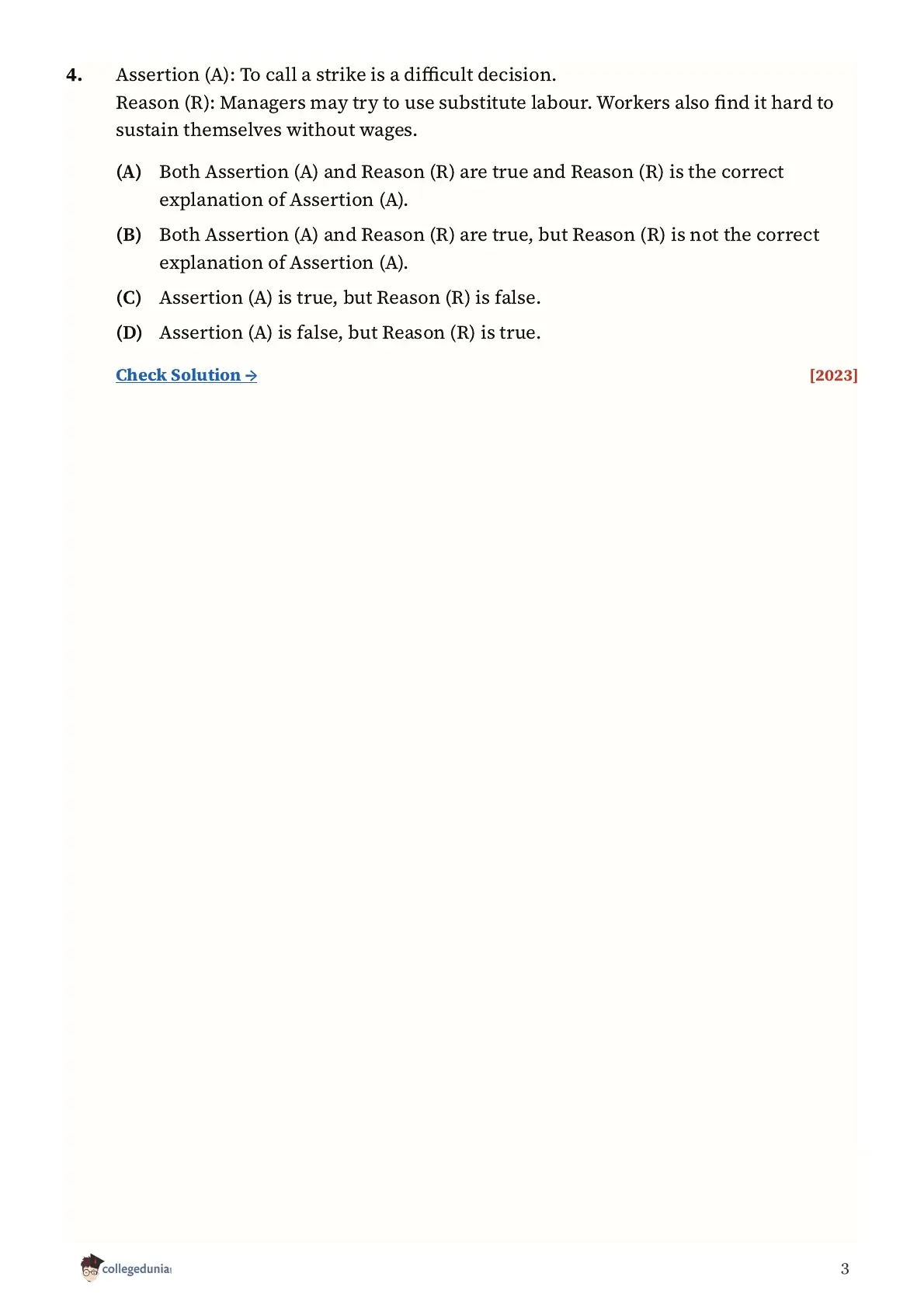
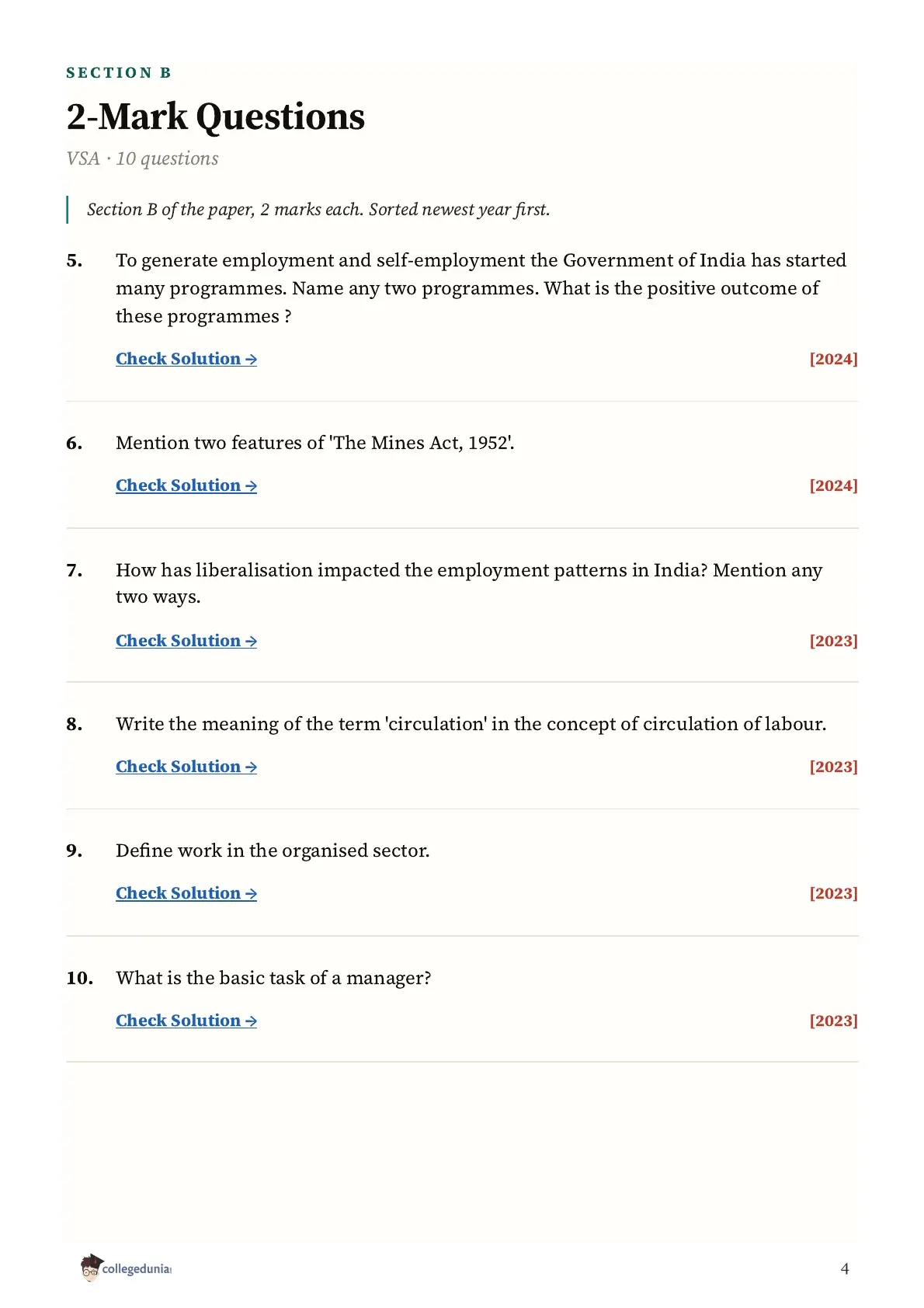
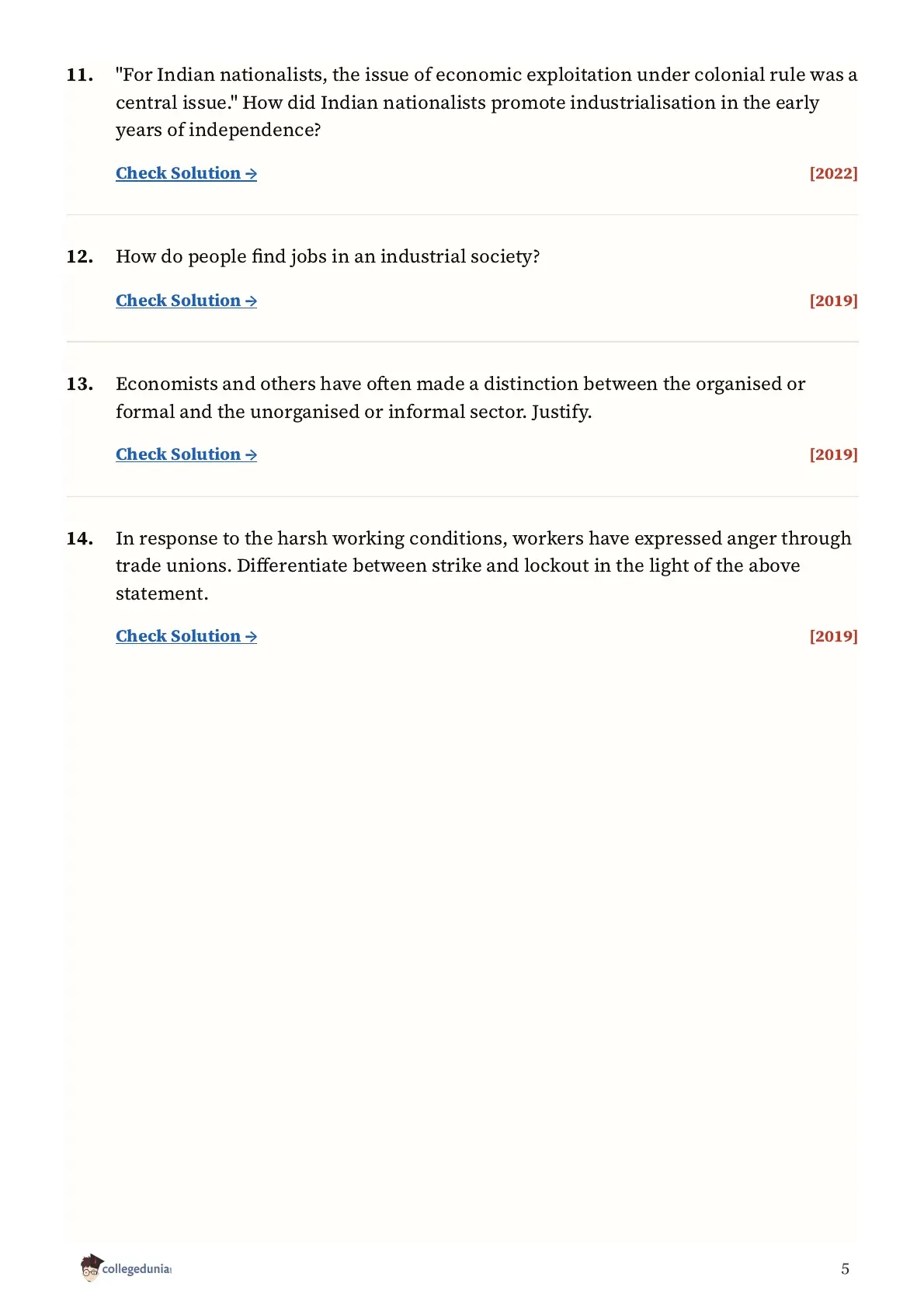
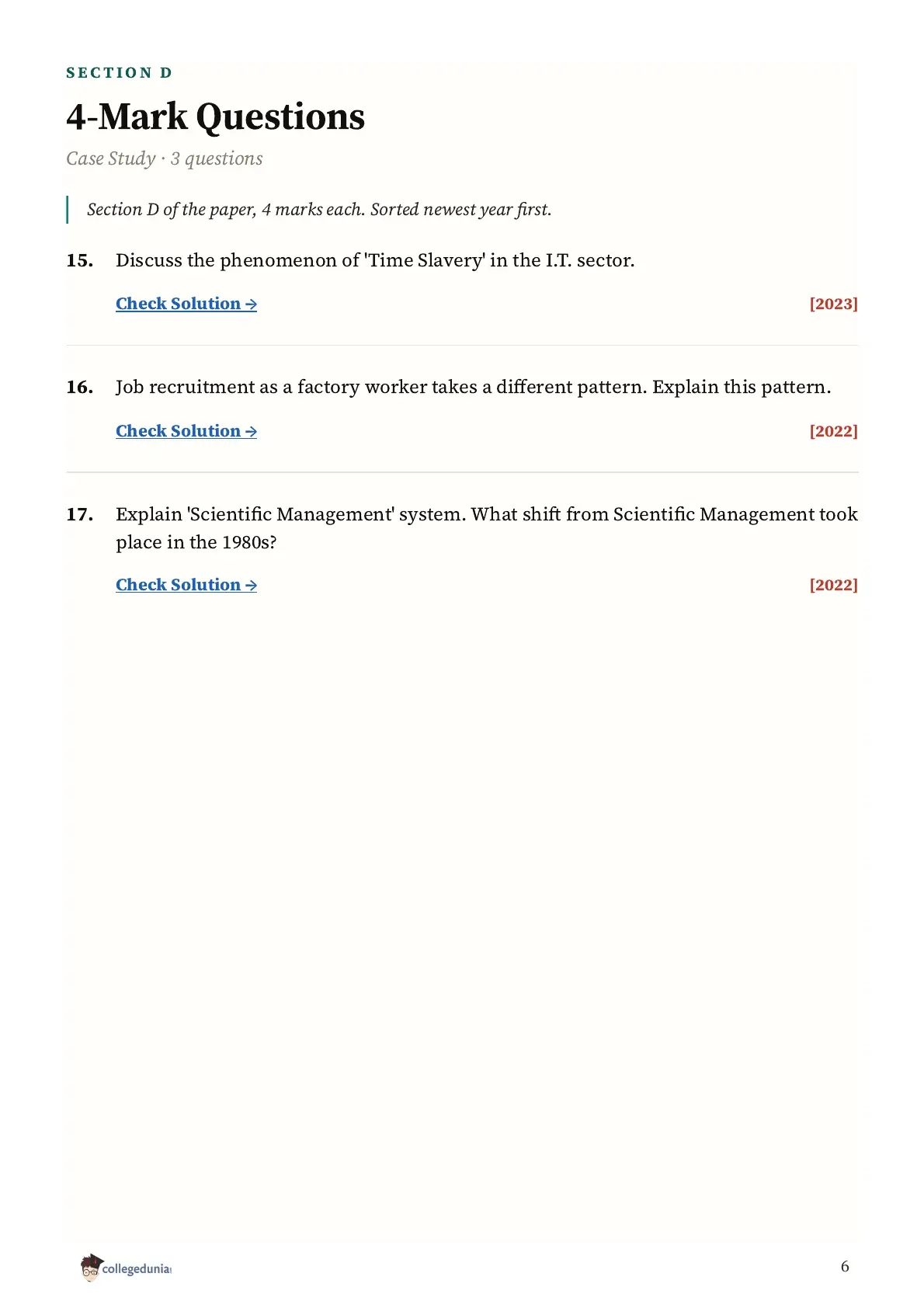
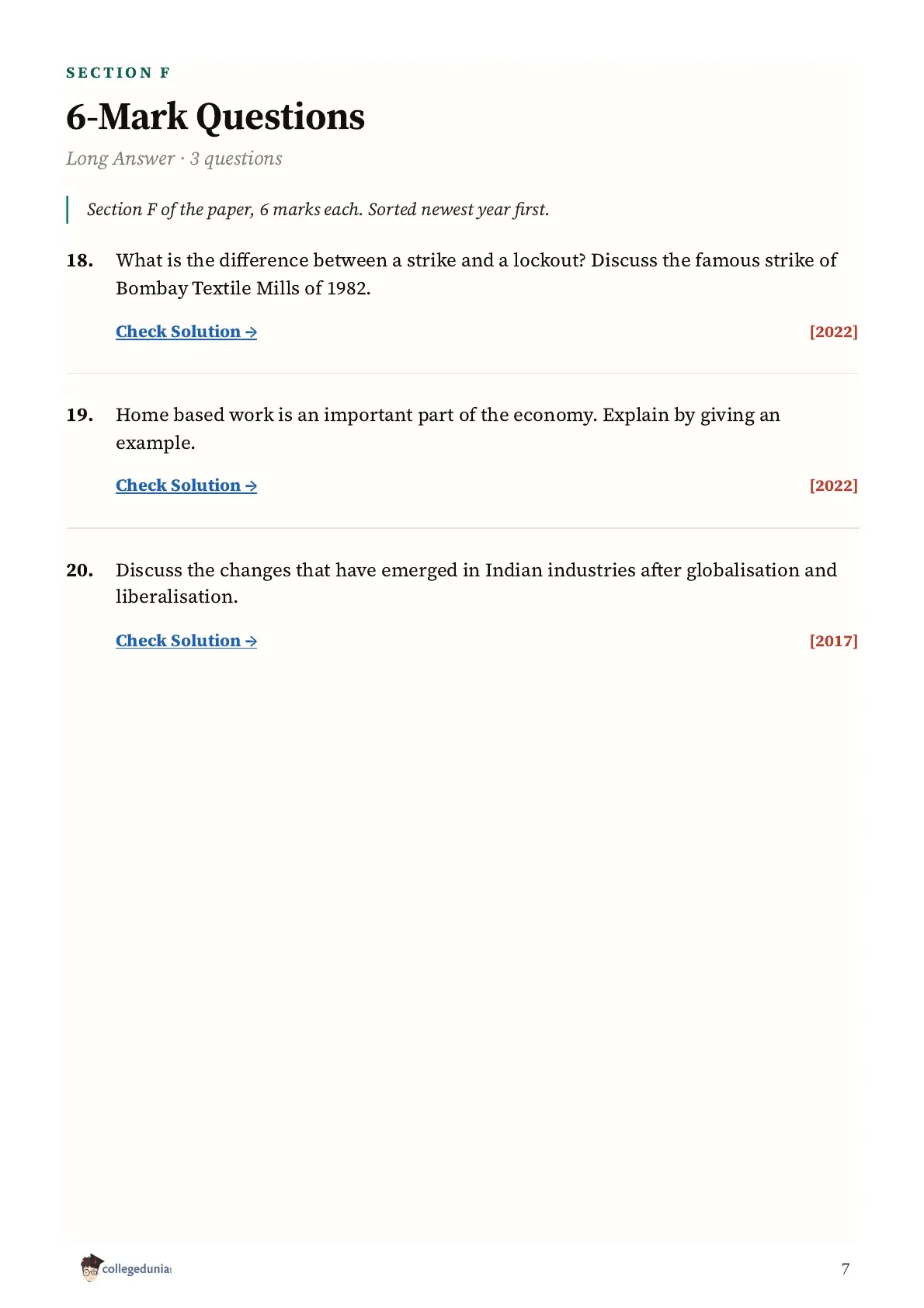

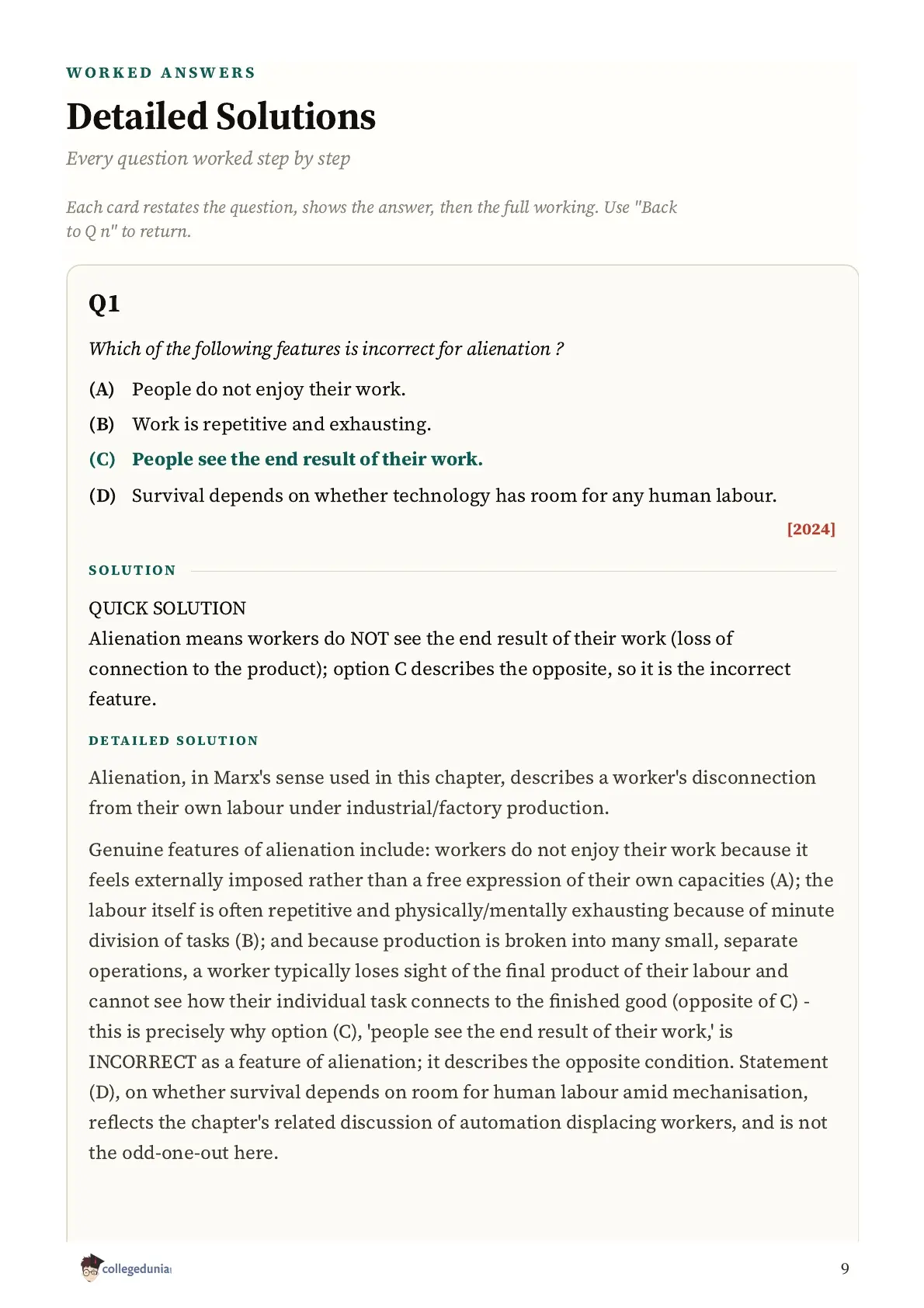
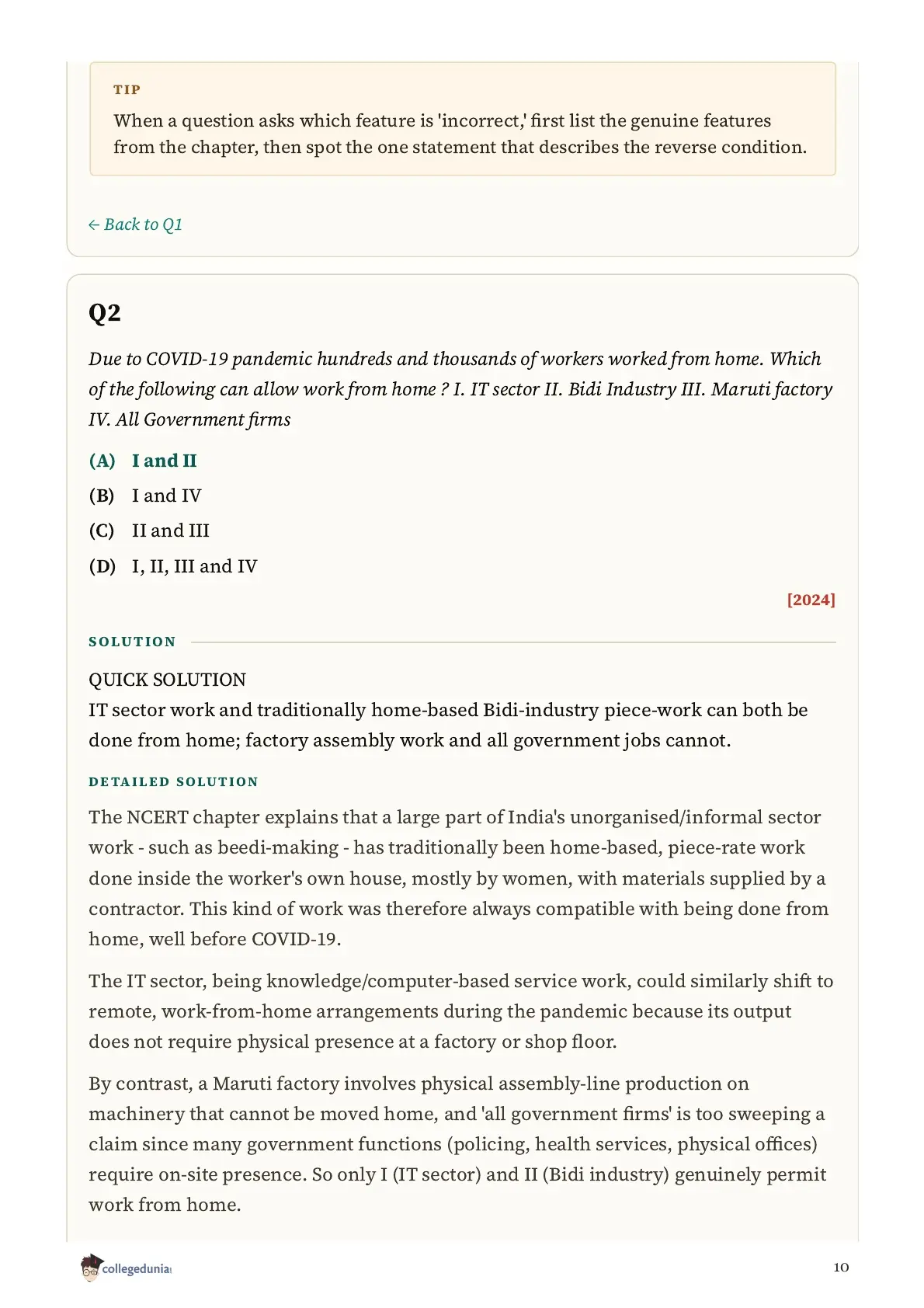
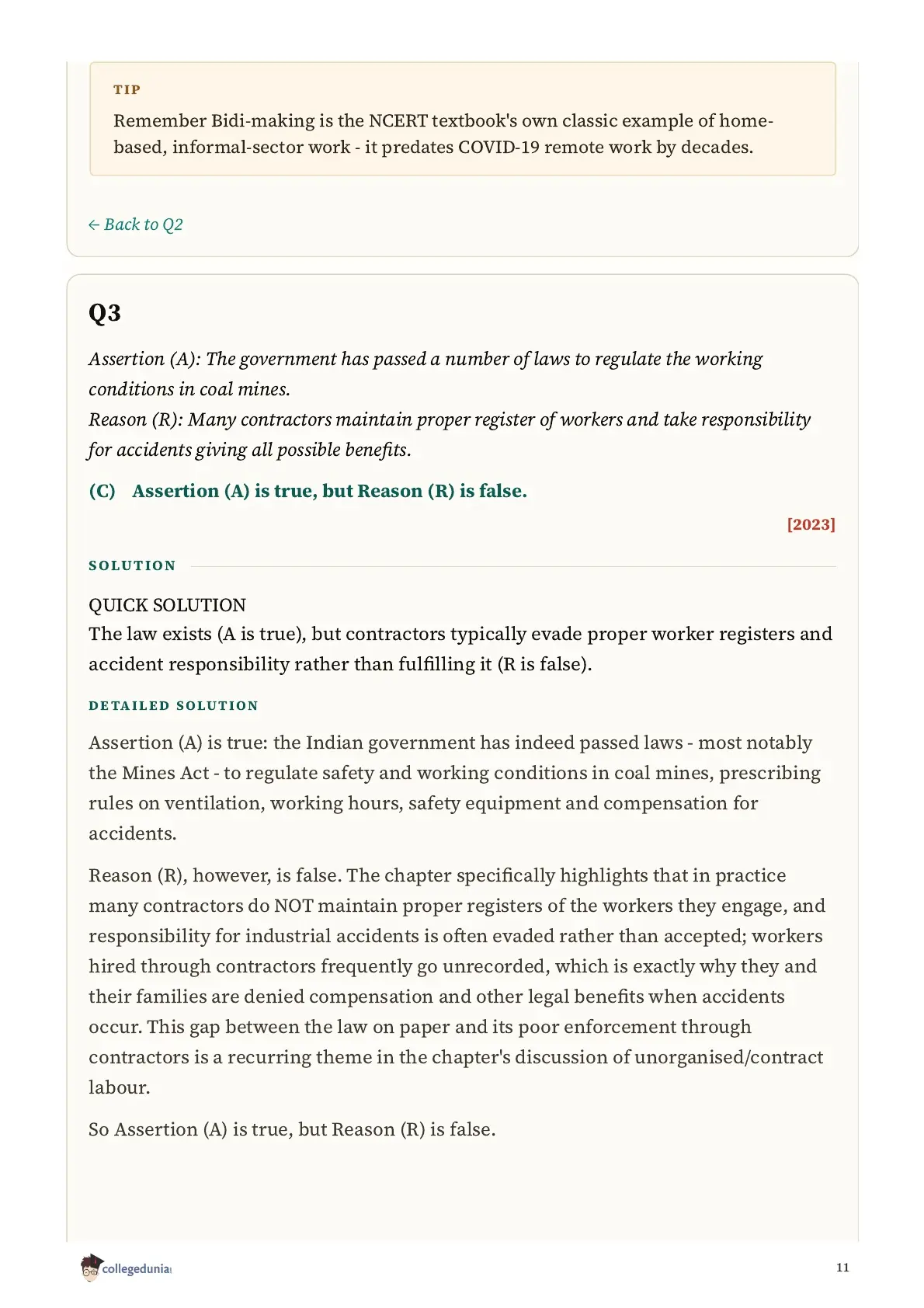
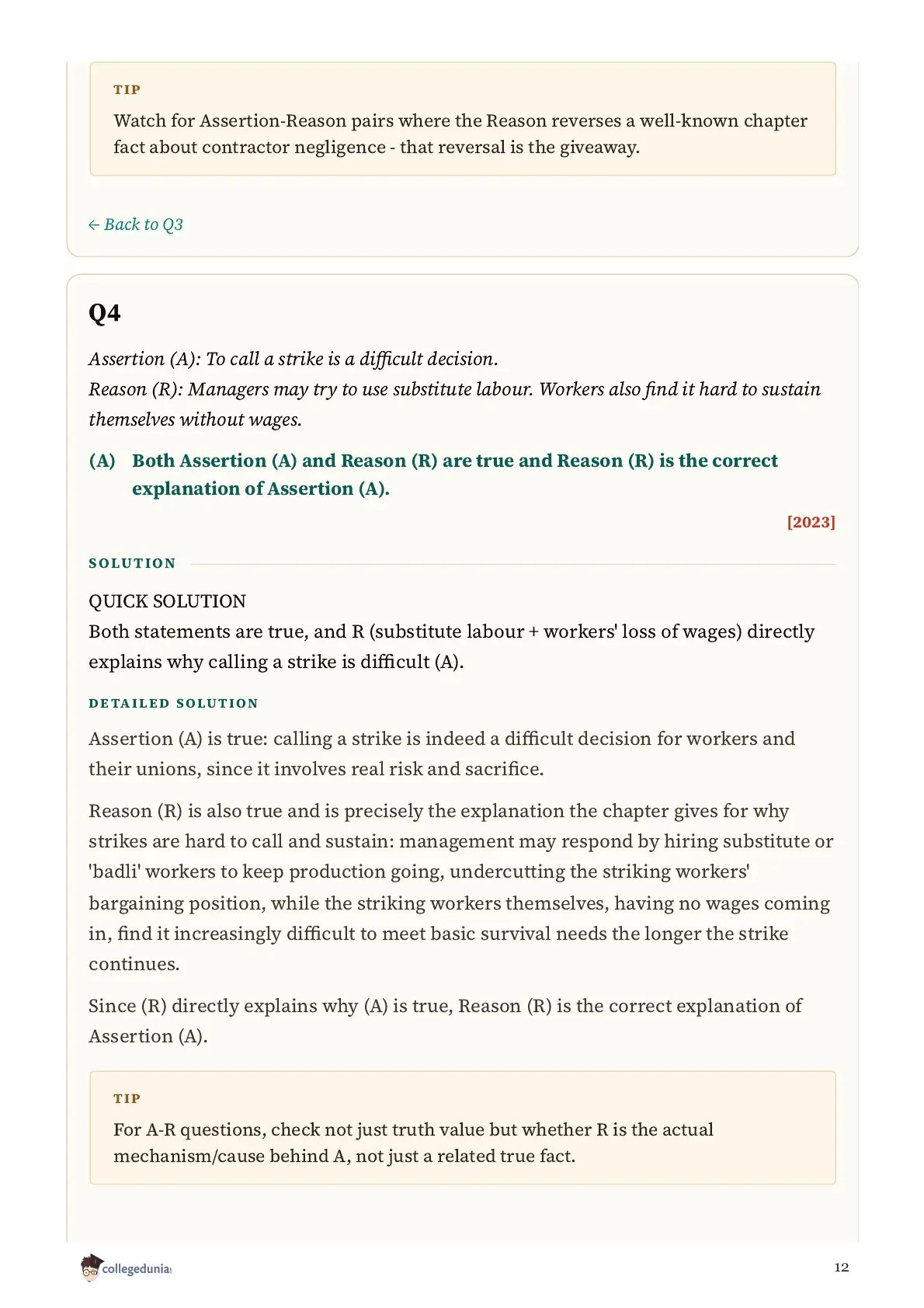
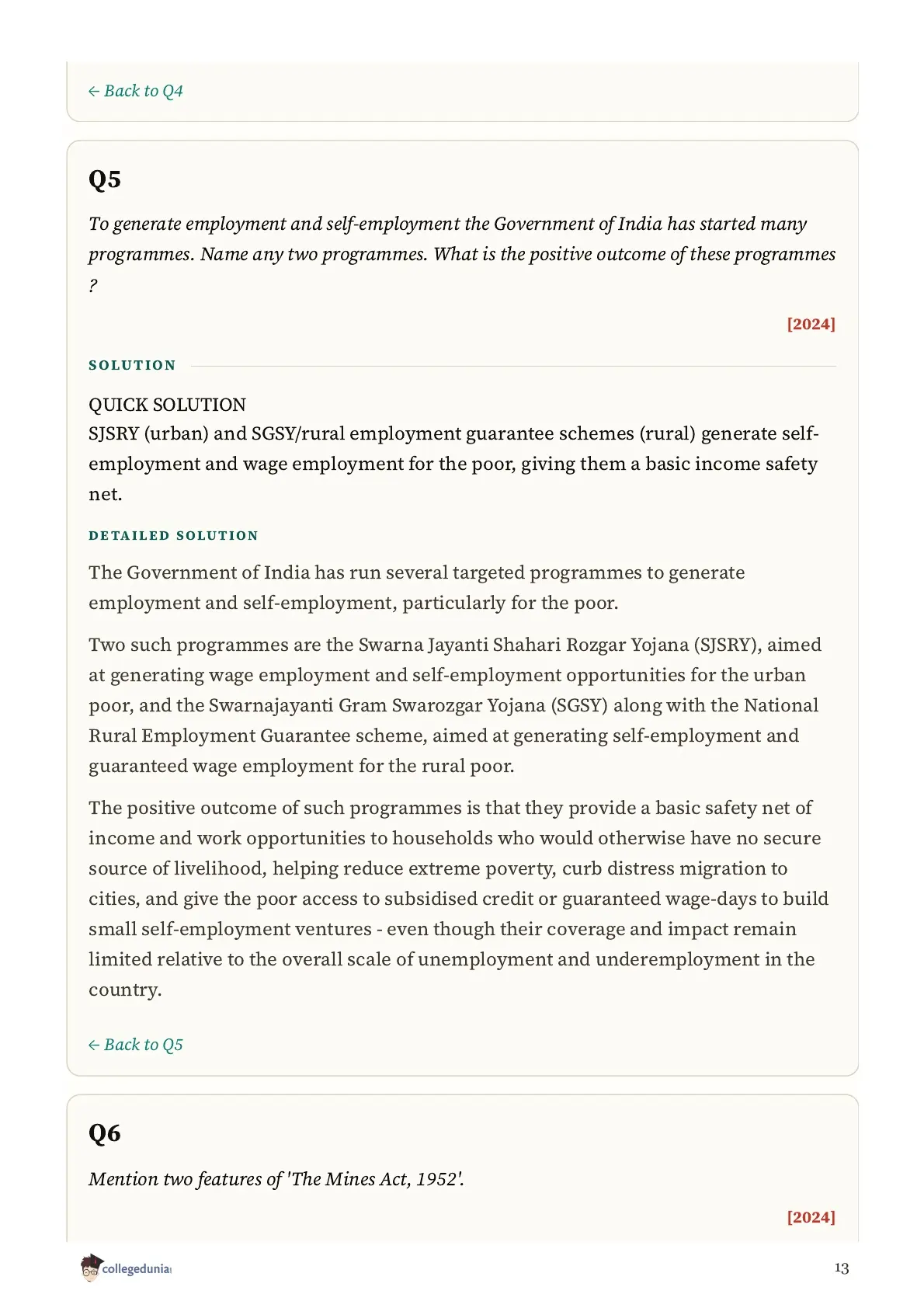
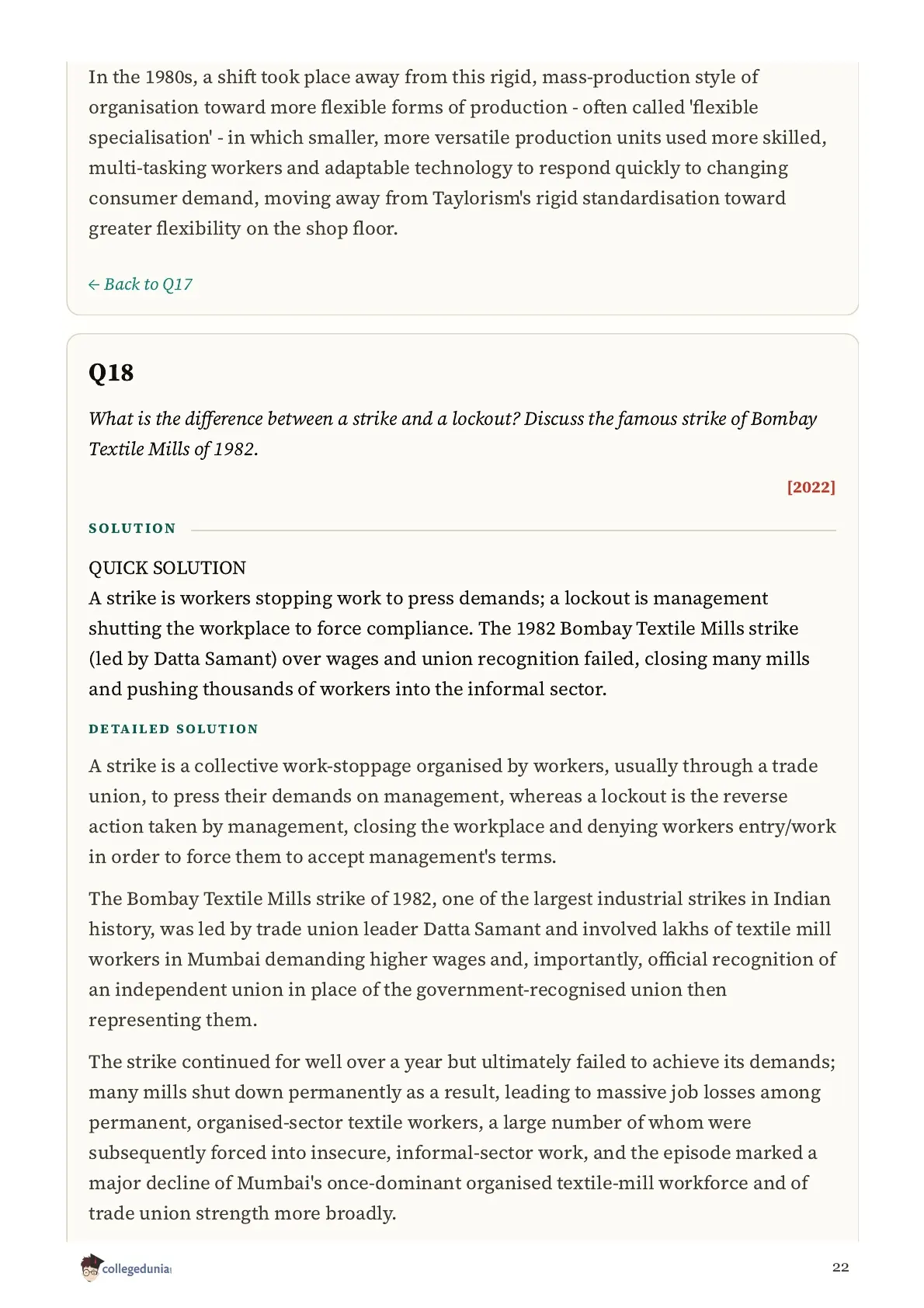
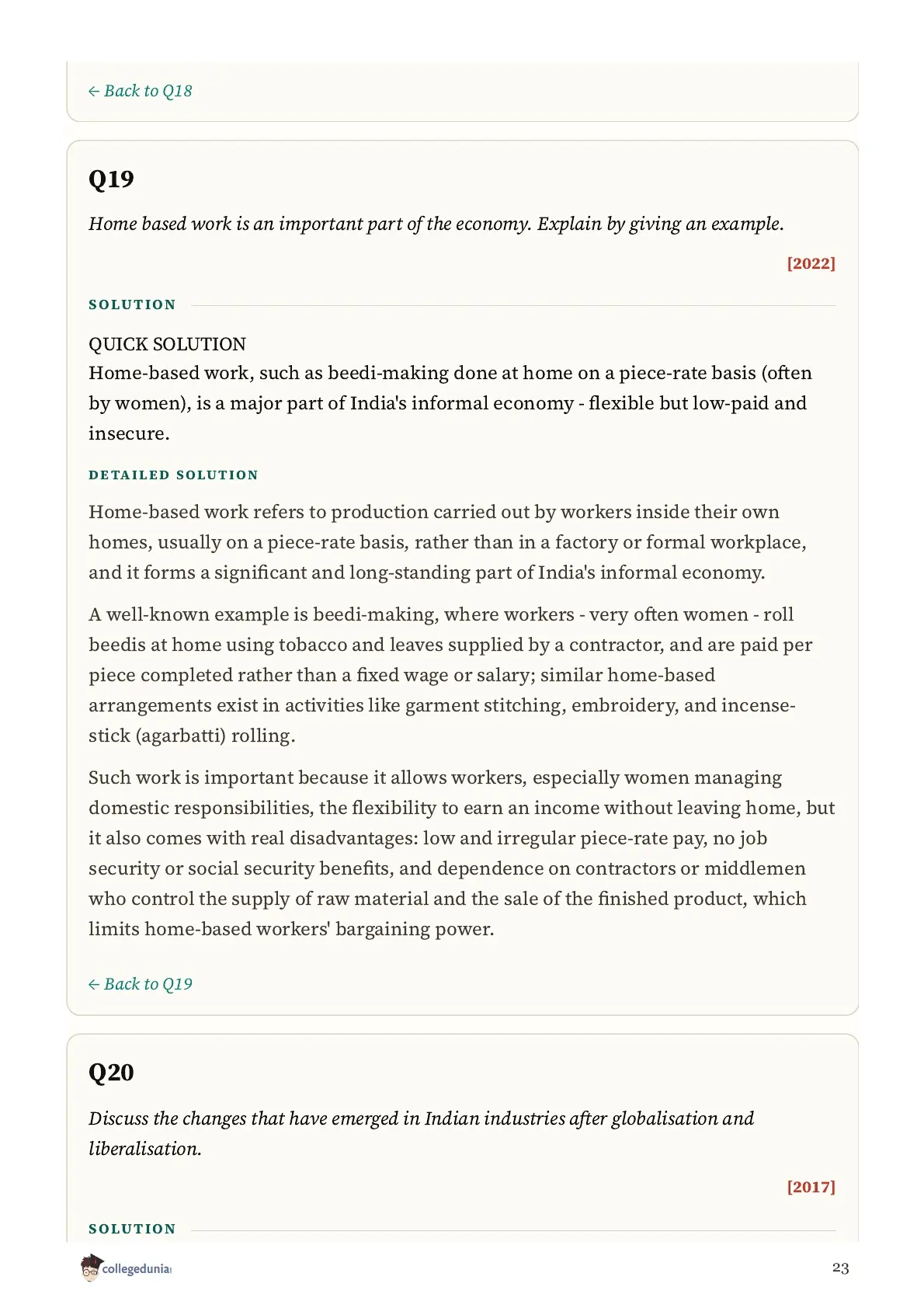
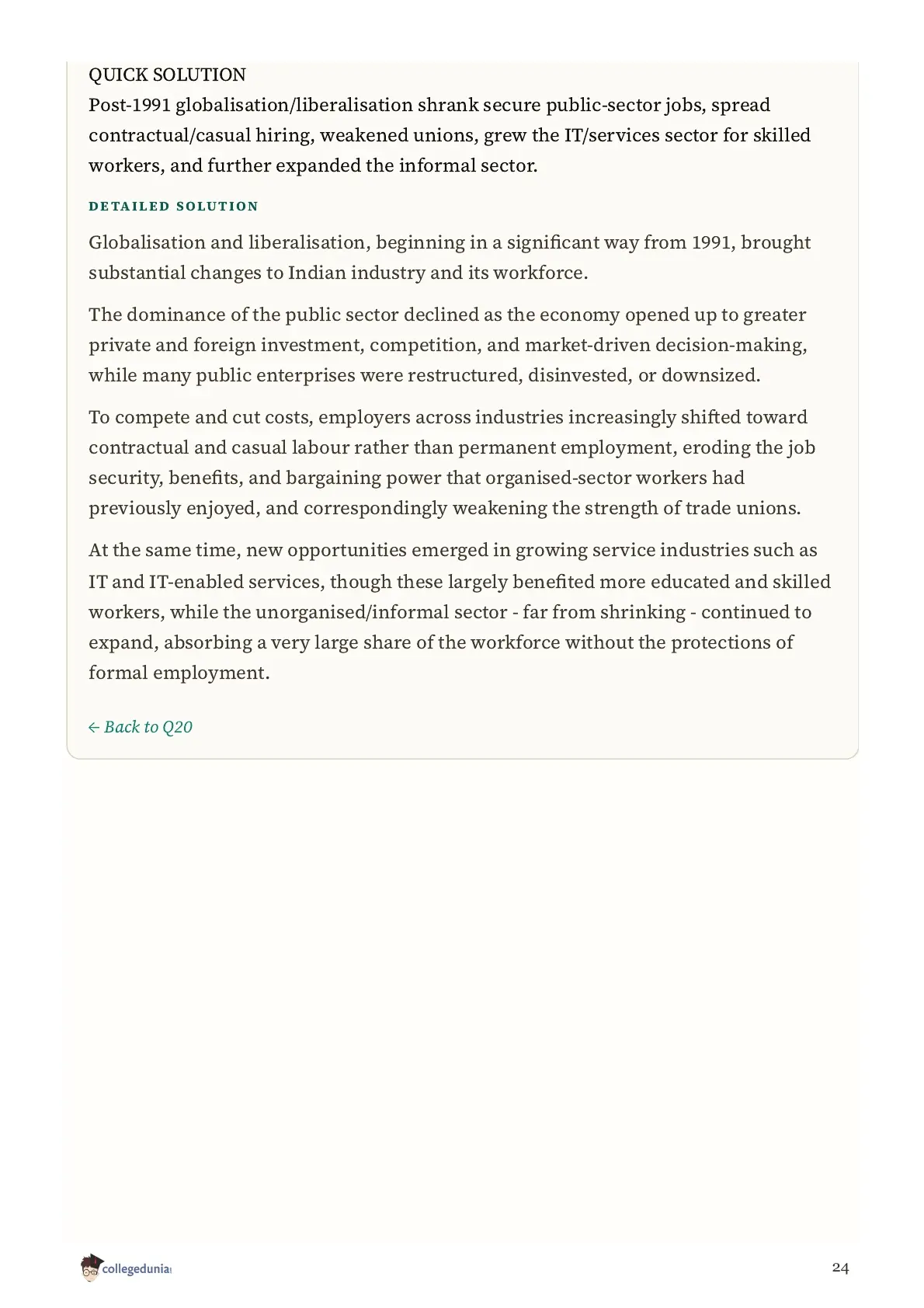
Every question in this Class 12 Sociology Chapter 5 (SCDI) PYQ set is lifted from an actual CBSE board paper (2017-2024) and answered in full by Collegedunia's Sociology experts, according to the 2026-27 NCERT syllabus.
What Class 12 Sociology Chapter 5 (SCDI) PYQs Test: Industrial Society and Organised/Unorganised Work
This chapter is where CBSE checks whether you can separate the theory of industrial change from the lived reality of Indian work. Board papers pull questions from India's post-independence industrialisation policy, the shift from a planned "mixed economy" to liberalisation and globalisation after 1991, the organised versus unorganised sector divide, and specific chapter case studies such as the Bombay Textile Mills strike of 1982. Questions on alienation, Scientific Management and recent disruptions like work from home during COVID-19 come up almost as often.
- Industrial policy and economic change: Five Year Plans, the public sector's role, and the 1991 shift to liberalisation, privatisation and globalisation.
- Organised vs unorganised sector: registration, job security and benefits versus casual, contract and home-based work.
- Labour and management concepts: alienation, Scientific Management and Taylorism, the basic tasks of a manager.
- Industrial action: the difference between a strike and a lockout, and the Bombay Textile Mills strike of 1982 as a named case study.
- Work and employment patterns: employment channels, self-employment schemes, factory worker recruitment, "time slavery" in IT, and work from home during the pandemic.
Marks-wise Distribution of Industrial Society PYQs
The 20 questions are spread across four CBSE mark bands. 2-mark Very Short Answer questions carry the most weight in this set (10 questions), while the 4-mark and 6-mark questions are where the chapter's case studies and comparisons, such as strike versus lockout, tend to appear.
| Question Type | Marks Each | Number of Questions |
|---|---|---|
| MCQ | 1 mark | 4 |
| Very Short Answer (VSA) | 2 marks | 10 |
| Short Answer (SA) | 4 marks | 3 |
| Long Answer (LA) | 6 marks | 3 |
MCQs mostly test whether you can identify a term like organised sector or alienation from its definition. The 6-mark long answers usually ask you to explain a change, such as the shift from Scientific Management or the impact of liberalisation on employment, with reasons and examples.
Year-wise Spread of Industrial Society PYQs: 2017 to 2024
The bank covers five CBSE board papers between 2017 and 2024, with no paper set in the intervening years. 2023 contributed the most questions (7), and the three most recent years, 2022, 2023 and 2024, together make up 16 of the 20 questions.
| Year | Number of Questions |
|---|---|
| 2024 | 4 |
| 2023 | 7 |
| 2022 | 5 |
| 2019 | 3 |
| 2017 | 1 |
Practising all five years together shows how CBSE has leaned more heavily on this chapter since 2022, rotating between the organised-unorganised divide, industrial action and post-liberalisation employment change rather than repeating the same angle.
Which Topics Repeat Most in Industrial Society PYQs
With 20 questions spread across a genuinely large chapter, some topics recur far more than others. The organised-unorganised sector divide and questions on strikes and lockouts, including the Bombay Textile Mills case, dominate the mix, while alienation and the effects of liberalisation on employment show up almost as often. A second tier of recruitment, management and policy questions fills out the rest, and a handful of contemporary topics like "time slavery" and pandemic work-from-home appear as one-off but recurring favourites.
- Most frequent: organised and unorganised sector (definitions, differences, examples), strike and lockout (including the Bombay Textile Mills strike, 1982), alienation in industrial society.
- Frequent: impact of liberalisation on employment patterns, employment channels in industrial society, Scientific Management and its 1980s shift.
- Regular: industrialisation policy in independent India, factory worker recruitment pattern, home-based work in the economy, employment and self-employment schemes, the basic task of a manager, meaning of circulation of labour, the Mines Act 1952, working conditions in coal mines, "time slavery" in the IT sector, and work from home during the COVID-19 pandemic.
How to Attempt Industrial Society PYQs
Start with the MCQs, since they move fast and confirm whether you have the chapter's core definitions right before you reach the longer questions. Then work through the 4-mark and 6-mark questions, which reward a specific, named answer over a general one.
- Always distinguish organised from unorganised sector explicitly. State the actual markers, registration, job security, benefits, rather than a vague "big company versus small company" description.
- Name the specific case (Bombay Textile Mills, 1982) rather than describing "a strike" in the abstract whenever the question calls for a case study or example of industrial action.
- When asked to differentiate strike from lockout, state the direction of the action. A strike is workers withholding labour; a lockout is the employer denying workers entry. Say this explicitly, don't just describe both as "industrial conflict."
- For alienation questions, tie the answer to loss of control over the end product of one's own labour, not just a general sense of boredom or fatigue at work.
Sample Question and Answer Approach for Industrial Society
Here is how to structure two typical question types from this chapter's PYQs. The pattern below is the same one the PDF's step-by-step solutions follow.
| Question Type | How to Structure the Answer |
|---|---|
| 1-mark MCQ (e.g. identifying organised vs unorganised sector work from a description) | Check whether the description mentions registration, job security or fixed benefits before picking an option. Don't pick the option that "sounds formal" without checking these specific markers. |
| 6-mark long answer (e.g. explaining the impact of liberalisation on employment patterns) | State the policy shift first (1991 liberalisation, privatisation, globalisation), then give two or three concrete employment effects, and close with one line connecting the effects back to the organised-unorganised divide. |
This habit, name the policy or case first, then explain its concrete effect, is what separates a partial 2-mark answer from a full 6-mark one.
Common Mistakes Students Make in Industrial Society Questions
Watch out for these recurring errors:
- Confusing a strike with a lockout. A strike is workers collectively refusing to work; a lockout is the employer shutting workers out. Treating them as the same action costs marks in nearly every year of this bank.
- Using "alienation" loosely. The chapter's specific Marxist sense is that workers no longer see or control the end product of their own labour under factory-based mass production, not just general dissatisfaction with a job.
- Forgetting that most Indian industrial employment is informal. Students often write as if large, registered factories are the norm, when most industrial work in India actually sits in the informal or unorganised sector.
- Describing Scientific Management without its criticism. Answers that explain Taylorism's efficiency goal but skip the de-skilling criticism, or the shift away from it since the 1980s, lose the second half of the marks.
Student Feedback: Industrial Society Difficulty Rating
What 9,860 students told us about this chapter's PYQs
In a Collegedunia poll of 9,860 Class 12 Sociology students conducted before the 2026-27 boards, 64% rated the strike-versus-lockout and organised-unorganised sector questions as the hardest part of this chapter, mainly because the two pairs get blurred together under exam pressure. Students who practised all five years of PYQs together reported fewer mix-ups on the actual paper.
Source: 2026-27 Class 12 Sociology student poll. Sample of 9,860 students from CBSE schools across 12 states.
How These PYQs Pair with Other Class 12 Sociology Chapter 5 (SCDI) Resources
This PYQ set works best alongside the other Chapter 5 resources already live on Collegedunia. Read the notes first, revise from the handwritten notes, solve these PYQs, then cross-check tricky answers against the full NCERT solutions.
| Resource | Link |
|---|---|
| NCERT Notes | Change and Development in Industrial Society Class 12 Notes |
| Handwritten Notes | Change and Development in Industrial Society Class 12 Handwritten Notes |
| NCERT Solutions | Change and Development in Industrial Society Class 12 NCERT Solutions |
| NCERT Book PDF | Change and Development in Industrial Society Class 12 NCERT Book PDF |
| PYQ (this page) | Change and Development in Industrial Society Class 12 PYQ |
Five other Class 12 Sociology PYQ chapters are already live as part of this same series: Structural Change, Cultural Change, Social Institutions: Continuity and Change, The Market as a Social Institution, and The Story of Indian Democracy.
How to Use the Industrial Society PYQ PDF Effectively
Don't jump to the solution on the first read. Try to name the concept or case and sketch an answer yourself, then check it against the step-by-step solution in the PDF.
- First pass: attempt all 20 questions without looking at the solutions, section by section.
- Second pass: compare each answer against the solution and mark where a specific term, case name or policy year was missing.
- Third pass: redo only the questions you got wrong, a day or two later, from memory.
Downloading and Using the PYQ PDF
The PDF is 24 pages and free to download. It opens with the question paper sorted by mark band, closes with a self-check answer key, and links every question to its full solution.
Change and Development in Industrial Society Class 12 Sociology PYQ FAQs
Ques. How many questions are in the Change and Development in Industrial Society Class 12 PYQ PDF?
Ans. The PDF has 20 questions from CBSE board papers between 2017 and 2024: 4 one-mark MCQs, 10 two-mark VSA, 3 four-mark SA and 3 six-mark LA questions.
Ques. Does this PYQ PDF include solutions, or only the questions?
Ans. It includes full solutions. Every one of the 20 questions has a step-by-step answer written out in the PDF, so you can check your own attempt against a worked solution rather than just an answer key.
Ques. Which years of CBSE board papers does this PYQ set cover?
Ans. It covers five years: 2017, 2019, 2022, 2023 and 2024. 2023 has the most questions (7), followed by 2022 (5), 2024 (4), 2019 (3) and 2017 (1).
Ques. Where can I download the Industrial Society PYQ PDF?
Ans. You can download it directly from this page. It is free and runs to 24 pages, with the questions sorted by mark band and every question linked to its solution.
Ques. Is this PYQ set aligned with the 2026-27 CBSE syllabus?
Ans. Yes. The chapter content and question pattern match the current 2026-27 NCERT Sociology syllabus for Class 12.
Ques. What is the difference between a strike and a lockout?
Ans. A strike is when workers collectively refuse to work, usually to press a demand. A lockout is when the employer refuses to let workers into the workplace. The direction of the action is opposite in each case, which is the detail examiners look for.
Ques. Why is most Indian industrial work in the unorganised sector?
Ans. Most industrial employment in India is spread across small workshops, home-based work and contract or casual labour that is not registered and offers no job security or fixed benefits, which is why the unorganised sector, not large registered factories, employs the majority of India's industrial workforce.



Comments