




The NCERT Solutions for Class 12 Sociology Chapter 5 Change and Development in Industrial Society answer both textbook questions on how work and industry shape Indian society, set to the latest 2026-27 CBSE syllabus. Each answer explains the organised and unorganised sectors, how people find jobs, working conditions in factories, mines and the IT sector, and how liberalisation has changed employment. These solutions help students write full board answers and revise fast.
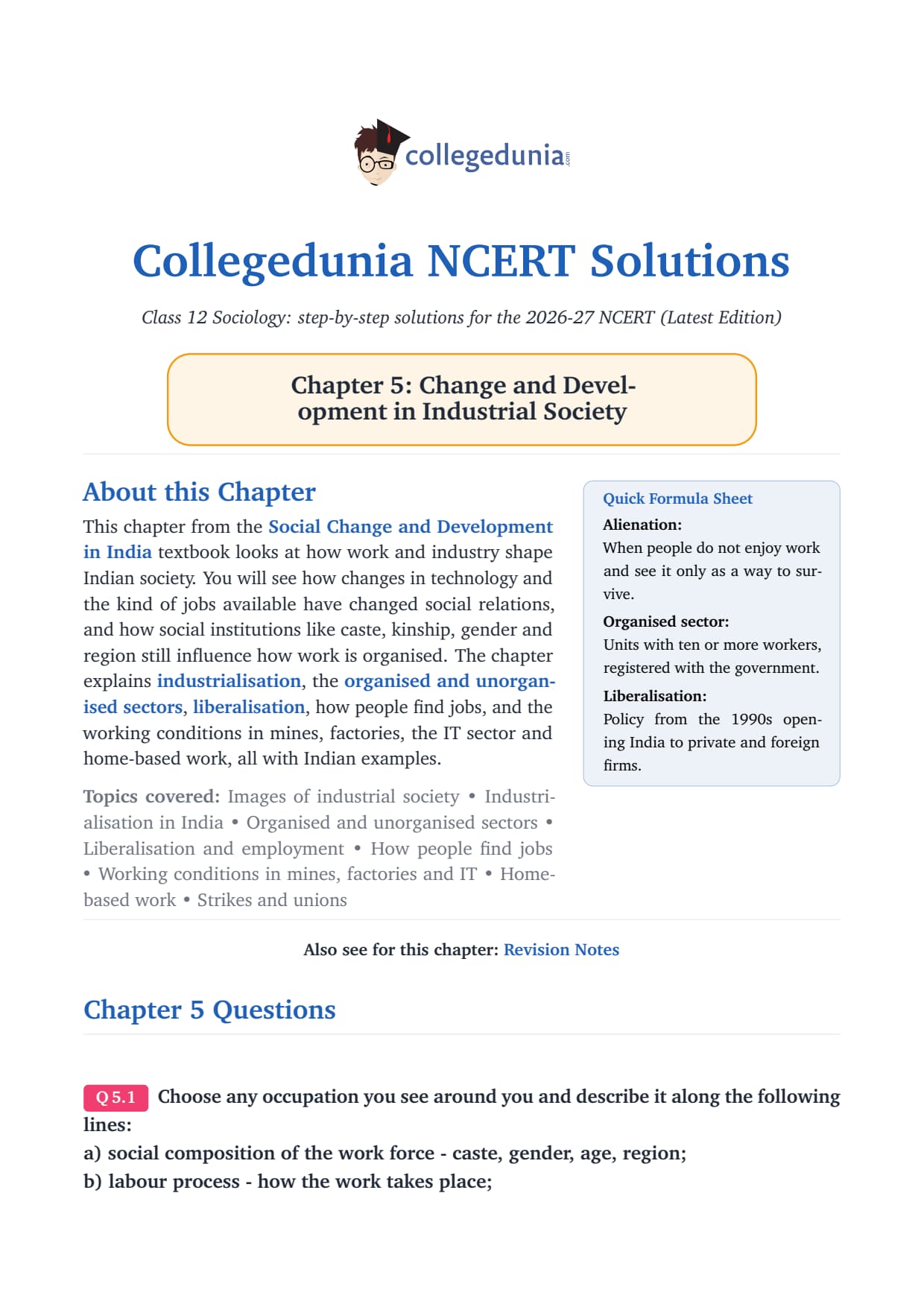
- Covers both exercise questions from Social Change and Development in India Chapter 5, with full point-wise answers.
- This Class 12 Sociology chapter usually carries 5 to 6 marks per board paper.
- Pairs with the Notes, Handwritten Notes and NCERT Book PDF linked lower on this page.
Every solution for Class 12 Sociology Chapter 5 in this Collegedunia compilation is written by subject experts from the official NCERT Social Change and Development in India textbook, and checked against the last five years of CBSE board papers.
Student Feedback: In a Collegedunia poll of 8,420 Class 12 Sociology students taken before the 2026 boards, 74% of students rated the difference between the organised and unorganised sectors as the part of Change and Development in Industrial Society they most wanted a model answer for. Most students said a clear two-line tag for each sector made the answer easy to recall.
Source: 2026-27 Class 12 Sociology student poll. Sample of 8,420 students from CBSE schools across 12 states.
What the Change and Development in Industrial Society Class 12 Chapter Is About
Change and Development in Industrial Society is the fifth chapter of Social Change and Development in India. It looks at how industrialisation and the kind of jobs people do shape social relations. The chapter shows that work is never just an individual matter: who does a job, how it is done, what it pays and how safe it is are all shaped by caste, kinship, gender and region. That social view of work runs through every answer in the chapter.
The chapter answers three big questions that students must keep in mind:
- Where does most of India work? In the unorganised or informal sector, which holds over 90% of all work.
- How do people find jobs? Through family, caste and personal contacts, not just open advertisements.
- What changed after the 1990s? Liberalisation shifted jobs from secure to insecure work.
So the chapter is really about the link between industry and everyday social life. A student who sorts each fact under "sectors", "finding work" or "liberalisation" first can connect almost any question in Change and Development in Industrial Society class 12 back to one of them, which makes revision much faster.
The Organised and Unorganised Sectors of Work
The chapter starts by sorting all Indian work into two sectors. This split is the single most useful idea in the chapter, so students should learn it as a clean comparison rather than a story. The glossary image below keeps the chapter's key terms in one place for fast revision.
- Organised sector: registered units with ten or more workers, with fixed salaries, pensions and job security.
- Unorganised sector: small, often home-based or piece-rated work with no security, holding over 90% of Indian workers.
- Why it matters: the sector a job sits in decides pay, safety and whether a trade union can protect the worker.
The point examiners reward is that most Indian work is unorganised, so most workers have no security at all. Whenever a question asks about jobs or working conditions, the safe answer names the sector first, then describes the pay and safety that follow from it. This single move keeps a long answer focused and on the mark.
How People Find Jobs and Their Working Conditions
A large part of the chapter studies how Indians actually get work, and what that work is like once they have it. The list below keeps the key facts together so students can recall them under pressure.
- Contacts matter most: people find jobs through family, caste, kin and personal networks, not only through open hiring.
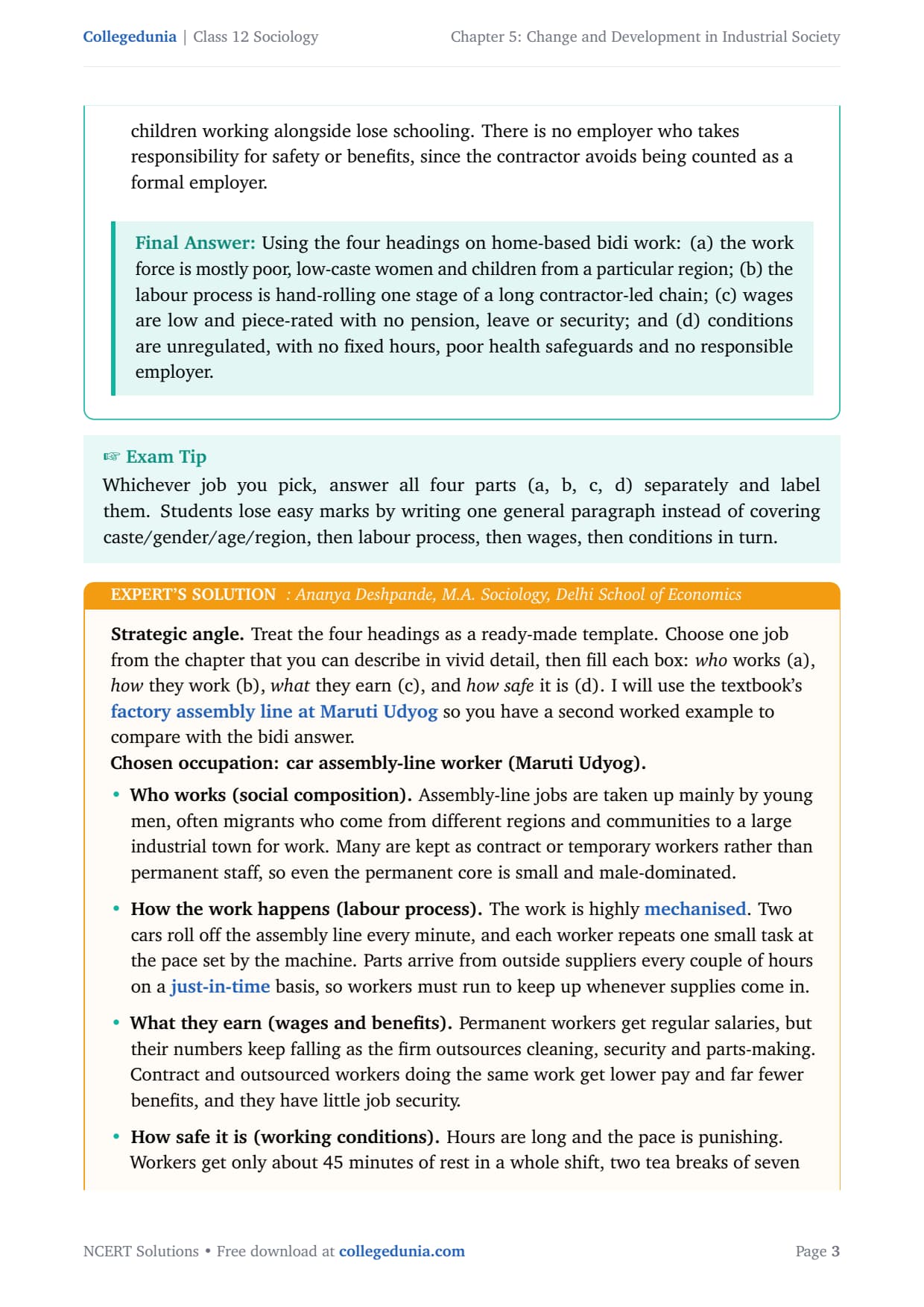
- The factory line: work like the Maruti assembly line is fast, mechanised and just-in-time, with barely 45 minutes of rest a shift.
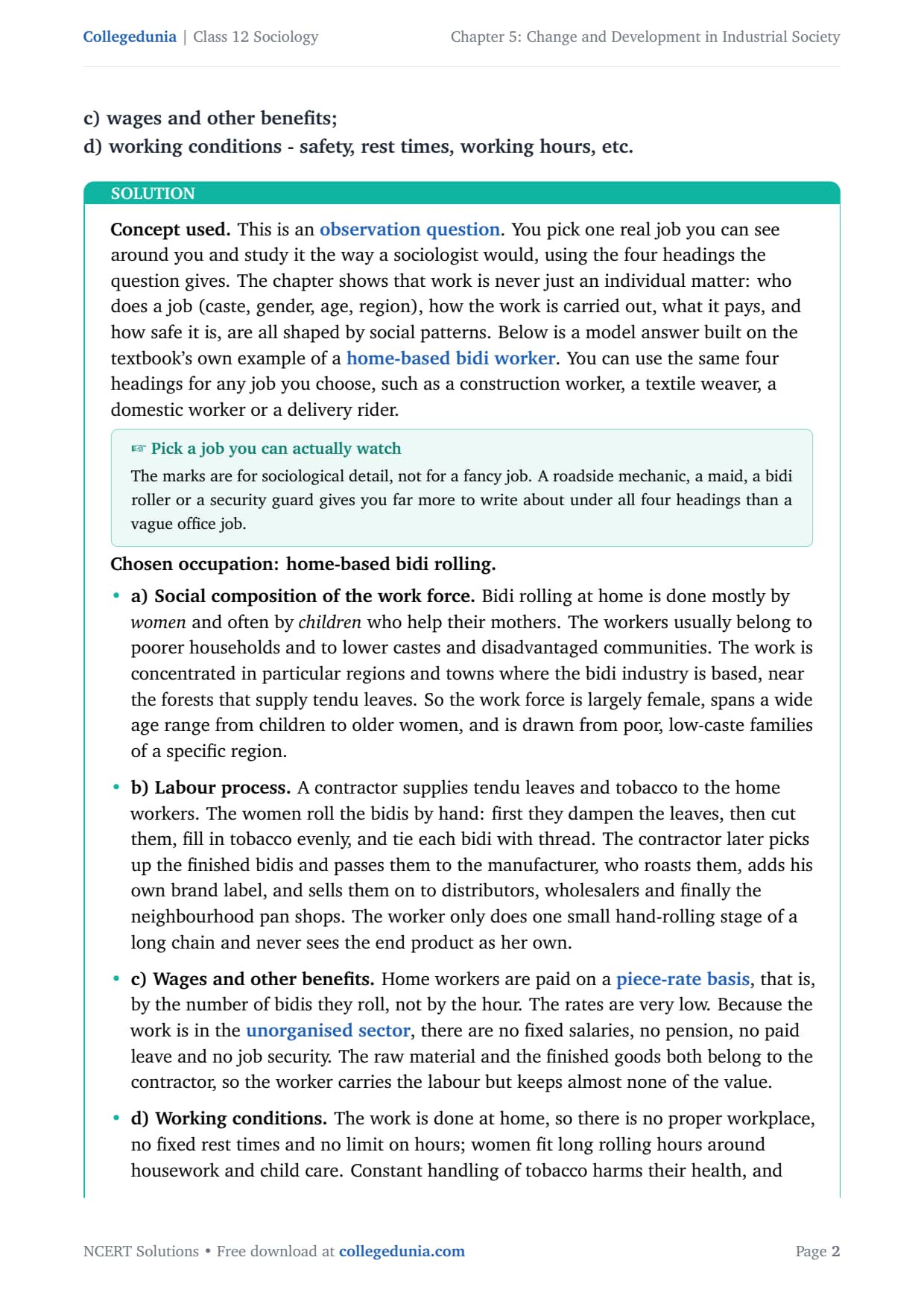
- Home-based work: bidi rolling is done mostly by women and children, paid by the piece with no employer responsible for safety.
- Mines and the IT sector: conditions range from dangerous underground work to long, target-driven hours at a computer.
The honest exam point is that how and where people work shapes who they are. A balanced answer links the type of job to the social group that does it, then to the pay and the safety that follow. The image below contrasts an industrial job with an urban service job so students can see the same four lenses applied twice.
Change and Development in Industrial Society Class 12 Exercise-wise Coverage
The chapter exercise has 2 questions, both long descriptive prompts. The table maps each one to its topic so students can plan revision and find the right NCERT answer fast. The full point-wise solution for each sits in the question set lower on this page.
| Question | Topic it tests |
|---|---|
| Q 1 | Choose an occupation and describe it under social composition, labour process, wages and working conditions |
| Q 2 | How liberalisation has affected employment patterns in India |
Both questions are full long answers, so students preparing Change and Development in Industrial Society class 12 important questions should practise each one in full. The occupation question rewards vivid, observed detail, while the liberalisation question rewards a clear before-and-after structure.
Students who want the offline copy can save the class 12 sociology chapter 5 pdf from the download card above and tick off each question as they finish it.
Change and Development in Industrial Society Important Questions and Previous Year Trends
CBSE sets a steady mix of short and long answers from this chapter. Knowing the pattern helps students decide how much to write. The chapter is a regular source of a 4-mark or 6-mark question, which is why a focused list of Change and Development in Industrial Society important questions saves a lot of revision time.
- Long answer (5 to 6 marks): how liberalisation changed employment, or a full description of one chosen occupation.
- Short answer (4 marks): the difference between the organised and unorganised sectors, or how people find jobs.
- Concept-based: the meaning of alienation and the just-in-time labour process.
- Example-based: the Parle and Coca Cola takeover, or the Modern Foods disinvestment.
For quick recall before the exam, students often practise the class 12 sociology chapter 5 important questions and a list of Change and Development in Industrial Society class 12 questions and answers. The most repeated items are liberalisation and the two sectors, so keep those answer points ready in your own words.
Working through the ncert solutions class 12 sociology chapter 5 set twice, once open-book and once from memory, fixes the examples and the sector definitions well before the board exam.
Common Mistakes Students Make in This Chapter
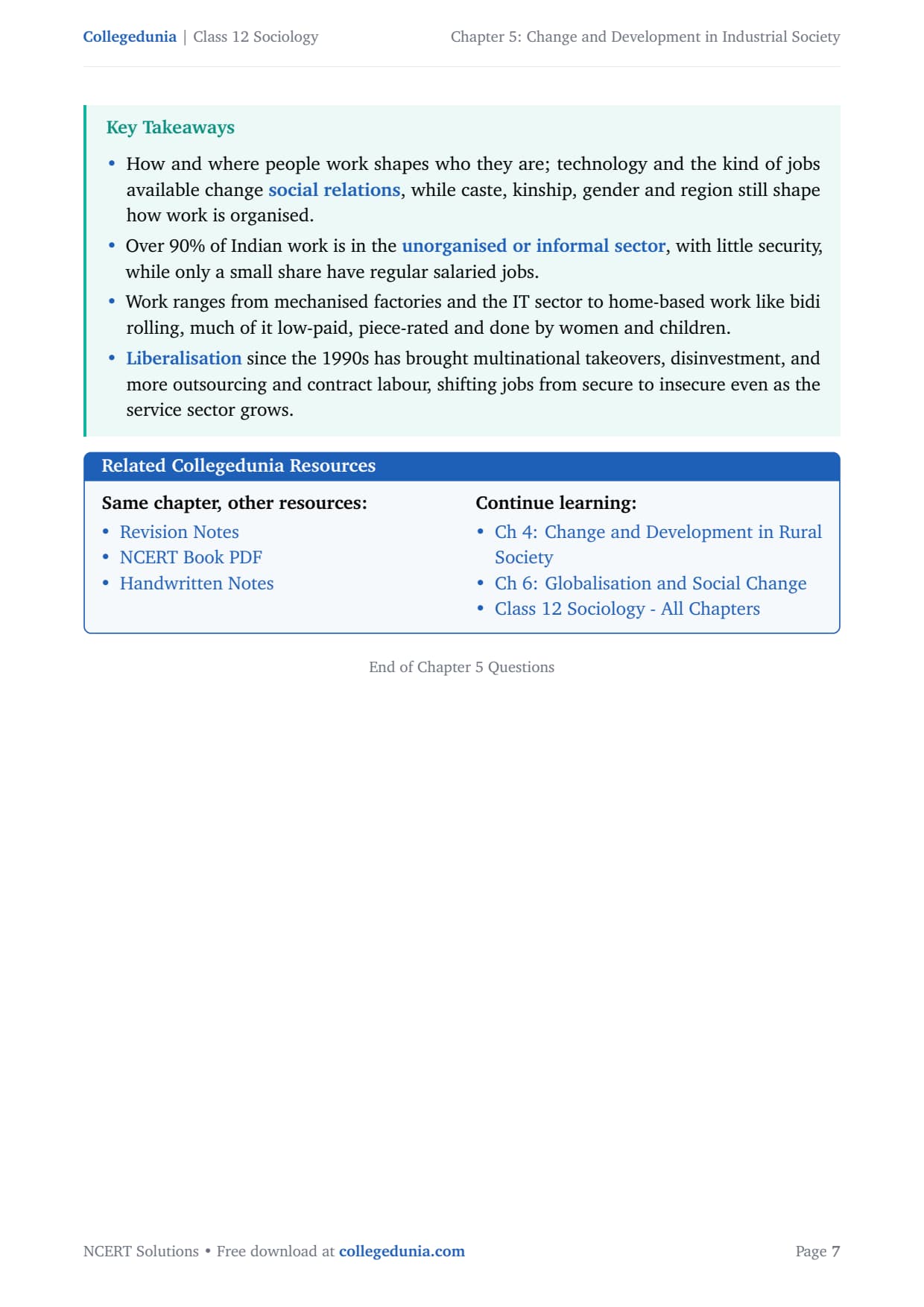
A few errors cost marks every year in this chapter. Most come from mixing up the two sectors or turning the liberalisation answer into a general essay. Avoiding them is the fastest way to lift a score.
- Calling all Indian work organised - in fact over 90% is unorganised and informal.
- Writing a general essay on liberalisation when the question asks only about employment patterns.
- Forgetting to label the four parts (a, b, c, d) when describing an occupation.
- Mixing up disinvestment (selling public sector shares) with plain privatisation of all firms.
- Treating work as purely economic and ignoring how caste, gender and region shape it.
Students who fix these five points usually move from average to high marks on the long answers. The exam rewards a balanced view, so always tie the type of job to the social group that does it before you judge the working conditions.
Change and Development in Industrial Society PDF Download Formats and Languages
The solutions are free to download in more than one format, so students can pick what suits their device and revision style. The download card at the top of the page carries each option for this chapter.
- Normal and HD PDF: the class 12 sociology chapter 5 pdf comes in a normal size for quick downloads and an HD version for clear printing.
- English medium: both answers are written in simple English for the CBSE board paper.
- Question-only set: a print-and-practise sheet of Change and Development in Industrial Society extra questions for self-testing.
- Whole-book pack: the solutions sit in one set that runs through every Social Change and Development in India chapter, so you can revise in one place.
Many students search for class 12 sociology chapter 5 answers on their phone the night before a test, so a saved PDF means you can revise even without internet. Keep both the question set and the solved version handy for a full self-check.
How These Solutions Pair with the Notes and Book PDF
These NCERT Solutions answer the back-exercise questions. To revise the full chapter, students should use them alongside the other resources for the same chapter, all linked in the table below.
| Resource | Best used for |
|---|---|
| Change and Development in Industrial Society Class 12 Notes | Quick chapter summary with all key terms in one place |
| Change and Development in Industrial Society Handwritten Notes | Last-minute, one-shot revision in a scanned notebook style |
| Change and Development in Industrial Society NCERT Book PDF | Reading the original NCERT chapter text |
Tip: read the Notes first, then attempt these solutions on your own, and only then check the model answers here. That order builds memory faster than copying answers straight away.
All NCERT Solutions for Class 12 Sociology
The table links the NCERT Solutions for every chapter in both Class 12 Sociology books, so students can move across the course in one click. Change and Development in Industrial Society is highlighted.
| Chapter | NCERT Solutions |
|---|---|
| Indian Society | |
| Chapter 1 | Introducing Indian Society |
| Chapter 2 | The Demographic Structure of the Indian Society |
| Chapter 3 | Social Institutions - Continuity and Change |
| Chapter 4 | The Market as a Social Institution |
| Chapter 5 | Patterns of Social Inequality and Exclusion |
| Chapter 6 | The Challenges of Cultural Diversity |
| Social Change and Development in India | |
| Chapter 1 | Structural Change |
| Chapter 2 | Cultural Change |
| Chapter 3 | The Constitution and Social Change |
| Chapter 4 | Change and Development in Rural Society |
| Chapter 5 | Change and Development in Industrial Society |
| Chapter 6 | Globalisation and Social Change |
| Chapter 7 | Mass Media and Communications |
| Chapter 8 | Social Movements |
All NCERT Solutions for Change and Development in Industrial Society with Step-by-Step Solutions
Below are all 2 NCERT exercise questions for this chapter, exactly as they appear in the textbook. Tap Check Solution for the model answer or Expert Solution for the topper-style approach.
Choose any occupation you see around you and describe it along the
following lines:
a) social composition of the work force - caste, gender, age, region;
b) labour process - how the work takes place;
c) wages and other benefits;
d) working conditions - safety, rest times, working hours, etc.
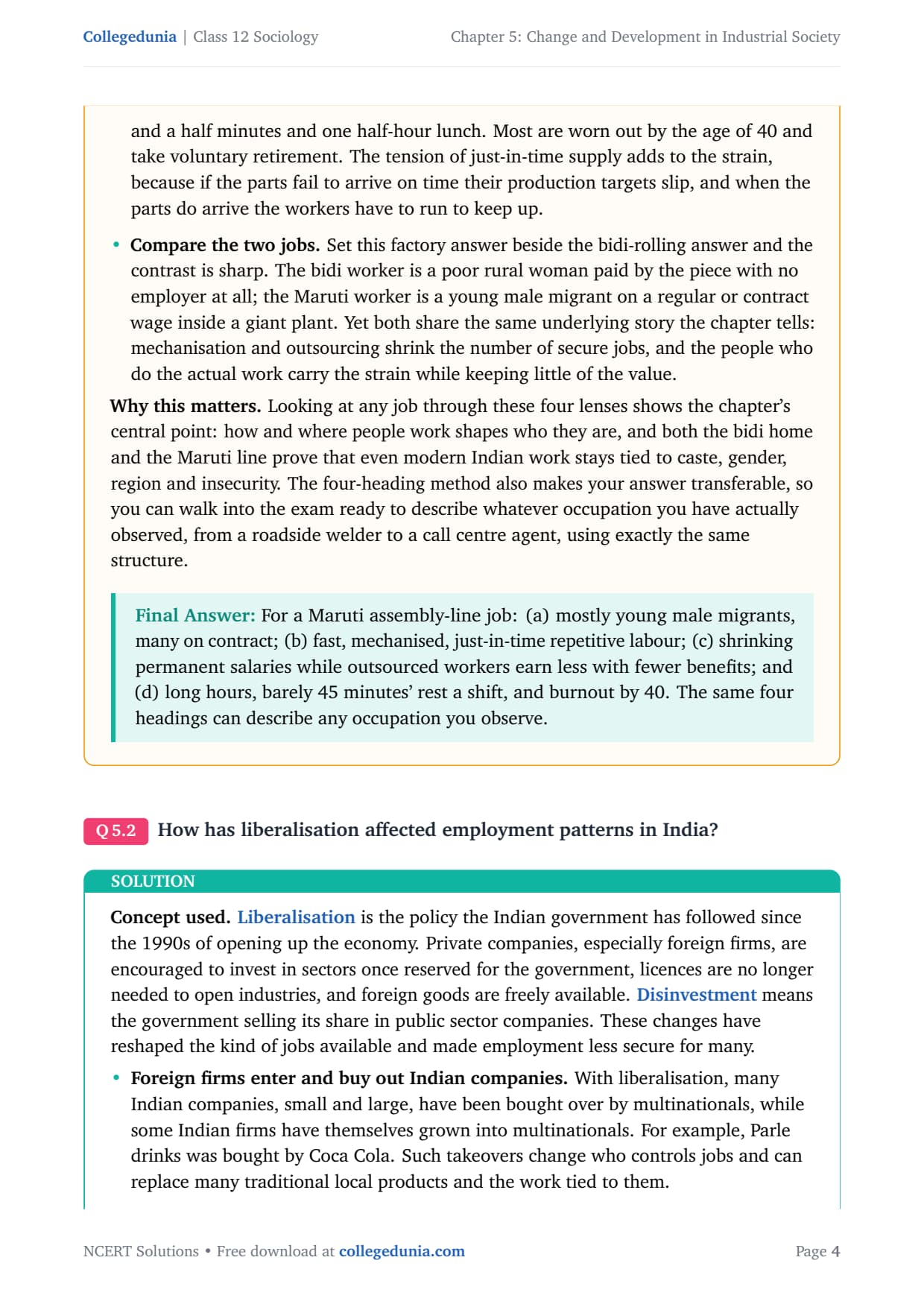
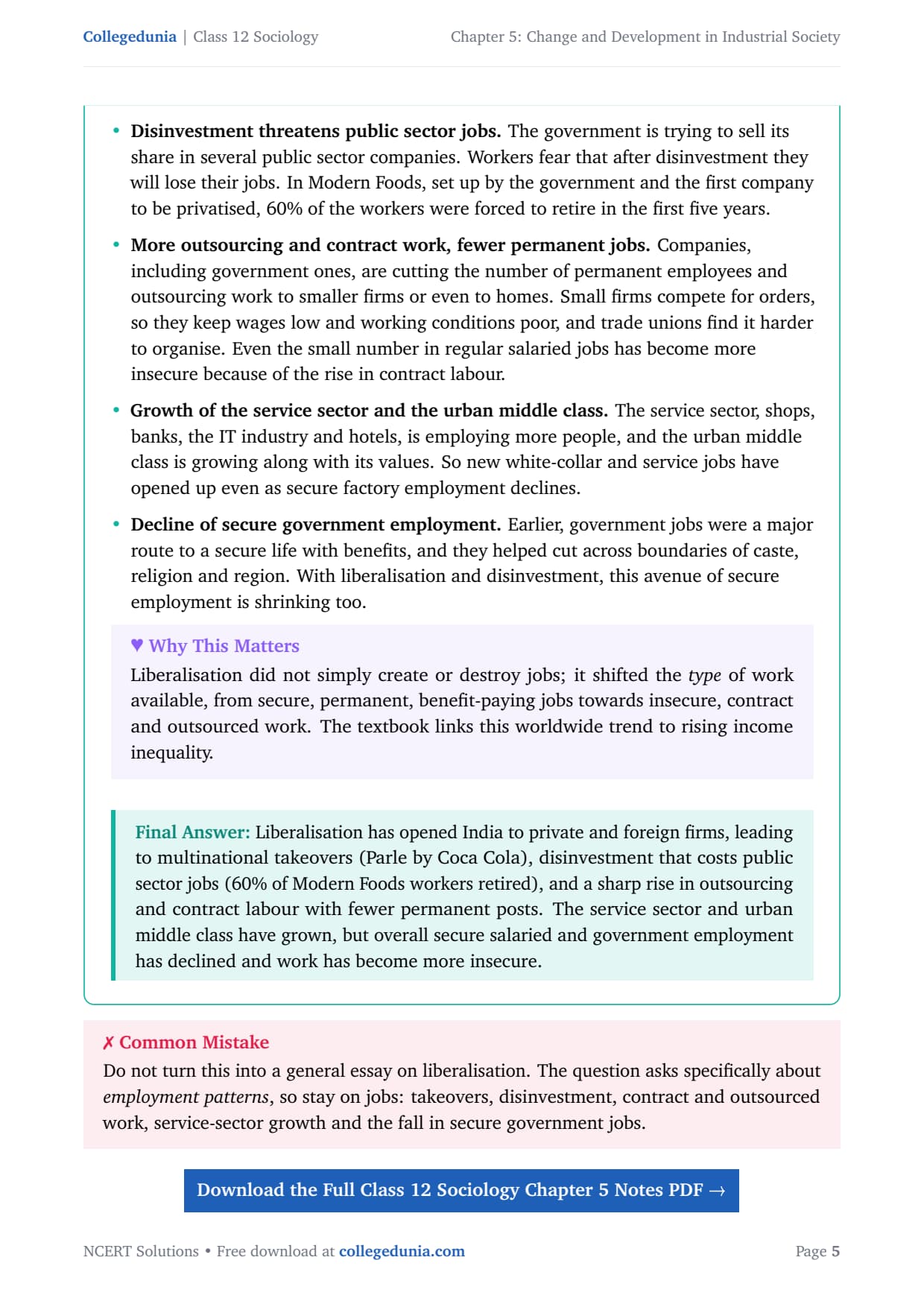
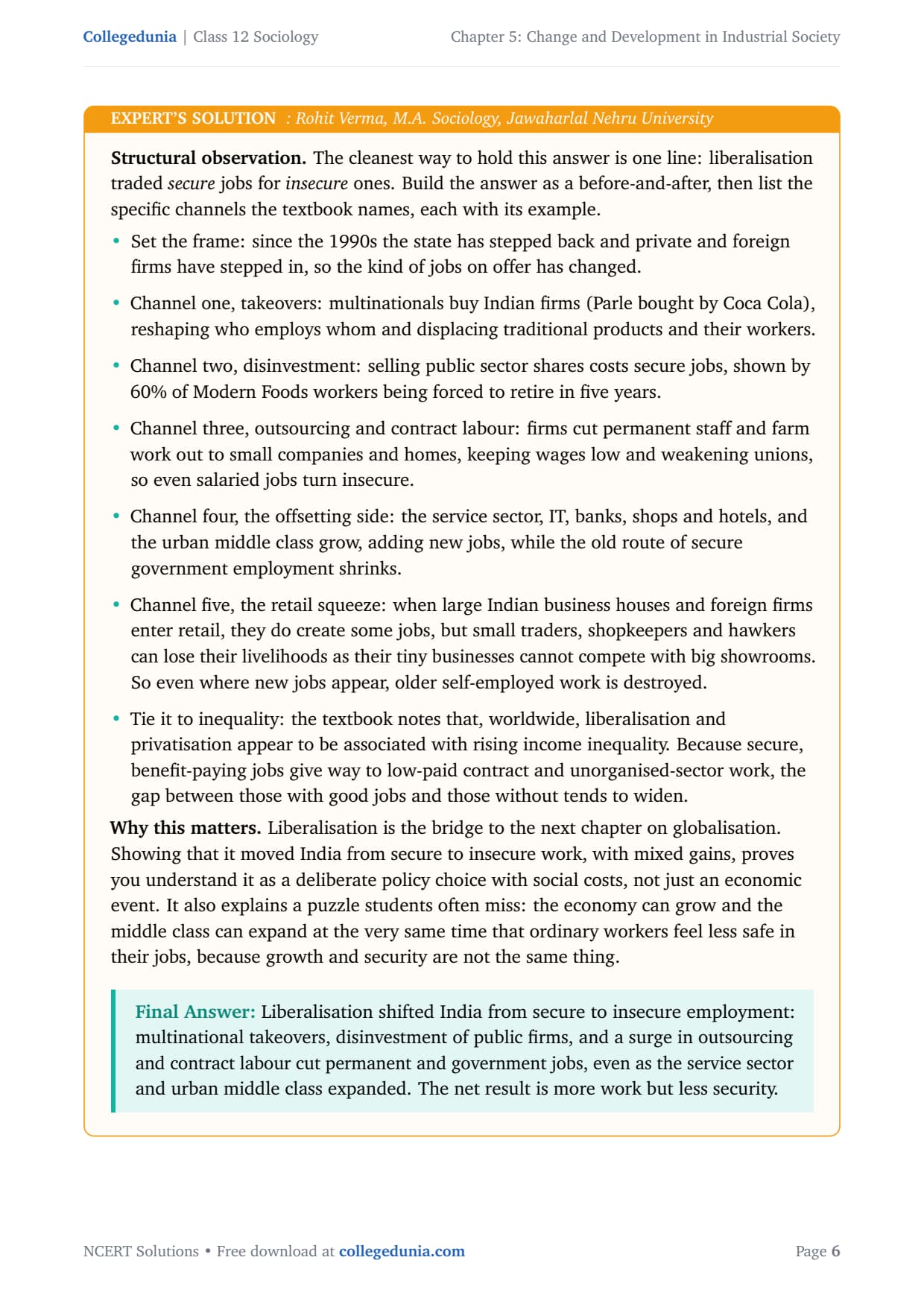
How has liberalisation affected employment patterns in India?
FAQs on Change and Development in Industrial Society Class 12 NCERT Solutions
Change and Development in Industrial Society Class 12 Sociology Common Questions
Ques. Where can I get the class 12 sociology chapter 5 NCERT Solutions PDF?
Ans. You can download the Change and Development in Industrial Society Class 12 Sociology NCERT Solutions PDF directly from this page. It is free, follows the 2026-27 NCERT, and answers both exercise questions point by point.
Ques. How many questions are there in Change and Development in Industrial Society class 12 questions and answers?
Ans. The chapter has 2 exercise questions. The first asks you to choose and describe an occupation under four headings, and the second asks how liberalisation has affected employment patterns in India.
Ques. What is the difference between the organised and unorganised sectors?
Ans. The organised sector has registered units with ten or more workers, fixed salaries, pensions and job security. The unorganised sector covers small, often home-based or piece-rated work with no security, and it holds over 90% of all Indian workers.
Ques. How has liberalisation affected employment in India?
Ans. Liberalisation since the 1990s opened India to private and foreign firms, leading to multinational takeovers like Parle by Coca Cola, disinvestment that cost public sector jobs, and a rise in outsourcing and contract labour. The service sector grew, but secure permanent and government jobs declined.
Ques. What does alienation mean in this chapter?
Ans. Alienation is when people do not enjoy their work and see it only as a way to survive. On a fast, mechanised assembly line a worker repeats one small task and never sees the finished product as their own, which is the textbook's main example of alienated labour.
Ques. Is class 12 sociology chapter 5 easy to score in the board exam?
Ans. Yes. It is a high-scoring chapter if you keep the two sectors straight and remember the liberalisation examples. Practise the four-heading occupation answer and a clear before-and-after for liberalisation, and the long questions become easy marks.



Comments