




The Class 12 Maths NCERT Exemplar Solutions (2026-27 syllabus) give you worked-out answers to every MCQ, MCQ-II, VSA, SA, and LA problem in the NCERT Exemplar Problems book. Each chapter comes as a free PDF you can download.
Class 12 Maths NCERT Exemplar Solutions PDF Download


Here is every chapter of the 2026-27 Class 12 Maths NCERT Exemplar. Each row links the worked-solutions PDF for that chapter.
The step-by-step working is what a JEE or CUET aspirant needs to solve the harder Exemplar problems.
- Chapters covered: 13 chapters, identical numbering to the main NCERT textbook
- Format: chapter-wise PDFs with one worked solution per Exemplar problem
- Question coverage: every MCQ, MCQ-II, VSA, SA, and LA problem from the official NCERT Exemplar publication
- Exam alignment: CBSE Class 12 Maths theory paper (80 marks), JEE Main, JEE Advanced, and CUET-UG Mathematics
Subject experts write every solution here. Each one is mapped to the 2026-27 NCERT Exemplar and matches the JEE and CUET-style working that examiners reward.
How will Collegedunia's Class 12 Maths NCERT Exemplar Solutions Help You?
The Exemplar Solutions take you past the NCERT back-exercise. They cover the deeper concepts that competitive exams test. Use them after the back-exercise and before mock tests. They fill the gap between board-level practice and competitive-exam readiness.
- Every Exemplar problem worked end to end: MCQ, MCQ-II (multi-correct), VSA, SA, and LA - every question in the official NCERT Exemplar publication carries a worked solution.
- 2026-27 NCERT Exemplar alignment: every solution matches the latest Exemplar print; rationalised content is flagged with an inline callout.
- Two-tab Solution format: a short Solution showing the minimum working a board examiner expects, plus an expanded Expert's Solution showing the longer, competitive-exam-style reasoning.
- Alternative methods shown: wherever a problem admits more than one approach, both methods are sketched so you can pick the one that matches your working style.
- Cross-resource navigation: jump from any Exemplar Solution into the same chapter's Notes, NCERT Solutions, Formula Sheet, or Handwritten Notes in one click.
- Verified by subject experts: every solution reviewed against the official Exemplar key and the latest JEE / CUET marking patterns.
What 16,420 students told us about their Class 12 Maths Exemplar Solutions usage
Source: Magnet Brains on YouTube
Class 12 Maths NCERT Exemplar Solutions Topic Map (Coverage)
How the 13 Exemplar chapters group into the CBSE units below. The Exemplar Solutions cover every problem in the source Exemplar publication, in NCERT order.
| Unit | Chapters | What this unit Exemplar Solutions cover |
|---|---|---|
| I. Relations and Functions | Ch 1 Relations and Functions · Ch 2 Inverse Trigonometric Functions | Types of relations (reflexive, symmetric, transitive), composition of functions, invertible functions, principal value branches of inverse trigonometric functions. |
| II. Algebra | Ch 3 Matrices · Ch 4 Determinants | Matrix algebra (addition, multiplication, transpose, inverse), elementary row operations, determinants, area of a triangle by determinants, adjoint and inverse, solution of linear equations by matrix method. |
| III. Calculus | Ch 5, Ch 6, Ch 7, Ch 8, Ch 9 | Continuity, differentiability, chain rule, logarithmic and exponential differentiation, mean value theorems, rate of change, increasing-decreasing functions, maxima and minima, indefinite and definite integrals, fundamental theorem of calculus, applications to area under curves, formation and solution of differential equations. |
| IV. Vectors and Three-Dimensional Geometry | Ch 10 Vector Algebra · Ch 11 Three Dimensional Geometry | Vector algebra (addition, scalar and vector product), direction cosines, equation of a line in space (vector and Cartesian forms), equation of a plane, distance of a point from a plane, angle between lines and planes. |
| V. Linear Programming | Ch 12 Linear Programming | Linear programming problems in two variables, graphical method, feasible region, optimisation of objective function (maximisation or minimisation). |
| VI. Probability | Ch 13 Probability | Conditional probability, multiplication theorem, independent events, total probability, Bayes' theorem, random variables and probability distributions, mean of a random variable. |
NCERT Class 12 Maths Deleted Syllabus 2026-27
NCERT trimmed the 2026-27 Class 12 Maths syllabus to cut the content load for CBSE Boards, JEE Main and JEE Advanced. The topics below are officially out of the 2026-27 question paper. Skip them while revising.
| Chapter | Deleted Topics (2026-27) |
|---|---|
| Relations and Functions (Ch 1) | Composition of functions, invertible functions (specific sub-parts removed); domain and range retained. |
| Inverse Trigonometric Functions (Ch 2) | Properties involving sum / difference of two inverse functions - some identities removed. |
| Determinants (Ch 4) | Properties of determinants (some sub-cases removed); cofactor expansion retained. |
| Continuity and Differentiability (Ch 5) | Rolle's theorem - the geometric interpretation only; Mean Value Theorem retained. |
| Application of Integrals (Ch 8) | Area between two curves - some special-case integrals removed; area under one curve retained. |
| Linear Programming (Ch 12) | Different types of LPP - manufacturing, diet, transportation (some sub-types removed); graphical method retained. |
| Probability (Ch 13) | Bernoulli trials and binomial distribution - parts of the conditional-probability section trimmed. |
The chapter-wise resources in the All Chapters index above already flag every deleted line inline, so you don't waste revision hours on dropped topics.
Class 12 Maths Chapter-wise Important Questions
The five chapter clusters below cover most of the CBSE 2026 Class 12 Maths paper and repeat almost every year. The first column lists the long-answer topics that come up as 3-mark and 5-mark questions. The second column lists the application questions that appear as 1-3 mark numericals, MCQs and case-studies in CBSE and JEE Main.
| Chapter Cluster | Important Derivations / Theorems (3-5 marks) | Important Application Problems (1-3 marks) |
|---|---|---|
| Relations, Functions and Inverse Trig (Ch 1-2) | 1. Composition of functions and one-one onto proof. 2. Properties of inverse trigonometric functions. 3. Derivation of principal-value branches. | Domain and range of inverse trig, simplification of complex inverse-trig expressions. |
| Matrices, Determinants and System of Equations (Ch 3-4) | 1. Properties of determinants - row / column operations. 2. Inverse of a matrix via adjoint method. 3. Cramer's rule for system of equations. | Determinant evaluation, finding inverse, area of triangle using determinant. |
| Calculus - Continuity, Derivatives and Integrals (Ch 5-9) | 1. Rolle's theorem and Mean Value Theorem. 2. Integration by parts and partial fractions. 3. Definite integral as area under a curve - first principles. | Maxima-minima word problems, area between curves, differential equations of homogeneous type. |
| Vectors and 3D Geometry (Ch 10-11) | 1. Scalar triple product geometric interpretation. 2. Equation of a plane in three forms. 3. Shortest distance between two skew lines derivation. | Cross product magnitude, angle between line and plane, foot of perpendicular from a point. |
| Linear Programming and Probability (Ch 12-13) | 1. Graphical solution of LPP with feasible region. 2. Bayes' theorem derivation. 3. Binomial distribution mean and variance. | Optimisation of profit / cost function, conditional probability tree, expected value calculation. |
The same five clusters appear in JEE Main 2026 with almost the same split. Calculus alone gives 8-10 of the 25 JEE Main Maths questions every cycle. The Expert's Solution tab on each chapter page shows the JEE-style method next to the CBSE board-style minimum-steps version.
EXEMPLAR SOLUTIONS · CLASS 12 MATHS
Class 12 Maths - Exam Weightage
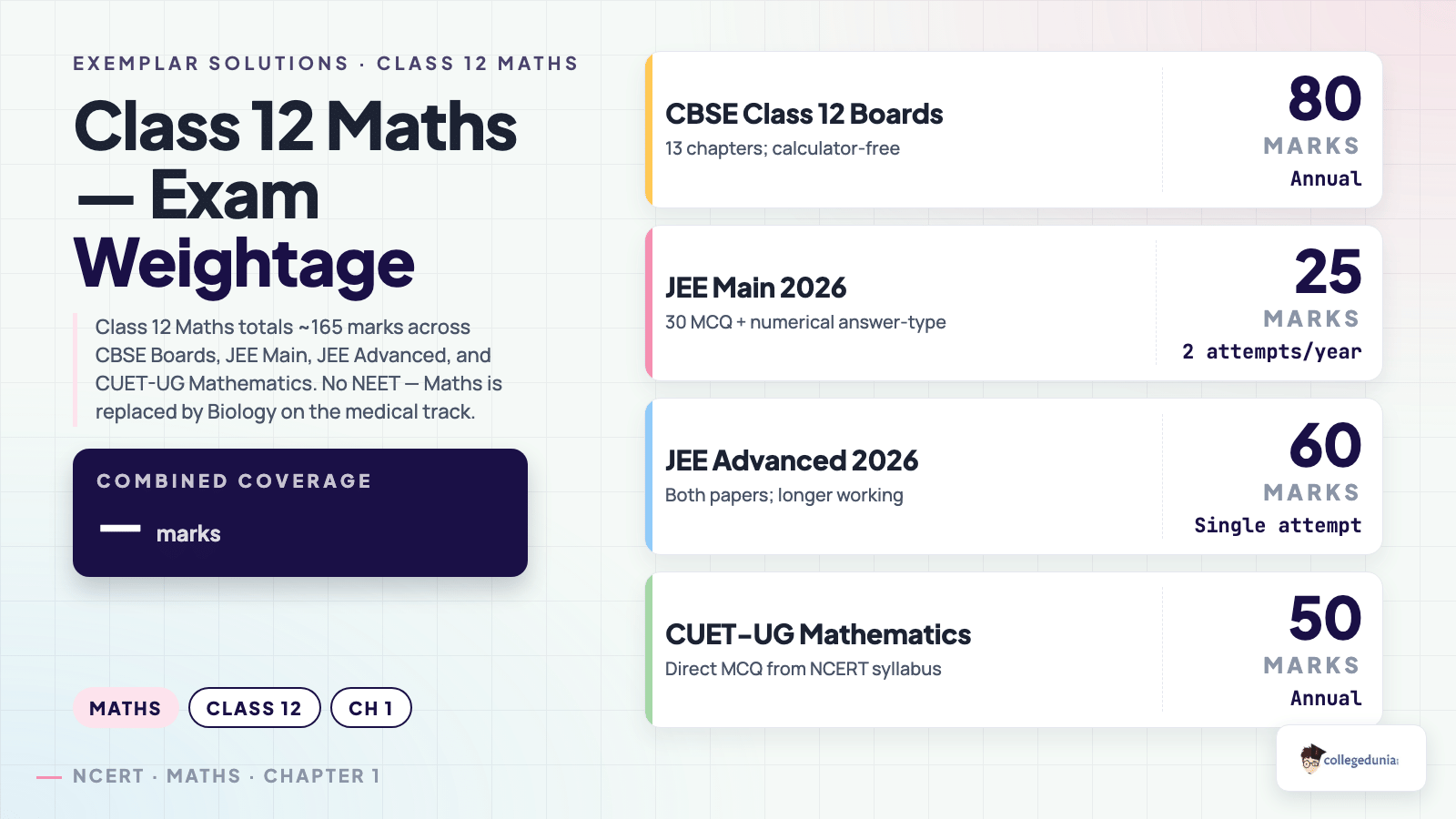
Class 12 Maths is worth about 240 marks combined across CBSE Boards, JEE Main and JEE Advanced. Maths is not tested in NEET, but it is the single largest engineering-entrance scoring block.
Class 12 Maths Weightage Snapshot (CBSE 2026 Theory Paper)
Put more Exemplar effort into the chapters that carry more marks. Calculus gives 35 marks of the 80-mark paper. Most of the harder Exemplar problems sit here too.
| Unit | Chapters | CBSE Marks (2026) | JEE Main 2025 Qs |
|---|---|---|---|
| Calculus | Ch 5, 6, 7, 8, 9 | 35 marks | 8-10 |
| Vectors and 3D Geometry | Ch 10, 11 | 14 marks | 3-4 |
| Algebra | Ch 3, 4 | 10 marks | 2-3 |
| Relations and Functions | Ch 1, 2 | 8 marks | 2 |
| Probability | Ch 13 | 8 marks | 1-2 |
| Linear Programming | Ch 12 | 5 marks | 0-1 |
Class 12 Maths CBSE 2026 Paper Pattern Snapshot
The 80-mark CBSE Class 12 Maths theory paper runs 3 hours and has five sections. Knowing the weight of each section is half the revision plan. Once you know which section a chapter feeds, you can pick the right resource. Use Notes for Section A recall and NCERT Solutions for the Section C and D working.
- Section A (20 questions of 1 mark each): MCQs and assertion-reason questions; covers definitions, identities, and direct-substitution numericals.
- Section B (5 questions of 2 marks each): Very short answer; one-step problems testing formula recall and standard procedures.
- Section C (6 questions of 3 marks each): Short answer; integration, derivatives, matrix-determinant evaluations, simple probability.
- Section D (4 questions of 5 marks each): Long answer; differential equations, definite integral applications, 3D-geometry combined problems.
- Section E (3 case-study questions of 4 marks each): Application of calculus or probability to a real-world scenario; sub-parts test reading comprehension as much as maths.
The 80-mark theory paper plus the 20-mark internal assessment (practical, project, viva) makes the 100-mark scheme. You earn the internal marks through a complete lab notebook and good viva prep. The theory paper is where your chapter-wise NCERT work actually shows.
Where to Start with Class 12 Maths NCERT Exemplar Solutions
Start with the six high-weightage chapters. Exemplar practice here gives you the biggest boost in competitive exams. Together these six chapters cover 62 of 80 board marks:
- Chapter 7, Integrals (part of the 35-mark Calculus block): the largest single chapter in the syllabus. Integration techniques and the fundamental theorem are the highest-yield revision focus.
- Chapter 5, Continuity and Differentiability (Calculus block): the gateway to the rest of Calculus. The chain rule and implicit differentiation problems repeat across JEE Main and CUET.
- Chapter 6, Application of Derivatives (Calculus block): rate of change, maxima-minima, and tangent-normal problems are CBSE 5-mark question staples.
- Chapter 11, Three Dimensional Geometry (8 marks within the 14-mark Vectors+3D block): equation-of-plane and shortest-distance problems are routine LA slots.
- Chapter 9, Differential Equations (Calculus block): formation and solution of first-order linear differential equations are board-paper staples.
- Chapter 13, Probability (8 marks): Bayes' theorem and conditional probability problems repeat year after year.
Class 12 Maths NCERT Exemplar Solutions PDF Formats
- HD print-ready PDF: high-resolution typesetting for the printed problem-and-solution booklet.
- Standard download PDF: smaller file size for phone reading.
- Hindi-medium Exemplar Solutions PDF: chapter-wise Hindi translations using NCERT's own technical vocabulary (Ganit).
- Combined all-chapters PDF: one file with every chapter's Exemplar Solutions back to back.
- MCQ key + worked solutions: the MCQ key sits at the front of each chapter's PDF for quick verification, with the full worked solutions following.
How Class 12 Maths NCERT Exemplar Solutions Pair with the Other Resources
- Class 12 Maths Exemplar Book PDF: the source problem set; open this alongside the Solutions for the question text.
- Class 12 Maths NCERT Solutions: the back-exercise worked answers; finish these first before opening the Exemplar.
- Class 12 Maths Notes: the concept layer; revisit whenever an Exemplar problem reveals a concept gap.
- Class 12 Maths Formula Sheet: keep this open while attempting Exemplar problems so formula recall is one glance away.
- Class 12 Maths NCERT Book PDF: the main textbook; cross-check derivations when an Exemplar problem references a textbook result.
- Class 12 Maths Handwritten Notes: notebook-style revision between Exemplar problem-solving sessions.
How to Use the Class 12 Maths NCERT Exemplar Solutions Most Effectively
5-STEP METHOD · CBSE TOPPER ROUTINE
How to Use the Exemplar Solutions - Class 12 Maths
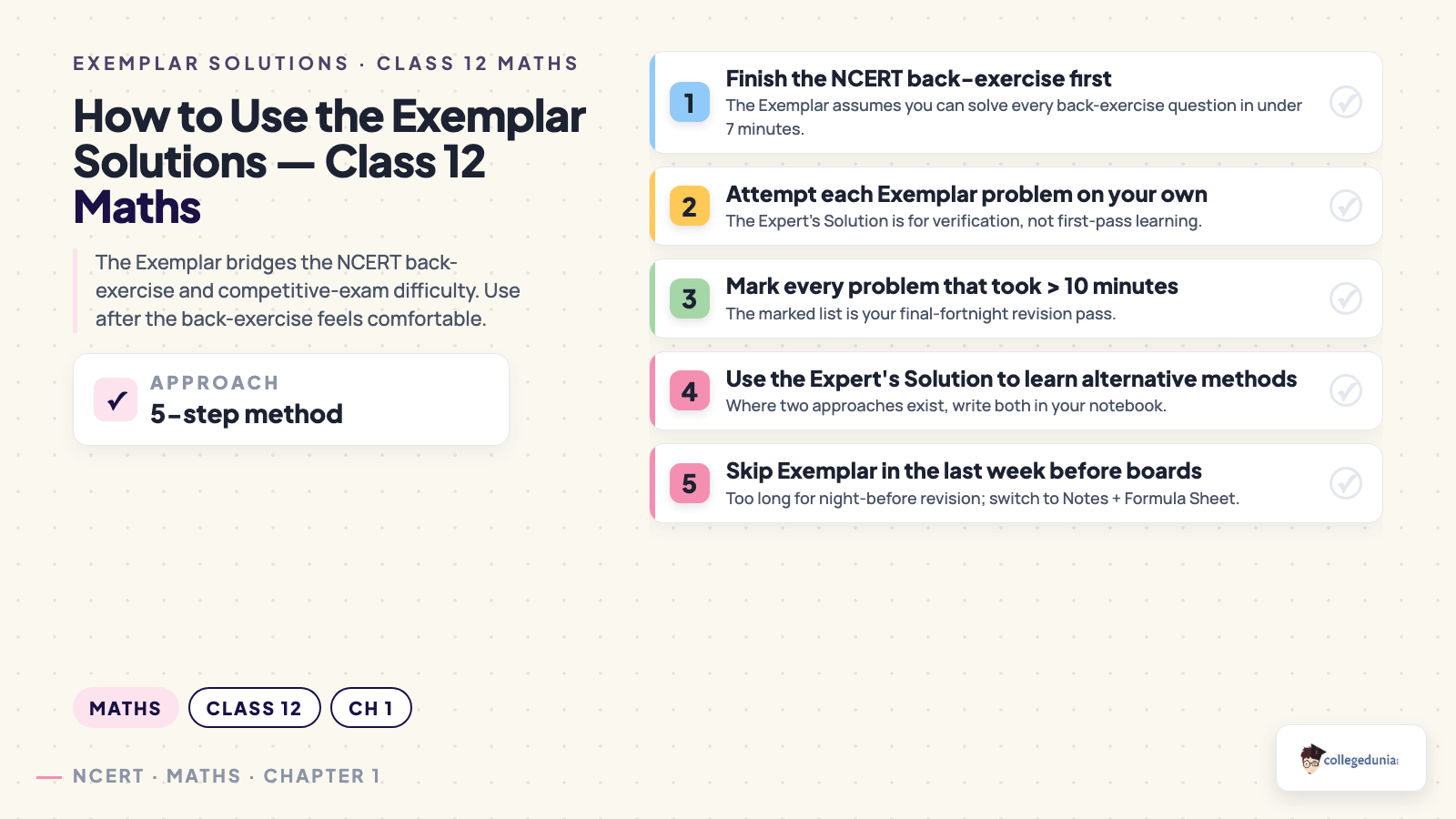
- 1Read the chapter first. Open the NCERT Book PDF or chapter Notes first. These solutions expect you to know the concepts already.
- 2Attempt each question on your own. Write the working in a notebook before you open the answer. Just reading the answer does not build exam speed.
- 3Compare your working to the resource. Mark every step where your method was different. Those are the spots that lose marks on the board paper.
- 4Flag questions taking over 7 minutes. These go on the re-attempt list for the final-week revision pass.
- 5Mark every question that took over 10 minutes. Give these a third pass in the final week. Exemplar problems repeat ideas, so the slow ones today become quick ones two weeks later.
- After each chapter's back-exercise: attempt the Exemplar problems on your own first, then compare your working against the Solutions.
- Within 2 months of JEE / CUET: work every SA and LA Exemplar problem of the high-weightage chapters. Use the Expert's Solution tab for the longer working.
- 1 month before the boards: go back to the problems you marked as hard and check them against the Solutions again.
- Skip in the final week: Exemplar Solutions are too long for night-before revision. Switch to the Notes and Formula Sheet at that point.
Common Mistakes Class 12 Maths Students Make with NCERT Exemplar Solutions
- Sign errors in integration by parts: Chapter 7 students forget the alternating sign in the LIATE-based formula. Write the formula out in full before substituting.
- Confusing maxima vs minima at the second-derivative test: Chapter 6 students mix up the sign rule. A maximum is where the second derivative is negative. A minimum is where it is positive.
- Forgetting the +c on indefinite integrals: CBSE cuts a half-mark for each missing constant of integration. Carry it through every step.
- Computing matrix products in the wrong order: Matrix multiplication does not work in any order. A times B is usually not the same as B times A. Chapter 3 problems test this often.
- Treating Bayes' theorem as a single formula instead of a conditional setup: Chapter 13 students often jump to the formula without first writing the prior and the likelihood. Show the sample space first.
- Direction cosines vs direction ratios in 3D Geometry: Chapter 11 problems test this difference. Direction cosines are the cosines of the angles with the axes. Direction ratios are any scalar multiple of those. Mixing them up costs marks.
Student Feedback: What 16,420 Class 12 Maths Students Told Us
What 16,420 students told us about their Class 12 Maths Exemplar Solutions usage
- 71% of students rated Chapter 7 Integrals as the highest-effort chapter, ahead of Chapter 11 Three Dimensional Geometry at 58% and Chapter 6 Application of Derivatives at 52%.
- Most-skipped chapter: Chapter 12 Linear Programming (skipped by about 24% of students, even though it carries 5 marks). Toppers said this is an easy chapter to get back, because the graphical-method problems become routine once you practise them.
- Toppers said that working the Expert's Solution tab on every Chapter 7 Integrals problem added 5-7 marks to their 80-mark score. Most of that came from faster integration recall.
- The average Class 12 Maths student spent 58 hours across the 13 chapters to finish the NCERT back-exercise once. Chapters 5, 6, 7 and 11 took the most time per question.
Also Check: Related Class 12 Maths Resources
- Also Check: CBSE Class 12 Maths chapter notes hub on Collegedunia Exams
- Also Check: CBSE Class 12 exam pattern, dates, and full-subject hub
- Also Check: CBSE Class 12 Syllabus 2026-27
- Also Check: JEE Main 2026 exam information
- Also Check: JEE Main 2026 Syllabus
- Also Check: JEE Advanced 2026 information
- Also Check: CUET-UG 2026 information
Topper-tested takeaways for Class 12 Maths Exemplar Solutions
- Try every Exemplar problem on your own first. Use the Solutions to check your work, not to learn the topic.
- When the Expert's Solution uses a different method, write both in your notebook side by side. Comparing them helps you remember the other approach.
- For JEE / CUET, do the SA and LA Exemplar Solutions of the high-weightage chapters first. The MCQ and MCQ-II sections come second.
- The Exemplar Solutions cover every problem in the Exemplar Book PDF. If a Solution is unclear, open the textbook's worked example for the same chapter.
Class 12 Maths Exemplar Solutions FAQs
Ques. Where can I download the Class 12 Maths Exemplar Solutions PDF?
Ans. Every chapter-wise Class 12 Maths Exemplar Solutions PDF is downloadable directly from the index above, from Chapter 1 Relations and Functions through Chapter 13 Probability. A combined all-chapters PDF is also linked. Both Normal and HD resolutions are free.
Ques. Is this Class 12 Maths Exemplar Solutions aligned with the 2026-27 NCERT?
Ans. Yes. Every chapter matches the current 2026-27 syllabus. Where NCERT dropped content from the older edition, those sections carry an inline callout. This way you do not waste time on dropped material.
Ques. How many chapters are there in Class 12 Maths per the 2026-27 NCERT?
Ans. Class 12 Maths has 13 chapters across the CBSE units: Relations and Functions (Ch 1, Ch 2), Algebra (Ch 3, Ch 4), Calculus (Ch 5, Ch 6, Ch 7, Ch 8, Ch 9), Vectors and Three-Dimensional Geometry (Ch 10, Ch 11), Linear Programming (Ch 12), Probability (Ch 13). The Topic Map table above lists every chapter under its unit.
Ques. Which Class 12 Maths chapter has the highest CBSE board weightage?
Ans. Calculus is the heaviest unit at 35 marks. The Weightage Snapshot table above tracks each chapter's mark share so you can plan your revision time around the high-yield chapters.
Ques. How are these Class 12 Maths Exemplar Solutions different from the other Class 12 Maths resources?
Ans. Pair the Class 12 Maths Exemplar Solutions with the Exemplar Book PDF for the source problems and the Notes for a concept refresher. Each resource on Collegedunia covers the same chapters in a different format. Together they make a complete revision toolkit.
Ques. Are these Class 12 Maths Exemplar Solutions files available in Hindi medium?
Ans. Yes. Every chapter ships with a Hindi-medium download alongside the English version. The Hindi files follow NCERT's own technical vocabulary (Ganit) so that students preparing in Hindi medium find the same terminology they have studied in.
Ques. What does Class 12 Maths cover?
Ans. Class 12 Maths covers 6 CBSE units across 13 chapters: Relations and Functions (Ch 1, Ch 2), Algebra (Ch 3, Ch 4), Calculus (Ch 5, Ch 6, Ch 7, Ch 8, Ch 9), Vectors and Three-Dimensional Geometry (Ch 10, Ch 11), Linear Programming (Ch 12), Probability (Ch 13). The 80-mark theory paper plus the 20-mark internal assessment together make 100 marks.
Ques. Which is the most-scoring chapter in Class 12 Maths?
Ans. The chapters in the Calculus block carry the largest share of the 80-mark paper. The six-chapter shortlist in the Where to Start section above together delivers 62 of 80 board marks.
Ques. How should I structure my Class 12 Maths preparation?
Ans. Build chapter by chapter and start with the high-weightage units. Use the Notes for concepts, the NCERT Solutions for the back-exercise, the Exemplar for harder practice, and the Formula Sheet for the last week. The Study Plan section above shows the 1-month, 2-week and 1-week countdown that most toppers use.



Comments