




The Atomic Foundations of Matter Class 9 Science Handwritten Notes are a topper's own neat revision of Chapter 9 from the new Exploration textbook. Every idea, the two laws of chemical combination, Dalton's atomic theory, covalent and ionic bonds, the criss-cross method for formulae, and molecular and formula unit mass, is written by hand with each key rule boxed in the margin. You revise the whole 2026-27 chapter in one short sitting, just as you would set it out in the exam.
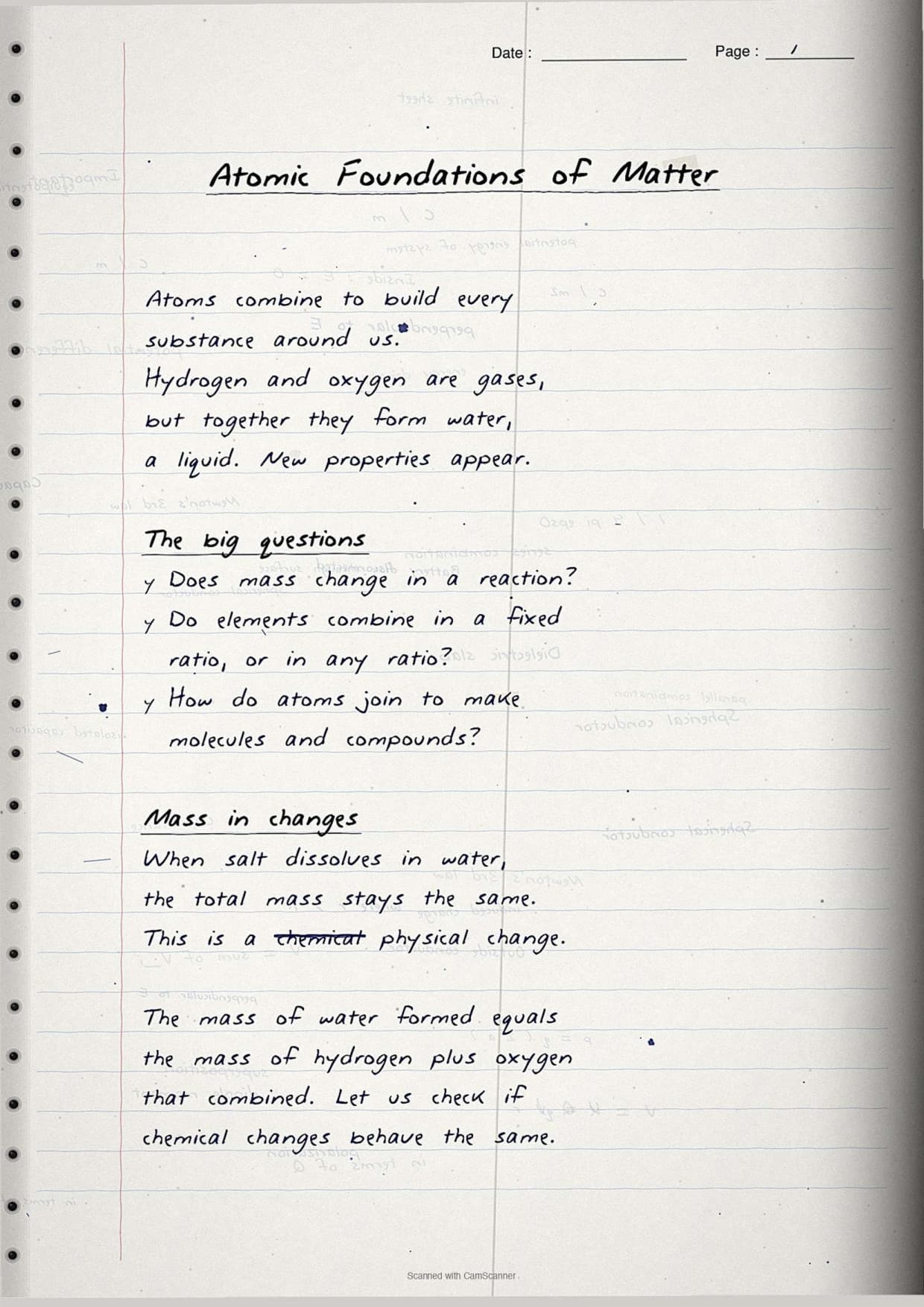
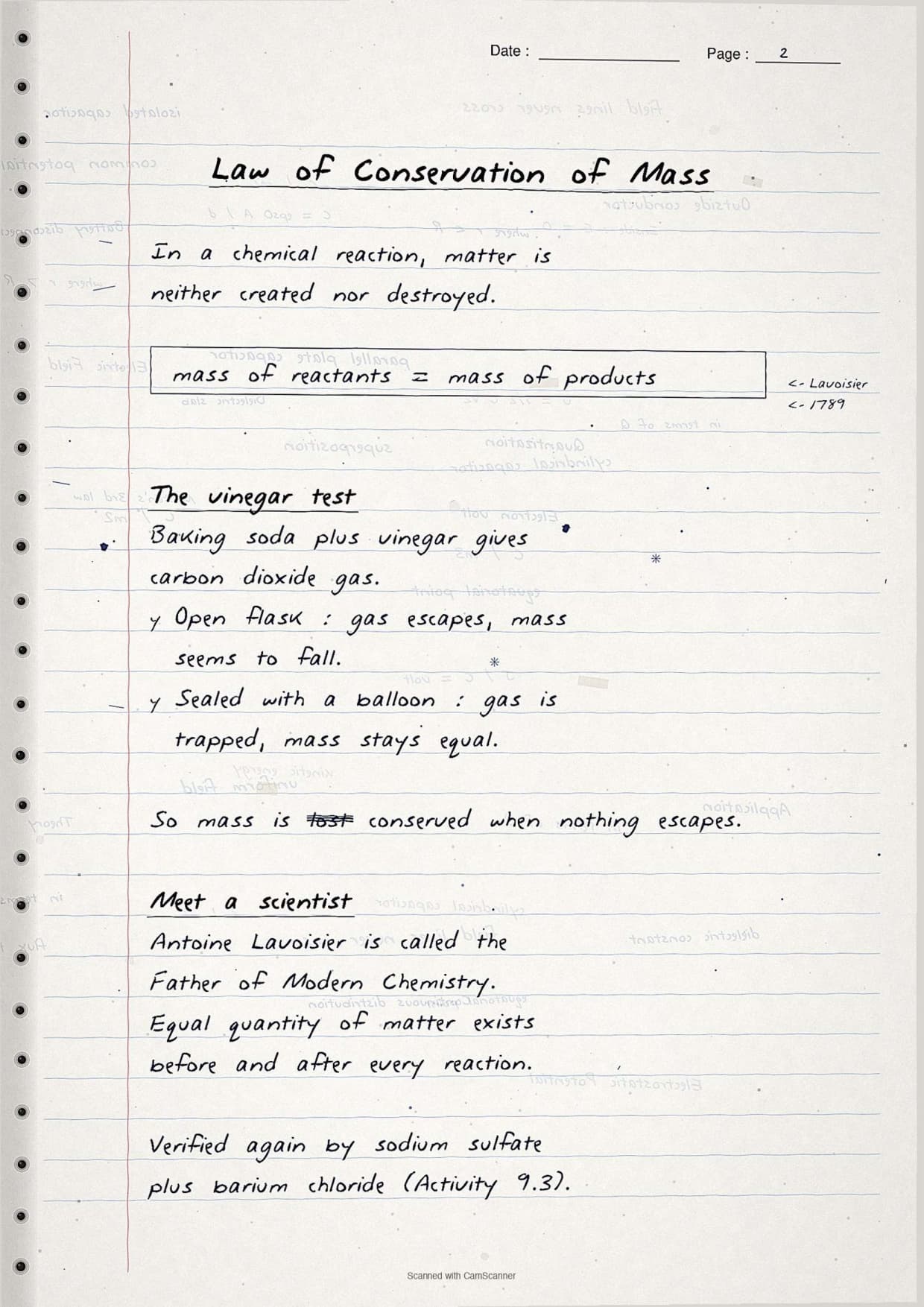
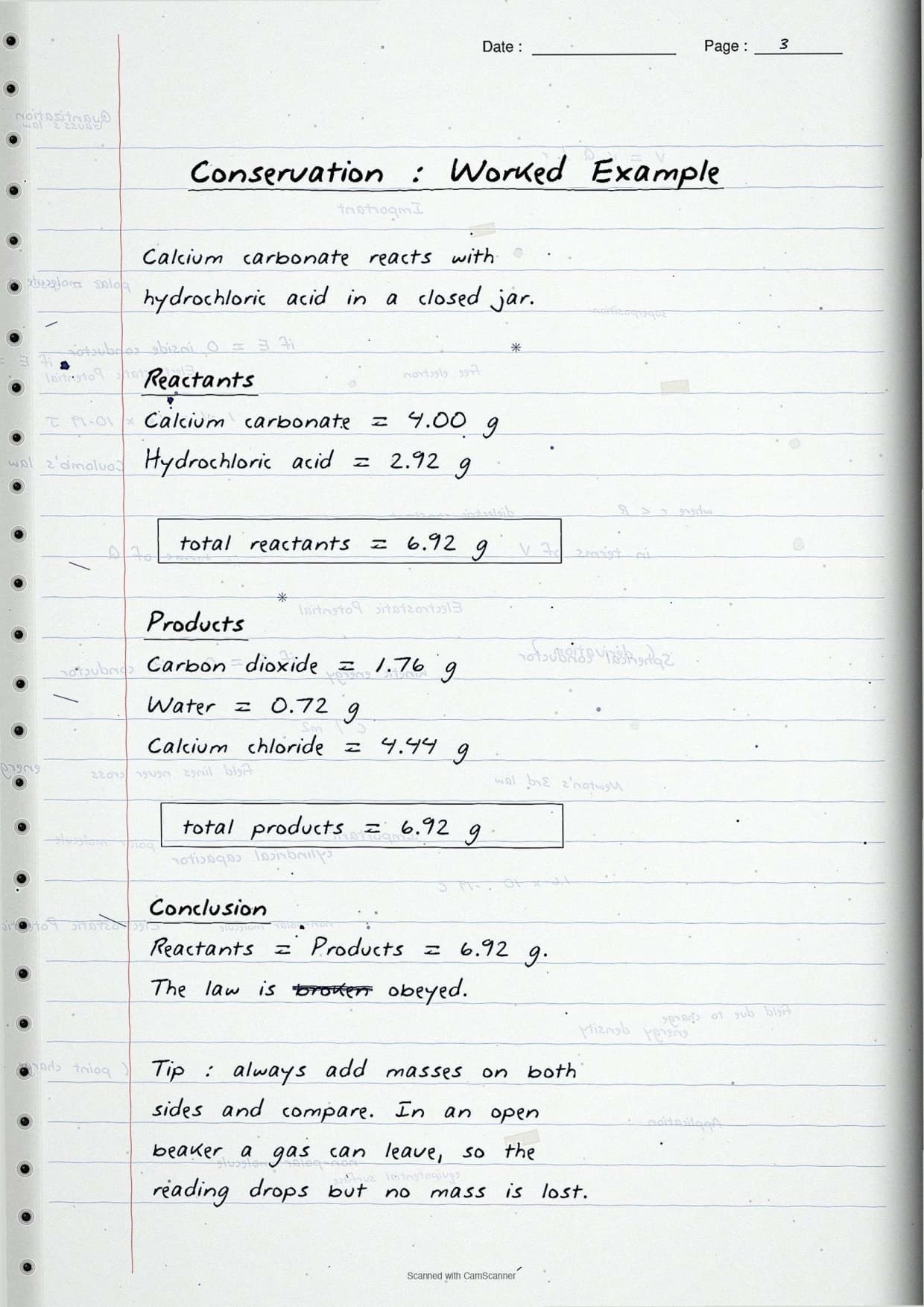
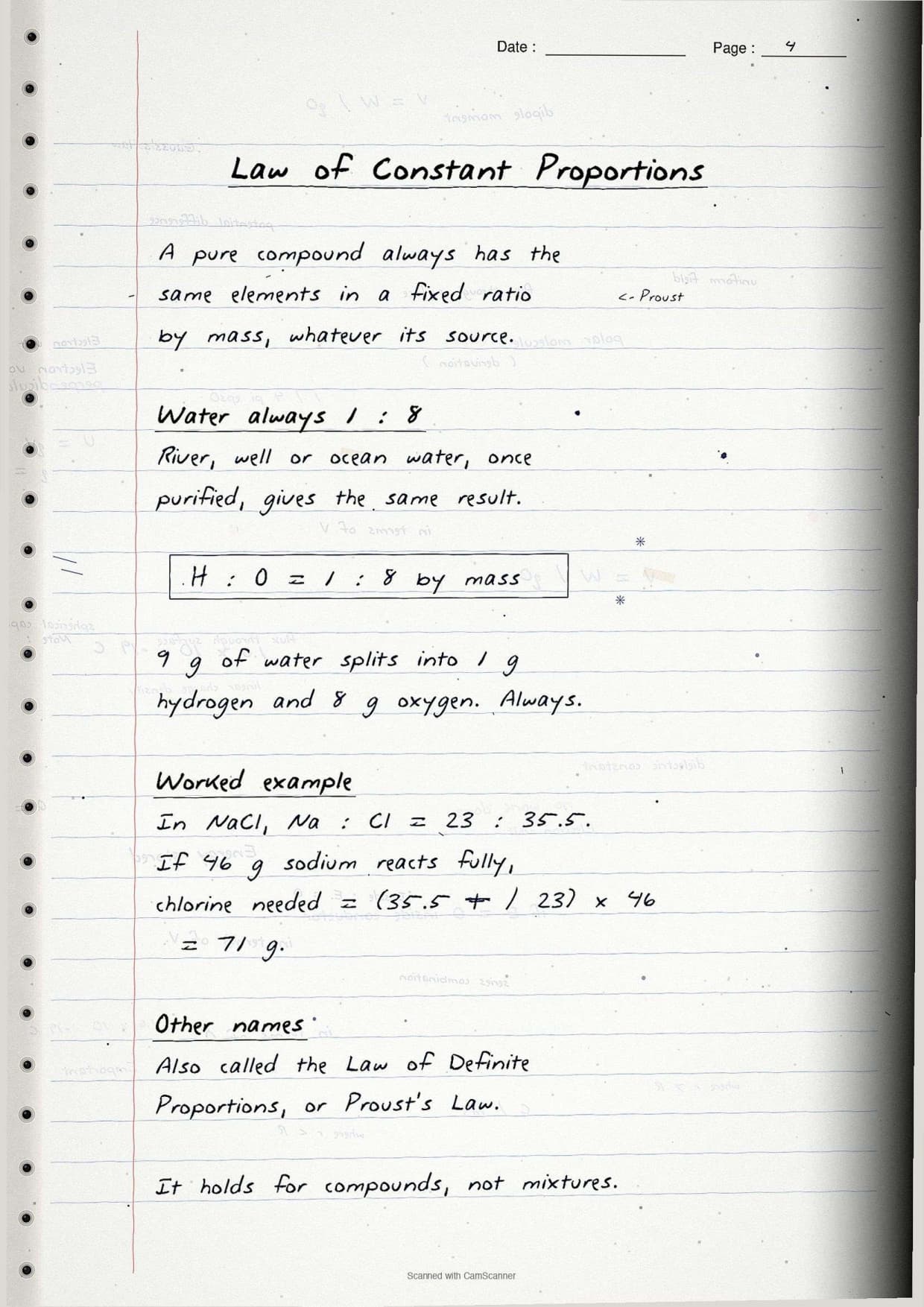
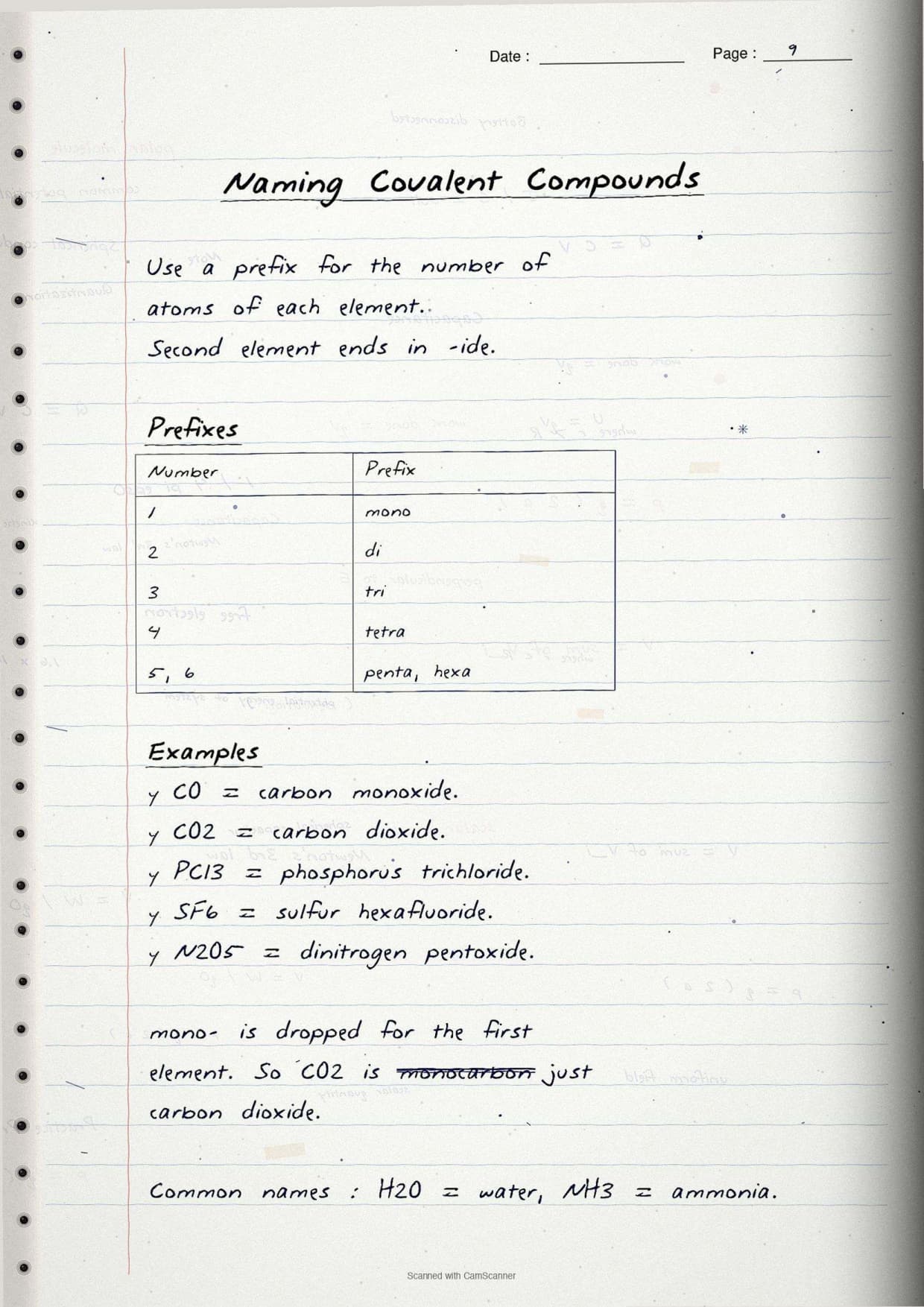
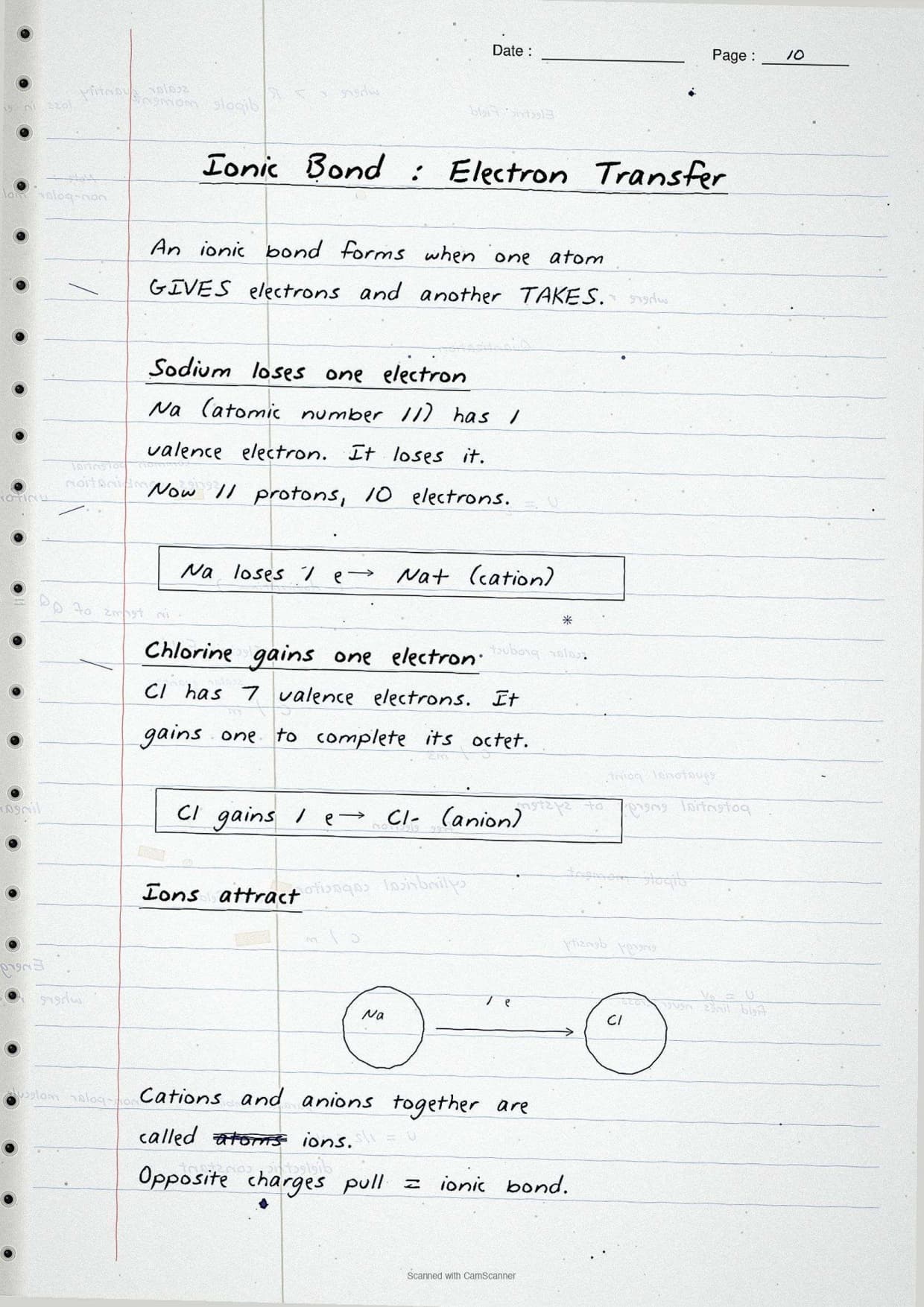
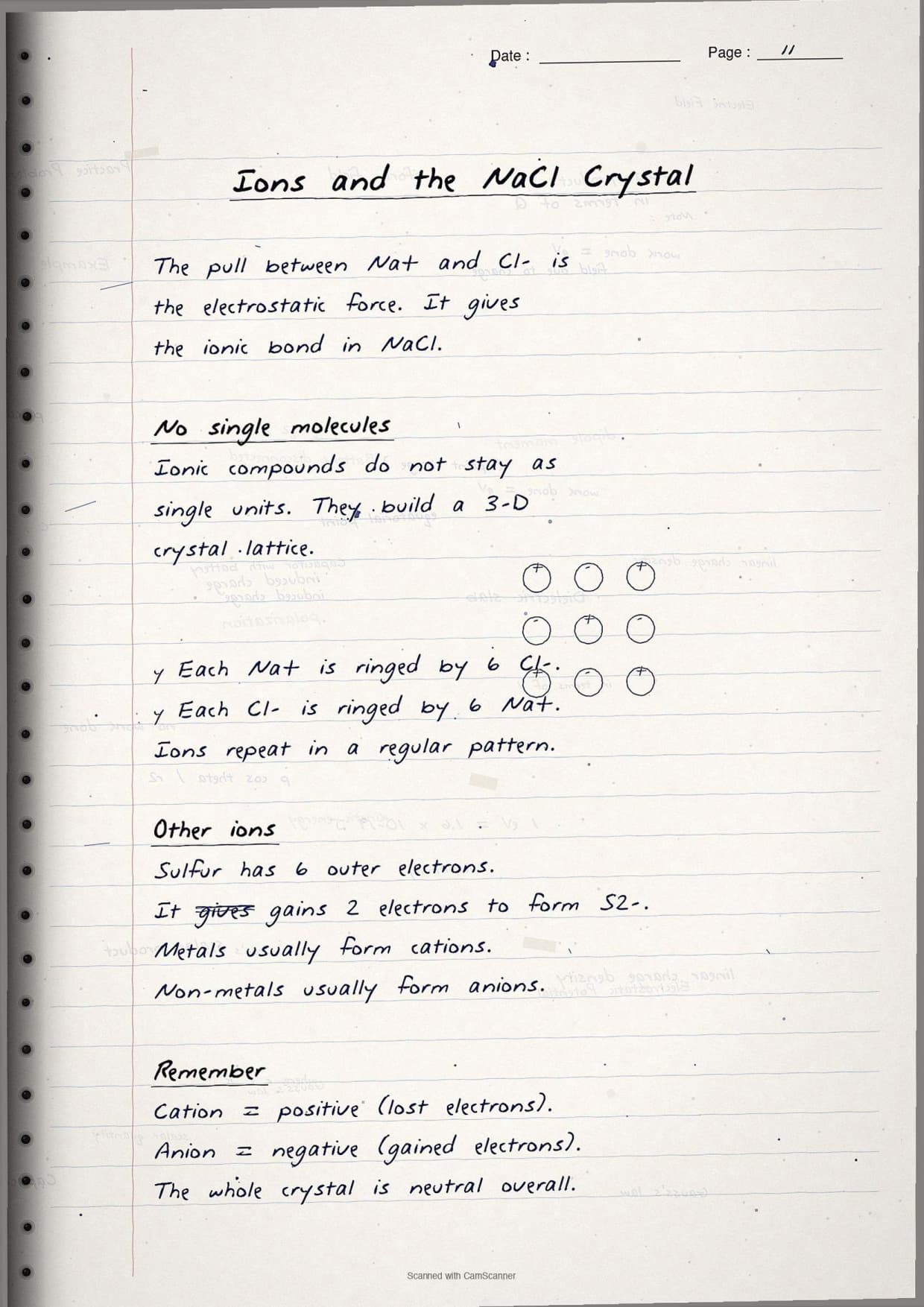
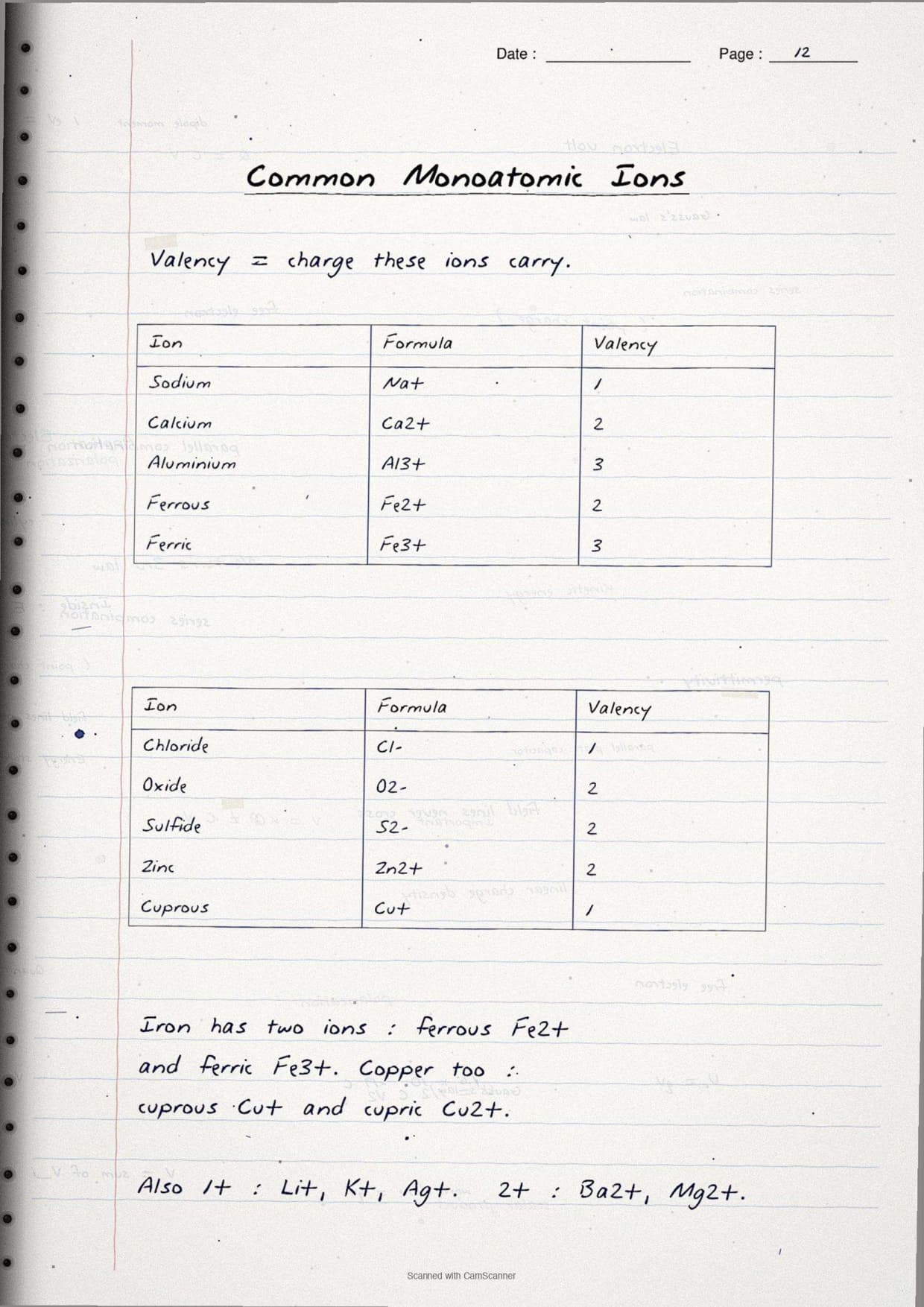
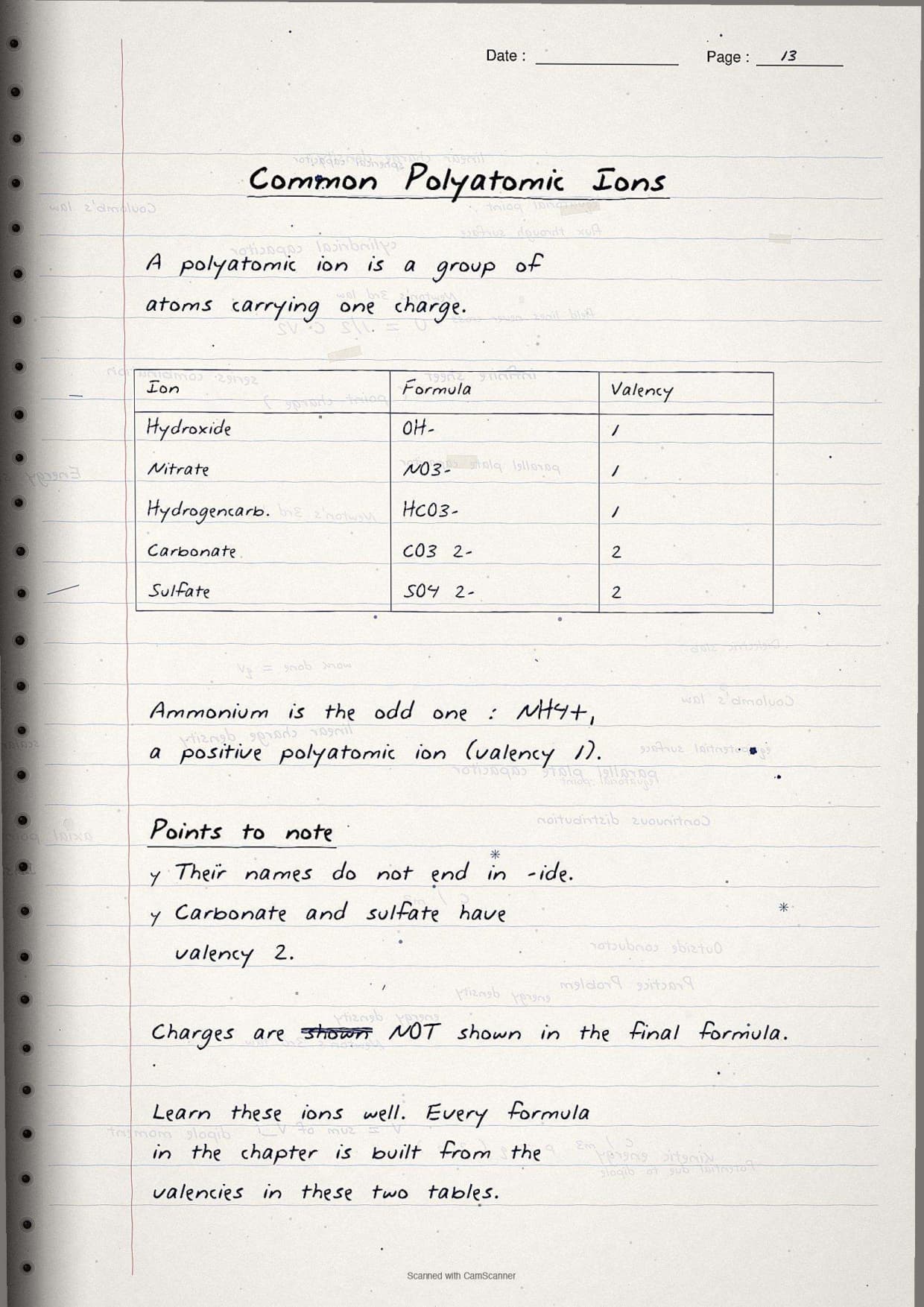
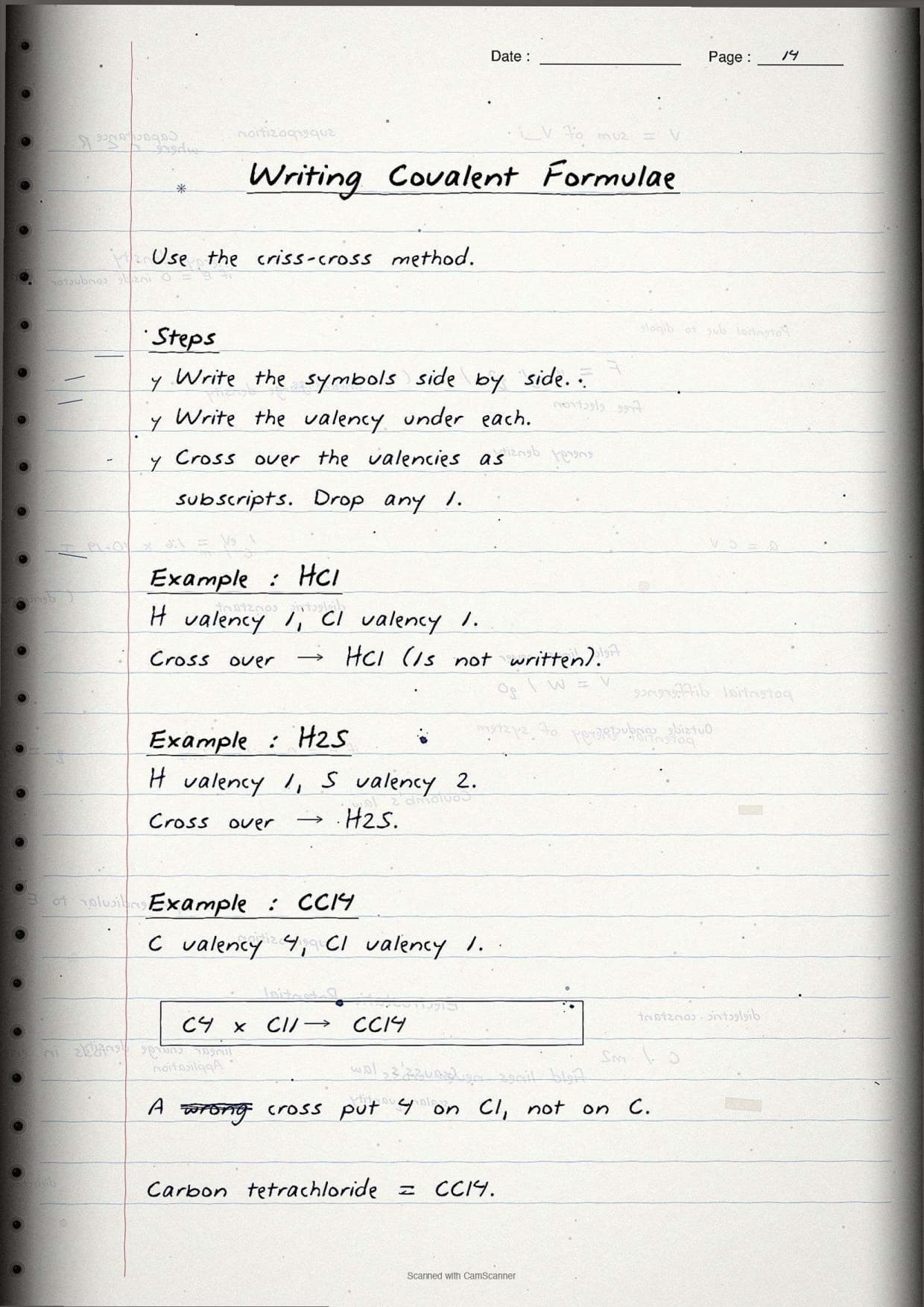
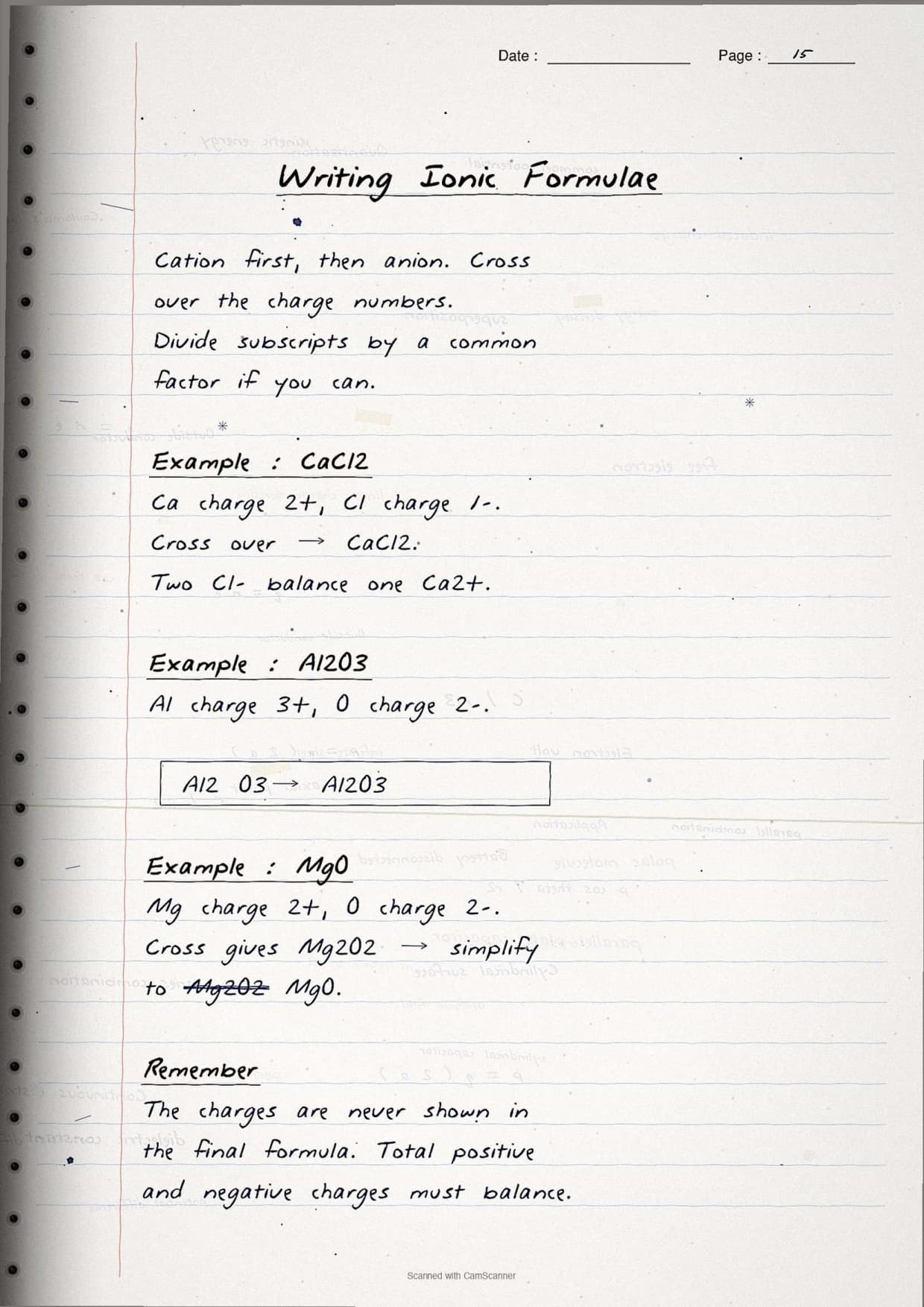
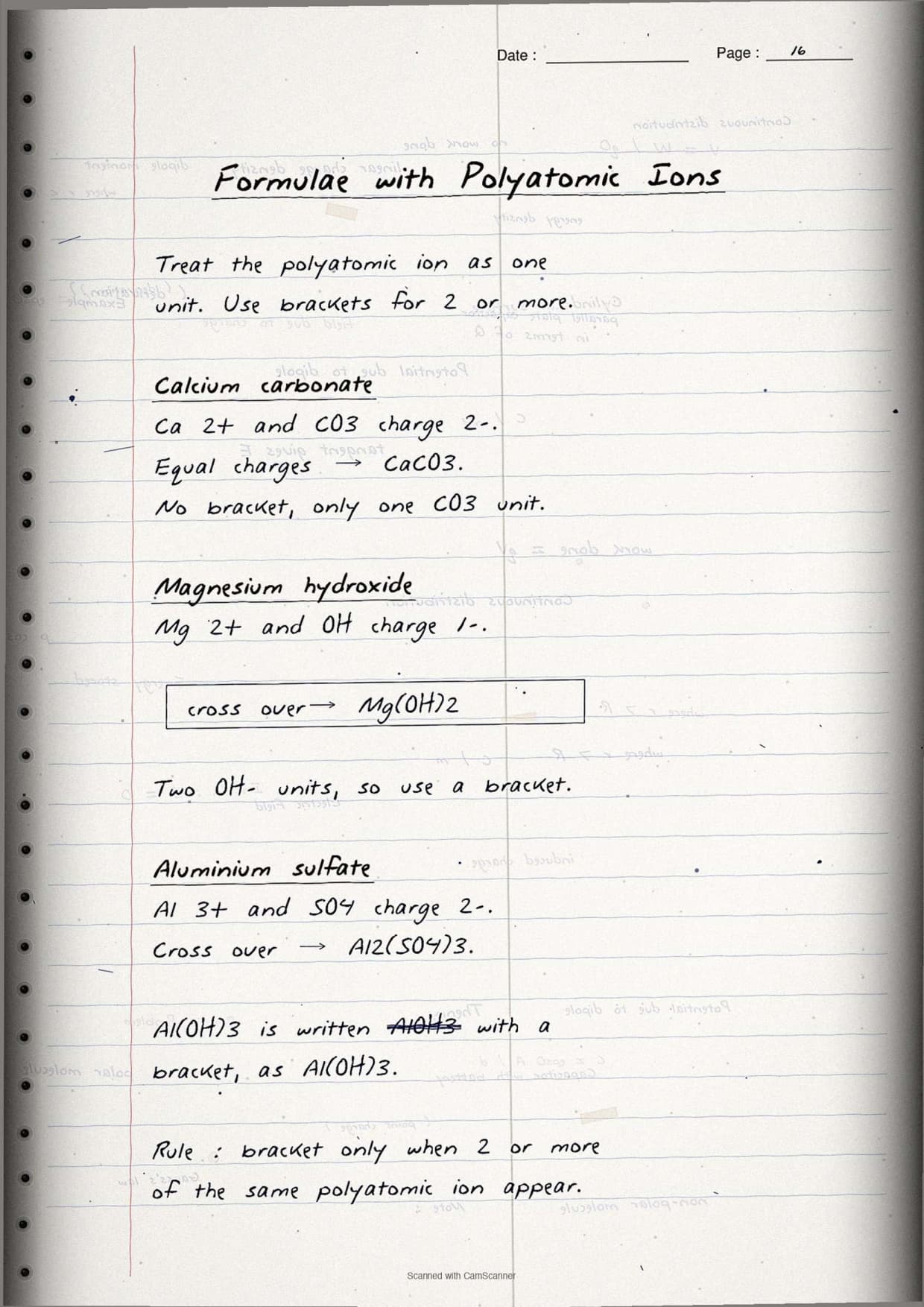
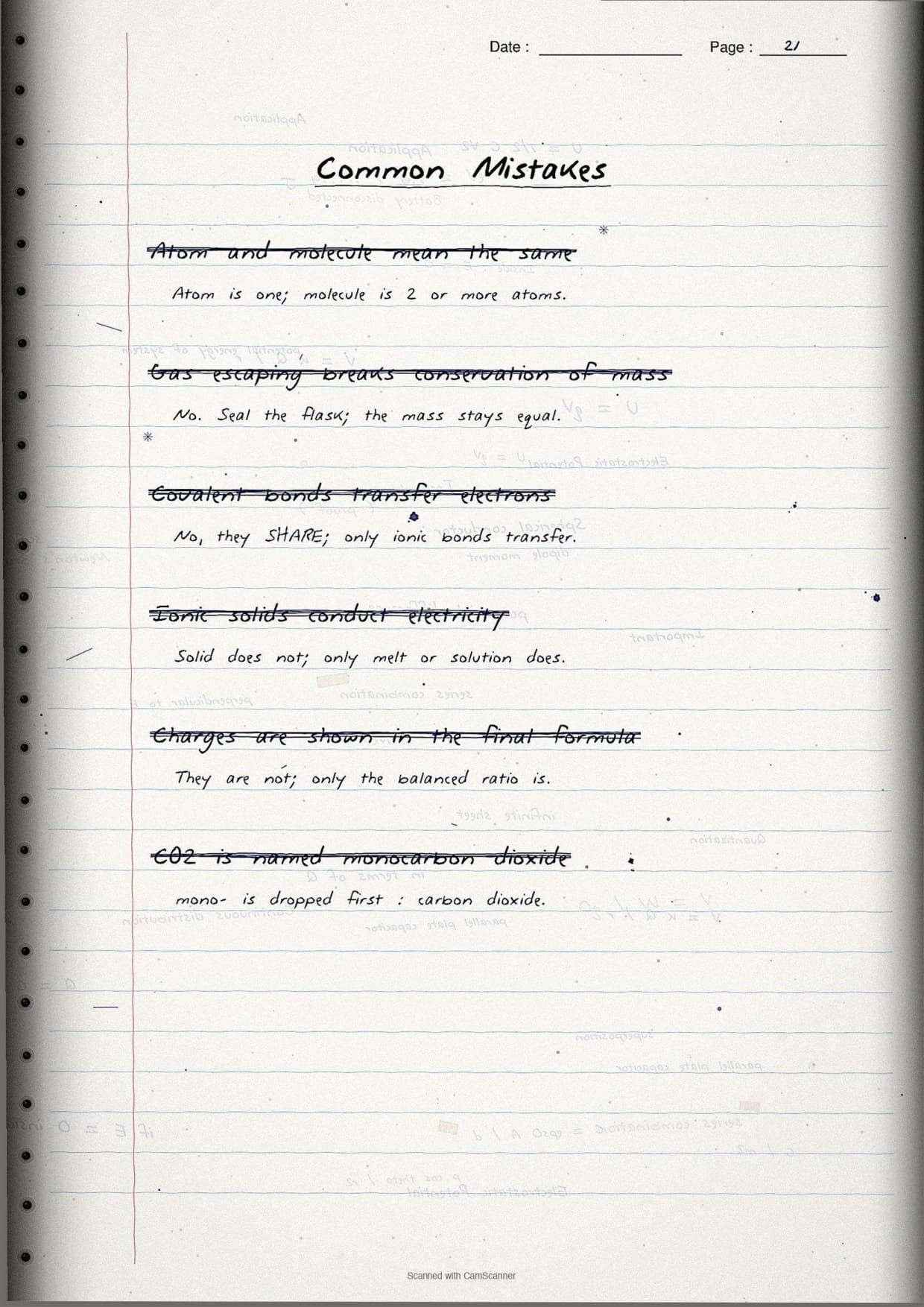
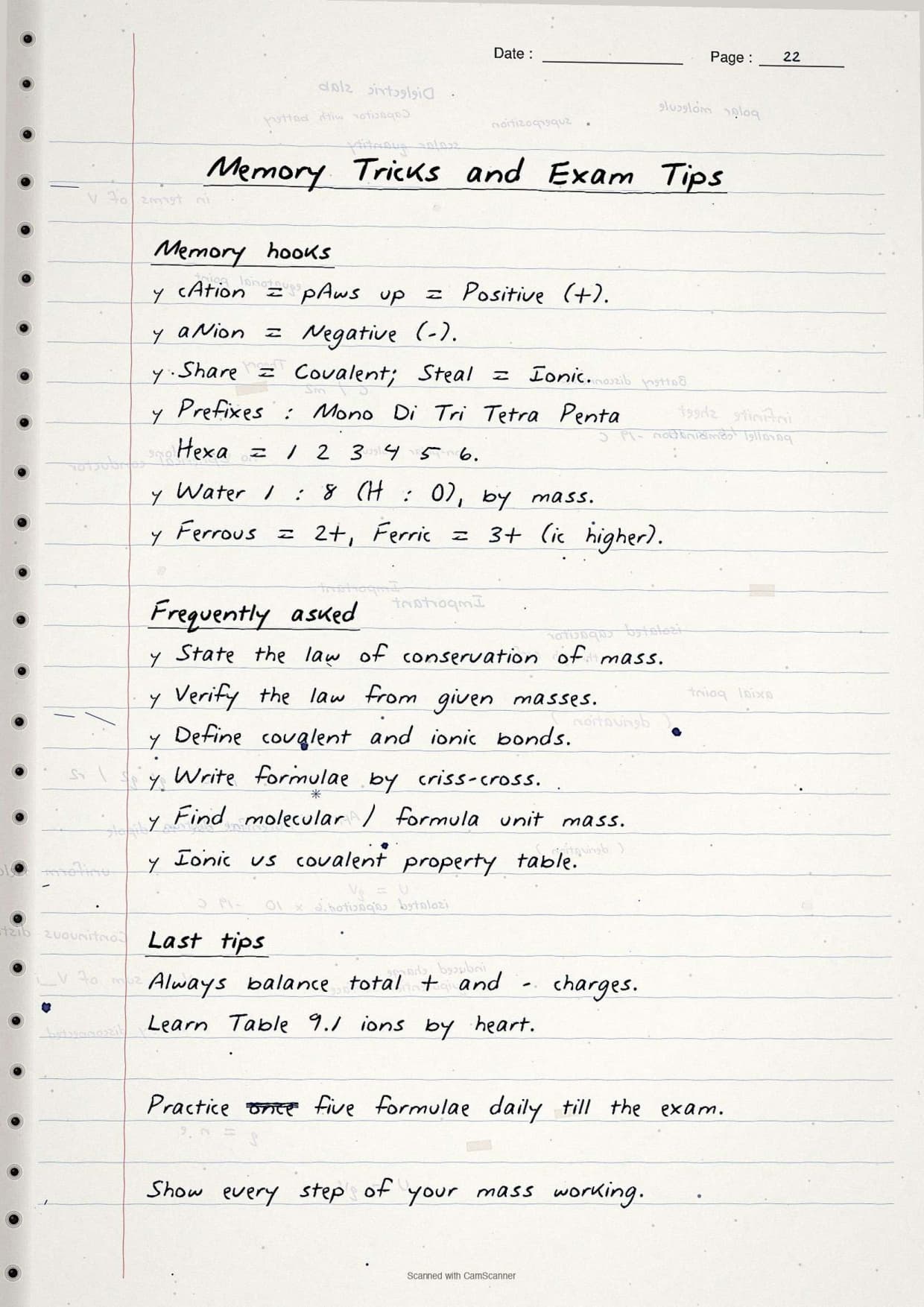
- What you get: the two laws of chemical combination, Dalton's postulates, covalent and ionic bonds, chemical formulae, and molecular and formula unit mass, all in clear handwriting.
- Colour-coded: new sub-topics in red, each rule and worked sum in a hand-drawn box, and solved examples in blue.
- Why by hand: writing the criss-cross swaps and each mass sum by hand helps you recall the method fast in the exam.
Student Feedback
In a Collegedunia study of 1,240 Class 9 students, 79% said hand-written pages of the criss-cross method and the two laws were easier to recall than typed notes. About 4 out of 5 rated the boxed molecular-mass sums and the red-marked mistakes as the most useful part before a test.
Atomic Foundations of Matter Class 9 Science Explained in One Shot
Source: Alakh Pandey - Class 9th & 10th on YouTube
Why Use Handwritten Notes for Class 9 Science Chapter 9 Atomic Foundations of Matter
Chapter 9 mixes short definitions with two mass laws, a set of postulates, and several small sums, so a clean, hand-written page saves real time. The Atomic Foundations of Matter Class 9 Science Handwritten Notes keep one idea per line, with a small diagram or worked sum beside it, so nothing runs together. You revise the full chapter in one sitting without flipping through the Exploration book. This chapter stops at molecular and formula unit mass, so there is no mole concept to worry about here.
- Each rule, like the Law of Conservation of Mass, sits in its own hand-drawn box.
- A quick atom or bond sketch is drawn next to the idea it explains.
- Red sub-headings split the chapter into short, easy parts.
- The wording is plain, like a senior showing you the method.
What Is Inside the Atomic Foundations of Matter Handwritten Notes PDF
The PDF runs to 22 pages of neat, hand-written revision. It moves from the two laws of chemical combination, to Dalton's atomic theory, then covalent and ionic bonds, the criss-cross method for chemical formulae, and finally molecular and formula unit mass, with a solved example after each idea. The colour code below tells you what every mark means.
- Red: new sub-topic headings, such as Ionic Bond, Cation and Anion, or Formula Unit.
- Boxes: each rule and each worked sum, like the molecular mass of water, drawn by hand.
- Blue: solved examples and the numbers worked out in them.
Two Laws of Chemical Combination in the Notes
The chapter opens with two mass laws, so the notes give each one a boxed statement and a small experiment sketch. These laws came before anyone had seen an atom, yet they became the first strong proof that matter is made of atoms.
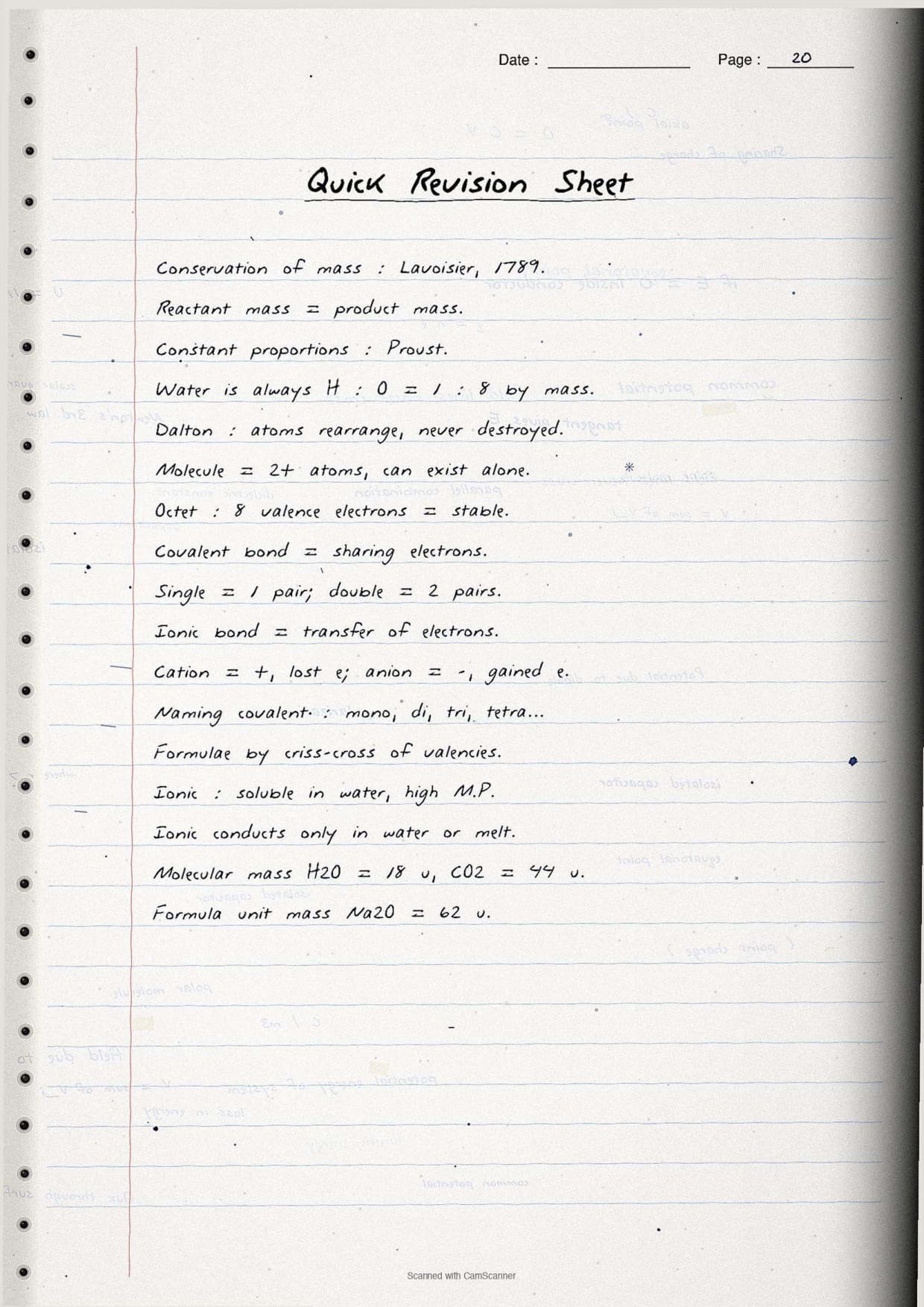
- Law of Conservation of Mass: in a chemical reaction, mass is neither made nor destroyed. The total mass of the reactants equals the total mass of the products. Antoine Lavoisier proved this in closed containers in 1789.
- Law of Constant Proportions: a pure compound always holds its elements in a fixed ratio by mass. Joseph Proust showed that pure water always has hydrogen and oxygen in the mass ratio 1 : 8, from any source.
The notes work a quick mass-balance sum in blue so the first law feels real. In a closed flask, 4.0 g of calcium carbonate reacts with 2.92 g of acid to give 1.76 g carbon dioxide, 0.72 g water, and 4.44 g calcium chloride. Reactants add to 6.92 g and products add to 6.92 g, so mass is conserved.
Dalton's Atomic Theory in Your Own Handwriting
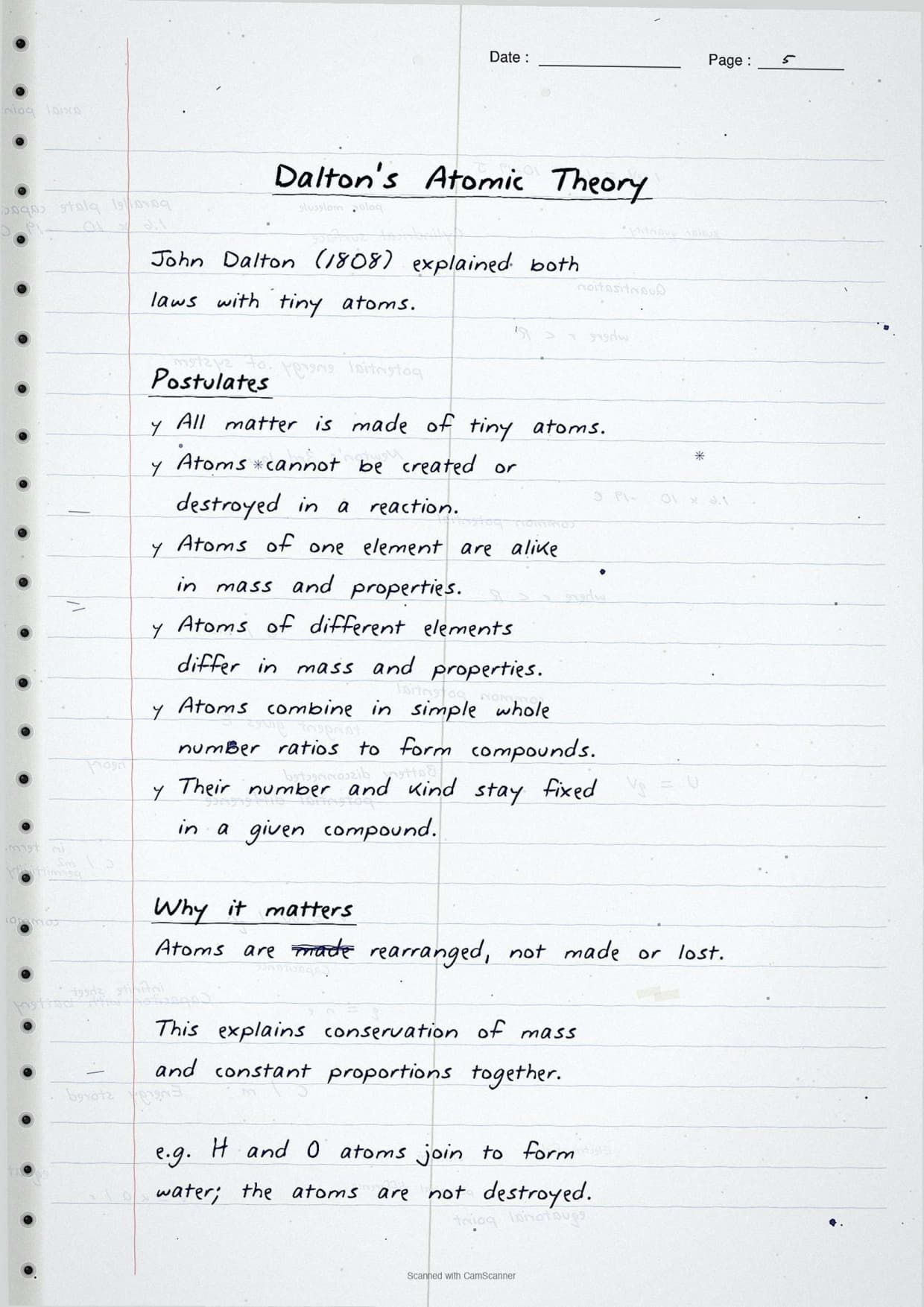
The two laws needed a reason, and in 1808 John Dalton gave one: matter is made of tiny, unbreakable atoms that only rearrange during a reaction. The notes list his postulates as short lines, then show how each one explains a law. Learn these and the rest of the chapter fits into place.
| Dalton's postulate | What it explains |
|---|---|
| All matter is made of tiny particles called atoms. | Gives a particle basis for every substance. |
| Atoms are indivisible and are not made or destroyed in a reaction. | Explains the Law of Conservation of Mass. |
| Atoms of one element are identical in mass and properties. | Explains why an element behaves the same way everywhere. |
| Atoms of different elements differ in mass and properties. | Explains why elements are different from one another. |
| Atoms combine in simple whole-number ratios. | Explains the Law of Constant Proportions. |
The notes sum the whole theory into one line drawn in red: atoms rearrange, they never disappear. Every product atom came from a reactant atom, which is why both mass laws hold at once.
Covalent and Ionic Bonds: Hand-Drawn Comparison
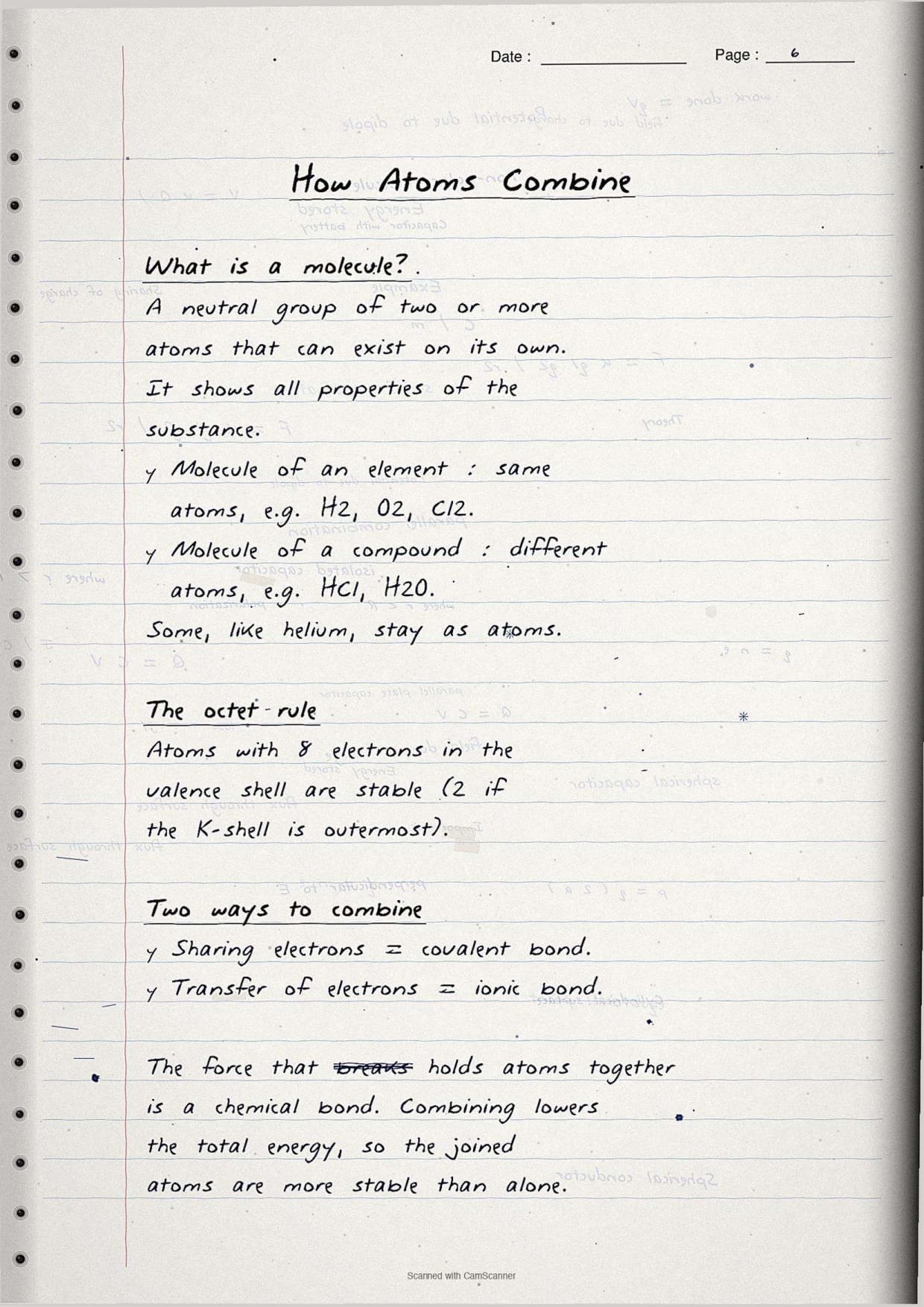
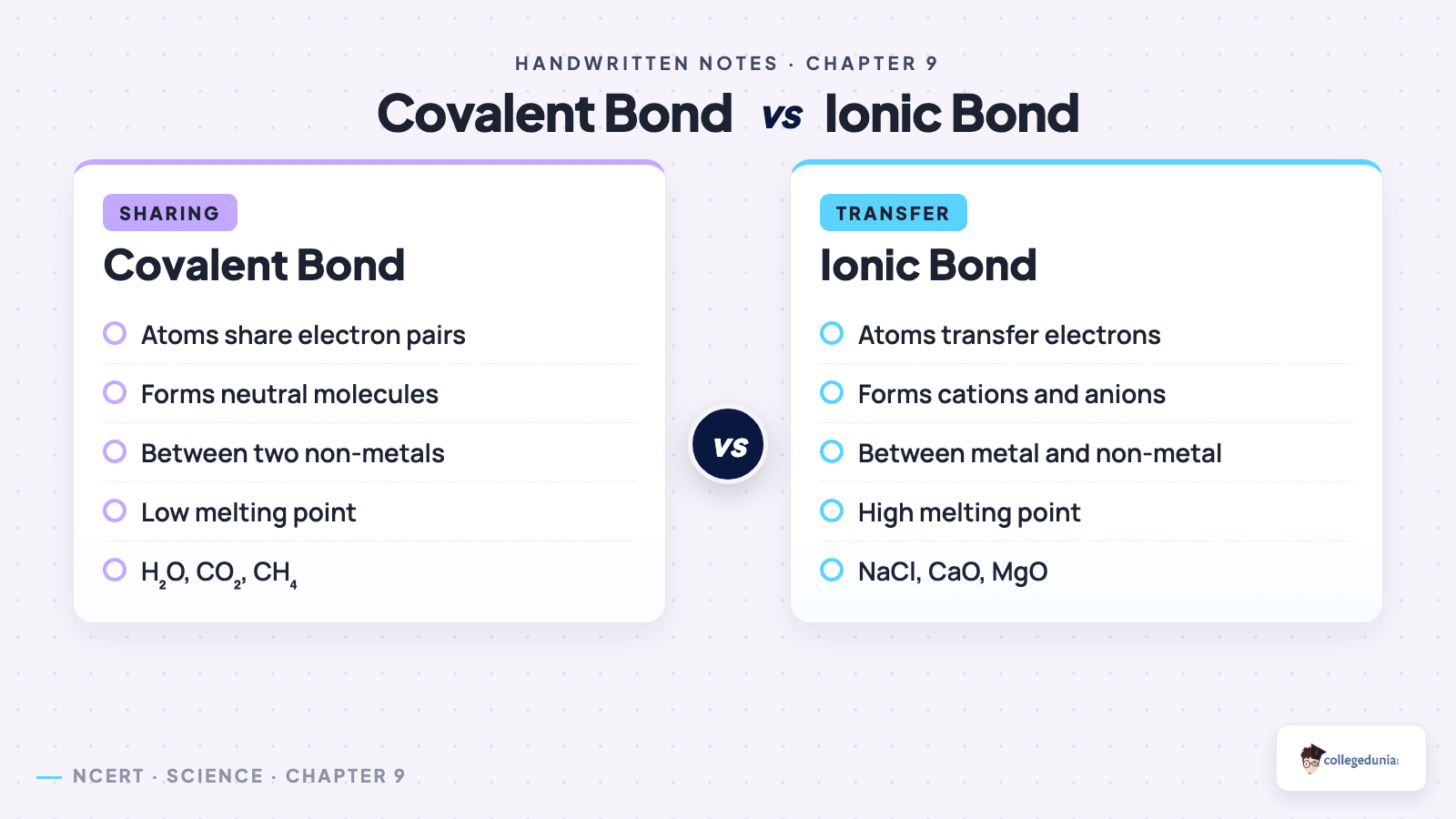
Most atoms are not stable on their own, so they combine to fill their outer shell, usually eight electrons. The force that holds joined atoms together is a chemical bond, and the notes give it a clear hand-drawn table. There are two main types.
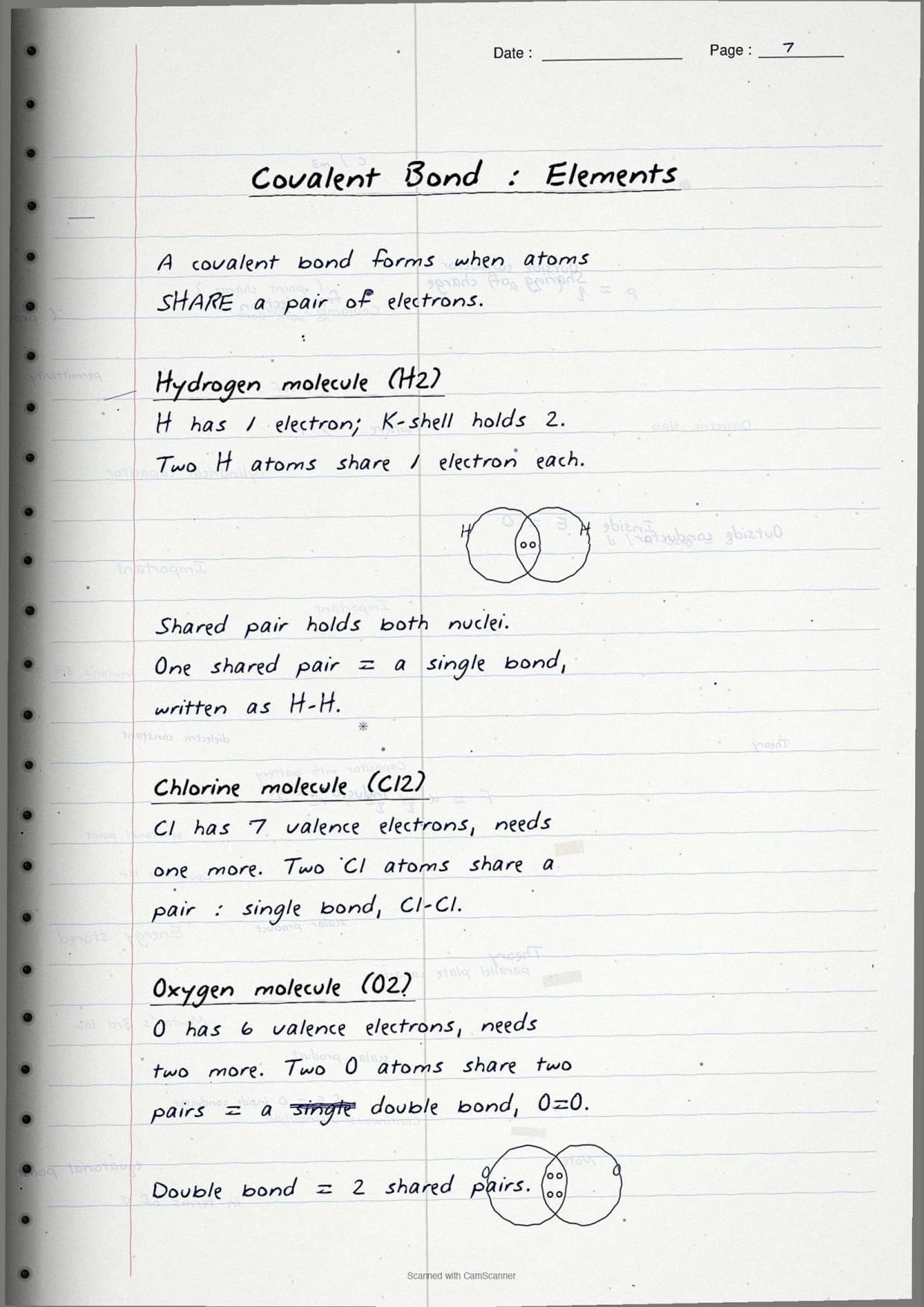
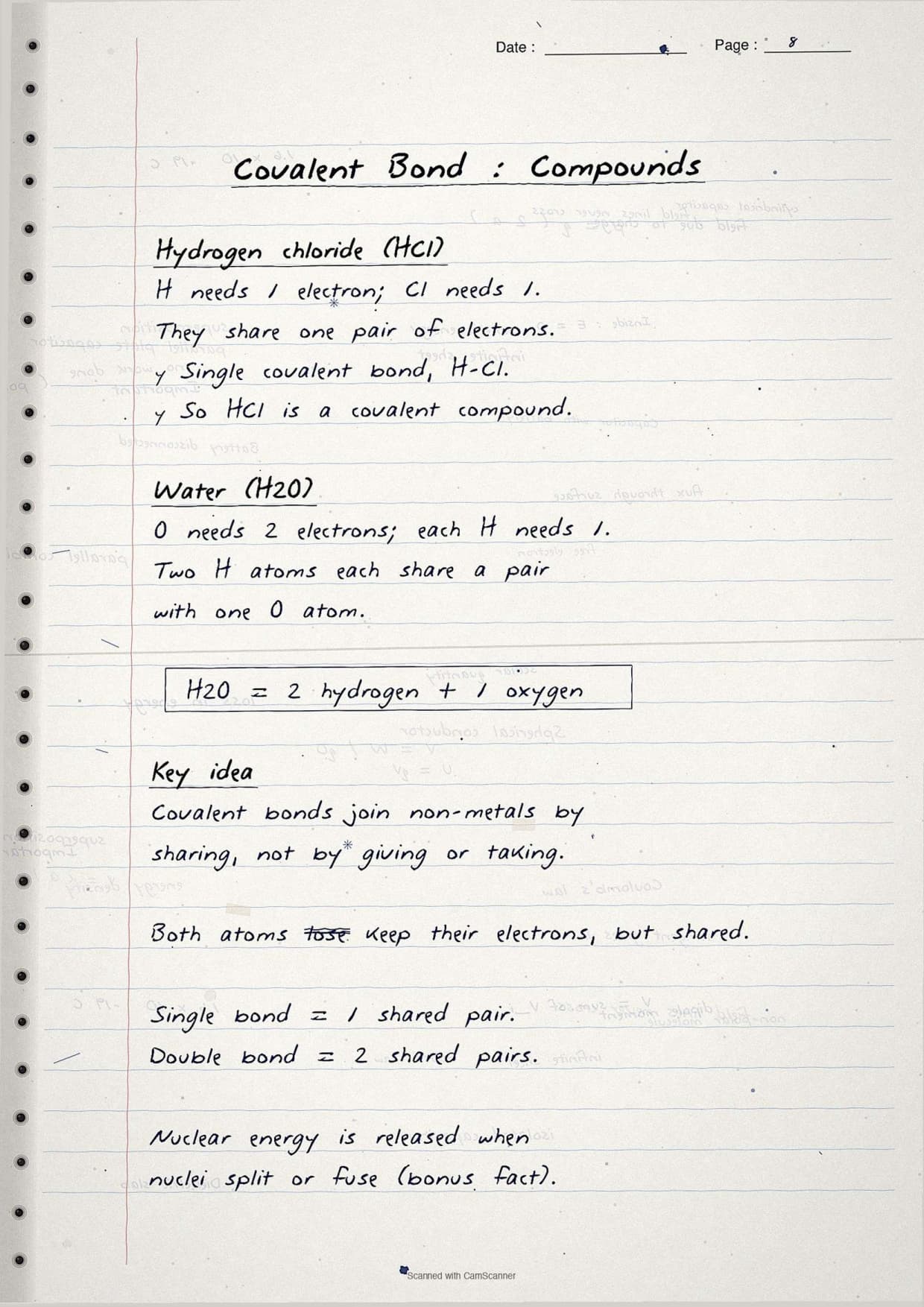
- A covalent bond forms when two atoms share a pair of electrons. One shared pair makes a single bond, like H–H; two pairs make a double bond, like O=O; three pairs make a triple bond, as in N2.
- An ionic bond forms when one atom transfers electrons to another. Sodium loses one electron to become a cation Na+, chlorine gains it to become an anion Cl-, and the opposite charges pull together.
| Feature | Covalent bond | Ionic bond |
|---|---|---|
| How it forms | Sharing electron pairs | Transfer of electrons |
| Particles made | Neutral molecules | Cations and anions |
| Between | Non-metal and non-metal | Metal and non-metal |
| Example | H2O, CO2 | NaCl, CaO |
The notes flag one trap in red: an ionic compound like sodium chloride is not a molecule. Its ions pack into a repeating crystal lattice, so the smallest unit is a formula unit, not a molecule.
Writing Chemical Formulae by the Criss-Cross Method
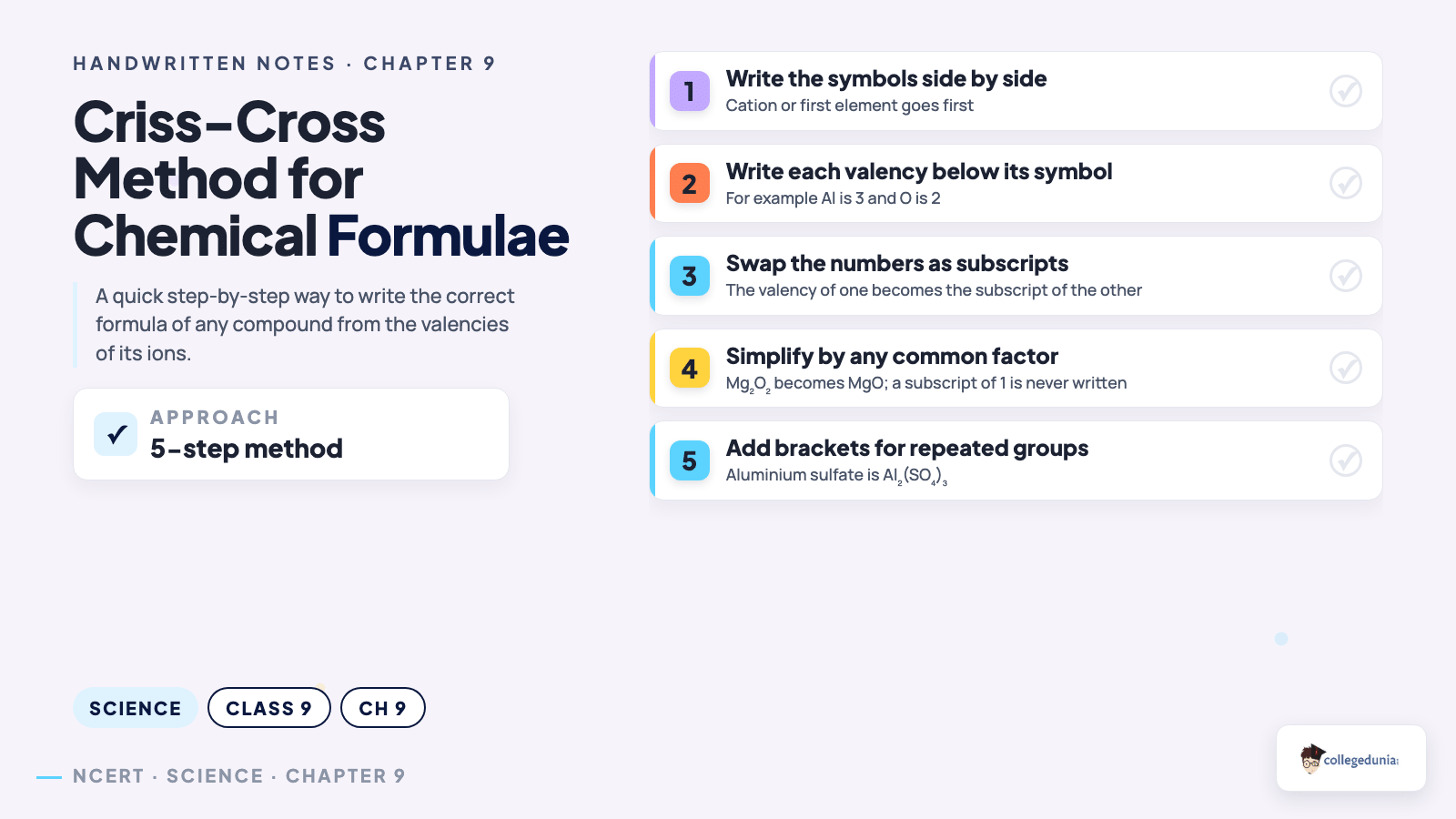
This is the most tested skill in the chapter, so the notes draw the criss-cross steps in full. You write each symbol, put its valency below it, then swap the valencies to become subscripts. The valency of an ion is the size of its charge, that is, the number of electrons it gives or takes.
- Aluminium oxide: Al3+ and O2- swap to give Al2O3.
- Magnesium oxide: Mg2+ and O2- give Mg2O2, simplified to MgO.
- Calcium chloride: Ca2+ and Cl- give CaCl2. A subscript of 1 is never written.
When a polyatomic ion, a group of atoms with one charge, appears more than once, the notes wrap it in a bracket. So magnesium hydroxide is Mg(OH)2 and aluminium sulfate is Al2(SO4)3. Always check that the total positive charge equals the total negative charge, so the compound stays neutral.
Molecular Mass and Formula Unit Mass Boxes Drawn by Hand
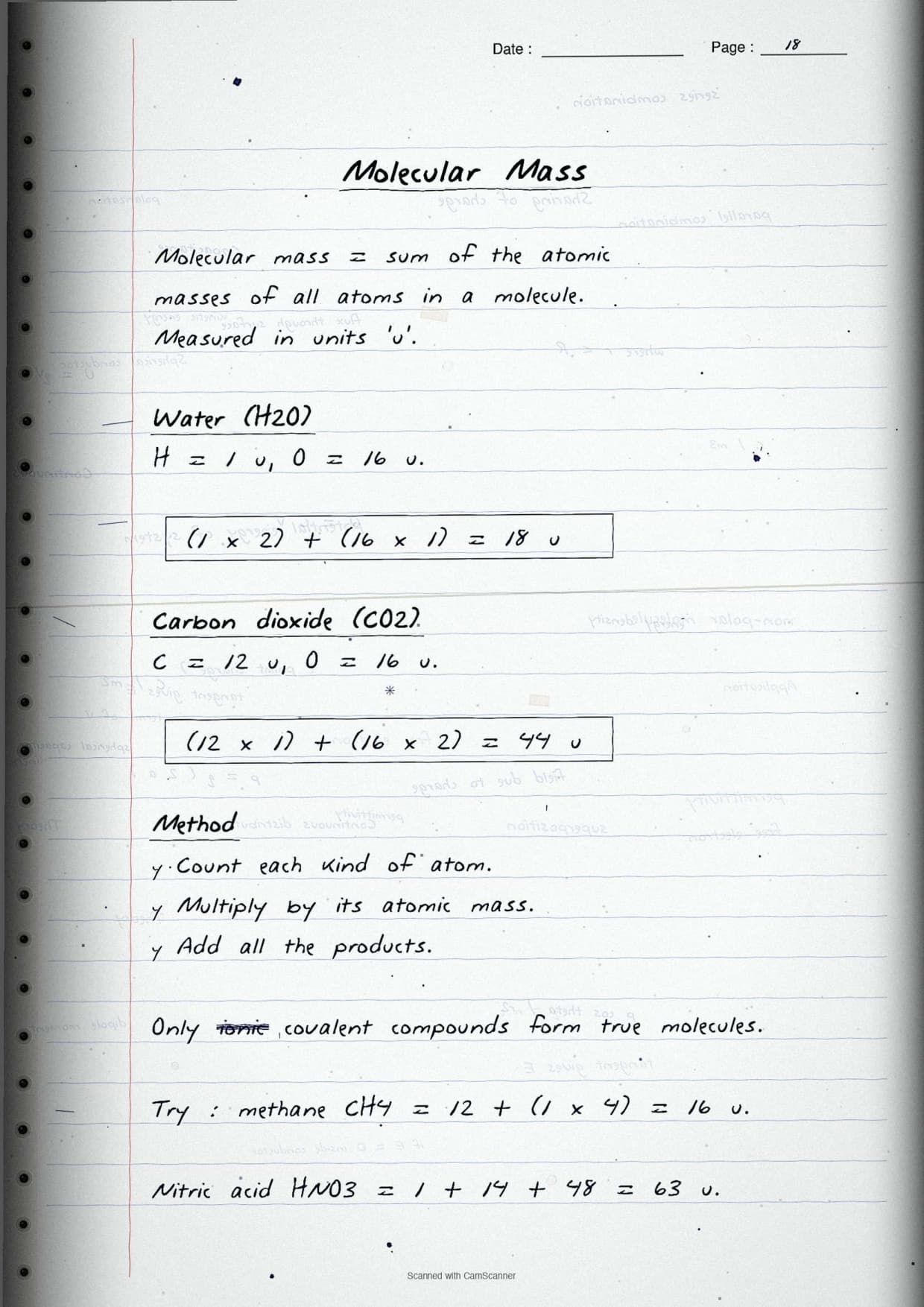
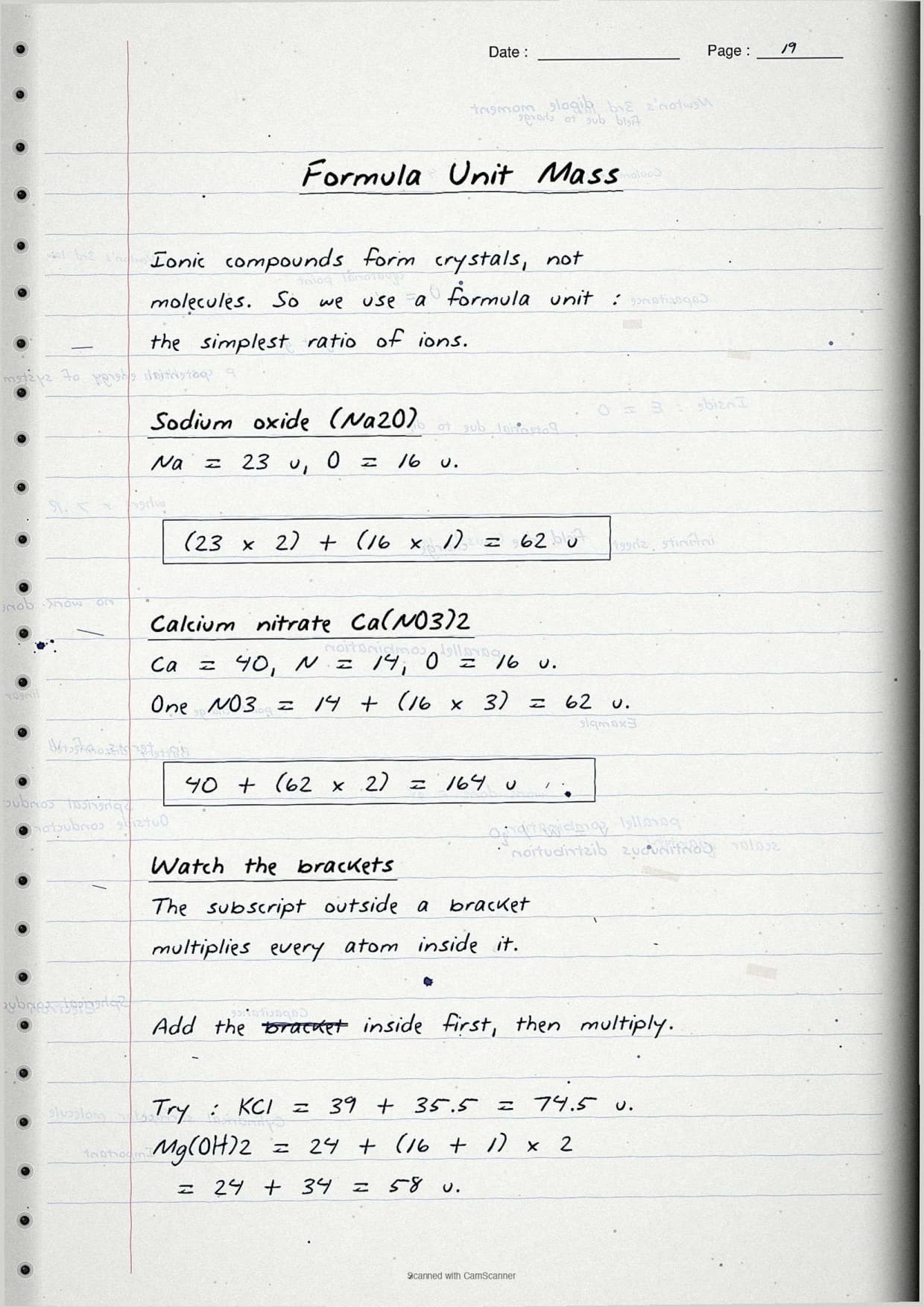
Every atom has a fixed atomic mass measured in units marked u. Add the atomic masses of all atoms in a formula and you get the mass of the compound. The name of that total depends on the bond type, and the notes box both worked sums in blue.
- Molecular mass is used for covalent compounds. For water H2O: (1 × 2) + (16 × 1) = 18 u. For carbon dioxide CO2: (12 × 1) + (16 × 2) = 44 u.
- Formula unit mass is used for ionic compounds. For sodium oxide Na2O: (23 × 2) + (16 × 1) = 62 u.
- For a bracket compound like calcium nitrate Ca(NO3)2: 40 + [(14 × 1) + (16 × 3)] × 2 = 164 u.
Keep this short table of common masses in view for the Revise, Reflect, Refine numericals. Each value is written out in the notes exactly as you should copy it in the exam.
| Compound | Formula | Molecular / formula mass |
|---|---|---|
| Water | H2O | 18 u |
| Carbon dioxide | CO2 | 44 u |
| Ammonia | NH3 | 17 u |
| Sodium chloride | NaCl | 58.5 u |
| Calcium carbonate | CaCO3 | 100 u |
Ionic and Covalent Properties Marked in the Margins
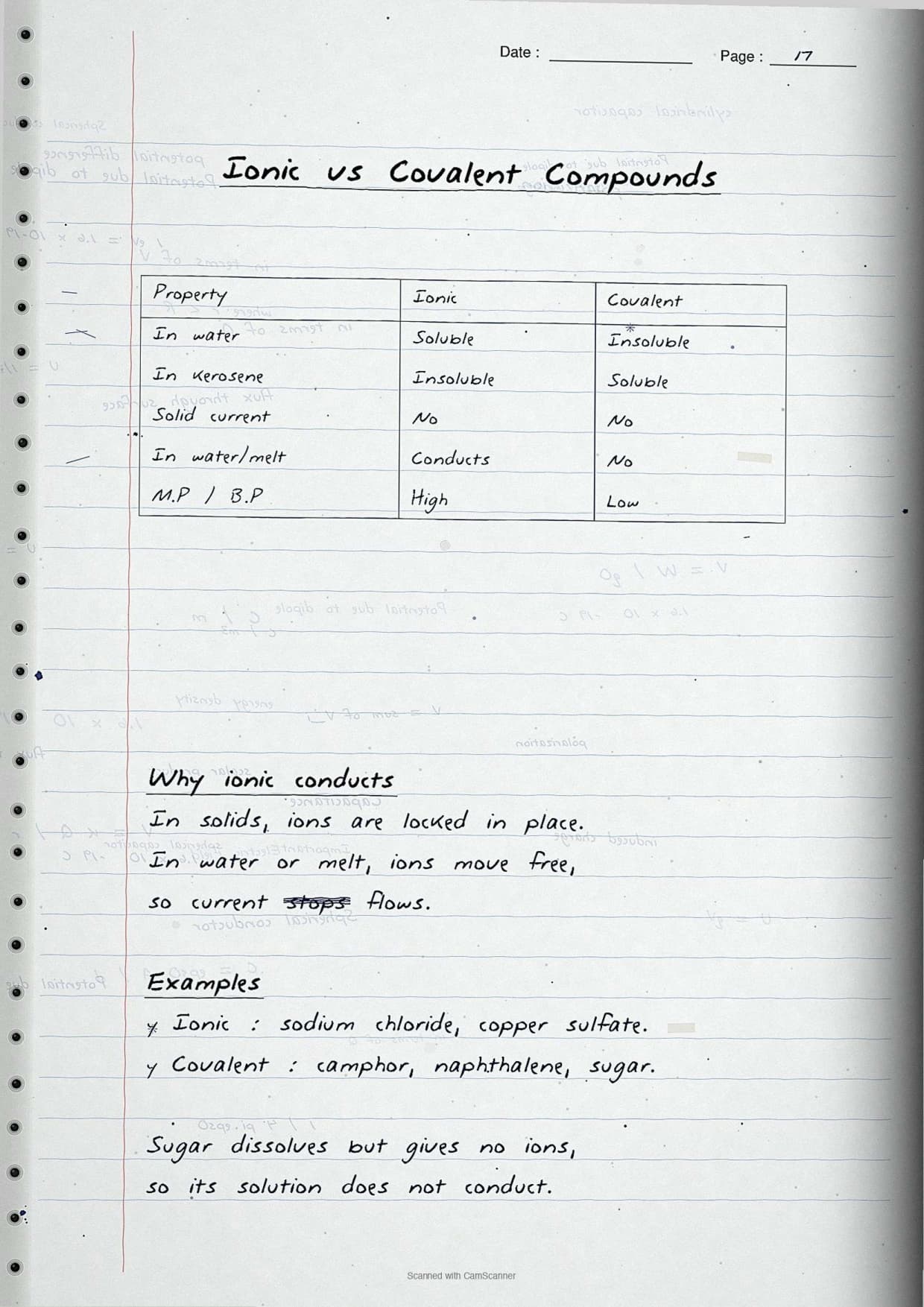
The bond type decides how a compound behaves, so the notes pin the pattern in the margins next to a small bulb-and-beaker sketch. A simple test with salt, sugar, copper sulfate, camphor and naphthalene sorts the samples into two clear groups.
| Property | Ionic compound | Covalent compound |
|---|---|---|
| Dissolves in | Water | Kerosene, petrol |
| Melting point | High | Low |
| Conducts in solution | Yes, free ions carry charge | Usually no |
| Example | Sodium chloride | Camphor, naphthalene |
The notes explain the conductivity point in red: in solid salt the ions are locked in the lattice and cannot move, so it does not conduct. Dissolve or melt the salt and the ions break free, so the solution now lights the bulb. Strong ionic pulls also need a lot of heat to break, which is why ionic compounds melt at high temperatures.
Common Mistakes Flagged in Red
Most lost marks in this chapter come from small slips, not hard ideas. The handwritten notes circle these in red so you fix them while you revise.
- Thinking mass is lost when a gas escapes an open beaker; it is not, weigh it in a closed system.
- Applying the Law of Constant Proportions to a mixture; it is only for pure compounds.
- Forgetting the bracket in Ca(NO3)2, so the subscript 2 misses part of the nitrate group.
- Writing a subscript of 1 in a formula, or leaving out the criss-cross swap.
Last-Minute Revision with These Handwritten Notes
The night before your exam, the Atomic Foundations of Matter Class 9 Science Handwritten Notes work as a quick skim. Every boxed rule and red heading is a checkpoint, so you can cover the whole chapter in well under an hour.
- State both laws of chemical combination in one line each.
- List any three of Dalton's postulates from their box.
- Say the difference between a covalent bond and an ionic bond.
- Use the criss-cross method to write the formula of aluminium oxide.
- Work the molecular mass of CO2 and the formula unit mass of Na2O from memory.
- Read the red mistake note before you close the notes.
More Atomic Foundations of Matter Class 9 Science Resources
Use the table below to open the other resources for this chapter of the new Class 9 Science Exploration book.
| Resource | Open |
|---|---|
| Handwritten Notes | Atomic Foundations of Matter Class 9 Science Handwritten Notes |
| NCERT Solutions | Atomic Foundations of Matter Class 9 Science NCERT Solutions |
| Revision Notes | Atomic Foundations of Matter Class 9 Science Notes |
| Formula Sheet | Atomic Foundations of Matter Class 9 Science Formula Sheet |
| NCERT Book PDF | Atomic Foundations of Matter Class 9 Science NCERT Book PDF |
NCERT Handwritten Notes for Class 9 Science: All Chapters
Use the table below to open the handwritten notes for any other chapter of the new Class 9 Science Exploration book.
| Chapter | Handwritten Notes |
|---|---|
| Chapter 2 | Cell The Building Block of Life |
| Chapter 3 | Tissues in Action |
| Chapter 4 | Describing Motion Around Us |
| Chapter 5 | Exploring Mixtures and their Separation |
| Chapter 6 | How Forces Affect Motion |
| Chapter 7 | Work, Energy, and Simple Machines |
| Chapter 8 | Journey Inside the Atom |
| Chapter 9 | Atomic Foundations of Matter |
| Chapter 10 | Sound Waves Characteristics and Applications |
| Chapter 11 | Reproduction How Life Continues |
| Chapter 12 | Patterns in Life Diversity and Classification |
| Chapter 13 | Earth as a System Energy, Matter, and Life |
Atomic Foundations of Matter Class 9 Science Handwritten Notes FAQs
Ques. How many pages are the Atomic Foundations of Matter Class 9 Science handwritten notes?
Ans. The handwritten notes run to 22 pages. They cover the full chapter, from the two laws of chemical combination and Dalton's atomic theory to covalent and ionic bonds, the criss-cross method, and molecular and formula unit mass, with a solved example after each idea.
Ques. Are these real handwritten notes?
Ans. Yes. They are a topper's own clear handwritten revision notes, with each rule boxed, atom and bond sketches drawn by hand, and sub-headings colour-coded in red.
Ques. Do the Chapter 9 notes cover the mole concept?
Ans. No. In the new Exploration book, Chapter 9 stops at molecular mass and formula unit mass. There is no mole concept, so the notes focus on the two mass laws, bonding, chemical formulae, and mass sums.
Ques. What is the criss-cross method in the notes?
Ans. The criss-cross method writes a chemical formula fast. You put each element with its valency, then swap the valencies to become subscripts and simplify. For example Al3+ and O2- give Al2O3.
Ques. Is Atomic Foundations of Matter part of the new Class 9 Science book?
Ans. Yes. Atomic Foundations of Matter is Chapter 9 of the new Exploration textbook for the 2026-27 syllabus. It builds on Chapter 8, Journey Inside the Atom, and its exercise is titled Revise, Reflect, Refine.



Comments