




The NCERT Notes Class 9 Science Chapter 9 Atomic Foundations of Matter give you a clear, quick revision of the whole chapter from the new Exploration textbook. In one place you get every key idea: the law of conservation of mass, the law of constant proportions, Dalton's atomic theory, how atoms form covalent and ionic bonds, writing chemical formulae, and finding molecular mass and formula unit mass. The notes use short lines and simple words, so you can revise the full chapter fast before a class test or the 2026-27 exam.
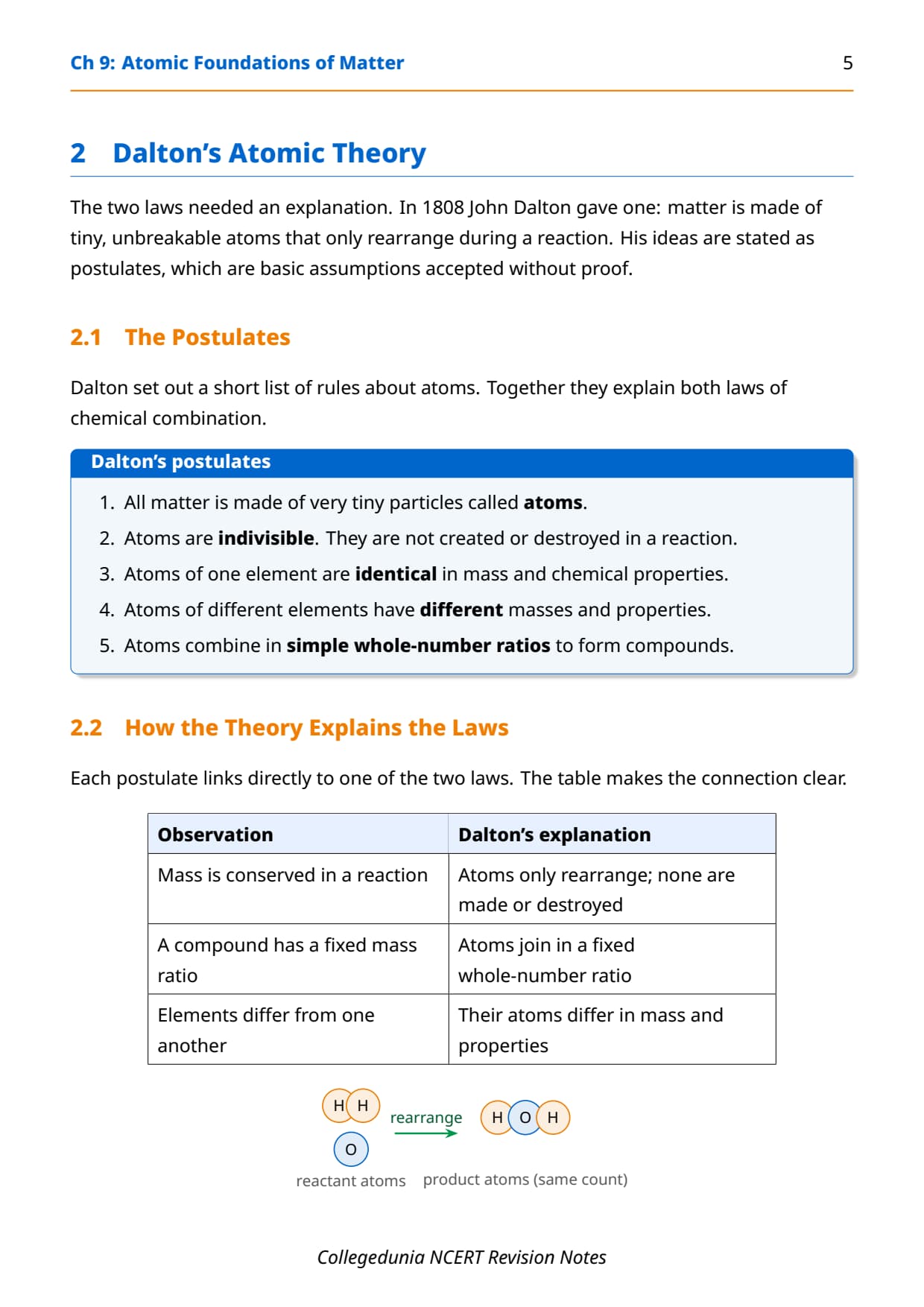
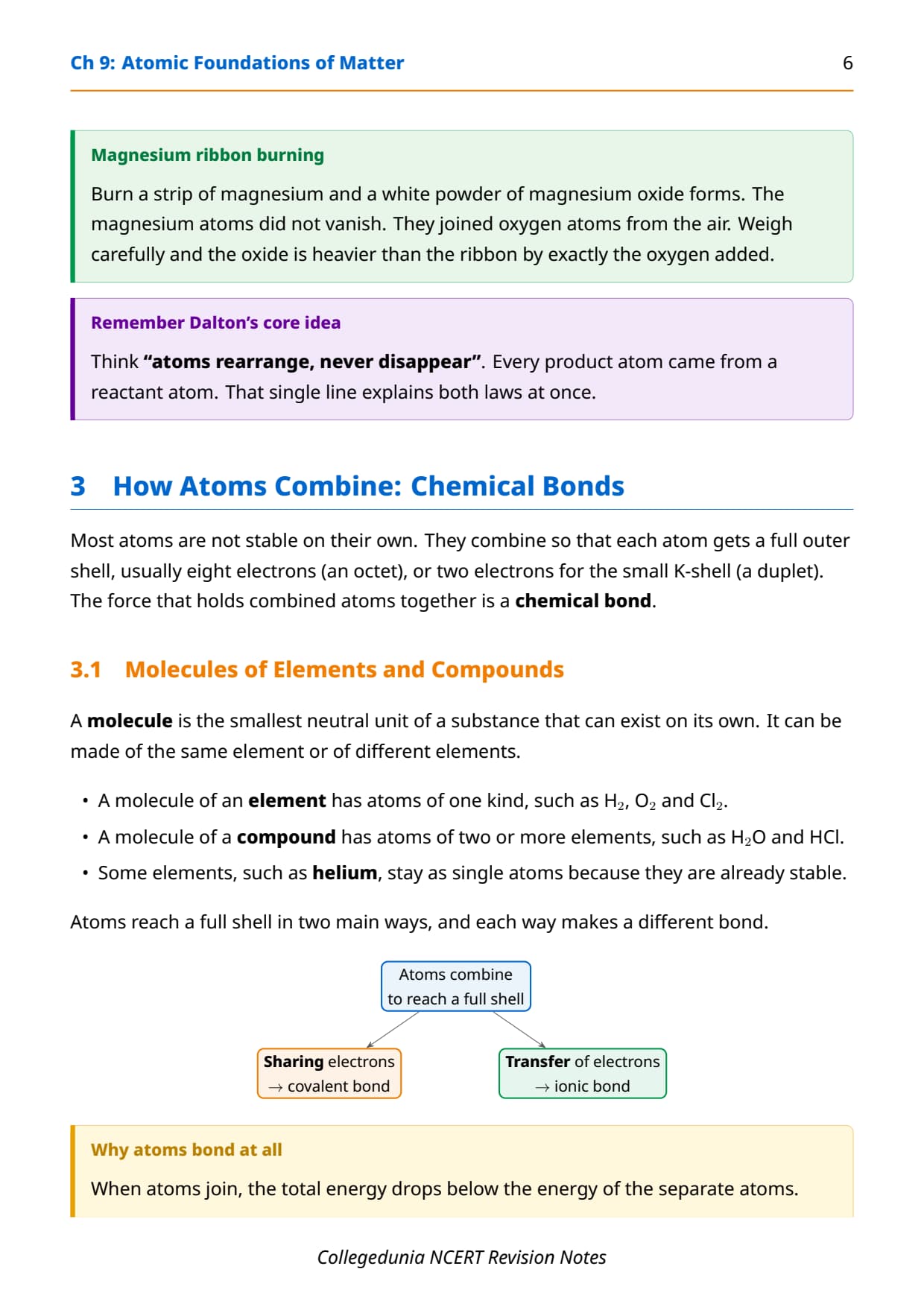
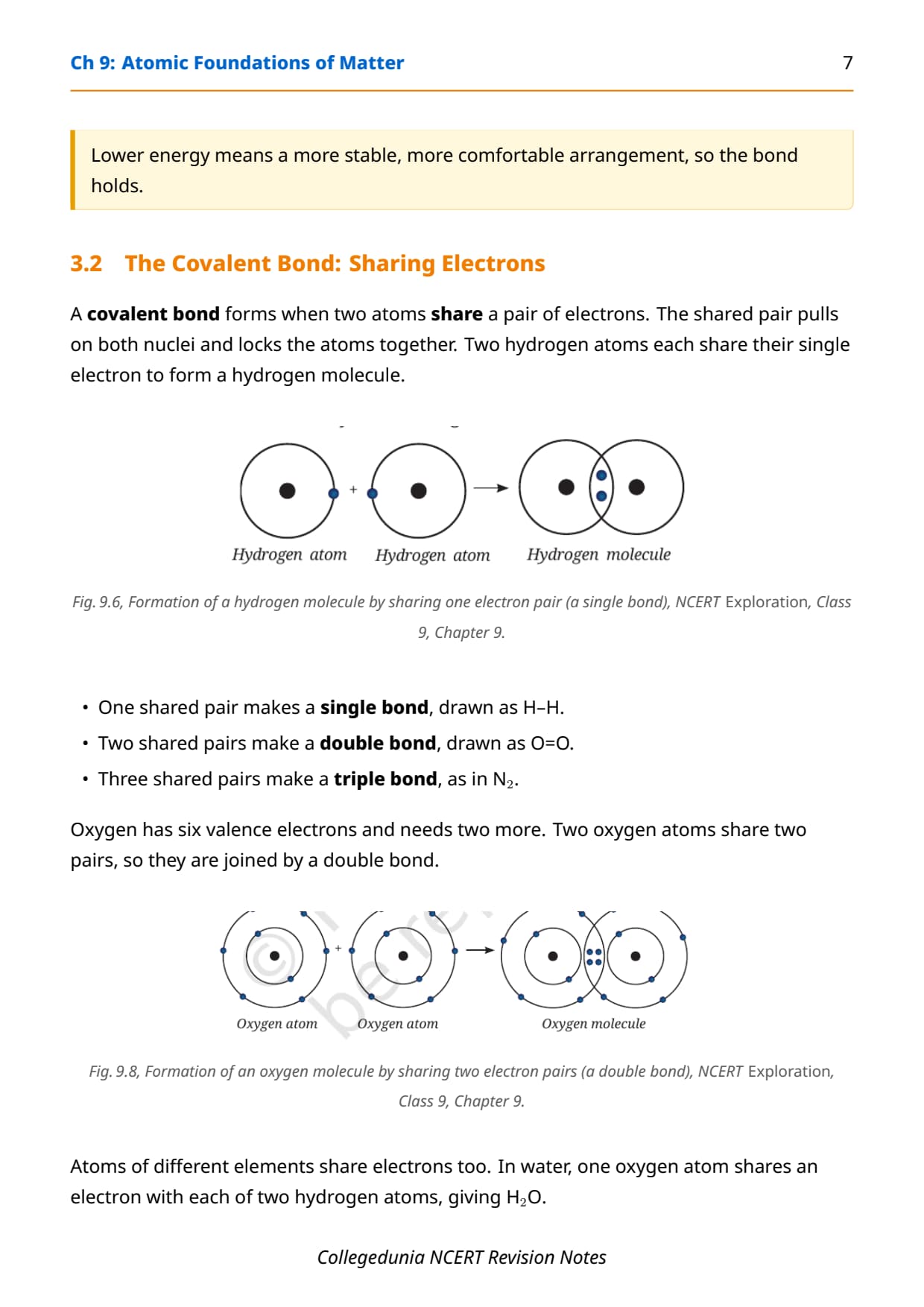
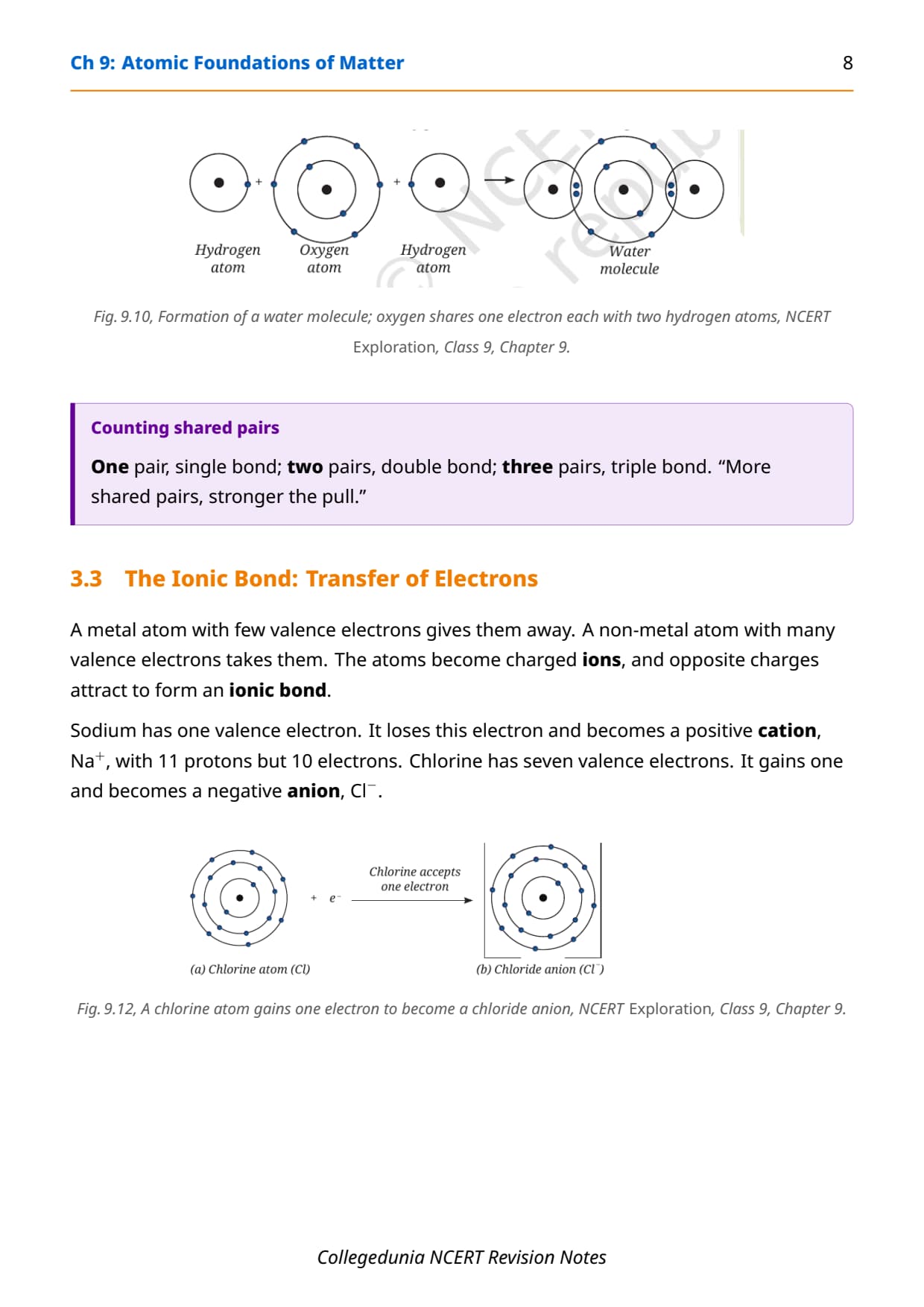
- Full concept revision: conservation of mass, constant proportions, Dalton's theory, covalent and ionic bonds, chemical formulae, and mass calculations in one set of notes.
- Formula ready: molecular mass and formula unit mass with the criss-cross method for writing formulae and worked values like H2O = 18 u.
- Why it matters: Chapter 9 is the base for chemical reactions, the mole concept, and later CBSE, JEE, and NEET chemistry.
Student Feedback
In a Collegedunia study of 1,180 Class 9 students, 78% said a one-page revision of the criss-cross method helped them write chemical formulae without slips. About 4 out of 5 rated the ionic versus covalent table the clearest part, and many said the worked molecular mass values made the numericals feel easy.
What You Revise in Class 9 Science Chapter 9 Atomic Foundations of Matter
Chapter 9 explains how atoms join to build every substance around you, and why mass and proportions stay fixed during this. The NCERT Notes Class 9 Science Chapter 9 Atomic Foundations of Matter cover every idea in the order the Exploration book uses, so your revision follows the same flow as the chapter.
These notes help you recall the core points in minutes:
- Two basic laws: the law of conservation of mass and the law of constant proportions.
- Dalton's atomic theory: the postulates that explain both laws.
- How atoms combine: covalent bonds by sharing electrons and ionic bonds by transferring electrons.
- Formulae and mass: the criss-cross method, molecular mass, and formula unit mass.
Atomic Foundations of Matter Class 9 Science in One Shot
Source: Alakh Pandey - Class 9th & 10th on YouTube
Law of Conservation of Mass: Quick Revision Notes
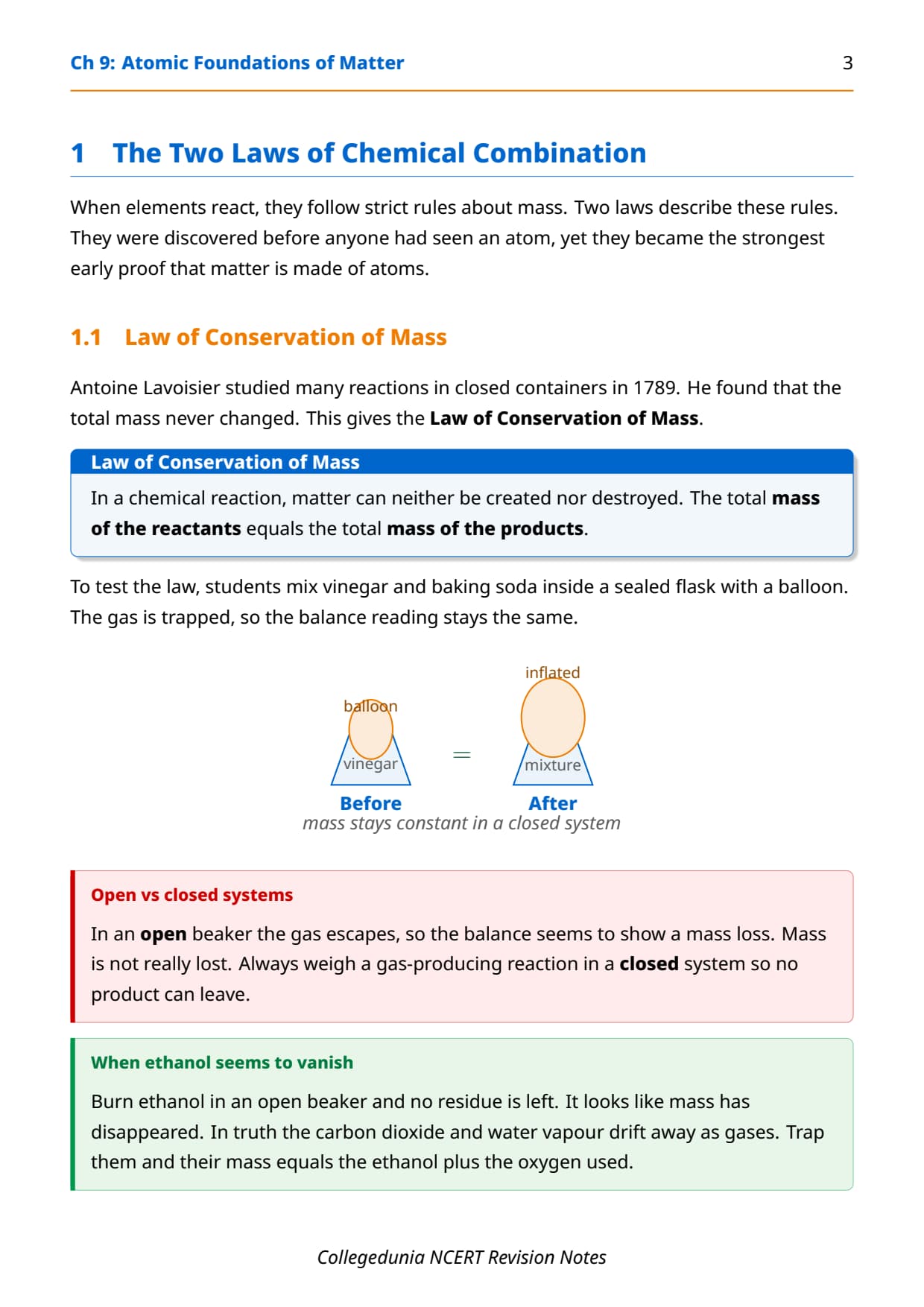
Start your revision with the first law of the chapter. The law of conservation of mass says that matter can neither be created nor destroyed in a chemical reaction. It was proposed by Antoine Lavoisier in 1789, and it holds for every chemical change.
- Meaning: the total mass of the reactants equals the total mass of the products.
- Why gas seems to break it: in an open flask a gas can escape, so the reading drops. Seal the flask and the mass stays the same.
- Example: 12 g of carbon reacts with 32 g of oxygen to give 44 g of carbon dioxide, and 12 + 32 = 44.
Law of Constant Proportions in Class 9 Science Chapter 9
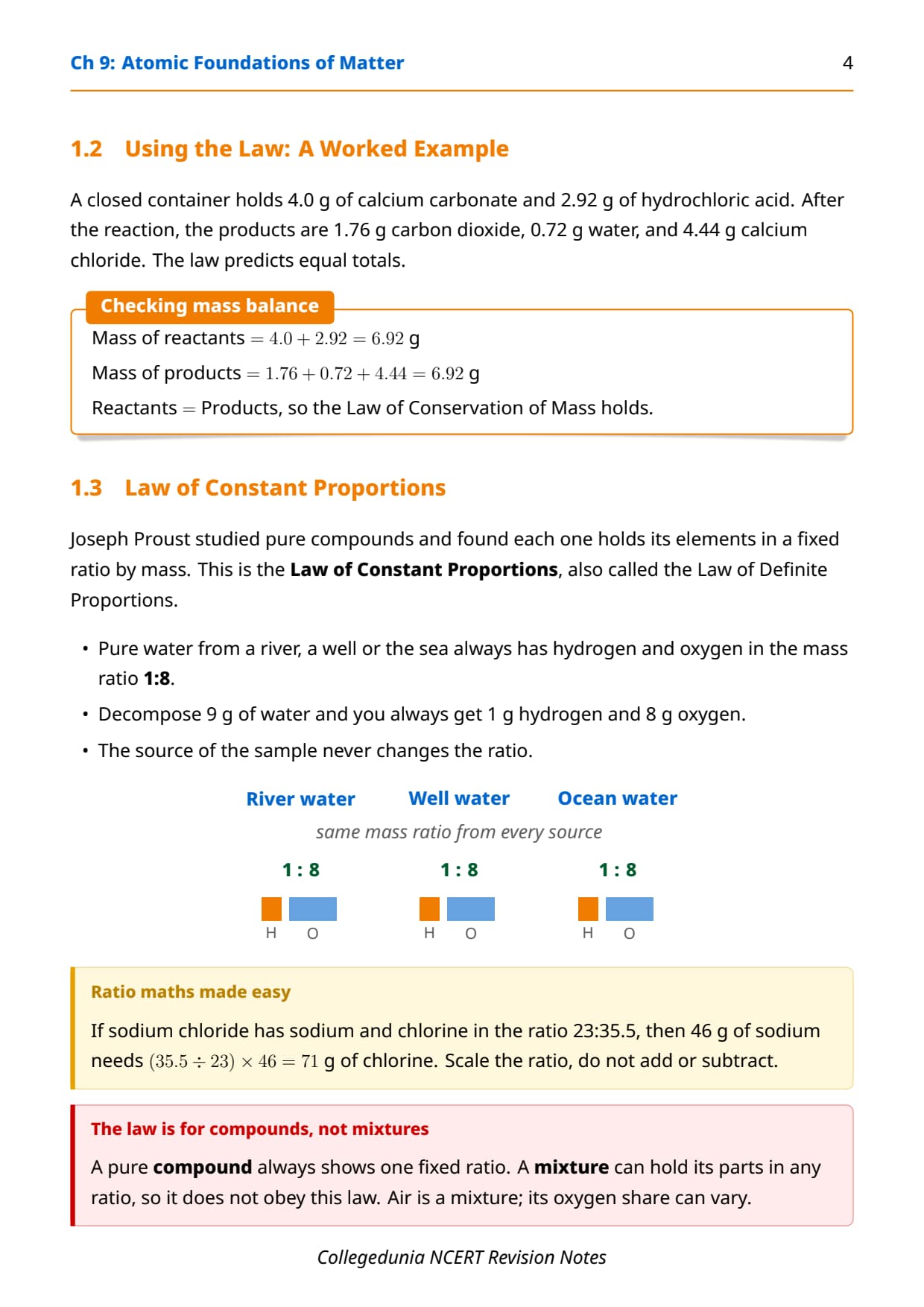
The second law is just as important for your exam. The law of constant proportions, given by Joseph Proust, says that a pure compound always contains the same elements combined in a fixed ratio by mass, no matter how or where it is made.
- Classic example: pure water from any source always has hydrogen and oxygen in the mass ratio 1:8. So 9 g of water gives 1 g of hydrogen and 8 g of oxygen.
- Other names: it is also called the law of definite proportions or Proust's law.
- Note: this law is true for compounds, not for mixtures, because a mixture has no fixed ratio.
Both laws together set the stage for Dalton's atomic theory, which explains why substances always combine in these fixed, whole-number ways.
Dalton's Atomic Theory Postulates for Class 9 Science
John Dalton explained the two laws with a set of postulates in 1808. A postulate is a basic idea accepted as true. Learn these points, as they are a favourite for one-mark and assertion-reason questions.
- All matter is made of tiny particles called atoms, which take part in chemical reactions.
- Atoms are indivisible and cannot be created or destroyed in a chemical reaction.
- Atoms of the same element are identical in mass and chemical properties.
- Atoms of different elements differ in mass and chemical properties.
- Atoms combine in the ratio of small whole numbers to form compounds.
The idea that atoms only rearrange, and are never made or destroyed, is exactly what keeps mass conserved and proportions fixed.
How Atoms Combine: Covalent and Ionic Bonds in Class 9
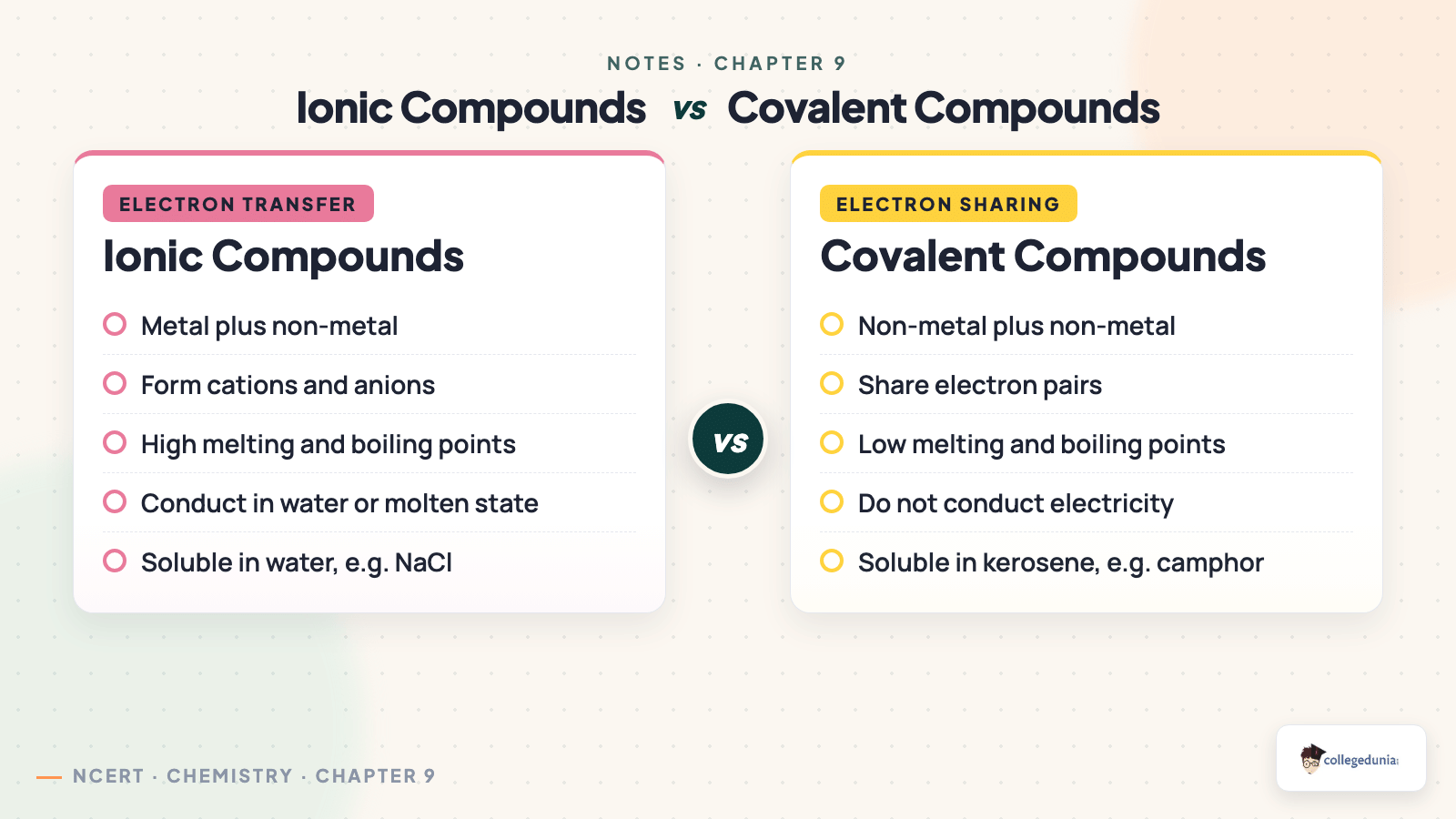
Atoms combine to complete their outer shell and become stable. They do this in two ways, and this is one of the most tested ideas in the chapter.
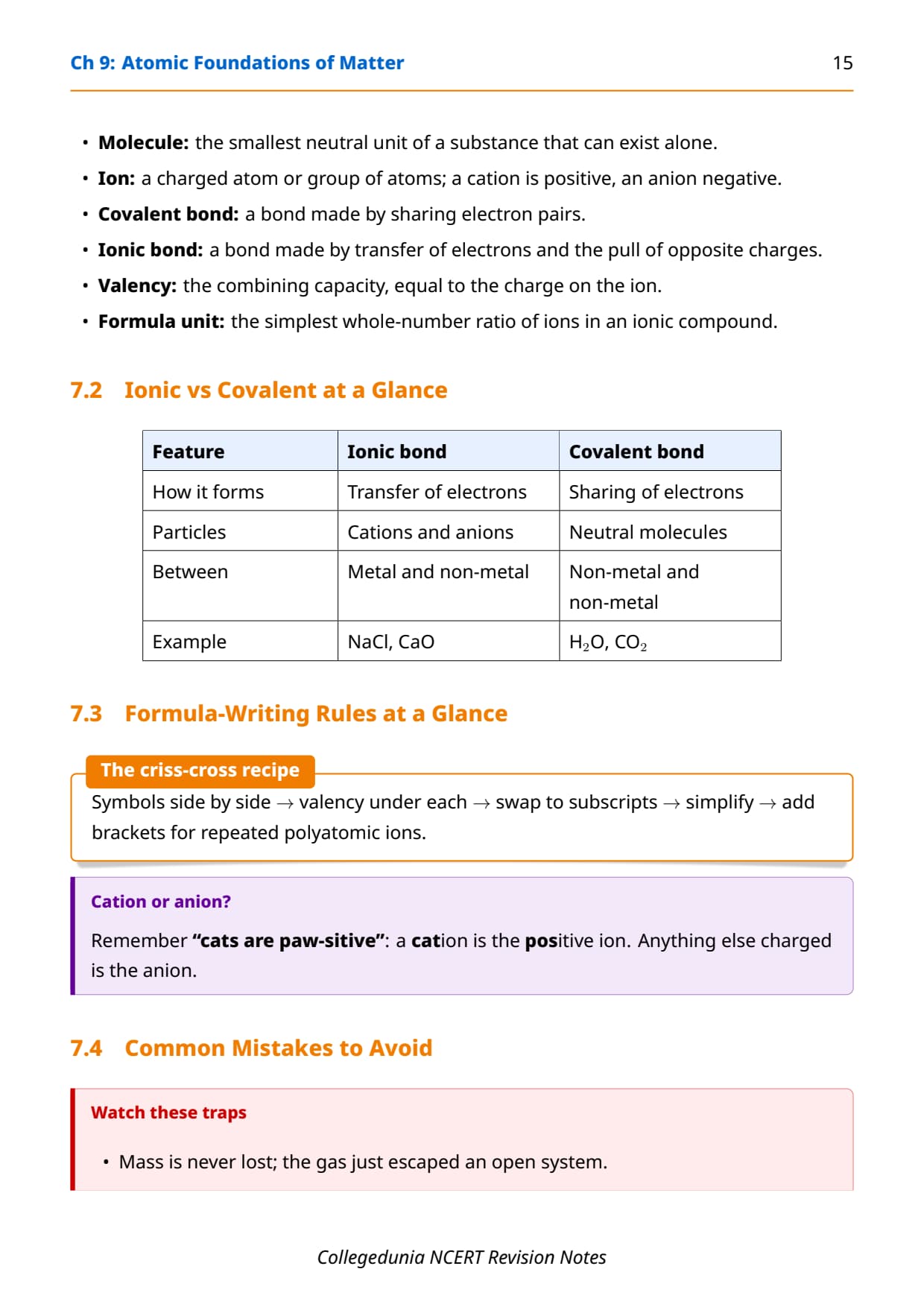
| Feature | Covalent bond | Ionic bond |
|---|---|---|
| How it forms | Sharing of electron pairs | Transfer of electrons |
| Formed between | Two non-metals | A metal and a non-metal |
| Particles made | Molecules | Cations and anions (ions) |
| Example | H2, Cl2, H2O | NaCl, MgO |
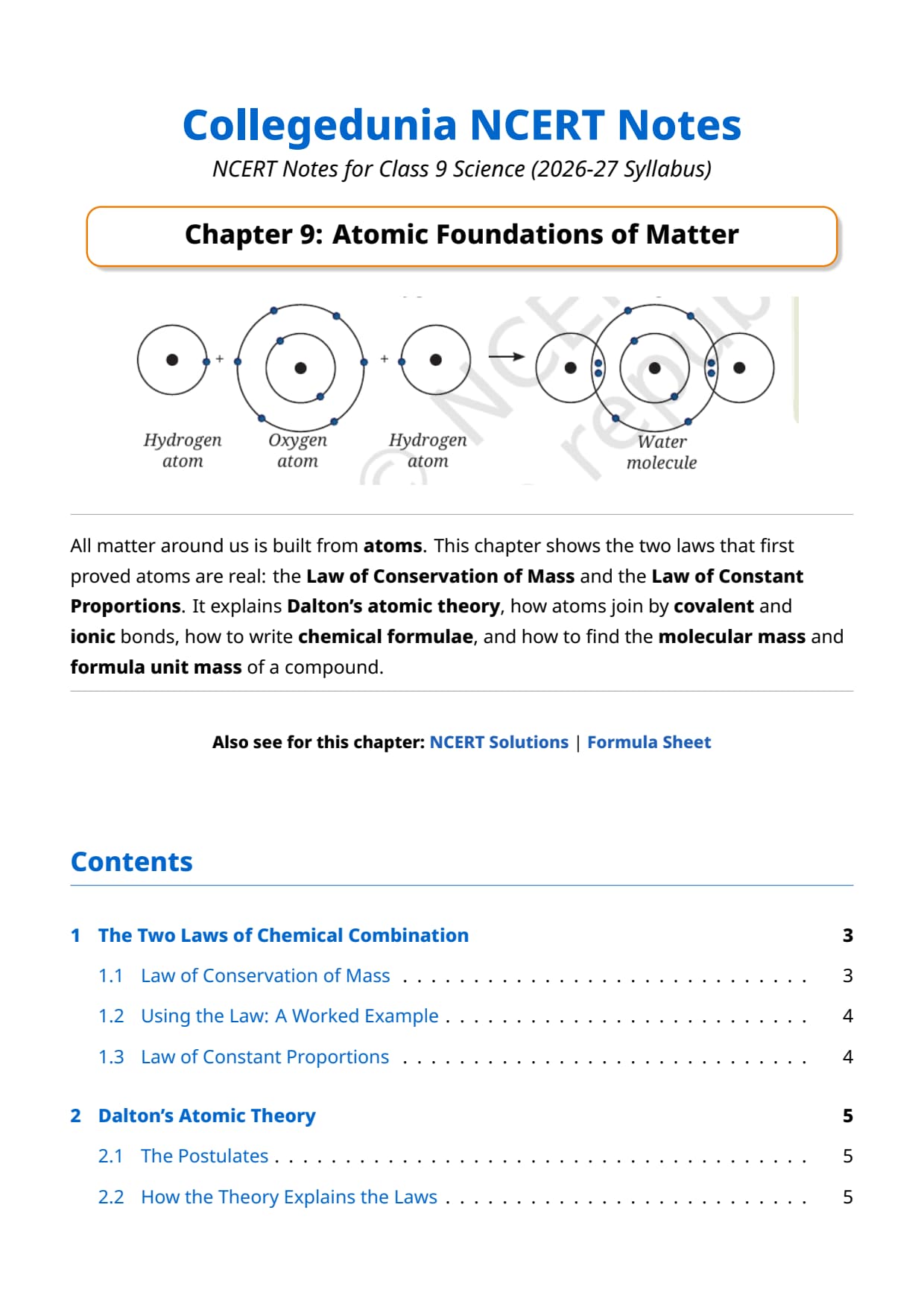
- Covalent bond: two hydrogen atoms share one electron each to form H2 (a single bond, H–H). Two oxygen atoms share two pairs, so oxygen has a double bond, O=O.
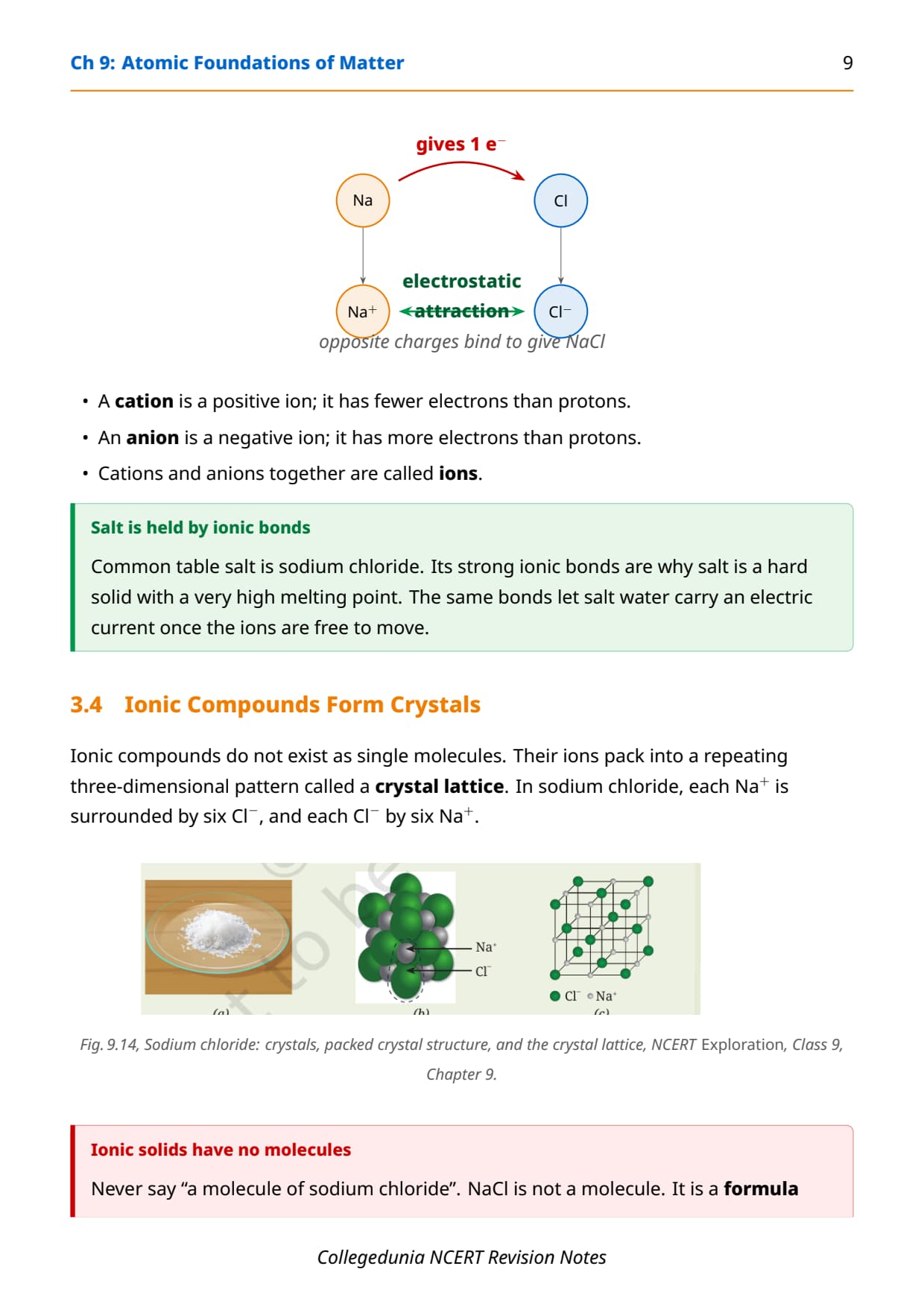
- Ionic bond: sodium loses one electron to become Na+, chlorine gains it to become Cl-, and the opposite charges attract to form NaCl.
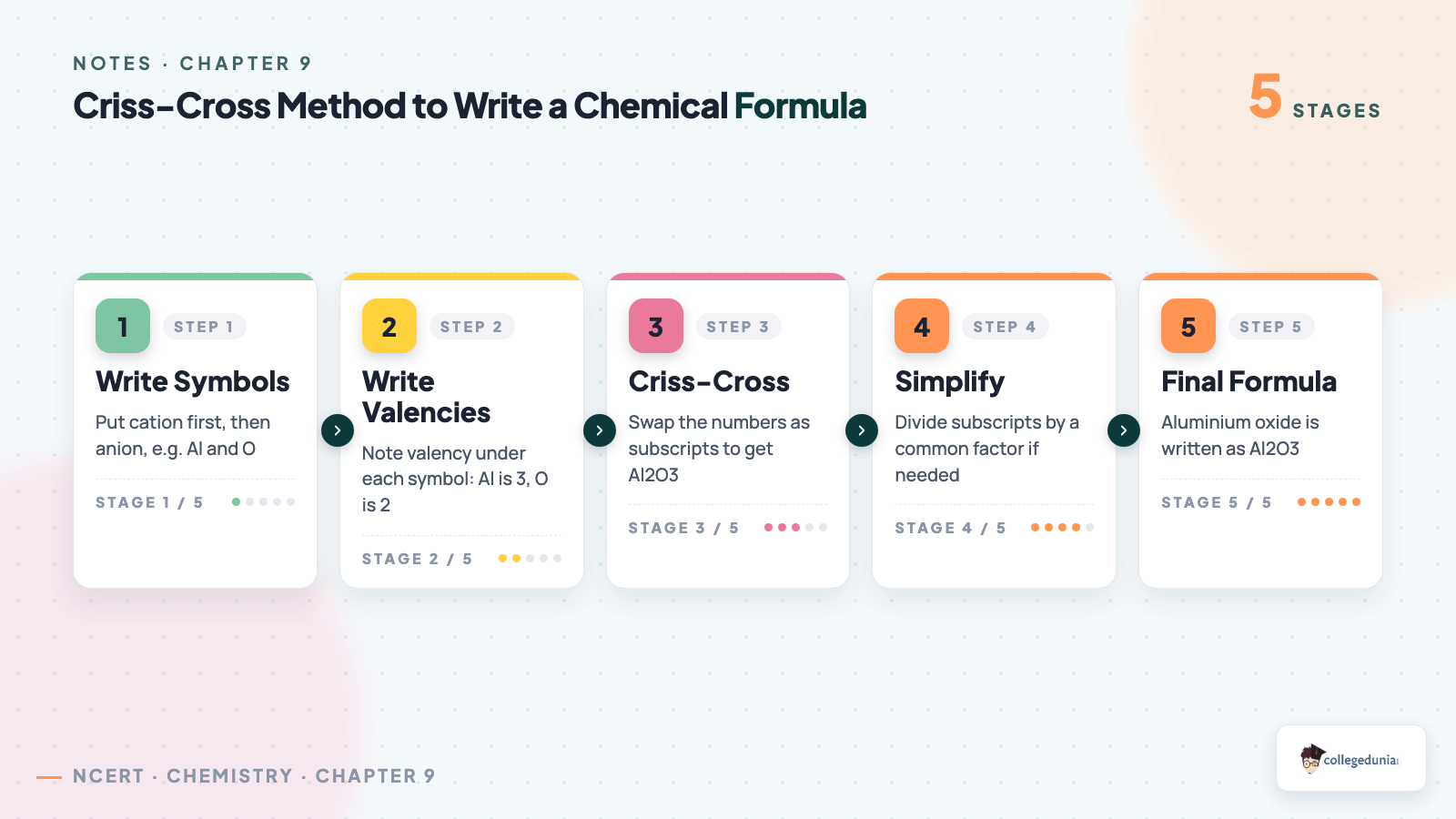
Writing Chemical Formulae by the Criss-Cross Method
The criss-cross method is the fastest way to write a correct formula, and it works for both covalent and ionic compounds. Keep it ready for the Revise, Reflect, Refine exercise.
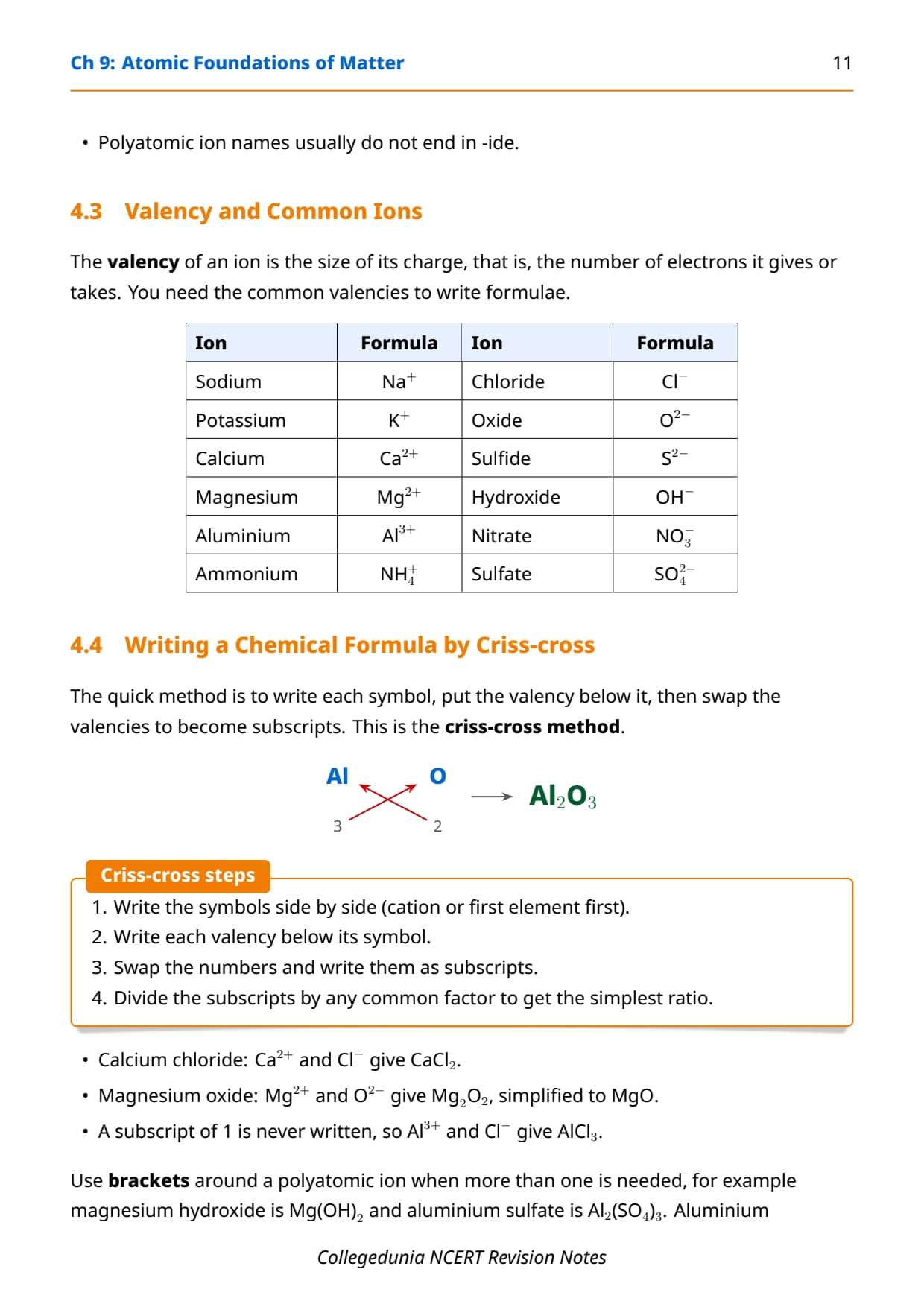
- Step 1: write the symbols, with the metal or positive part first.
- Step 2: write the valency (or charge number) below each symbol.
- Step 3: cross over the valencies and write them as subscripts.
- Step 4: divide the subscripts by a common factor if needed.
For example, aluminium (valency 3) and oxygen (valency 2) cross over to give Al2O3. For magnesium and oxygen, both valencies are 2, so Mg2O2 is simplified to MgO. Use brackets for two or more of the same polyatomic ion, as in Mg(OH)2.
Molecular Mass and Formula Unit Mass in Class 9 Science Chapter 9
These two calculations appear in almost every exam set from this chapter. Both are just careful addition of atomic masses, measured in the unit u.
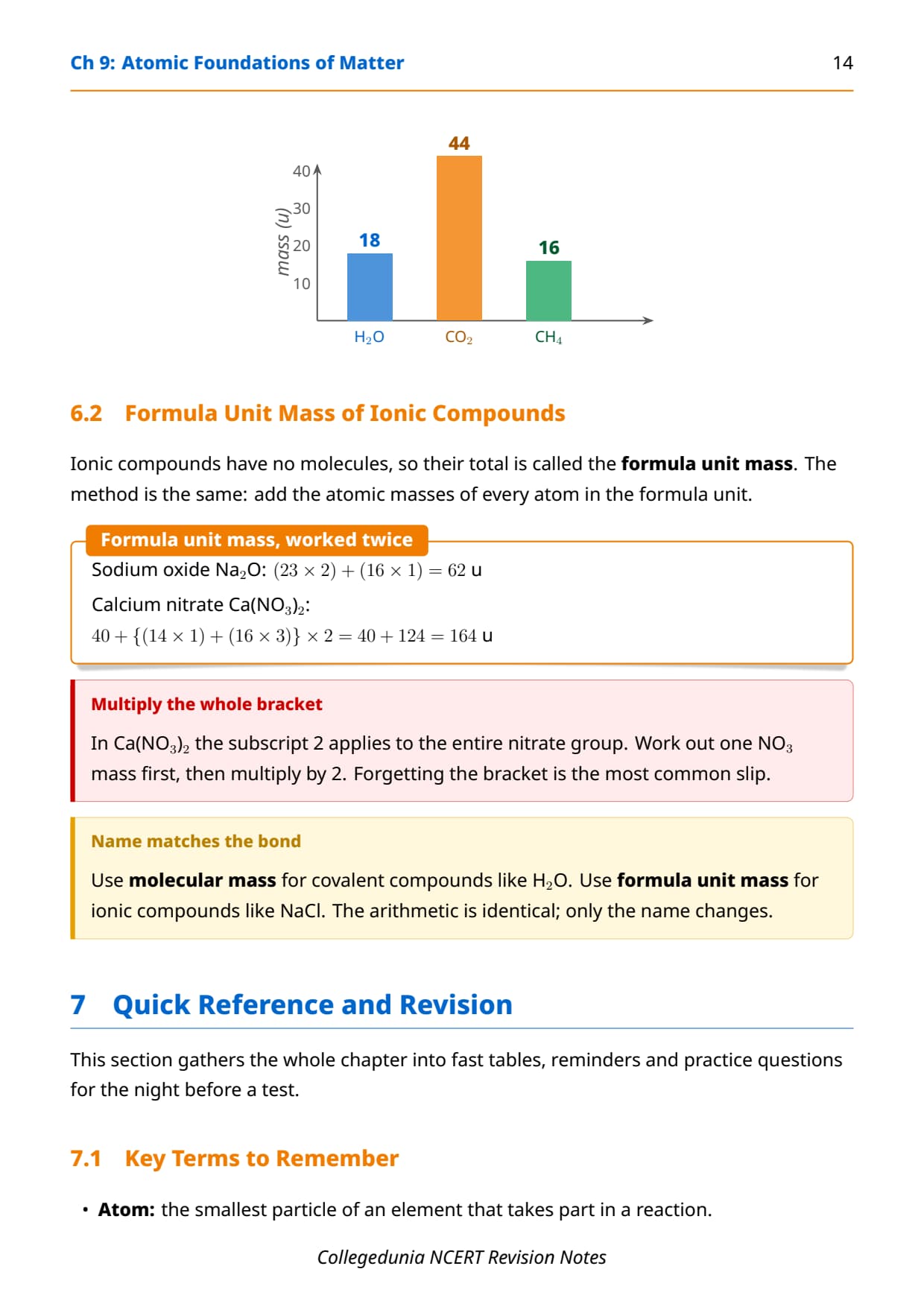
- Molecular mass: add the atomic masses of all atoms in a molecule of a covalent compound.
- Formula unit mass: add the atomic masses of all atoms in one formula unit of an ionic compound, since ionic compounds do not form molecules.
| Compound | Working | Mass |
|---|---|---|
| Water, H2O | (1 × 2) + (16 × 1) | 18 u |
| Carbon dioxide, CO2 | (12 × 1) + (16 × 2) | 44 u |
| Sodium oxide, Na2O | (23 × 2) + (16 × 1) | 62 u |
Properties of Ionic and Covalent Compounds Class 9 Notes
The chapter ends with a simple experiment on how these two types of compounds behave. This is easy to revise and often asked as a reasoning question.
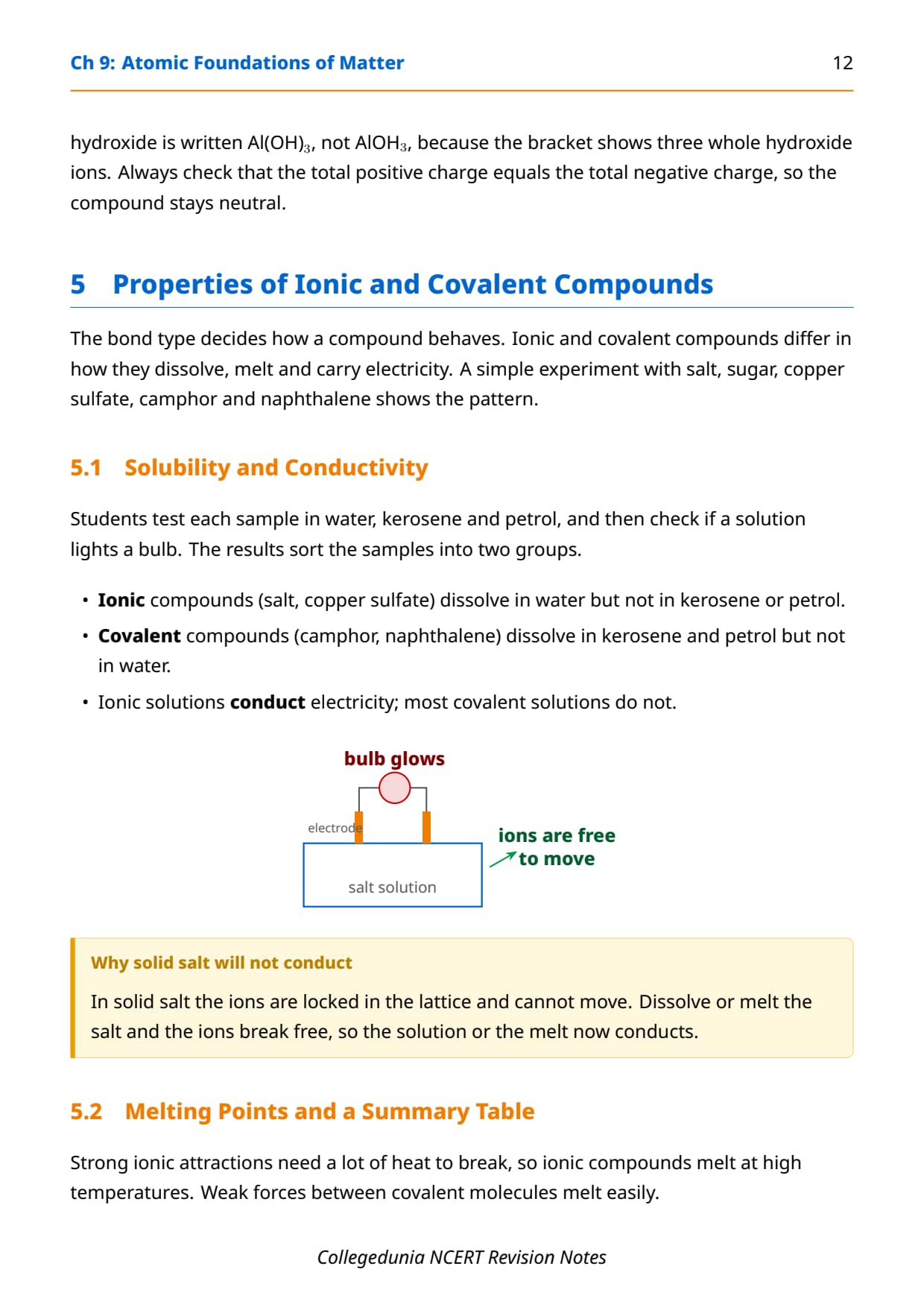
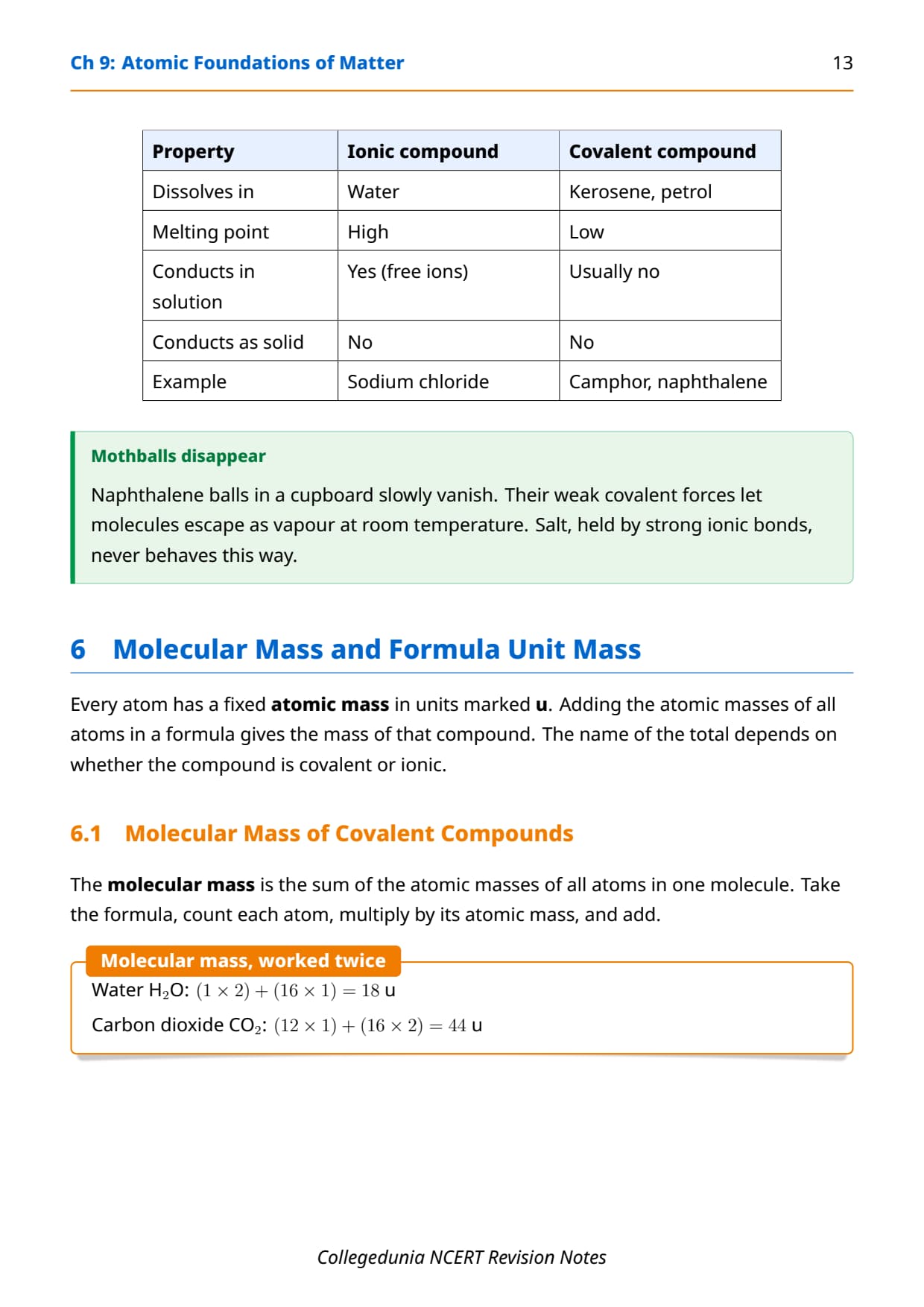
- Ionic compounds (like NaCl, copper sulfate) dissolve in water, have high melting and boiling points, and conduct electricity when dissolved or molten, because their ions become free to move.
- Covalent compounds (like camphor, naphthalene) dissolve in kerosene or petrol, have low melting and boiling points, and usually do not conduct electricity.
- Sugar dissolves in water but does not conduct, because it does not give ions in solution.
Common Mistakes and Quick Revision Tips for Atomic Foundations of Matter
Most lost marks in this chapter come from small slips, not hard ideas. Fix these while you revise and your answers stay clean.
- Confusing a cation (loses electrons, positive) with an anion (gains electrons, negative).
- Forgetting to divide the criss-cross subscripts by a common factor, so writing Mg2O2 instead of MgO.
- Missing the atoms inside brackets when finding formula unit mass.
- Applying the law of constant proportions to a mixture, which has no fixed ratio.
How Collegedunia Notes Help You Revise Atomic Foundations of Matter
Collegedunia gives you the full NCERT Notes Class 9 Science Chapter 9 Atomic Foundations of Matter as clean, short, easy-to-read revision in one place.
- 2026-27 Exploration match: every note follows the new textbook and the Revise, Reflect, Refine flow.
- Simple English: short lines and everyday words, so a Class 9 student can revise without help.
- Formula and table ready: the criss-cross method, molecular mass values, and the ionic versus covalent table in one view.
- Free PDF: download the notes and revise offline before your exam.
More Atomic Foundations of Matter Class 9 Science Resources
| Resource | Open |
|---|---|
| Revision Notes | Atomic Foundations of Matter Class 9 Science Notes |
| NCERT Solutions | Atomic Foundations of Matter Class 9 Science NCERT Solutions |
| Handwritten Notes | Atomic Foundations of Matter Class 9 Science Handwritten Notes |
| Formula Sheet | Atomic Foundations of Matter Class 9 Science Formula Sheet |
| NCERT Book PDF | Atomic Foundations of Matter Class 9 Science NCERT Book PDF |
NCERT Notes for Class 9 Science: All Chapters
Use the table below to open the NCERT Notes for any other chapter of the new Class 9 Science Exploration book.
| Chapter | NCERT Notes |
|---|---|
| Chapter 2 | Cell The Building Block of Life |
| Chapter 3 | Tissues in Action |
| Chapter 4 | Describing Motion Around Us |
| Chapter 5 | Exploring Mixtures and their Separation |
| Chapter 6 | How Forces Affect Motion |
| Chapter 7 | Work, Energy, and Simple Machines |
| Chapter 8 | Journey Inside the Atom |
| Chapter 9 | Atomic Foundations of Matter |
| Chapter 10 | Sound Waves Characteristics and Applications |
| Chapter 11 | Reproduction How Life Continues |
| Chapter 12 | Patterns in Life Diversity and Classification |
| Chapter 13 | Earth as a System Energy, Matter, and Life |
Atomic Foundations of Matter Class 9 Science Notes FAQs
Ques. Where can I download the NCERT Notes Class 9 Science Chapter 9 Atomic Foundations of Matter PDF?
Ans. You can download the Atomic Foundations of Matter Notes PDF free from this page. Both the Normal and HD versions match the 2026-27 Exploration book.
Ques. What topics do the Class 9 Science Chapter 9 notes cover?
Ans. The notes cover the law of conservation of mass, the law of constant proportions, Dalton's atomic theory, covalent and ionic bonds, writing chemical formulae, and molecular mass and formula unit mass.
Ques. What is the difference between a covalent bond and an ionic bond?
Ans. A covalent bond forms when atoms share electron pairs, usually between two non-metals. An ionic bond forms when one atom transfers electrons to another, usually between a metal and a non-metal, creating cations and anions.
Ques. How do I find the molecular mass of a compound in Chapter 9?
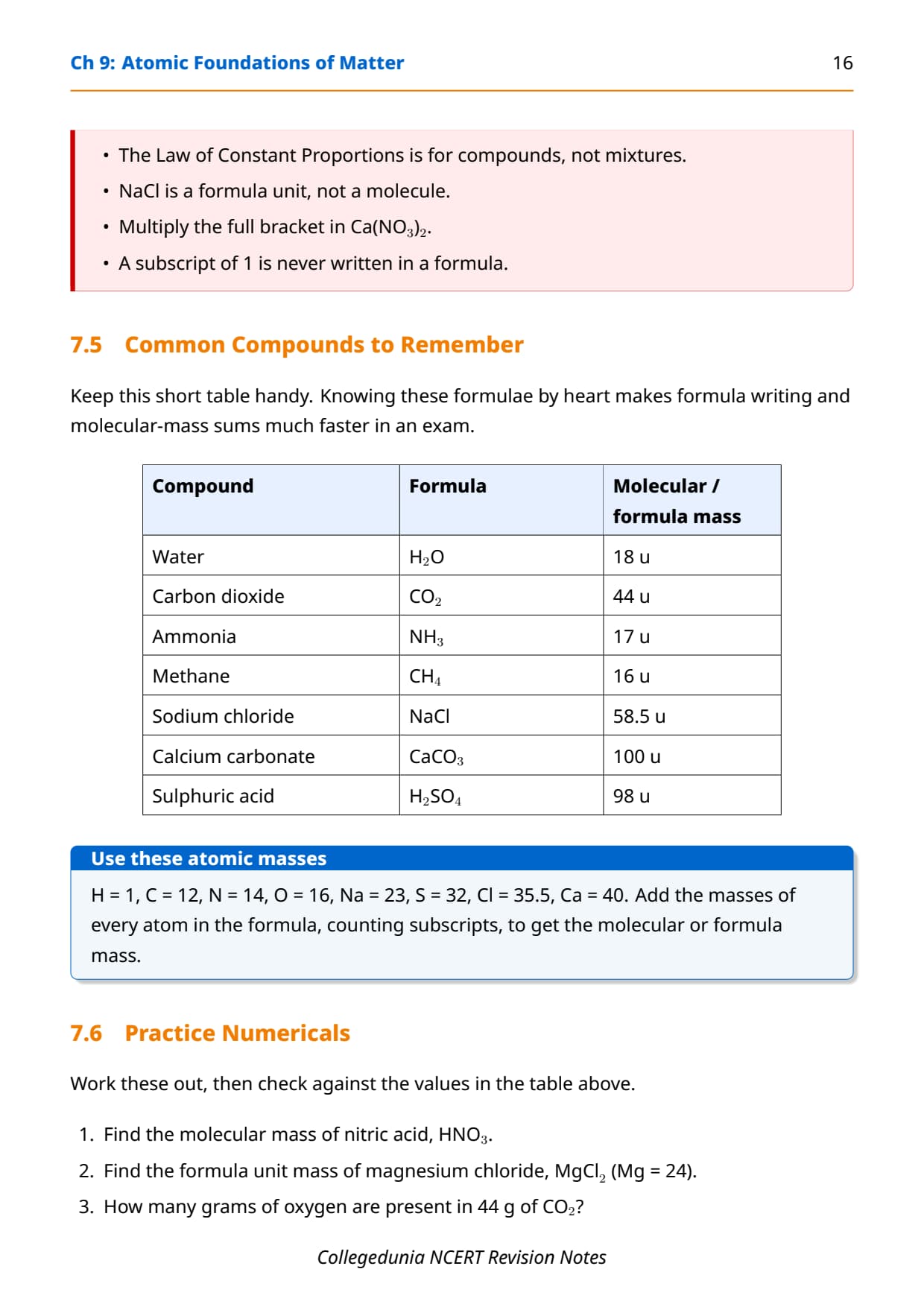
Ans. Add the atomic masses of all atoms in one molecule. For water H2O, molecular mass = (1 × 2) + (16 × 1) = 18 u.
Ques. Is Chapter 9 part of the new Class 9 Science book?
Ans. Yes. Atomic Foundations of Matter is Chapter 9 of the new Exploration textbook for the 2026-27 syllabus. It is a core base chapter for later chemistry topics like reactions and the mole concept.



Comments