




The handwritten notes on Class 12 Fine Arts Chapter 1 The Mughal School of Miniature Painting have been carefully prepared for quick one-shot revision, according to the 2026-27 NCERT print of An Introduction to Indian Art Part 2.
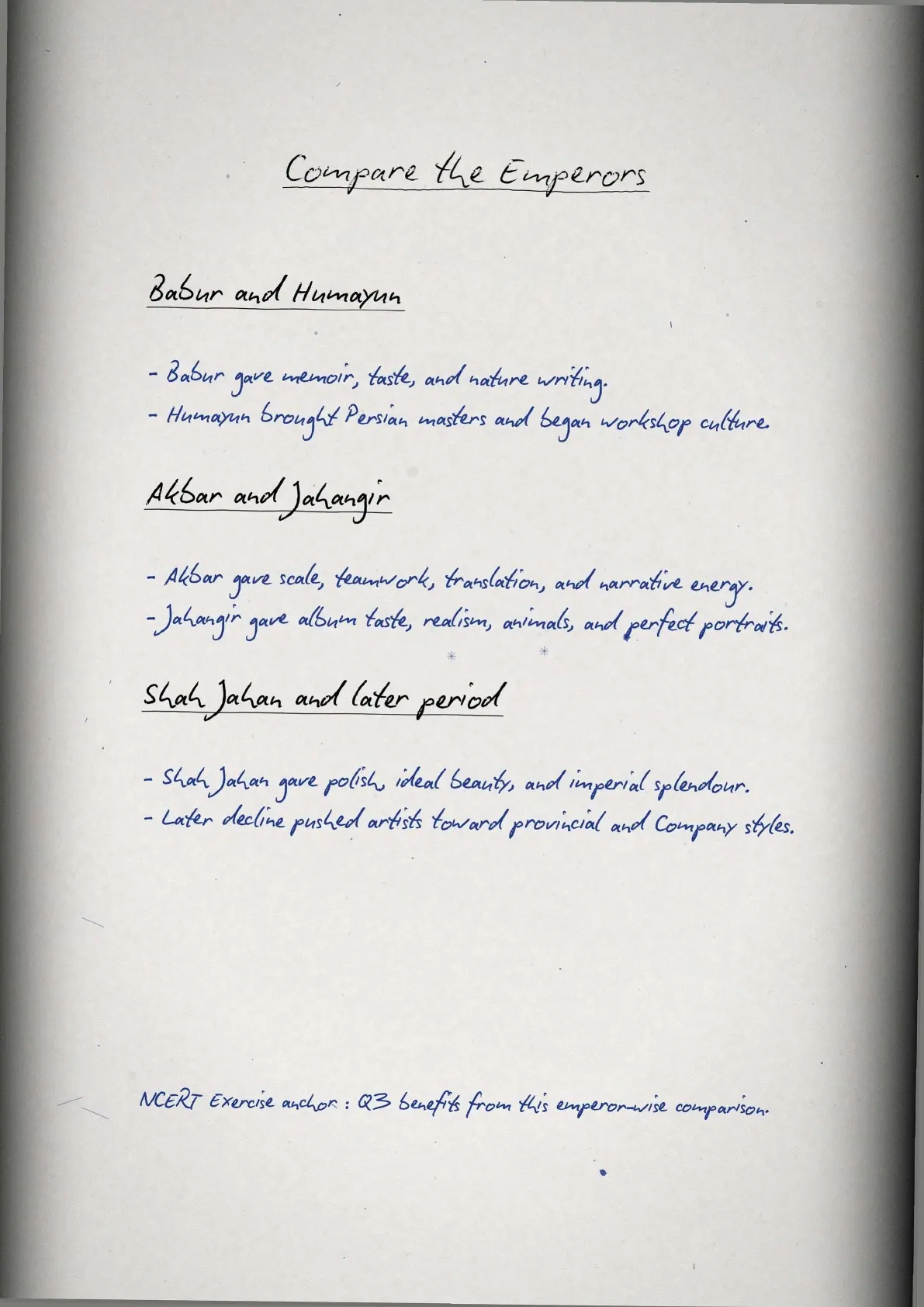
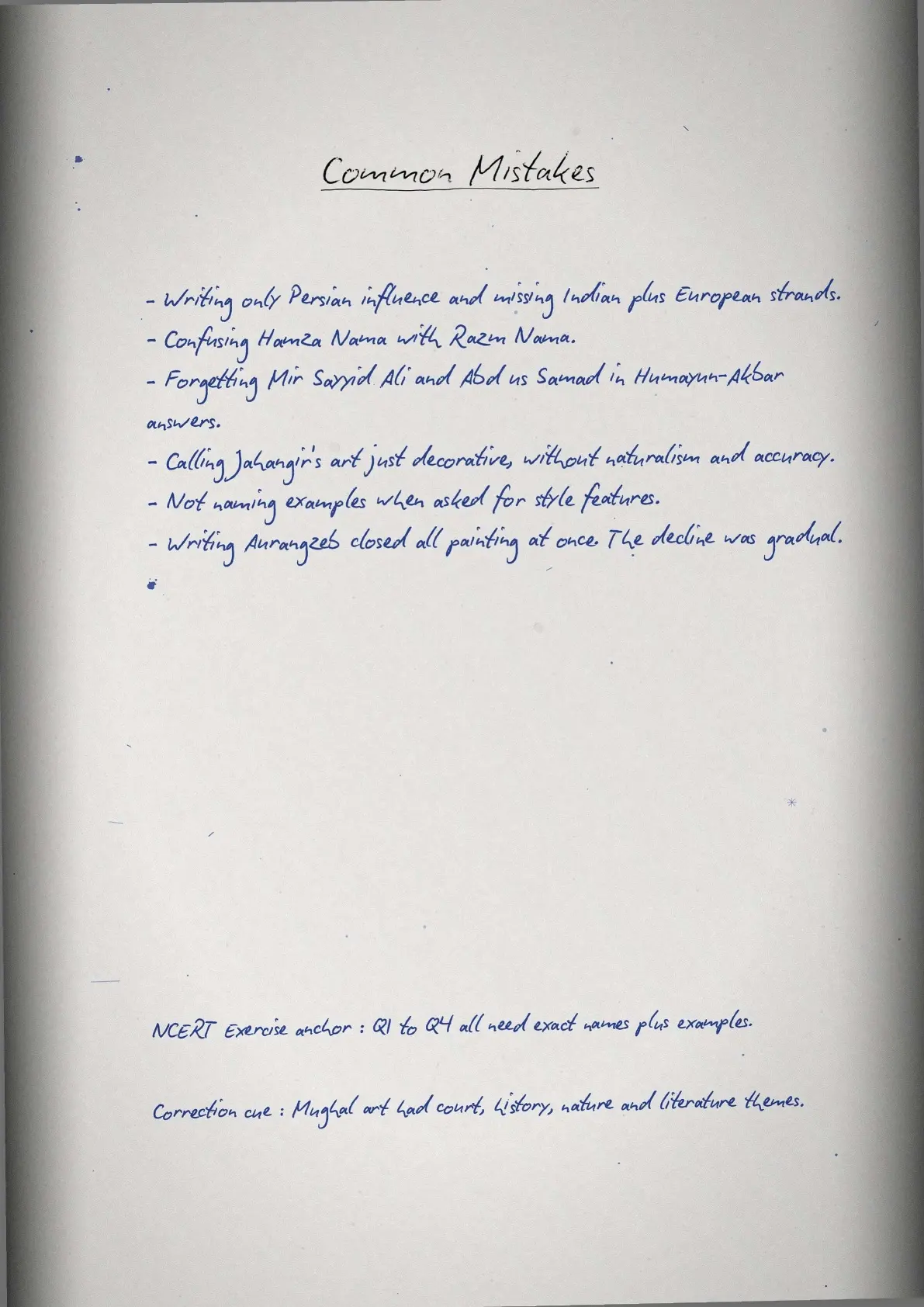
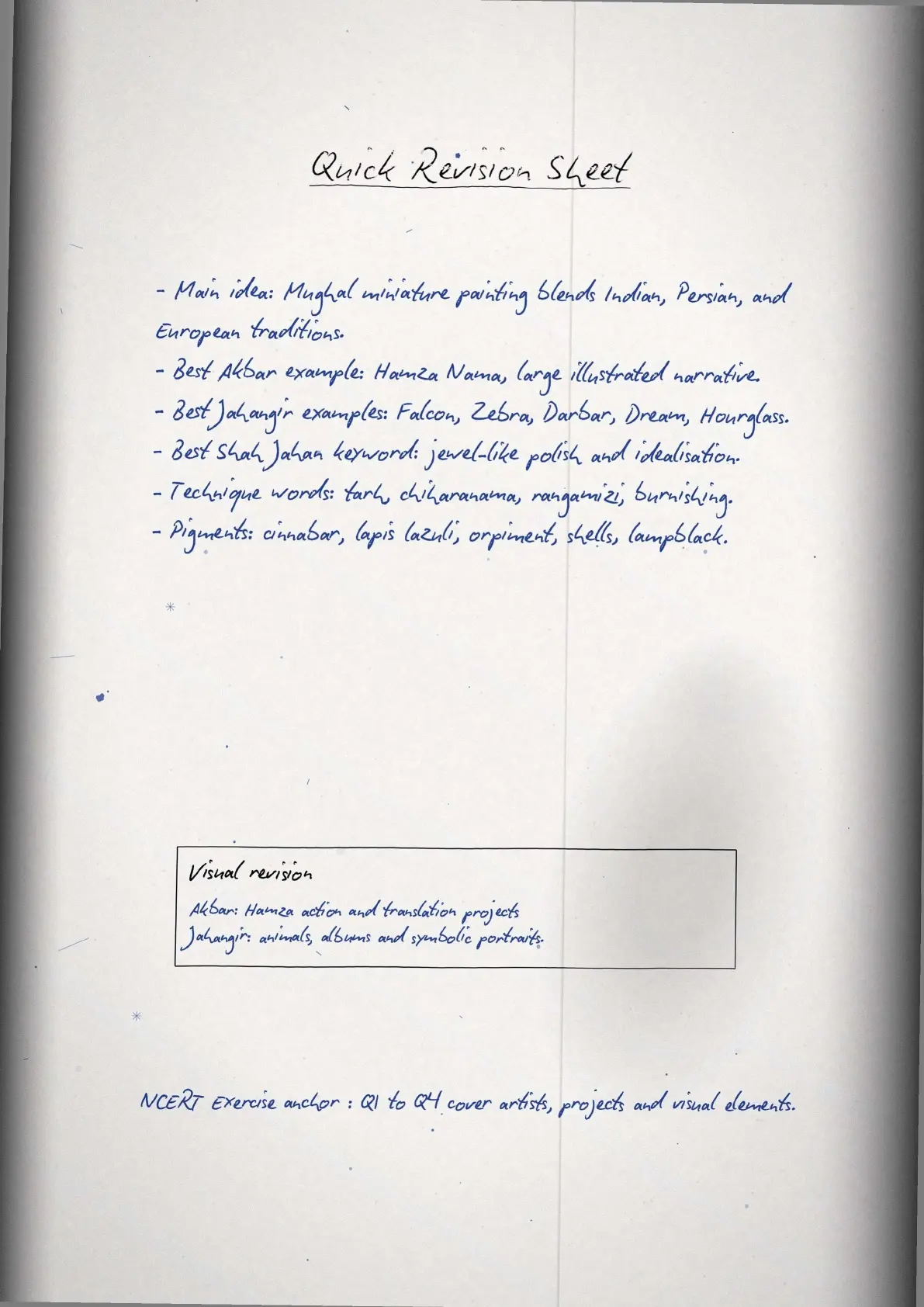
- Covers Mughal painting from 1526 to the mid nineteenth century, and its slide into the Provincial and Company styles.
- Artist names you must spell right: Mir Sayyid Ali, Abd us Samad, Daswant, Basawan, Miskin, Abul Hasan, Bichitra, Ustad Mansur.
- Ends with 4 NCERT exercise questions, 1 student project and 5 full page paintings set for appreciation answers.
Every fact in these Mughal School of Miniature Painting handwritten notes is taken from the official NCERT chapter, checked line by line against the Reprint 2026-27 text, and arranged by Collegedunia Fine Arts teachers in the order the CBSE theory paper asks for it.
Read the printed chapter alongside these handwritten notes
The official NCERT chapter from An Introduction to Indian Art Part 2, Reprint 2026-27, with every plate and caption.
What the Mughal School of Miniature Painting Notes Cover for Class 12 Fine Arts
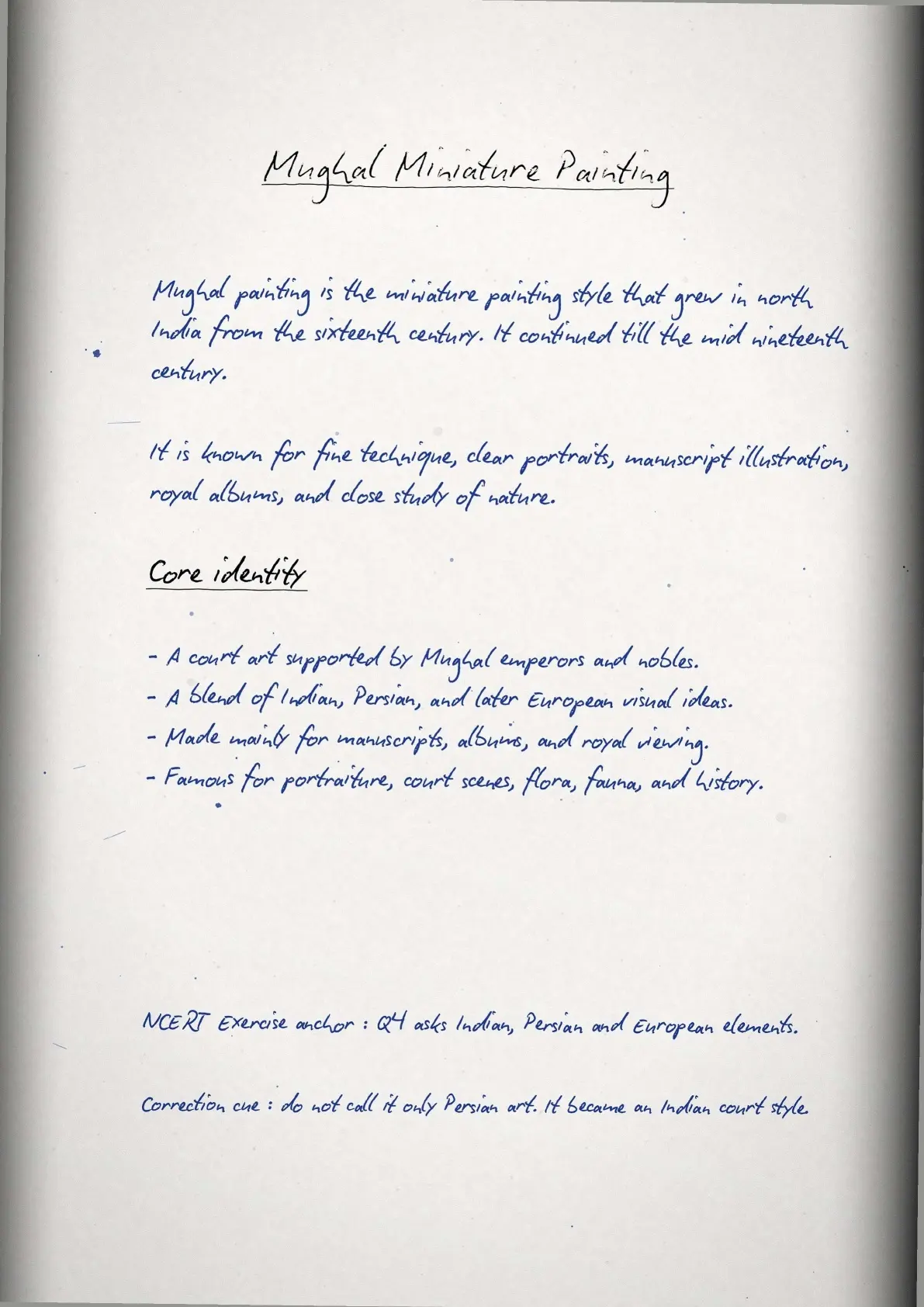
Mughal painting is the style of miniature painting that grew in the northern Indian subcontinent in the sixteenth century and ran on until the mid nineteenth century. It is known for its refined technique and its wide range of subjects. The chapter moves in a straight line from one patron to the next, so learn it in that order.
| Block in the chapter | What you must remember | Question type it feeds |
|---|---|---|
| Opening on Mughal painting | Definition, the sixteenth to mid nineteenth century span, and why the style holds a fixed place among Indian schools | 1 mark, 2 marks |
| Influences on Mughal Painting | The blend of indigenous, Persian and later European visual culture inside one atelier | 5 marks |
| Early Mughal Painting | Babur, Humayun, Mir Sayyid Ali, Abd us Samad and the Nigaar Khana | 3 marks, 5 marks |
| Akbar to Aurangzeb | Hamza Nama, Razm Nama, Akbar Nama, the muraqqa albums, Padshahnama, the decline | 5 marks, appreciation |
| Later Mughal Painting | Provincial patrons, Bahadur Shah Zafar, the merge into Provincial and Company styles | 2 marks, 3 marks |
| Process, Colours and Technique | Tarh, chihara-nama, rangamizi, natural pigments, squirrel hair brushes, the agate burnish | 3 marks |
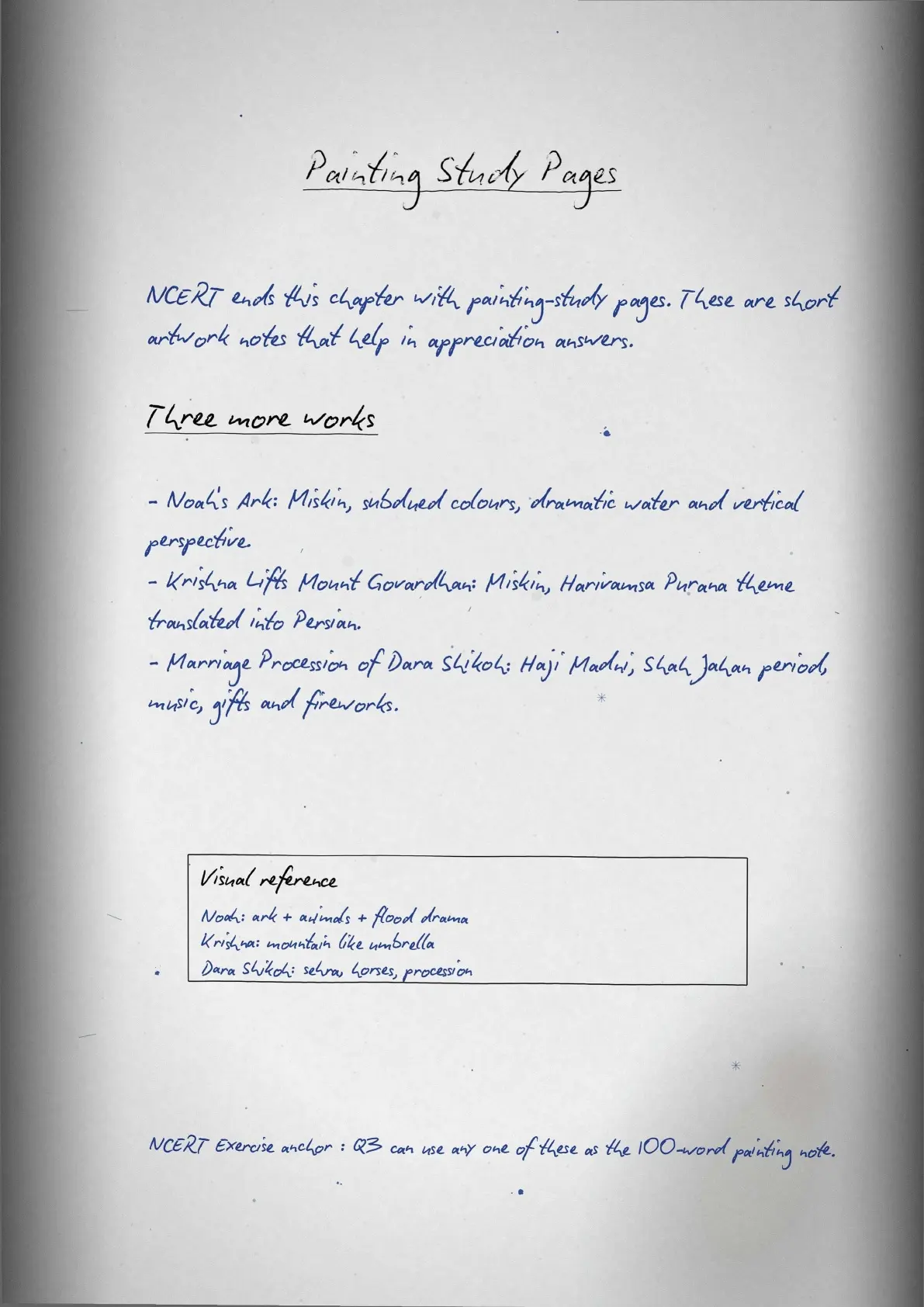
The chapter closes with five painting appreciations that sit after the exercise: Noah's Ark, Krishna Lifts Mount Govardhan, Falcon Perched on a Bird Rest, Zebra and The Marriage Procession of Dara Shikoh. Picture based questions come from these plates, so do not stop reading at the exercise.
Influences on Mughal Painting: How Persian, Indian and European Styles Met in One Atelier
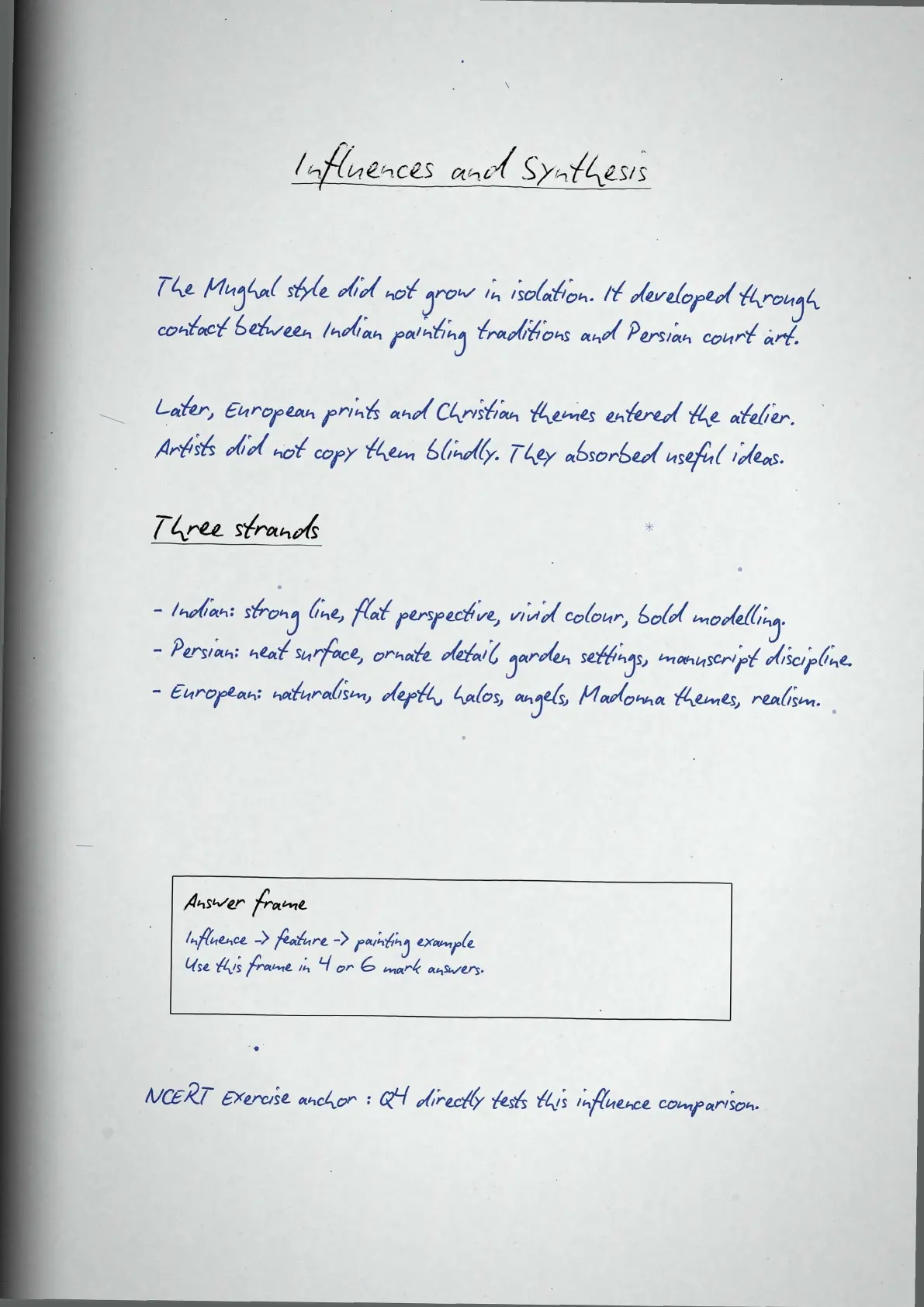
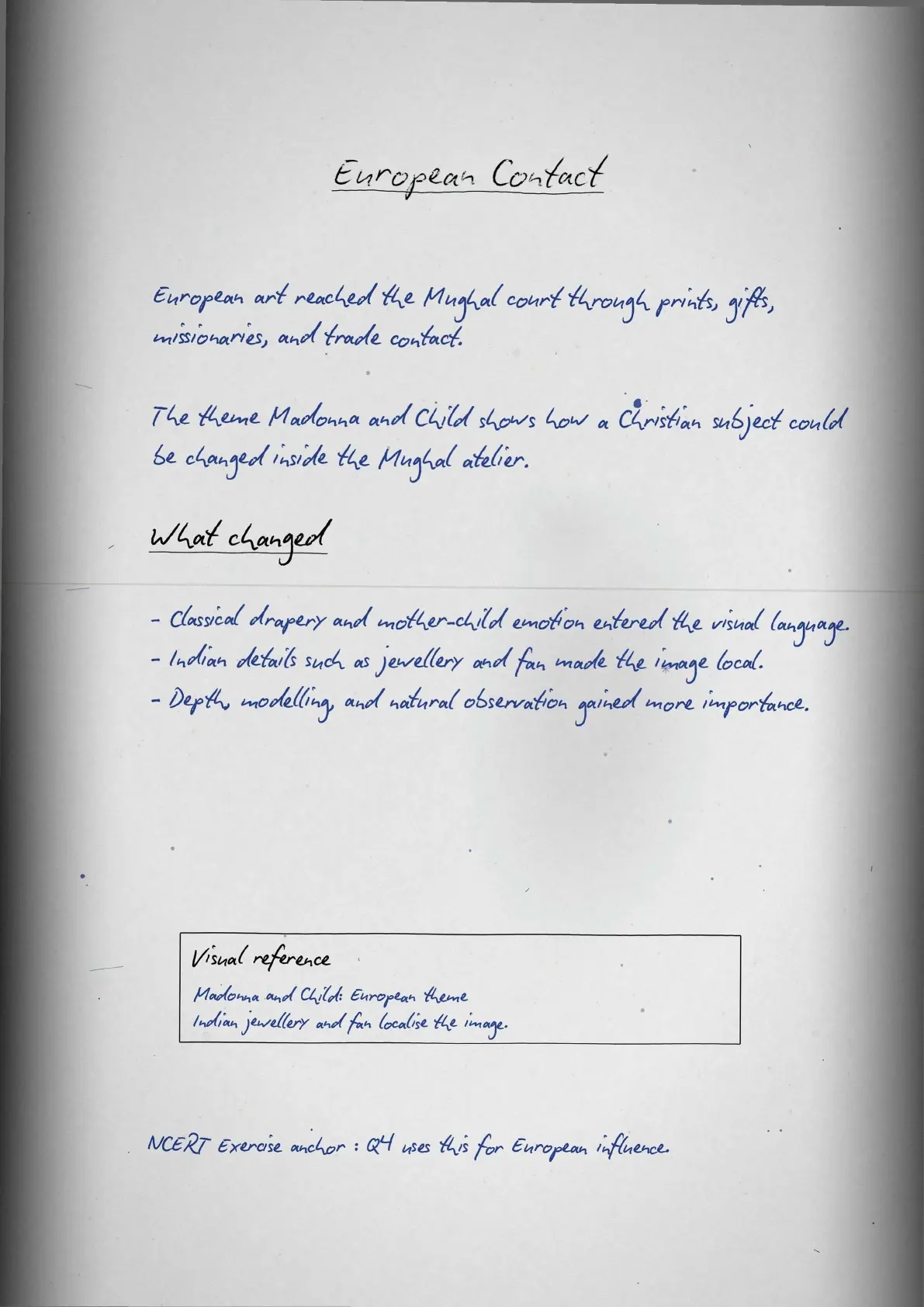
The chapter makes one central claim. The Mughal style did not grow in a vacuum. It grew because Iranian and Indian artists worked in the same royal workshop, and later because European gifts reached the court. The peak of Mughal painting is a blend of Islamic, Hindu and European visual culture.
- Indigenous Indian style: flat perspective, strong use of lines, a vivid colour palette, bold modelling of figures and architecture.
- Mughal style: subtlety and finesse, almost three dimensional figures, and what the chapter calls optical reality.
- Persian arrival: artists brought from Iran into formal court workshops, giving the early years a strong Indo-Iranian character.
- European entry: Christian themes, haloes, winged angels and humanist mother and child compositions, arriving as gifts.
- Favourite Mughal subjects: royal court scenes, portraits, and accurate flora and fauna.
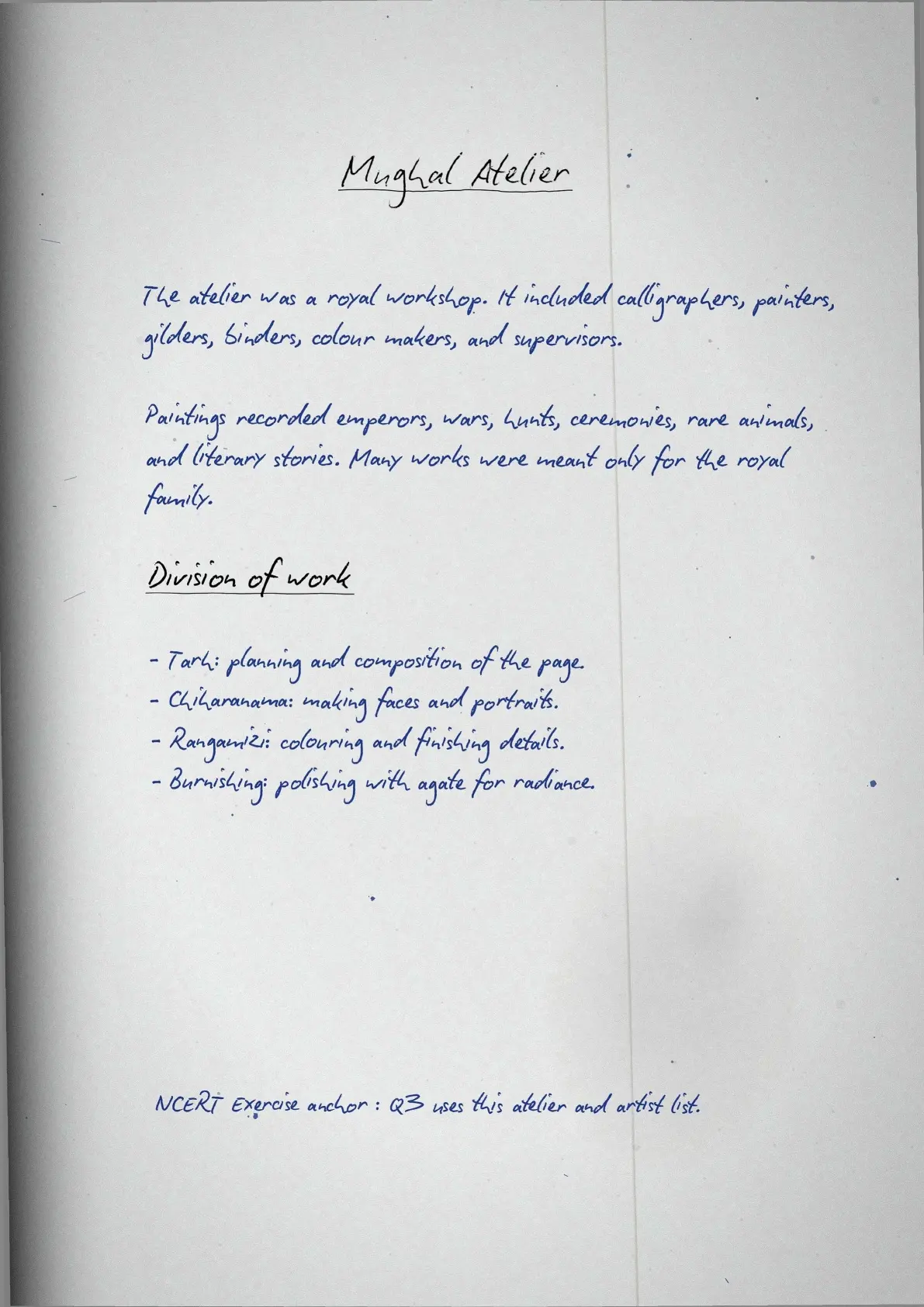
The Mughal atelier held calligraphers, painters, gilders and binders. The paintings were made for the royal family alone. They lived inside manuscripts and albums, not on walls, and they recorded events, personalities and the interests of the emperor.
Mughal Miniature Painting Explained in One Sitting
Source: Study Box on YouTube
Early Mughal Painting Under Babur and Humayun and the Two Persian Masters
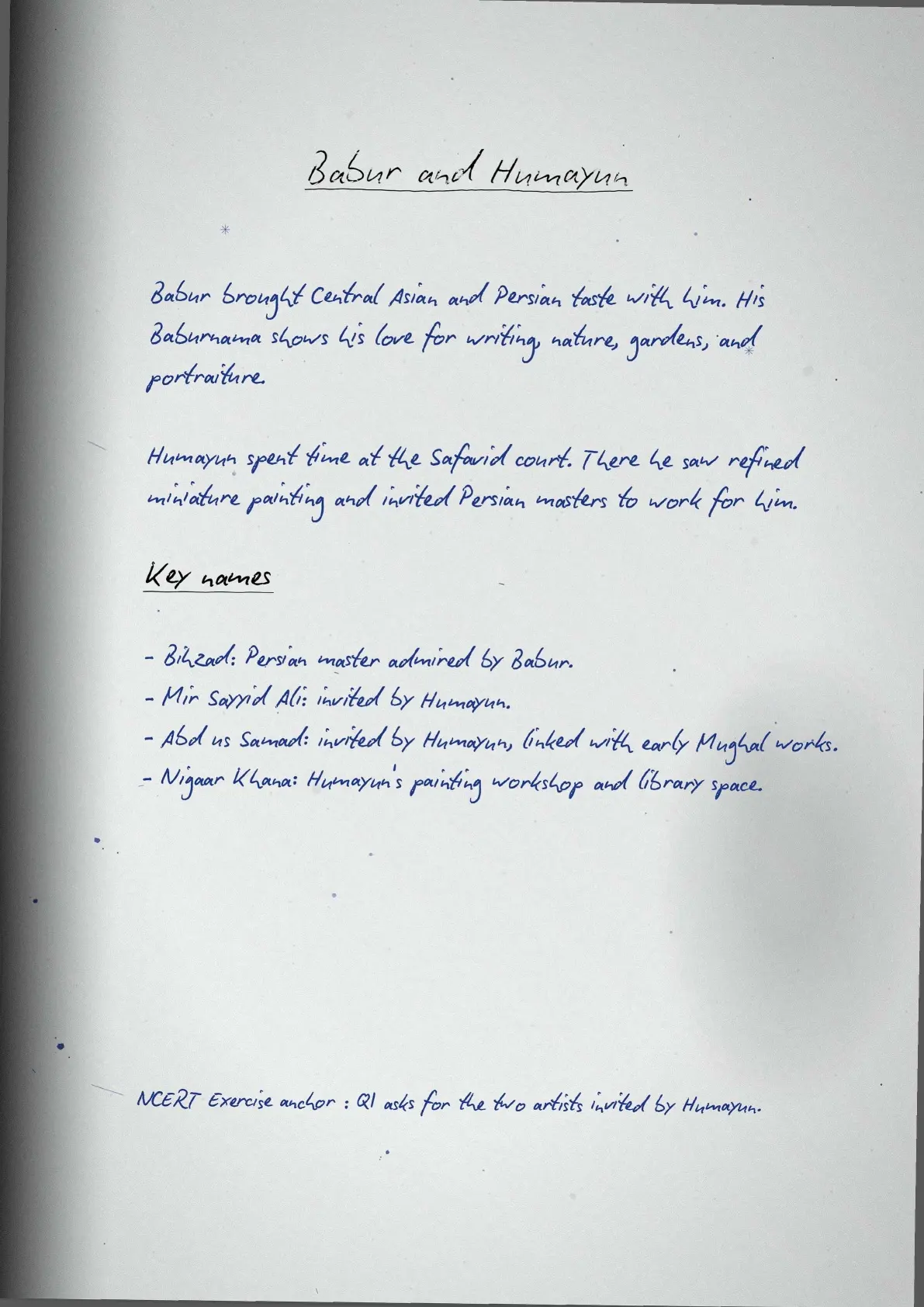
Babur reached India in 1526 from present day Uzbekistan. He was a descendant of Timur and a Chaghatai Turk, so he carried the taste of Persia and Central Asia with him. His autobiography, Baburnama, began the Mughal habit of keeping memoirs that every successor followed.
- Bihzad, the master of the Persian school at Herat, is praised in Babur's memoirs for fine compositions and colour tints, but faulted for drawing faces poorly and lengthening the double chin, the ghab-ghab.
- Shah Muzaffar is named as a painter who excelled at hairstyle.
- Humayun succeeded Babur in 1530, lost the throne to the Afghan Sher Khan, and took refuge with the Safavid ruler Shah Tahmasp.
- Humayun set up his court in Kabul in 1545 and brought master artists back to India when he regained power.
- He invited two Persian artists, Mir Sayyid Ali and Abd us Samad, both respected for portraiture, to run a studio at his court.
Humayun founded the Nigaar Khana, the painting workshop attached to his library. Little is known about its size, but we know he started the Hamza Nama illustration project that his son Akbar later finished. Humayun's exile in Persia is the single accident that gave India the Mughal atelier.
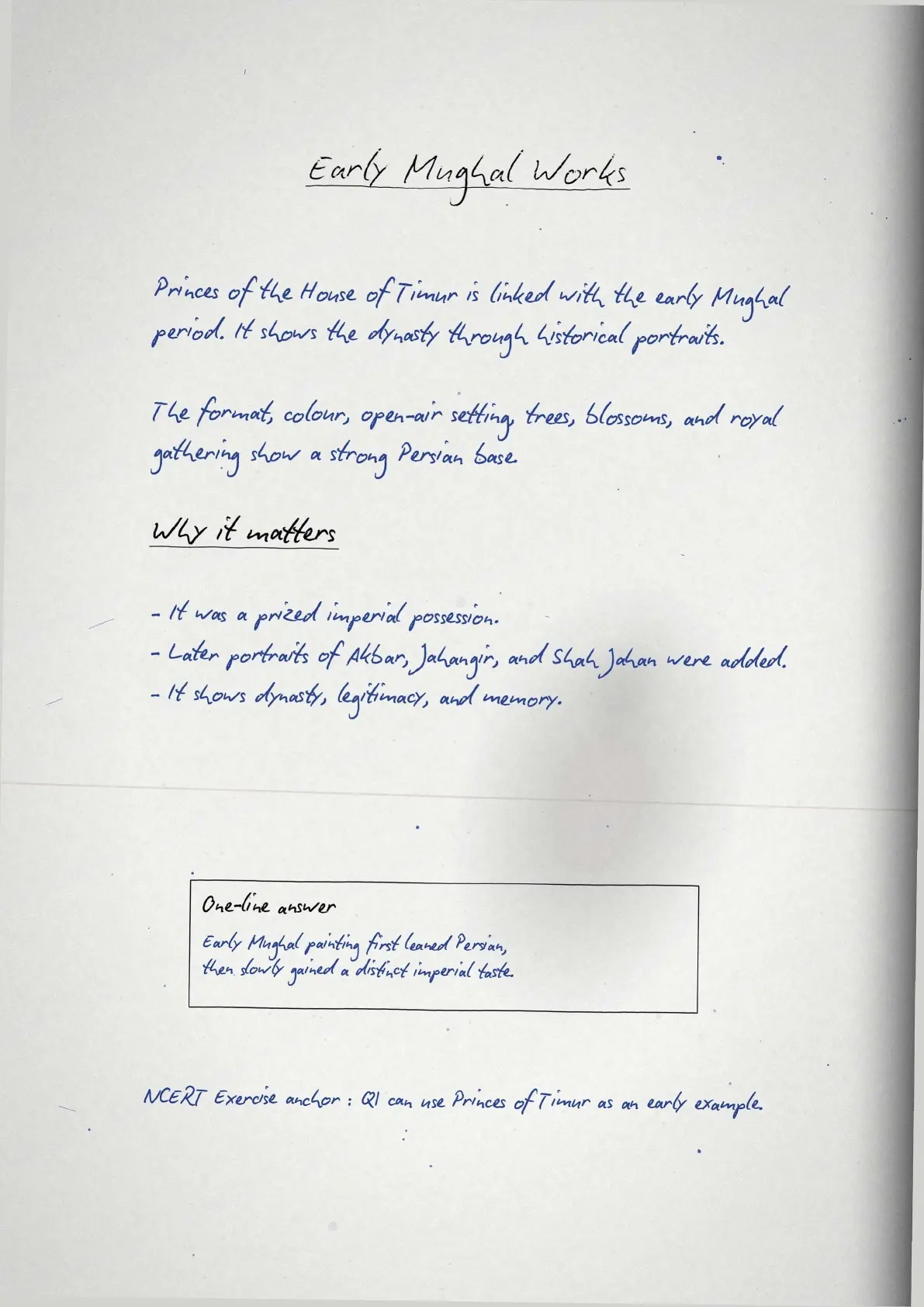
The best early painting to quote is Princes of the House of Timur, dated 1545 to 1550, probably by Abd us Samad, in opaque watercolour on cotton, now in the British Museum, London. Later portraits were painted over the original, so the faces of Akbar, Jahangir and Shah Jahan sit on top of the Humayun period work. The format, theme, figures and palette are still strongly Persian.
Akbar's Ateliers: Hamza Nama, Razm Nama and the Artists Who Built the Mughal Idiom
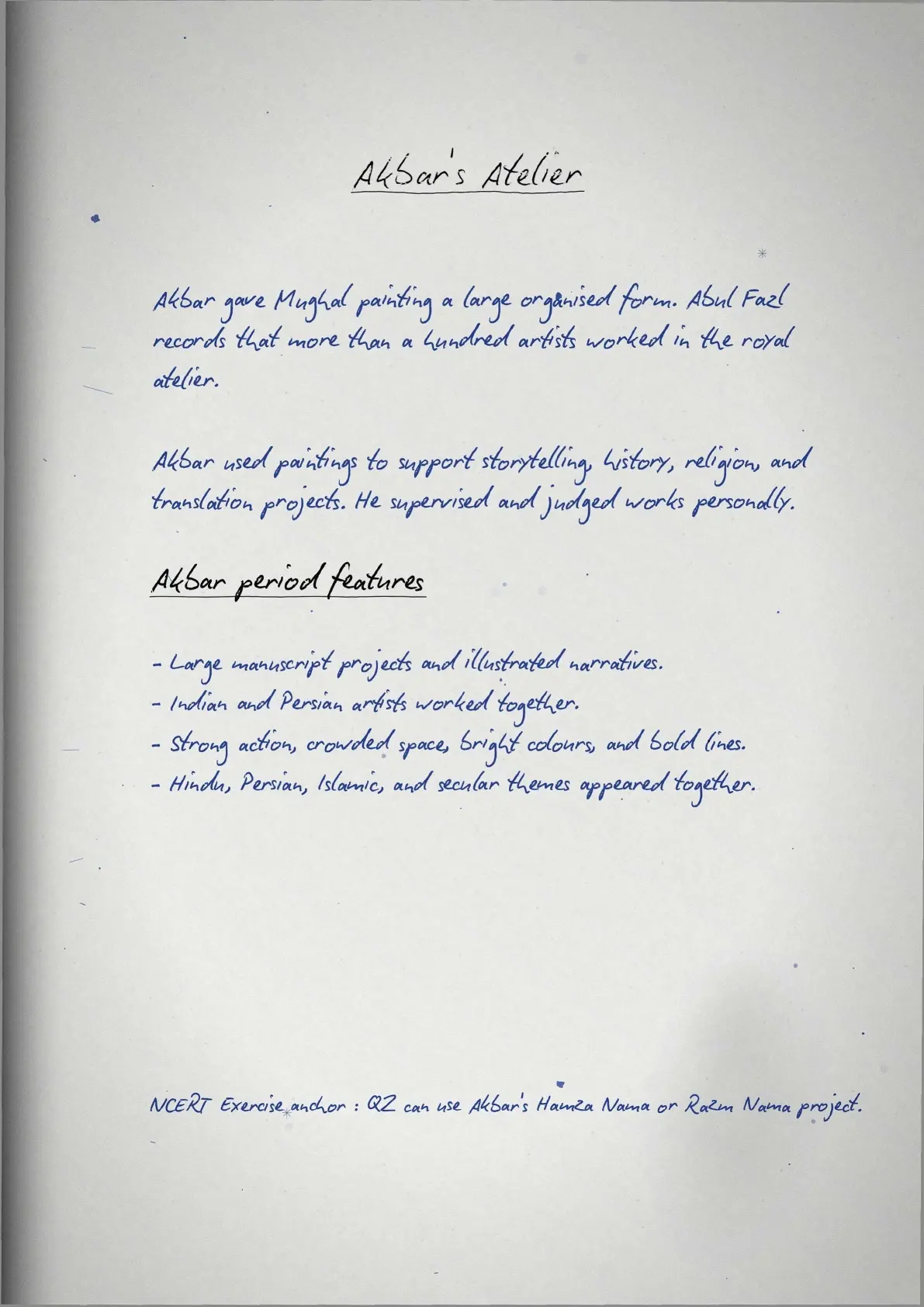
Akbar ruled from 1556 to 1605 and turned his father's workshop into a factory of manuscripts. His court historian Abul Fazl records that more than a hundred artists worked in the royal atelier, both Persian and Indian. Akbar is believed to have had dyslexia, so he leaned hard on illustrated manuscripts and had stories read aloud to him.
| Project | What it is | Facts examiners ask for |
|---|---|---|
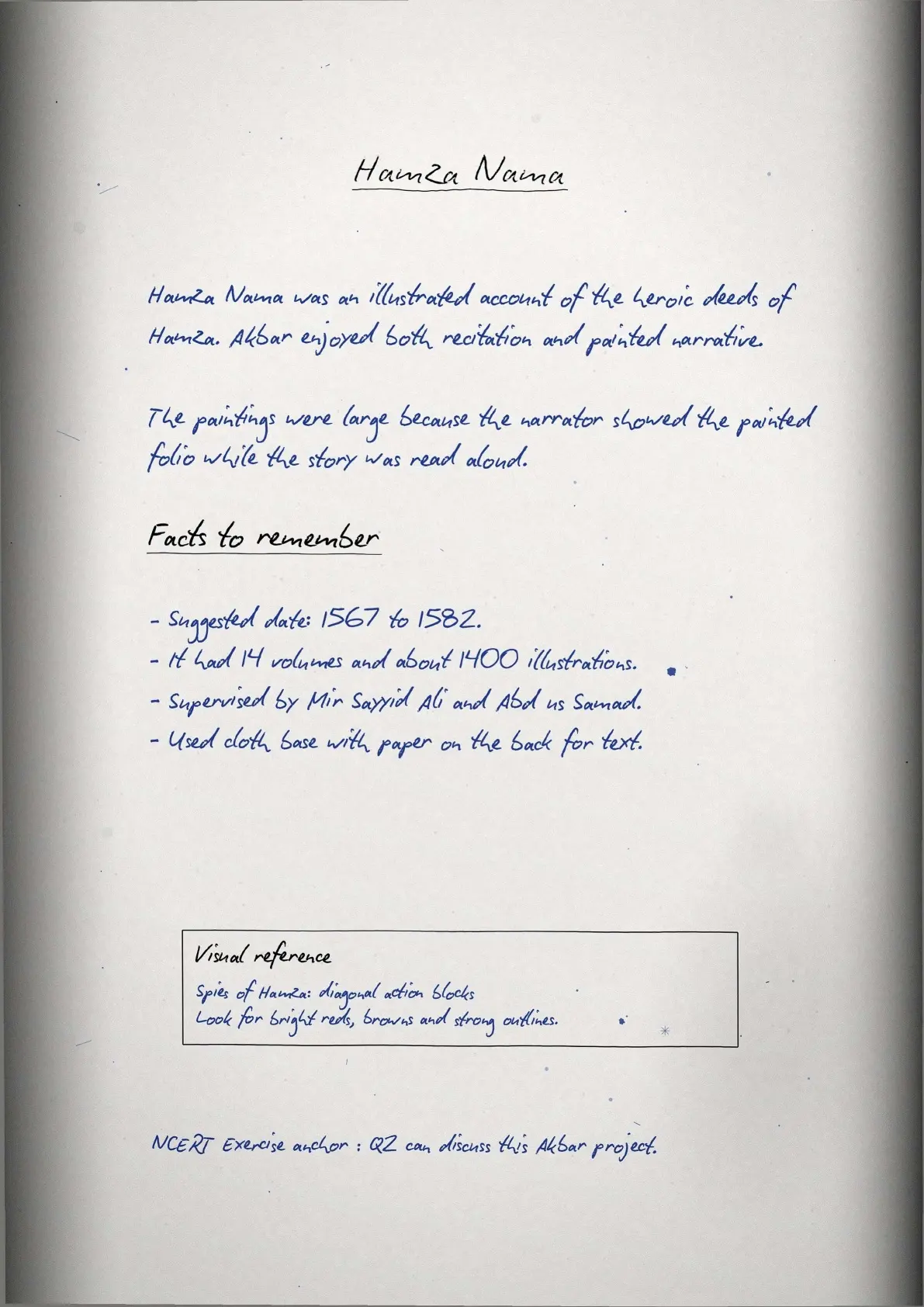
| Hamza Nama | Illustrated account of the heroic deeds of Hamza, uncle of Prophet Muhammad | 14 volumes, 1400 illustrations, nearly 15 years, dated 1567 to 1582, supervised by Mir Sayyid Ali and Abd us Samad |
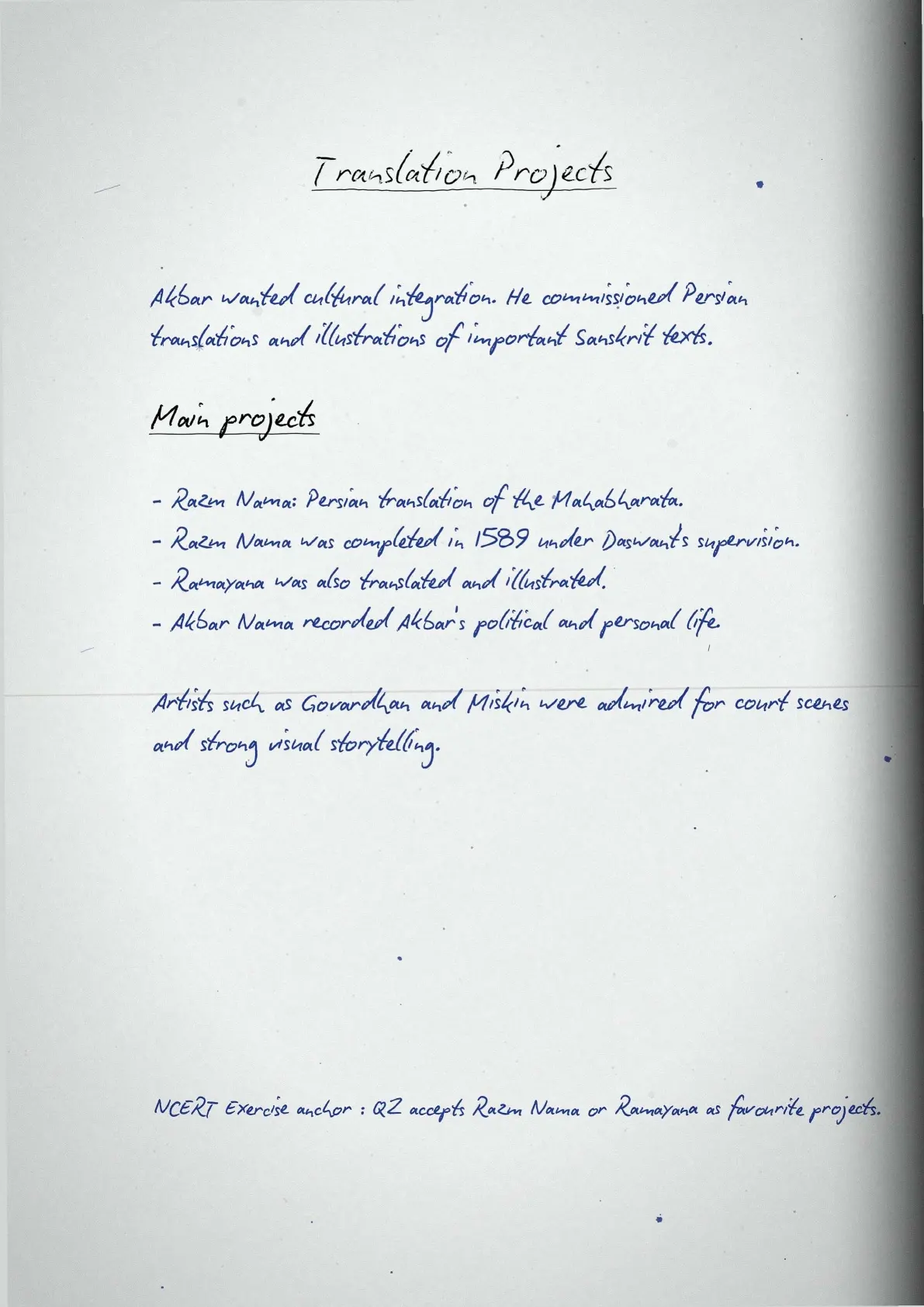
| Razm Nama | Persian translation and illustrated version of the Mahabharata | Completed 1589 under master artist Daswant, 169 paintings, ornate calligraphy |
| Ramayana | Sanskrit epic translated and illustrated around the same time | Part of Akbar's plan of cultural integration |
| Akbar Nama | Detailed account of Akbar's political and personal life | One of the most expensive projects Akbar undertook |
| Madonna and Child | Opaque watercolour on paper on a European theme | Dated 1580 in the chapter text, the plate is captioned to Basawan, San Diego Museum of Art |
The Hamza Nama was made to be shown while a narrator read aloud, so its format is large. The base surface is cloth with paper behind it, the text is written on the back for the narrator, and the technique is gouache, water based and opaque. The folios are now scattered across collections worldwide.
For a full appreciation answer, use Spies of Hamza Attack the City of Kaymar, dated 1567 to 1582, in the Museum of Applied Arts, Vienna. The points to write are fixed:
- Space is sharply cut and divided so the eye can read the narrative in order.
- A great deal of action is packed in, and vibrant colours carry the energy of the attack.
- A strong outer line defines the foliage and other forms.
- Faces are largely in profile, though three fourth faces also appear.
- Persian sources: the rich patterns on floor, columns and canopy, the four limbed animals and the rocks.
- Indian sources: the trees and creepers, and the palette of pure yellows, reds and browns.
Two more artist names belong here. Govardhan and Miskin were celebrated for court scenes, and Miskin is the artist behind two of the appreciation plates. Akbar personally engaged with his artists, supervised the work and judged it, which is why the chapter treats him as the emperor who formalised the Mughal style.
Jahangir's Naturalism and Portraiture: Ustad Mansur, Abul Hasan and the Album Page
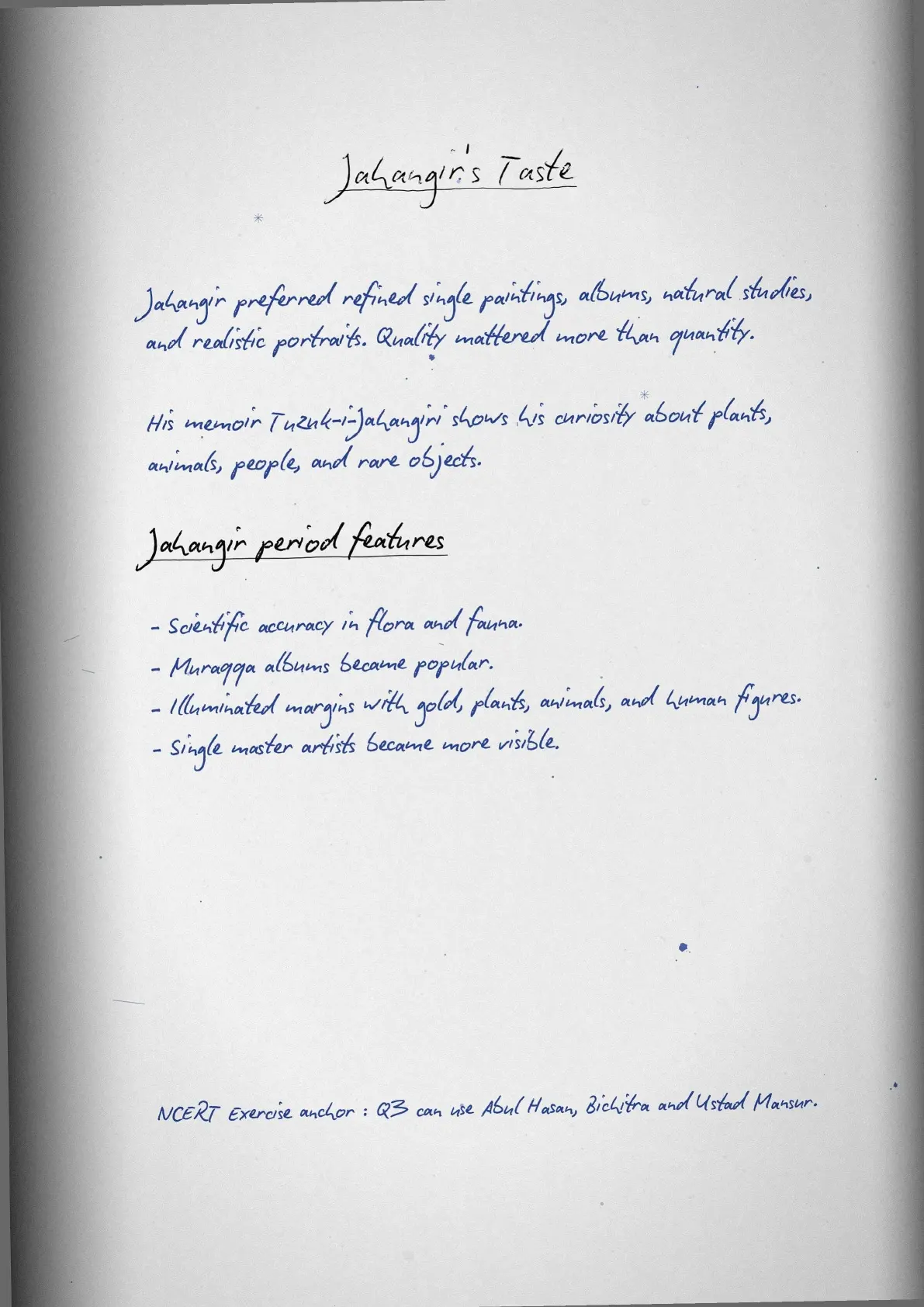
Jahangir ruled from 1605 to 1627. As Prince Salim he already had a curious eye and set up his own atelier alongside his father's. He took the title Jahangir, the World Seizer, on gaining the throne. His memoirs, the Tuzuk-i-Jahangiri, record his hunt for scientific correctness in flora and fauna.
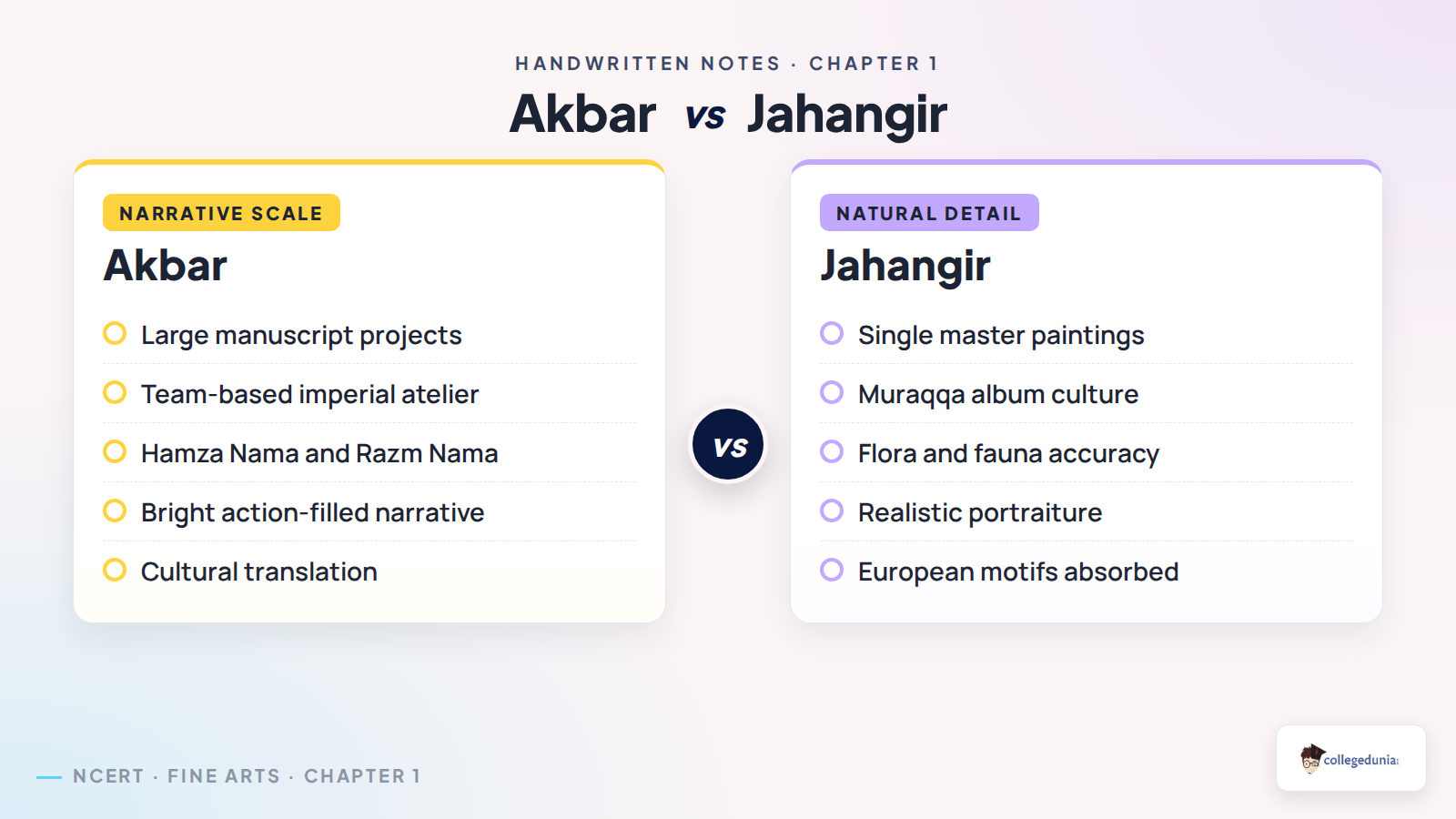
The shift from Akbar to Jahangir is the most asked comparison in this chapter. Akbar's atelier mass produced narrative manuscripts, Jahangir's atelier made fewer works of higher quality by a single master artist.
| Point of comparison | Akbar period | Jahangir period |
|---|---|---|
| Output | Mass produced, team based manuscripts | Fewer works, better quality, often one master artist |
| Subject | War scenes, conquests, narrative, translated epics | Lavish court scenes, portraits, character traits, flora and fauna |
| Format | Illustrated bound manuscripts | Muraqqa, single paintings mounted in albums |
| Margins | Plain borders | Illuminated in gold with flora, fauna and poised human figures |
| Key artists | Daswant, Basawan, Miskin, Govardhan | Aqa Riza, Abul Hasan, Manohar, Bichitra, Ustad Mansur |
Jahangir employed Aqa Riza, a well known Iranian painter, and his son Abul Hasan. European paintings and decorative objects arrived as gifts, and contact with the English Crown pushed European motifs deeper into the Indo-Iranian style. The result is what the chapter calls a melting pot of three styles, indigenous, Persian and European.
Three named Jahangir period paintings carry almost all the marks in this section:
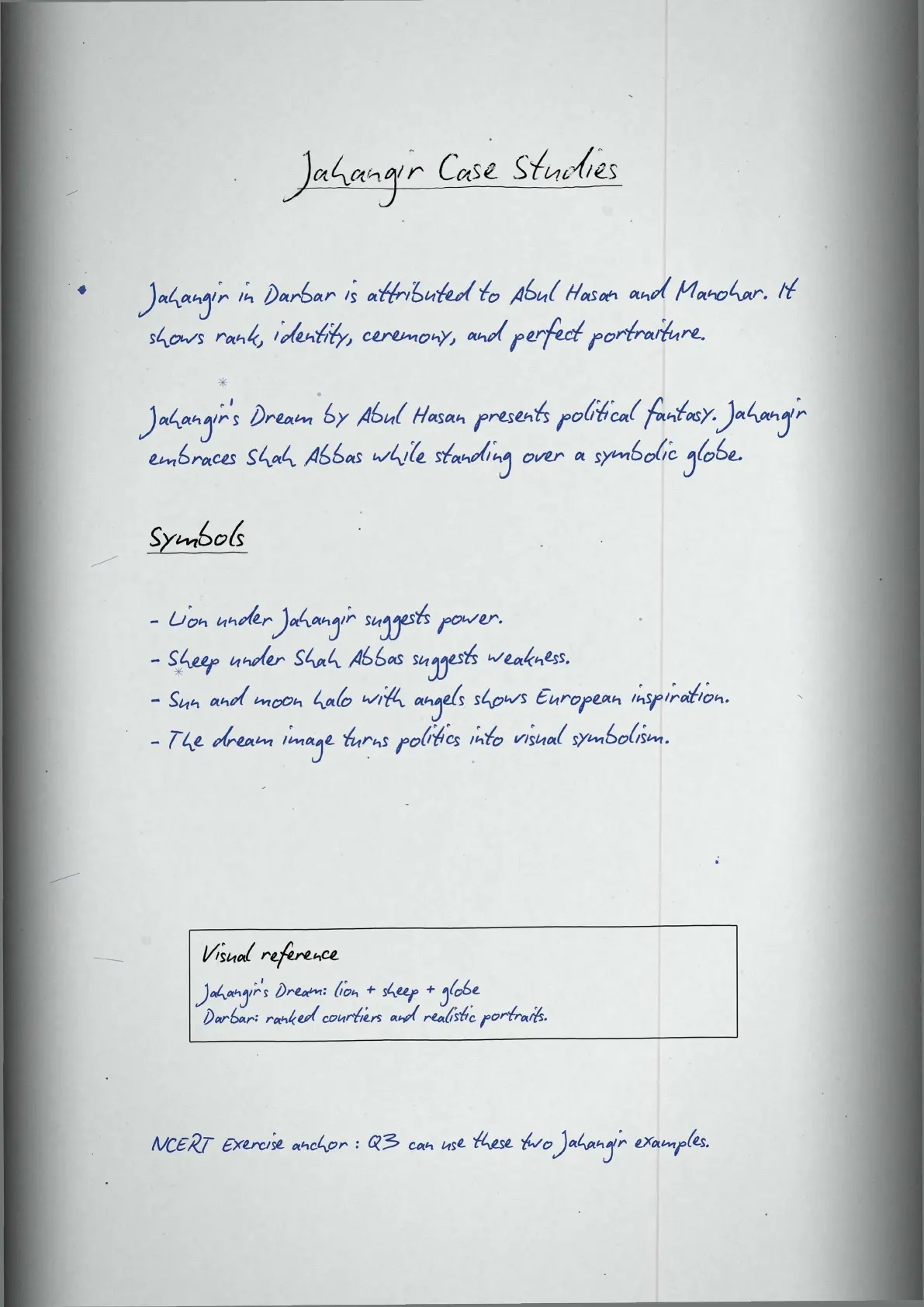
- Jahangir in Darbar, from the Jahangirnama, attributed to Abul Hasan and Manohar, 1620, Museum of Fine Arts, Boston. Jahangir sits highest and central under white pillars and a framed canopy. Khurram stands with folded hands, flanked by his son Shuja. Courtiers are placed by rank and their portraits are exact, and the Jesuit priest Father Corsi has his name inscribed beside him.
- Jahangir's Dream, 1618 to 1622, by Abul Hasan, who held the title Nadir al Zaman, Wonder of the Age. Jahangir embraces the frail Safavid Shah Abbas over a globe. Jahangir towers on a powerful lion, the Shah stands on a docile sheep, and a golden halo of sun and moon is held by two winged angels, a clear European borrowing.
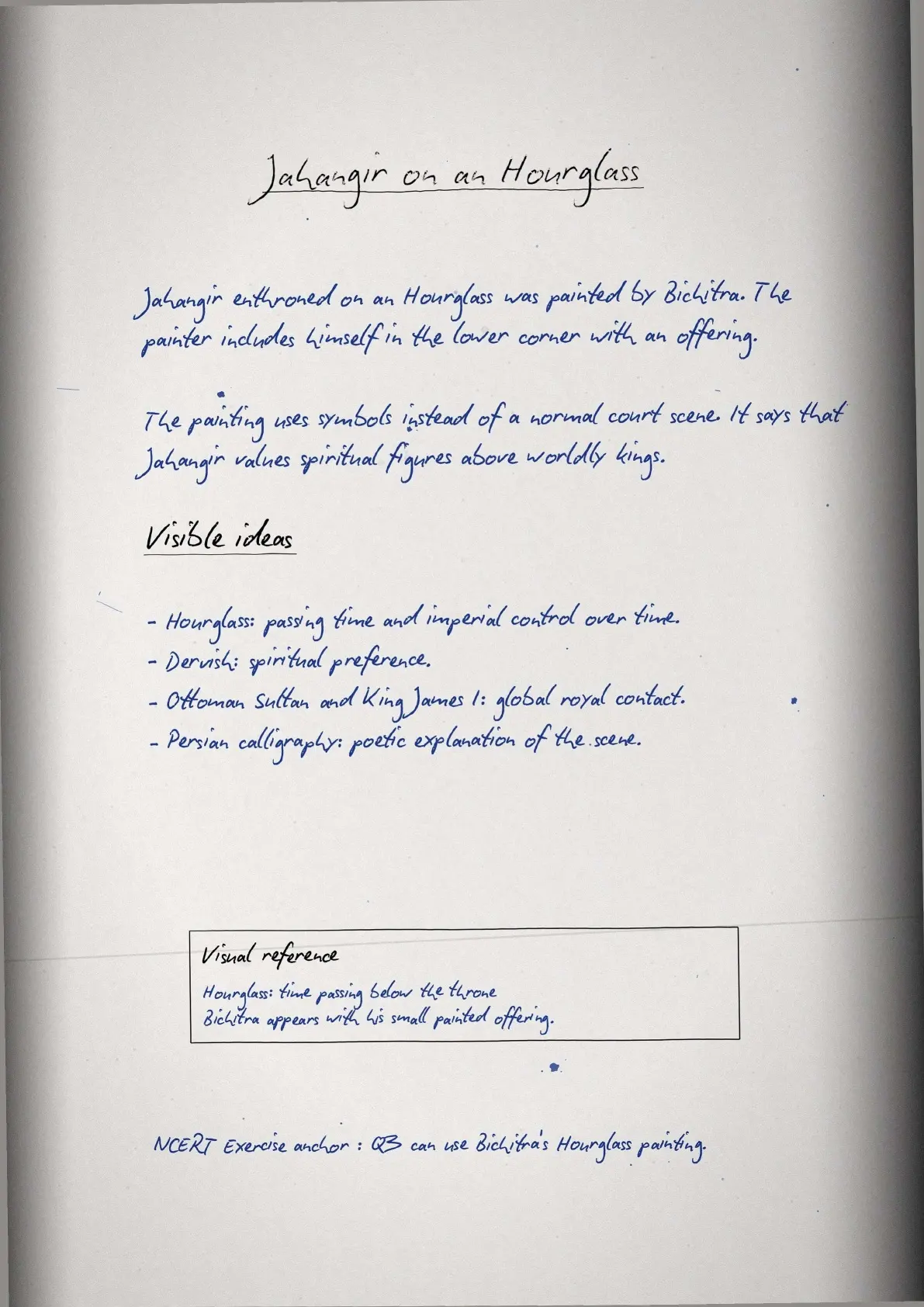
- Jahangir Enthroned on an Hourglass, 1625, by Bichitra, who painted himself into the lower right corner holding a painting as his offering. Persian verses at the top and bottom say the Shahs of the world may stand before him, yet Jahangir prefers the dervishes. Figures resembling the Ottoman Sultan and King James I of England wait on the right.
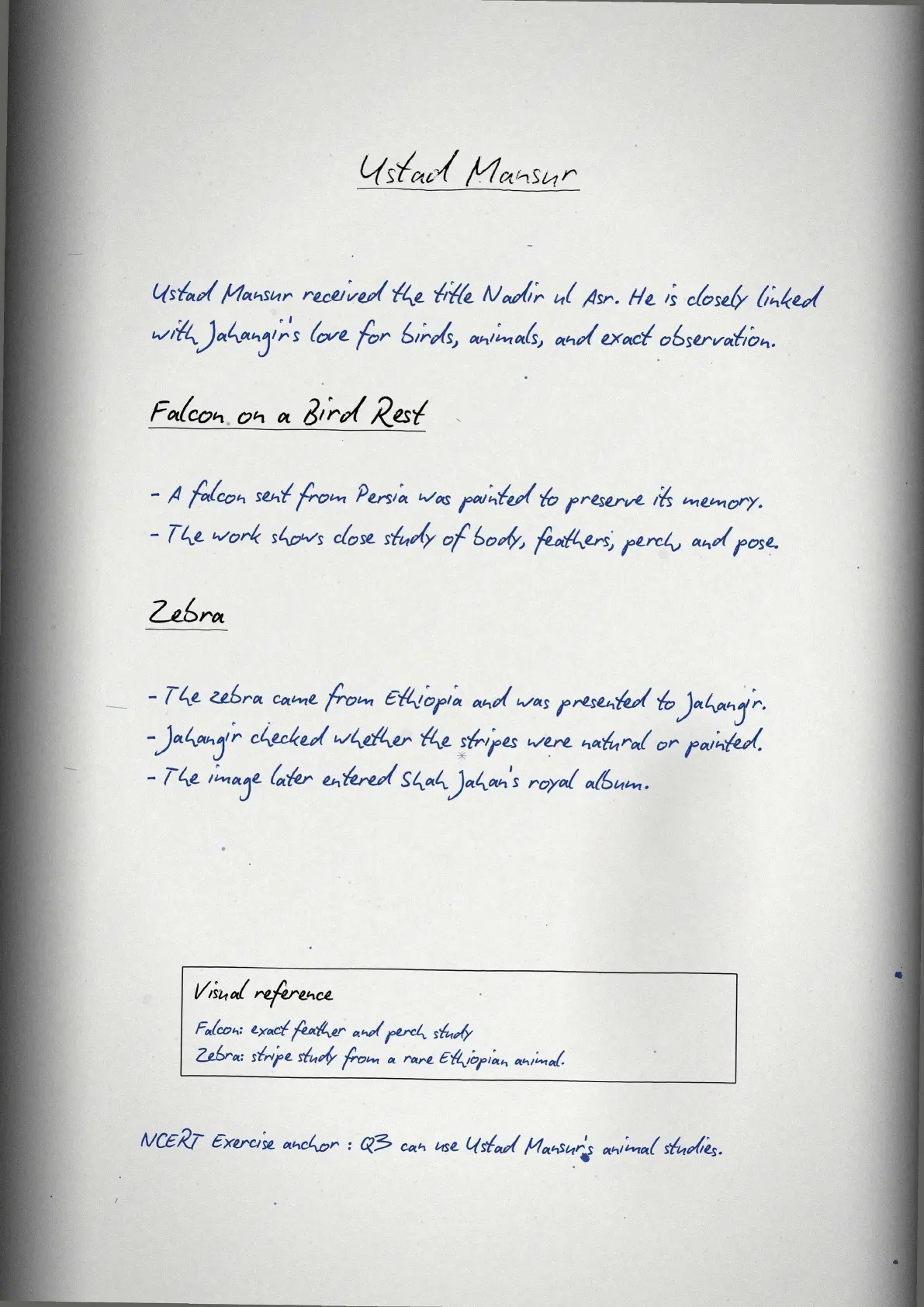
Ustad Mansur, who received the title Nadir ul Asr from Jahangir, is the nature painter of the reign. He painted the Falcon Perched on a Bird Rest, 1615, now in the Cleveland Museum of Art, Ohio, and the famous Zebra study. One more portraitist worth a line in a long answer is Bishandas, whom Jahangir sent to the Safavid court to take the likeness of Shah Abbas. Bishandas is not named in the NCERT chapter, so keep him as supporting detail and build your answer on Mansur, Abul Hasan and Bichitra.
Shah Jahan's Padshahnama and the Formal Court Style of Idealisation
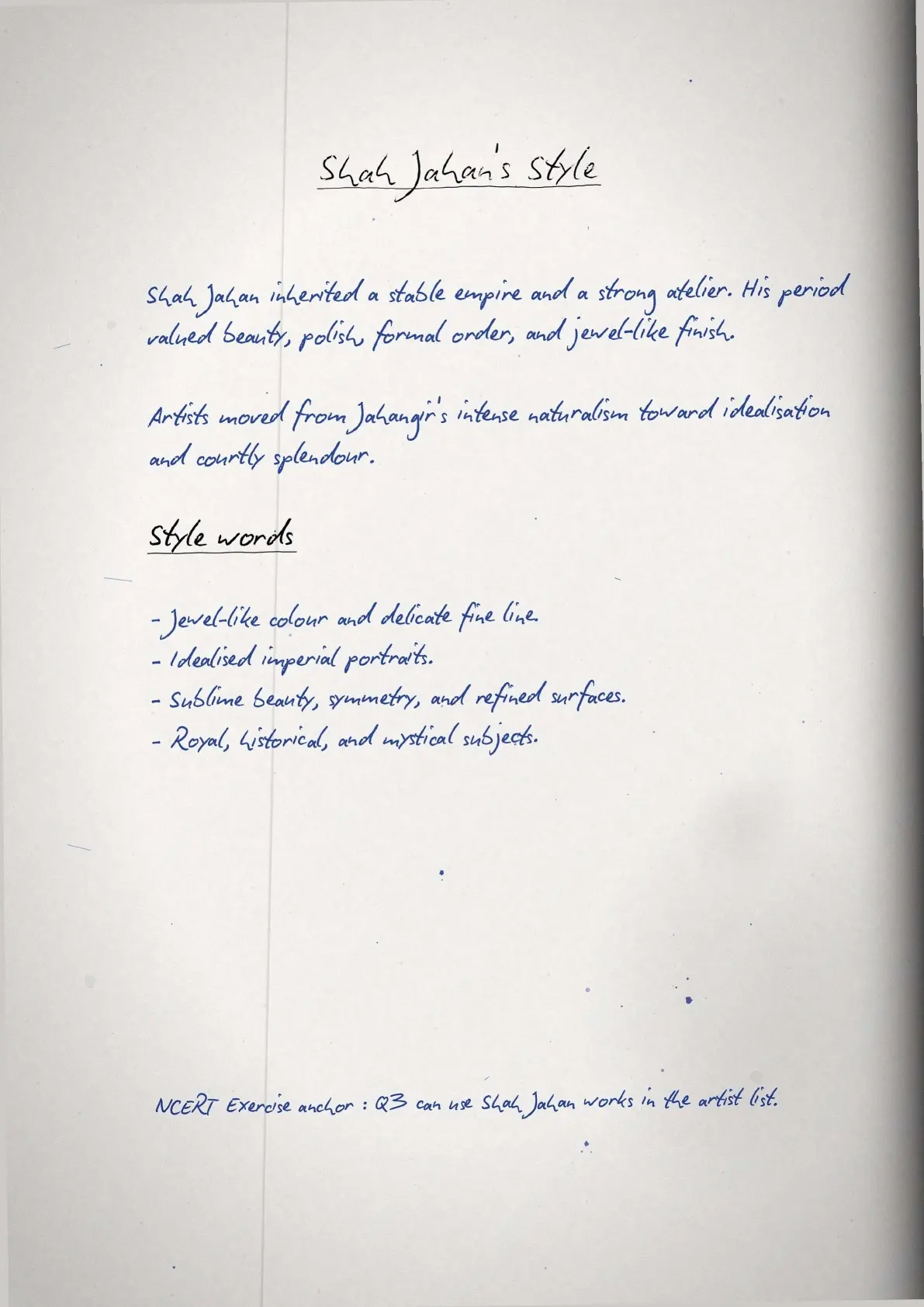
Prince Khurram took the throne as Shah Jahan and ruled from 1628 to 1658. He inherited a stable empire and the finest atelier in Asia. The style now turns away from Jahangir's naturalism. Idealisation and stylisation are preferred over accurate depiction.
- Jewel like colours, perfect rendering and intricate fine lines replace close observation.
- Paintings are built to carry several layers of meaning at once, so higher concepts get prominence.
- Imperial portraits with glorious titles present the emperor as he wished to be remembered.
- Padshahnama, The Chronicles of the King, is the flagship project of the reign and the high point of Indian miniature painting.
- Mughal painting of this period shows multiple perspectives, a rich palette and sophisticated composition for royal, historical and mystic subjects.
The chapter adds one detail students often miss. Rembrandt studied Mughal court paintings and made drawings after them to master the delicate line. Use that line whenever a question asks about the international standing of the Mughal school.
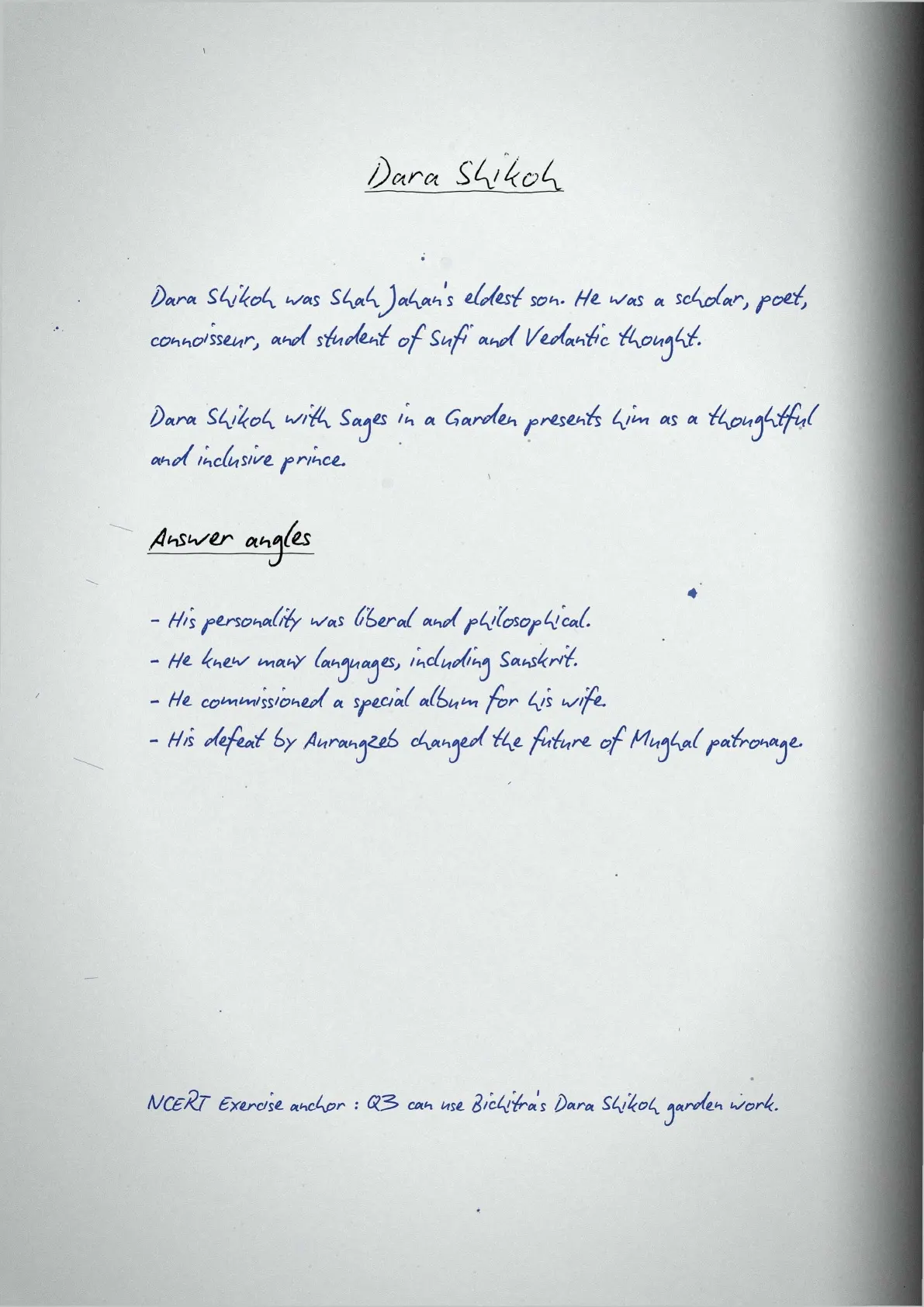
Dara Shikoh, the eldest son of Shah Jahan, is the tragic figure of the chapter. He knew Sanskrit, followed Sufi mysticism, read Vedanta and commissioned a special album of paintings as a gift for his wife. Dara Shikoh with Sages in a Garden, by Bichitra, in the Chester Beatty Library, Dublin, preserves his image. He lost the war of succession to Aurangzeb and was denied both empire and life.
Decline Under Aurangzeb and the Dispersal of Artists to Regional Courts
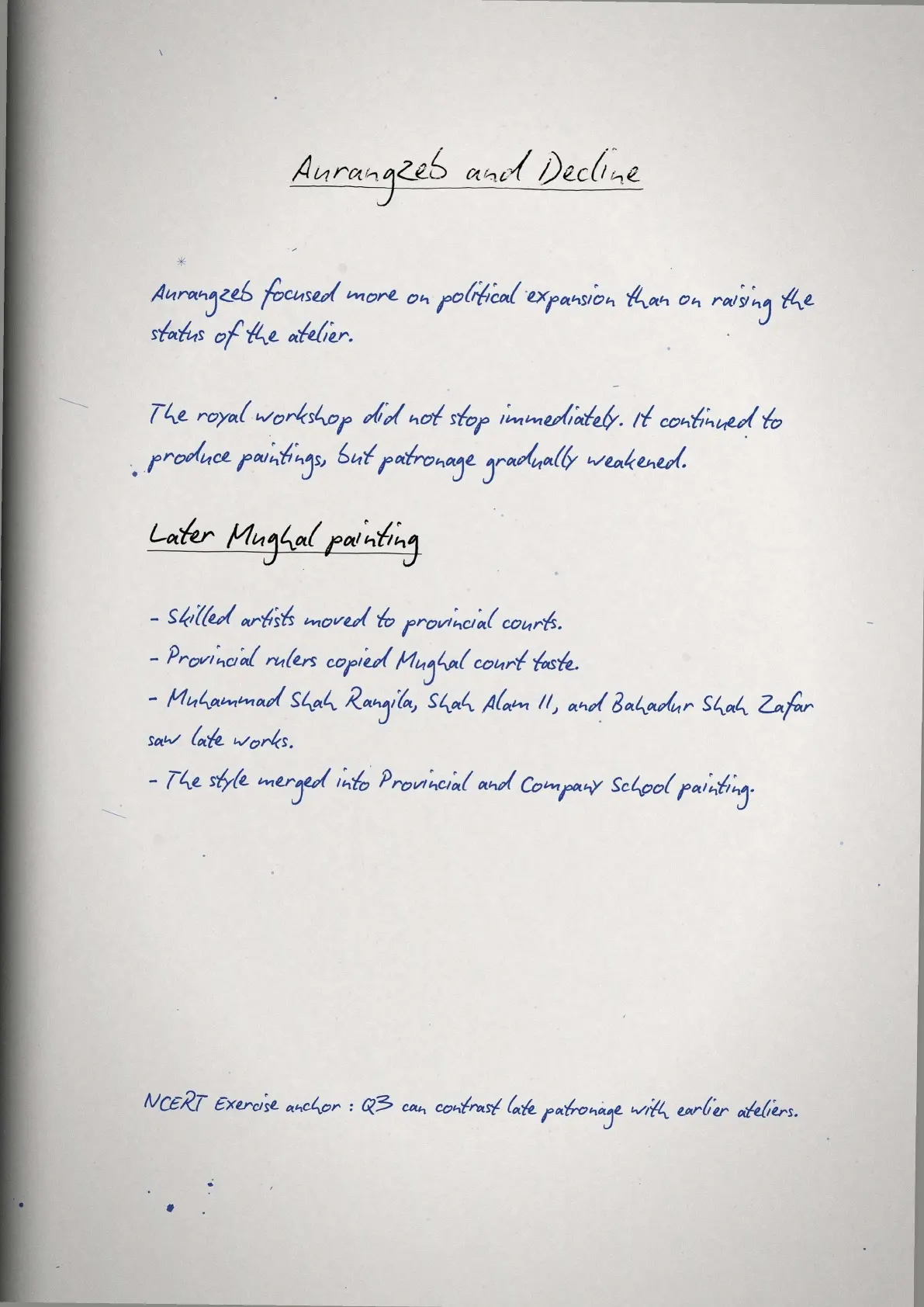
Aurangzeb, who took the title Alamgir, spent his reign on expansion and unification rather than on the atelier. Get one nuance right here, because it is a favourite trap. The royal atelier was not shut down immediately, and it kept producing fine paintings. What fell away was steady, enthusiastic patronage.
- With patronage thinning, highly skilled artists left the imperial atelier and were welcomed by provincial Mughal rulers.
- Those provincial patrons copied imperial taste and wanted their own dynasty and court events painted in the same manner.
- Some masterworks still appeared under Muhammad Shah Rangila, Shah Alam II and Bahadur Shah Zafar, described in the chapter as the last flickers of a dying candle.
- The portrait of Bahadur Shah Zafar, dated 1838, now in the Fogg Museum of Art, Cambridge, was made about two decades before the British exiled him to Burma after the failure of the Indian Revolt of 1857.
- Bahadur Shah Zafar was the last Mughal ruler, and also a poet, scholar and connoisseur.
The dispersal is the bridge to the rest of your syllabus. New patrons, unsettled regional kingdoms and rising English power reshaped Indian painting again, and the Mughal miniature style merged into the Provincial and Company styles. That is exactly where the Deccan, Rajasthani, Pahari and Company School chapters pick up the thread.
Materials and Technique of Mughal Miniature Painting You Must Be Able to Name
This is the shortest section of the chapter and the easiest 3 marks in the paper, because the answer is a list of concrete things. Learn it as a sequence: surface, drawing, colour, burnish.
| Material or step | What the chapter says |
|---|---|
| Painting surface | Handmade paper prepared specially for the purpose, cut to the size of the manuscript. Workshops call this layered burnished sheet wasli. |
| Brushes | A variety of brushes made from the hair of squirrels or kittens, fine enough for single hair detail |
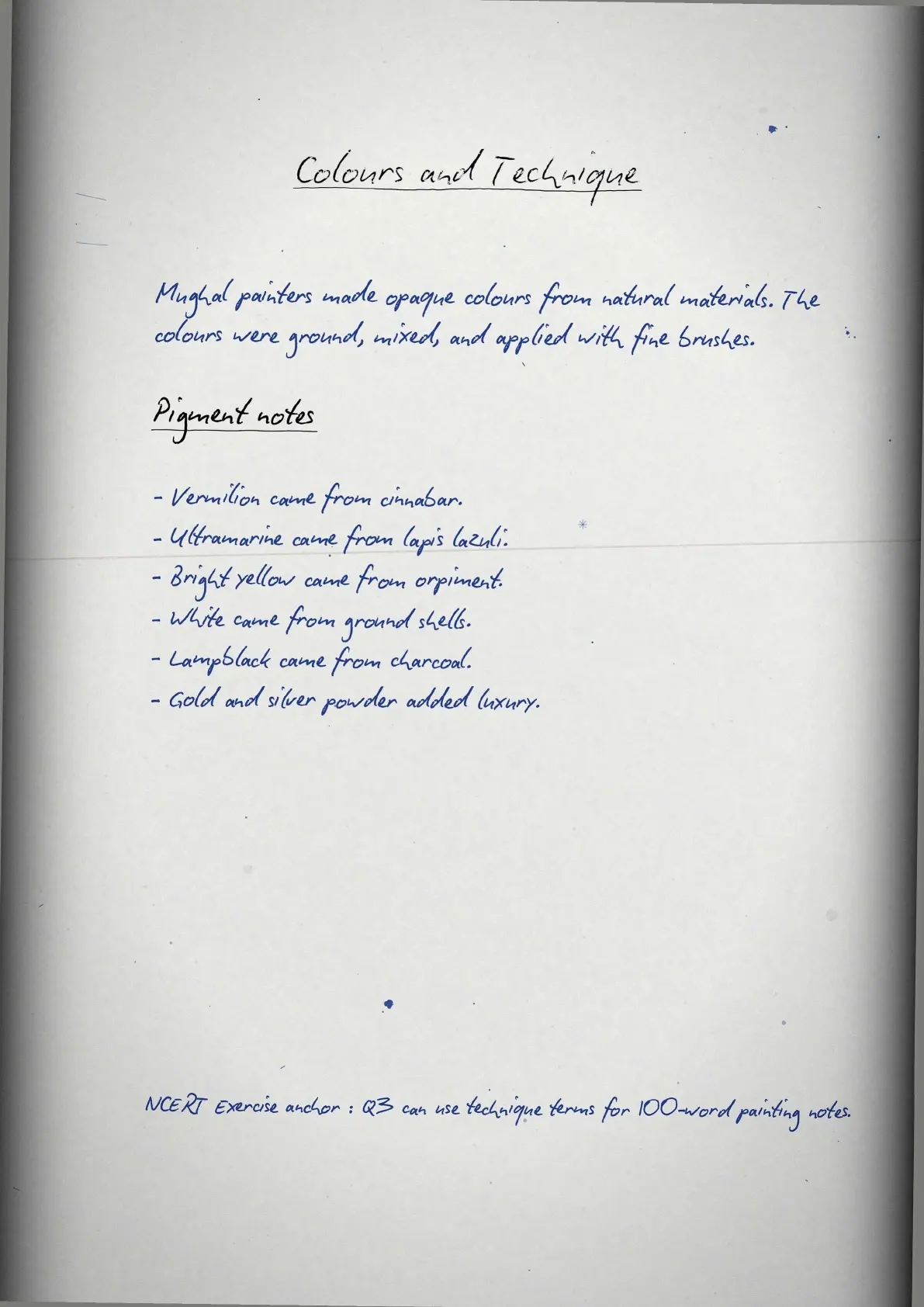
| Colours | Opaque colours from natural sources, obtained by grinding and mixing pigments to get exact shades |
| Vermilion | From cinnabar |
| Ultramarine | From lapis lazuli |
| Bright yellow | From orpiment |
| White | From ground shells |
| Lampblack | From charcoal |
| Extravagance | Gold and silver powders mixed into colours or sprinkled on the surface |
| Finishing | Agate, a gemstone, rubbed over the finished work to set the colours and give radiance |
Two workshop terms are worth knowing even though the chapter does not print them. The layered handmade sheet is called wasli, and the first black ink drawing laid on it is called siyah qalam, the black pen. If you use them in an answer, tie them straight back to the NCERT wording so the examiner can see the link: wasli is the handmade paper, siyah qalam is the outline drawing stage.
Division of Labour in the Mughal Atelier: Tarh, Chihara-nama and Rangamizi
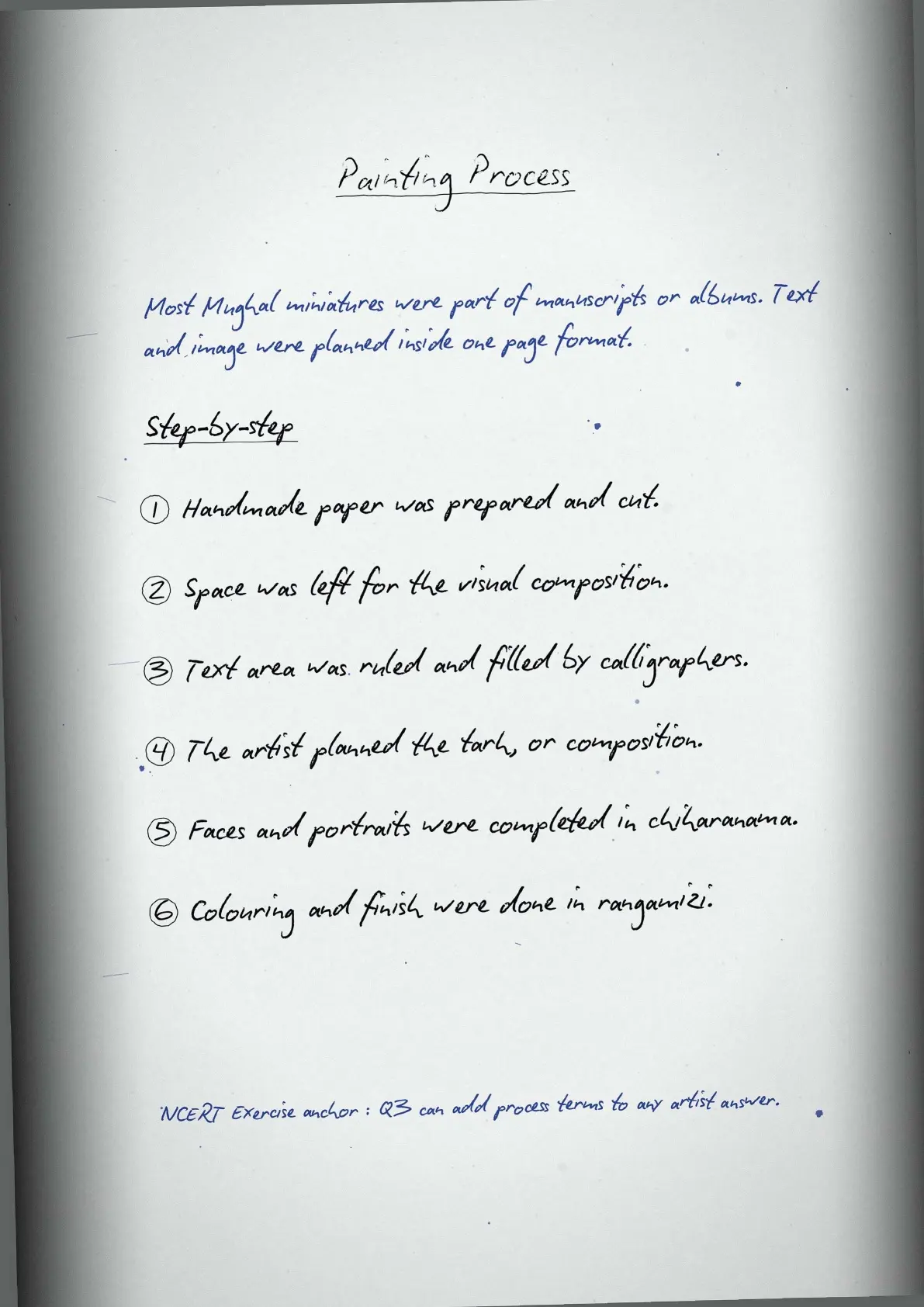
Most Mughal miniatures were pages of a manuscript or a royal album, so the picture and the text shared one sheet. The chapter sets out the book making order clearly, and a question on the process expects it in sequence.
- Sheets of handmade paper are prepared and cut to the size of the manuscript.
- A designated space is left blank for the artist to fill with a visual composition.
- The pages are ruled and the text is written in.
- The written page goes to the artist, who composes a synoptic visual version of that text.
- Tarh: the composition, the drawing that fixes the layout of the whole picture.
- Chihara-nama: the faces and portraits, done by the specialist in likeness.
- Rangamizi: the final colouring stage.
In the workshop the work was split. Basic draft drawing, grinding and filling in of colours, and adding details were usually distributed among a group, though a painting could also be done single handedly. Each artist took the part he was best at or was assigned. Records show that artists received incentives and salary increments according to the work done, and the surviving master names tell us how high their standing was inside the atelier.
Named Paintings You Must Be Able to Appreciate in the Board Answer
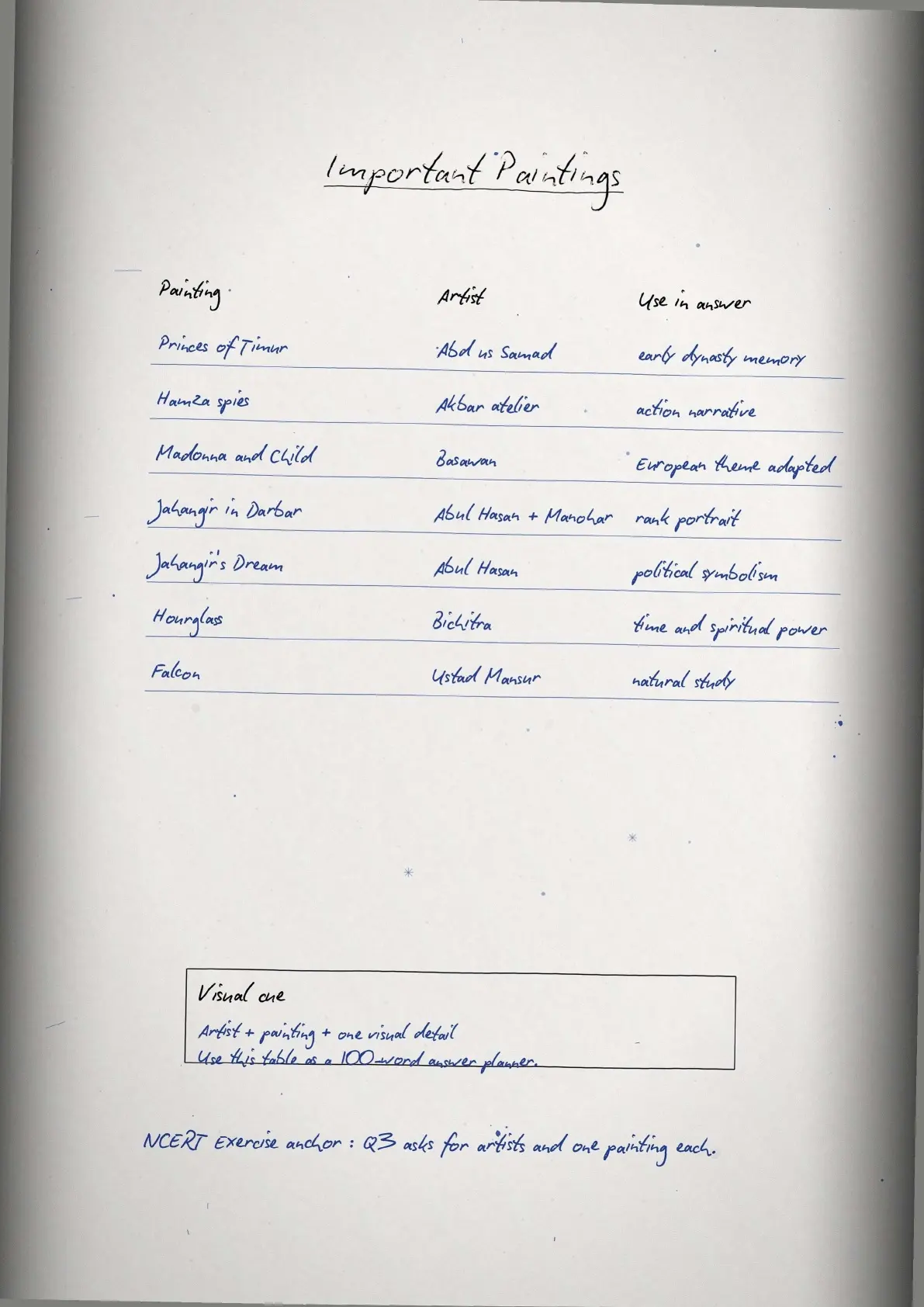
Appreciation questions carry the heaviest marks in the Fine Arts theory paper. The safe answer names the artist, the date, the collection, the subject and two visual qualities. Build one card per painting and revise from the card, not from the chapter.
| Painting | Artist and date | Collection | What to write about it |
|---|---|---|---|
| Princes of the House of Timur | Probably Abd us Samad, 1545 to 1550 | British Museum, London | Opaque watercolour on cotton, large and complex, later portraits painted over the original |
| Spies of Hamza Attack the City of Kaymar | Hamza Nama atelier, 1567 to 1582 | Museum of Applied Arts, Vienna | Divided space, strong outer line, profile faces, Persian patterns with Indian trees and palette |
| Noah's Ark | Ascribed to Miskin, from a dispersed Divan-i Hafiz manuscript of 1590 | Freer Gallery of Art, Smithsonian Institution | Subdued palette, pure white with soft red, blue and yellow, sons of Noah throwing out Iblis, vertical perspective adds drama |
| Krishna Lifts Mount Govardhan | Attributed to Miskin, 1585 to 1590 | Metropolitan Museum of Art, New York | From the Harivamsa Purana translated by Badauni, Krishna holds the mountain like an umbrella over villagers and livestock |
| Falcon Perched on a Bird Rest | Ustad Mansur, 1615 | Cleveland Museum of Art, Ohio | A falcon gifted by Shah Abbas, mauled by a cat, painted after death on the emperor's order |
| Zebra | Ustad Mansur, presented at Nowruz in March 1621 | Royal Mughal album | Brought from Ethiopia by Turks with Mir Ja'far, inscribed by Jahangir in Persian, ornate borders added under Shah Jahan |
| The Marriage Procession of Dara Shikoh | Haji Madni, Shah Jahan period | National Museum, New Delhi | Dara on a brown stallion wearing the sehra, Shah Jahan with a nimbus on a white horse, music, dance, gifts and fireworks |
Three smaller plates also appear in the chapter and are worth one line each: Tutinama, The Girl and the Parrot, 1580 to 1585, Chester Beatty Library, Dublin; Babur Inspecting the Fort of Gwalior by Bhure, from the Baburnama, 1598, National Museum, New Delhi; and A Prince and a Hermit, a folio from the Diwan of Amir Shahi, 1595, Aga Khan Museum, Canada.
Common Mistakes Students Make in the Mughal School of Miniature Painting Chapter
Watch out: almost every mark lost in this chapter comes from mixing up two patrons, two artists or two manuscripts.
- Writing that Aurangzeb closed the royal atelier. The chapter says the opposite, that it was not shut down immediately and kept producing.
- Swapping Razm Nama and Akbar Nama. Razm Nama is the Mahabharata in Persian, Akbar Nama is the life of Akbar.
- Crediting the Hamza Nama to Akbar alone. Humayun began it, Akbar completed it under Mir Sayyid Ali and Abd us Samad.
- Calling Jahangir's period more narrative than Akbar's. It is the reverse, Jahangir moved from narrative to portrait, album page and nature study.
- Naming Bichitra as a nature painter. Bichitra painted Jahangir Enthroned on an Hourglass and Dara Shikoh with Sages in a Garden, Ustad Mansur is the nature painter.
- Writing that Mughal miniatures were wall paintings. They were manuscript and album pages meant for royal eyes only.
- Giving the technique of the Hamza Nama as watercolour on paper. It is gouache on cloth with paper backing.
One more habit costs marks quietly. Students write appreciation answers with adjectives but no proof. Name the collection, name the date, then describe. An examiner can reward a specific detail like the golden halo held by two winged angels, but cannot reward the word beautiful.
Student Feedback on the Mughal School of Miniature Painting Chapter
What 11,540 students told us about studying this chapter
- 68% said the artist to painting matching was the hardest part, ahead of the timeline of patrons.
- 3 out of 5 students could not name the three stages of the painting process on first attempt.
- Students who made one index card per painting scored 4 to 6 marks higher on appreciation questions.
- Most skipped block: Later Mughal Painting, left out by nearly 31% of students in their first revision round.
Source: Collegedunia Class 12 Fine Arts student poll conducted before the 2026-27 board exams. Sample of 11,540 students from CBSE schools across 14 states.
The takeaway is simple. Students lose marks on names, not on ideas. Spend your second revision on the artist and painting index rather than on rereading the prose.
How to Revise the Mughal School of Miniature Painting in a Three Block Study Plan
This chapter rewards short, repeated passes far more than one long sitting. Three blocks of about 40 minutes each will cover it, and the third block is the one that actually earns the marks.
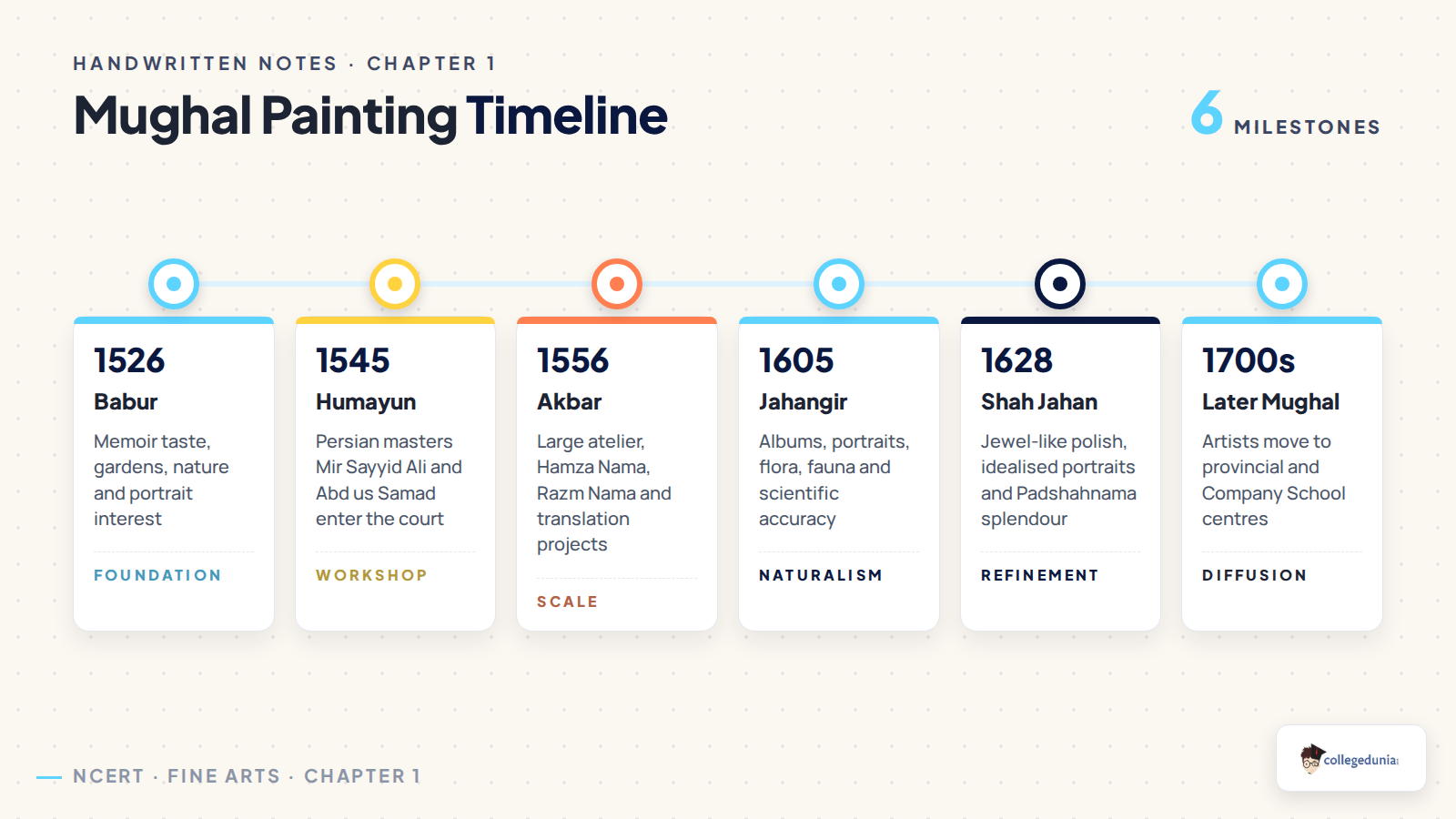
- Block 1, the timeline. Write the patrons in order with their dates: Babur 1526, Humayun from 1530, Akbar 1556 to 1605, Jahangir 1605 to 1627, Shah Jahan 1628 to 1658, then Aurangzeb and the later rulers. Add one project name under each.
- Block 2, the artist and painting index. Make one card per painting with artist, date, collection, subject and two visual points. Seven cards cover every appreciation question in the chapter.
- Block 3, process and technique. Recite the sequence out loud: paper, blank space, ruling and text, tarh, chihara-nama, rangamizi, then the agate burnish. Add the five pigments and their sources.
Finish by writing one full 5 mark answer from memory on the Akbar to Jahangir shift, then check it against the comparison table above. Self testing beats rereading on a name heavy chapter like this one.
Mughal School of Miniature Painting Exam Focus for CBSE Fine Arts Theory and CUET
Class 12 Fine Arts Theory, subject code 049, is a 30 mark written paper based on An Introduction to Indian Art Part 2, with the rest of the subject carried by practical work. The Mughal School chapter is one of the most reliable sources of long answer and appreciation questions in that paper.
| Question shape | What it asks from this chapter | How to answer |
|---|---|---|
| 1 mark recall | Artist of a named painting, the collection, a date, a term such as muraqqa or tarh | One line, exact noun, no padding |
| 2 to 3 marks | Process of Mughal painting, pigments and their sources, the role of the atelier | List format, three to five points |
| 5 marks, appreciation | Appreciate any one Mughal painting from your syllabus | Artist, date, collection, subject, then composition, colour and line |
| 5 marks, comparison | Akbar period against Jahangir period, or Persian against indigenous elements | Two columns worth of points, then one closing judgement |
| CUET style objective | Match artist to painting, patron to manuscript, pigment to source | Revise from the index cards, not from prose |
The four NCERT exercise questions at the end of the chapter map straight onto these shapes. They ask you to name the two masters invited by Humayun and discuss their masterpieces, to pick a favourite Akbar project and explain it, to list the artists of the Mughal court with one painting each in about 100 words, and to discuss indigenous, Persian and European elements using three paintings of your choice. Answer all four in writing at least once before the exam.
How These Handwritten Notes Pair with the Other Mughal School of Miniature Painting Resources
These handwritten notes are the explanation layer. The chapter PDF gives you the plates and the exact NCERT wording, the solutions give you model answers to the four exercise questions, and the handwritten notes give you a fast last look before the paper. Use them in that order.
| Resource | What it gives you | When to use it |
|---|---|---|
| The Mughal School of Miniature Painting Class 12 NCERT Book PDF | The official chapter with all plates, captions and the exercise | First read, and every time you need the exact NCERT phrasing |
| The Mughal School of Miniature Painting Class 12 NCERT Solutions | Model answers to the four exercise questions | After your second reading, to check your own answers |
| The Mughal School of Miniature Painting Class 12 Handwritten Notes | Clear handwritten revision notes with the artist and painting index | The night before the theory paper |
All 8 Chapters of Class 12 Fine Arts with Handwritten Notes
Indian painting after the Mughals splits into regional schools, then into the nationalist and modern periods. Reading the chapters in order shows you how one style hands over to the next.
The Mughal School of Miniature Painting Class 12 Fine Arts Handwritten Notes FAQs
Questions Class 12 Students Ask Most About the Mughal School Chapter
Ques. What is the Mughal School of Miniature Painting?
Ans. It is the style of miniature painting that developed in the northern Indian subcontinent in the sixteenth century and continued until the mid nineteenth century. It is known for refined technique and a wide range of subjects, and it blends indigenous Indian, Persian and later European styles.
Ques. Which two Persian artists did Humayun invite to India?
Ans. Humayun invited Mir Sayyid Ali and Abd us Samad to set up a studio at his court. Both were respected for their skill in portraiture, and both later supervised the Hamza Nama project under Akbar.
Ques. How is Mughal painting under Jahangir different from Mughal painting under Akbar?
Ans. Akbar's atelier mass produced narrative manuscripts on war, conquest and translated epics. Jahangir's atelier made fewer works of higher quality, usually by a single master artist, and moved to portraits, lavish court scenes, album pages called muraqqa, and scientifically accurate flora and fauna.
Ques. What are the three stages of making a Mughal painting?
Ans. The artist begins with tarh, the composition, then moves to chihara-nama, the portraits and faces, and finishes with rangamizi, the colouring. Before all three, the handmade paper is cut, blank space is left for the picture, and the text is ruled and written in.
Ques. How many illustrations does the Hamza Nama have?
Ans. The Hamza Nama is recorded as 14 volumes with 1400 illustrations. It took nearly 15 years, is dated 1567 to 1582, and was completed under Mir Sayyid Ali and Abd us Samad. Its folios are now scattered across collections around the world.
Ques. What is the Razm Nama and who supervised it?
Ans. The Razm Nama is the Persian translation and illustrated version of the Mahabharata commissioned by Akbar. It was completed in 1589 under the master artist Daswant, contains 169 paintings and was scribed in ornate calligraphy.
Ques. Which colours were used in Mughal miniature painting and where did they come from?
Ans. Vermilion came from cinnabar, ultramarine from lapis lazuli, bright yellow from orpiment, white from ground shells and lampblack from charcoal. Gold and silver powders were mixed in or sprinkled on. All the colours were opaque and made by grinding natural pigments in the atelier.
Ques. What was agate used for in Mughal painting?
Ans. Agate is a gemstone. Once a painting was finished, it was rubbed over the surface to burnish the work. Burnishing set the colours and gave the painting the radiance that Mughal miniatures are known for.
Ques. Who was Ustad Mansur and what did he paint?
Ans. Ustad Mansur was Jahangir's nature painter and received the title Nadir ul Asr, Wonder of the Age. He painted the Falcon Perched on a Bird Rest, dated 1615 and now in the Cleveland Museum of Art, and the Zebra study that Jahangir inscribed in Persian.
Ques. Who painted Jahangir's Dream and what does it show?
Ans. Abul Hasan, who held the title Nadir al Zaman, painted it between 1618 and 1622. Jahangir embraces the frail Safavid ruler Shah Abbas over a globe. Jahangir stands on a powerful lion, Shah Abbas on a docile sheep, under a golden halo of sun and moon held by two winged angels.
Ques. Did Aurangzeb shut down the Mughal royal atelier?
Ans. No. Aurangzeb focused on expansion and unification and did not push the atelier forward, but the chapter states clearly that the royal atelier was not shut down immediately and continued producing paintings. The real change was that skilled artists left for provincial courts as patronage weakened.
Ques. What happened to Mughal painting after the later Mughal rulers?
Ans. Masterworks still appeared under Muhammad Shah Rangila, Shah Alam II and Bahadur Shah Zafar, but they were the last flickers of the style. As regional kingdoms grew unsettled and English power rose, the Mughal miniature style merged into the Provincial and Company styles.
Ques. Is the Mughal School of Miniature Painting part of the 2026-27 Class 12 Fine Arts syllabus?
Ans. Yes. It is a chapter of An Introduction to Indian Art Part 2, the NCERT textbook prescribed for Class 12 Fine Arts Theory, subject code 049, in the 2026-27 session. It is a regular source of appreciation and long answer questions in the CBSE theory paper and of matching questions in CUET style objective tests.



Comments