




These Class 12 Geography Chapter 5 Secondary Activities notes cover every NCERT definition, the full classification of manufacturing industries (by size, raw material, output and ownership), the factors of industrial location, and high-technology industries and technopolies, all aligned to the 2026-27 syllabus. They are built for a quick, full-chapter revision the night before the exam.



- Concept-first revision for the entire chapter: what secondary activities are, how they differ from primary activities, and the three scales of manufacturing (cottage, small-scale and large-scale).
- All key definitions and location factors that CBSE, CUET and UPSC examiners repeatedly pick, including footloose industries, agri-business and technopolies.
- Cross-pointers to the matching NCERT Solutions, Handwritten Notes and NCERT Book PDF, so students see where each concept gets applied in a worked answer.

Every line in these Secondary Activities Class 12 Geography notes is written by Collegedunia geography subject experts, mapped to the 2026-27 NCERT Fundamentals of Human Geography textbook, and pressure-tested against the last five years of CBSE Class 12 board papers, CUET Geography question patterns and UPSC preliminary exam trends.
Student Feedback
67% of Class 12 students found the classification of industries the most-confused area, and 3 out of 4 rated the factors of industrial location as most worth revising. Most finished a full revision in about 30 minutes.
Source: 2026-27 Class 12 Geography student poll, 8,620 CBSE students.
Quick Concept Recap: Secondary Activities at a Glance
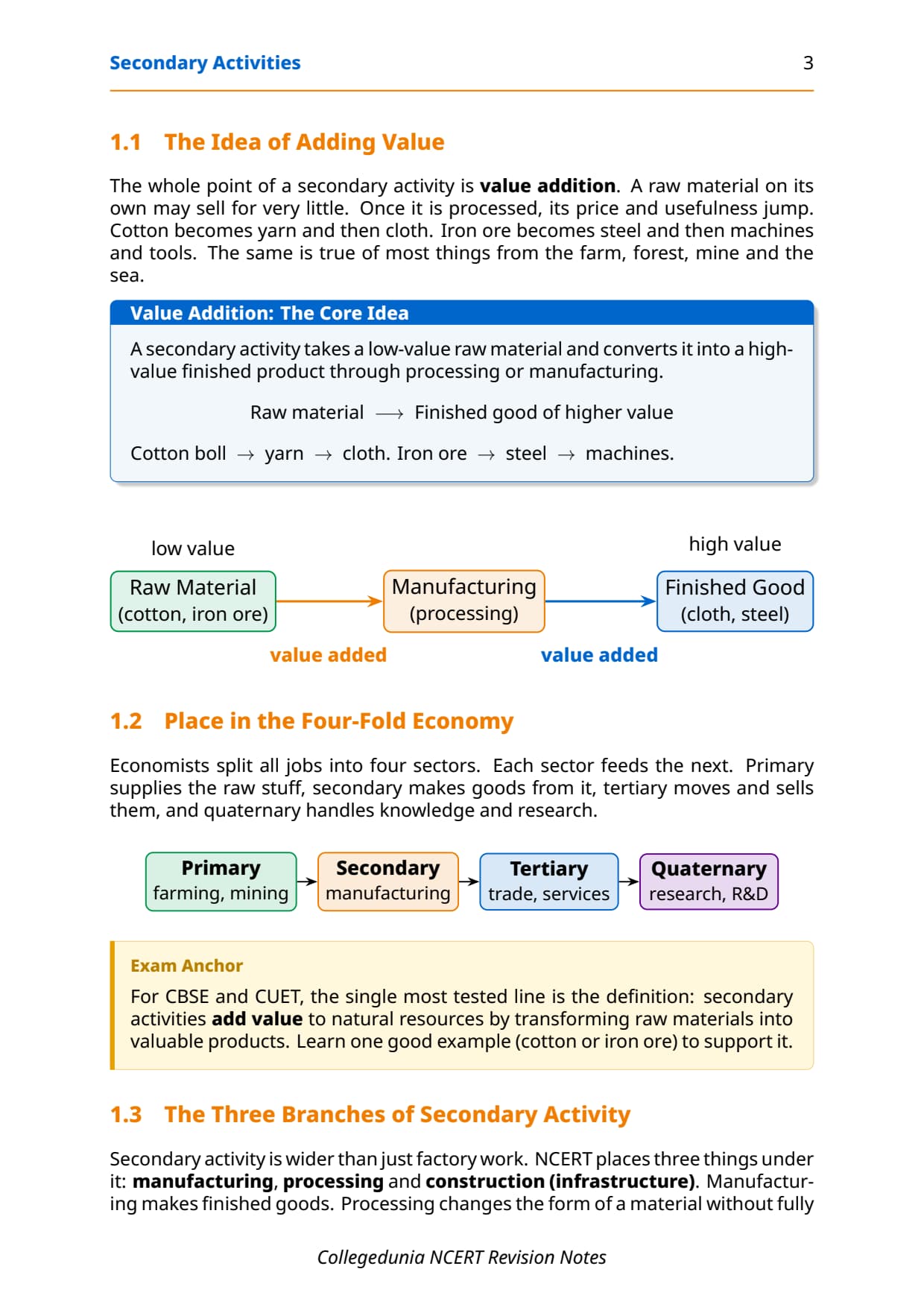
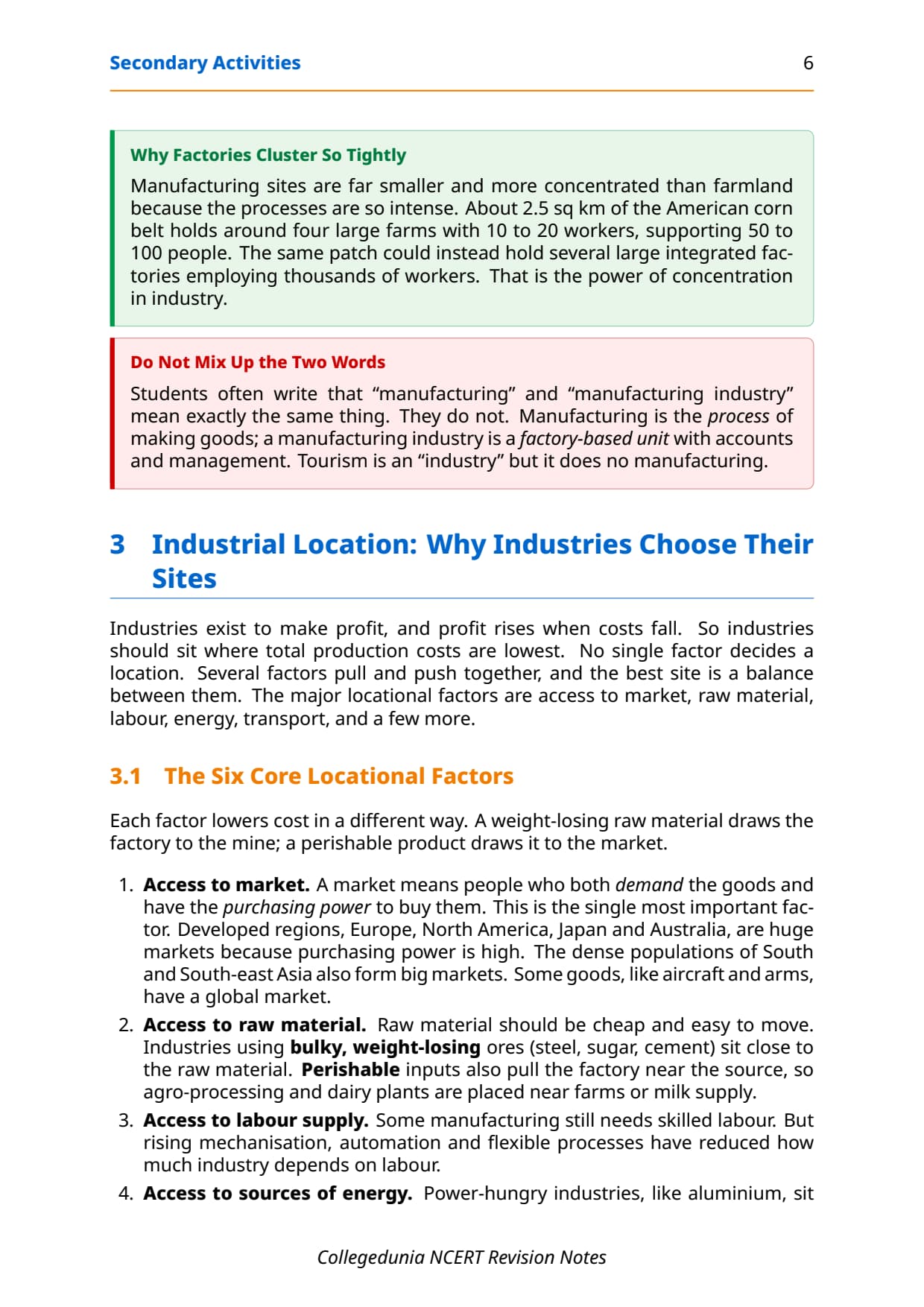
Chapter 5 of NCERT Class 12 Fundamentals of Human Geography explains how raw materials are turned into finished goods of higher value. Primary activities extract from nature; secondary activities add value to what they produce. Cotton becomes yarn, iron ore becomes steel, timber becomes furniture. That value-addition through manufacturing, processing and construction is the core idea of the chapter.
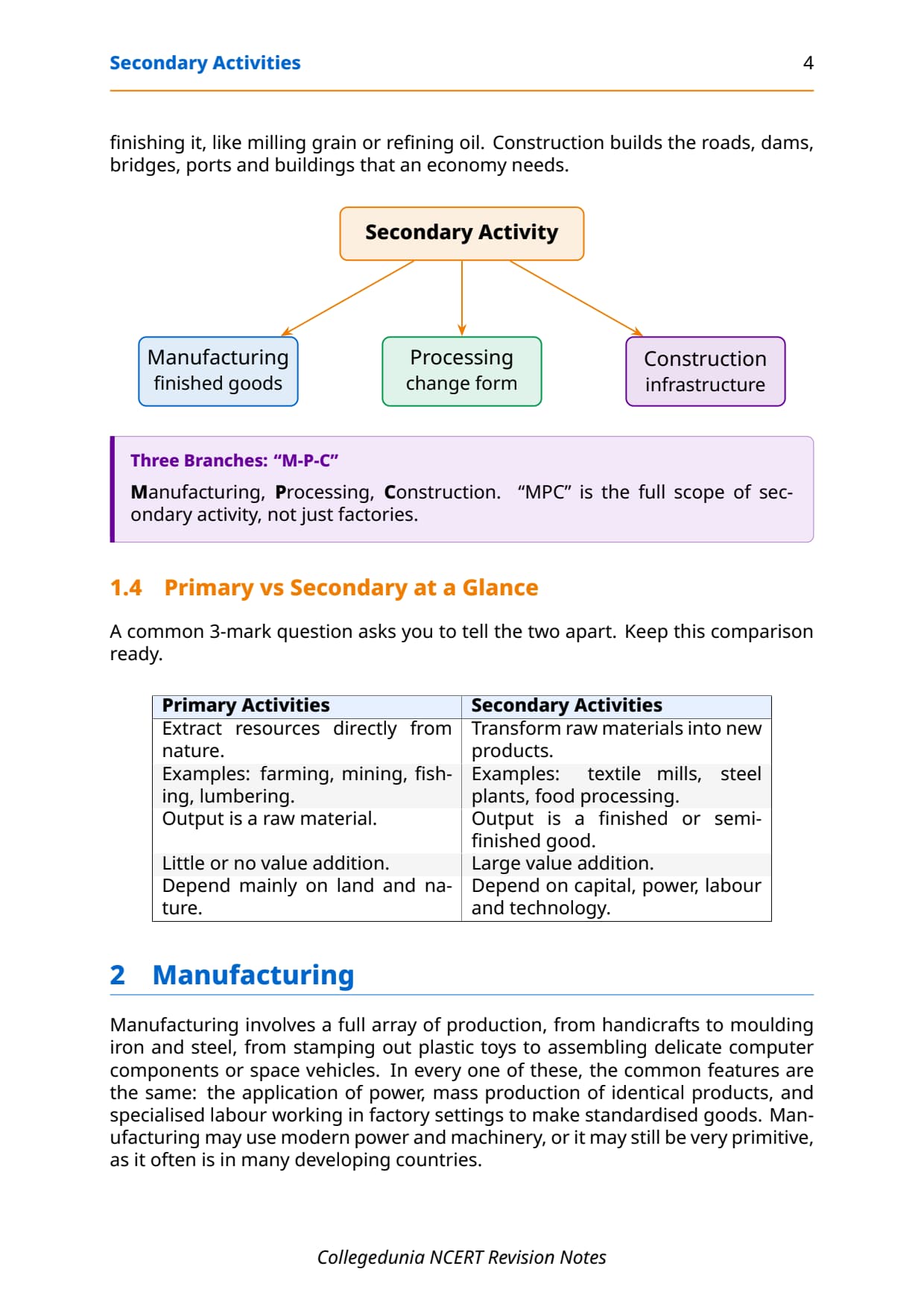
- Secondary activities: manufacturing, processing and construction that turn raw materials into products worth more than the original input.
- Three scales of manufacturing: cottage (home-based, family labour), small-scale (workshop, power-driven machines) and large-scale (vast capital, advanced technology, mass production).
- Factors of industrial location: market, raw material, labour, energy, transport, agglomeration and government policy.
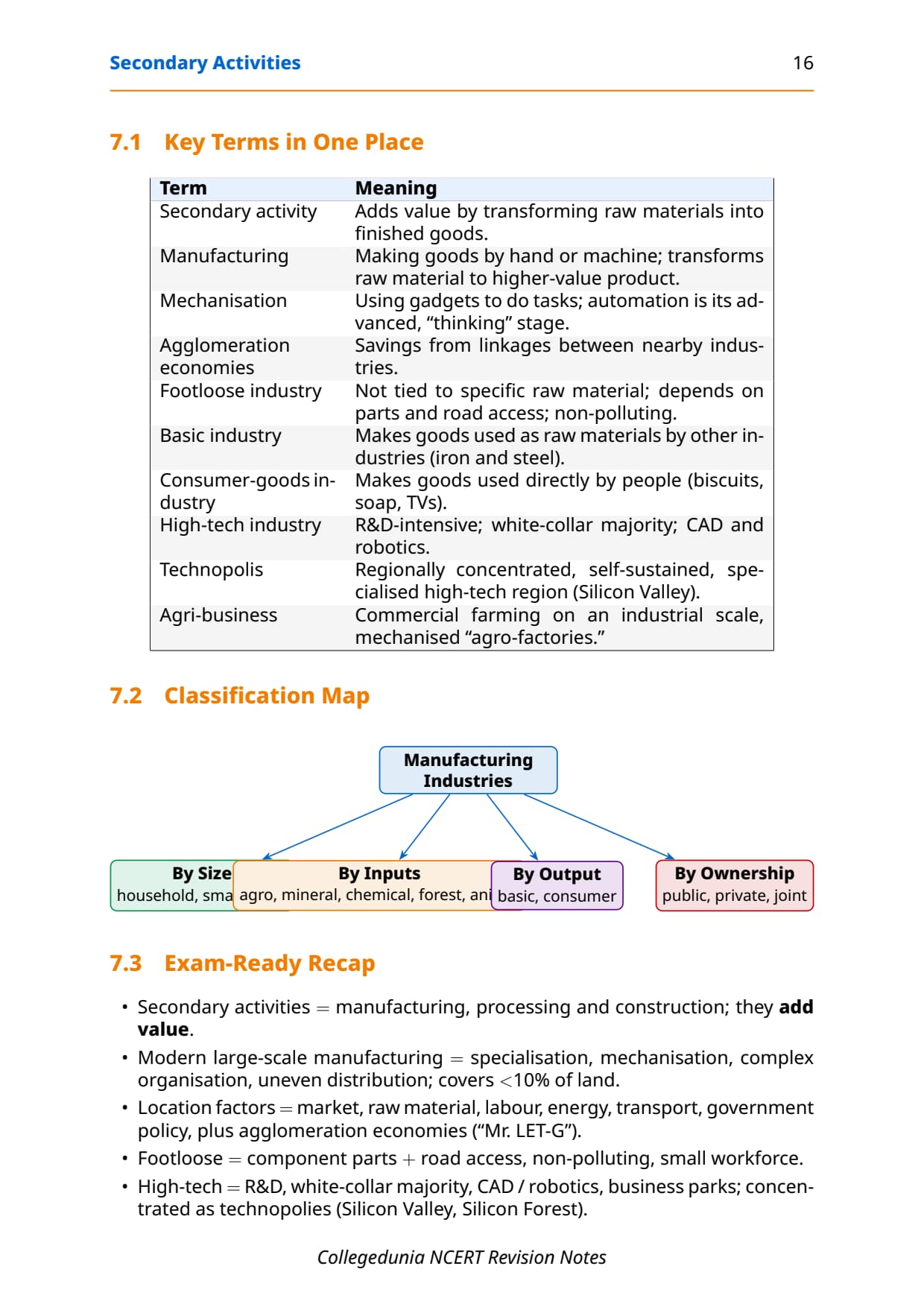
- Classification: by size, by raw material, by output (basic vs consumer goods) and by ownership (public, private, joint).
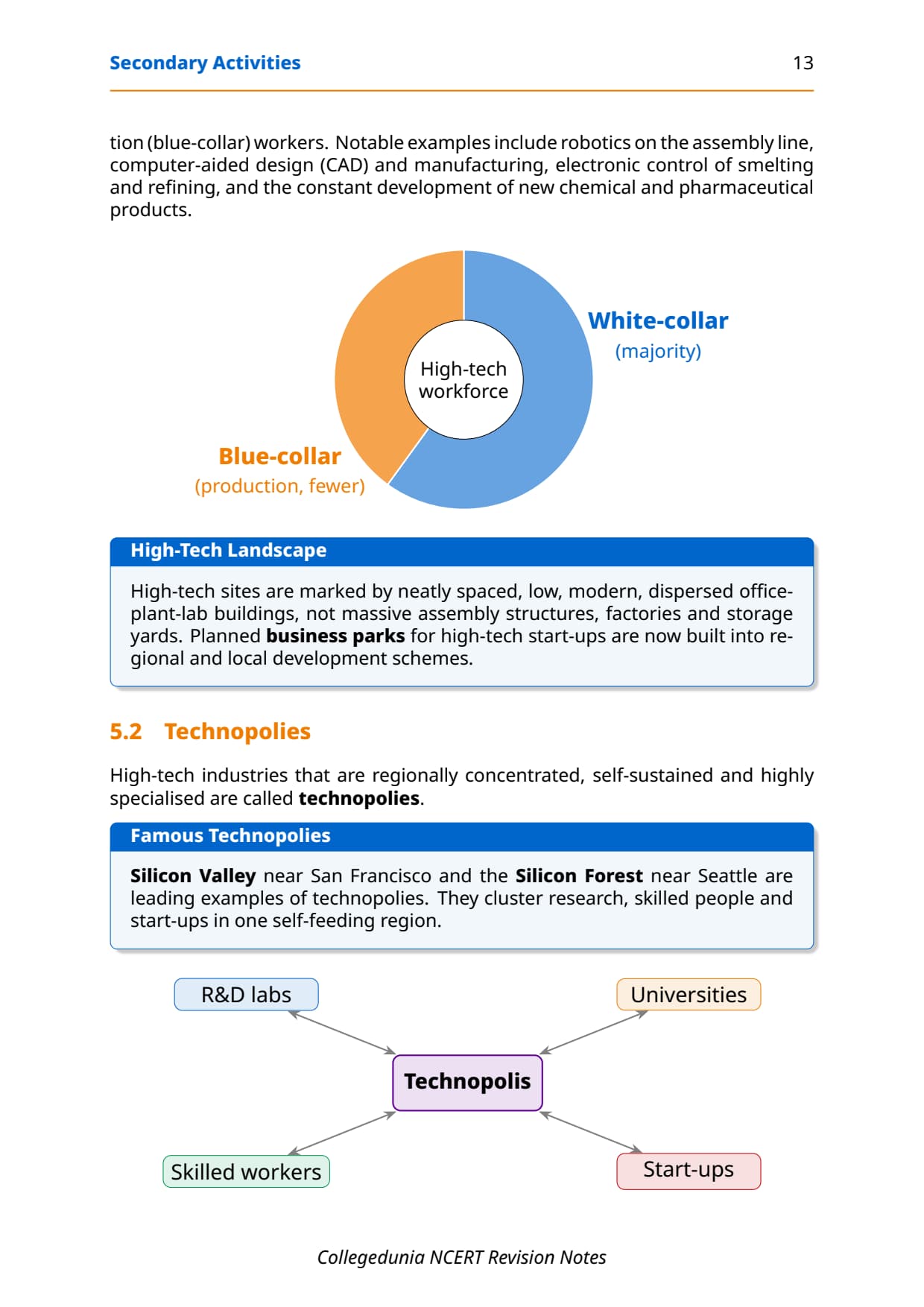
- High-technology industries: R and D intensive, white-collar workers outnumber blue-collar; regionally specialised clusters are called technopolies.
- Footloose industries: not tied to any raw material or energy source; locate wherever road access is good; small labour force, low pollution.
Read these notes first, then use the matching NCERT Solutions for Class 12 Geography Chapter 5 for the exercise drill.
Source: Magnet Brains on YouTube
Key Definitions for Secondary Activities Class 12
Every theory question on this chapter begins with a definition. The terms below are written in the exact one-line form CBSE markers expect.
| Term | One-line definition | NCERT section pointer |
|---|---|---|
| Secondary Activities | Activities that add value to natural resources by transforming raw materials into more valuable and usable products through manufacturing, processing and construction. | Chapter 5 intro |
| Manufacturing | The process of transforming raw materials into finished goods of higher value for sale in local or distant markets; now includes goods made by machines, not just by hand. | Manufacturing section |
| Cottage Industry | The smallest manufacturing unit where artisans use local raw materials and simple tools to produce everyday goods at home with family or part-time labour. | Household Industries section |
| Small Scale Manufacturing | Manufacturing done in a workshop outside the producer's home, using local raw materials, simple power-driven machines and semi-skilled labour. | Small Scale section |
| Large Scale Manufacturing | Manufacturing that uses vast capital, enormous energy, various raw materials, specialised workers, advanced technology and mass production for a large market. | Large Scale section |
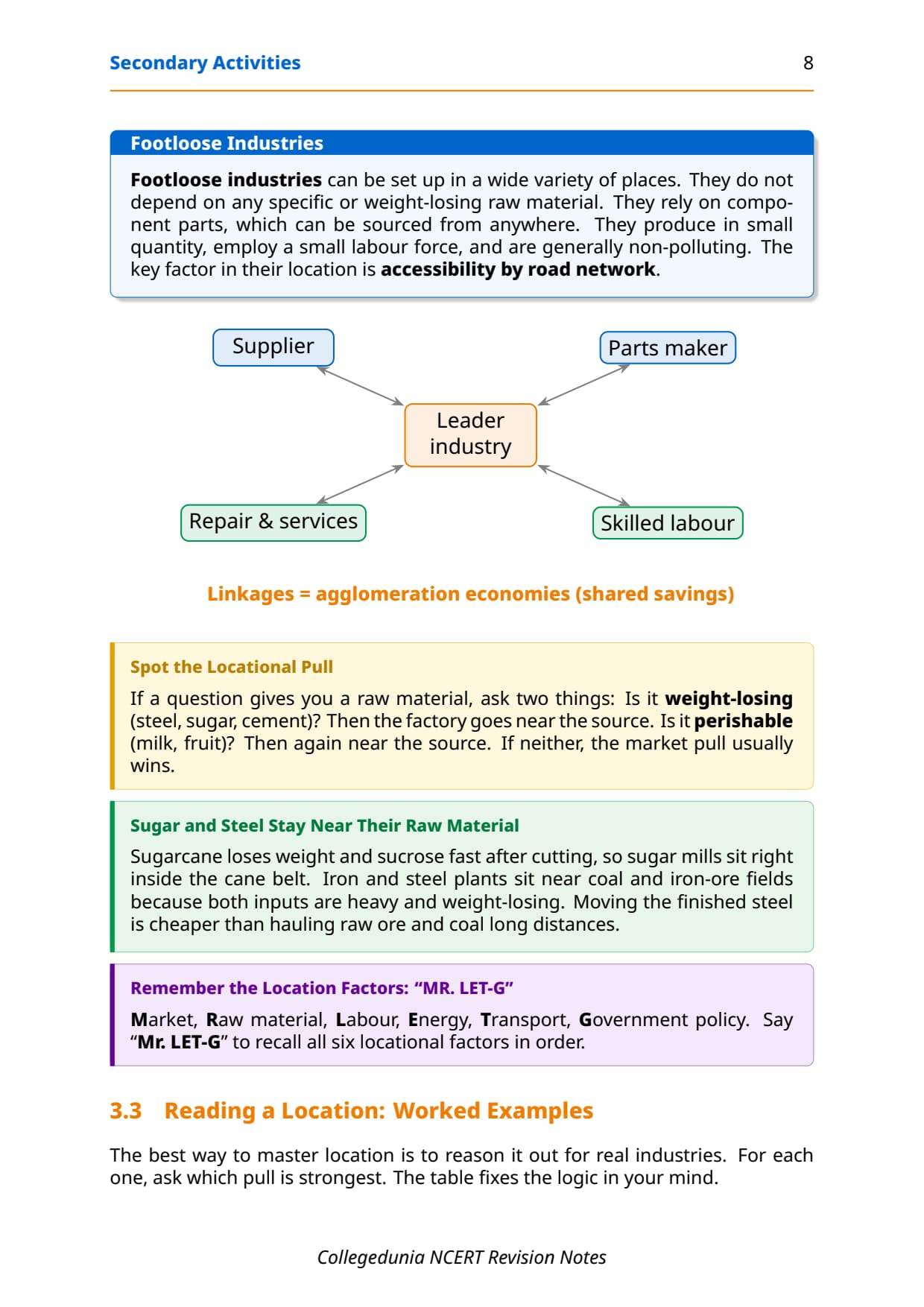
| Footloose Industries | Industries that can locate in a wide variety of places because they are not dependent on any specific raw material and require only a small labour force and good road access. | Footloose box |
| Agglomeration Economies | Benefits that industries gain by locating near a leader-industry or other related industries; savings from shared infrastructure, linkages and common services. | Location factors section |
| High Technology (High-Tech) Industry | The latest generation of manufacturing based on intensive R and D, producing advanced scientific and engineering products; white-collar specialists outnumber blue-collar workers. | High-Tech section |
| Technopolis | A regionally concentrated, self-sustained and highly specialised high-tech industrial cluster; example: Silicon Valley near San Francisco. | High-Tech section |
| Agri-business | Commercial farming on an industrial scale, often financed by large corporations; mechanised, large in size, highly structured and reliant on chemicals; sometimes called agro-factories. | Agri-business box |
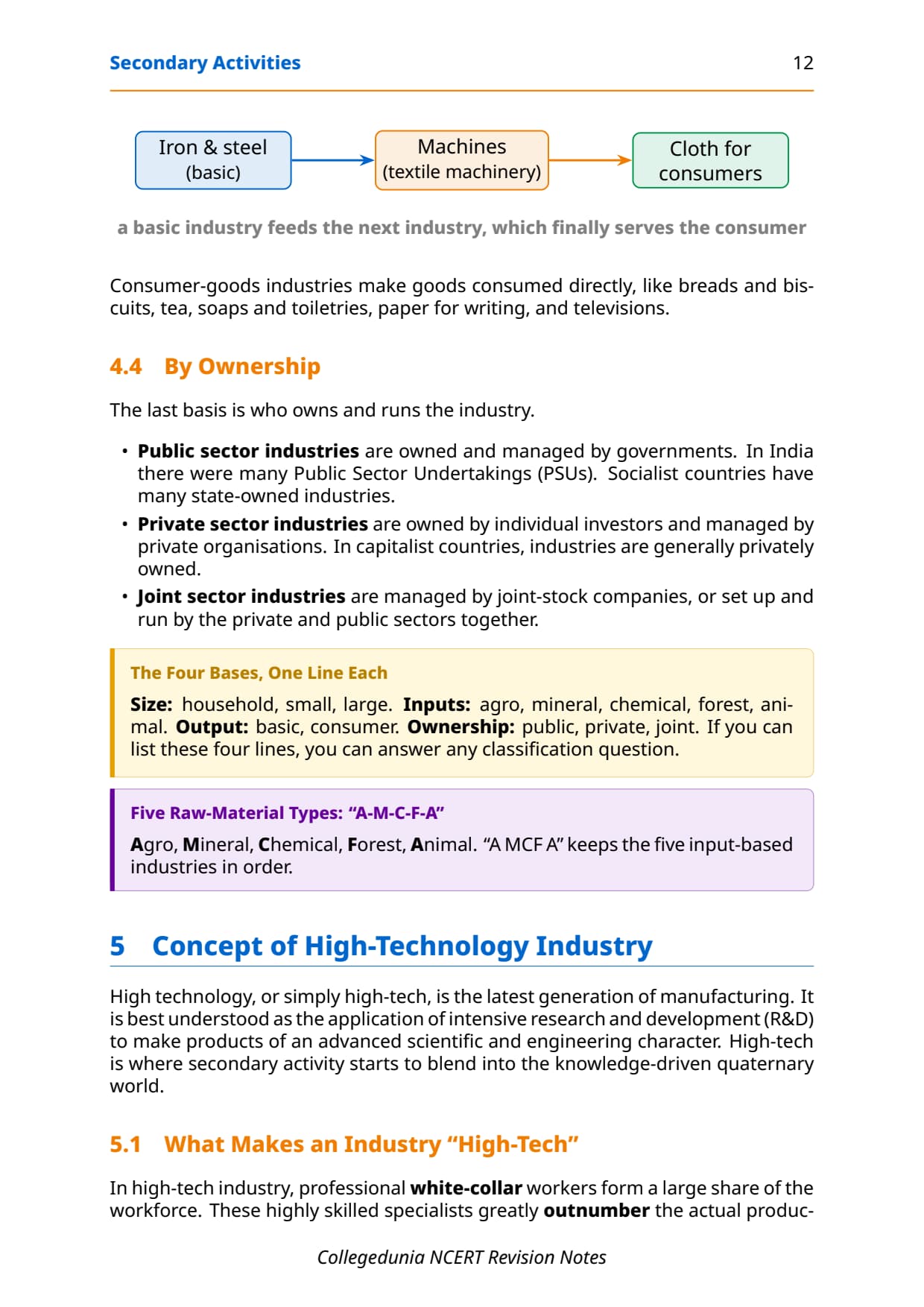
| Basic Industries | Industries whose products are used as raw materials for other industries; for example, the iron and steel industry supplies machines used in the textile industry. | Industries by Output section |
| Consumer Goods Industries | Industries that produce goods consumed directly by consumers; for example, bread, biscuits, soaps, televisions and paper. | Industries by Output section |
These twelve definitions cover most of the one-mark and 3-mark theory questions CBSE has asked on this chapter since 2021, so learn them first.
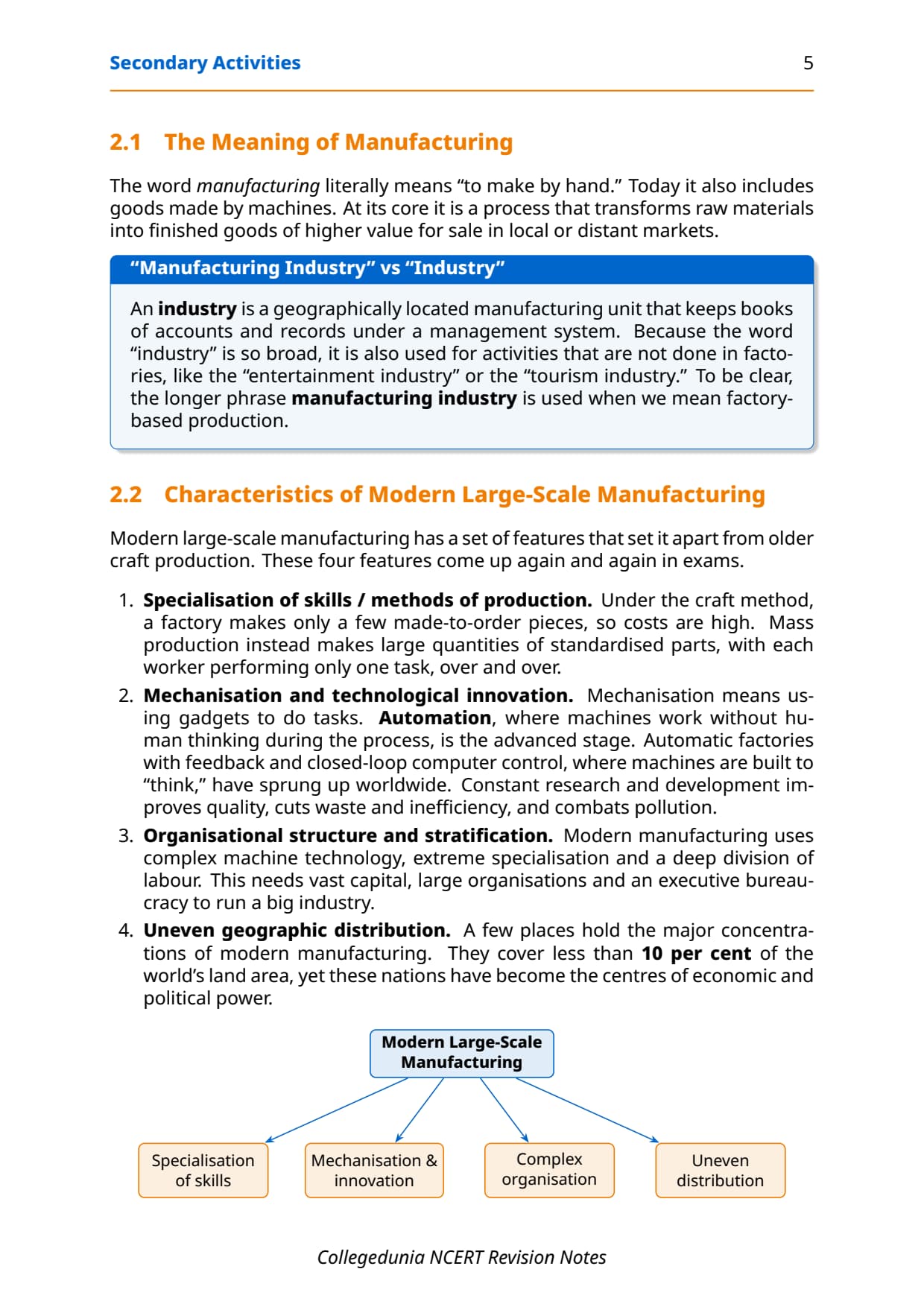
Characteristics of Modern Large Scale Manufacturing
The NCERT chapter lists five characteristics that set modern large-scale manufacturing apart from cottage or small-scale production. CBSE picks at least one nearly every year. The table below is the standard 5-mark answer.
| Characteristic | What it means in simple terms | CBSE exam angle |
|---|---|---|
| Specialisation of skills | Each worker does one task repeatedly; standardised parts produced at scale. | Distinguish from craft method |
| Mechanisation / Automation | Machines do the work; feedback-loop computers run automatic factories. | Define automation vs mechanisation |
| Complex organisation | Layers of management, vast capital, large workforce with hierarchy. | Why large-scale needs bureaucracy |
| Uneven distribution | Less than 10% of world's land area has major manufacturing. | Explain geographic concentration |
| Technological innovation | R and D for quality, efficiency, waste reduction and pollution control. | Link R and D to high-tech industry |
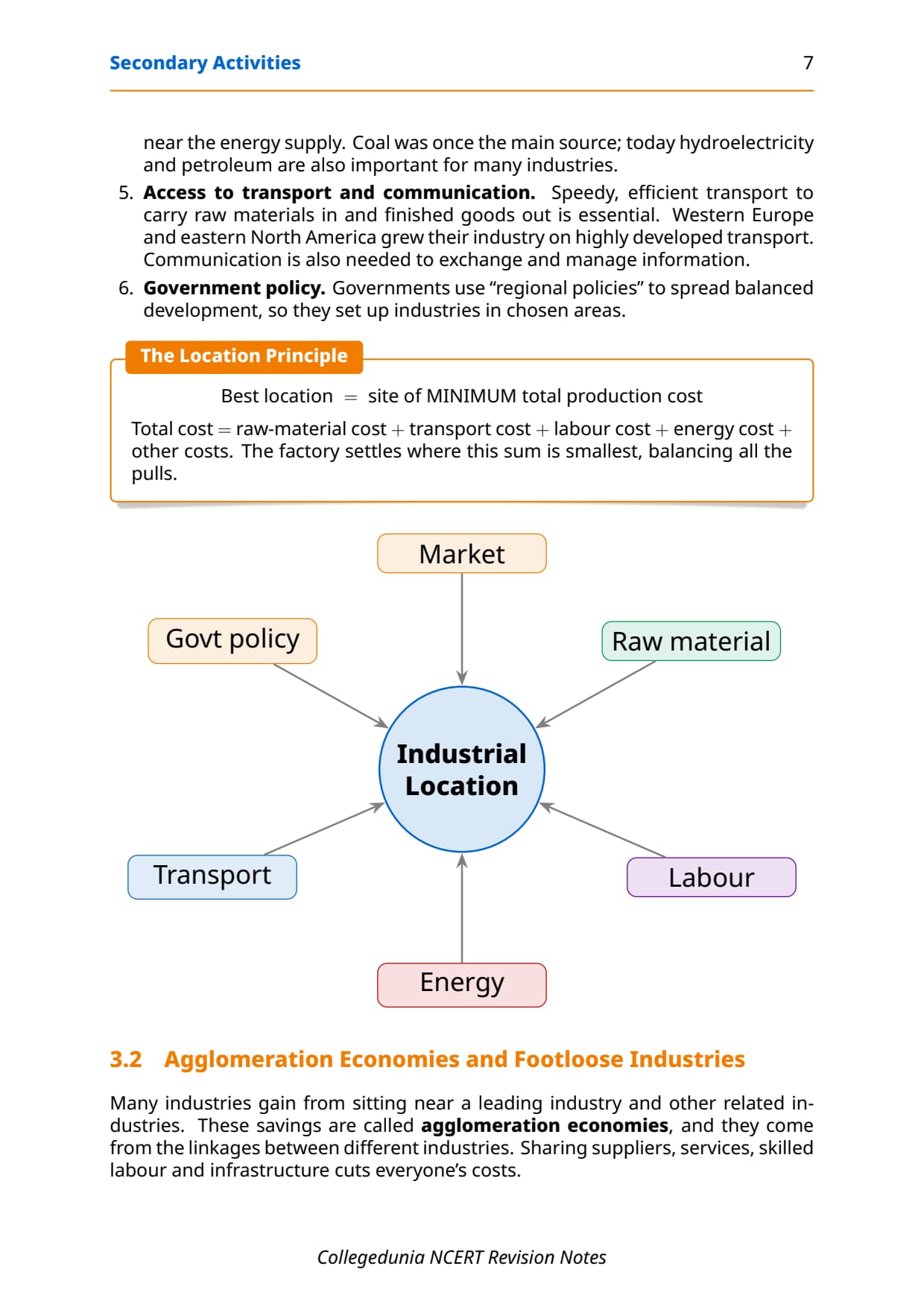
Factors of Industrial Location
Industries maximise profits by locating where production costs are lowest. The NCERT chapter lists seven factors that decide where an industry sets up. CBSE asks this as a 5-mark or 6-mark question roughly every alternate year, and naming all seven with one example each earns full marks.
| Factor | What it means | Classic example |
|---|---|---|
| Market | The most important factor; people with demand and purchasing power must exist near the production site. | Europe, North America, Japan and Australia for global consumer goods |
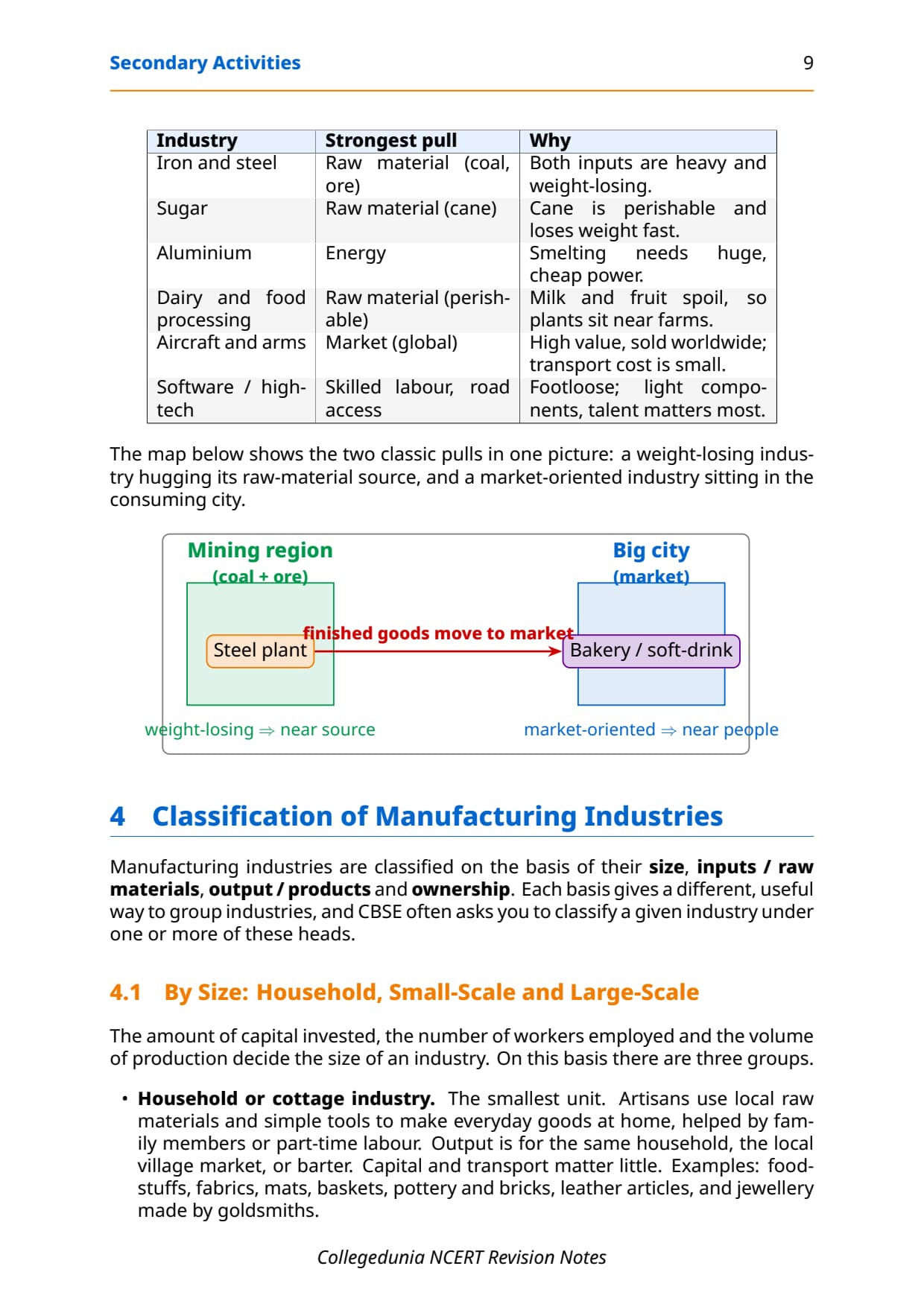
| Raw Material | Cheap, easily transportable inputs; weight-losing bulky ores push industries toward their source. | Steel and cement plants near iron ore and limestone mines |
| Labour | Skilled or semi-skilled workers; labour-intensive industries locate near large, affordable labour pools. | Garment and electronics assembly in India, China, Indonesia, Brazil |
| Energy | Power-hungry industries locate near their energy source; earlier coal, now hydroelectricity and petroleum. | Aluminium industry near hydroelectric stations |
| Transport and Communication | Fast, low-cost transport for inputs and outputs; communication for information management. | Dense rail-road networks of Western Europe and eastern North America |
| Agglomeration Economies | Benefits from clustering near a leader-industry: shared infrastructure, common suppliers, pooled workers. | Detroit automobile cluster; Ruhr steel-and-coal complex |
| Government Policy | Tax holidays, subsidised land, special economic zones and export-promotion schemes directed at particular areas. | India's special economic zones; China's coastal export zones |
Memory hook for the 7 factors: Market, Raw material, Labour, Energy, Transport, Agglomeration, Government, or use the first letters M-R-L-E-T-A-G. Write these seven letters before answering any location question, then expand each from memory.
Classification of Manufacturing Industries
NCERT classifies manufacturing industries on four bases: size, raw material, output and ownership. Every row below appears in the chapter and in recent CBSE or CUET questions.
| Basis of classification | Types | Examples from NCERT |
|---|---|---|
| Size | Cottage/household, Small-scale, Large-scale | Pottery (cottage); garments (small); iron and steel (large) |
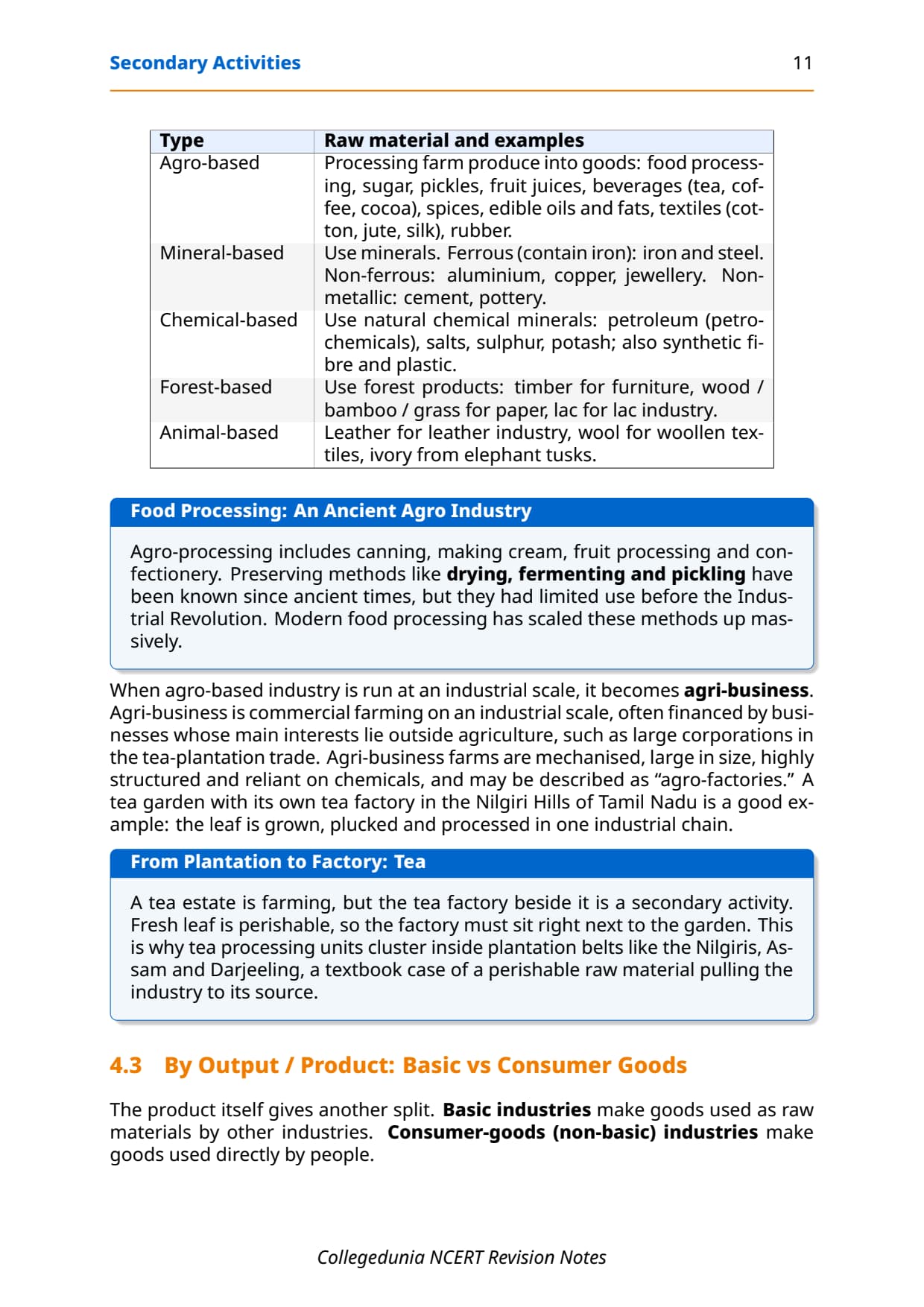
| Raw material (inputs) | Agro-based, Mineral-based, Chemical-based, Forest-based, Animal-based | Sugar, tea (agro); iron and steel (mineral); petrochem (chemical); timber, paper (forest); leather, wool (animal) |
| Output/product | Basic industries, Consumer goods industries | Iron and steel = basic; bread, soap, TV = consumer goods |
| Ownership | Public sector, Private sector, Joint sector | PSUs (public); MNCs (private); joint ventures (joint) |
Tip: CBSE has asked "classify manufacturing industries on the basis of raw material" as a 3-mark question four times since 2020. The five input-based types are agro-based (sugar, tea, textiles), mineral-based (iron and steel, aluminium, cement), chemical-based (petrochemicals, synthetic fibres, plastics), forest-based (timber, paper, lac) and animal-based (leather, wool, ivory). Give one example for each to earn full marks.
Cottage, Small Scale and Large Scale Manufacturing
The three-tier size classification is the most-tested part of the chapter. Students who write the differences clearly, with examples, earn full marks on the 5-mark distinction question. The comparison table below is that answer.
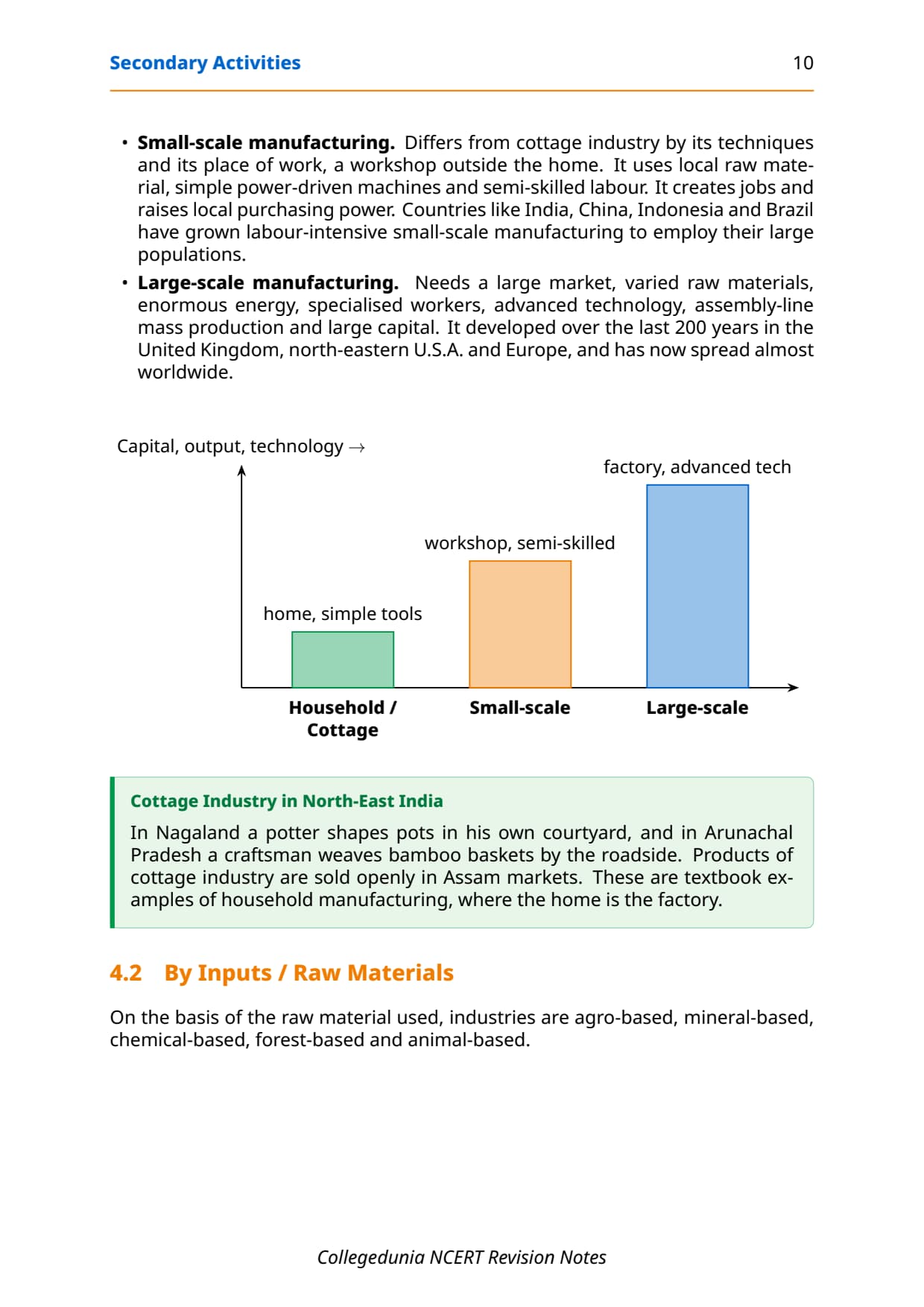
- Cottage (household): the smallest unit; artisans use local raw materials and simple tools at home with family labour; products like pottery, baskets and jewellery are sold locally or bartered.
- Small scale: production moves into a workshop using power-driven machines and semi-skilled labour; India, China, Indonesia and Brazil promote it to create jobs at scale.
- Large scale: needs a large market, various raw materials, enormous energy, specialised workers, advanced technology and large capital; it began about 200 years ago in the UK, Europe and north-eastern USA and spread worldwide.
| Feature | Cottage | Small Scale | Large Scale |
|---|---|---|---|
| Location | Home/household | Workshop outside home | Factory, industrial estate |
| Raw material | Local only | Mainly local | Various, often from distant sources |
| Labour | Family + part-time | Semi-skilled | Specialised, skilled, large workforce |
| Technology | Simple hand tools | Power-driven machines | Advanced automation, assembly lines |
| Capital | Very low | Low to moderate | Vast |
| Market | Local/barter | Local and regional | Regional, national or global |
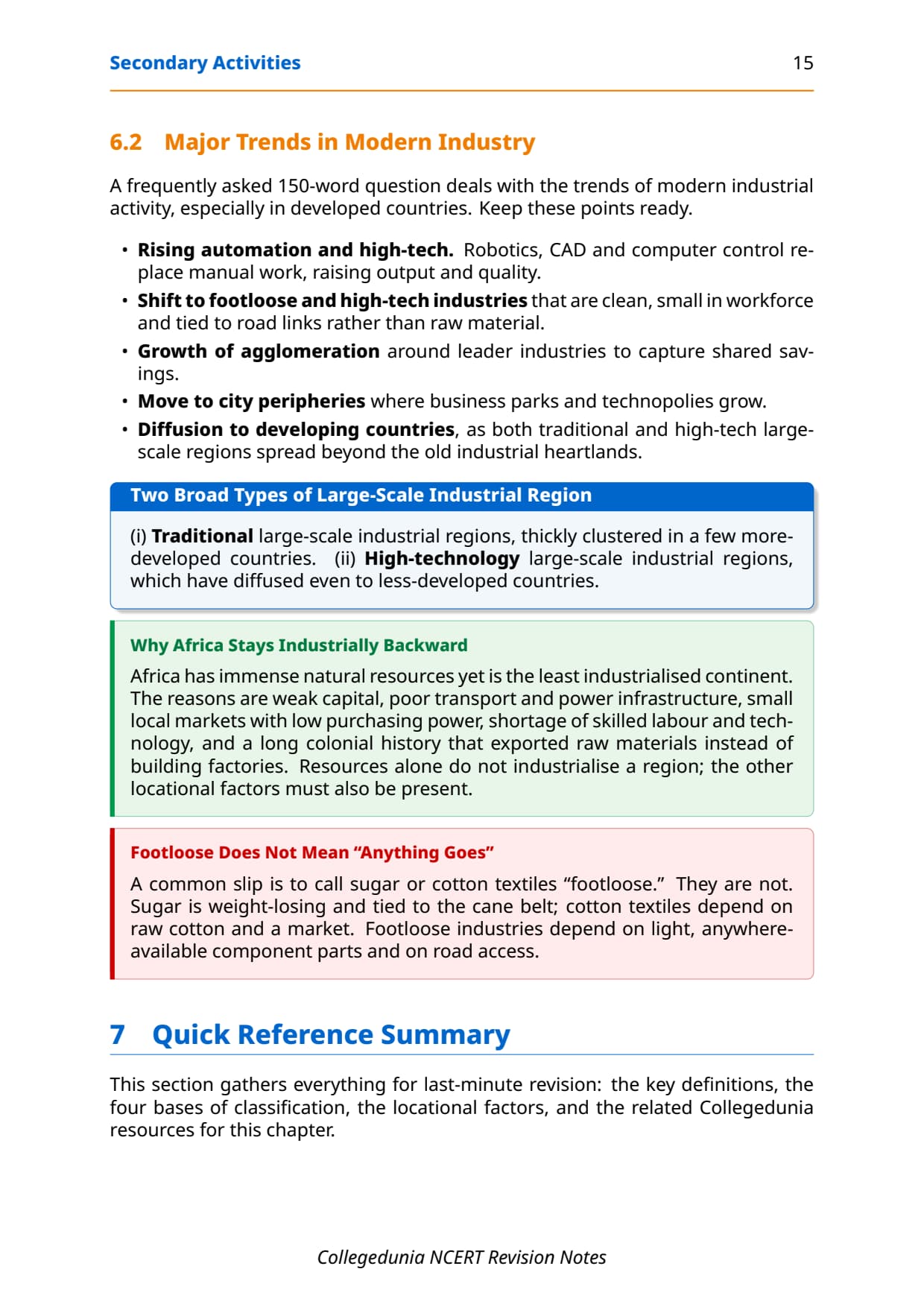
| Examples | Pottery, basket-weaving, jewellery | Garments, small food processing | Iron and steel, automobiles, electronics |
High Technology Industries and Technopolies
High-tech industry is the latest generation of manufacturing, applying intensive research and development (R and D) to make advanced scientific and engineering products. It is consistently asked in the 3-mark short-note format.
- Professional white-collar workers (scientists, engineers, researchers) greatly outnumber blue-collar production workers.
- Intensive R and D, robotics on the assembly line and computer-aided design and manufacturing.
- Neatly spaced, low, modern office-plant-lab buildings in planned business parks, not massive assembly sheds.
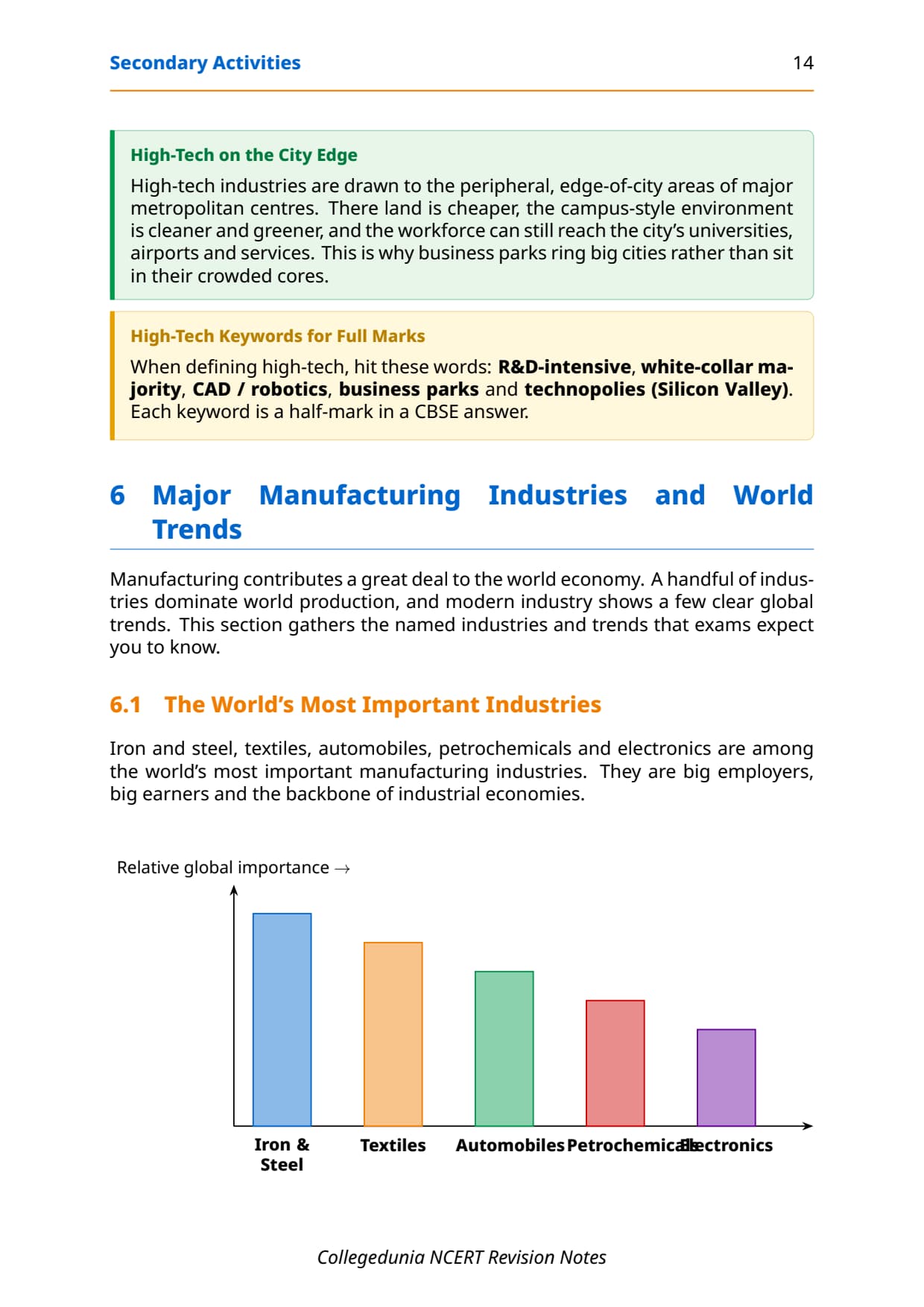
High-tech industries that are regionally concentrated, self-sustained and highly specialised are called technopolies. The NCERT examples are Silicon Valley near San Francisco and Silicon Forest near Seattle, both in the USA. Indian examples students can add are Bengaluru, Hyderabad and Pune, though NCERT does not name them.
Memory hook: High-tech = high R and D + high white-collar + high dispersal + low pollution. A technopolis feeds itself: research leads to products, products attract investment, investment funds more research. Silicon Valley is the global prototype.
Previous Year Question Trends from Secondary Activities Chapter 5
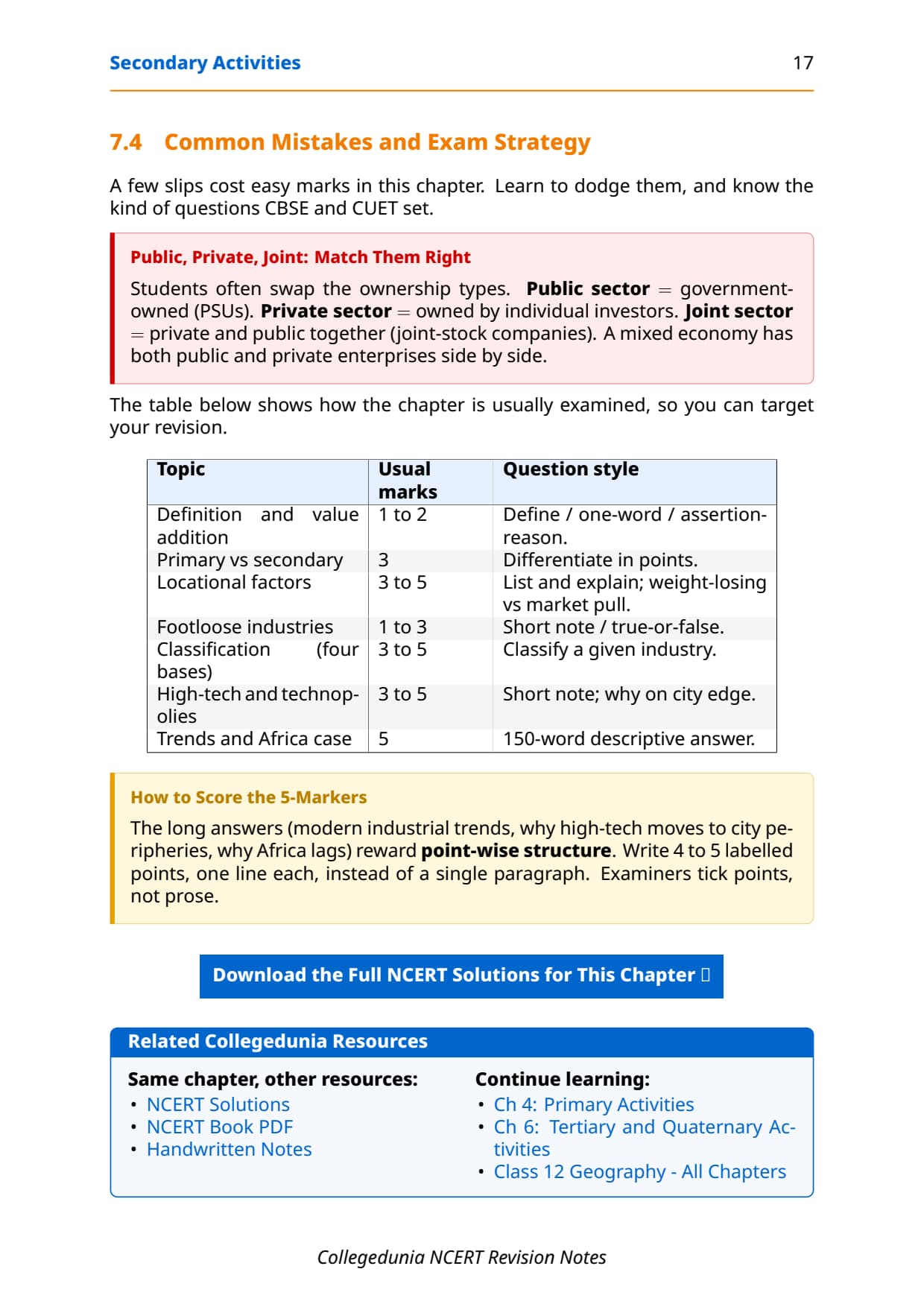
Secondary activities class 12 important questions follow a stable pattern across recent CBSE board papers, and these notes are structured around exactly that pattern. The table below maps what the board has asked over the last five years.
| Year | Question type asked | Marks | Notes section to revise |
|---|---|---|---|
| 2025 | Define footloose industries + classify industries based on raw material with examples | 2 + 4 | Key Definitions + Classification table |
| 2024 | Explain any five factors of industrial location | 5 | Factors of Industrial Location section |
| 2023 | Distinguish between cottage and large scale manufacturing + MCQ on technopolis | 4 + 1 | Three-Tier Comparison table + High-Tech section |
| 2022 | What is agglomeration economy? + Explain characteristics of modern large scale manufacturing (any three) | 2 + 4 | Key Definitions + Characteristics section |
| 2021 | Name two examples of technopolies + Write a short note on high-technology industry | 2 + 3 | High-Tech section + Technopolies subsection |
The chapter carries an effective weight of 8 to 10 marks per year across theory and application questions combined, which is why secondary activities class 12 notes consistently rank in the top three most-searched Class 12 Geography resources before board exams.
Other Resources for Class 12 Geography Chapter 5 Secondary Activities
Pair these revision notes with the matching NCERT Solutions, handwritten notes and the official NCERT book chapter. The cross-resource table below links to every Collegedunia file for Class 12 Geography Chapter 5.
| Resource | What it covers | Open |
|---|---|---|
| Notes | Concept-first revision notes covering definitions, seven location factors, four classification bases, three-tier size comparison and high-tech industry. | You are here |
| NCERT Solutions | Step-by-step answers to all NCERT exercise questions with 30-word and 150-word model answers for every question. | Class 12 Geography Chapter 5 NCERT Solutions |
| Handwritten Notes | Topper's handwritten revision pages for last-minute board exam practice. | Class 12 Geography Chapter 5 Handwritten Notes |
| NCERT Book PDF | Official NCERT Fundamentals of Human Geography Chapter 5 textbook in PDF form. | Class 12 Geography Chapter 5 NCERT Book PDF |
| Subject Hub | All chapters of Class 12 Geography with every resource in one place. | Class 12 Geography Subject Hub |
All Chapters Notes for Class 12 Geography (Fundamentals of Human Geography)
Related Links: Use the table below to navigate to the Notes for the other chapters of Class 12 Fundamentals of Human Geography. Every chapter ships with the same revision-friendly structure, definitions table and FAQ block.
| Chapter | Topic | Notes link |
|---|---|---|
| Chapter 1 | Human Geography: Nature and Scope | Class 12 Geography Chapter 1 Notes |
| Chapter 2 | The World Population: Distribution, Density and Growth | Class 12 Geography Chapter 2 Notes |
| Chapter 3 | Human Development | Class 12 Geography Chapter 3 Notes |
| Chapter 4 | Primary Activities | Class 12 Geography Chapter 4 Notes |
| Chapter 5 | Secondary Activities | You are here |
| Chapter 6 | Tertiary and Quaternary Activities | Coming soon |
| Chapter 7 | Transport and Communication | Coming soon |
| Chapter 8 | International Trade | Coming soon |
NCERT Notes Class 12 Geography Chapter 5 Secondary Activities FAQs
Ques. What does Class 12 Geography Chapter 5 Secondary Activities cover?
Ans. Class 12 Geography Chapter 5 Secondary Activities covers the definition and nature of secondary activities, manufacturing as a form of secondary activity, the characteristics of modern large-scale manufacturing (specialisation, mechanisation, automation, uneven distribution, technological innovation), seven factors of industrial location (market, raw material, labour, energy, transport, agglomeration, government), classification of industries (by size, raw material, output and ownership), the three tiers of manufacturing (cottage, small-scale, large-scale) and the concept of high-technology industries including technopolies. These notes compress all of this into a single printable revision file for the 2026-27 CBSE board exam.
Ques. What are footloose industries in Class 12 Geography?
Ans. Footloose industries are industries that can locate in a wide variety of places because they are not dependent on any specific raw material or energy source. They produce in small quantities, employ a small labour force and are generally not polluting. Their most important locational factor is accessibility by road network. Examples from the NCERT chapter include electronics assembly and light manufacturing. Because they are not tied to raw material sources or bulk energy supplies, footloose industries show the most flexible locational behaviour of all industry types.
Ques. What is the difference between cottage industry and small scale manufacturing?
Ans. Cottage industry (household manufacturing) takes place inside the home using simple hand tools, local raw materials and family labour. Capital investment is very low and the market is local or barter-based. Examples are pottery, basket-weaving and jewellery-making. Small scale manufacturing moves outside the home into a workshop and uses simple power-driven machines and semi-skilled labour. It serves local and regional markets and uses modest capital. The key distinction CBSE markers look for is the shift from the home to a workshop, and the introduction of power-driven machines in small-scale manufacturing.
Ques. What are the factors of industrial location in Class 12 Geography?
Ans. The seven factors of industrial location from the NCERT chapter are: access to market (most important factor; people with purchasing power), access to raw material (cheap, transportable; weight-losing industries locate near source), access to labour supply (skilled or semi-skilled workers; labour-intensive industries follow labour pools), access to energy (power-hungry industries near hydroelectric or coal sources), access to transportation and communication (efficient movement of inputs and outputs), access to agglomeration economies (benefits of locating near related industries) and government policy (regional policies, tax holidays, special zones). All seven together determine the optimal location for any industry.
Ques. What is a technopolis in Geography Class 12?
Ans. A technopolis is a regionally concentrated, self-sustained and highly specialised high-tech industrial cluster. The term comes from the NCERT chapter on secondary activities. High-tech industries that are clustered together share R and D facilities, a skilled specialist workforce and proximity to universities and research institutions. The most famous examples from the NCERT are Silicon Valley near San Francisco and Silicon Forest near Seattle, both in the USA. A technopolis grows because research attracts investment, investment produces products, products fund more research and the cycle accelerates.
Ques. What are agglomeration economies in industrial location?
Ans. Agglomeration economies are the benefits that industries gain by locating close to a leader-industry or a cluster of related industries. These benefits come from shared infrastructure (roads, power), common supplier networks, a pooled skilled workforce, proximity to customers and faster information flows. The Detroit automobile cluster and the Ruhr steel-and-coal complex are classic examples of agglomeration economies at work. CBSE typically asks for a definition (2 marks) or asks students to explain why industries cluster together (4 marks); in both cases, agglomeration economies is the core concept to name and define.
Ques. How are industries classified on the basis of raw material in secondary activities?
Ans. Industries are classified into five types on the basis of raw material: agro-based (cotton, jute, sugar, tea, food processing), mineral-based (iron and steel, aluminium, cement, pottery), chemical-based (petrochemicals, synthetic fibres, plastics, salts, sulphur), forest-based (timber for furniture, bamboo for paper, lac) and animal-based (leather from hides, wool from sheep, ivory from elephants). This five-way split is directly from the NCERT chapter and appears as a 3-mark or 4-mark question in CBSE board exams almost every year. Give one example for each type to earn full marks.
Ques. What are the characteristics of modern large scale manufacturing?
Ans. The NCERT chapter lists five main characteristics of modern large scale manufacturing. First, specialisation of skills: mass production of standardised parts by each worker doing one task repeatedly. Second, mechanisation and automation: machines and feedback-loop computer systems do the work without continuous human intervention. Third, complex organisational structure: layers of management, vast capital and large hierarchies. Fourth, uneven geographic distribution: manufacturing concentrates in less than 10 per cent of the world's land area. Fifth, technological innovation: continuous R and D to improve quality, cut waste, raise efficiency and control pollution. These five points together are the standard 5-mark answer for this question type.
Ques. What is agri-business and how is it different from small scale farming?
Ans. Agri-business is commercial farming on an industrial scale, often financed by large corporations whose main interests lie outside agriculture, such as tea plantation companies. Agri-business farms are mechanised, large in size, highly structured and reliant on chemicals; they are sometimes described as agro-factories. Small scale farming, in contrast, is done by individual families or small cooperatives on modest land areas, using limited capital and often traditional methods. The main difference is in scale, mechanisation, corporate financing and the industrial level of input use. Agri-business is a secondary-activity concept even though it deals with farm produce, because it applies industrial-scale processing to agricultural output.
Ques. Why are major manufacturing industries concentrated in less than 10 per cent of the world's land area?
Ans. Major manufacturing industries are highly concentrated because all the favourable location factors cluster together in a few places. Developed regions of Western Europe, eastern North America and Japan offer large, high-purchasing-power markets; dense transport networks; access to capital; a skilled labour pool; and established agglomeration economies from existing industrial clusters. Setting up in these places reduces costs and maximises reach. Moreover, agglomeration benefits grow over time: once a region becomes an industrial hub, new firms prefer it for the shared infrastructure and supplier networks, reinforcing concentration. The NCERT notes this covers less than 10 per cent of the world's land area but generates a disproportionately high share of global output.
Ques. Is the Class 12 Geography syllabus for Chapter 5 Secondary Activities changing in 2026-27?
Ans. No major reductions in 2026-27. Chapter 5 of Fundamentals of Human Geography remains fully in syllabus. The NCERT textbook chapter structure is unchanged for the current cycle, and the CBSE marking scheme continues to reward structured answers that correctly classify industries and clearly list all location factors. These secondary activities class 12 notes for 2026-27 are aligned to the unchanged textbook and the latest CBSE sample paper released for the 2026 boards.



Comments