




These Class 12 Geography Chapter 1 Human Geography Nature and Scope notes cover every NCERT definition, the three approaches (environmental determinism, possibilism and neo-determinism) and the full sub-fields table, all aligned to the 2026-27 syllabus. They are built for a quick, full-chapter revision the night before the exam.
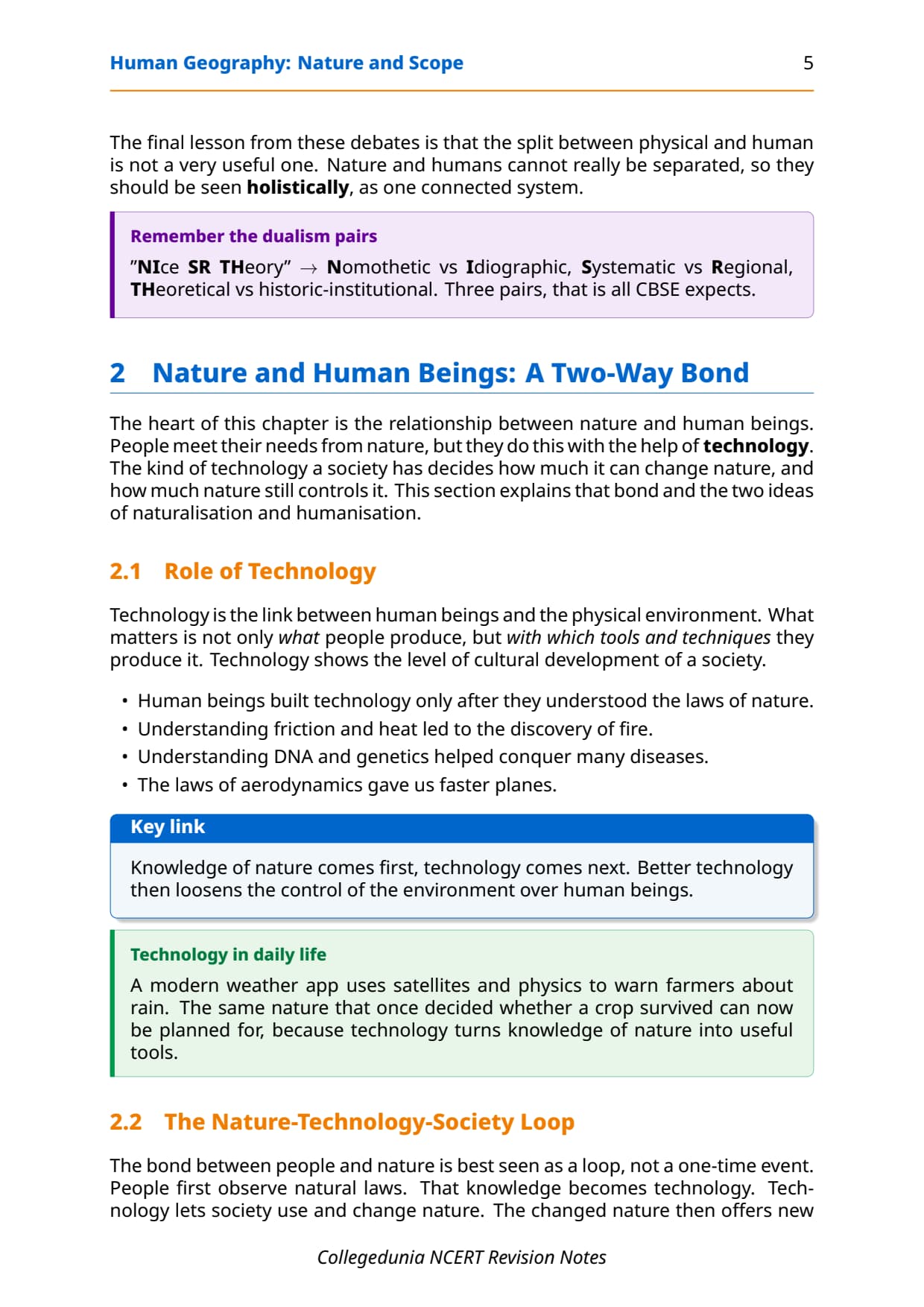
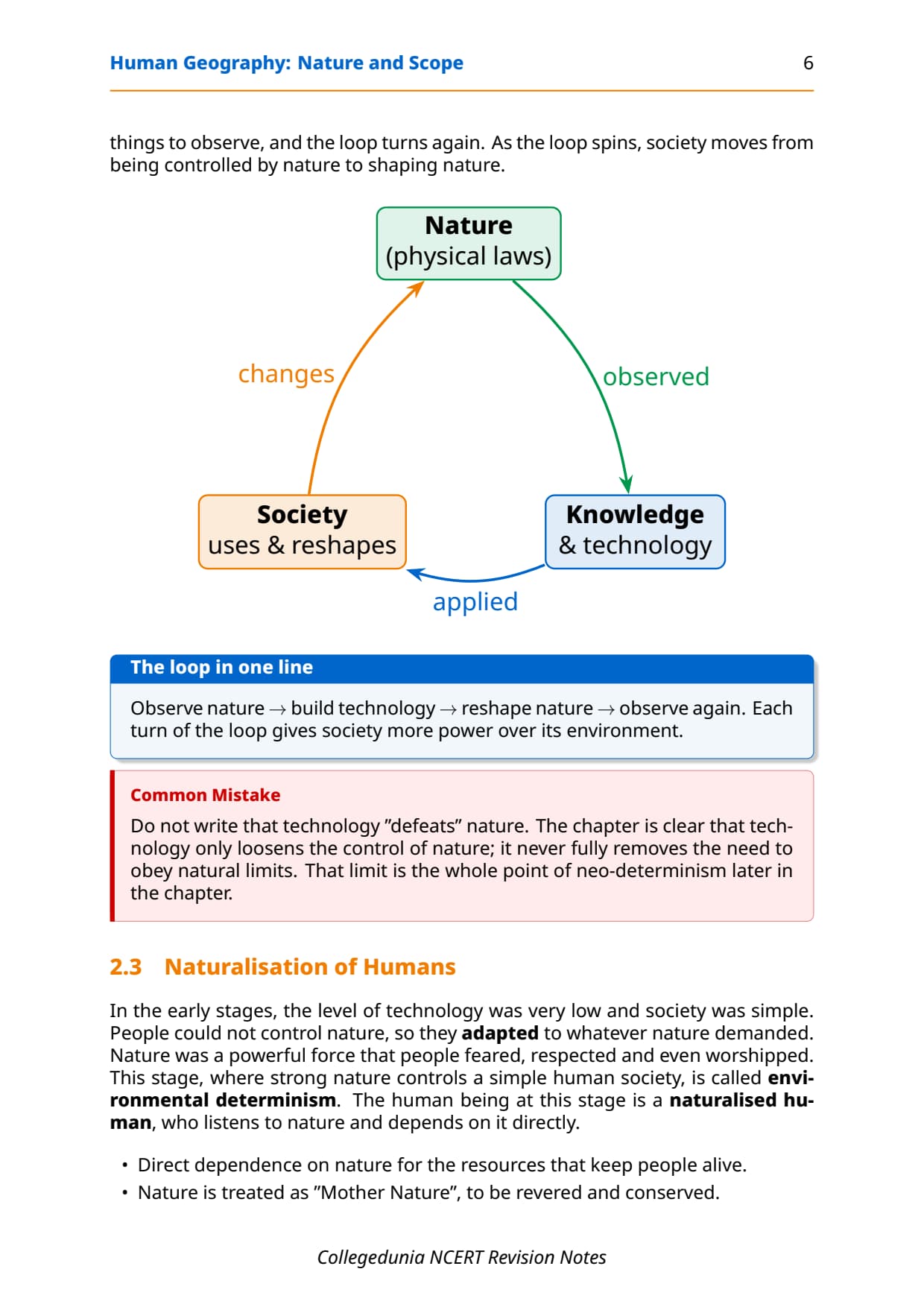
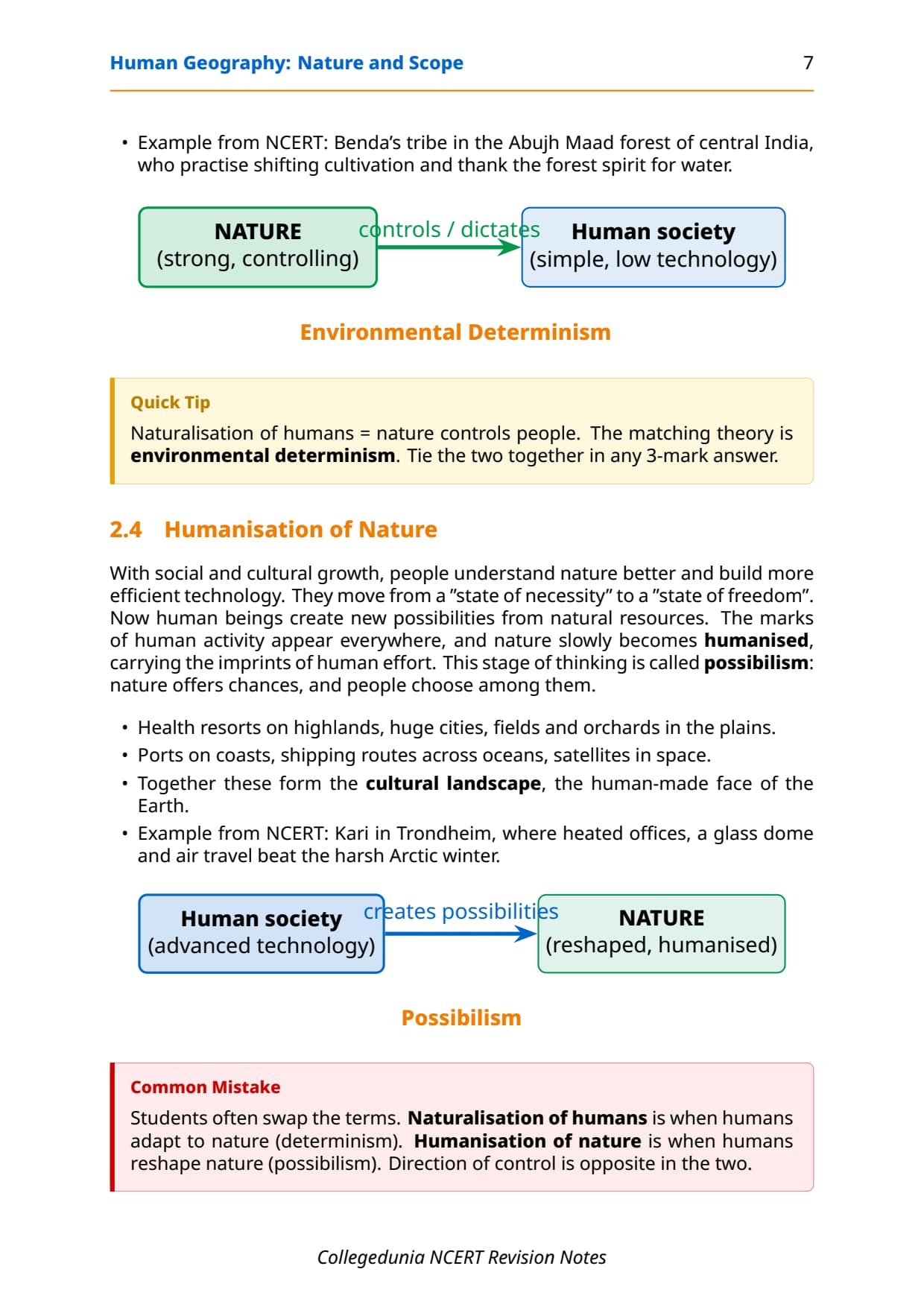
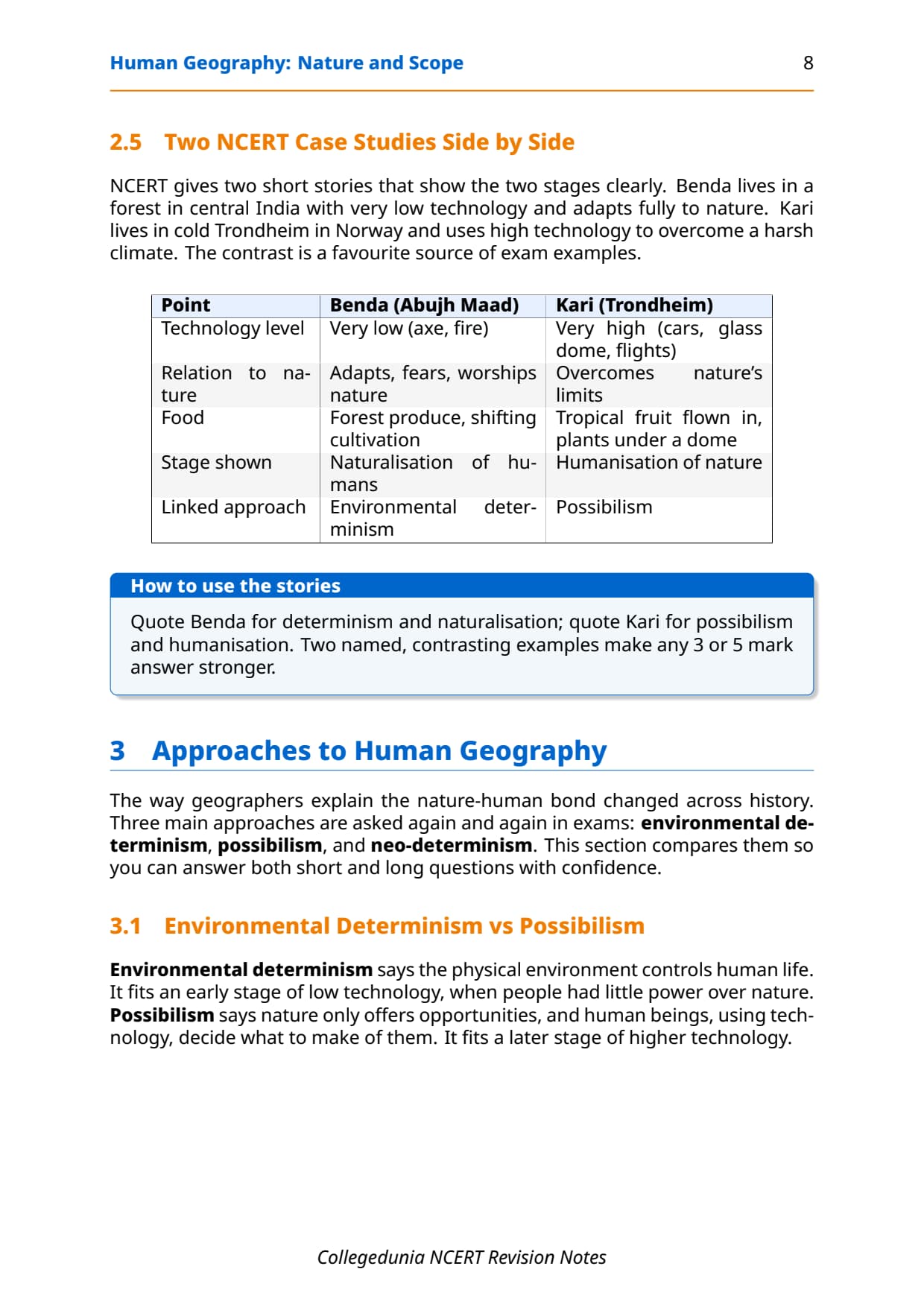


- Concept-first revision for the entire chapter: the nature of human geography, humanisation of nature, naturalisation of humans, and the three philosophical approaches (determinism, possibilism, neo-determinism).
- All major definitions by Ratzel, Semple and Vidal de la Blache that CBSE, CUET and UPSC examiners repeatedly pick, plus the complete sub-fields table matching NCERT Table 1.2.
- Cross-pointers to the matching NCERT Solutions, Handwritten Notes and NCERT Book PDF, so students see exactly where each concept gets applied in a worked answer.
Every line in these Human Geography Nature and Scope Class 12 notes is written by Collegedunia geography subject experts, mapped to the 2026-27 NCERT Fundamentals of Human Geography textbook, and pressure-tested against the last five years of CBSE Class 12 board papers, CUET Geography question patterns and UPSC preliminary exam trends.
Student Feedback
71% of Class 12 students said the three approaches (determinism, possibilism, neo-determinism) were the most-confused part, and 3 out of 4 rated the sub-fields table as the single most worth revising. Most finished a full revision from these notes in about 28 minutes.
Source: 2026-27 Class 12 Geography student poll, 9,400 CBSE students.
Quick Concept Recap: Human Geography at a Glance
Human geography studies the relationship between the physical environment and the socio-cultural environment that human beings create through mutual interaction. The earth has two components: nature (the physical environment) and life forms including humans. Everything on the human side, cities, farms, ports, roads and industries, is what this book explains chapter by chapter.
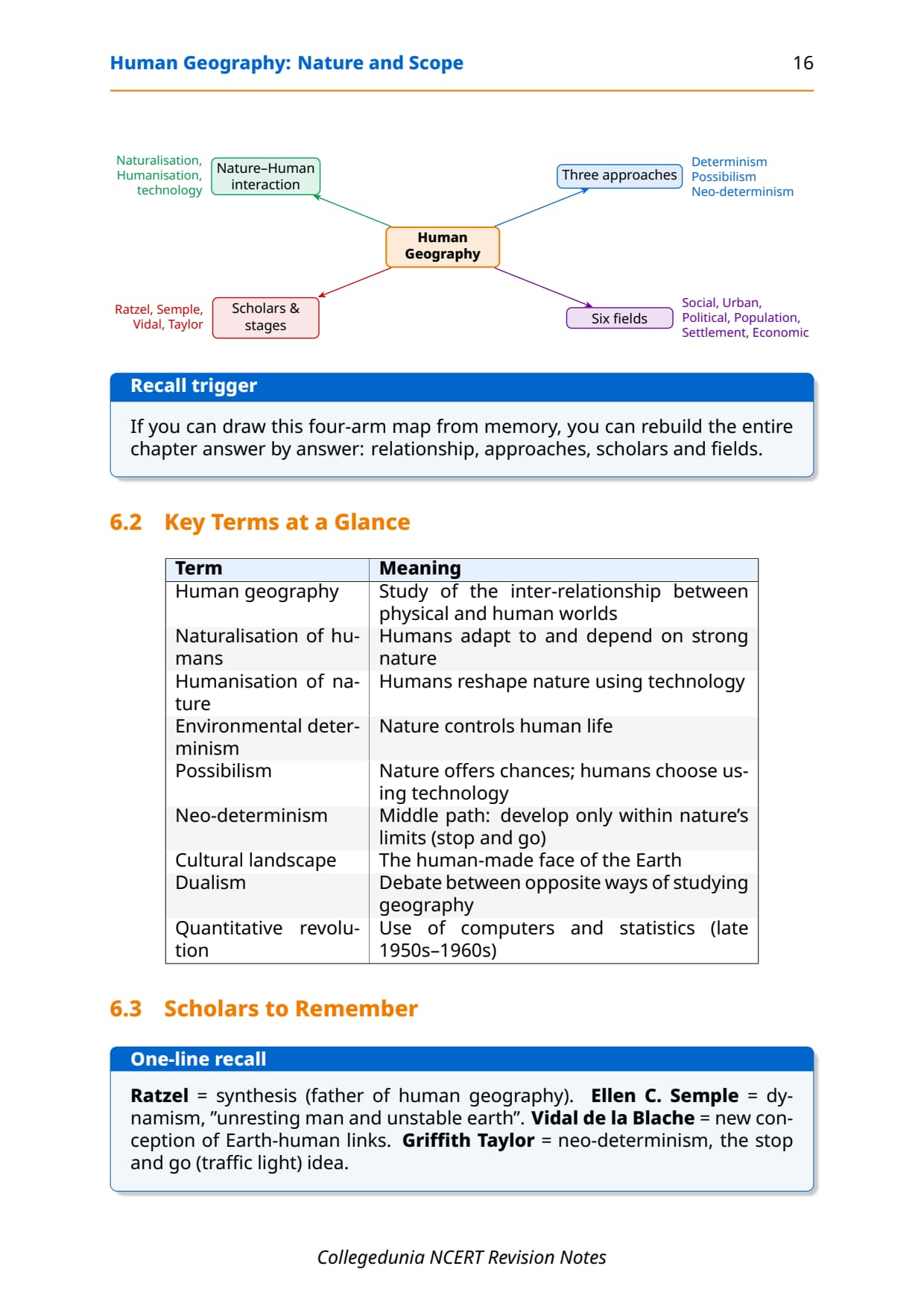
- Three scholars' definitions: Ratzel (synthetic study of relationship between human societies and earth's surface), Semple (changing relationship between unresting man and unstable earth), Vidal de la Blache (new conception of interrelationships between earth and human beings).
- Three philosophical approaches: environmental determinism (nature controls humans), possibilism (humans use nature's opportunities), neo-determinism or stop-and-go determinism (Griffith Taylor's middle path).
- Two key processes: naturalisation of humans (primitive society adapting to nature) and humanisation of nature (technology allowing humans to modify their environment).
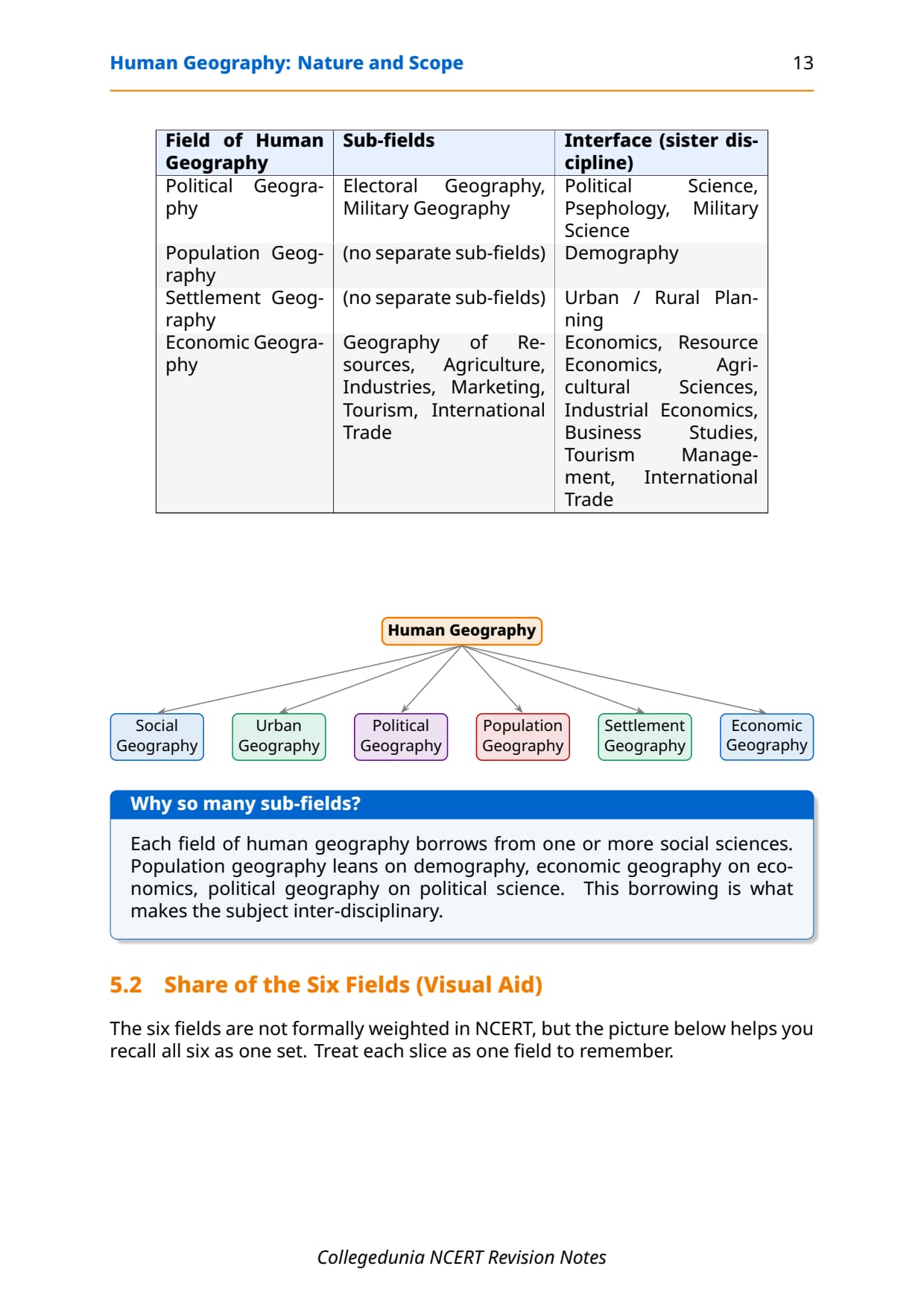
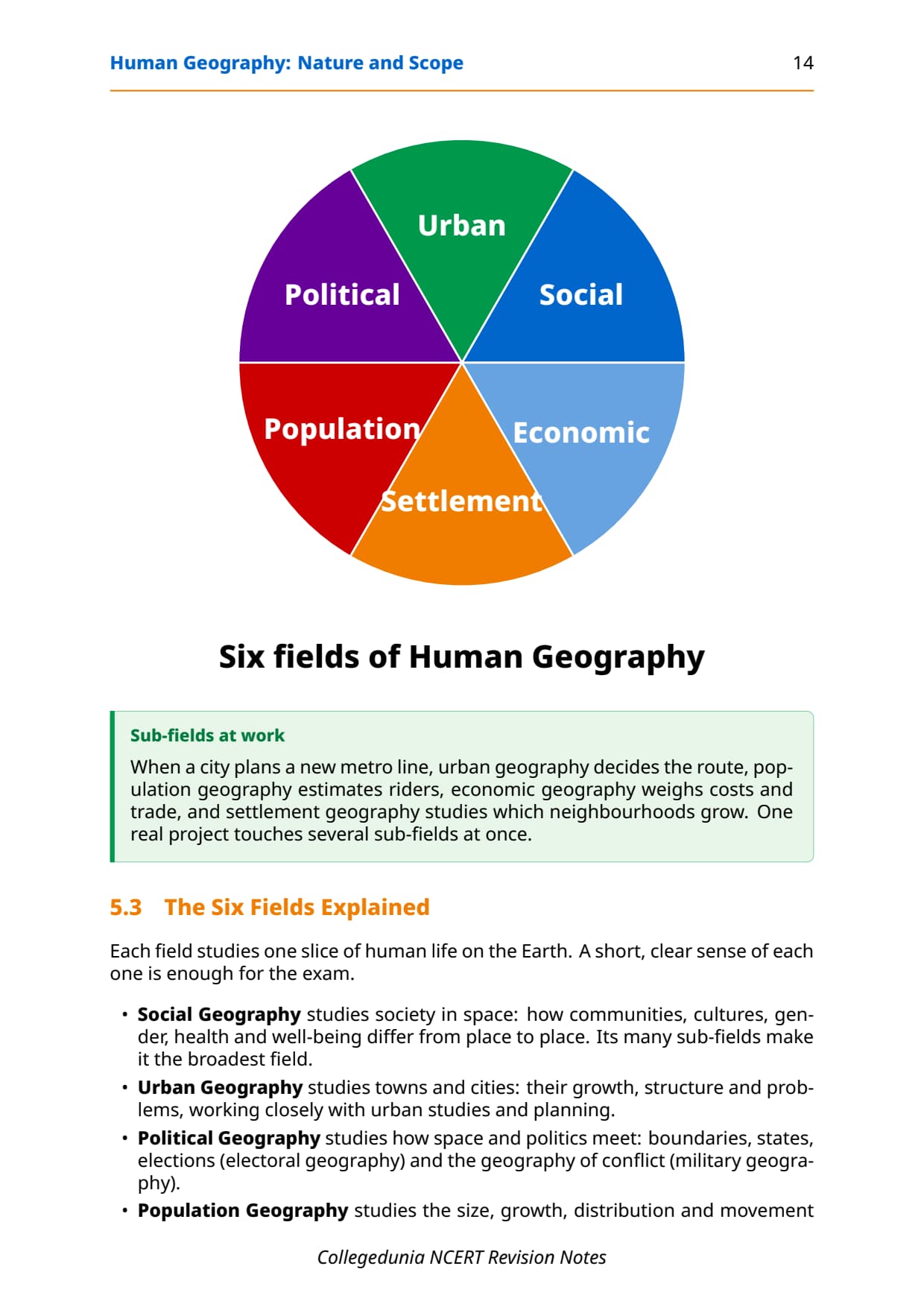
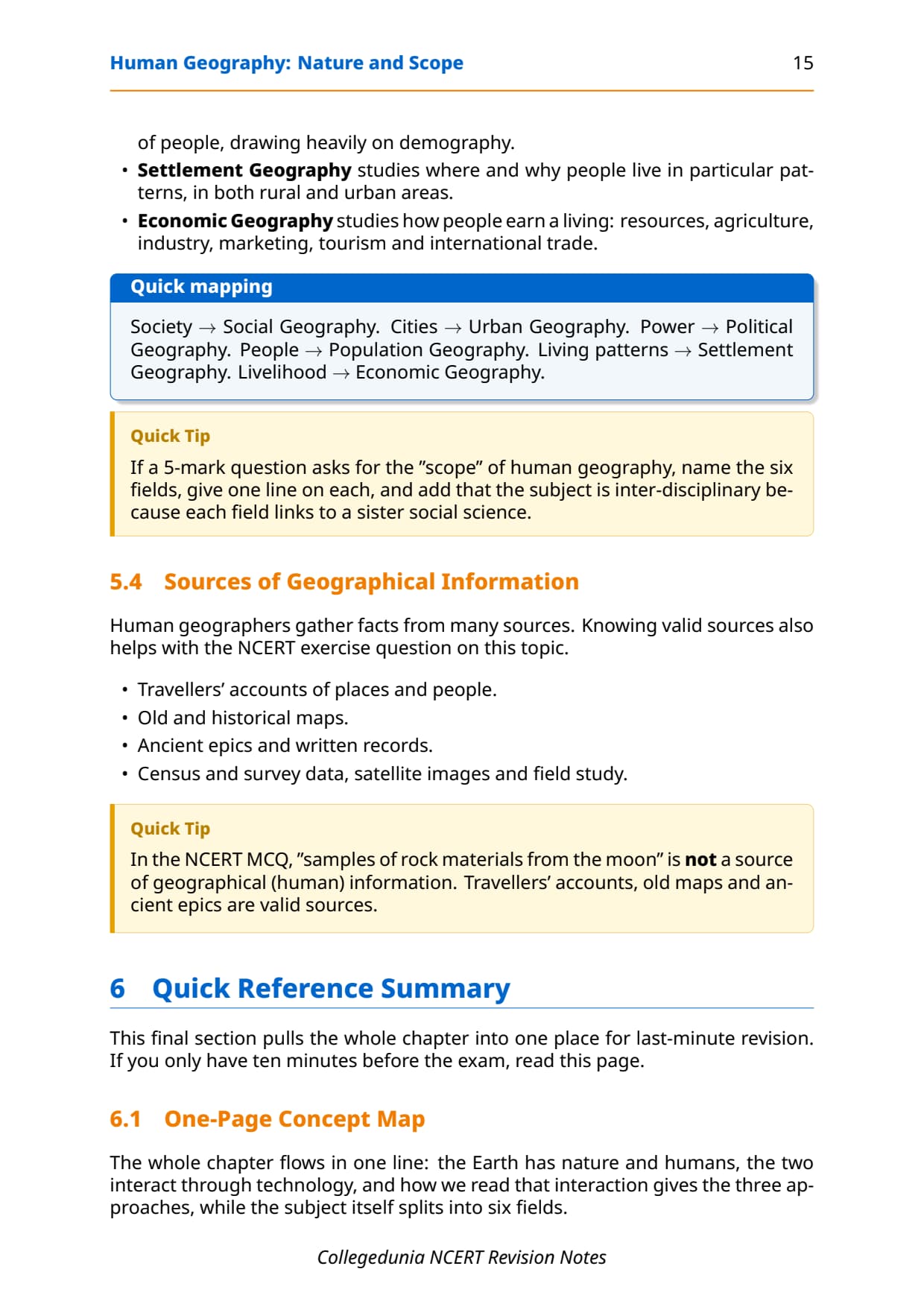
- Sub-fields: social geography, cultural geography, population geography, settlement geography, economic geography, political geography and their interface disciplines from social sciences.
- Historical stages: exploration and description, regional analysis, areal differentiation, spatial organisation (quantitative revolution), humanistic/radical/behavioural schools, post-modernism.
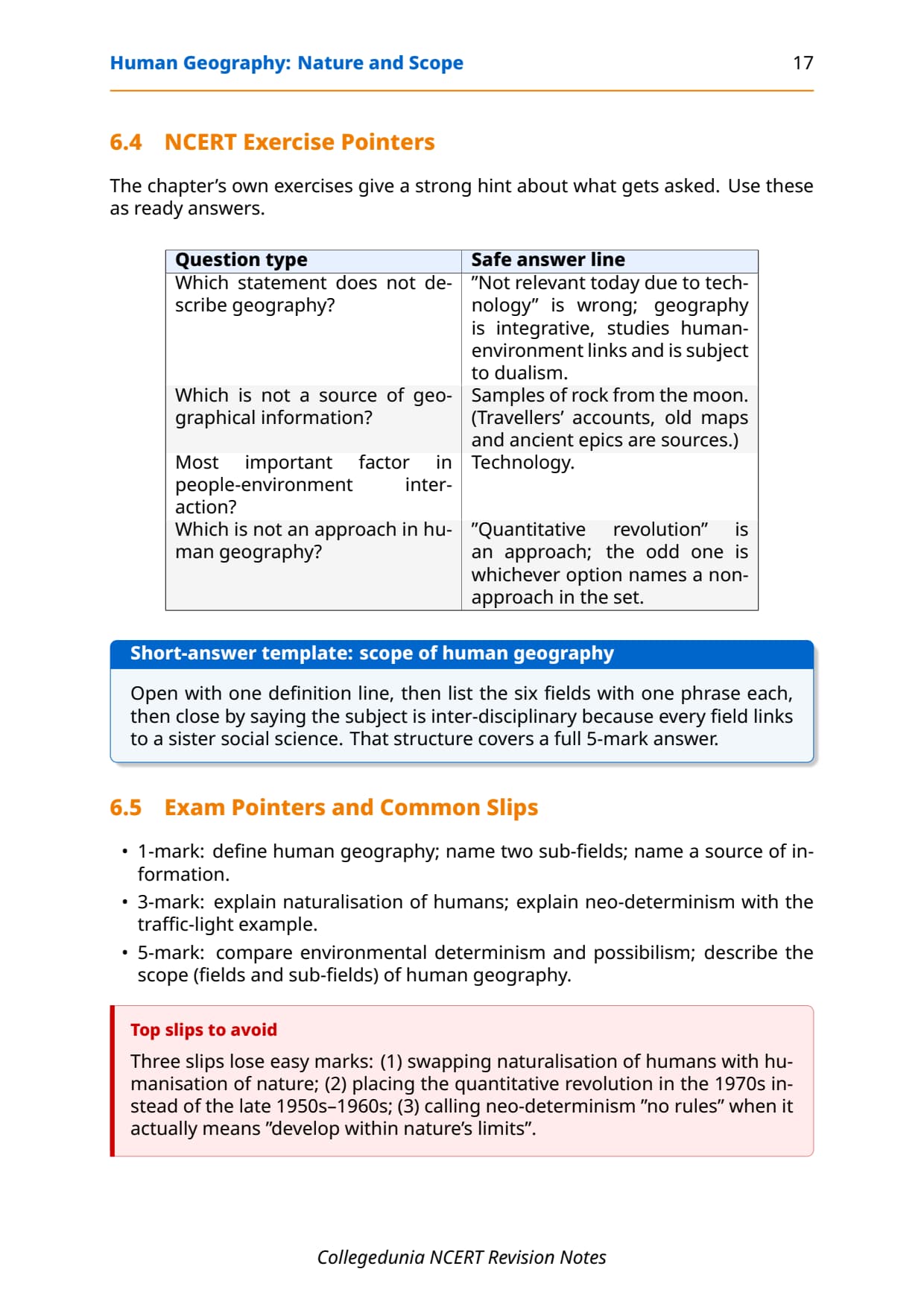
Read these notes first, then use the matching NCERT Solutions for Class 12 Geography Chapter 1 for the exercise drill.
Source: Magnet Brains on YouTube
Key Definitions by Ratzel, Semple and Vidal de la Blache
Every theory-based question in the CBSE Class 12 Geography paper on this chapter begins with a definition. The human geography nature and scope definitions below are written in the exact one-line form CBSE markers expect, and are the same definitions used inside the downloadable PDF version of these class 12 geography chapter 1 notes.
| Scholar | Definition | Key emphasis |
|---|---|---|
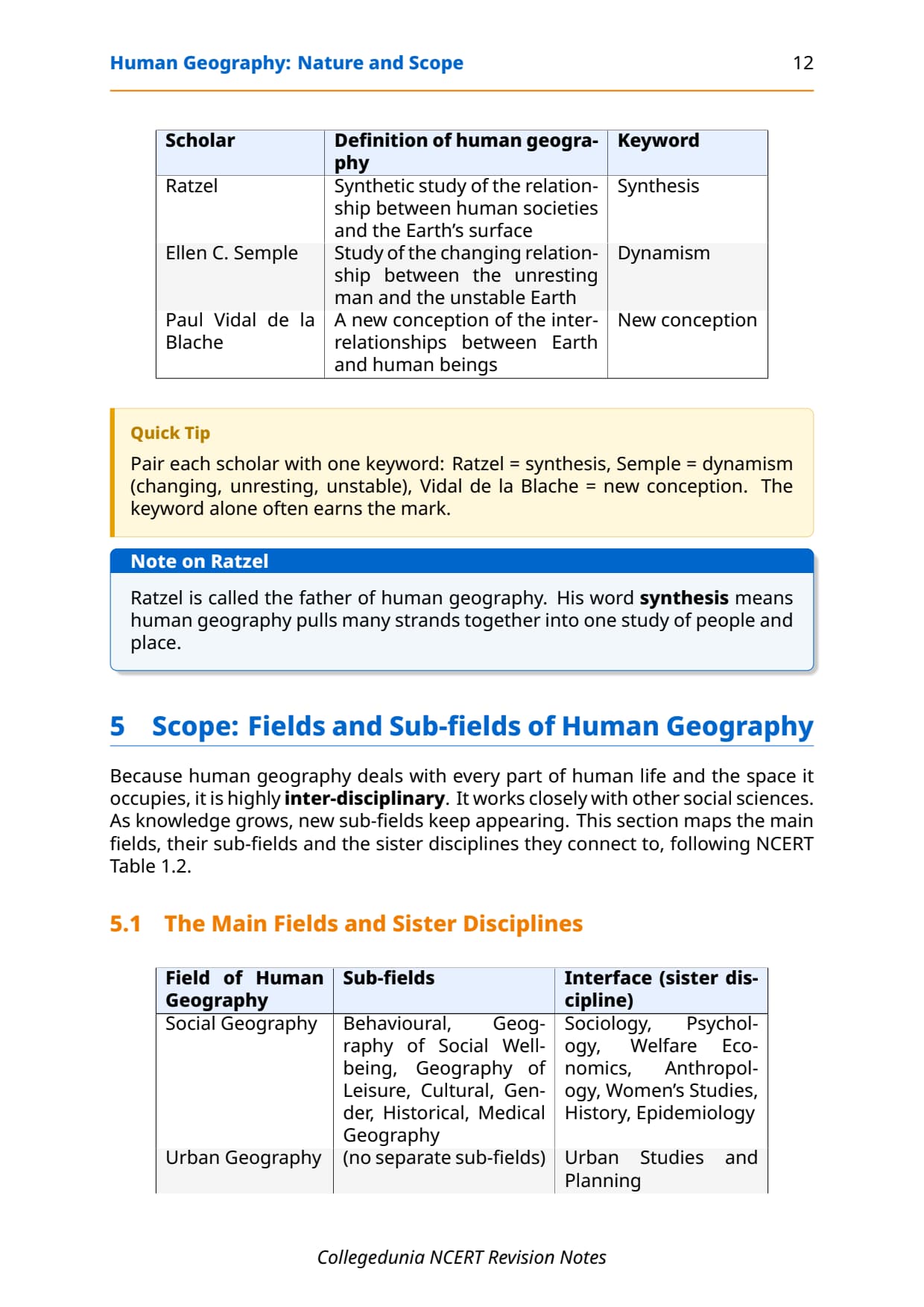
| Friedrich Ratzel | "Human geography is the synthetic study of relationship between human societies and earth's surface." | Synthesis between humans and earth |
| Ellen C. Semple | "Human geography is the study of the changing relationship between the unresting man and the unstable earth." | Dynamism and constant change |
| Paul Vidal de la Blache | "Conception resulting from a more synthetic knowledge of the physical laws governing our earth and of the relations between the living beings which inhabit it." | New conception of earth-human interrelationship |
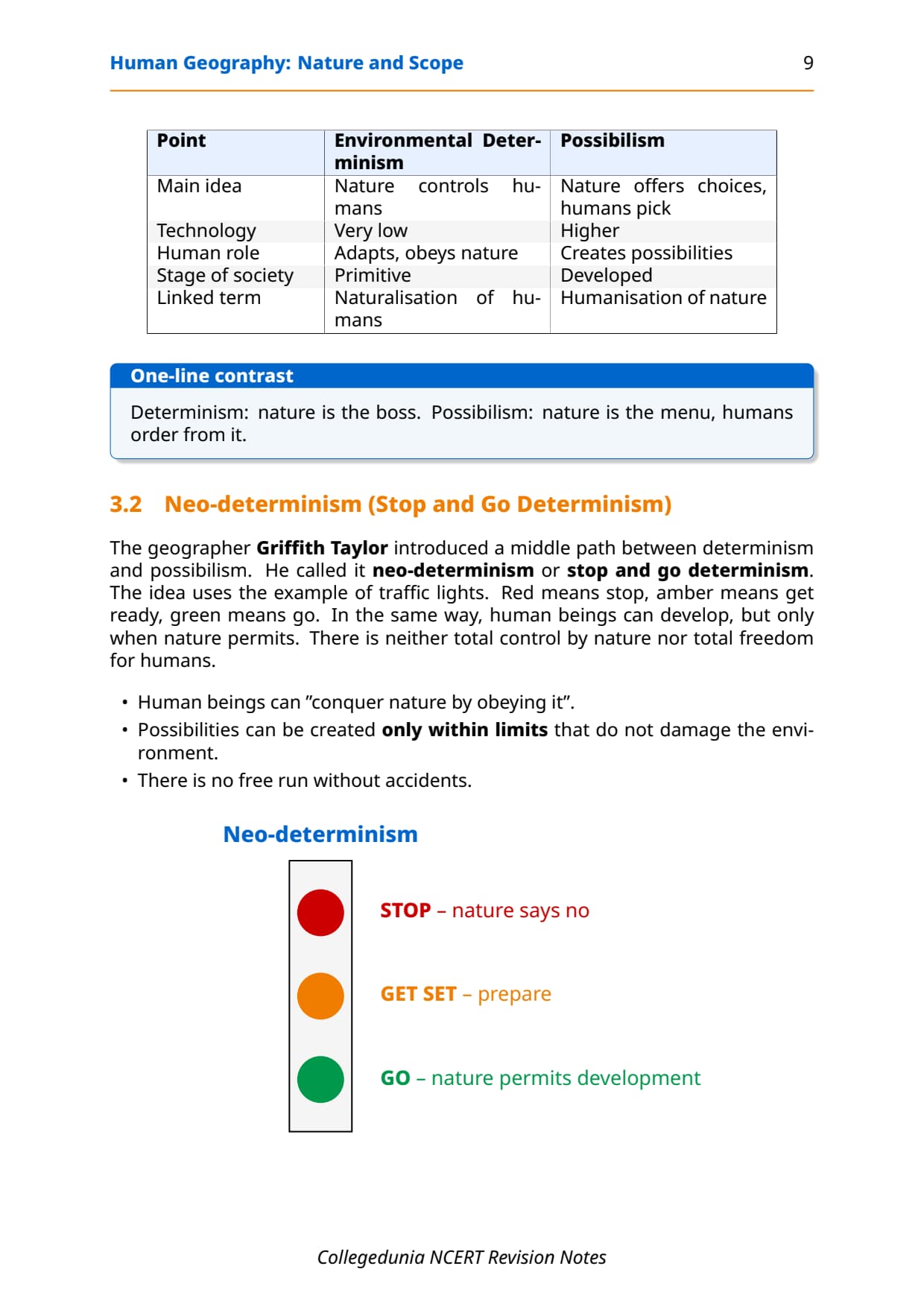
| Environmental Determinism | The idea that the physical environment controls and determines human activities; humans adapt to the dictates of nature. | Nature over humans |
| Possibilism | The idea that nature provides opportunities and human beings make use of these; humans create possibilities within the environment. | Humans over nature |
| Neo-determinism | Concept by Griffith Taylor; a middle path between determinism and possibilism; humans can conquer nature by obeying it, like traffic lights signal stop and go. | Balanced, conditional freedom |
| Cultural Landscape | The imprint of human activities on the physical environment; human endeavour transforms the natural landscape into a cultural one. | Human imprint on earth |
| Technology | Indicates the level of cultural development of society; technology loosens the shackles of environment on human beings. | Mediator between humans and nature |
These eight definitions cover most of the one-mark and three-mark theory questions CBSE has asked on this chapter since 2021, so learn them first.
Nature of Human Geography: Three Philosophical Approaches
Three positions explain how humans relate to their physical environment. Naming the right scholar with the right concept is the difference between a 2-mark and a 0-mark answer.
Environmental Determinism
In the early stages, humans were greatly influenced by nature and adapted to its dictates. Technology was very low and society was primitive. A naturalised human listened to nature, feared its fury and worshipped it. Nature was all-powerful.
One-line formula: nature is all-powerful, humans adapt and obey, very low technology, primitive stage.
Possibilism
With better technology, humans moved from necessity to freedom and created possibilities from the resources around them. This human imprint is the cultural landscape: health resorts on highlands, urban sprawls, fields, ports, oceanic routes and satellites. Nature provides opportunities and humans use them, so nature gets humanised.
One-line formula: humans use nature's opportunities, create the cultural landscape, technology is high, nature is a resource base not a controller.
Neo-determinism (Stop and Go Determinism)
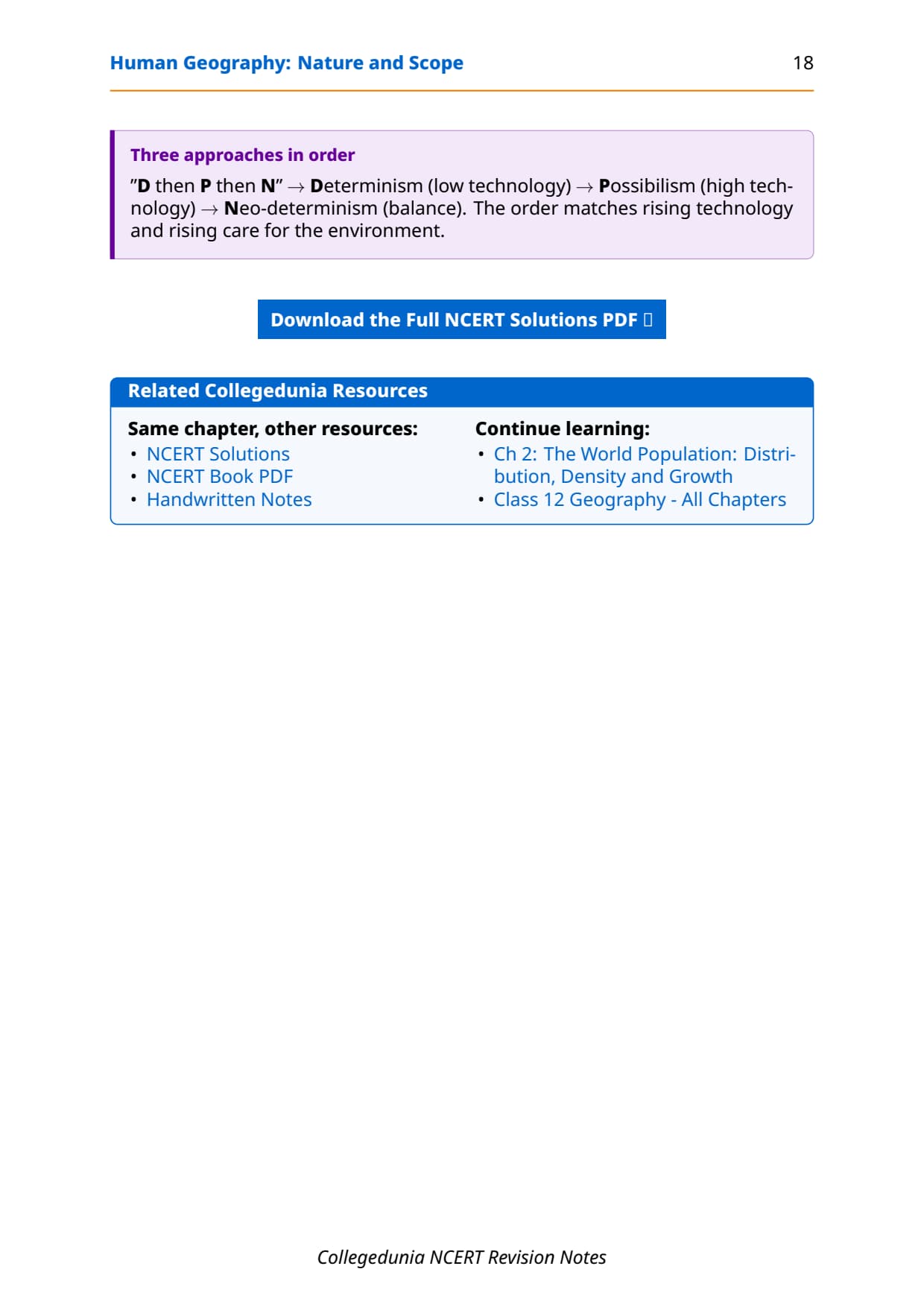
Griffith Taylor's middle path uses a traffic-light metaphor: red stop, amber get ready, green go. Neither absolute necessity nor absolute freedom exists. Humans can conquer nature by obeying it, creating possibilities within limits that do not damage the environment. Unchecked development has already caused global warming, ozone depletion and receding glaciers.
At a glance: the three approaches compared
- Determinism: nature commands, humans obey; primitive stage; scholars Ratzel and Semple.
- Possibilism: humans use nature's stage; technology is the key; Vidal de la Blache and the French school.
- Neo-determinism: middle path; conditions apply; Griffith Taylor; conquer nature by obeying it.
- Key warning for CBSE: do not confuse the scholar's name across approaches; Griffith Taylor is always neo-determinism, never possibilism.
Naturalisation of Humans and Humanisation of Nature
NCERT uses two case studies to show the two extremes. Both are common 3-mark passage questions in CBSE papers.
Naturalisation of Humans: Benda's Story
Benda, from the Abujh Maad area, practices shifting cultivation, uses ash to fertilise the soil, and thanks Loi-Lugi (the forest spirit) for water. He is completely dependent on and in harmony with the forest.
Memory hook: Naturalisation = the human becomes part of nature. Nature controls Benda, technology is low. This is environmental determinism in action.
Humanisation of Nature: Kari's Story
Kari, in Trondheim, Norway, faces fierce winters, but uses winter tyres, a glass-domed campus, a heated office and imported tropical fruit, and flies to London for a meeting. Technology makes a harsh place comfortable.
Memory hook: Humanisation = humans control nature. Technology makes Trondheim comfortable for Kari. This is possibilism in action.
Fields and Sub-fields of Human Geography
Every sub-field below appears in NCERT Table 1.2 and in recent CBSE or CUET questions. Use this as your final-revision block.
| Field of Human Geography | Sub-fields / Specialisations | Sister discipline interface |
|---|---|---|
| Social Geography | Behavioural Geography, Geography of Social Well-being, Geography of Leisure | Sociology, Psychology, Welfare Economics |
| Cultural Geography | Cultural Geography, Gender Geography, Historical Geography, Medical Geography | Anthropology, Sociology, Women's Studies, History, Epidemiology |
| Urban Geography | Urban Geography | Urban Studies and Planning |
| Political Geography | Electoral Geography, Military Geography | Political Science, Psephology, Military Science |
| Population Geography | Population Geography, Settlement Geography | Demography, Urban/Rural Planning |
| Economic Geography | Geography of Resources, Geography of Agriculture, Geography of Industries, Geography of Marketing, Geography of Tourism, Geography of International Trade | Economics, Resource Economics, Agricultural Sciences, Industrial Economics, Business Studies, Tourism Management, International Trade |
Tip: CBSE has asked "name two sub-fields of human geography" four times since 2020. Any two from the Economic Geography row earn full marks.
Historical Stages of Human Geography
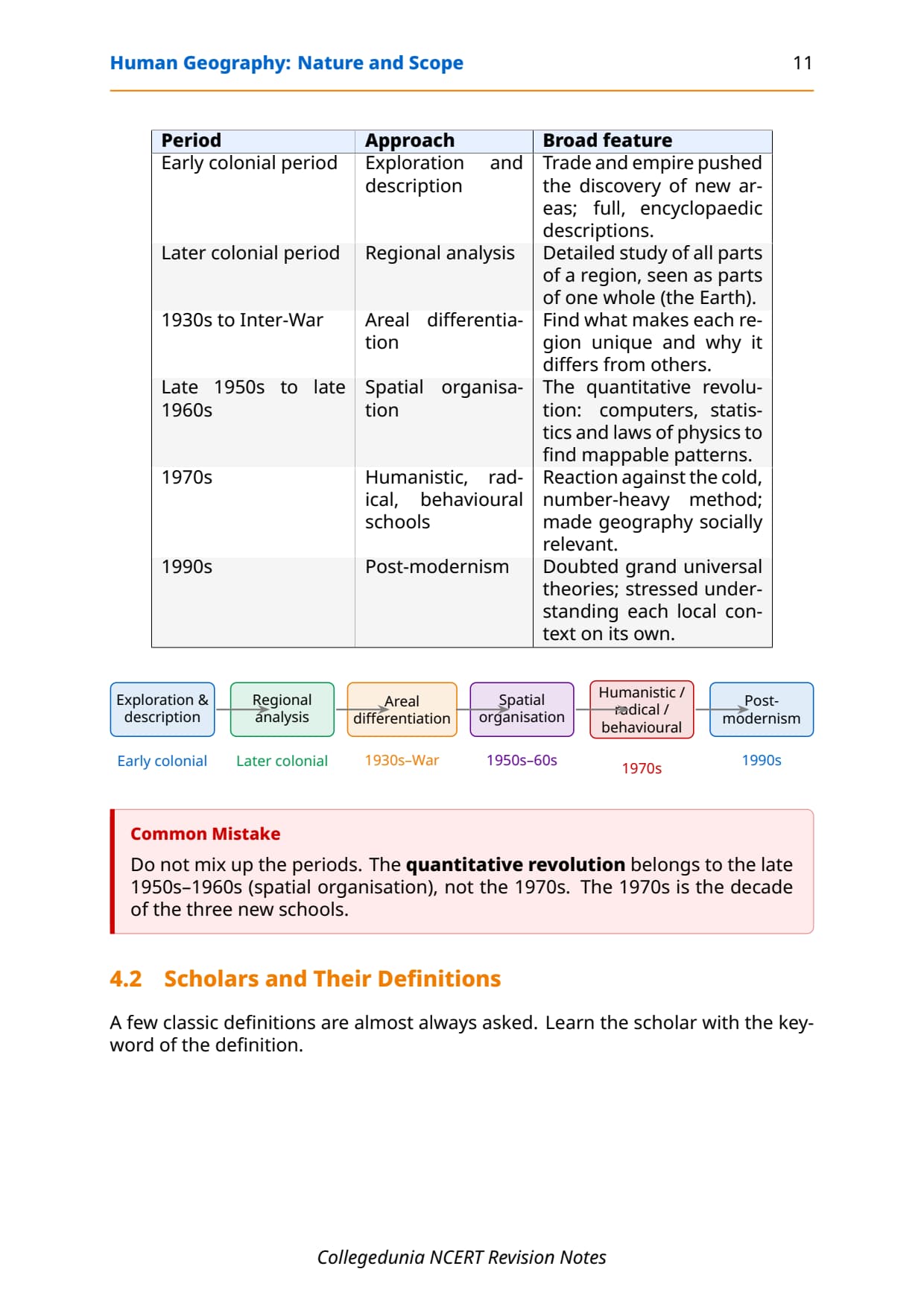
NCERT Table 1.1 lists six stages in the growth of human geography. CBSE asked this as a 4-mark question in 2023 and 2024, so memorise the period, approach and features for each.
| Period | Approach | Broad features |
|---|---|---|
| Early Colonial period | Exploration and description | Imperial and trade interests prompted discovery; encyclopaedic description of newly found areas. |
| Later Colonial period | Regional analysis | Elaborate description of all aspects of a region; understanding each part to understand the whole earth. |
| 1930s through inter-War period | Areal differentiation | Focus on uniqueness of any region; understanding how and why it differed from others. |
| Late 1950s to late 1960s | Spatial organisation | Computers and statistical tools; laws of physics applied to map human phenomena; quantitative revolution. |
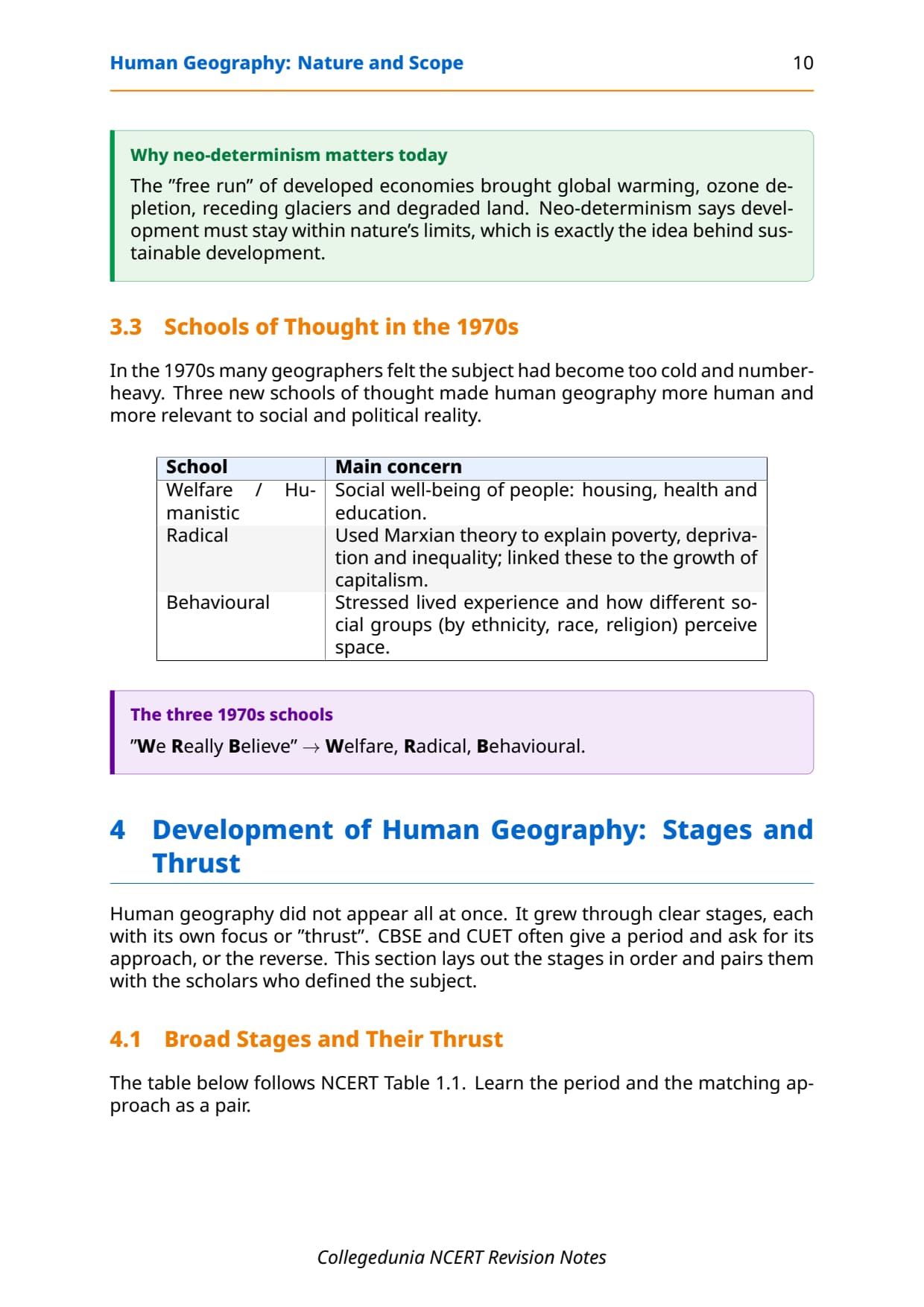
| 1970s | Humanistic, radical and behavioural schools | Discontentment with quantitative dehumanisation; Welfare, Radical (Marxian) and Behavioural geography emerged. |
| 1990s | Post-modernism | Universal theories questioned; importance of local context emphasised; grand generalisations rejected. |
The chapter carries about 8 to 10 marks per year in the CBSE Class 12 Geography paper.
Previous Year Question Trends from Human Geography Chapter 1
The table below maps what CBSE has asked from this chapter over the last five years.
| Year | Question type asked | Marks | Notes section to revise |
|---|---|---|---|
| 2025 | Explain neo-determinism with the traffic-light metaphor + name three sub-fields | 5 + 2 | Three Approaches + Sub-fields table |
| 2024 | Historical stages of human geography (tabular) + define possibilism | 4 + 2 | Historical Stages + Key Definitions |
| 2023 | Distinguish between environmental determinism and possibilism + Benda case study MCQ | 4 + 1 | Three Approaches + Naturalisation section |
| 2022 | Scope of human geography + name sister disciplines of economic geography | 4 + 2 | Scope section + Sub-fields table |
| 2021 | Define human geography (any one scholar) + explain humanisation of nature | 2 + 4 | Key Definitions + Humanisation section |
Other Resources for Class 12 Geography Chapter 1 Human Geography Nature and Scope
Pair these notes with the matching resources for Class 12 Geography Chapter 1.
| Resource | What it covers | Open |
|---|---|---|
| Notes | Concept-first revision notes covering definitions, three philosophical approaches, sub-fields table, historical stages and common CBSE question types. | You are here |
| NCERT Solutions | Step-by-step answers to all NCERT exercise questions with 30-word and 150-word model answers for every question. | Class 12 Geography Chapter 1 NCERT Solutions |
| Handwritten Notes | Topper's handwritten revision pages for last-minute board exam practice. | Class 12 Geography Chapter 1 Handwritten Notes |
| NCERT Book PDF | Official NCERT Fundamentals of Human Geography Chapter 1 textbook in PDF form. | Class 12 Geography Chapter 1 NCERT Book PDF |
| Subject Hub | All chapters of Class 12 Geography with every resource in one place. | Class 12 Geography Subject Hub |
All Chapters Notes for Class 12 Geography (Fundamentals of Human Geography)
Related Links: Use the table below to navigate to the Notes for the other chapters of Class 12 Fundamentals of Human Geography. Every chapter ships with the same revision-friendly structure, definitions table and FAQ block.
| Chapter | Topic | Notes link |
|---|---|---|
| Chapter 1 | Human Geography: Nature and Scope | You are here |
| Chapter 2 | The World Population: Distribution, Density and Growth | Class 12 Geography Chapter 2 Notes |
| Chapter 3 | Human Development | Class 12 Geography Chapter 3 Notes |
| Chapter 4 | Primary Activities | Class 12 Geography Chapter 4 Notes |
| Chapter 5 | Secondary Activities | Class 12 Geography Chapter 5 Notes |
| Chapter 6 | Tertiary and Quaternary Activities | Coming soon |
| Chapter 7 | Transport and Communication | Coming soon |
| Chapter 8 | International Trade | Coming soon |
NCERT Notes Class 12 Geography Chapter 1 Human Geography Nature and Scope FAQs
Ques. What does human geography class 12 chapter 1 cover?
Ans. Human geography class 12 chapter 1 covers the definition and nature of human geography, three philosophical approaches (environmental determinism, possibilism and neo-determinism), the two case studies on naturalisation of humans and humanisation of nature, the fields and sub-fields of human geography with their sister discipline interfaces, and the historical stages of the discipline from early colonial exploration to post-modernism. These notes compress all of this into a single printable revision file for the 2026-27 CBSE board exam.
Ques. Who gave the concept of neo-determinism in human geography?
Ans. Griffith Taylor gave the concept of neo-determinism, also called stop-and-go determinism. He introduced it as a middle path between environmental determinism and possibilism. The concept uses a traffic-light metaphor: red means stop, amber means get ready and green means go. It shows that humans can conquer nature by obeying it, and that possibilities can be created within limits that do not damage the environment. This is a direct CBSE board exam favourite; the scholar's name must be spelled correctly as Griffith Taylor.
Ques. What is the difference between environmental determinism and possibilism in class 12 geography?
Ans. Environmental determinism says nature is all-powerful and controls human activities; humans adapt to the dictates of nature. It corresponds to the primitive stage of human society with very low technology. Possibilism says nature provides opportunities and human beings make use of these; humans create cultural landscapes using resources obtained from the environment. It corresponds to the technologically advanced stage where humans modify nature significantly. Benda's story illustrates determinism; Kari's Trondheim story illustrates possibilism. Both stories are from the NCERT chapter and are used as passage-based questions in CBSE papers.
Ques. What is the scope of human geography class 12?
Ans. The scope of human geography is very wide. It studies the relationship between the physical environment and the socio-cultural environment created by human beings. It covers the spatial distribution of human phenomena (where people live, where industries are located), social and economic differences between regions, and how and why these patterns exist. It develops an interface with social sciences including sociology, economics, political science, history, demography, anthropology and psychology. The NCERT chapter says human geography is integrative, empirical and practical, making it relevant across disciplines.
Ques. Name the sub-fields of human geography and their sister disciplines.
Ans. The major sub-fields of human geography and their sister disciplines are: Social Geography (Sociology, Psychology, Welfare Economics), Cultural Geography (Anthropology, History, Women's Studies, Epidemiology), Urban Geography (Urban Studies and Planning), Political Geography (Political Science, Psephology, Military Science), Population Geography (Demography), Settlement Geography (Urban/Rural Planning) and Economic Geography (Economics, Agricultural Sciences, Industrial Economics, Business Studies, Tourism Management, International Trade). This full list comes from NCERT Table 1.2 and is the basis of most 2-mark and 3-mark sub-field questions in CBSE and CUET.
Ques. What is the naturalisation of humans in class 12 geography?
Ans. Naturalisation of humans refers to the process where primitive human societies live in complete harmony with their natural environment and are largely controlled by it. The NCERT chapter illustrates this through Benda's story: Benda lives in the Abujh Maad area, practices shifting cultivation, thanks the forest spirit for drinking water, and collects herbs to barter at tribal fairs. He is deeply dependent on and adapted to nature. This is the living example of environmental determinism. In such societies, nature is a powerful force that is worshipped, revered and conserved.
Ques. What are the three definitions of human geography students must know?
Ans. The three definitions students must know are: Ratzel's ("Human geography is the synthetic study of relationship between human societies and earth's surface"), Semple's ("Human geography is the study of the changing relationship between the unresting man and the unstable earth") and Vidal de la Blache's ("Conception resulting from a more synthetic knowledge of the physical laws governing our earth and of the relations between the living beings which inhabit it"). CBSE typically asks for any one definition in a 2-mark question. Knowing all three allows students to choose the easiest one to reproduce under exam pressure.
Ques. How many marks does human geography chapter 1 carry in the CBSE Class 12 board paper?
Ans. Human Geography Chapter 1 typically carries 8 to 10 marks in the CBSE Class 12 Geography board paper. This includes 1-mark MCQs on sub-fields and scholars, 2-mark define questions on key terms, 4-mark questions on historical stages or the three philosophical approaches, and occasionally a 5-mark question on the scope of human geography. The chapter is part of Unit 1 which is consistently the highest-weighted unit in the paper. These human geography nature and scope class 12 notes are built around this exact mark distribution.
Ques. What is a cultural landscape in human geography class 12?
Ans. A cultural landscape is the imprint of human activities on the physical environment. It represents the stage where nature has been humanised and starts bearing the marks of human endeavour. Examples from the NCERT chapter include health resorts on highlands, huge urban sprawls, fields and orchards in plains and rolling hills, ports on the coasts, oceanic routes on the sea surface and satellites in space. The concept of cultural landscape is central to possibilism: when humans use nature's opportunities and create possibilities, the natural landscape transforms into a cultural landscape over time.
Ques. How are the 1970s schools of thought in human geography different from each other?
Ans. The three 1970s schools of thought emerged as a reaction to the dehumanised quantitative revolution of the 1960s. The Welfare or Humanistic school focused on social well-being of people: housing, health and education. The Radical school used Marxian theory to explain poverty, deprivation and social inequality as products of capitalism. The Behavioural school emphasised lived experience and the perception of space by social categories based on ethnicity, race and religion. All three shared discontentment with the overly mathematical spatial organisation approach but took very different routes to make geography more socially relevant.
Ques. Is the Class 12 Geography syllabus for chapter 1 changing in 2026-27?
Ans. No major reductions in 2026-27. Chapter 1 of Fundamentals of Human Geography remains fully in syllabus. The NCERT textbook chapter structure is unchanged for the current cycle, and the CBSE marking scheme continues to reward structured answers that name scholars correctly and distinguish clearly between the three philosophical approaches. These human geography nature and scope class 12 notes for 2026-27 are aligned to the unchanged textbook and the latest CBSE sample paper released for the 2026 boards.



Comments