




Class 12 Physics Notes (2026-27 syllabus) shrink every chapter of the NCERT textbook into short, exam-ready revision material. They are mapped to the 2026 CBSE boards and the JEE Main and NEET pattern.
Class 12 Physics Notes PDF Download


Every chapter of the 2026-27 Class 12 Physics syllabus is here, with the notes PDF linked on each row. The list runs in NCERT order, so it matches the order you would revise the textbook in.
Every chapter comes as a free downloadable PDF. The index below links to chapter-wise notes with formula boxes, derivations, and quick-revision strips.
- Chapters covered: 14 chapters across 8 CBSE units, from Electrostatics to Semiconductor Electronics
- Format: compact concept notes, formula highlight boxes, derivation walkthroughs, quick-revision strips per chapter
- Page count: 18 to 26 pages per chapter, depending on weightage
- Exam alignment: CBSE Class 12 Boards (70 theory marks) · JEE Main · JEE Advanced · NEET
Every chapter in this Collegedunia Class 12 Physics Notes set is made by subject experts, mapped to the 2026-27 NCERT, and checked against the last five years of CBSE Board, JEE Main, and NEET papers.
Why Use Collegedunia's Class 12 Physics Notes?
Notes are what you open BEFORE you try a back-exercise question, not after. The Class 12 Physics notes on this page let you revise a full chapter in 30-45 minutes. You pick up every formula, every key derivation, and every exam-pattern hint the NCERT textbook leaves out.
- Concept-first layout: each chapter opens with a 1-page concept map showing how the sections link. Then come formula boxes for every result NCERT derives.
- Derivation walkthroughs: the 8-12 derivations that come up on CBSE board papers, with every step labelled, plus the "why this step" note that NCERT skips.
- Quick-revision strip per section: a 4-5 bullet recap at the end of each section, so night-before revision still touches every concept.
- Common-mistake callouts: the 3-4 errors examiners flag most often per chapter, shown inline in red boxes.
- Mapped to JEE / NEET extras: any concept that NCERT mentions but does not derive, and can be tested on JEE Main or NEET, gets a labelled "Extension" box.
- Hindi-medium versions: every chapter comes with a Hindi-medium PDF using NCERT's own technical vocabulary.
Class 12 Physics Notes
Source: Magnet Brains on YouTube
Class 12 Physics Topic Map (2026-27 NCERT)
How the 14 Class 12 Physics chapters group into 8 CBSE units. Pick by the unit your current weekly test covers. The notes for each chapter sit under its unit row.
| Unit | Chapters | Key concepts the notes cover |
|---|---|---|
| I. Electrostatics | Ch 1, Ch 2 | Coulomb's law, electric field due to point and continuous charges, dipole moment, Gauss's law and its three classical applications, electric potential, equipotential surfaces, parallel-plate capacitor with dielectric. |
| II. Current Electricity | Ch 3 | Drift velocity derivation, Ohm's law microscopic and macroscopic forms, Kirchhoff's rules, Wheatstone bridge balance condition, meter bridge, potentiometer comparisons. |
| III. Magnetism | Ch 4, Ch 5 | Biot-Savart law, magnetic field of circular loop and solenoid, Ampere's law applications, force on a moving charge, moving-coil galvanometer sensitivity, bar magnet vs solenoid, magnetic materials. |
| IV. EMI and Alternating Current | Ch 6, Ch 7 | Faraday and Lenz laws, induced EMF and current, self and mutual inductance, AC generator EMF expression, LCR series circuit phasors, resonance, power factor, transformer. |
| V. Electromagnetic Waves | Ch 8 | Displacement current qualitative idea, properties of EM waves, EM spectrum from radio to gamma with frequency and wavelength ranges. |
| VI. Optics | Ch 9, Ch 10 | Reflection and refraction at spherical surfaces, mirror and lens formulas, refraction through prism, simple and compound microscope, astronomical telescope. Huygens principle, Young's double-slit interference, single-slit diffraction, polarisation by reflection and Brewster's angle. |
| VII. Dual Nature of Radiation and Matter | Ch 11 | Photoelectric effect, Einstein's photon equation, threshold frequency, stopping potential, de Broglie matter waves, Davisson-Germer experiment idea. |
| VIII. Atoms and Nuclei | Ch 12, Ch 13 | Rutherford alpha-scattering, Bohr model assumptions and radii, hydrogen spectral series, nuclear binding energy per nucleon, mass-energy equivalence, radioactivity decay law, nuclear fission and fusion. |
| IX. Electronic Devices | Ch 14 | Energy band theory of solids, intrinsic and extrinsic semiconductors, p-n junction forward and reverse bias, half-wave and full-wave rectifier with output waveforms. |
NCERT Class 12 Physics Deleted Syllabus 2026-27
The NCERT 2026-27 syllabus for Class 12 Physics has been trimmed by the exam authority to cut the content load for CBSE Boards, JEE and NEET. The seven topics below are officially out of the 2026-27 question paper, so skip them while revising.
| Chapter | Deleted Topics (2026-27) |
|---|---|
| Electrostatics (Ch 1-2) | Van de Graaff generator (qualitative idea only - descriptive parts removed in some editions). |
| Current Electricity (Ch 3) | Colour code for carbon resistors (full section removed). |
| Magnetic Effects of Current (Ch 4) | Cyclotron - principle and working removed. |
| Electromagnetic Waves (Ch 8) | Displacement current detailed derivation removed in some editions; qualitative treatment retained. |
| Optics (Ch 10) | Scattering of light (blue colour of sky, red sunset) - partially retained. |
| Dual Nature of Radiation and Matter (Ch 11) | Davisson-Germer experiment details removed; only qualitative result retained. |
| Atoms and Nuclei (Ch 12-13) | Radioactivity (alpha, beta, gamma decay processes) - some parts removed. |
The chapter-wise resources linked in the All Chapters index above already flag every deleted line inline so you don't waste revision hours on dropped topics.
Class 12 Physics Chapter-wise Important Questions (Derivations + Numericals)
The five chapter clusters below carry most of the CBSE 2026 Class 12 Physics paper and repeat almost every year. The Derivations column lists the 3-mark and 5-mark derivations that come up in the long-answer section. The Numericals column lists the questions that appear as 2-mark numericals or as numerical-value questions in JEE Main.
| Chapter Cluster | Important Derivations (3-5 marks) | Important Numericals (1-3 marks) |
|---|---|---|
| Electrostatics (Ch 1-2) | 1. Electric field due to a dipole. 2. Torque on a dipole in a uniform field. 3. Capacitance of a parallel plate capacitor with a dielectric. | Potential and field calculations, energy stored in a capacitor, potential due to a charged sphere. |
| Current Electricity (Ch 3) | 1. Wheatstone bridge balance condition. 2. Potentiometer comparison of EMFs. 3. Kirchhoff's laws applications (loop rule). | Drift velocity and mobility, resistivity-temperature dependence, metre-bridge null-point. |
| Magnetism and EMI (Ch 4-7) | 1. Force on a current-carrying conductor in a magnetic field. 2. Faraday's law and induced EMF. 3. AC generator working principle. | Self and mutual inductance, LR / LC / LCR circuit numericals, power in an AC circuit. |
| Optics (Ch 9-10) | 1. Lens maker's formula. 2. Refraction at a single spherical surface. 3. Young's double slit fringe-width derivation. | Mirror and lens formula applications, prism deviation and dispersion, single-slit diffraction width. |
| Modern Physics (Ch 11-13) | 1. Photoelectric effect equation. 2. Bohr's radius and orbital velocity expression. 3. Radioactivity decay law. | Photoelectric work-function threshold, de Broglie wavelength, nuclear binding energy per nucleon. |
The same five clusters appear in JEE Main 2026 with almost the same split. The derivations show up as multi-step numerical-value problems, and the numericals as single-step MCQs. The Expert's Solution tab on each chapter page shows the JEE / NEET-style path next to the CBSE board-style short version.
NCERT NOTES · CLASS 12 PHYSICS
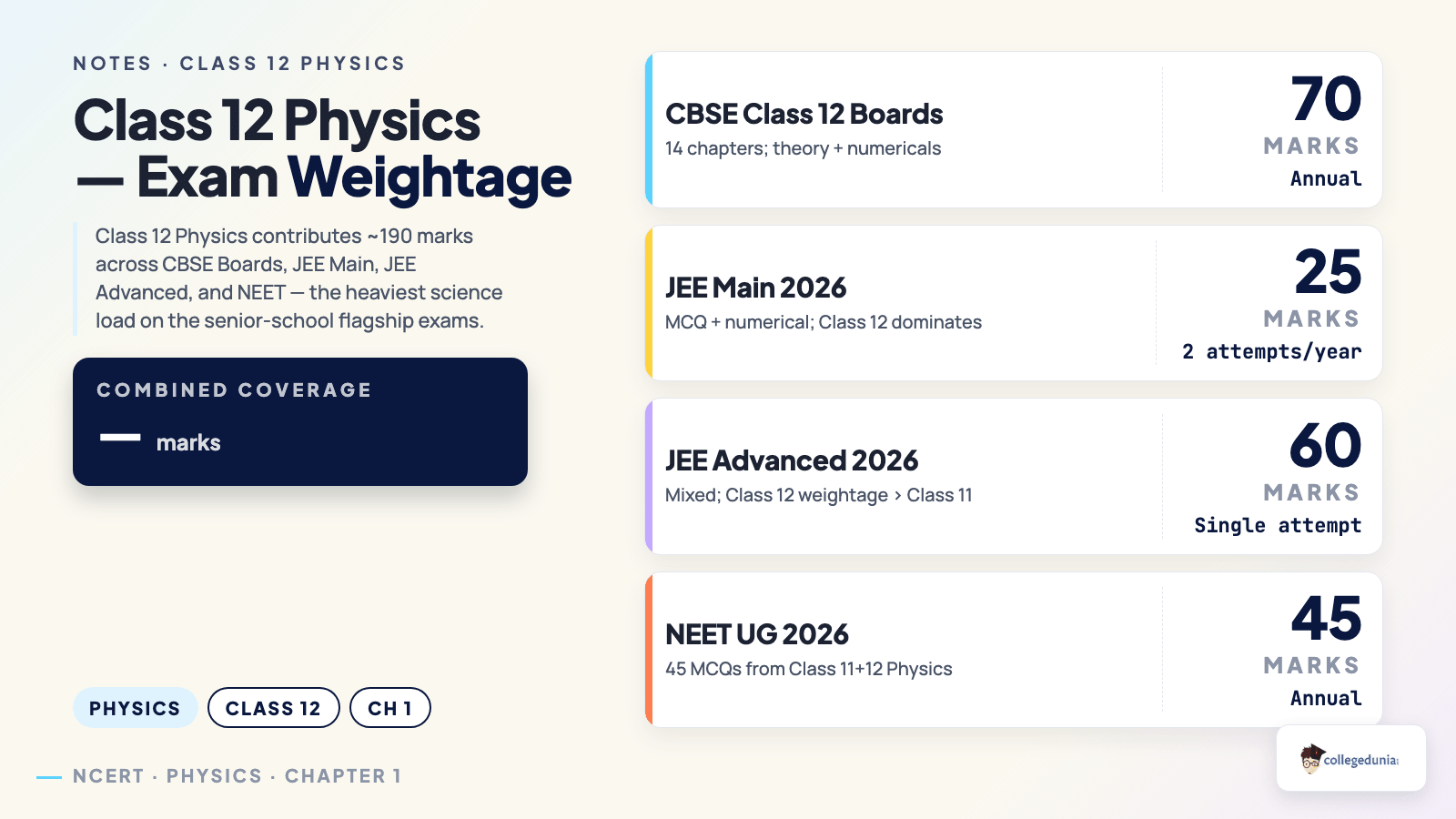
Class 12 Physics - Exam Weightage Across CBSE, JEE and NEET
Class 12 Physics carries about 200 marks combined across CBSE Boards, JEE Main, JEE Advanced and NEET UG. That is the heaviest science load on the big senior-school exams.
Class 12 Physics Weightage Snapshot (CBSE 2026 Theory Paper)
The 70-mark CBSE Class 12 Physics theory paper splits unevenly across the 14 chapters. Optics leads the table at 14 marks combined, then Magnetism at 11 marks and Electrostatics at 10 marks. Plan your revision time so the high-weightage chapters get a second pass before the boards.
| Chapter | Topic | CBSE Marks (2026) | JEE Main 2025 Qs |
|---|---|---|---|
| Ch 9 | Ray Optics and Optical Instruments | 10 marks | 2-3 |
| Ch 14 | Semiconductor Electronics | 7 marks | 1-2 |
| Ch 3 | Current Electricity | 6 marks | 2 |
| Ch 4 | Moving Charges and Magnetism | 6 marks | 2 |
| Ch 1 | Electric Charges and Fields | 5 marks | 2 |
| Ch 2 | Electrostatic Potential and Capacitance | 5 marks | 2 |
| Ch 5 | Magnetism and Matter | 5 marks | 1 |
| Ch 6 | Electromagnetic Induction | 4 marks | 1-2 |
| Ch 8 | Electromagnetic Waves | 4 marks | 1 |
| Ch 10 | Wave Optics | 4 marks | 1-2 |
| Ch 11 | Dual Nature of Radiation and Matter | 4 marks | 1 |
| Ch 12 | Atoms | 4 marks | 1 |
| Ch 13 | Nuclei | 4 marks | 1 |
| Ch 7 | Alternating Current | 2 marks | 1-2 |
Where to Start with Class 12 Physics Notes
Six chapters carry about half of the 70-mark theory paper. If you only have time to revise a few Class 12 physics notes, work this list top-to-bottom:
- Chapter 9, Ray Optics and Optical Instruments (10 marks): the highest single-chapter weightage. Sign convention and lens-maker's formula derivations are asked often.
- Chapter 14, Semiconductor Electronics (7 marks): the p-n junction characteristic and rectifier waveform are sure exam content.
- Chapter 3, Current Electricity (6 marks): the Wheatstone bridge and meter bridge derivations come back in lab-based questions.
- Chapter 4, Moving Charges and Magnetism (6 marks): Biot-Savart law and moving-coil galvanometer sensitivity are the routine 5-mark slot.
- Chapter 2, Electrostatic Potential and Capacitance (5 marks): capacitor combinations and the parallel-plate dielectric derivation repeat every cycle.
- Chapter 6, Electromagnetic Induction (4 marks): the long-answer derivation slot on most papers, with Faraday and Lenz law applications.
Together these six chapters carry 38 of 70 board marks. A clean revision of just their Class 12 physics notes still gets you a comfortable theory-paper score.
Class 12 Physics Notes: PDF Formats and Languages
Every chapter in the Class 12 Physics notes index comes in three types, plus a Hindi-medium one. The format you pick matters, because phone reading, board-day printout, and night-before revision each suit a different file.
- HD print-ready PDF: high-resolution diagrams, best for printing the chapter as a revision booklet.
- Standard download PDF: smaller file size, made for mobile reading.
- Hindi-medium PDF: chapter-wise translations using NCERT's own Hindi vocabulary, with technical terms like आवेश, विभव, and चुंबकीय फ्लक्स kept as NCERT writes them.
- Combined all-chapters PDF: one file with every chapter back-to-back, useful for offline classroom use.
- Handwritten counterpart: a notebook-style version of each chapter for students who like the board-feel revision style. The handwritten edition has the same content as the typeset notes, but shows it as scanned-look pages.
How Class 12 Physics Notes Pair with the Other Resources
The notes handle the concept revision and the formula recall. They do not replace problem solving or the textbook itself. Those live in sibling resources that share the same chapter slugs.
- Class 12 Physics NCERT Solutions: every back-exercise question solved step by step. Open the notes for the concept, then go to the solutions for the application.
- Class 12 Physics Formula Sheet: the formula highlight boxes from the notes, cut down to one 14-22 page reference for the final week.
- Class 12 Physics NCERT Book PDF: the official textbook itself. Use it when the notes point to a worked example or a figure you want to see in full.
- Class 12 Physics Exemplar Solutions: worked-out solutions for the harder Exemplar problems, useful once the NCERT back-exercise feels too easy.
- Class 12 Physics Handwritten Notes: the notebook-style edition of the same content for board-feel final-week revision.
- Class 12 Physics Exemplar Book PDF: the NCERT Exemplar problem book for extra practice across question types.
The chapter-wise pages for each sibling resource are linked from their subject listings as they roll out across the 2026-27 cycle.
What's New in the 2026-27 Class 12 Physics NCERT Notes
The 2026-27 NCERT print kept most of the cuts made in the 2024-25 edition, but a few changes affect what you should revise from this notes set. The main updates per unit:
- Electrostatics (Ch 1, Ch 2): the proof of Gauss's law from Coulomb's inverse-square law stays, but is played down. The notes mark it as worth knowing, but not the most-tested. The Van de Graaff generator, cut earlier, is now just a labelled diagram with a 2-line working principle.
- Magnetism (Ch 4, Ch 5): the cyclotron derivation stays as a standard 5-mark question. The "magnetic dipole moment of a revolving electron" part was made simpler. The notes keep the gyromagnetic ratio result without the full angular-momentum derivation.
- EMI and AC (Ch 6, Ch 7): the LCR resonance derivation was tightened. The notes flag this as the most likely long-answer slot. The transformer efficiency and power loss numericals stay in full.
- Optics (Ch 9, Ch 10): the resolving power of a microscope and telescope stays as one of the top-scoring 3-mark sections. Wave Optics polarisation by reflection (Brewster's law) is back in scope after a short removal in earlier editions.
- Modern Physics (Ch 11, Ch 12, Ch 13): the Bohr atom energy-level diagram is the examiner's most frequent pick. The Davisson-Germer experiment is now a qualitative topic, with the de Broglie wavelength formula as the only numerical part.
- Semiconductor Electronics (Ch 14): the chapter was cut down to p-n junction diodes and rectifiers. Transistor amplifier and logic gate sections were removed. The notes match the new shorter scope.
Every chapter's notes file has an inline "Rationalised in 2026-27" callout wherever content was added, changed, or removed from the older edition. So you can spot the changes against your old revision material at a glance.
How to Revise from These Class 12 Physics Notes
A three-pass revision routine works best with the notes. The first pass builds the mental map. The second pass loads the derivations. The third pass is pure formula recall.
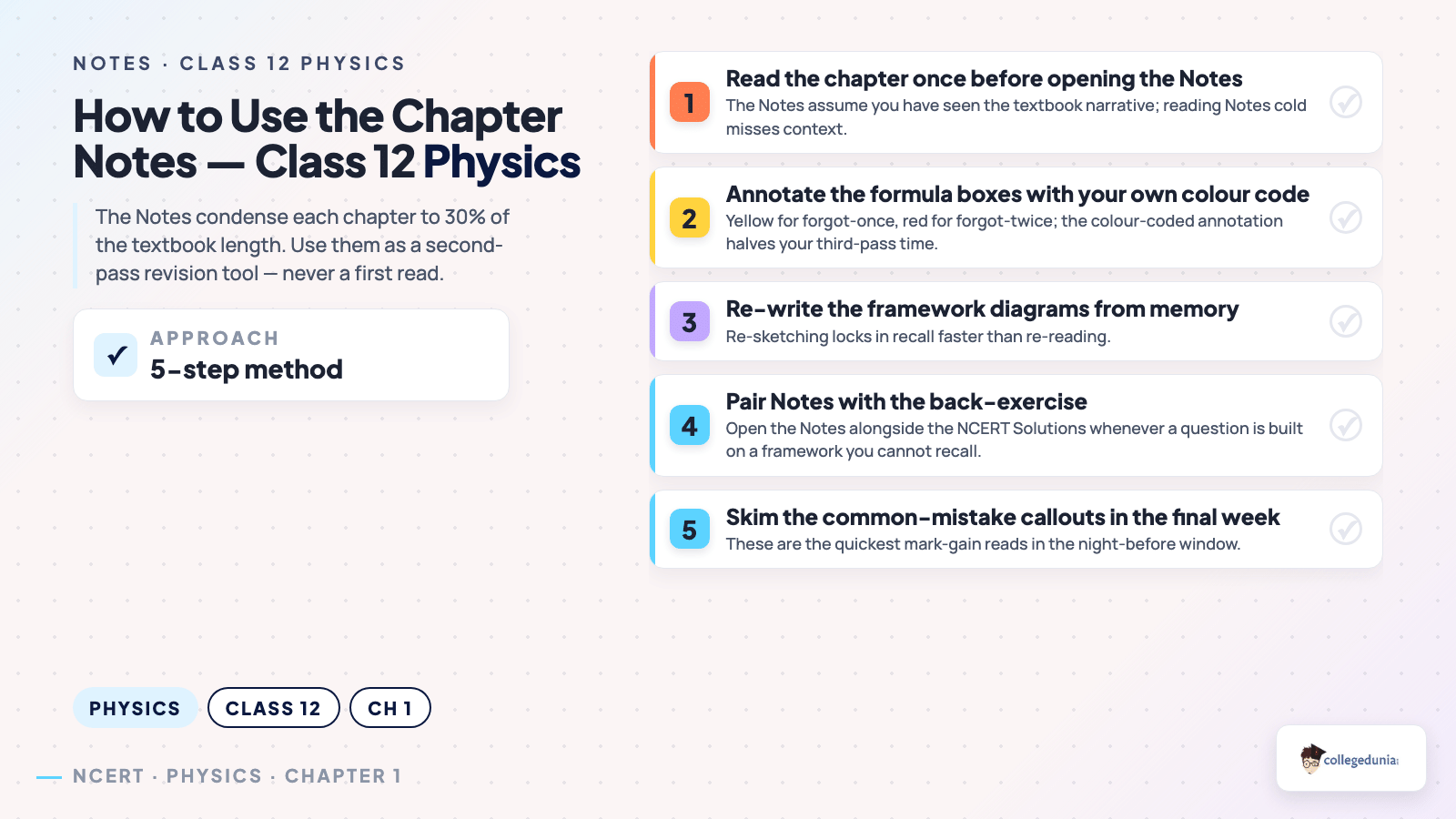
5-STEP METHOD · CBSE TOPPER ROUTINE
How to Use the Class 12 Physics Notes - Class 12 Physics
- 1Read the chapter first. Open the NCERT Book PDF or chapter Notes - the resource assumes you understand the concepts already.
- 2Attempt each question on your own. Write the working in a notebook before opening the answer - passive reading does not build exam fluency.
- 3Compare your working to the resource. Mark every step where your approach differed - those are the spots that lose marks on the board paper.
- 4Flag questions taking over 7 minutes. These go on the re-attempt list for the final-week revision pass.
- 5Sketch each derivation from memory. Before checking against the typeset Notes PDF, draw the diagram and write the derivation in your own hand - recall builds exam fluency, not re-reading.
- Pass 1, 1 month before the boards: read every chapter once, end to end, in NCERT order. Mark any concept you cannot explain in 2 sentences without looking at the page. Those concepts get a second pass tomorrow.
- Pass 2, 2 weeks before the boards: try the derivation walkthrough in each chapter without looking at the notes. Then compare with the notes. If you missed a step, write it out twice on a blank page.
- Pass 3, 1 week before the boards: use only the formula highlight boxes and the quick-revision strips. The night before, skim the common-mistake callouts to keep the frequent errors out of your working.
Common Mistakes Class 12 Physics Students Make Across Chapters
- Treating electric field and electric potential as the same thing: field is a vector, potential is a scalar. Always sketch the field direction before you use any work-done formula in Chapter 1 or Chapter 2.
- Sign convention errors in Ray Optics: students use the Cartesian sign convention in different ways for mirrors, lenses, and refracting surfaces. Decide which side is positive at the start of every question in Chapter 9.
- Forgetting the work function in photoelectric numericals: Chapter 11 students write KE = hν instead of KE = hν minus phi-zero. The work-function subtraction is the single most-tested step in this chapter.
- Confusing peak, rms, and average in AC: Chapter 7 questions often ask for one form when students work out another. Learn I-peak over root 2 and 2 times I-peak over pi from the notes.
- Dropping units in numerical answers: CBSE cuts 1 mark per missing unit on a final answer line. Carry units through every substitution step, not just the answer.
- Mixing up the Bohr model conditions: Chapter 12 students often quote the angular-momentum rule without the centripetal-force balance. You need both to derive the Bohr radii.
Student Feedback: What 15,290 Class 12 Physics Students Told Us
What 15,290 students told us about how they used their Class 12 Physics notes
- 71% of students said the formula highlight boxes were the most-used part of the notes during final-week revision.
- Most-revisited chapter: Chapter 6 Electromagnetic Induction, opened on average 5.4 times per student in the final month before the 2026 boards.
- 62% of toppers said reading the notes BEFORE the NCERT back-exercise saved them 2 to 4 hours per chapter in revision time.
- The average student spent 38 minutes on a first read of a typical chapter notes file, and 12 to 18 minutes on the second pass.
Also Check: Related Class 12 Physics Resources
- Also Check: CBSE Class 12 Physics, chapter notes hub on Collegedunia Exams
- Also Check: CBSE Class 12, exam pattern, dates, and full-subject hub
- Also Check: CBSE Class 12 Syllabus 2026-27
- Also Check: JEE Main 2026 exam information
- Also Check: JEE Main 2026 Syllabus
- Also Check: JEE Advanced 2026 information
- Also Check: NEET 2026 exam information
- Also Check: NEET 2026 Syllabus
Class 12 Physics Notes FAQs
Ques. Where can I download the full Class 12 Physics notes PDF?
Ans. You can download every chapter-wise Class 12 physics notes PDF from the index above, from Chapter 1 Electric Charges and Fields to Chapter 14 Semiconductor Electronics. A combined all-chapters file is also there, in both Normal and HD resolutions, free.
Ques. Are these Class 12 physics notes aligned with the 2026-27 NCERT?
Ans. Yes. Every chapter follows the current 2026-27 syllabus. Where NCERT cut content from the older 2025-26 edition (deleted derivations, removed end-of-chapter questions, simpler diagrams), the notes carry an inline callout flagging what was removed, so you do not waste revision time.
Ques. How many chapters are there in Class 12 Physics per the 2026-27 NCERT?
Ans. Class 12 Physics has 14 chapters across 8 CBSE units: Electrostatics (Ch 1, Ch 2), Current Electricity (Ch 3), Magnetism (Ch 4, Ch 5), Electromagnetic Induction and Alternating Current (Ch 6, Ch 7), Electromagnetic Waves (Ch 8), Optics (Ch 9, Ch 10), Modern Physics (Ch 11, Ch 12, Ch 13), and Electronic Devices (Ch 14). The Topic Map table above lists every chapter under its unit.
Ques. Are these notes alone enough to clear the Class 12 Physics board paper?
Ans. For a passing score, yes. For a 90-plus score, no. Pair the notes with the NCERT Solutions back-exercise practice and at least one round of the Exemplar problems. Toppers said notes-only revision usually lands a student between 55 and 70 marks out of 70. The final 10-15 marks need solving practice.
Ques. How are these notes different from the formula sheet?
Ans. The notes are the full concept revision (18-26 pages per chapter) with derivation walkthroughs and worked-example notes. The Class 12 Physics formula sheet is a short 14-22 page sheet with only the equations, constants, and key results, plus one-line notes. It has no derivations and no diagrams. Most students use the notes a month out and switch to the formula sheet in the final week.
Ques. Which Class 12 Physics chapter has the highest CBSE board weightage?
Ans. Chapter 9 Ray Optics and Optical Instruments carries the highest CBSE Class 12 Physics weightage at 10 marks per paper, followed by Chapter 14 Semiconductor Electronics at 7 marks and Chapters 3, 4 at 6 marks each. The Weightage Snapshot table above tracks every chapter's mark share.
Ques. Are Class 12 Physics notes available in Hindi medium?
Ans. Yes. Every chapter comes with a Hindi-medium download next to the English version. The Hindi notes follow NCERT's own terms. So students preparing in Hindi medium for the CBSE boards or the Hindi-medium JEE or NEET papers find the same vocabulary they have studied in.
Ques. Should I read the notes first or jump straight to the NCERT Solutions?
Ans. Read the notes first. The NCERT Solutions assume you already understand the concepts. If a back-exercise question stumps you, the matching section in the notes is usually a 2-3 minute fix. Trying to learn the concept from the solution itself wastes time.
Ques. How long does it take to revise one chapter from these notes?
Ans. A first read takes 30 to 45 minutes for a typical chapter, and 50 to 60 minutes for a derivation-heavy chapter like Electromagnetic Induction or Ray Optics. The second pass, using only the highlighted formulas and the quick-revision strip, takes 12 to 18 minutes per chapter.
Ques. What does Class 12 Physics cover?
Ans. Class 12 Physics covers the second half of senior-school physics: electrostatics, current electricity, magnetism, electromagnetic induction and alternating current, electromagnetic waves, ray and wave optics, modern physics (photoelectric effect, atoms, nuclei), and semiconductor electronics. The 14-chapter course is the base for JEE Main, JEE Advanced, and NEET physics, and makes up most of the 70-mark CBSE Class 12 Physics theory paper.
Ques. Which Class 12 Physics chapter is the most-revised by toppers?
Ans. Chapter 6 Electromagnetic Induction. The Student Feedback panel above puts it at 5.4 average revisits per student in the final month before the 2026 boards. The long-answer derivation slot on the theory paper has come from this chapter in 4 of the last 5 cycles.
Ques. How should I structure my Class 12 Physics preparation?
Ans. Build chapter by chapter. Start with the notes for the concept. Try the NCERT back-exercise once with the Solutions open as a check. Do the Exemplar problems for any chapter where you scored above 80% on the back-exercise. Finish with the Formula Sheet in the final week. The Revision section above shows the three-pass routine that most toppers settle into.



Comments