




These Era of One-Party Dominance Class 12 Notes give a quick, exam-ready summary of how the Congress won the first three general elections and ruled free India, set to the 2026-27 CBSE syllabus. The notes pull together every key date, party and idea from Chapter 2 of Politics in India Since Independence. Students can use them for a fast revision the night before a test or to fix the main ideas before they attempt the back-exercise questions.
- Covers the first elections, why the Congress dominated, the nature of dominance and the opposition parties in one place.
- This Class 12 Political Science chapter usually carries 5 to 6 marks in the board paper.
- Pairs with the NCERT Solutions, Handwritten Notes and Book PDF linked lower on this page.
These Era of One-Party Dominance Class 12 notes are written from the official NCERT Politics in India Since Independence textbook and checked against the last five years of CBSE board papers.
Student Feedback: In a Collegedunia poll of 8,520 Class 12 Political Science students taken before the 2026 boards, 72% of students said short, point-wise notes on the reasons for Congress dominance and the opposition parties were the fastest way to revise this chapter. Most students kept the party-leader links on a single sheet for last-minute recall.
Source: 2026-27 Class 12 Political Science student poll. Sample of 8,520 students from CBSE schools across 12 states.
What the One-Party Dominance Notes Cover
Era of One-Party Dominance is the second chapter of Politics in India Since Independence. It studies how the Congress won the first three general elections of 1952, 1957 and 1962 and ruled at the Centre and in most states. This long lead of one party over all others is called one-party dominance.
The easiest way to organise your revision is to split the chapter into three threads:
- The elections: how the first polls were run and what the results were.
- Why Congress won: its roots, organisation and a weak opposition.
- The nature of dominance: why it stayed democratic and how it was a coalition.
So these notes are really about how India built a democracy and yet saw one party rule for years. If you sort each fact under elections, why-Congress-won or nature-of-dominance first, almost every question in Era of One-Party Dominance class 12 becomes easier to answer. Keep this three-part frame at the top of your revision sheet and slot each new detail into one of the boxes as you read.
The First Elections and the Election Commission
India chose democracy at Independence and held its first general elections in 1952, on a scale never seen before. For quick revision, learn the key facts as four short, boxed points so you can copy them straight onto the answer sheet.
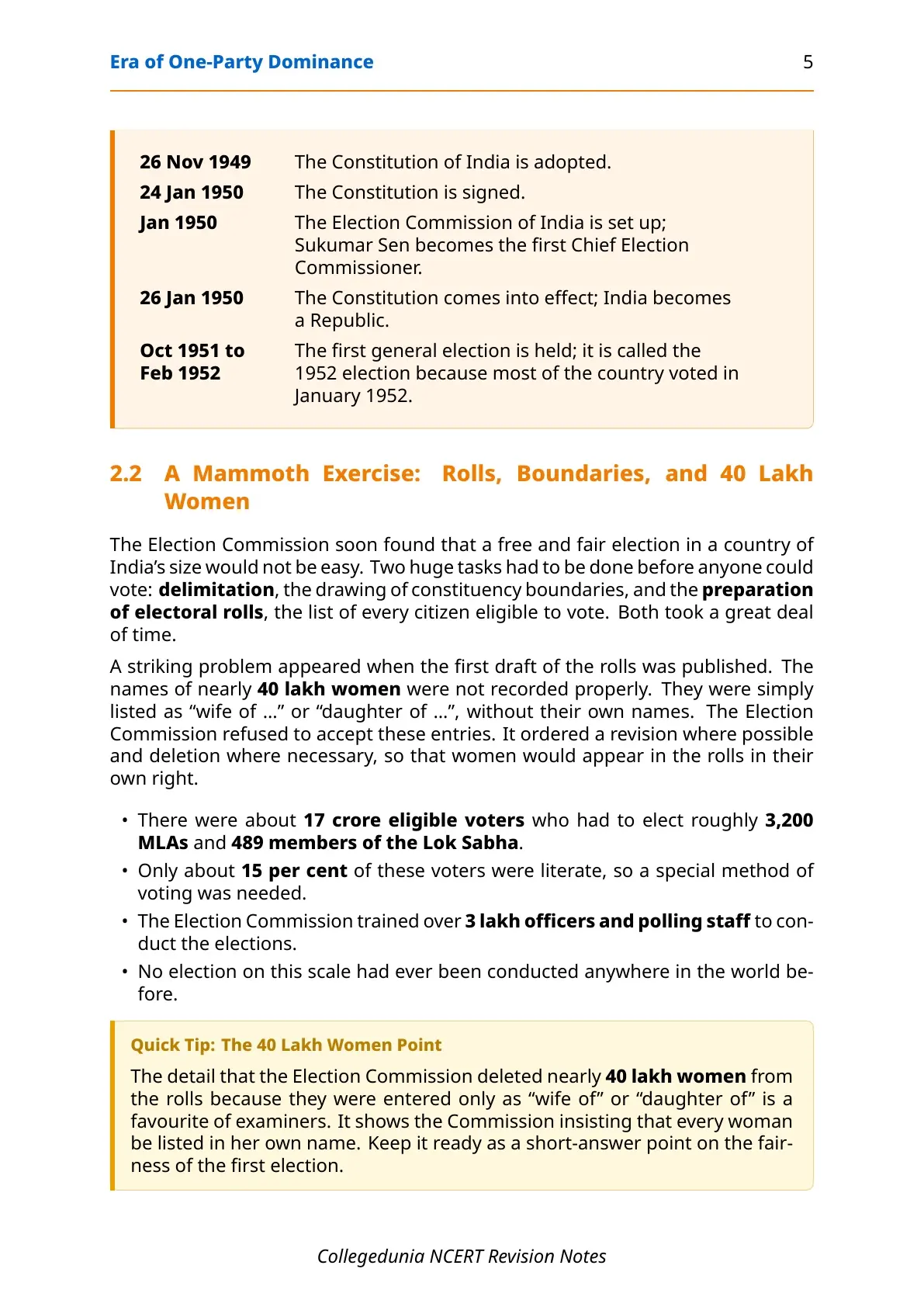
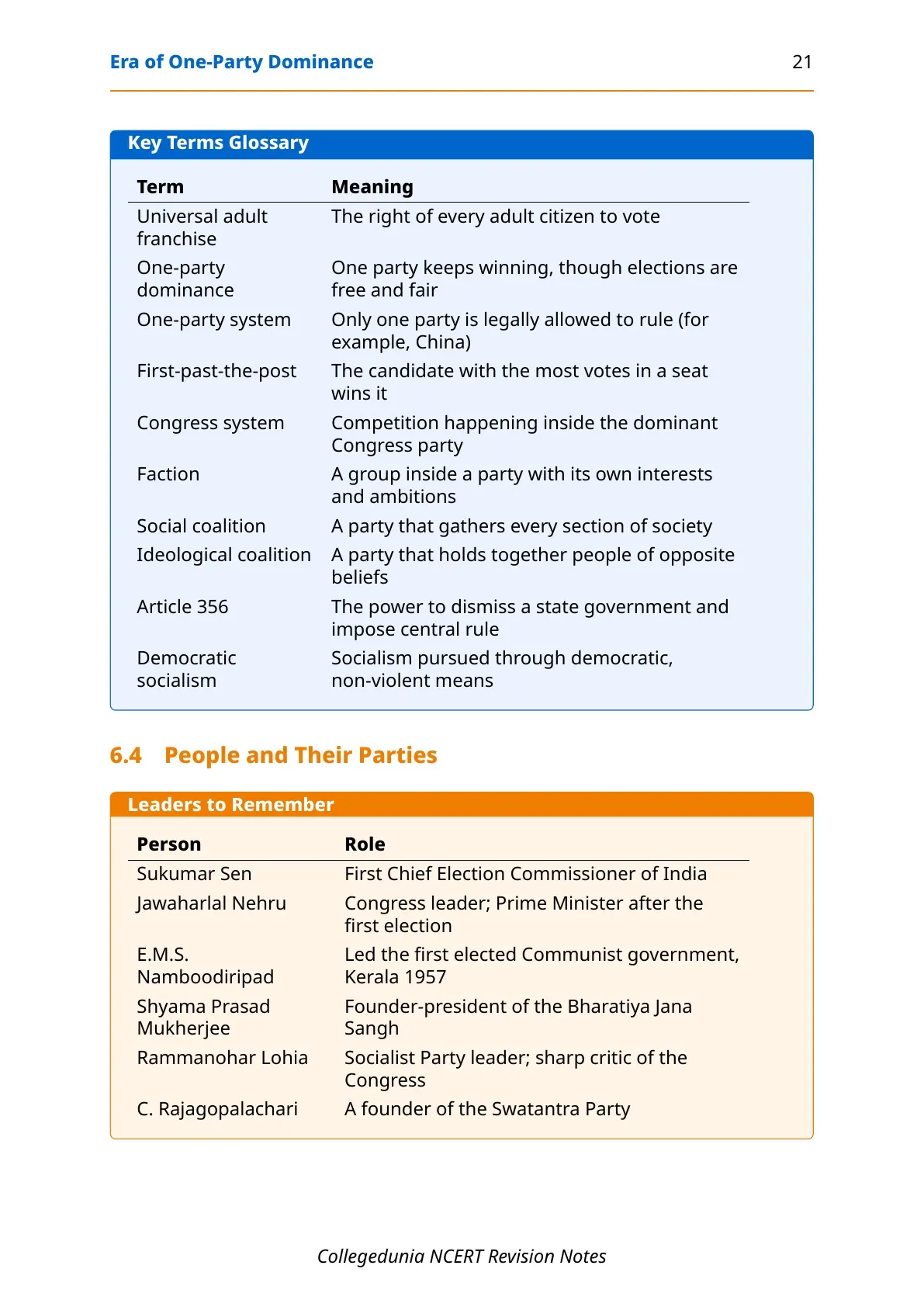
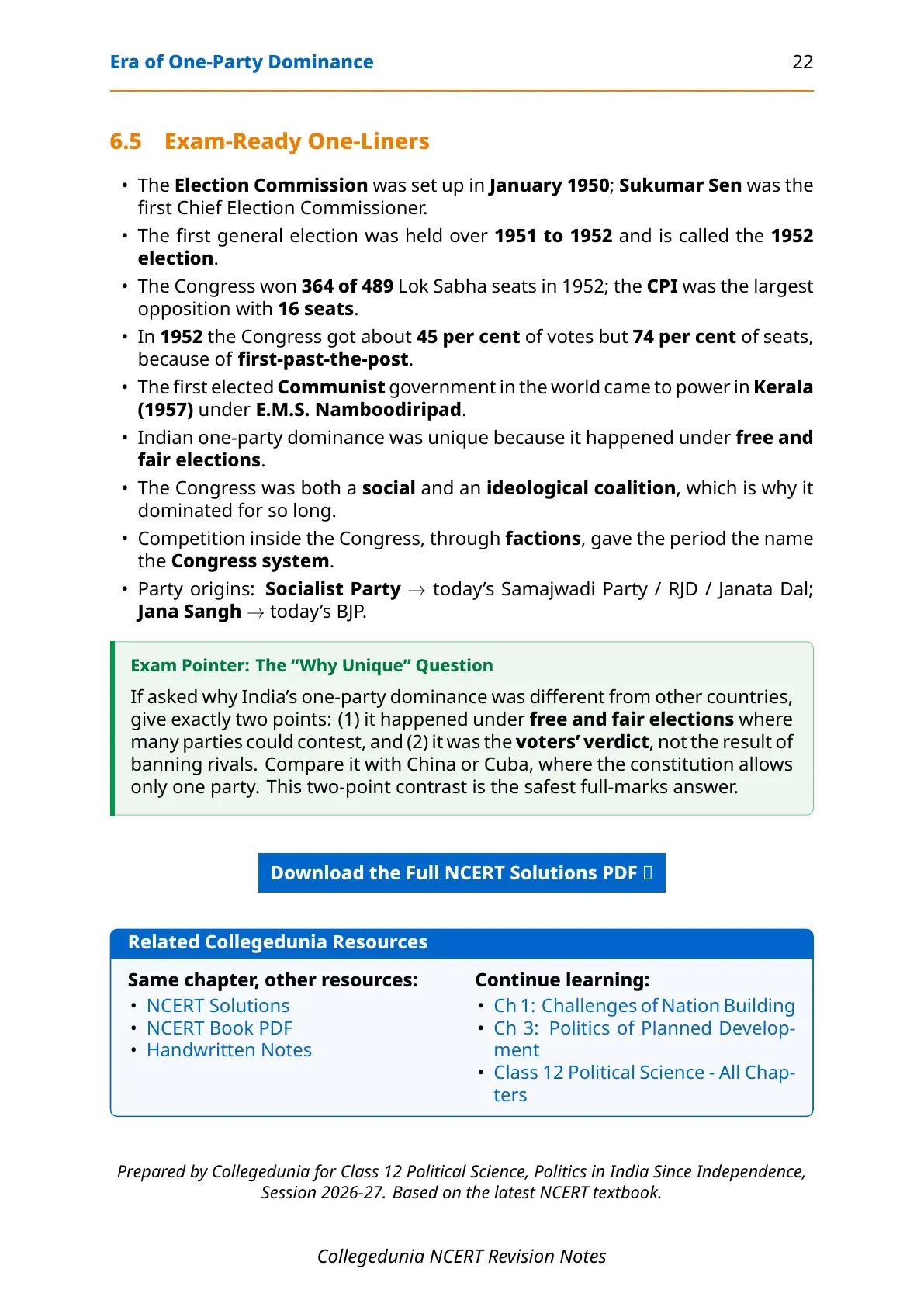
- Election Commission: set up in January 1950, with Sukumar Sen as the first Chief Election Commissioner.
- Scale: the 1952 polls elected 489 Lok Sabha members and about 3,200 MLAs together.
- Method: first-past-the-post voting, with universal adult franchise from the start.
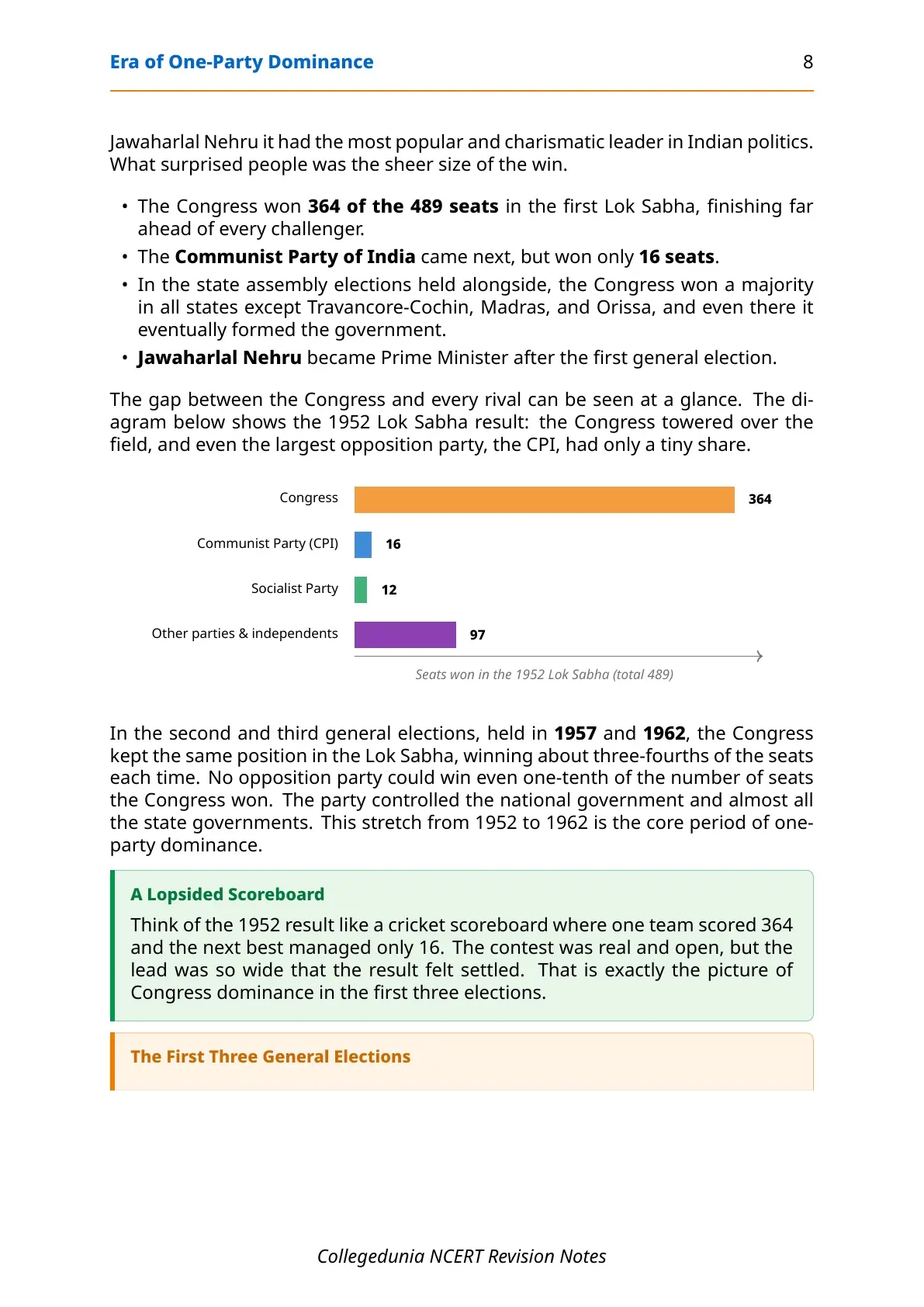
- Result: the Congress won 364 of 489 Lok Sabha seats; the CPI came second with 16.
The point examiners test most is that the 1952 elections were held for the Lok Sabha and the State Assemblies at the same time. Keep this clear, along with Sukumar Sen's name and the 364-versus-16 result, because the fill-in-the-blank question turns on exactly these facts.
Why the Congress Dominated
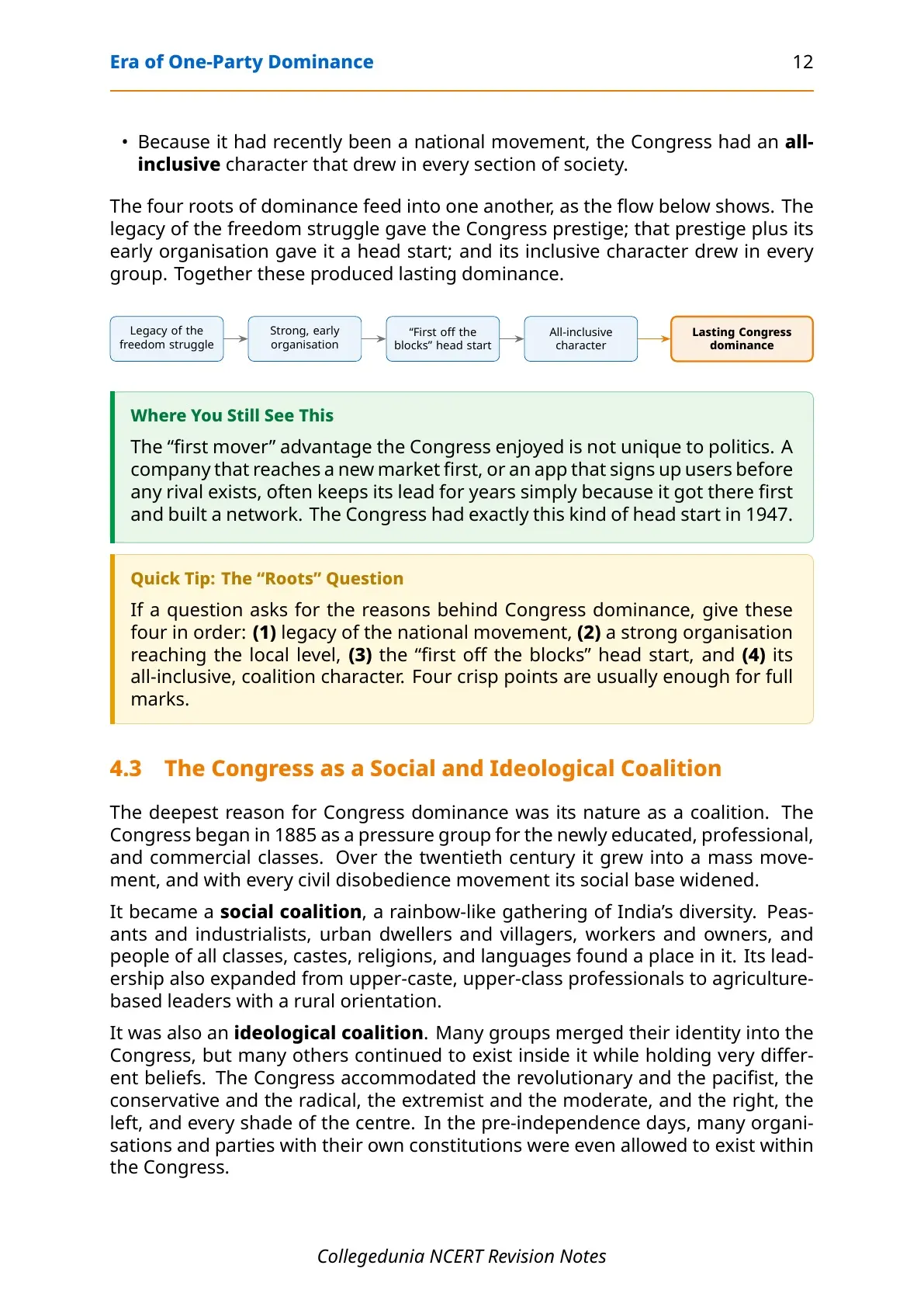
The Congress won election after election by huge margins. The reasons are a long-answer favourite, so these notes keep them as a clear table rather than a story. Learn them as a list and you can answer any version of the question.
| Reason | What it meant |
|---|---|
| Legacy of the freedom struggle | The Congress had led the fight for Independence, so it was seen as the inheritor of the national movement. |
| Head start in organisation | It already had a country-wide network when most rivals were only just being formed. |
| Tall leaders | Nehru, Patel and other freedom-struggle figures gave it national stature. |
| Weak, divided opposition | The opposition parties were small, scattered and could not match the Congress reach. |
| Broad social base | It drew support from every caste, class, region and religion in the country. |
The one-line takeaway for your sheet is that the Congress's biggest advantage was being "first off the blocks". Because it grew out of the anti-colonial struggle, it had a ready organisation and a moral claim that newer parties could not match. Keep this head-start idea clear in your notes.
The Nature of Congress Dominance
Many countries have seen one party rule for years, but India's case was different. These notes keep the comparison ready, because the exam often asks how India's dominance stayed democratic. Learn one contrast and one number for it.
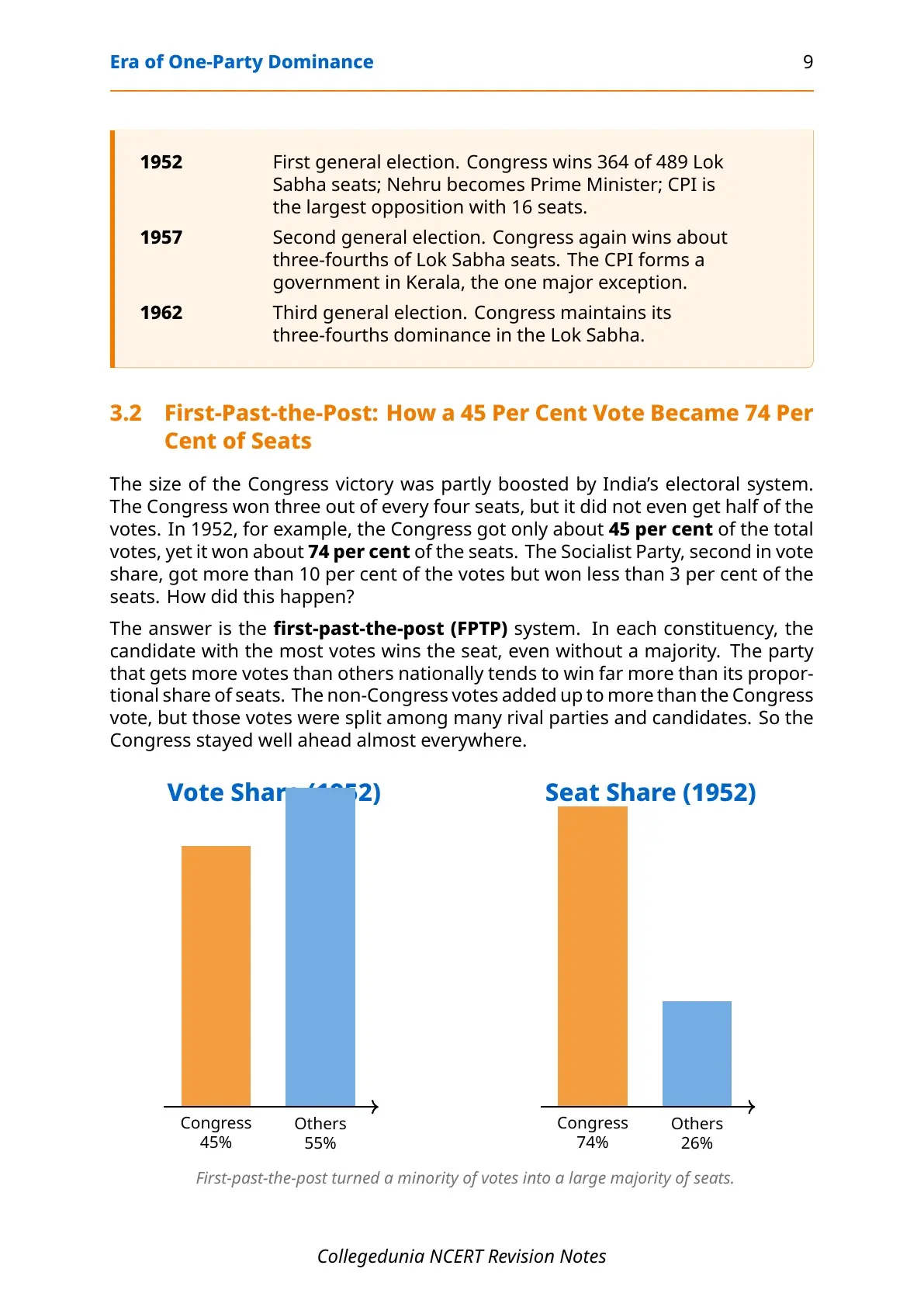
- Vote vs seats: in 1952 the Congress took about 45% of votes but 74% of Lok Sabha seats.
- The reason: first-past-the-post turned a vote lead into a much bigger seat lead.
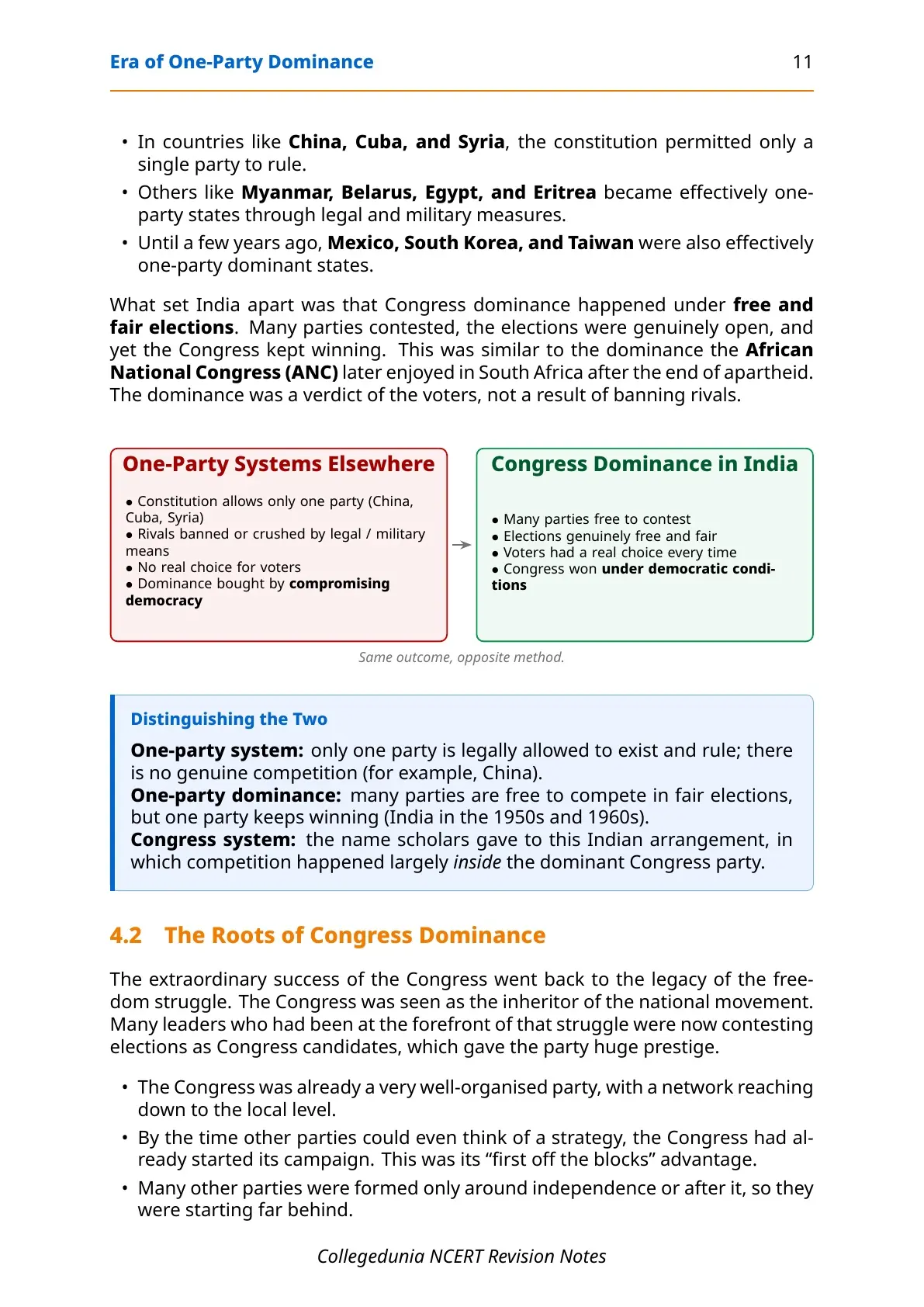
- The contrast: in China, Cuba or Syria one party rules because rivals are banned.
- India's way: many parties contested freely, and the Congress still won.
The judgement to remember is that Indian one-party dominance rested on free public choice, not on suppressing rivals. The Socialist Party, the CPI, the Jana Sangh and the Swatantra Party all contested openly. The Congress won because voters chose it, which is why this is called the democratic kind of dominance. Keep this verdict and the 45%-to-74% number as two clear notes.
The Congress as a Coalition and Its Factions
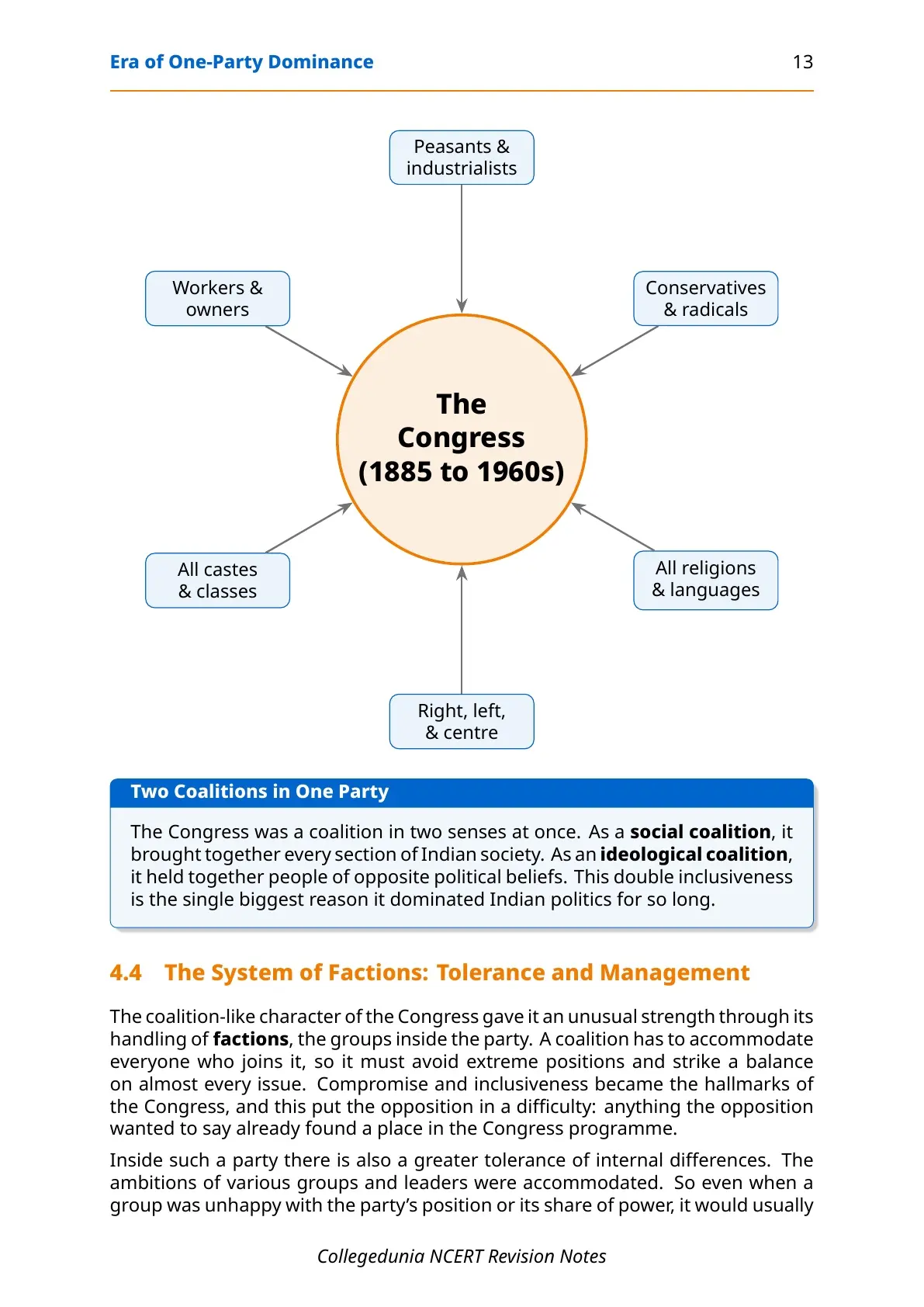
The Congress was not a narrow party but a wide tent, and this idea is the heart of the chapter. These notes keep the two kinds of coalition side by side, because students often miss one of them. Learn a one-line definition for each.
| Feature | What it meant |
|---|---|
| Social coalition | Peasants and industrialists, workers and owners, all castes, classes, regions and faiths together. |
| Ideological coalition | The conservative and the radical, left, right and centre, all inside one party. |
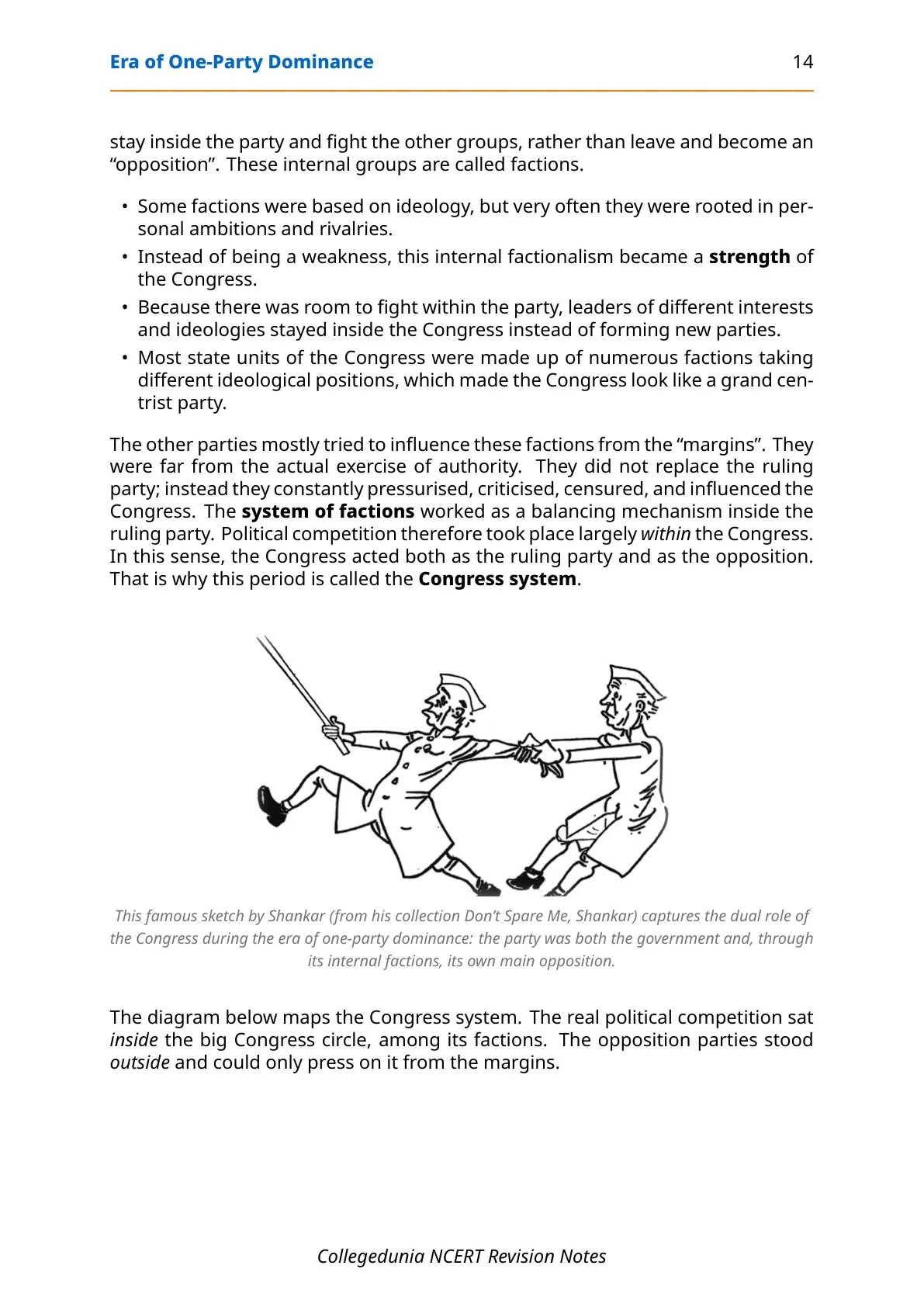
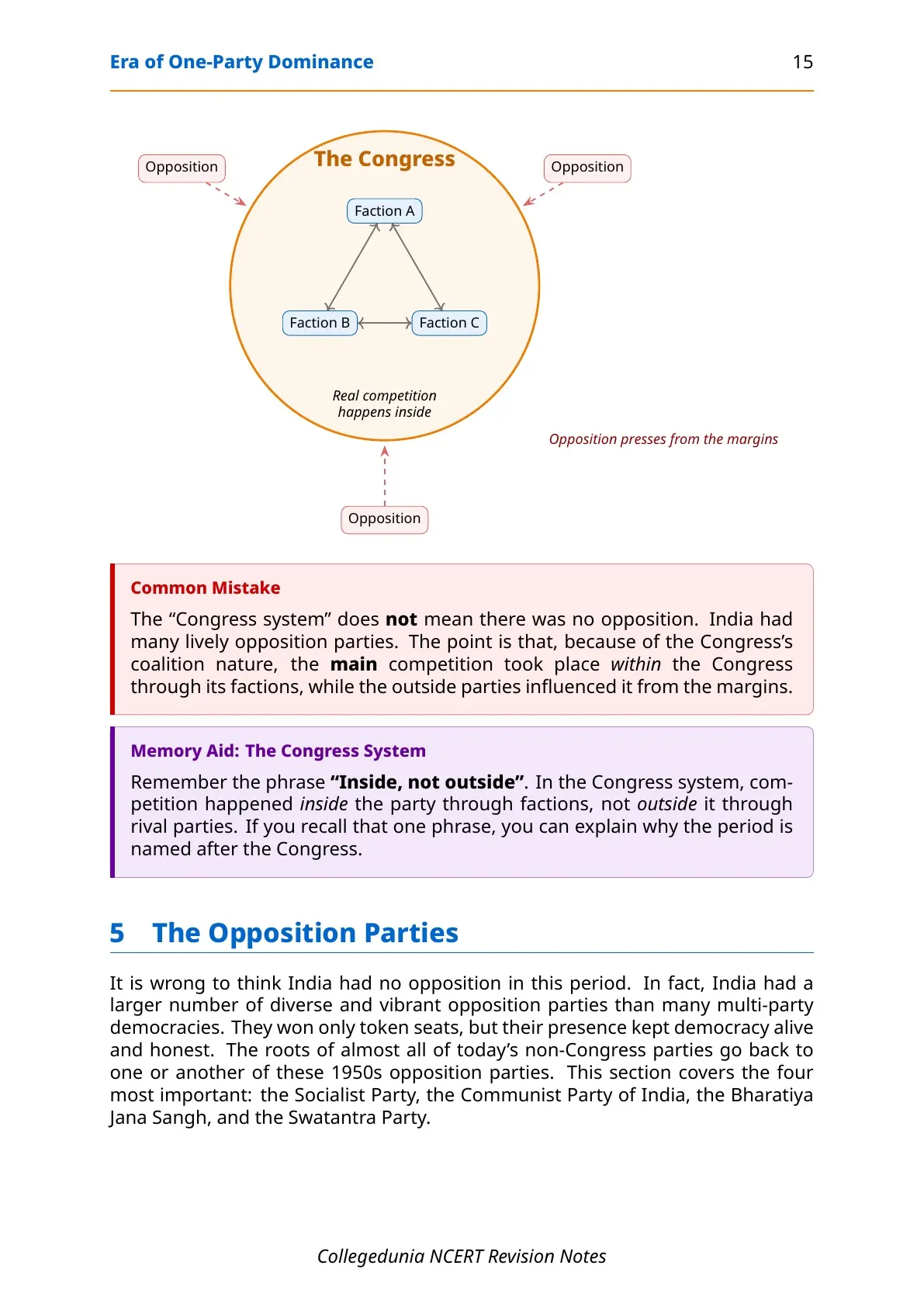
| Tolerance of factions | Groups with different beliefs stayed inside and fought one another, rather than splitting away. |
The sharp point for your notes is that the very trait critics called a weakness, holding many groups at once, was the source of Congress strength. Tolerating factions kept rival groups inside the party rather than in the opposition. This "all-embracing" character is exactly what Rajni Kothari praises in the passage-based exercise, so keep it ready for the long answer.
The Opposition Parties of the 1950s
The opposition was small but real, and it kept the system democratic. These notes pair each party with its core belief and a key leader, because the match question turns on these links. Learn the four together.
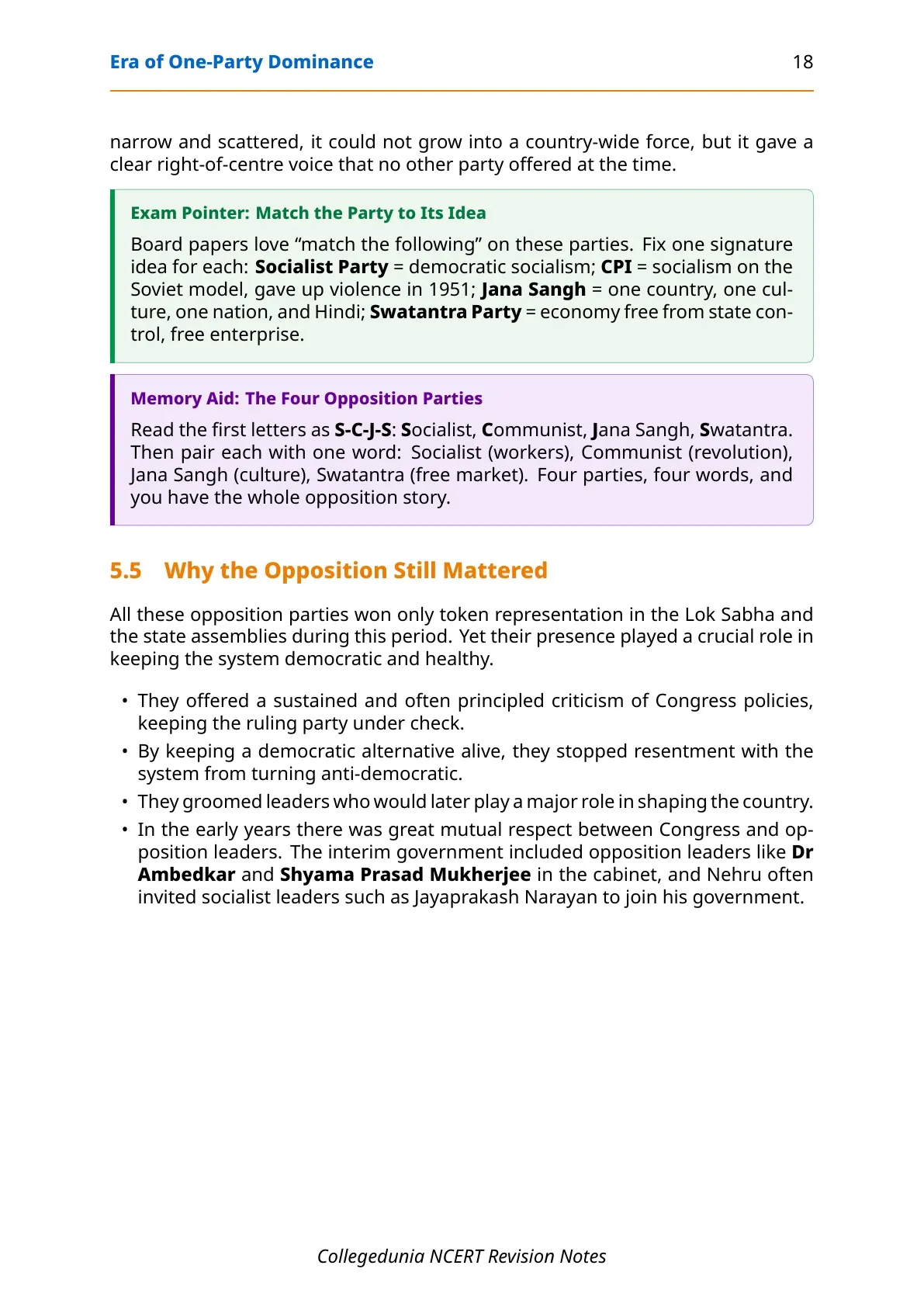
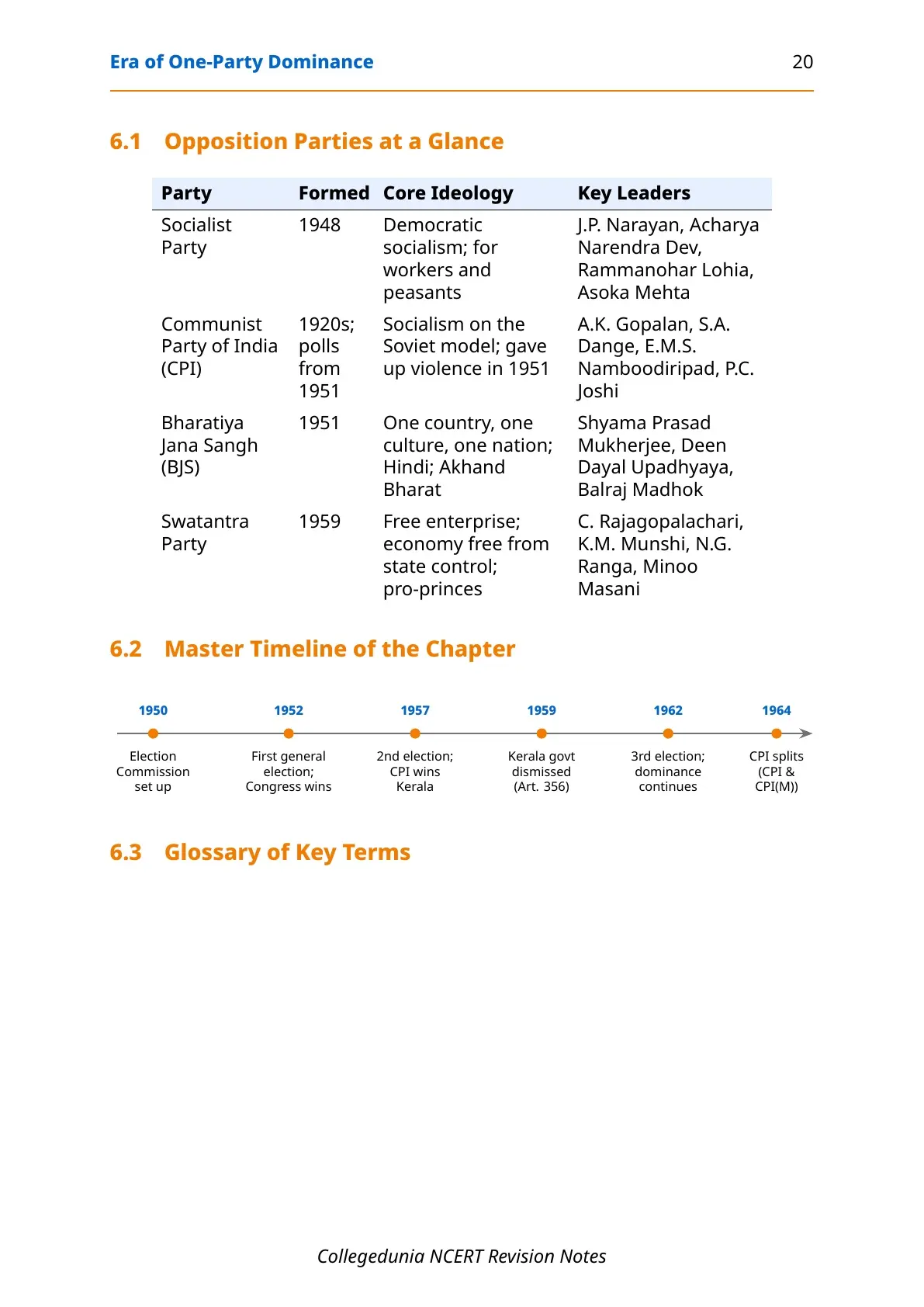
| Party | Core belief and key leader |
|---|---|
| Communist Party of India | Workers and class interests; S. A. Dange. Won Kerala in 1957 under E. M. S. Namboodiripad. |
| Praja Socialist Party | Democratic socialism; Asoka Mehta a leading figure. |
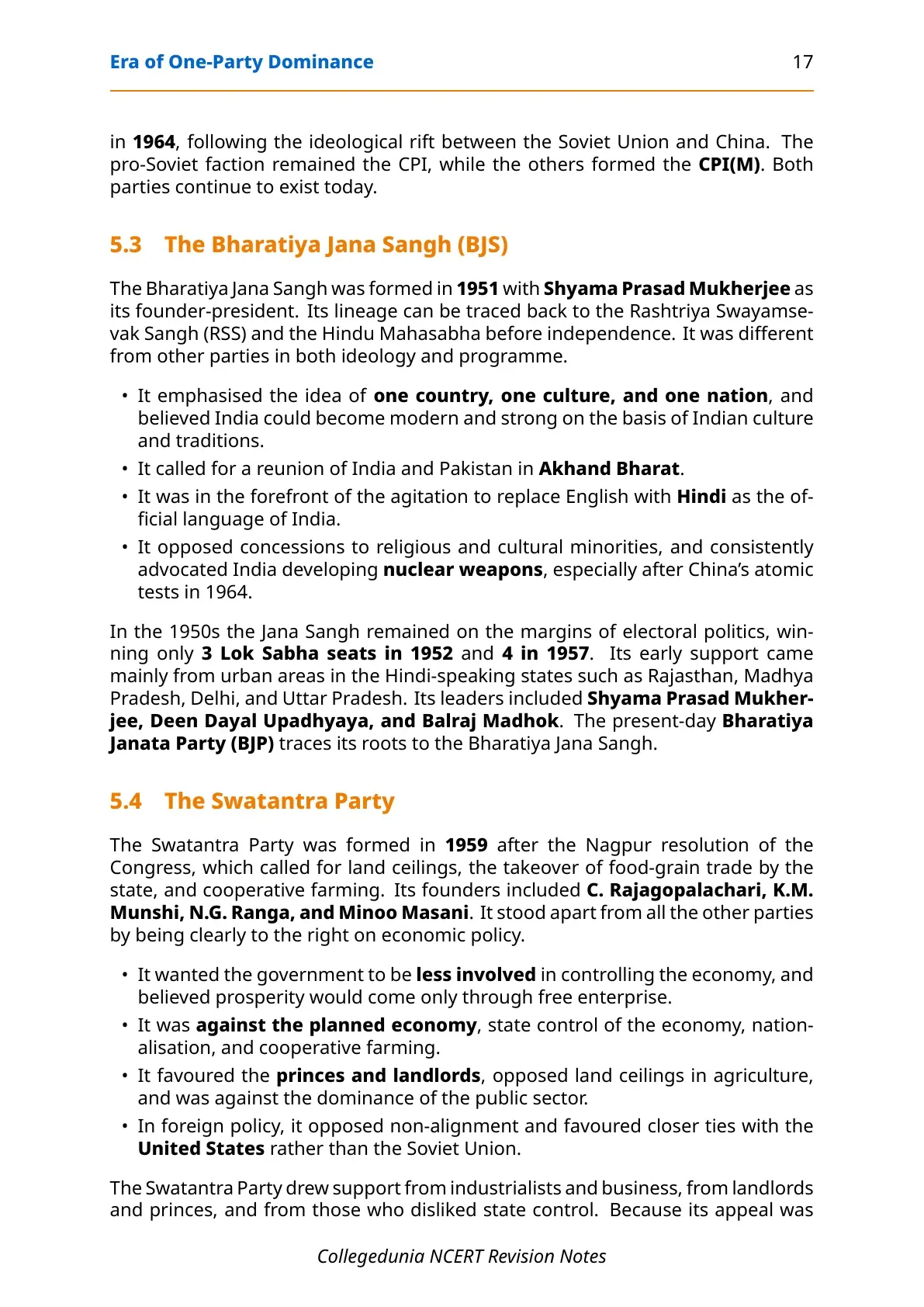
| Bharatiya Jana Sangh | Cultural nationalism; founded by Shyama Prasad Mukherjee in 1951. |
| Swatantra Party | Free-market economy, against state control; Minoo Masani and C. Rajagopalachari. |
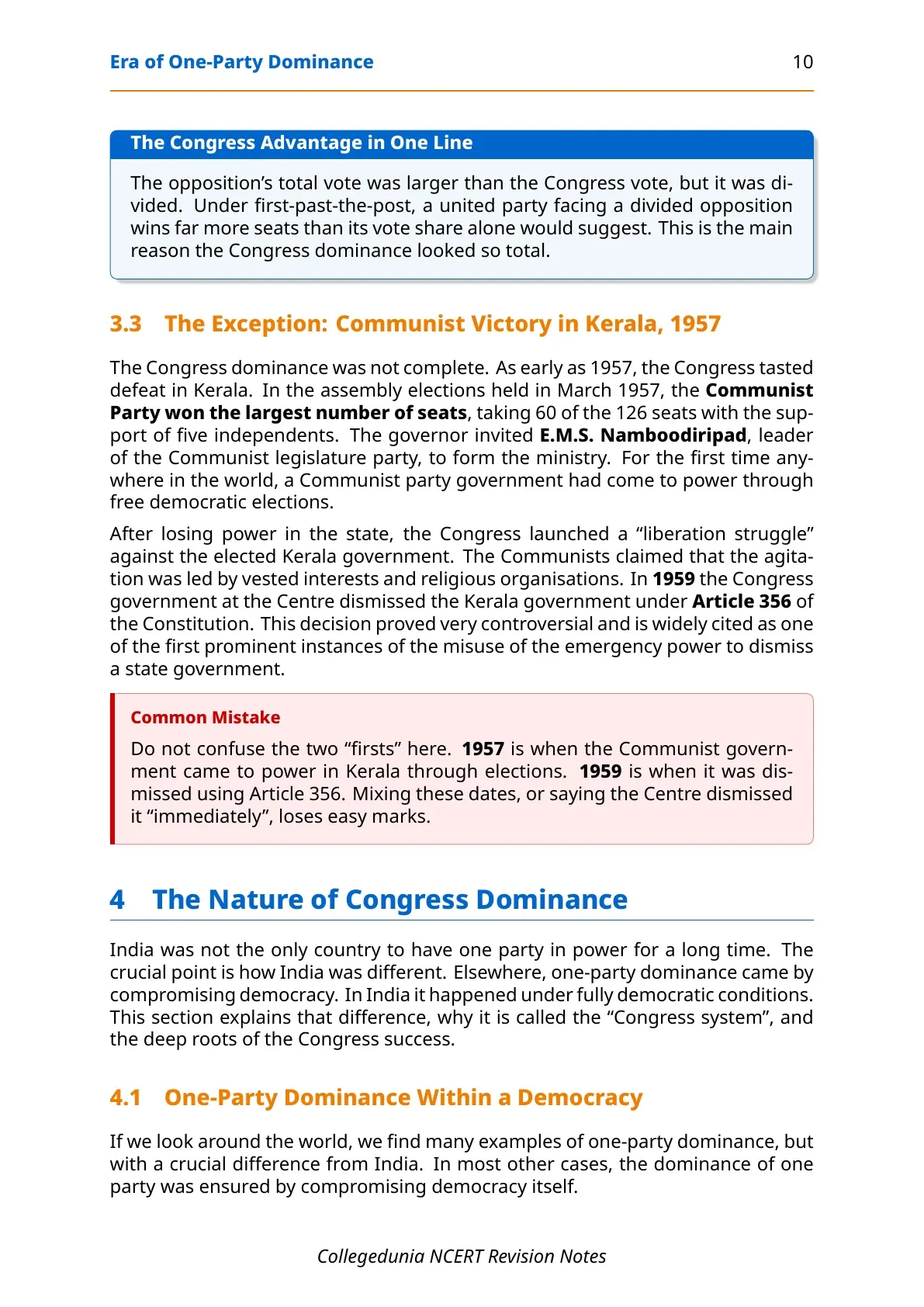
The fact to box on your sheet is that Kerala in 1957 saw the first non-Congress state government, formed by the CPI. Note also that the BJP did not exist in 1952 (it was founded only in 1980), so it is always a trap option in the fill-in-the-blank question. Keep the party-leader links and this Kerala point ready for quick marks.
Era of One-Party Dominance Important Questions and Exam Pointers
CBSE sets a steady mix of MCQ, short and long answers from this chapter. Knowing the pattern helps students decide how much to write and which topics to revise first. A focused list of Era of One-Party Dominance important questions saves a lot of time before the board exam.
- Long answer (5 to 6 marks): why the Congress dominated, or the nature of one-party dominance.
- Short answer (4 marks): the Congress as a social and ideological coalition, or the role of factions.
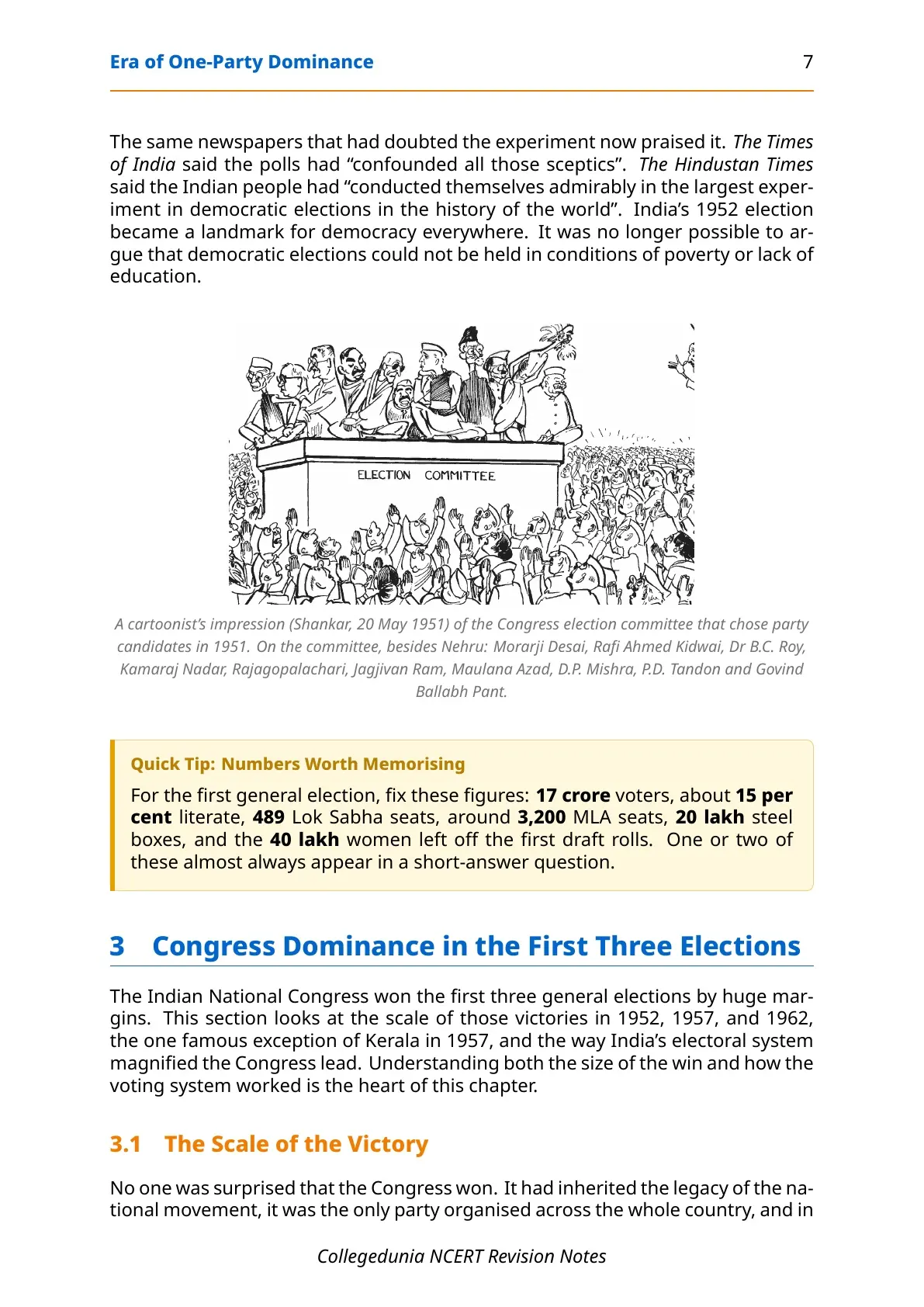
- Source-based: a passage like Rajni Kothari's, with sub-parts on the eclectic Congress.
- Objective and MCQ: the first elections, Sukumar Sen, the 1952 results, and party-leader matches.
For quick recall, students often practise a short class 12 political science chapter 2 mcq drill and a list of Era of One-Party Dominance class 12 important questions. The most repeated items are the reasons for Congress dominance and the coalition idea, so keep those answer points ready in your own words. Reading these notes once, then writing the key lists from memory, is the fastest way to lock the chapter in.
Common Mistakes Students Make in This Chapter
A few errors cost marks every year. Most come from mixing up parties or saying that dominance was undemocratic. Fixing these five points is the quickest way to lift a score, so add them to the end of your revision sheet.
- Picking the BJP as the second party in 1952 - it did not exist then; the answer is the CPI with 16 seats.
- Confusing the Jana Sangh (cultural nationalist) with the Swatantra Party (free-market) - keep them separate.
- Saying one-party dominance meant weak democracy - in India it grew under free and fair elections.
- Treating the Congress's tolerance of factions as a flaw - it was a source of its strength.
- Forgetting that Kerala (1957, CPI) was the first non-Congress state government.
Students who fix these five points usually move from average to high marks. The exam rewards a balanced view, so always show that India's dominance was the democratic kind before you compare it with forced one-party rule abroad. These notes flag each soft point so you can phrase it safely in the answer sheet.
How These Notes Pair with the Solutions and Book PDF
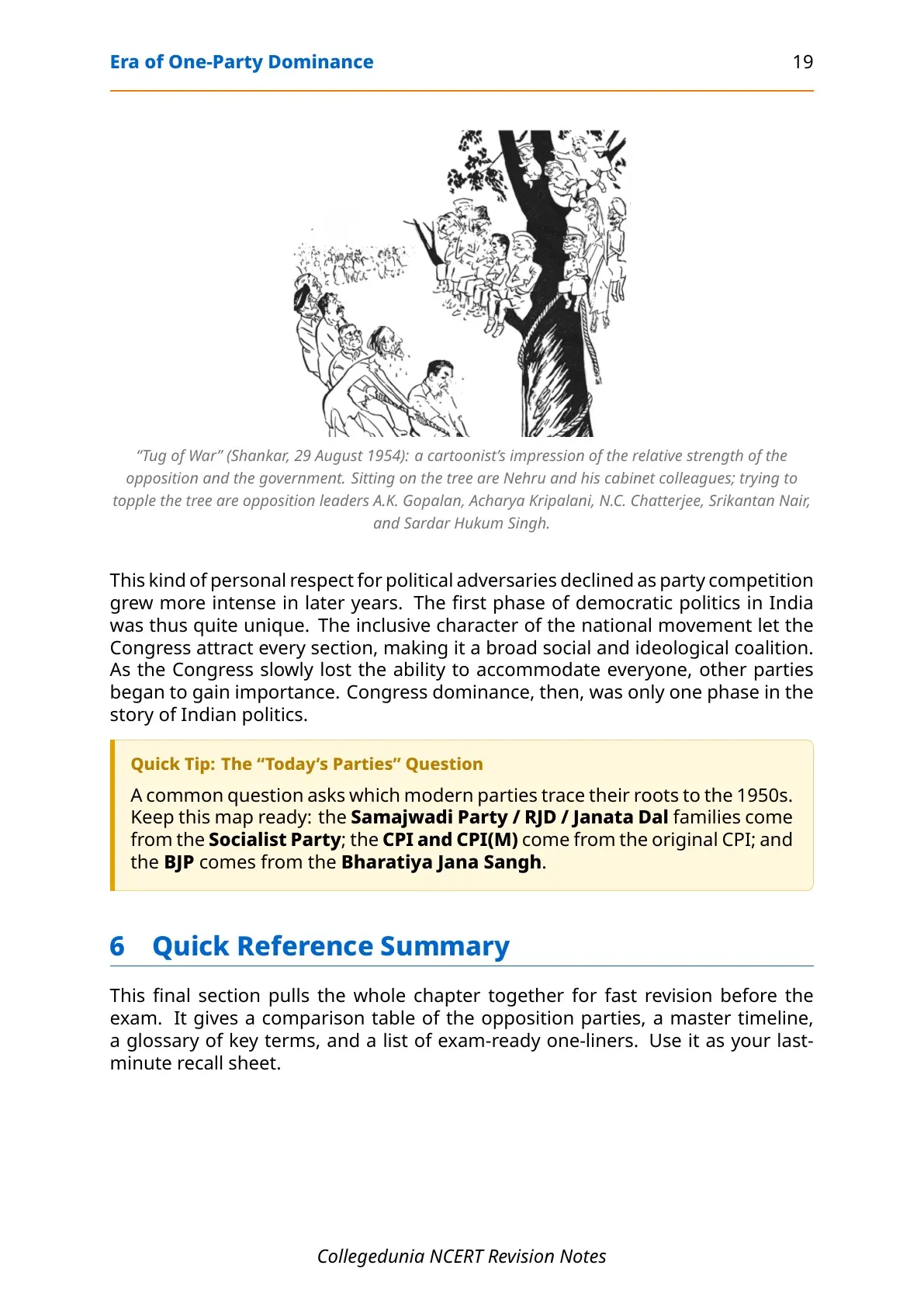
These revision notes summarise the chapter. To prepare fully, students should use them alongside the other resources for the same chapter, all linked in the table below. Read the notes first, then test yourself with the solutions, and open the book PDF whenever you need the original text, map and cartoons.
| Resource | Best used for |
|---|---|
| Era of One-Party Dominance NCERT Solutions | Step-by-step answers to all 5 back-exercise questions |
| Era of One-Party Dominance Handwritten Notes | Last-minute, one-shot revision in a scanned notebook style |
| Era of One-Party Dominance NCERT Book PDF | Reading the original NCERT chapter text, map and cartoons |
Tip: read these notes first, then attempt the solutions on your own, and only then check the model answers. That order builds memory faster than copying answers straight away.
All Class 12 Political Science Notes by Chapter
The table links the revision notes for every chapter in both Class 12 Political Science books, so students can move across the course in one click. Era of One-Party Dominance is highlighted.
| Chapter | Notes |
|---|---|
| Contemporary World Politics | |
| Chapter 1 | The End of Bipolarity |
| Chapter 2 | Contemporary Centres of Power |
| Chapter 3 | Contemporary South Asia |
| Chapter 4 | International Organisations |
| Chapter 5 | Security in the Contemporary World |
| Chapter 6 | Environment and Natural Resources |
| Chapter 7 | Globalisation |
| Politics in India Since Independence | |
| Chapter 1 | Challenges of Nation Building |
| Chapter 2 | Era of One-Party Dominance |
| Chapter 3 | Politics of Planned Development |
| Chapter 4 | India's External Relations |
| Chapter 5 | Challenges to and Restoration of the Congress System |
| Chapter 6 | The Crisis of Democratic Order |
| Chapter 7 | Regional Aspirations |
| Chapter 8 | Recent Developments in Indian Politics |
FAQs on Era of One-Party Dominance Class 12 Notes
Era of One-Party Dominance Class 12 Political Science Notes Common Questions
Ques. Where can I download the Era of One-Party Dominance Class 12 notes PDF?
Ans. You can download the Era of One-Party Dominance Class 12 Political Science notes PDF directly from this page. It is free, follows the 2026-27 NCERT, and covers the first elections, the reasons for Congress dominance, the nature of dominance and the opposition parties in a short, point-wise format.
Ques. What does Era of One-Party Dominance chapter cover for Class 12?
Ans. It covers the challenge of building democracy, the first three general elections of 1952, 1957 and 1962, why the Congress dominated, the democratic nature of that dominance, the Congress as a coalition, and the main opposition parties of the 1950s.
Ques. Why did the Congress dominate the first general elections?
Ans. Because it had led the freedom struggle, already had a country-wide organisation, had tall leaders like Nehru and Patel, faced a small, divided opposition, and drew support from every caste, class, region and religion. This head start made it "first off the blocks".
Ques. Why is Era of One-Party Dominance important for the board exam?
Ans. Because it is a high-scoring chapter whose ideas, the reasons for Congress dominance, the coalition nature, and the contrast with forced one-party rule, appear almost every year. Revising these notes well secures both MCQ and long-answer marks.
Ques. How should I use these notes to revise quickly?
Ans. Read the notes once under the elections, why-Congress-won and nature-of-dominance frame, keep the party-leader links and key dates on one sheet, then write the key lists from memory. Finish by attempting a short class 12 political science chapter 2 mcq drill to test the small facts.



Comments