




These Challenges to and Restoration of the Congress System Class 12 Notes give a quick, exam-ready summary of Indian politics in the decade after Nehru, set to the 2026-27 CBSE syllabus. The notes pull together every key date, name and idea from Chapter 5 of Politics in India Since Independence. Students can use them for a fast revision the night before a test or to fix the main ideas before they attempt the back-exercise questions.
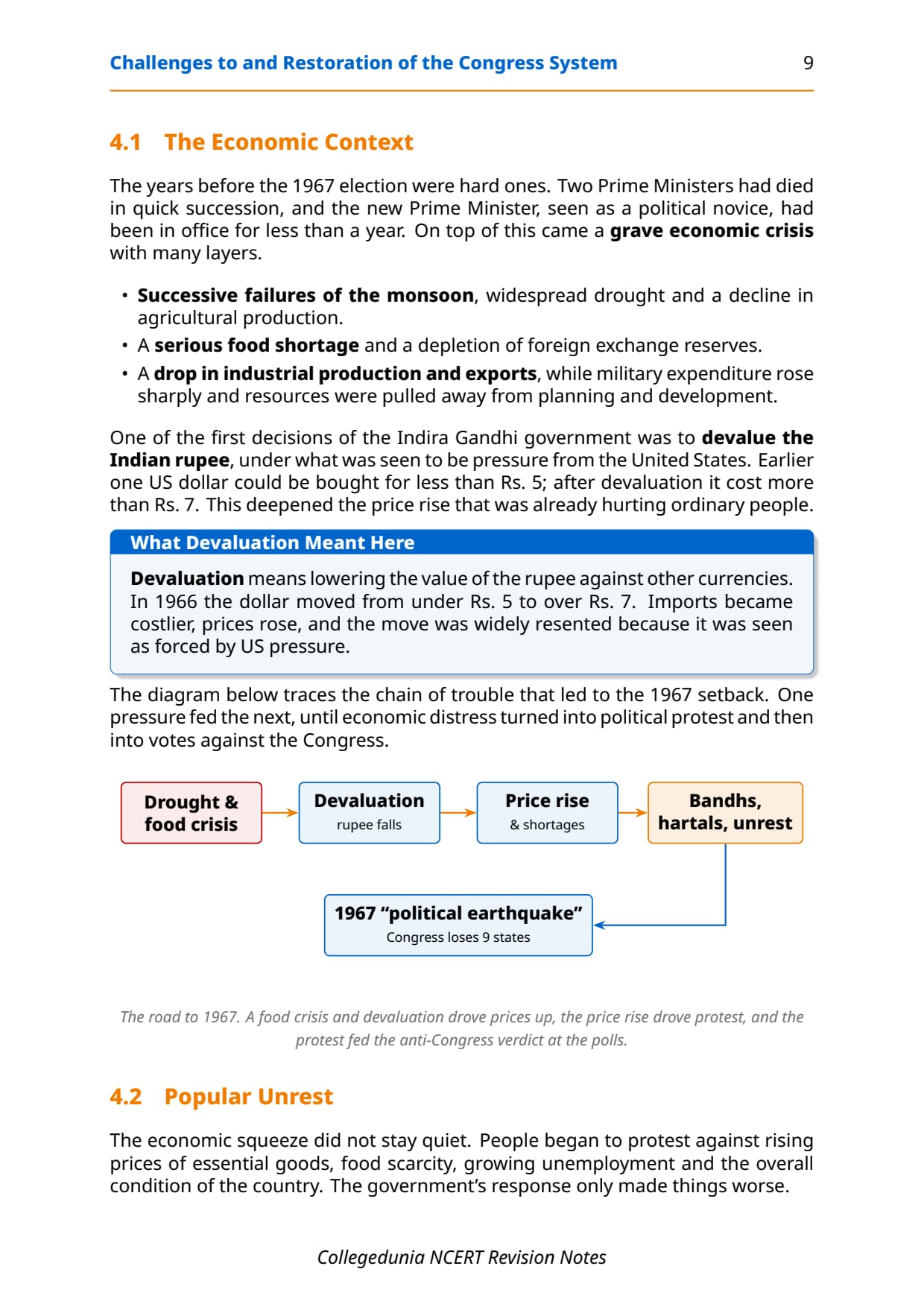
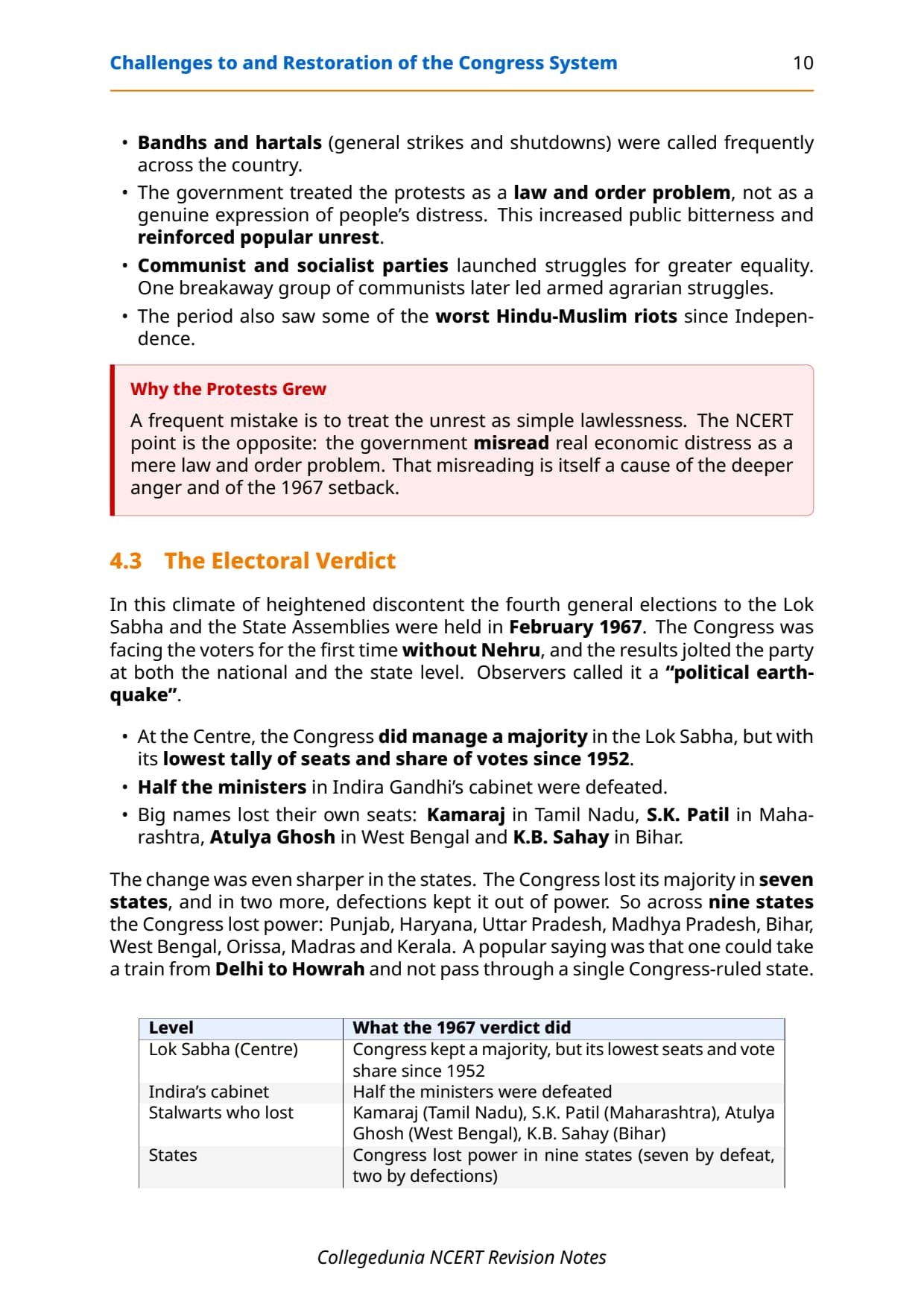
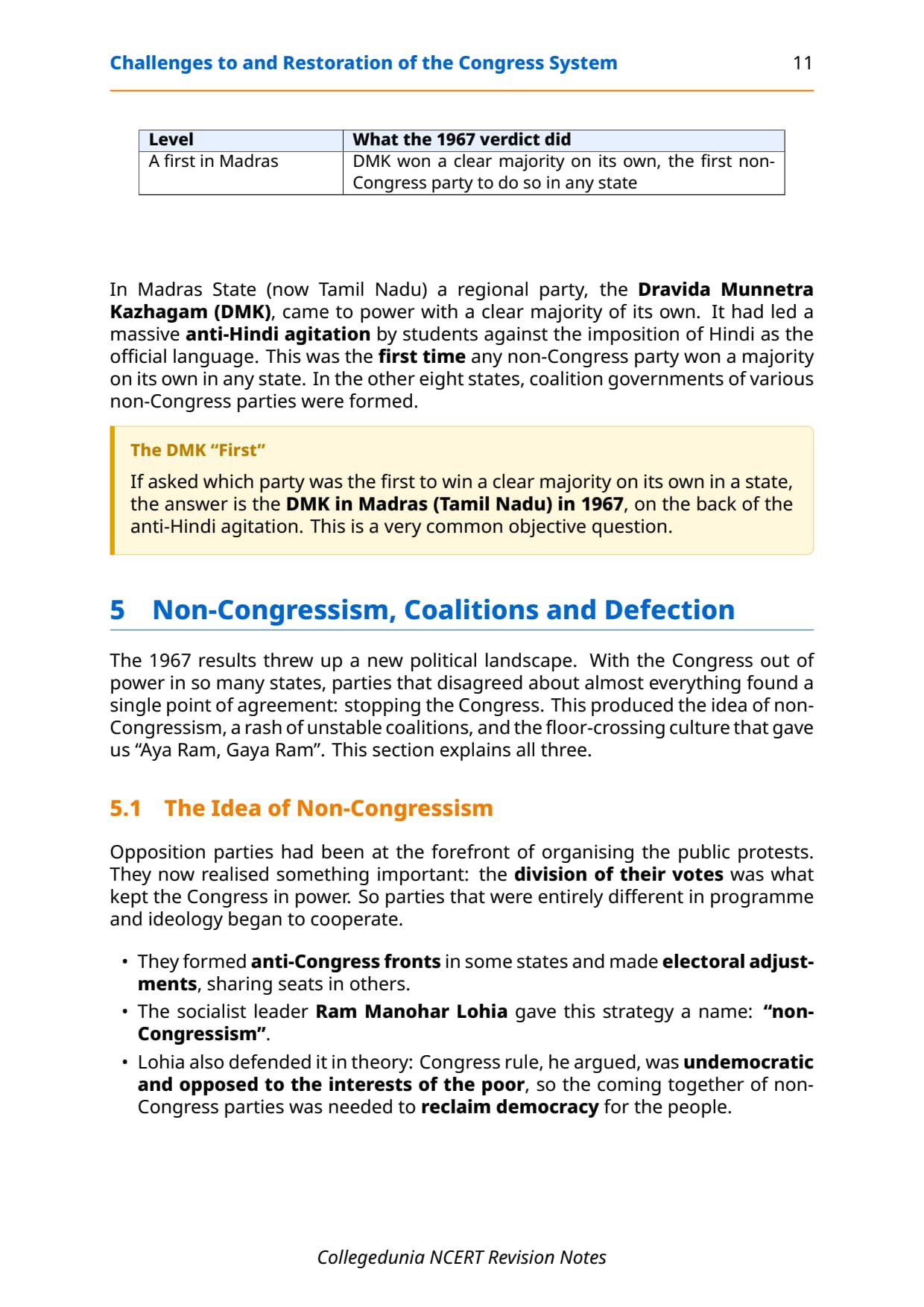
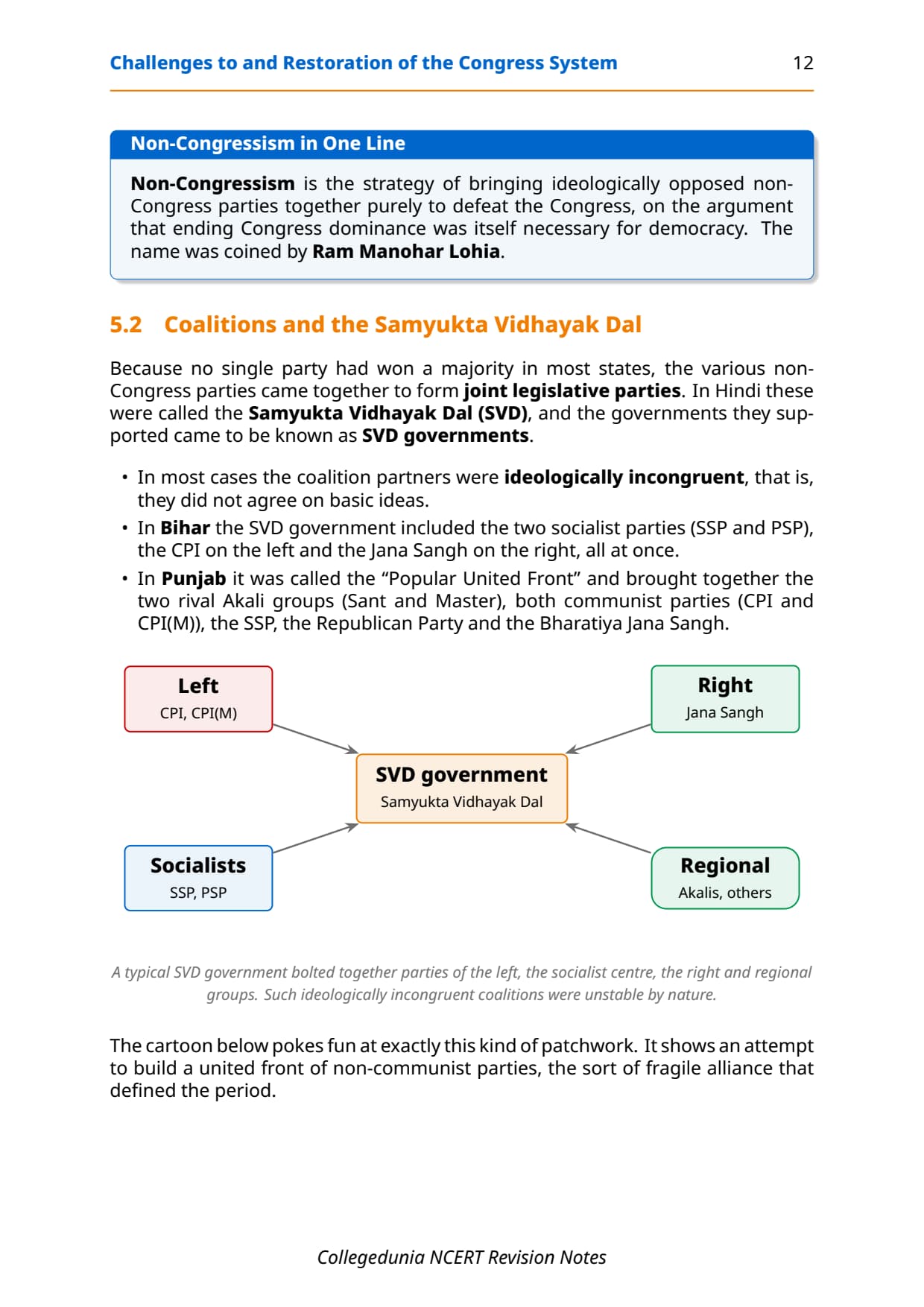
- Covers political succession, the 1967 election, non-Congressism, the 1969 split and the 1971 restoration in one place.
- This Class 12 Political Science chapter usually carries 5 to 6 marks in the board paper.
- Pairs with the NCERT Solutions, Handwritten Notes and Book PDF linked lower on this page.
These Challenges to and Restoration of the Congress System Class 12 notes are written from the official NCERT Politics in India Since Independence textbook and checked against the last five years of CBSE board papers.
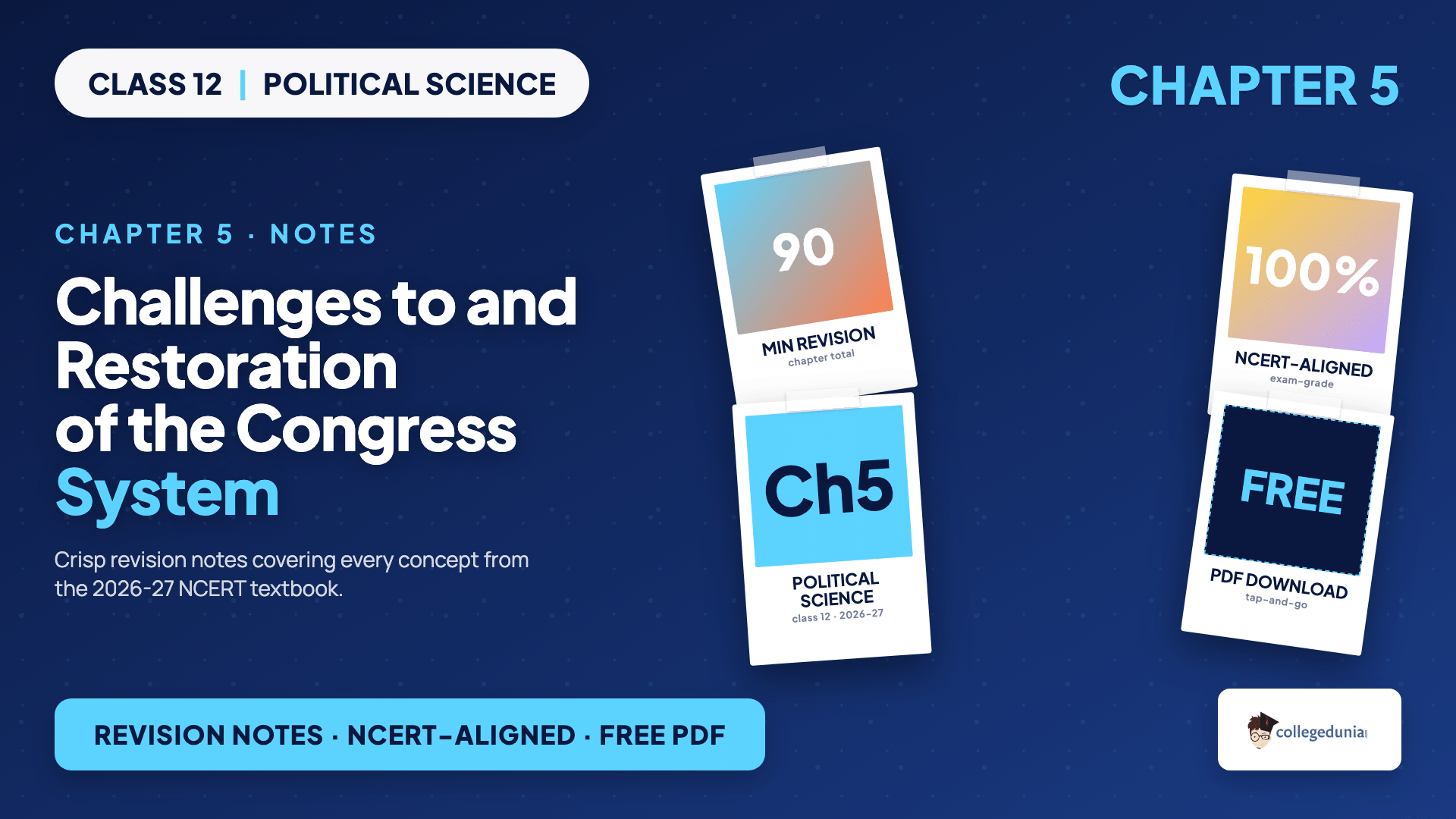
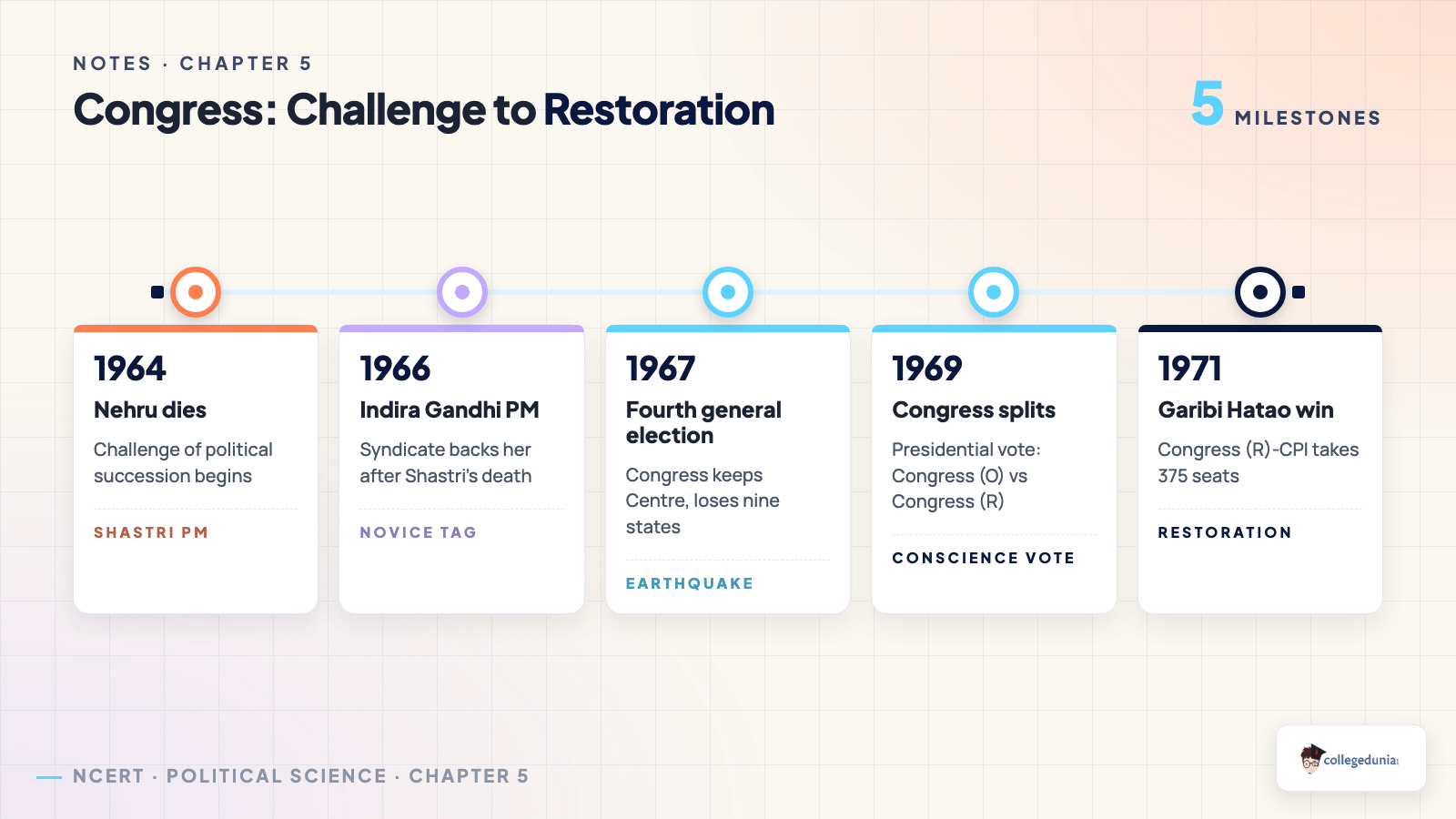
Student Feedback: In a Collegedunia poll of 8,150 Class 12 Political Science students taken before the 2026 boards, 72% of students said a short timeline of 1964, 1967, 1969 and 1971 was the fastest way to revise this chapter. Most students kept the Congress (O) versus Congress (R) split on a single sheet for last-minute recall.
Source: 2026-27 Class 12 Political Science student poll. Sample of 8,150 students from CBSE schools across 12 states.
What the Challenges to and Restoration of the Congress System Notes Cover
Challenges to and Restoration of the Congress System is the fifth chapter of Politics in India Since Independence. It traces Indian politics through the decade after Nehru, from his death in 1964 to Indira Gandhi's win in 1971. These notes condense the whole chapter into a fast, point-wise summary.
The easiest way to organise your revision is to split the chapter into three threads:
- Succession: the deaths of Nehru and Shastri, and the rise of Indira Gandhi.
- Challenge: the 1967 election, non-Congressism and the 1969 split.
- Restoration: the 1971 "Garibi Hatao" win that rebuilt Congress dominance.
So these notes are really about challenge and recovery. If you sort each fact under one of these threads first, almost every question in Challenges to and Restoration of the Congress System class 12 becomes easier to answer. Keep this frame at the top of your revision sheet and slot each new detail into the right box as you read.
Political Succession After Nehru
Nehru's death in 1964 raised a real fear about whether democracy could survive without him. Learn the succession as a boxed list, because the exam asks how the transfers were managed. Each name carries its own follow-up question.
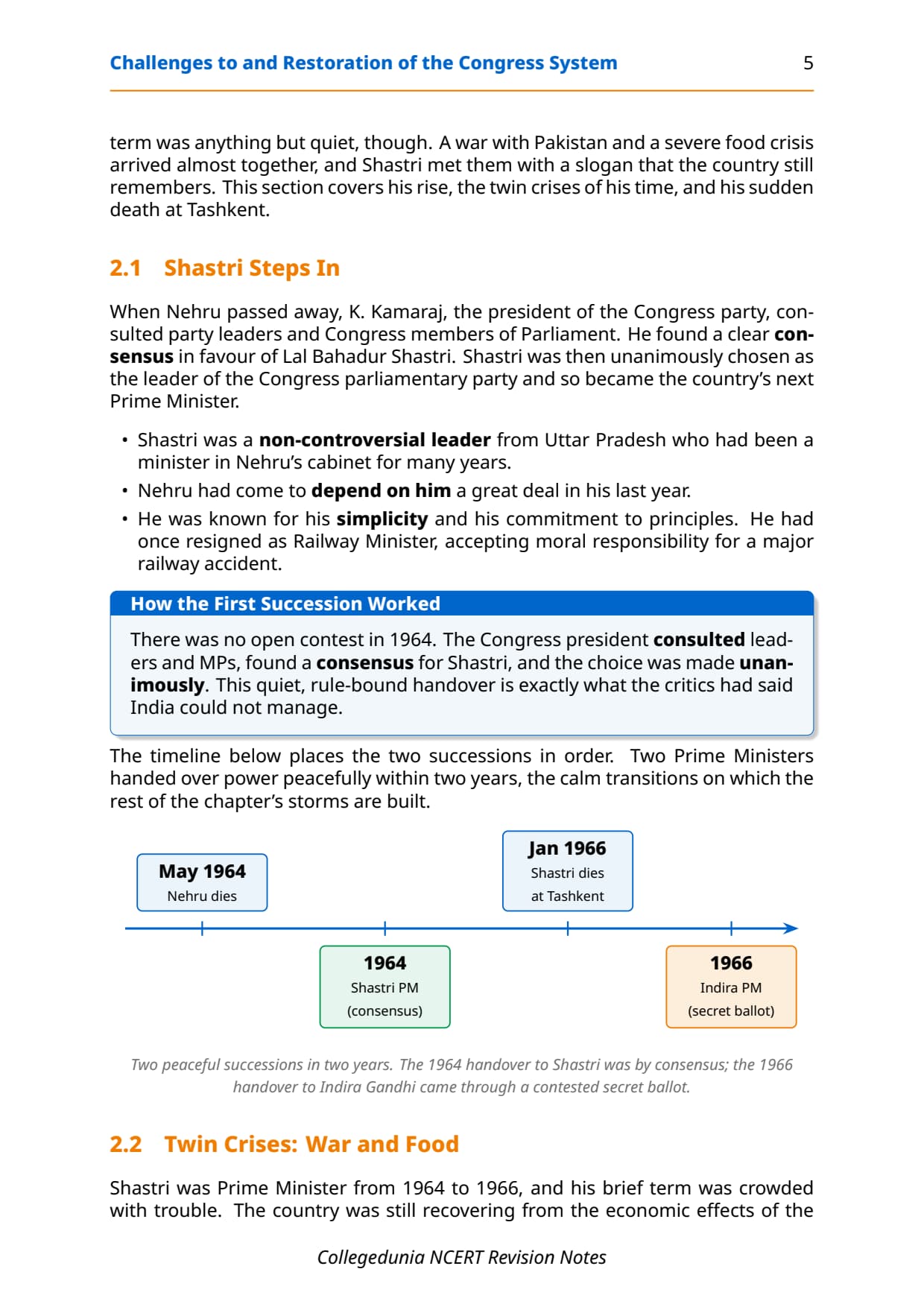
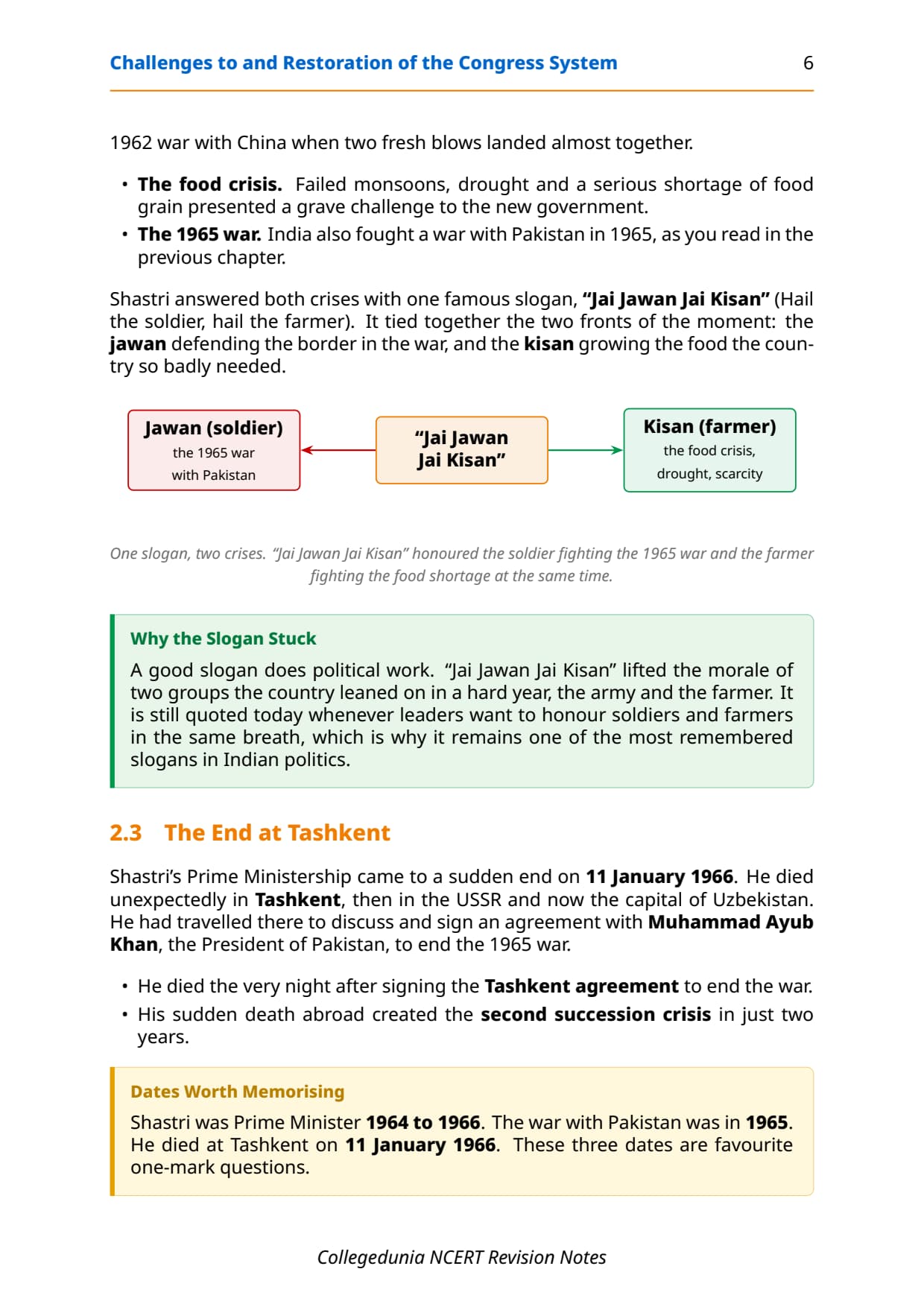
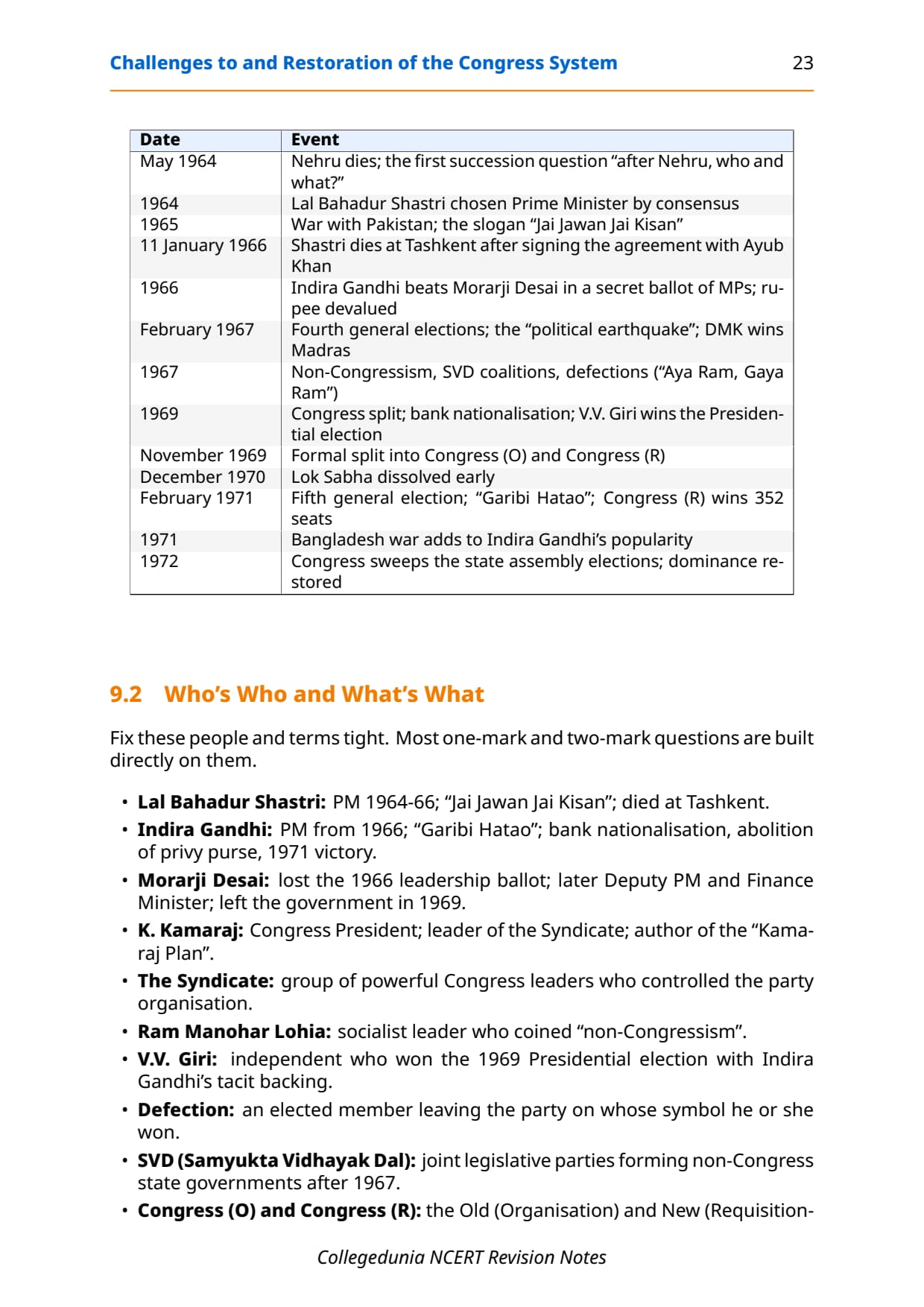
- Lal Bahadur Shastri: PM in 1964; gave "Jai Jawan, Jai Kisan" in 1965 during the war and food shortage.
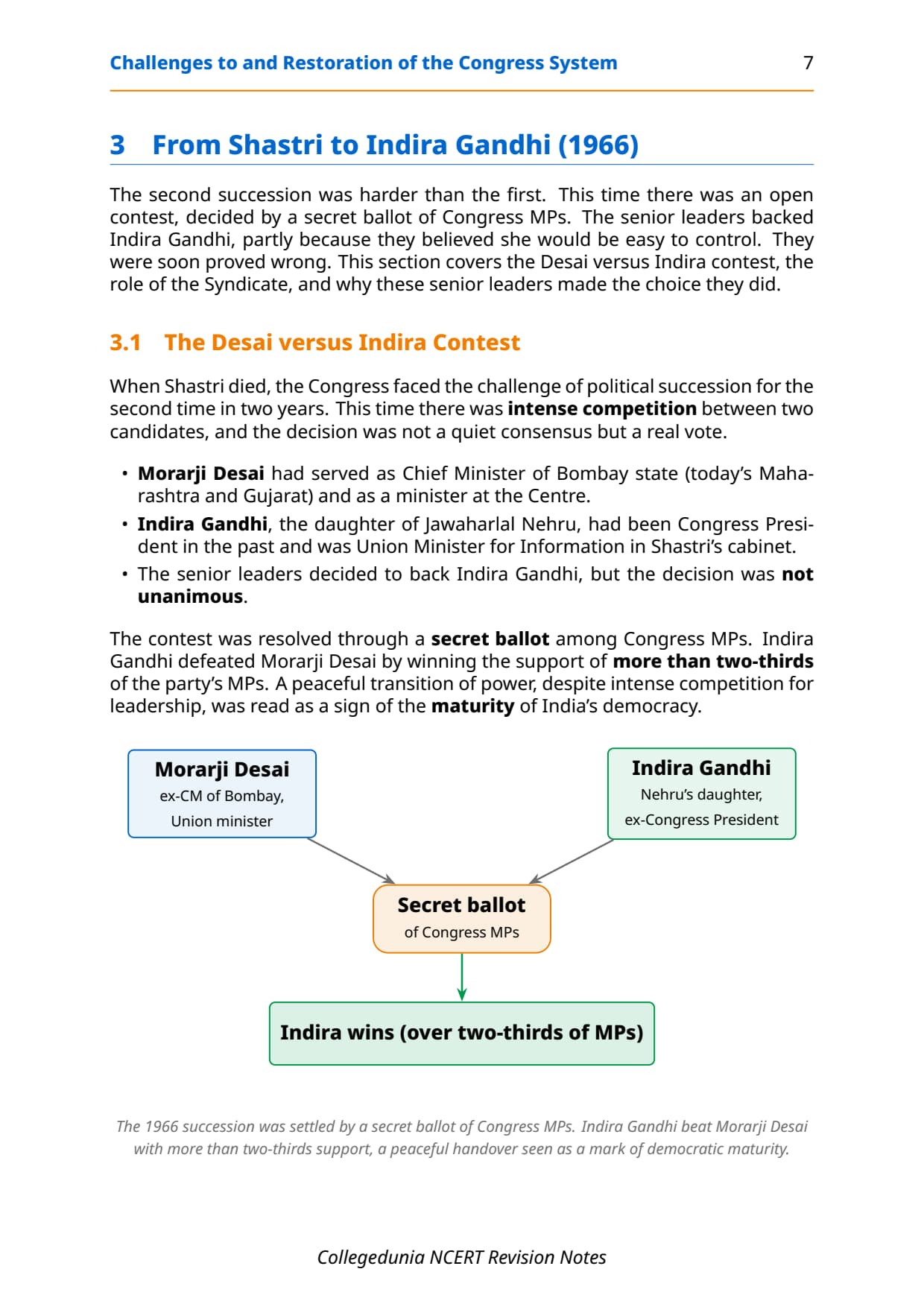
- Indira Gandhi: PM in 1966 after Shastri's sudden death at Tashkent.
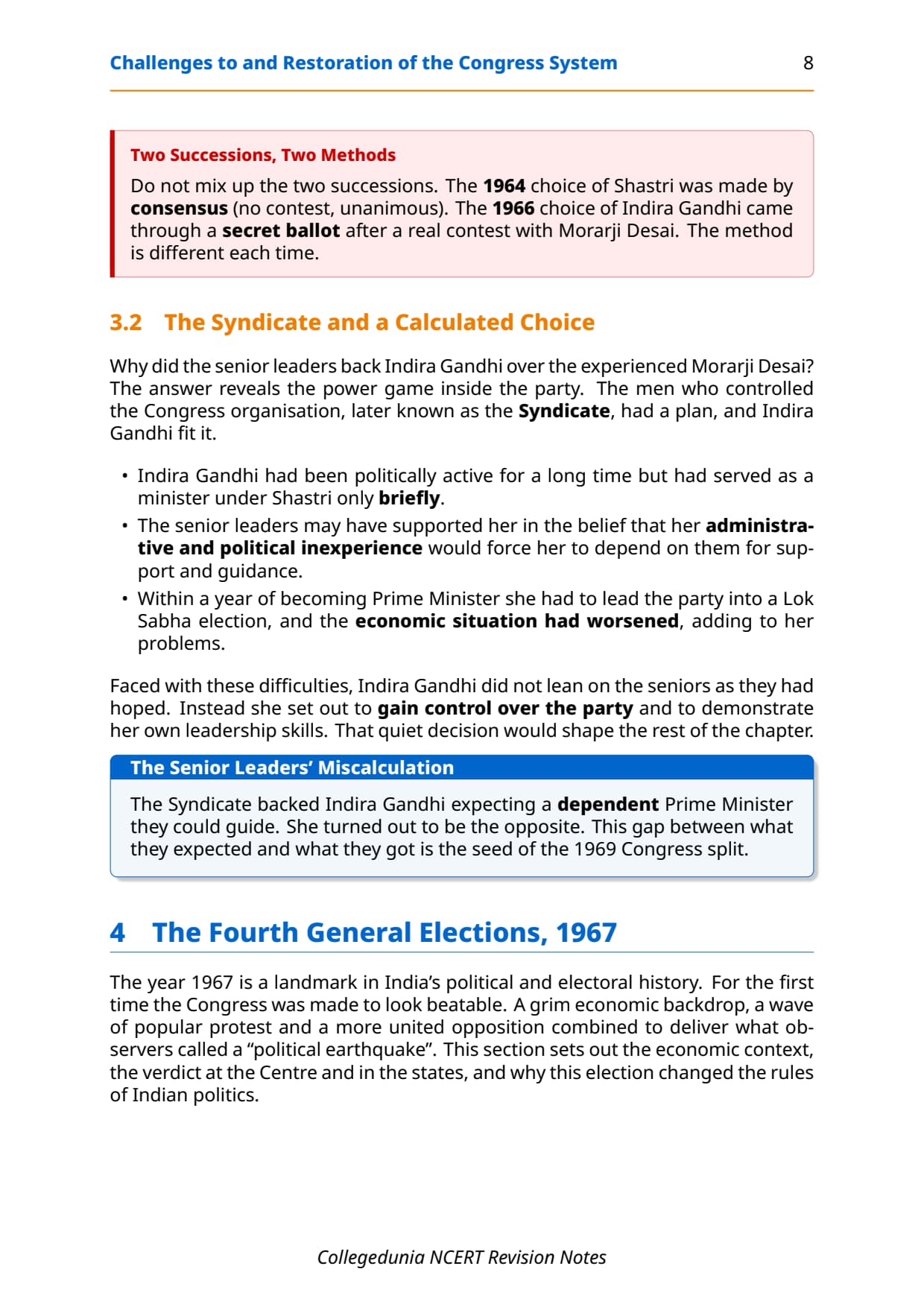
- The Syndicate: senior leaders led by K. Kamaraj who backed both choices.
- The catch: both transfers were peaceful, but Indira Gandhi was still seen as a "novice".
The point examiners test most is that the Congress managed succession smoothly, but the Syndicate expected to control the new leader. The senior leaders assumed Indira Gandhi would follow their advice. Keep this idea ready, because the Syndicate question and the 1969-split answer both turn on it.
The Fourth General Election of 1967
The 1967 election was a turning point, fought amid drought and economic crisis. The result is a long-answer favourite, so these notes keep it as a clear table rather than a story. Learn the facts as a list and you can answer any version of the question.
| Result | What to recall |
|---|---|
| Congress kept the Centre | It won the Lok Sabha, but with its lowest tally of seats since 1952. |
| Lost nine states | Out of power in Punjab, Haryana, UP, MP, Bihar, West Bengal, Orissa, Madras and Kerala. |
| DMK in Madras | The DMK won Madras outright after the anti-Hindi agitation. |
| Ministers lost | Half the ministers in Indira Gandhi's cabinet lost their seats. |
| "Political earthquake" | The phrase observers used for the Congress setback. |
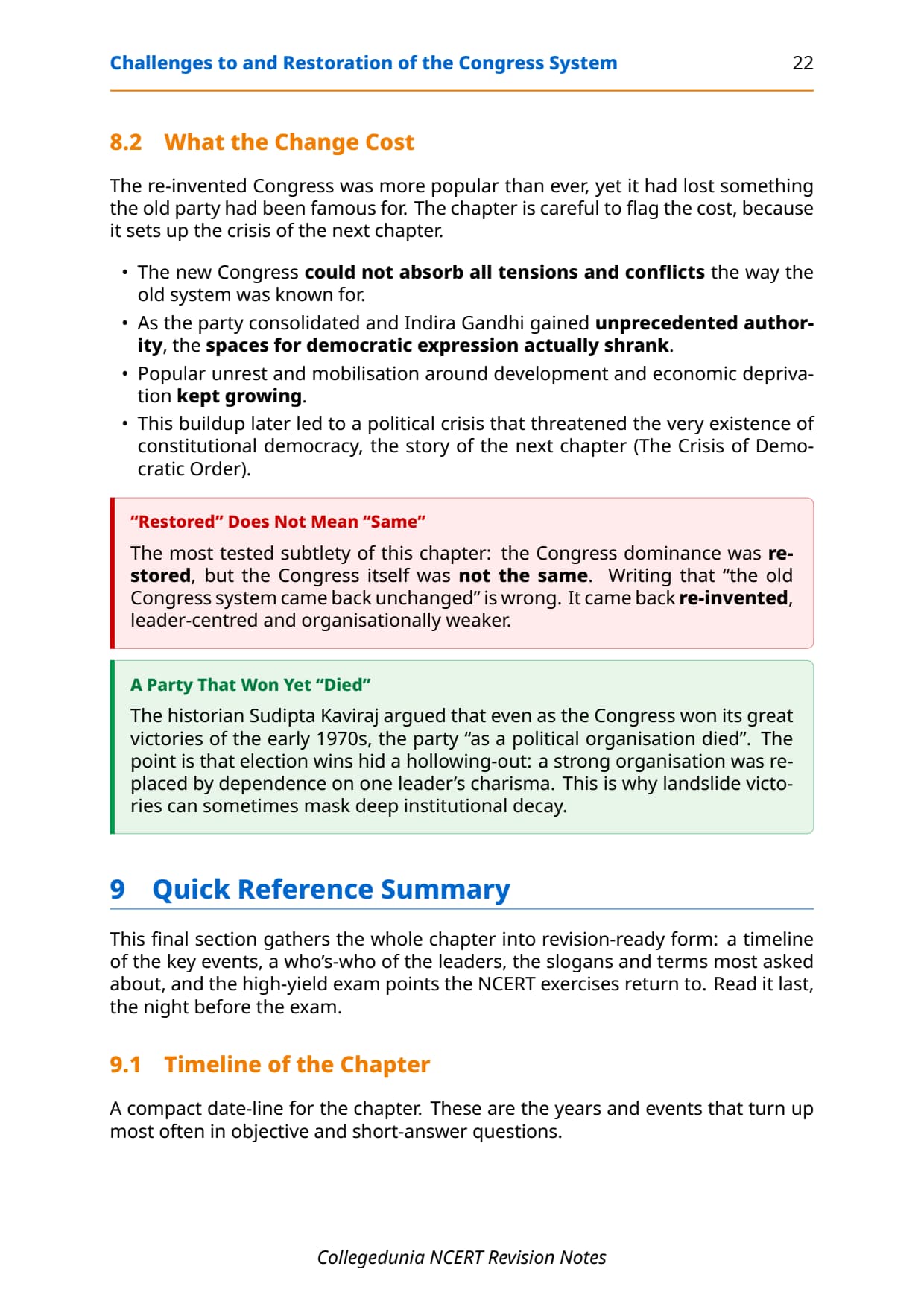
The one-line takeaway for your sheet is that 1967 was a split verdict: a win at the Centre, a rout in the states. The trap is to call the 1969 split a cause of the 1967 defeat. That is false, because the split came two years later. Keep the dates 1967 and 1969 clearly apart in your notes.
Non-Congressism, Defection and the Syndicate
Three new forces reshaped politics after 1967, and the exam tests all three by name. These notes keep each as a short boxed definition, because match questions use them directly.
- Non-Congressism: coined by Ram Manohar Lohia; rival parties uniting only to beat the Congress.
- Samyukta Vidhayak Dal (SVD): the non-Congress coalition governments in many states.
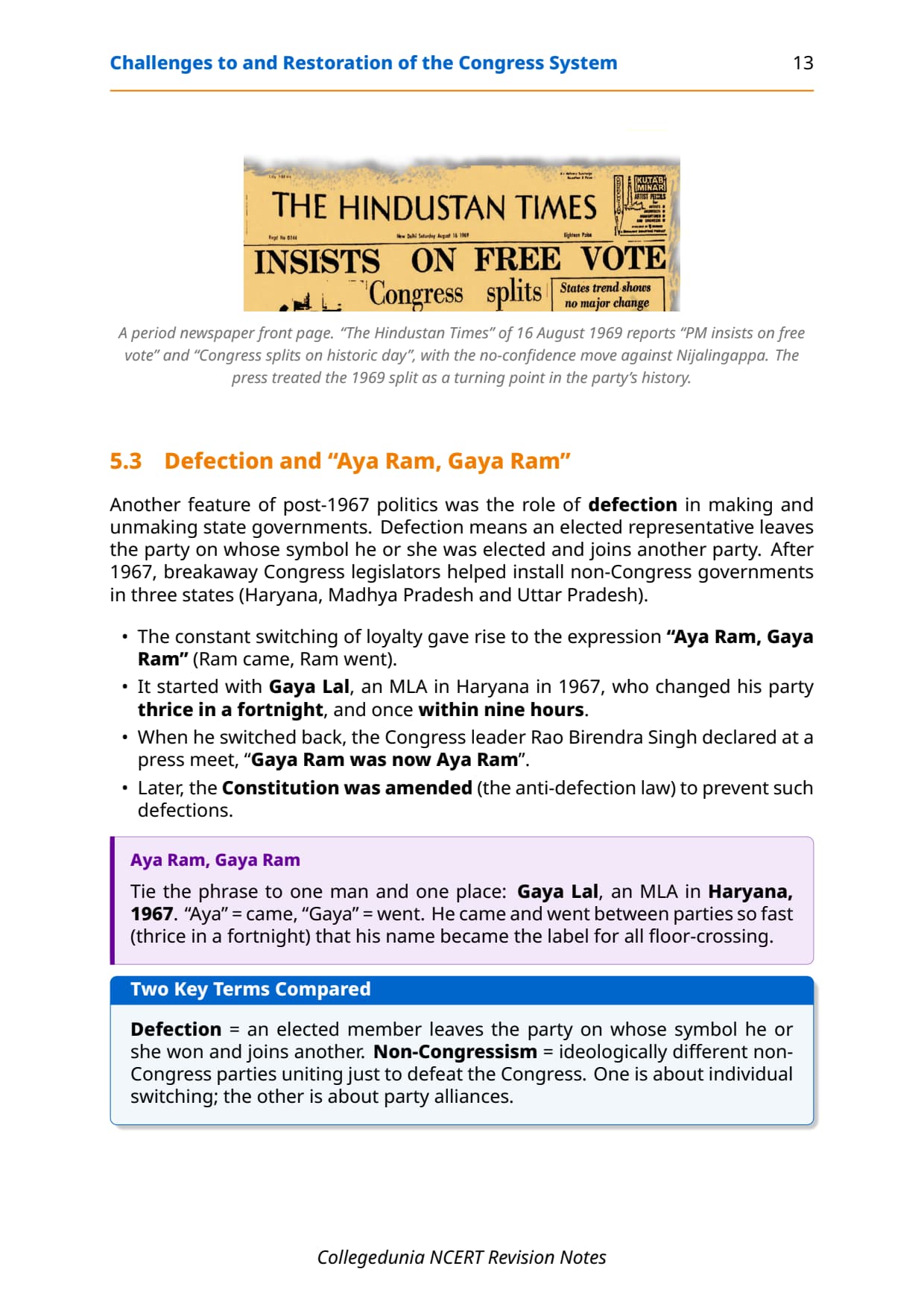
- Defection: an elected member leaving the party whose ticket got them elected; "Aya Ram, Gaya Ram".
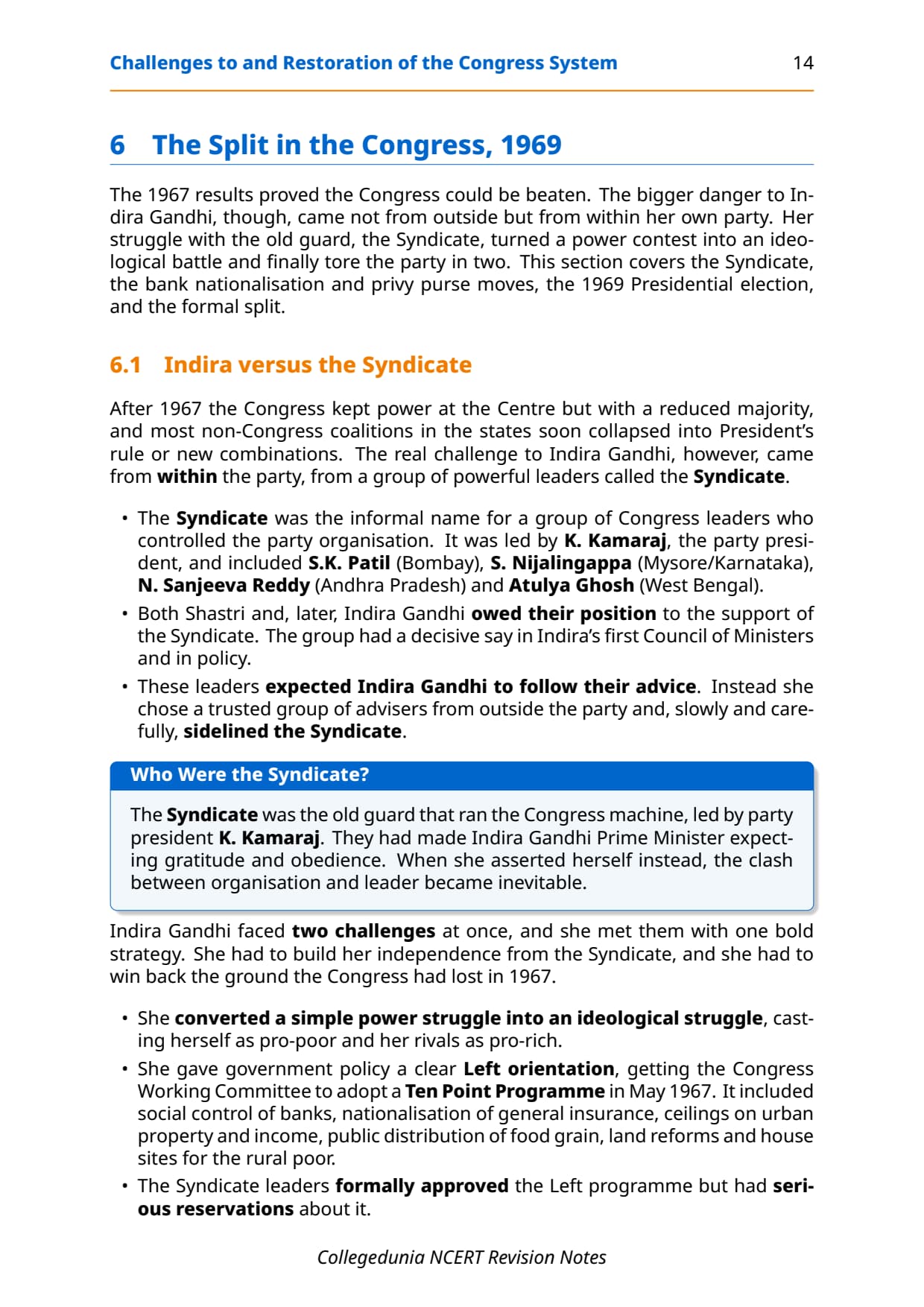
- The Syndicate: the powerful Congress organisation bosses, led by K. Kamaraj.
The honest revision line is that the Syndicate was inside the Congress, while non-Congressism was the strategy of the parties outside. Do not swap them. One pulled the party from within, the other pushed against it from outside. Tie "Aya Ram, Gaya Ram" to defection so the point sticks, and the match question becomes quick marks.
The Congress Split of 1969
The 1969 split is the most-asked long answer in the chapter. It grew out of the power struggle between Indira Gandhi and the Syndicate, but the trigger was one specific event. These notes give the sequence in order, because the exam asks for the immediate cause.
- The rivalry: Indira Gandhi wanted independence; the Syndicate wanted control.
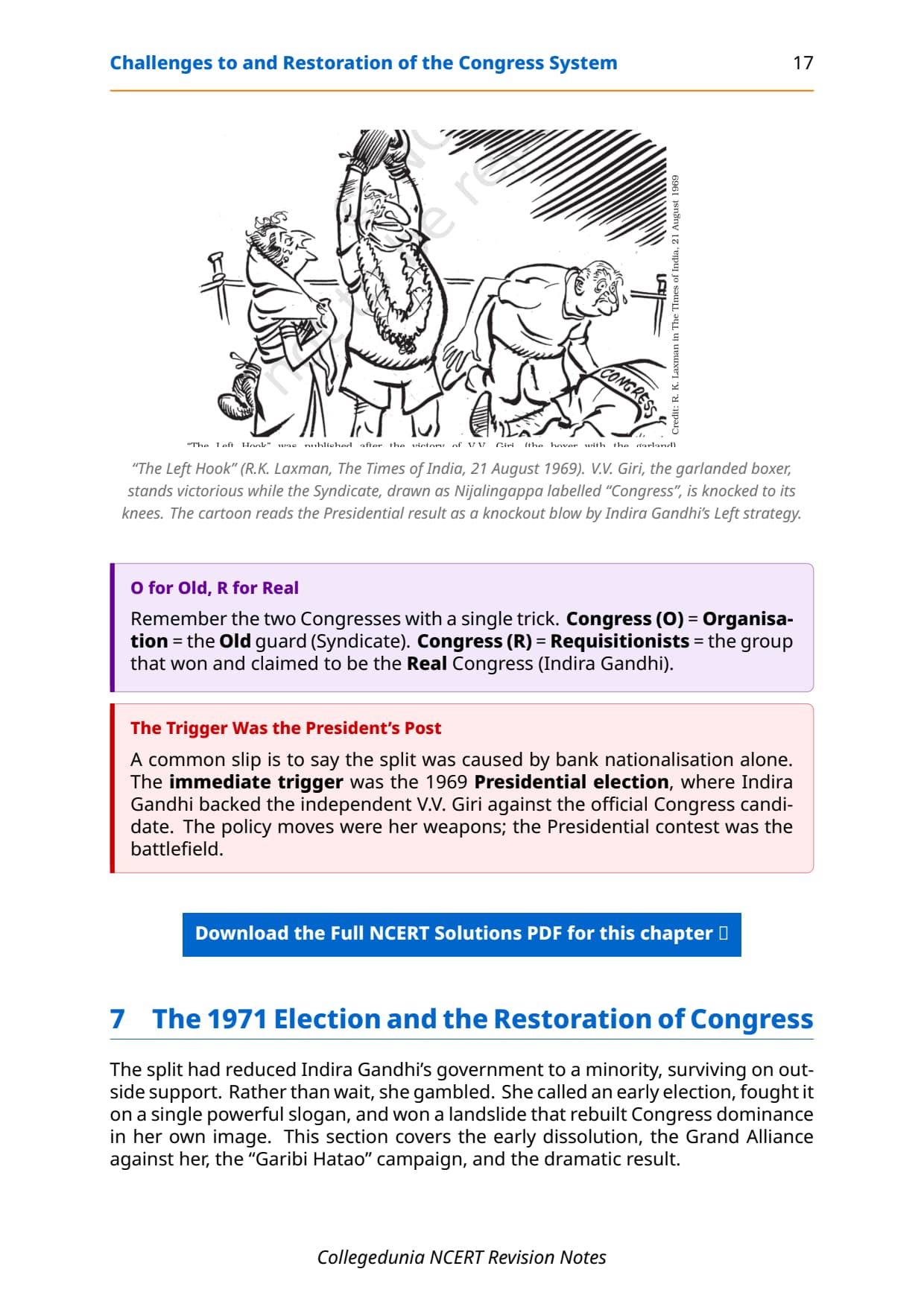
- The trigger: the 1969 Presidential election, after President Zakir Hussain died.
- The contest: the Syndicate's N. Sanjeeva Reddy versus the independent V. V. Giri.
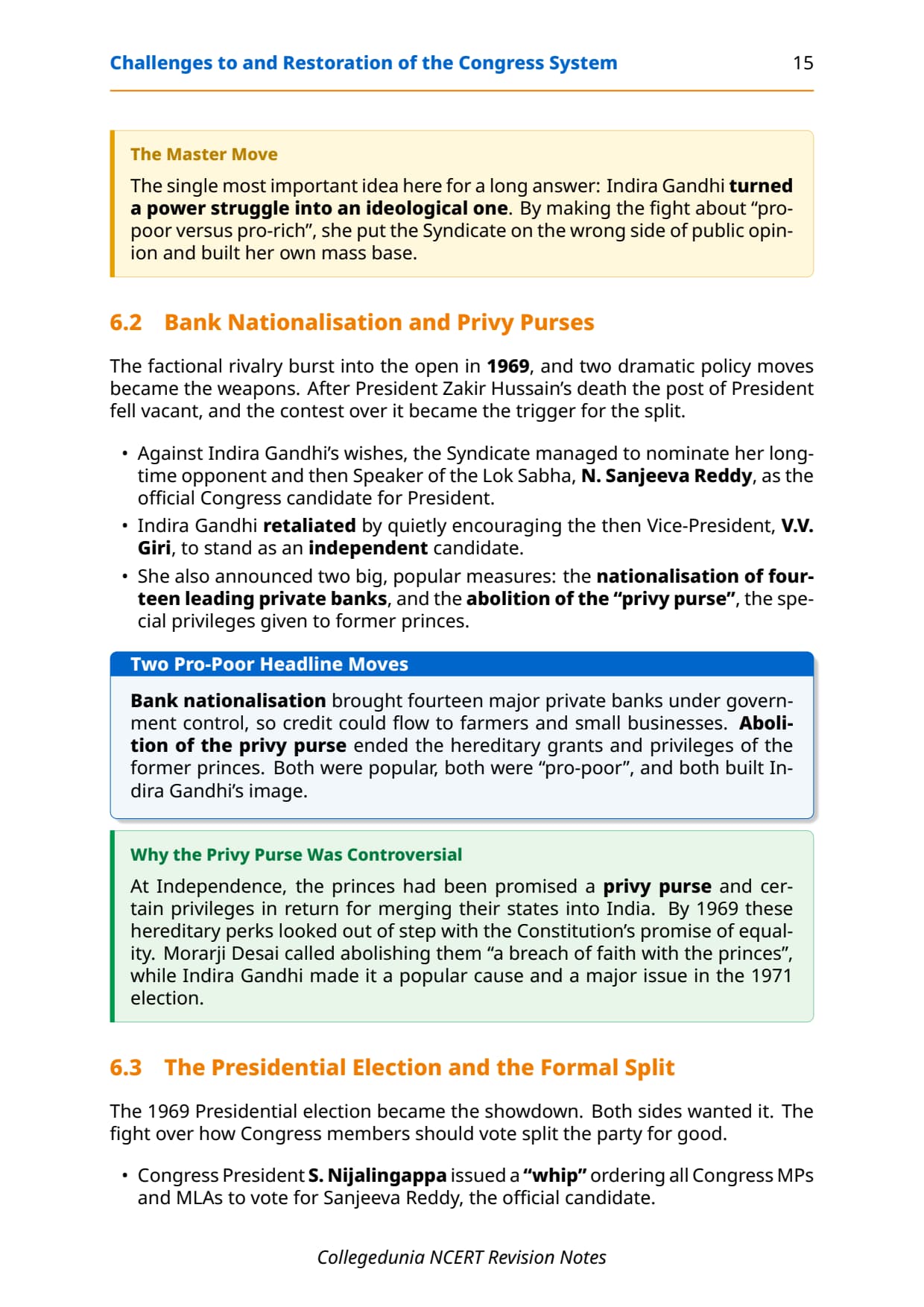
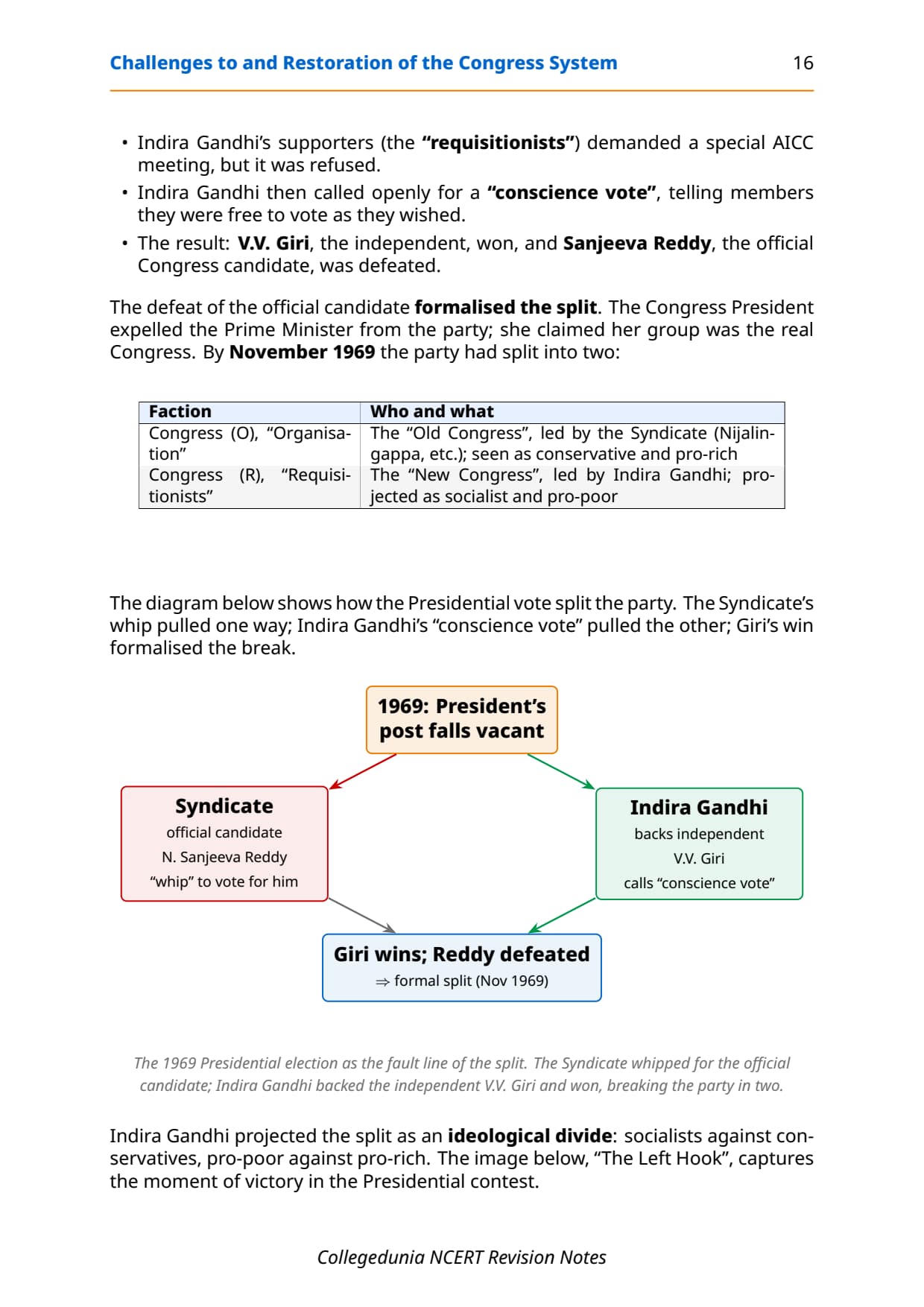
- The split: the whip ordered a vote for Reddy; Indira Gandhi called for a "conscience vote"; Giri won; the party split into Congress (O) and Congress (R).
The judgement to remember is that the split was a contest over who would control the party, not just a quarrel. The Syndicate's Old Congress (O) faced Indira Gandhi's New Congress (R), framed as conservatives versus socialists. Keep the trigger (the Presidential vote) and the two factions as clear notes for full marks.
The 1971 Election and Restoration
The 1971 election is where the Congress system is restored. This topic links to Indira Gandhi's rise, so it is a regular short and long answer. These notes keep the two rival slogans and the result side by side.
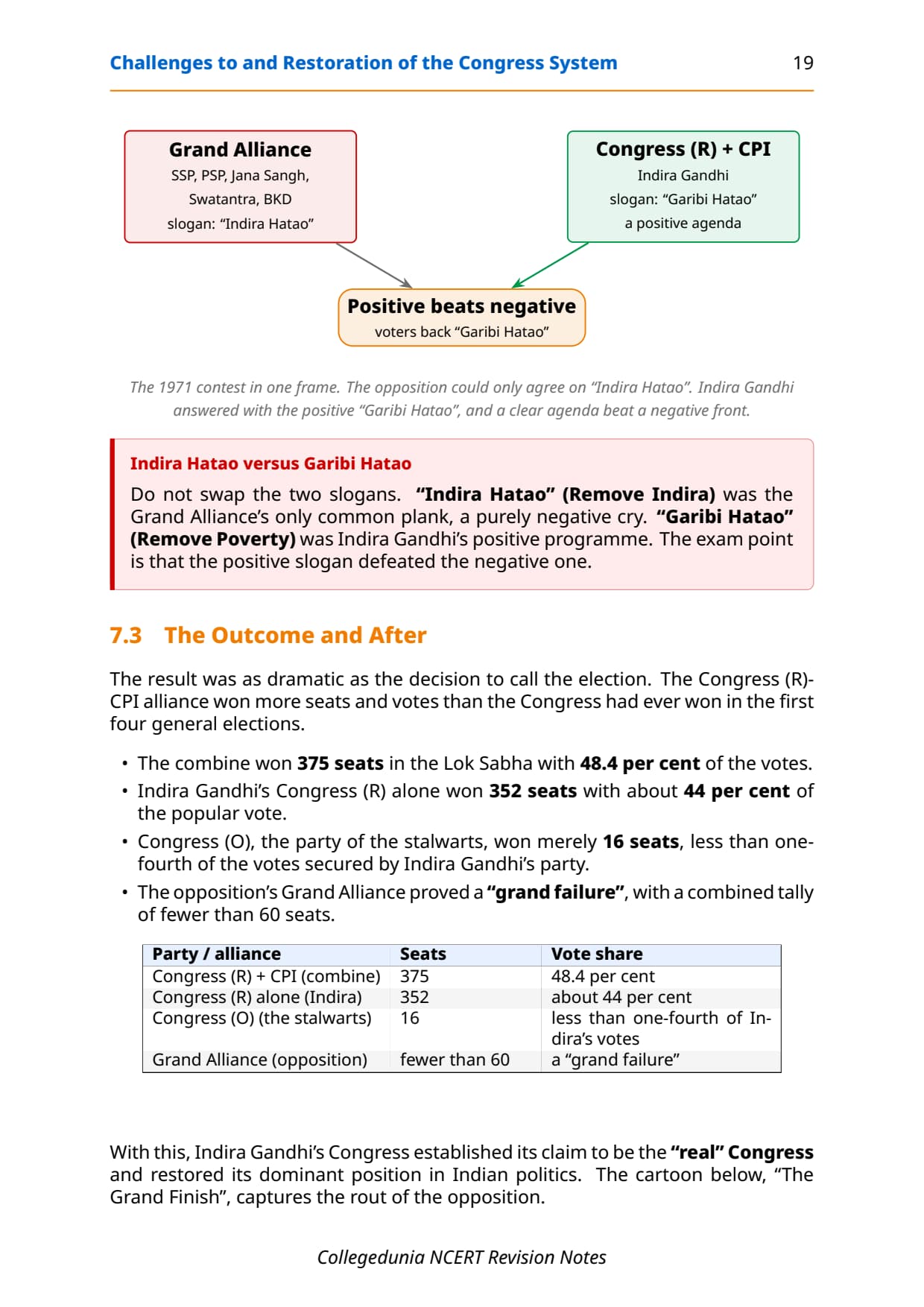
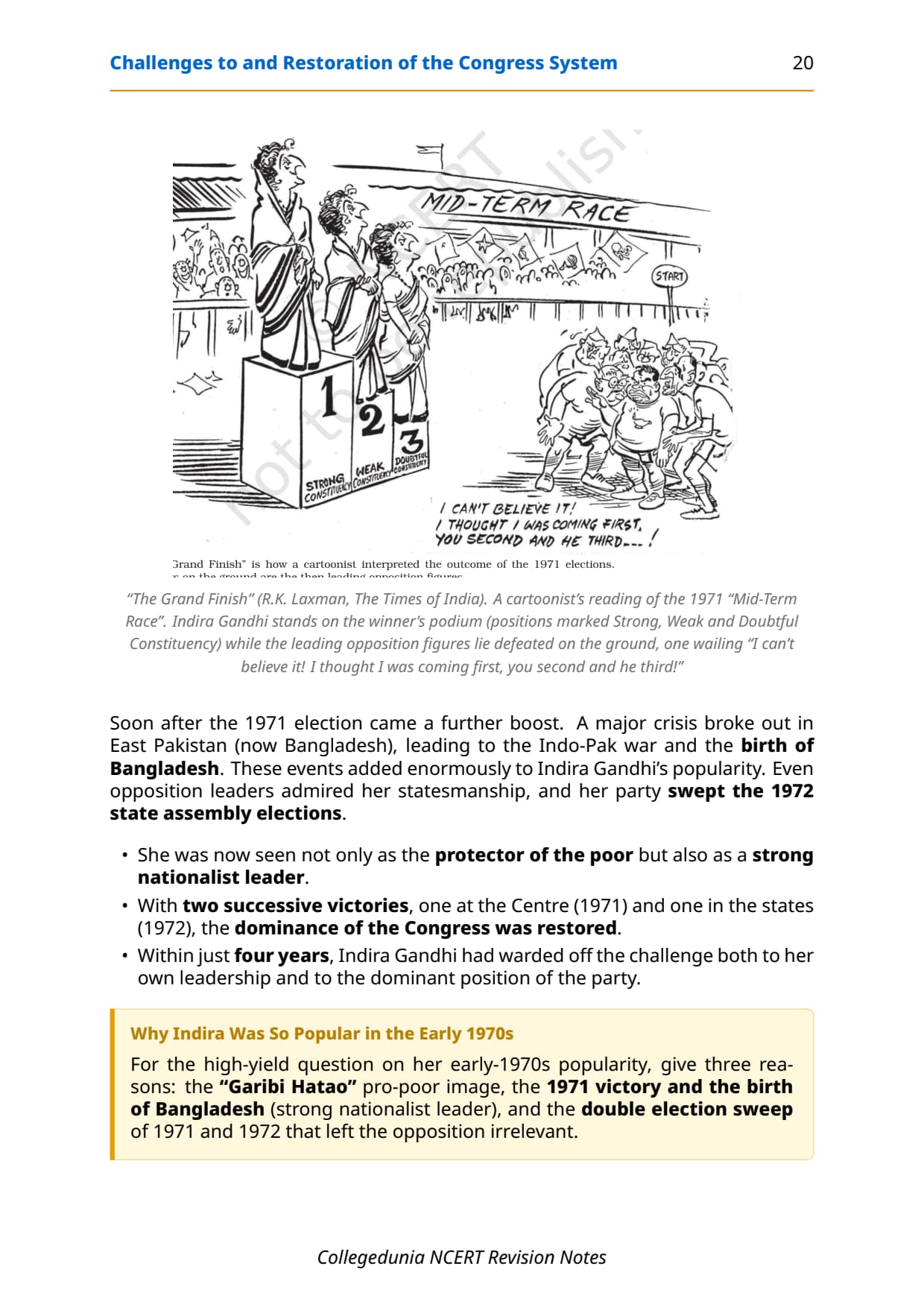
- Indira Gandhi (Congress R): "Garibi Hatao"; allied with the CPI; won 375 seats.
- The Grand Alliance: non-communist, non-Congress parties; only plank was "Indira Hatao"; under 60 seats.
- The boost: the 1971 war with Pakistan and the birth of Bangladesh sealed her stature.
- The base: bank nationalisation and the abolition of privy purses won over the poor.
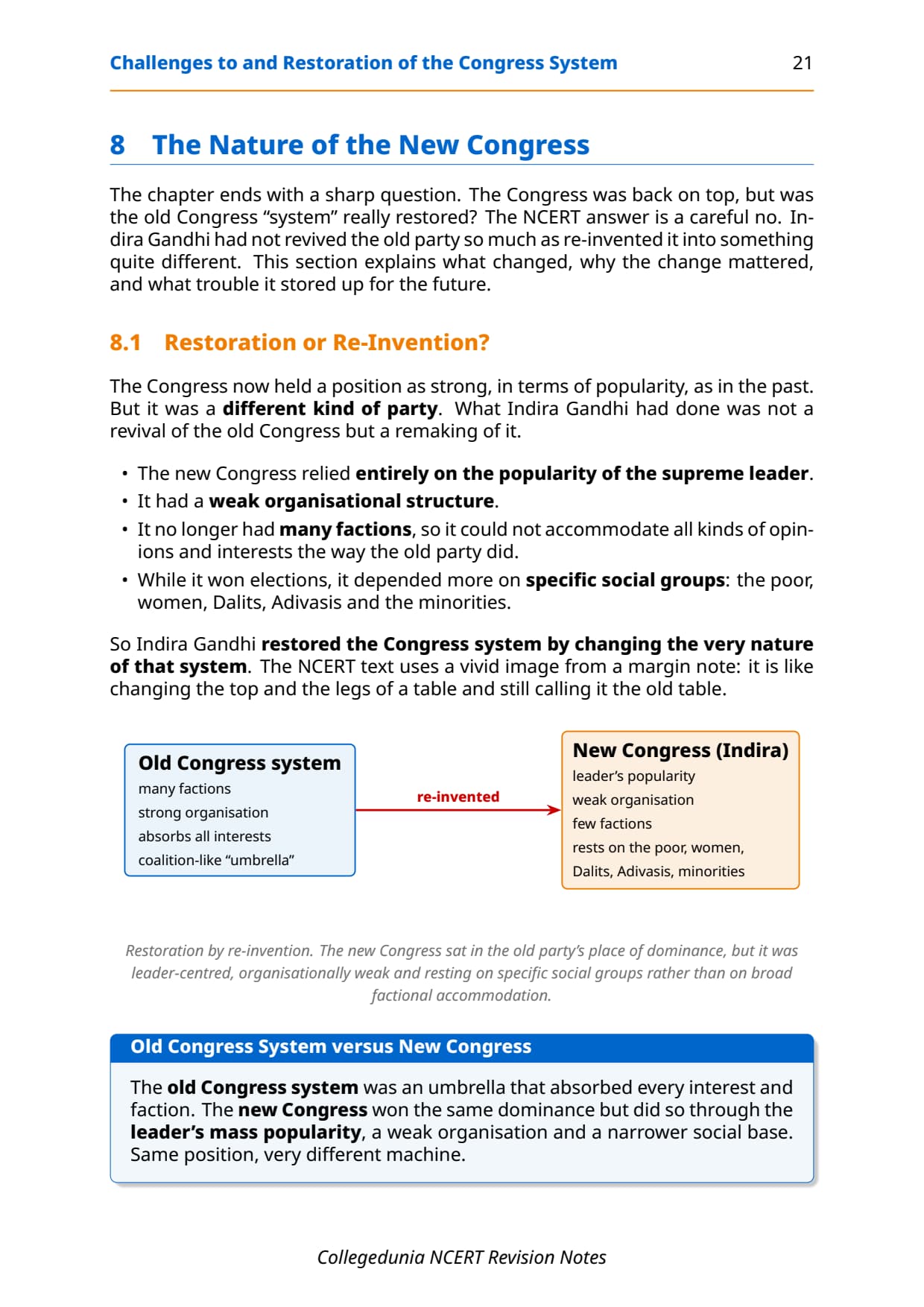
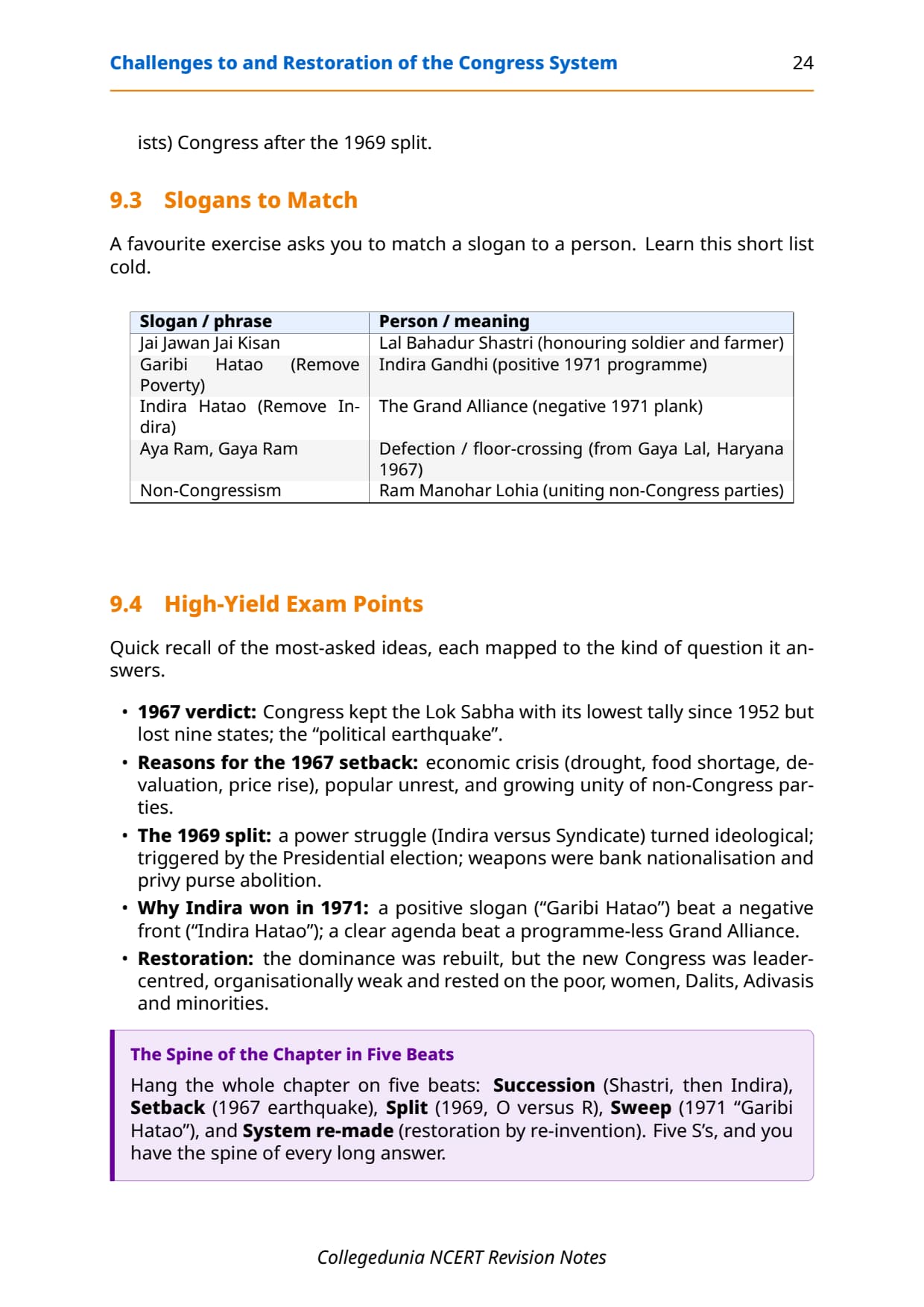
The judgement to remember is that a positive slogan beat a negative one. "Garibi Hatao" (Remove Poverty) won where "Indira Hatao" (Remove Indira) failed, because unity against someone is not unity for something. But the restored Congress was rebuilt around a single leader, the key idea for the "restoration" answer.
Challenges to and Restoration of the Congress System Important Questions and Exam Pointers
CBSE sets a steady mix of MCQ, short and long answers from this chapter. Knowing the pattern helps students decide how much to write and which topics to revise first. A focused list of Challenges to and Restoration of the Congress System important questions saves a lot of time before the board exam.
- Long answer (5 to 6 marks): the 1969 split, or the factors behind Indira Gandhi's popularity.
- Short answer (4 marks): the meaning and role of the Syndicate, or the reasons for the 1967 defeat.
- Source-based: the Sudipta Kaviraj passage on the "death" of the Congress organisation, with sub-parts.
- Objective and MCQ: the 1967 result, the Grand Alliance, "Garibi Hatao" and the key terms.
For quick recall, students often practise a short class 12 political science chapter 5 mcq drill and a list of Challenges to and Restoration of the Congress System class 12 important questions. The most repeated items are the 1969 split and the 1971 restoration, so keep those answer points ready in your own words. Reading these notes once, then writing the key lists from memory, is the fastest way to lock the chapter in.
Common Mistakes Students Make in This Chapter
A few errors cost marks every year. Most come from mixing up the dates of 1967 and 1969 or swapping the two Congress factions. Fixing these five points is the quickest way to lift a score, so add them to the end of your revision sheet.
- Calling the 1969 split a cause of the 1967 defeat - the split came after, in 1969.
- Swapping Congress (O) and Congress (R) - the Syndicate was Congress (O), Indira Gandhi led Congress (R).
- Confusing the Syndicate (inside the party) with non-Congressism (the parties outside).
- Treating "Indira Hatao" as Indira Gandhi's slogan - it was the opposition's plank against her.
- Saying the Grand Alliance had a clear programme - its only common plank was "Indira Hatao".
Students who fix these five points usually move from average to high marks. The exam rewards a clear timeline, so always check the order of 1964, 1967, 1969 and 1971 before you judge. These notes flag each soft point so you can phrase it safely in the answer sheet.
How These Notes Pair with the Solutions and Book PDF
These revision notes summarise the chapter. To prepare fully, students should use them alongside the other resources for the same chapter, all linked in the table below. Read the notes first, then test yourself with the solutions, and open the book PDF whenever you need the original text and figures.
| Resource | Best used for |
|---|---|
| Challenges to and Restoration of the Congress System NCERT Solutions | Step-by-step answers to all 10 back-exercise questions |
| Challenges to and Restoration of the Congress System Handwritten Notes | Last-minute, one-shot revision in a scanned notebook style |
| Challenges to and Restoration of the Congress System NCERT Book PDF | Reading the original NCERT chapter text and figures |
Tip: read these notes first, then attempt the solutions on your own, and only then check the model answers. That order builds memory faster than copying answers straight away.
All Class 12 Political Science Notes by Chapter
The table links the revision notes for every chapter in both Class 12 Political Science books, so students can move across the course in one click. Challenges to and Restoration of the Congress System is highlighted.
| Chapter | Notes |
|---|---|
| Contemporary World Politics | |
| Chapter 1 | The End of Bipolarity |
| Chapter 2 | Contemporary Centres of Power |
| Chapter 3 | Contemporary South Asia |
| Chapter 4 | International Organisations |
| Chapter 5 | Security in the Contemporary World |
| Chapter 6 | Environment and Natural Resources |
| Chapter 7 | Globalisation |
| Politics in India Since Independence | |
| Chapter 1 | Challenges of Nation Building |
| Chapter 2 | Era of One-Party Dominance |
| Chapter 3 | Politics of Planned Development |
| Chapter 4 | India's External Relations |
| Chapter 5 | Challenges to and Restoration of the Congress System |
| Chapter 6 | The Crisis of Democratic Order |
| Chapter 7 | Regional Aspirations |
| Chapter 8 | Recent Developments in Indian Politics |
FAQs on Challenges to and Restoration of the Congress System Class 12 Notes
Challenges to and Restoration of the Congress System Class 12 Political Science Notes Common Questions
Ques. Where can I download the Challenges to and Restoration of the Congress System Class 12 notes PDF?
Ans. You can download the Challenges to and Restoration of the Congress System Class 12 Political Science notes PDF directly from this page. It is free, follows the 2026-27 NCERT, and covers succession, the 1967 election, non-Congressism, the 1969 split and the 1971 restoration in a short, point-wise format.
Ques. What does the Challenges to and Restoration of the Congress System chapter cover for Class 12?
Ans. It covers the political succession after Nehru, the 1967 "political earthquake" election, non-Congressism and defection, the 1969 split into Congress (O) and Congress (R), and the 1971 "Garibi Hatao" election that restored Congress dominance.
Ques. What were Congress (O) and Congress (R)?
Ans. After the 1969 split, Congress (O) was the Syndicate's Old Congress led by Nijalingappa and Kamaraj, and Congress (R) was Indira Gandhi's New Congress. Congress (R) won the 1971 election and the old leaders lost their power and prestige.
Ques. Why is Challenges to and Restoration of the Congress System important for the board exam?
Ans. Because it is a high-scoring chapter that explains the 1969 split and the rise of Indira Gandhi. The 1967 election, the Syndicate and the 1971 restoration appear almost every year, so revising these notes well secures both MCQ and long-answer marks.
Ques. How should I use these notes to revise quickly?
Ans. Read the notes once under the succession, challenge and restoration frame, keep the timeline of 1964, 1967, 1969 and 1971 on one sheet, then write the key lists from memory. Finish by attempting a short class 12 political science chapter 5 mcq drill to test the small facts.



Comments