




These India's External Relations Class 12 Notes give a quick, exam-ready summary of India's foreign policy, from non-alignment to the three wars, set to the 2026-27 CBSE syllabus. The notes pull together every key date, term and idea from Chapter 4 of Politics in India Since Independence. Students can use them for a fast revision the night before a test or to fix the main ideas before they attempt the back-exercise questions.
- Covers non-alignment, NAM, the China and Pakistan wars and India's nuclear policy in one place.
- This Class 12 Political Science chapter usually carries 5 to 6 marks in the board paper.
- Pairs with the NCERT Solutions, Handwritten Notes and Book PDF linked lower on this page.
These India's External Relations Class 12 notes are written from the official NCERT Politics in India Since Independence textbook and checked against the last five years of CBSE board papers.
Student Feedback: In a Collegedunia poll of 8,410 Class 12 Political Science students taken before the 2026 boards, 71% of students said short, point-wise notes on non-alignment and the three wars were the fastest way to revise this chapter. Most students kept the key dates and Nehru's three objectives on a single sheet for last-minute recall.
Source: 2026-27 Class 12 Political Science student poll. Sample of 8,410 students from CBSE schools across 12 states.
What the India's External Relations Notes Cover
India's External Relations is the fourth chapter of Politics in India Since Independence. It studies how a newly free India dealt with the world outside its borders during the Cold War. It explains why Nehru chose non-alignment, how India dealt with China and Pakistan, and what India's nuclear stand was.
The easiest way to organise your revision is to split the chapter into three threads:
- The goals: sovereignty, territorial integrity and rapid economic development.
- The neighbours: friendship then war with China, and three wars with Pakistan.
- The nuclear stand: a peaceful programme, no NPT, and the 1974 test.
So these notes are really about how a poor, newly free country found its own voice in world politics. If you sort each fact under goals, neighbours or nuclear first, almost every question in India's External Relations class 12 becomes easier to answer. Keep this three-part frame at the top of your revision sheet and slot each new detail into one of the boxes as you read.
Non-Alignment and Nehru's Three Objectives
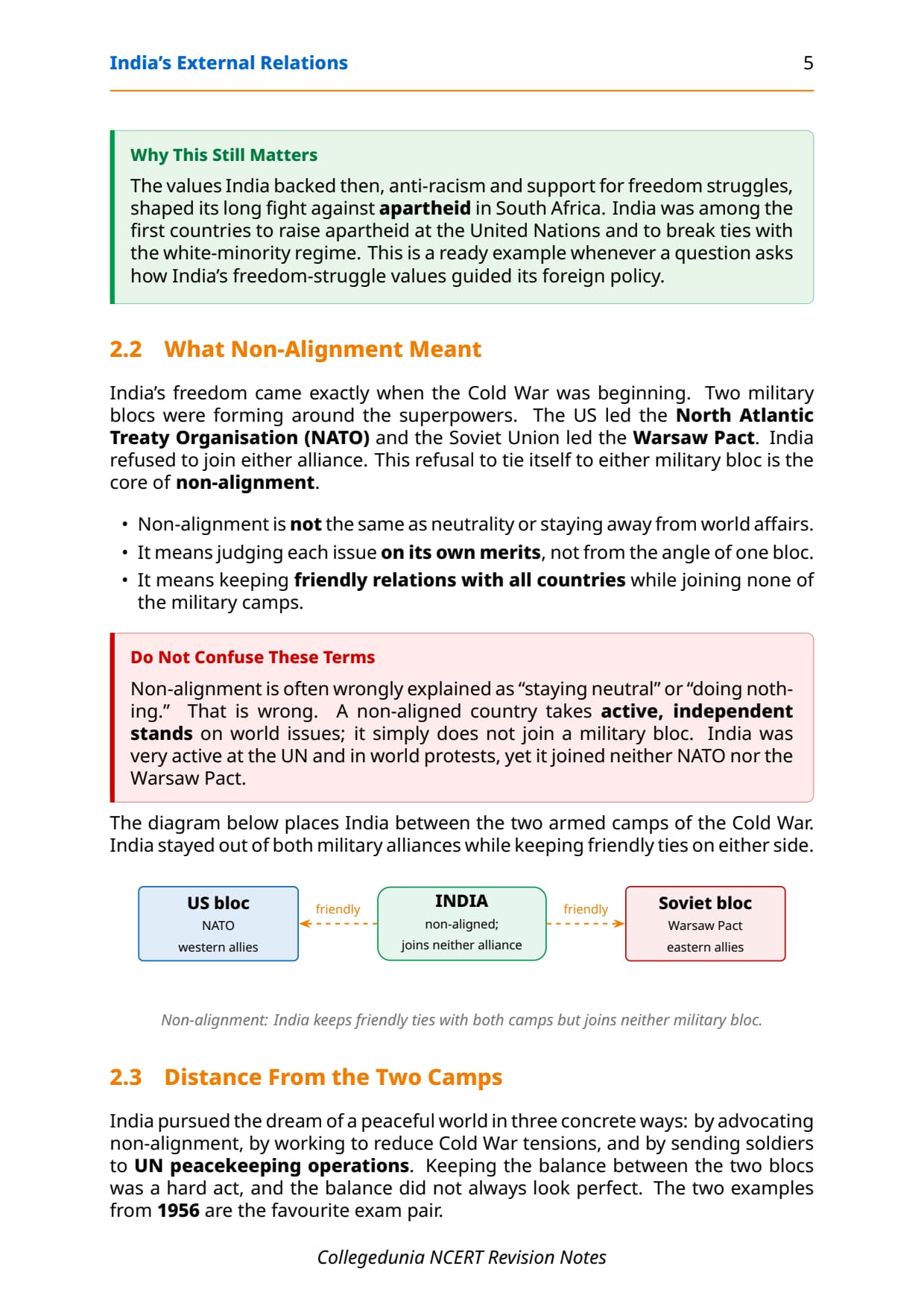
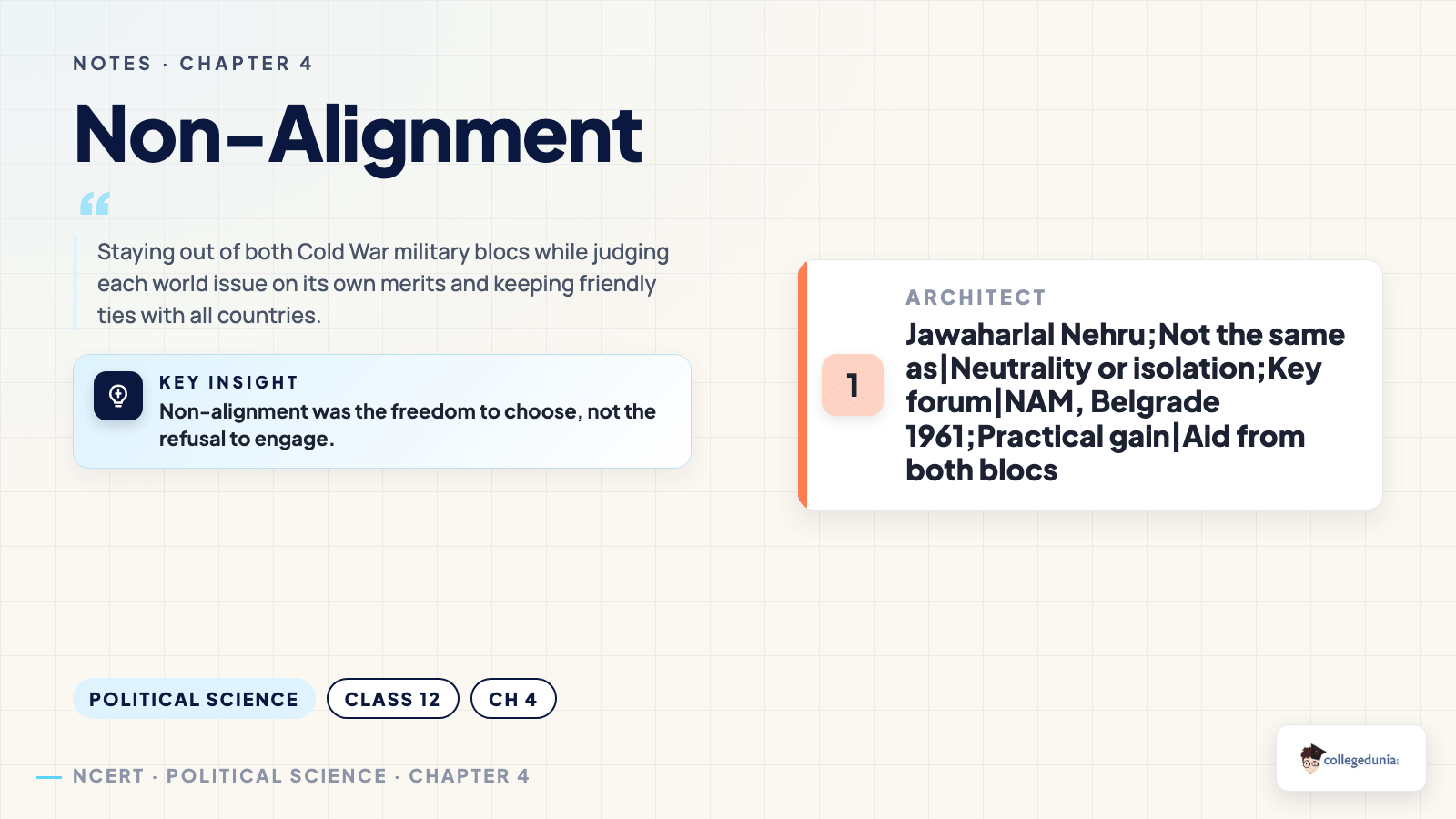
After 1947 the world was splitting into a US-led bloc and a Soviet-led bloc, and Nehru refused to join either. For quick revision, learn non-alignment as a few short, boxed points so you can copy them straight onto the answer sheet.
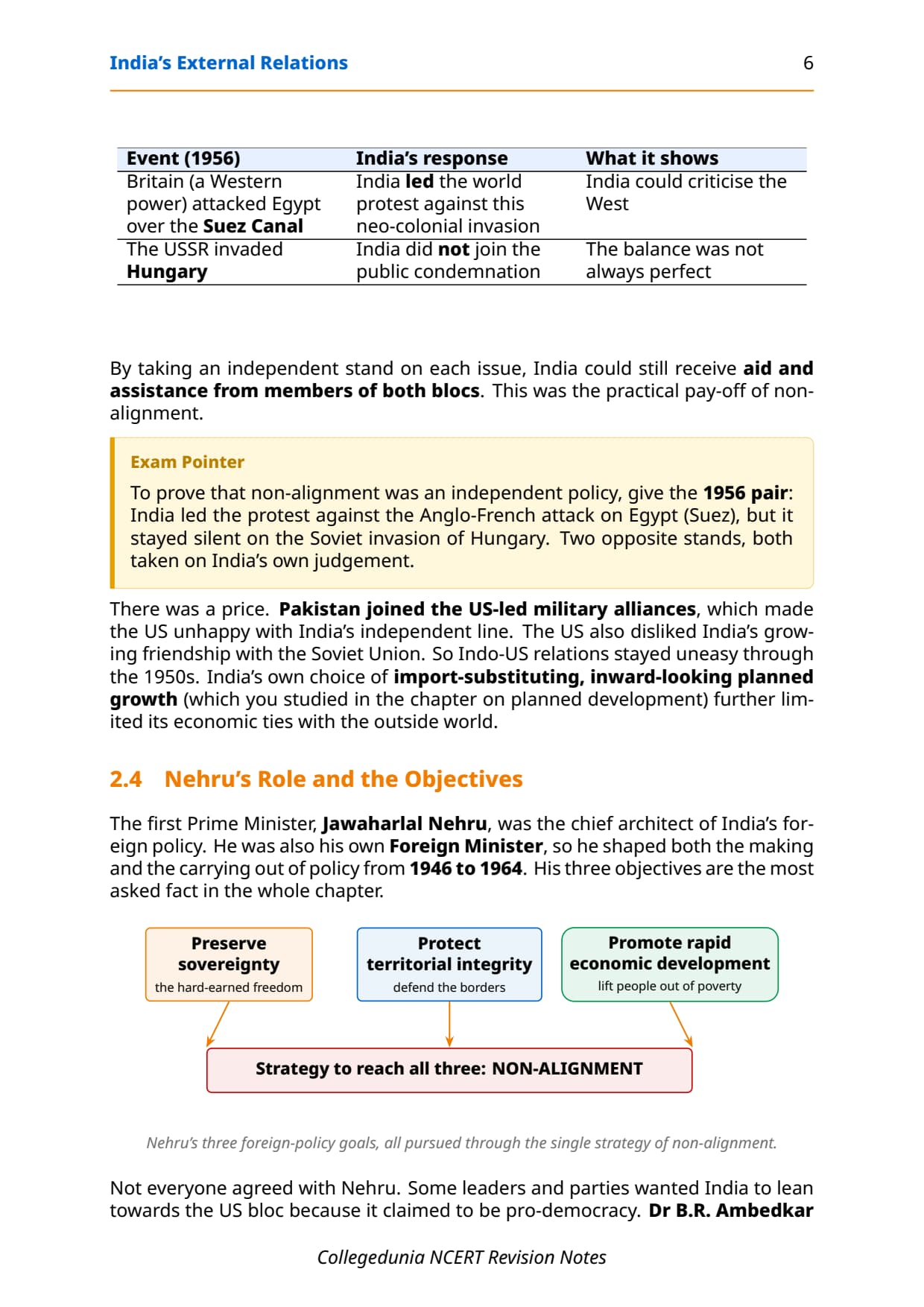
- Preserve sovereignty: keep the freedom to decide India's own external policy.
- Protect territorial integrity: guard the borders of the new nation.
- Promote economic development: use foreign ties to help a poor country grow fast.
- The gain: by staying unaligned, India could take aid from both blocs.
The point examiners test most is that non-alignment was not neutrality; it was the freedom to choose. India led the Suez protest in 1956 but did not parrot the Soviet line over Hungary. Nehru saw foreign relations as the very test of independence, because once they pass to someone else, "to that extent you are not independent". Keep this idea ready, as three of the chapter's questions turn on it.
Afro-Asian Unity, Bandung and the NAM
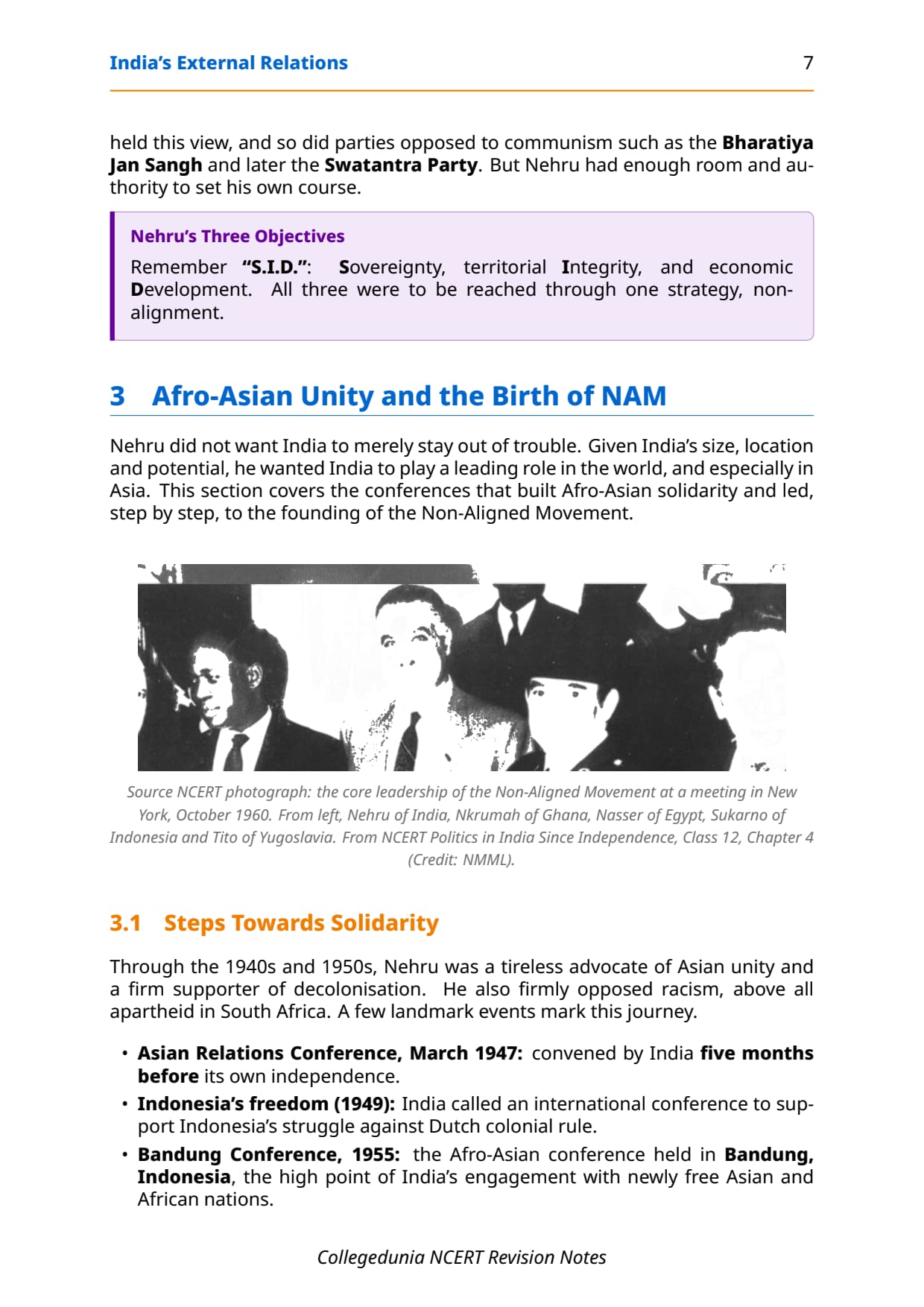
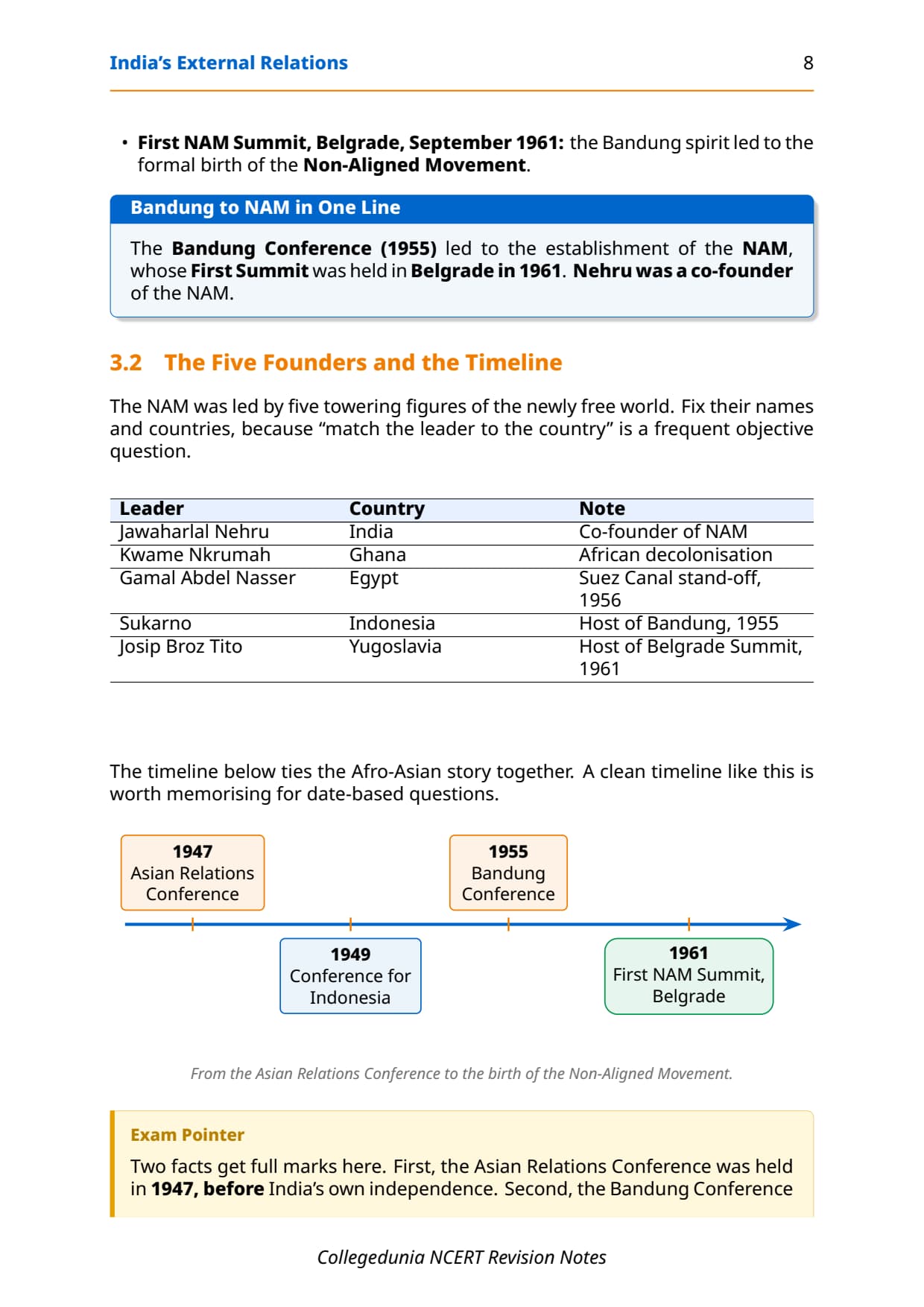
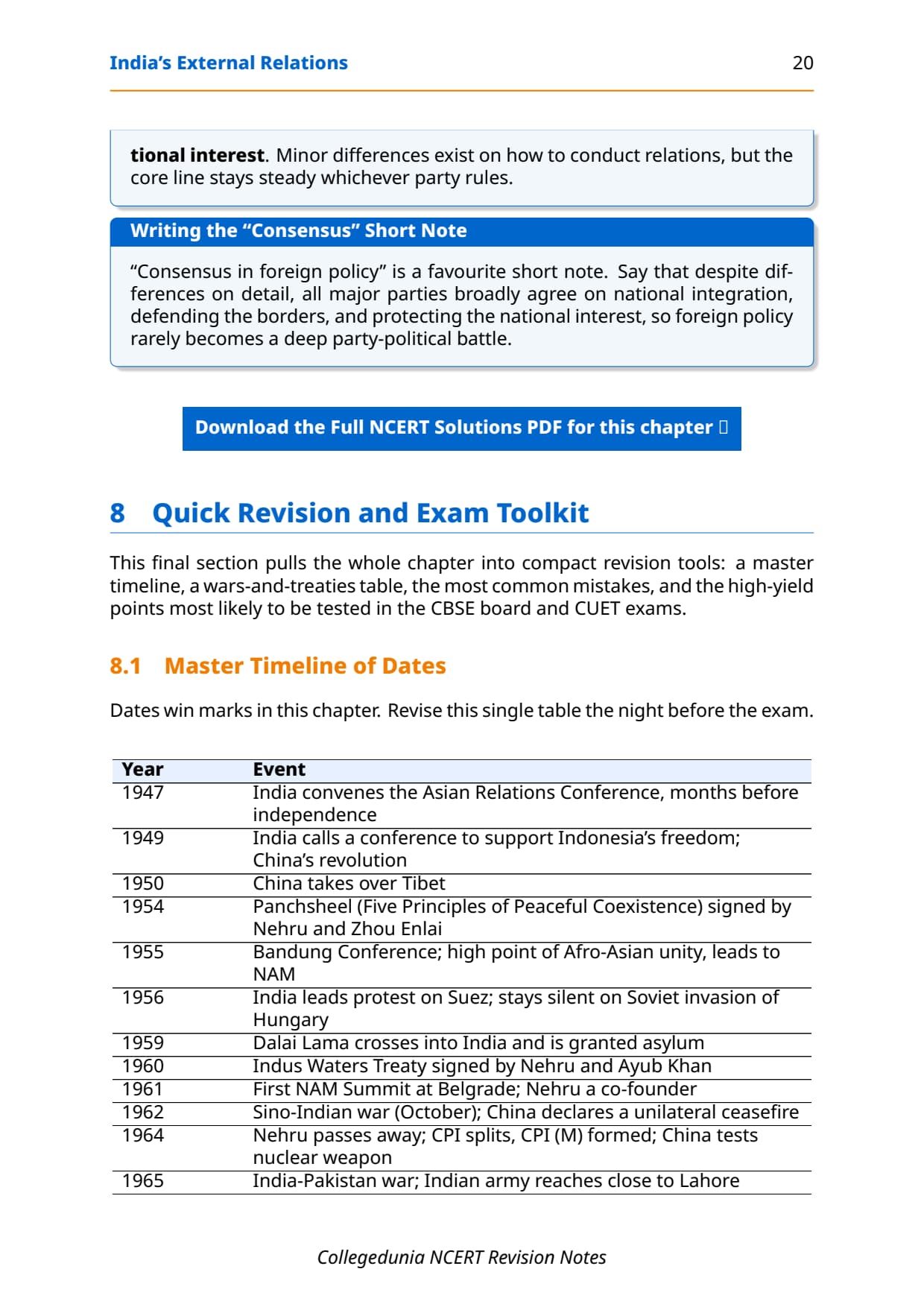
India also tried to build a third path with other newly free nations. The causes and milestones of this are a regular short answer, so these notes keep them as a clear table rather than a story. Learn them as a list and you can answer any version of the question.
| Milestone | What it meant |
|---|---|
| Panchsheel (1954) | Five Principles of Peaceful Coexistence, with China, on 29 April. |
| Bandung Conference (1955) | Deepened Afro-Asian contacts; the seed of the Non-Aligned Movement. |
| NAM founded (1961) | First summit at Belgrade; Nehru was a co-founder. |
| Goal of NAM | Nations that would not tie themselves to either superpower. |
The one-line takeaway for your sheet is that Panchsheel is the five principles, while Bandung is the meeting that fed into NAM. Students often swap these two, so box them separately. The chapter shows Afro-Asian unity as Nehru's way of giving small nations a louder voice in a world run by two giants.
India and China: Panchsheel to the 1962 War
India's ties with China swung from friendship to war in just a few years. These notes keep the sequence clear, because the chronology is easy to muddle. Learn the four stages and you can describe the whole arc in the exam.
- The friendly start: free India began relations with China "on a very friendly note", sealed by Panchsheel in 1954.
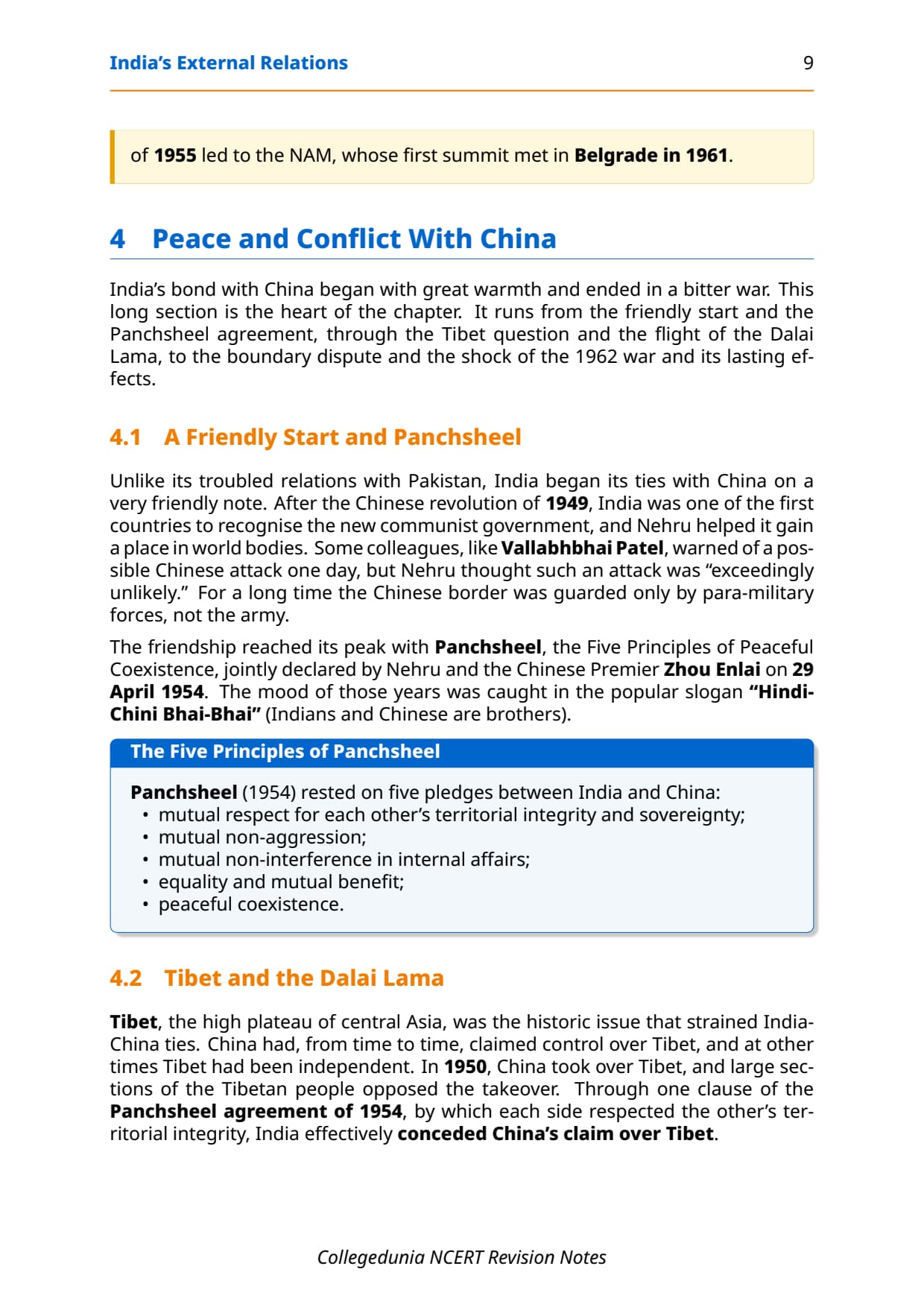
- The Tibet issue: the Dalai Lama crossed into India and was given asylum in 1959, which angered China.
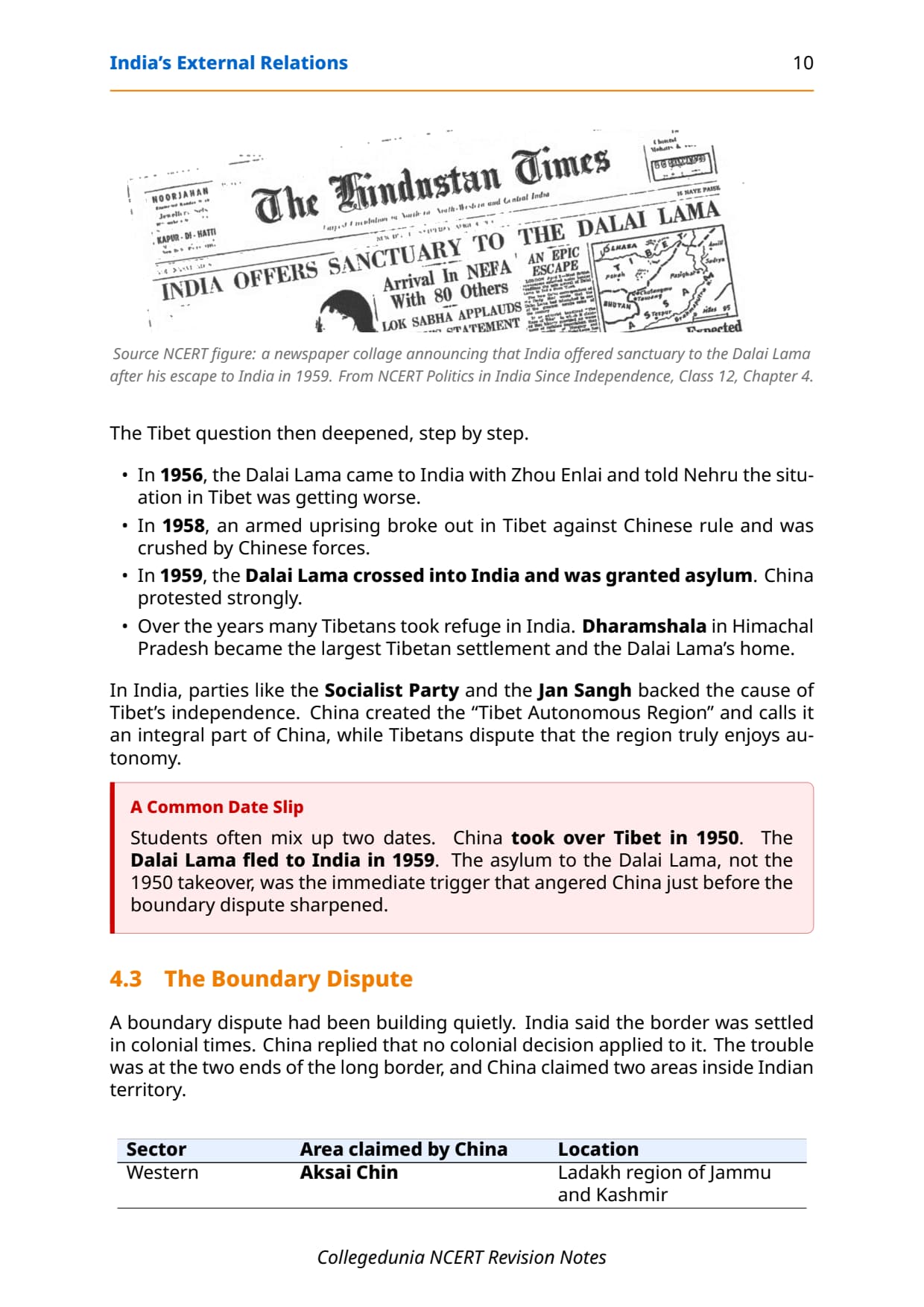
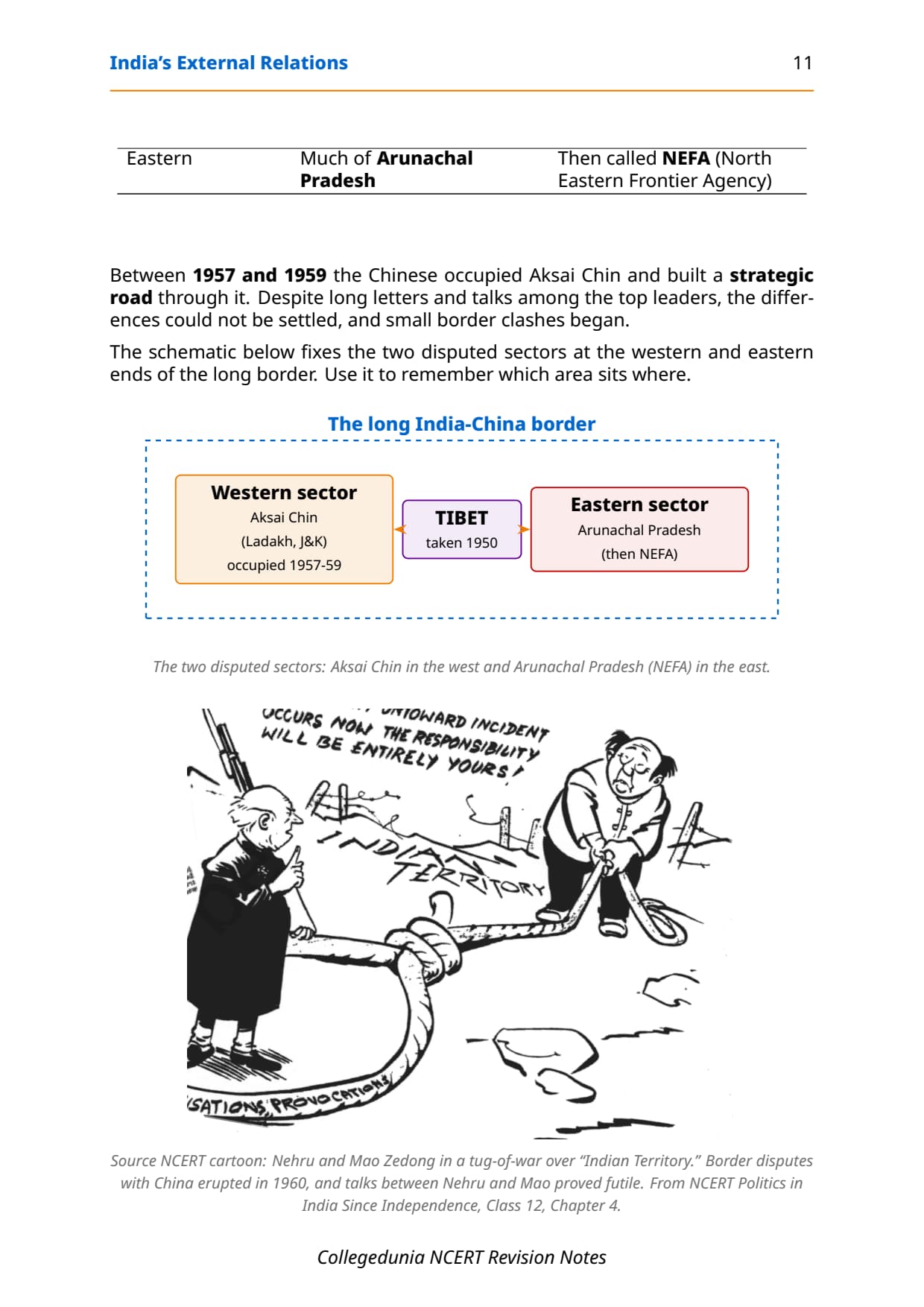
- The border dispute: China occupied Aksai-chin and claimed Indian territory.
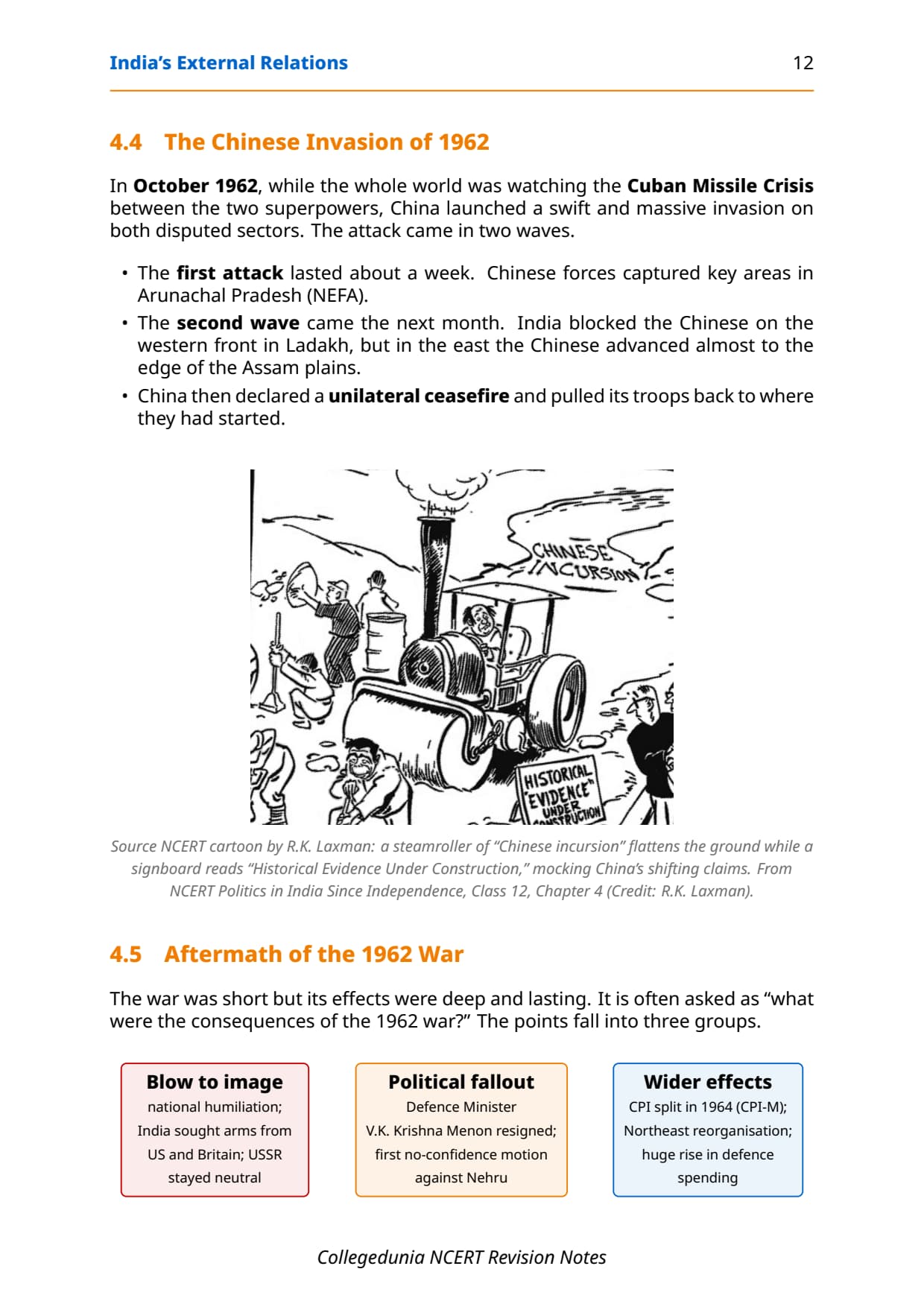
- The 1962 war: China launched a massive invasion in October 1962, during the Cuban Missile Crisis.
The honest revision line is that the 1962 defeat dented India's image and forced real change at home. Krishna Menon left the cabinet, the first no-confidence motion was moved against Nehru, and India began a defence build-up. This is the chapter's clearest example of foreign policy as a two-way interaction between domestic compulsions and the international climate. Tie the dates to the events so the timeline sticks.
Wars with Pakistan and the Nuclear Policy
India fought Pakistan in 1965 and 1971, and also built a nuclear programme. These notes give the war facts and the nuclear facts as short lists, because the exam wants the key points before any judgement.
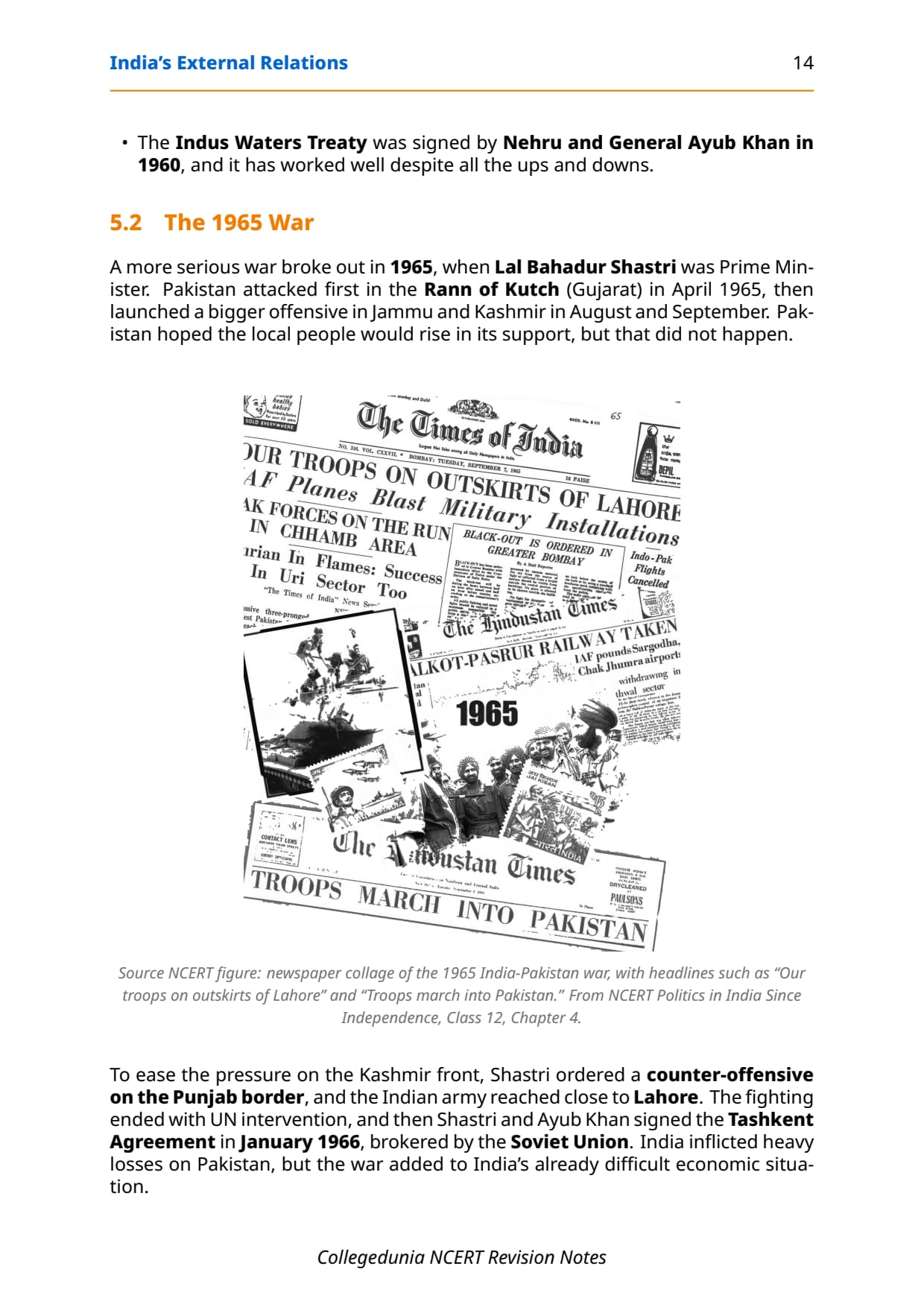
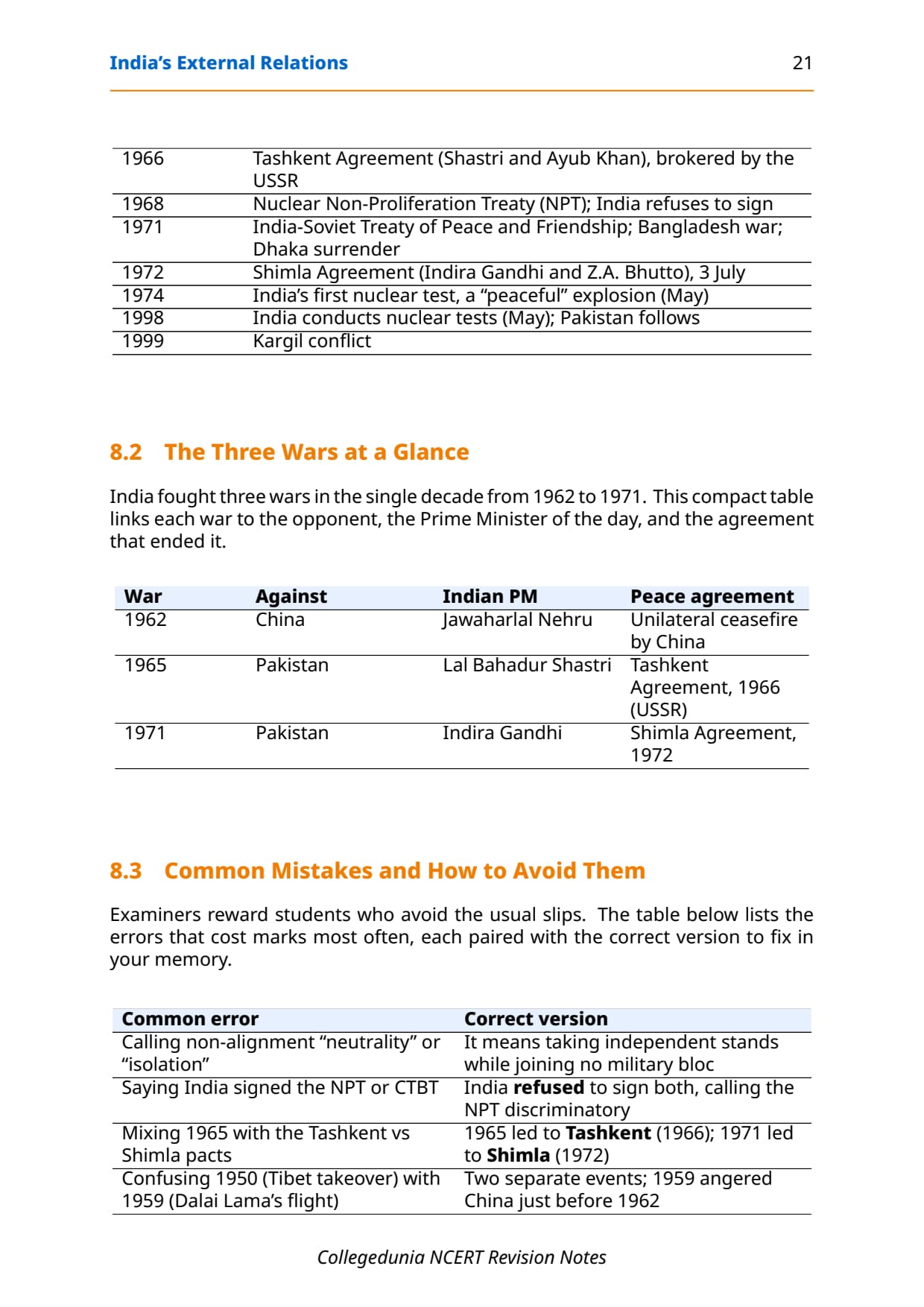
- 1965 war: over Kashmir and the Rann of Kutch; ended with the Tashkent Agreement.
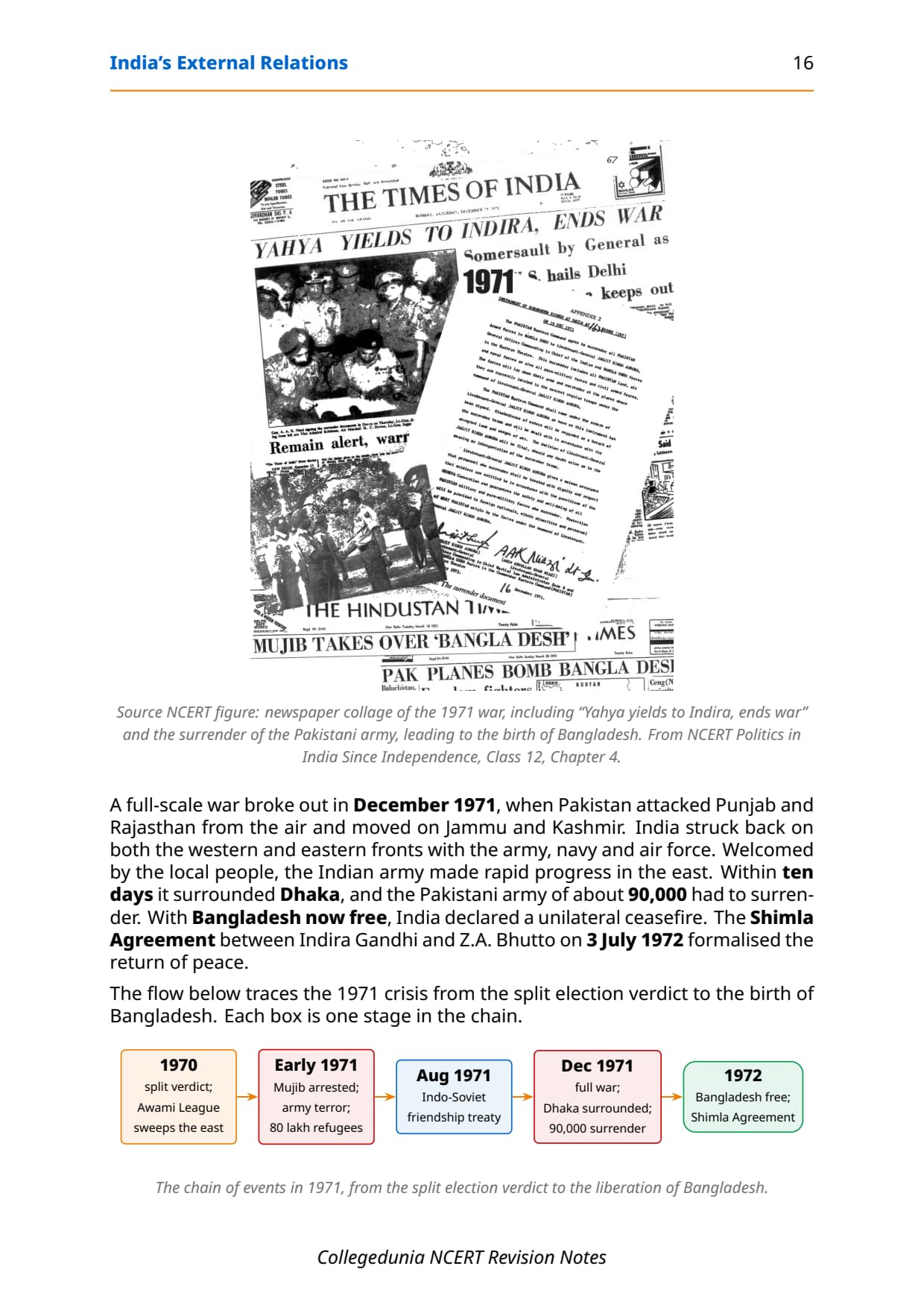
- 1971 war: followed 80 lakh refugees from East Pakistan; about 90,000 troops surrendered at Dhaka; Bangladesh was born.
- 1971 Soviet treaty: the Treaty of Peace and Friendship, signed to balance the US-China-Pakistan axis.
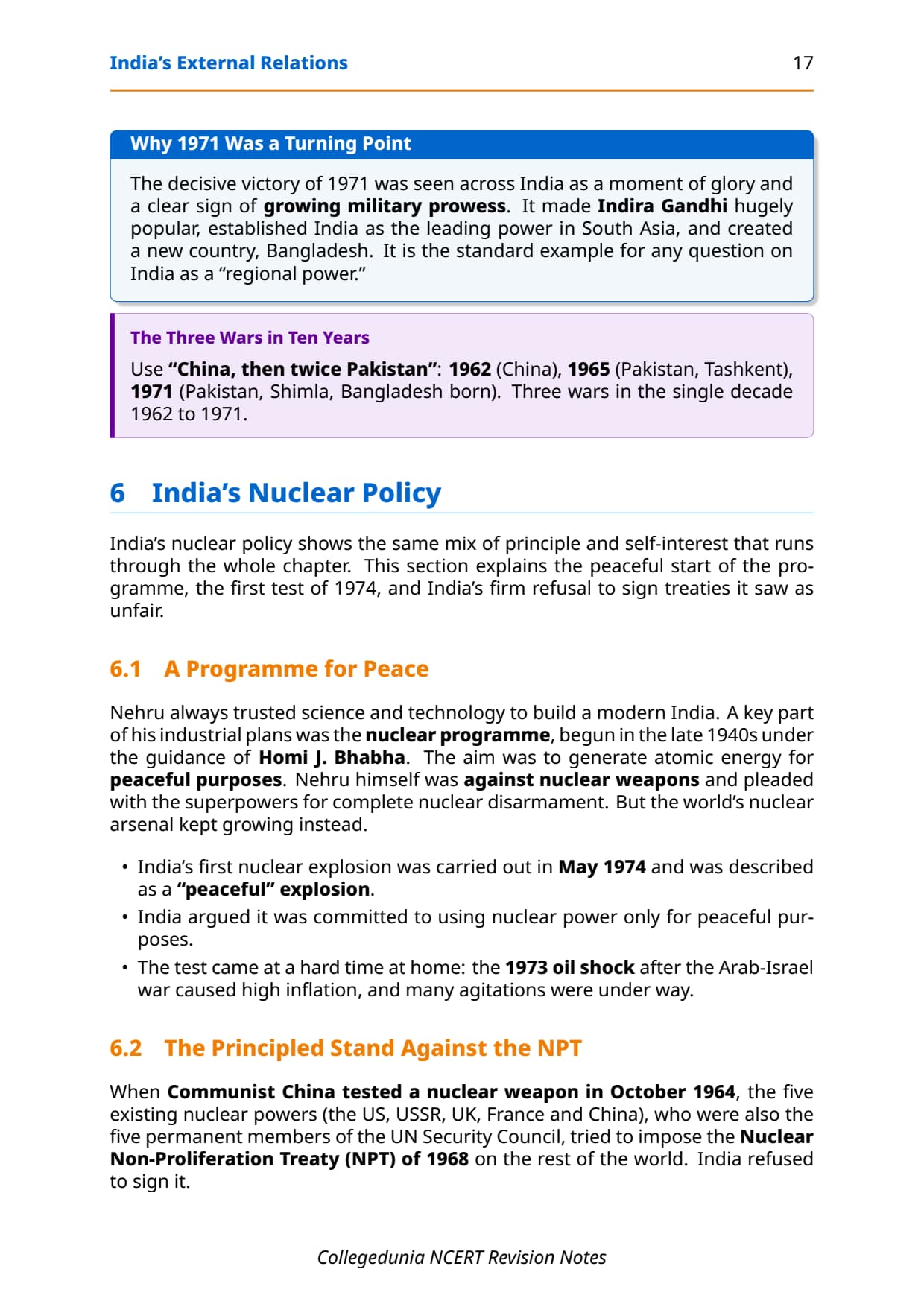
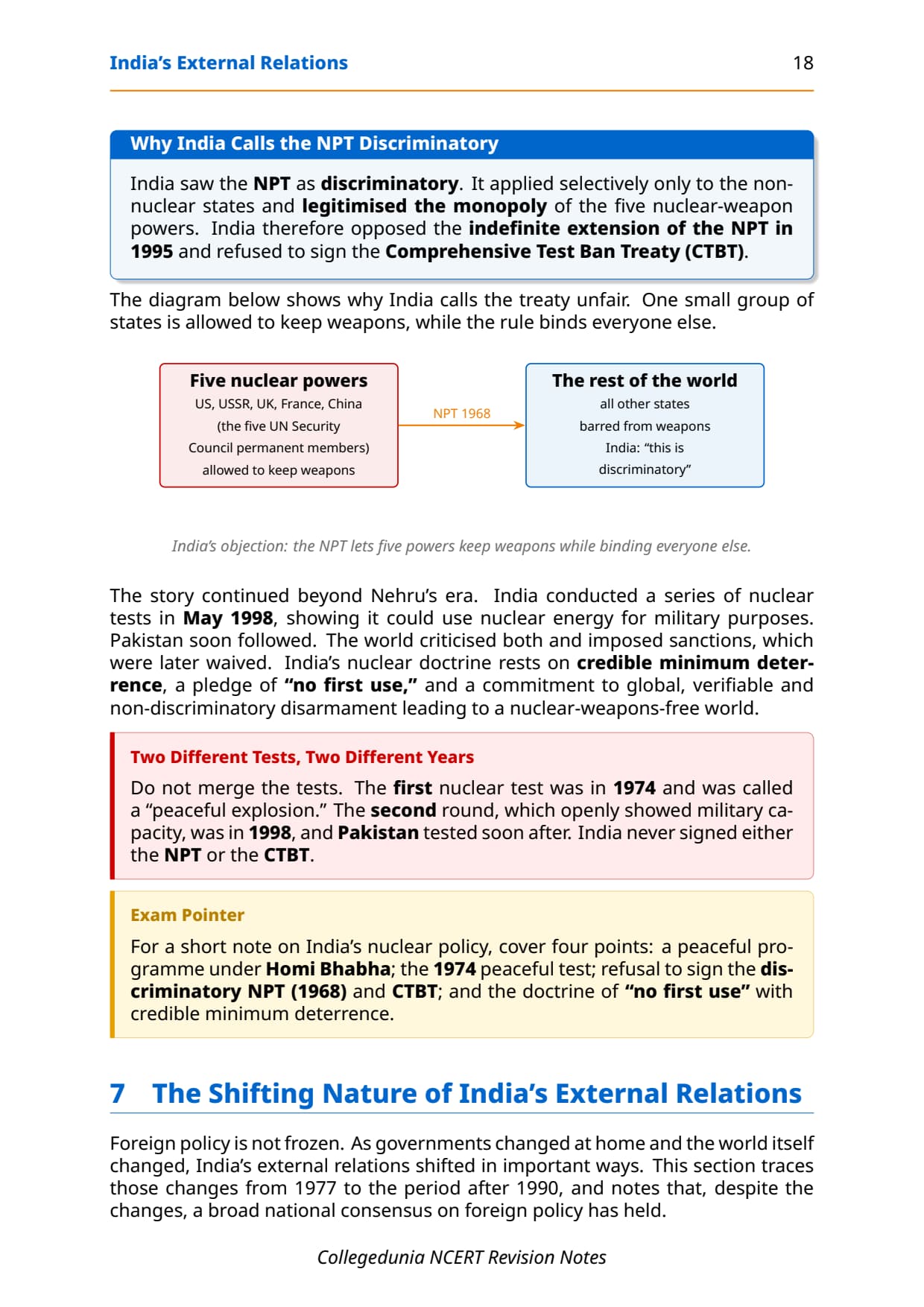
- Nuclear policy: a peaceful programme under Bhabha, no NPT (called discriminatory), and the 1974 "peaceful" test.
The judgement to remember is that India fought only when attacked, so the wars were mainly a result of the international situation. The 1971 war also showed India acting as a regional power. For the nuclear note, the two facts that must appear are the 1974 test and the refusal to sign the NPT. Keep the war facts and the nuclear facts as two clear blocks.
Consequences and Foreign-Policy Consensus
The chapter closes with the lasting marks of these years and the broad agreement among parties on foreign policy. This topic explains why India's policy changed slowly, so it is a regular short answer. The table keeps the two ideas side by side for fast revision.
| Area | Key points to recall |
|---|---|
| Regional power | The 1971 war and the Bangladesh outcome showed India's growing military and diplomatic weight in South Asia. |
| Defence build-up | After 1962, India expanded its defence budget and modernised the armed forces. |
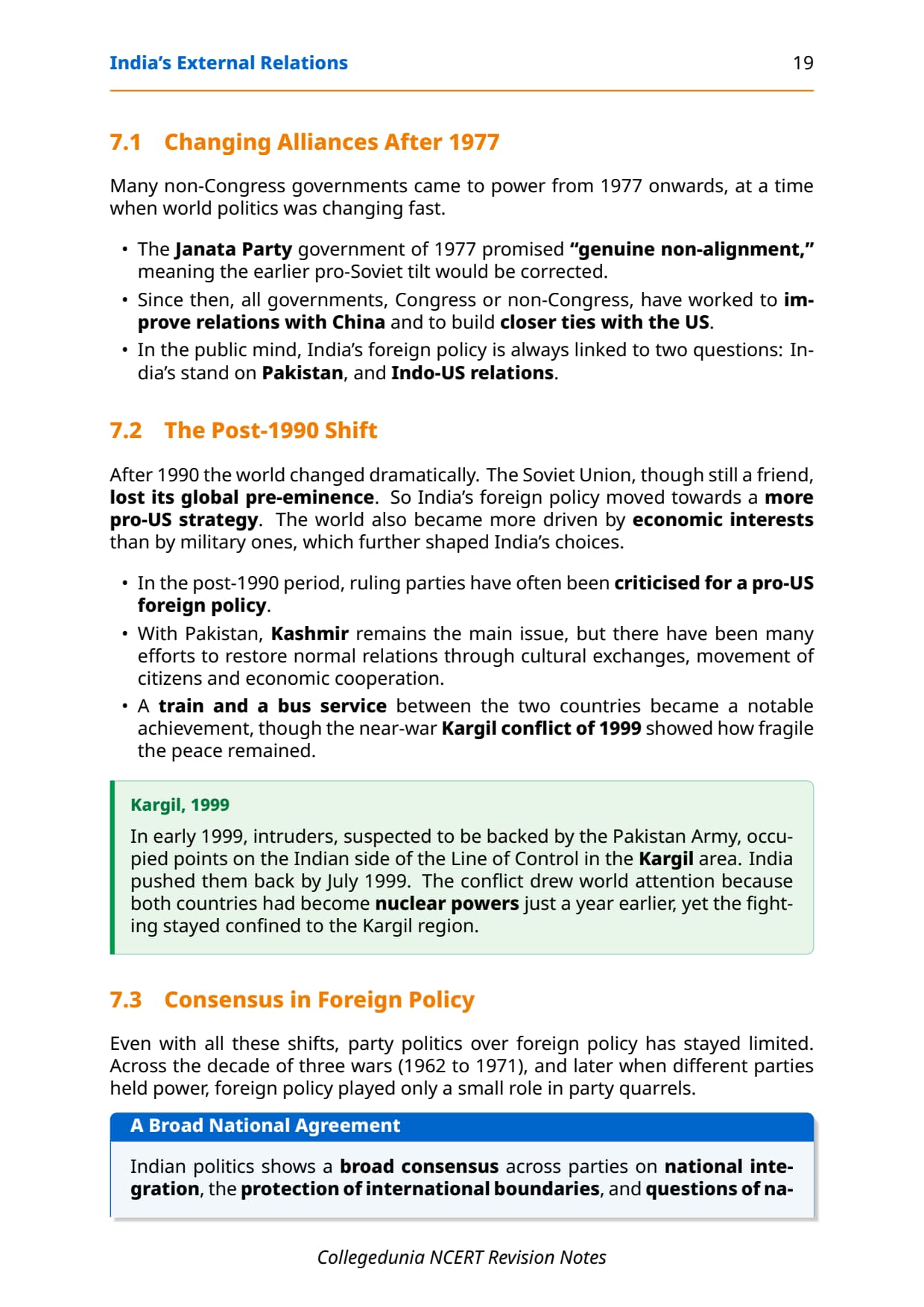
| Consensus | Parties broadly agree on integration, borders and national interest, so foreign policy stayed out of party conflict. |
The sharp point for your notes is that cross-party consensus kept foreign policy stable even across the wars of 1962 to 1971. The basic direction stayed the same even when different parties came to power. So India's foreign policy showed striking continuity, principled on nuclear weapons and consensual across parties, which is the chapter's closing theme.
India's External Relations Important Questions and Exam Pointers
CBSE sets a steady mix of MCQ, short and long answers from this chapter. Knowing the pattern helps students decide how much to write and which topics to revise first. A focused list of India's External Relations important questions saves a lot of time before the board exam.
- Long answer (5 to 6 marks): were the three wars a failure, or how leadership shaped foreign policy.
- Short answer (4 marks): Nehru's three objectives, the 1971 war, or India's nuclear policy.
- Source-based: a passage on non-alignment or the Indo-Soviet treaty, with sub-parts.
- Objective and matching: Panchsheel, Bandung, NAM and the Dalai Lama.
For quick recall, students often practise a short class 12 political science chapter 4 mcq drill and a list of India's External Relations class 12 important questions. The most repeated items are the meaning of non-alignment and the 1971 war, so keep those answer points ready in your own words. Reading these notes once, then writing the key lists from memory, is the fastest way to lock the chapter in.
Common Mistakes Students Make in This Chapter
A few errors cost marks every year. Most come from mixing up the 1971 treaty partner or giving only one side of the three-wars debate. Fixing these five points is the quickest way to lift a score, so add them to the end of your revision sheet.
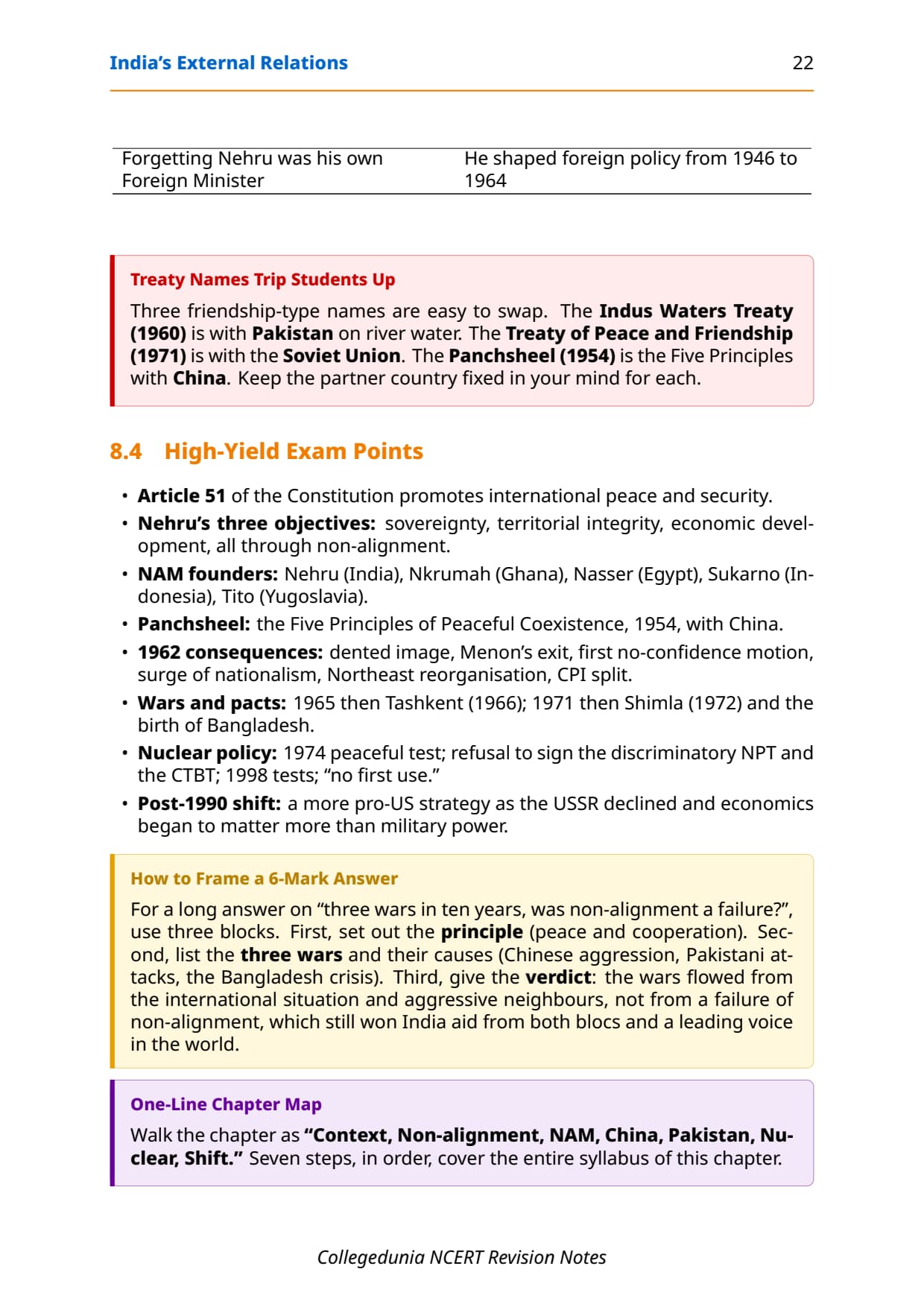
- Saying the 1971 Treaty of Peace and Friendship was with the USA - it was with the USSR.
- Swapping Panchsheel (five principles) with the Bandung Conference (the meeting that fed NAM).
- Calling non-alignment "neutrality" - it was the freedom to choose, not staying out of world affairs.
- Writing that India started the three wars - India fought only when attacked.
- Forgetting that the 1974 test was a "peaceful explosion" and that India refused the NPT.
Students who fix these five points usually move from average to high marks. The exam rewards a balanced view, so always give both sides before you judge whether the wars were a failure. These notes flag each soft point so you can phrase it safely in the answer sheet.
How These Notes Pair with the Solutions and Book PDF
These revision notes summarise the chapter. To prepare fully, students should use them alongside the other resources for the same chapter, all linked in the table below. Read the notes first, then test yourself with the solutions, and open the book PDF whenever you need the original text and figures.
| Resource | Best used for |
|---|---|
| India's External Relations NCERT Solutions | Step-by-step answers to all 10 back-exercise questions |
| India's External Relations Handwritten Notes | Last-minute, one-shot revision in a scanned notebook style |
| India's External Relations NCERT Book PDF | Reading the original NCERT chapter text and figures |
Tip: read these notes first, then attempt the solutions on your own, and only then check the model answers. That order builds memory faster than copying answers straight away.
All Class 12 Political Science Notes by Chapter
The table links the revision notes for every chapter in both Class 12 Political Science books, so students can move across the course in one click. India's External Relations is highlighted.
| Chapter | Notes |
|---|---|
| Contemporary World Politics | |
| Chapter 1 | The End of Bipolarity |
| Chapter 2 | Contemporary Centres of Power |
| Chapter 3 | Contemporary South Asia |
| Chapter 4 | International Organisations |
| Chapter 5 | Security in the Contemporary World |
| Chapter 6 | Environment and Natural Resources |
| Chapter 7 | Globalisation |
| Politics in India Since Independence | |
| Chapter 1 | Challenges of Nation Building |
| Chapter 2 | Era of One-Party Dominance |
| Chapter 3 | Politics of Planned Development |
| Chapter 4 | India's External Relations |
| Chapter 5 | Challenges to and Restoration of the Congress System |
| Chapter 6 | The Crisis of Democratic Order |
| Chapter 7 | Regional Aspirations |
| Chapter 8 | Recent Developments in Indian Politics |
FAQs on India's External Relations Class 12 Notes
India's External Relations Class 12 Political Science Notes Common Questions
Ques. Where can I download the India's External Relations Class 12 notes PDF?
Ans. You can download the India's External Relations Class 12 Political Science notes PDF directly from this page. It is free, follows the 2026-27 NCERT, and covers non-alignment, the China and Pakistan wars and India's nuclear policy in a short, point-wise format.
Ques. What does India's External Relations chapter cover for Class 12?
Ans. It covers India's foreign-policy goals, non-alignment and NAM, friendship and war with China (Panchsheel, Tibet, the 1962 war), the 1965 and 1971 wars with Pakistan, the birth of Bangladesh, and India's nuclear policy and NPT stand.
Ques. What were Nehru's three foreign-policy objectives?
Ans. Nehru's three objectives for 1950 to 1964 were to preserve India's sovereignty, protect its territorial integrity, and promote rapid economic development. Non-alignment was the policy he chose to serve these goals while staying out of both Cold War blocs.
Ques. Why is India's External Relations important for the board exam?
Ans. Because it is a high-scoring chapter that sets up India's whole foreign-policy story. Non-alignment, the three wars and the nuclear policy appear almost every year, so revising these notes well secures both objective and long-answer marks.
Ques. How should I use these notes to revise quickly?
Ans. Read the notes once under the goals, neighbours and nuclear frame, keep all dates and Nehru's three objectives on one sheet, then write the key lists from memory. Finish by attempting a short class 12 political science chapter 4 mcq drill to test the small facts.



Comments